
Key takeaways
- Place a portable generator outdoors only, at least 20 feet from windows, doors and vents, exhaust pointed away. Exact distances, setup steps and CO rules here.
When the power fails in winter, the most important decision you make is not which generator to buy or what to plug into it. It is where should you place a generator during a power outage, because that single choice decides whether the machine helps your household or quietly fills it with a gas you cannot see or smell. The direct answer from the federal safety agencies is short: outdoors only, at least 20 feet from the house, with the exhaust pointed away from every window, door and vent. Everything below is the detail a short answer cannot carry — how to measure that distance on a real lot, which openings count, how to protect the machine from weather without enclosing it, and the mistakes that turn a routine outage into an emergency. If you are still working through the first minutes of an outage, our guide to what to do when the power goes out in winter covers the order of operations; this article covers the one job that has to be done right before anything else matters.
The short answer, with the exact distances
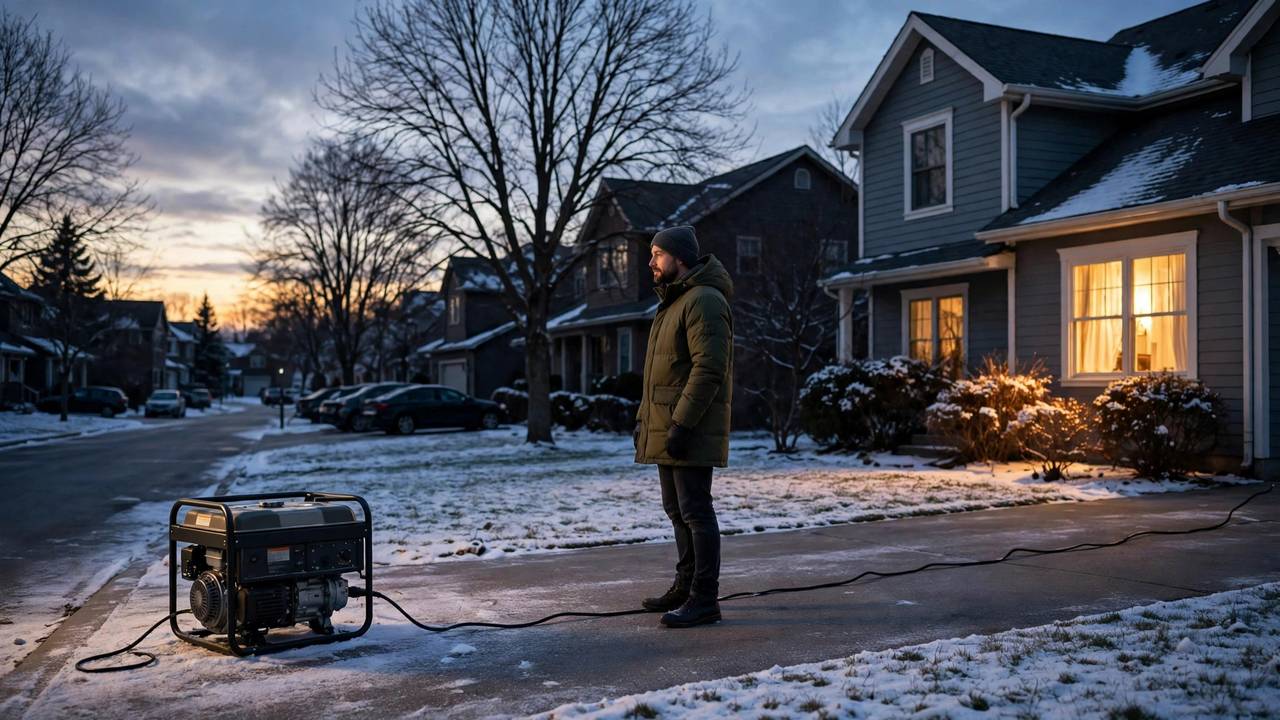
A portable generator belongs outside, on a dry and level surface, at least 20 feet from your home, with its exhaust directed away from the house and from any other building someone can enter. The Centers for Disease Control and Prevention (CDC) phrases the distance slightly more strictly than the other agencies: the CDC lists using generators only outside, more than 20 feet away from any windows, doors and vents. The U.S. Consumer Product Safety Commission (CPSC) lists operating portable generators outside only, at least 20 feet away from the house. Ready.gov, the federal preparedness site, lists generators and fuel being used outdoors and at least 20 feet away from windows, doors and attached garages. Read together, the working rule is simple: measure more than 20 feet from the nearest opening, not from the nearest wall, and you satisfy every version of the guidance at once.
| Placement rule | What the authorities list | Source |
|---|---|---|
| Distance from the house | At least 20 feet away from the house | CPSC |
| Distance from openings | More than 20 feet from any windows, doors and vents | CDC |
| Distance from windows, doors and attached garages | At least 20 feet, outdoors only | Ready.gov |
| Exhaust direction | Directed away from the home and other buildings where someone can enter | CPSC |
| Clear space around the unit | 3 to 4 feet of clear space on all sides and above it, for ventilation | OSHA |
| Inside a home, garage, basement, crawlspace or shed | Never, even with doors or windows open | CPSC and CDC |
| On a porch or in a carport | Do not — it is too close to the home | CPSC |
| CO alarms inside | Battery-operated or battery-backup alarms on each level and outside separate sleeping areas; test monthly | CPSC |
That table is the whole placement system in miniature. The sections that follow explain how to apply each row on an actual property, in actual winter weather, when you are tired, cold and working by flashlight — which is exactly when these rules get bent.
Why placement is the whole safety question
Carbon monoxide, shortened to CO, is the reason placement matters more than any other generator decision. The CDC describes CO as an odorless, colorless gas that can cause sudden illness and death if inhaled, and notes that it kills without warning. The CPSC calls it the invisible killer for the same reason: it is colorless and odorless, and poisoning from a gasoline-powered portable generator can happen so quickly that a person may become unconscious before recognizing symptoms such as nausea, dizziness or weakness. There is no smell to warn you, no smoke to see, and no irritation to wake you up.
The scale of the problem is not small. The CPSC reports that an average of nearly 100 consumers die in the United States each year from CO poisoning from portable generators, according to its latest report on non-fire carbon monoxide deaths associated with consumer products. The CDC’s wider figures, covering all unintentional CO poisoning not linked to fires, are that each year more than 400 Americans die, more than 100,000 visit an emergency department, and more than 14,000 are hospitalized. Portable generators are one of the household sources the CDC names, alongside gas- and oil-burning furnaces and charcoal grills.
Notice what kind of hazard this is. A generator does not have to malfunction to produce lethal CO — it produces CO whenever it runs, as a normal part of burning fuel. The machine is working exactly as designed while it does it. That is why no feature, setting or accessory changes the placement rule, and why the agencies frame placement itself as the protection. Distance, open air and exhaust direction are not precautions added to the real safety system. They are the safety system.
How to measure the 20 feet correctly
Most placement mistakes are measurement mistakes. People pace off 20 feet from the wall of the house and stop there, but the authorities do not measure from the wall. The CDC measures from windows, doors and vents. Ready.gov measures from windows, doors and attached garages. The CPSC measures from the house and then adds the instruction that matters most in practice: close windows and seal off vent openings that are near the generator or in the path of its exhaust. So the correct measurement starts at the nearest opening on the side of the house facing the generator — and openings are easy to forget.
Walk the wall facing your planned spot and count everything that can admit air: ground-floor windows, basement windows at grade, the back or side door, a dryer vent, a bathroom or kitchen exhaust vent, a furnace or water-heater intake or exhaust, a crawlspace vent, and a window air conditioner. Your 20 feet runs from the closest of those, not from the siding. A spot that is 22 feet from the wall but 16 feet from a basement window fails the rule. A spot that clears the house but sits 12 feet from a neighbor’s window fails it in spirit and in safety, because the CPSC directs the exhaust away from other buildings where someone can enter, not just your own.
Then check the second floor. Exhaust rises and drifts, and an upstairs bedroom window above the generator is still an opening into a sleeping area. If the only spot that clears every opening on both floors is farther than 20 feet, farther is correct — 20 feet is a minimum, not a target. Nothing in the guidance rewards placing the machine exactly at the line, and winter wind, snowbanks and fences all change how exhaust moves around a yard from one night to the next.
What if the exhaust points at the house from 25 feet?
It is still wrong. Distance and direction are separate requirements, and both apply at the same time. The CPSC lists operating the generator at least 20 feet away and directing the generator’s exhaust away from the home as two parts of the same instruction. A machine at a good distance with its muffler aimed at an open window is pushing its exhaust plume straight at the one opening you most needed to protect. Turn the machine, not just the measurement: the exhaust side faces away from every building, ideally so the prevailing wind carries the plume away from the house rather than along the wall toward another window or a neighbor’s door.
Step-by-step: placing the generator when the power goes out
Step 1: Choose and clear the spot before you start the engine
Pick the spot in daylight if you possibly can, and ideally pick it before the outage ever happens. The ground should be dry, firm and level, well away from standing water and melting snow. Clear snow down to a stable surface rather than setting the machine on a drift that will soften and tilt as the engine warms it. Keep the Occupational Safety and Health Administration (OSHA) clearance in mind as you choose: OSHA lists making sure a generator has 3 to 4 feet of clear space on all sides and above it to ensure adequate ventilation. That means no tucking the machine into a corner between a fence and a shed wall, under a low deck, or into an alcove — even outdoors, a pocket of still air defeats the purpose of being outside.
Step 2: Measure from the nearest opening, then add margin
Measure, do not estimate. Use a tape, a measured cord or counted paces you have checked against a tape on a calm day. Start at the nearest window, door or vent on the house, walk outward past 20 feet, and set your marker there. Then look up for second-floor openings and sideways for the neighbor’s openings and adjust. If the spot that satisfies every opening is 24 or 28 feet out, use it and buy the longer cord the distance requires; cord length is a solvable problem, and CO is not.
Step 3: Orient the exhaust away from every building
Before starting, identify the muffler and exhaust outlet on your machine from its manual, and rotate the whole generator so that outlet points away from your house, away from the neighbor’s house, and away from any garage or shed someone enters. Check where the wind is moving — in winter, watch where breath vapor, snow or a flag drifts — and avoid an orientation that sends the plume back along your own wall. Re-check the orientation every time the machine is moved, refueled or restarted; a generator that was turned to reach the fuel cap may now be aimed at the kitchen window.
Step 4: Close and seal the openings on that side of the house
The CPSC instructs users to close windows and seal off vent openings that are near the generator or in the path of its exhaust. Do this from inside before you start the machine: shut and latch the windows on the generator side, including basement windows, and do not leave a door or window propped open to pass an extension cord through. That last point is one of the most common winter errors — a cord run through a cracked window creates exactly the opening the distance rule exists to avoid, at exactly the place the cord leads to the generator. Run cords through a proper inlet arrangement instead, or accept a closed door over a cord run planned in advance, and never wedge an opening ajar for convenience.
Step 5: Set up weather protection that does not enclose the machine
Winter outages arrive with snow and freezing rain, and a generator must stay dry — but protection must never become enclosure. The American Red Cross lists keeping the generator dry, not using it in rain or wet conditions, and operating it on a dry surface under an open canopy-like structure, such as a tarp held up on poles, and not touching the generator with wet hands. The CPSC similarly advises following the generator’s instructions about electrical shock hazards in inclement weather, which may include use of an NFPA-rated non-combustible generator tent or may state to wait until rain passes. The pattern is consistent: a roof with open sides, held well clear of the hot machine, following your manual — never a closed box, a sealed tent, a tarp draped over the running machine, or a move indoors because the weather is bad. If your manual says to wait out the rain, waiting is the instruction.
Step 6: Start it, connect loads, and re-check after ten minutes
Start the generator outdoors at its spot, let it stabilize, and only then connect loads. Models chosen for cold-weather starting, such as the portable generators with electric start for cold weather, still live by every rule in this article — an easier start changes nothing about where the machine sits. After ten minutes of running, walk the house side once: confirm the exhaust is still pointing away, confirm no window on that side has been opened by someone inside who did not know, and confirm you cannot smell exhaust at the door you are using. If anything has changed, shut down, reposition, and restart the check.
Getting the power inside without undoing the placement
A generator 20-plus feet out is only useful if its power can reach the house safely, and the connection method is where placement discipline often collapses. There are exactly two safe routes, and both are described the same way by every authority used for this article.
Route one: extension cords, used properly
The Red Cross lists plugging appliances directly into the generator, or using a heavy-duty, outdoor-rated extension cord that is rated in watts or amps at least equal to the sum of the connected appliance loads. It adds checking that the entire cord is free of cuts or tears and that the plug has all three prongs, especially the grounding pin. Ready.gov likewise lists always connecting the generator to appliances with heavy-duty extension cords. OSHA’s fact sheet adds using ground fault circuit interrupters (GFCIs), especially where electrical equipment is used in or around wet or damp locations — which describes most winter yards — and making sure the generator is properly grounded, following the manufacturer’s instructions for grounding methods. In practice: one appliance per appropriately rated cord where you can, no daisy-chained household cords, no cord run under a rug or through a pinching doorway, and no cord so long and thin that it overheats under load. If you are sizing loads for a refrigerator and a few essentials, our breakdown of what size generator you need to run a refrigerator works through the running and starting watts before you buy cords to match.
Route two: a transfer switch installed by an electrician
If you want the generator to feed house circuits — a furnace blower, a well pump, hardwired lighting — the only safe route is a transfer switch. OSHA states it plainly: never attach a generator directly to the electrical system of a structure unless a qualified electrician has properly installed the generator with a transfer switch, because attaching it without one can energize wiring systems for great distances and creates a risk of electrocution for utility workers and others in the area. The Red Cross describes the forbidden shortcut by name: never try to power the house wiring by plugging the generator into a wall outlet, a practice known as backfeeding, which puts utility workers, your neighbors and your household at risk of electrocution. A transfer switch or inlet box, installed before the outage by a licensed electrician, is also what makes the 20-foot placement easy to live with: the generator stays far out in the yard, one proper cord runs to the inlet, and no window has to stand open. Machines built for this arrangement, including the tri-fuel generators for home emergency backup and the dual-fuel inverter generators for home outages, still sit in exactly the same outdoor spot — the switch moves the power, never the machine.
Fuel handling at the placement spot
Placement includes where the fuel lives and how refueling happens. The Red Cross lists turning the generator off and letting it cool down before refueling, because gasoline spilled on hot engine parts could ignite, and storing fuel in an approved safety can, outside living areas in a locked shed or other protected area, not near a fuel-burning appliance such as a natural gas water heater in a garage. Ready.gov adds the same two points in short form: keep the generator dry, and let it cool before refueling because fuel spilled on hot engine parts can ignite. OSHA’s fire guidance matches: generators stay hot long after they stop, fuel belongs in approved, properly marked, vented containers, and fuel should not be stored in the home but away from living areas. Build the refuel pause into your routine — shut down, cool, refuel outdoors at the spot, restart — and never pour fuel by flashlight into a hot machine because the house is getting cold.
CO alarms: the second line of defense inside the house
Distance is the first line of defense; alarms are the second, and the outage is exactly when they are most likely to fail. A plug-in alarm with no battery backup goes silent when the power does. The CPSC lists installing battery-operated CO alarms or CO alarms with battery backup on each level of the home and outside separate sleeping areas, notes that interconnected alarms are best because when one sounds they all sound, and lists testing alarms monthly and replacing batteries if needed. The CDC lists installing battery-operated or battery back-up CO detectors near every sleeping area, checking the batteries when you change the clocks each spring and fall, and replacing the detector following the manufacturer’s instructions or every five years. Ready.gov lists installing carbon monoxide detectors with battery backup in central locations on every level of the home.
Three practical consequences follow. First, test the alarms before storm season, not during the outage — the test button is a ten-second job in October and a miserable one at midnight in January. Second, the alarm layout matters most around sleep: the CDC notes that people who are sleeping can die from CO poisoning before they have symptoms, which is why outside sleeping areas is the placement every source repeats. Third, an alarm is information, not protection by itself — it only helps if the response is automatic. The CPSC’s instruction is short: never ignore an alarm when it sounds, get outside immediately, then call 911. Do not open windows and stay, do not go looking for the source, and do not silence the alarm and wait to see if it sounds again.
Know the symptoms, and treat them as an emergency
The CDC lists the most common symptoms of CO poisoning as headache, dizziness, weakness, upset stomach, vomiting, chest pain and confusion, and notes the symptoms are often described as flu-like. OSHA lists dizziness, headaches, nausea and tiredness, with the instruction to get to fresh air immediately and seek medical attention, and not to re-enter the area until it is determined to be safe by trained and properly equipped personnel. In a winter outage, every one of those symptoms has an innocent explanation — tiredness, cold, stress, a virus — which is precisely why they are dangerous. If several people in the house feel ill at the same time while a generator is running, treat it as CO until proven otherwise: everyone outside, then 911, from fresh air.
What about generators with a CO shut-off feature?
The CPSC advises looking for portable generators that have a CO shut-off safety feature, which automatically shuts the generator off when high levels of CO are present around the generator, and notes that models certified to the latest PGMA G300-2018 and UL 2201 safety standards are estimated to reduce deaths from CO poisoning substantially, with UL 2201 models also having reduced CO emissions. Buy the feature if you are choosing a machine — but understand what it measures: CO around the generator, outdoors. It cannot measure the air inside your bedroom, and it does not shorten the 20-foot rule by a single inch. It is a backstop for a drifting plume, not a placement strategy.
Mistakes that kill: the placement errors to refuse
- Running it in the garage with the door open. The CDC lists never using a generator inside your home or garage, even if doors and windows are open, and the CPSC repeats that opening doors or windows will not provide enough ventilation to prevent the buildup of lethal levels of CO. An open garage door is not ventilation in any sense that protects you; an attached garage also shares walls, doors and air pathways with the house.
- Moving it onto the porch or into the carport to keep it dry. The CPSC says directly: do not operate a generator on a porch or in a carport — it is too close to the home and puts your family at risk of CO poisoning. Convenience and weather are the usual reasons, and neither changes the distance.
- Placing it under a window because the cord is short. A short cord is a purchasing problem, not a placement argument. The CDC’s distance is measured from windows, doors and vents precisely because exhaust at a window enters the house.
- Propping a window or door open for the cord. The CPSC lists closing windows and sealing vent openings near the generator or in the path of its exhaust. An opening held ajar for a cord defeats both the distance rule and the sealing rule at once.
- Pointing the exhaust at the house, a fence corner or the neighbor’s door. The CPSC lists directing the exhaust away from your home and other buildings where someone can enter. A plume aimed at a wall pools against it and finds the openings in it.
- Backfeeding through a wall outlet or dryer outlet. The Red Cross lists never powering house wiring by plugging the generator into a wall outlet, and OSHA warns that connecting without a properly installed transfer switch can energize wiring for great distances and electrocute utility workers. This mistake endangers people outside your household, including the crews restoring your power.
- Refueling hot, or storing fuel in the house. The Red Cross and Ready.gov both list letting the generator cool before refueling because fuel spilled on hot parts can ignite, and OSHA lists storing fuel away from living areas in approved containers. A fuel can beside the water heater in the garage is a fire waiting for a pilot light.
- Trusting a CO shut-off sensor instead of distance. The sensor measures air at the machine. The CPSC recommends the feature as an added layer; no authority treats it as a substitute for the 20-foot outdoor placement.
- Running it in rain under a draped tarp or closed cover. The Red Cross canopy guidance is an open structure on poles that keeps the machine dry while air moves freely. A cover that traps heat and exhaust around the machine recreates the enclosed-space problem outdoors.
Read that list again and notice the pattern: almost every fatal mistake is a comfort or convenience decision made in the first hour of an outage — closer to the door, under cover, near the window the cord reaches. The rules in this article are designed to be decided before the outage, when nobody is cold, tired or in a hurry.
What if your property has no safe 20-foot spot?
Some homes honestly cannot satisfy the rule: a small urban lot, a townhouse with a tiny rear yard, an apartment with only a balcony. A balcony is not a placement option — it is attached to the building, surrounded by windows and doors, and close to neighbors above and below. If you cannot place a fuel-burning generator outdoors, more than 20 feet from every window, door and vent — yours and your neighbors’ — the safe answer is not a shorter distance. It is a different technology for those loads.
Battery power stations produce no exhaust and are used indoors, which is why they exist in outage plans for exactly this situation. The portable power stations for winter outages cover refrigeration, lights, phones and connectivity through a night without any placement problem at all. Many households combine the two approaches where the property allows: a generator placed correctly outdoors for the heavy loads, and a battery station indoors for the bedroom, the router and medical devices that should never depend on a cord run in a storm. What no household should do is split the difference on distance. Fifteen feet is not a compromise position; it is simply a spot the authorities do not list as safe.
Renters should also check the practical limits before buying: a landlord’s rules, a lease, and local ordinances can all restrict generator use and fuel storage, and none of them can be solved by running the machine closer to the building. Plan the outage kit your actual property can support.
Frequently asked questions
How far should a generator be from the house?
At least 20 feet, per the CPSC, measured from the house — and more than 20 feet from any windows, doors and vents, per the CDC. Measure from the nearest opening rather than the wall, include basement windows and vents, and treat 20 feet as a minimum: if a farther spot clears every opening better, use it.
Can I run a generator in my garage if I open the door and windows?
No. The CDC lists never using a generator inside a home or garage even if doors and windows are open, and the CPSC states that opening doors or windows will not provide enough ventilation to prevent lethal CO buildup. The same applies to basements, crawlspaces and sheds.
Can I put the generator on my porch or in the carport to keep it out of the snow?
No. The CPSC says not to operate a generator on a porch or in a carport because it is too close to the home. For weather, use what the Red Cross describes instead: a dry surface under an open canopy-like structure such as a tarp on poles, following your manual — or an NFPA-rated non-combustible generator tent if your manual specifies one, per the CPSC.
Which way should the exhaust point?
Away from your home and away from other buildings where someone can enter, per the CPSC. Check the wind as well: an orientation that lets the breeze carry the plume back along your wall toward another window is the wrong orientation even if the muffler technically faces outward.
Do I still need CO alarms if the generator is 20 feet away?
Yes. The CPSC lists battery-operated or battery-backup CO alarms on each level of the home and outside separate sleeping areas, tested monthly, and the CDC lists battery-operated or battery back-up detectors near every sleeping area. Wind shifts, an opened window or a blocked vent can change the picture at 3 a.m.; the alarm is how you find out. If it sounds, get outside immediately and then call 911, per the CPSC.
Can I plug the generator into a wall outlet to power the house?
Never. The Red Cross calls this backfeeding and lists it as putting utility workers, neighbors and your household at risk of electrocution. OSHA lists never attaching a generator to a structure’s electrical system unless a qualified electrician has installed a proper transfer switch. Use cords to individual appliances, or have the transfer switch installed before you need it.
Conclusion
The placement rule fits in one sentence — outdoors only, more than 20 feet from every window, door and vent, exhaust pointed away — but keeping a household safe through a winter outage means applying that sentence carefully: measuring from openings instead of walls, sealing the house side instead of propping it open for a cord, sheltering the machine under an open canopy instead of a porch roof, refueling it cold, and letting battery-backed CO alarms on every level stand guard over the whole arrangement. Decide your spot now, in daylight, and measure it once with a tape. When the power goes out, there should be nothing left to improvise — because with generators, improvisation is where the danger lives.










Write Your Review
No reviews yet. Be the first to share your experience!