
Key takeaways
- A winter outage timeline: what to do in the first hour, first night and multi-day outage, with food safety times, pipe protection, heat and CO safety steps.
Knowing what to do when the power goes out in winter is mostly a question of timing: the moves that protect your food, your pipes and your family are different in the first hour than they are on the first night or on day three. In short, keep the refrigerator and freezer doors shut, gather everyone into one warm room, protect exposed pipes, and never run a generator, grill or gas oven indoors or for heat. The timeline below is the full version, organized by the clock so you can follow it during a real outage, in the order the decisions actually arrive.
A summer outage is an inconvenience. A winter outage is a race against falling temperatures inside the house. As the rooms cool, three clocks start running at once: the food clock in your refrigerator, the freeze clock on your water pipes, and the warmth clock on the people in the house. Every section of this guide maps to one of those clocks, and the checklist format is deliberate. A search snippet can give you three tips, but it cannot walk you through hour one, night one and day three in sequence, with the exact times and temperatures the federal safety agencies publish. That sequence is what follows.
The first hour: the checklist that protects everything else
The first hour is not about comfort. It is about locking in the advantages you still have while the house is warm, the refrigerator is cold and your phone battery is full. Work through these steps in order before you settle in.
Minute 0 to 10: confirm, report and look outside
- Check whether the outage is only your house or the whole street. If the neighbors are dark too, report the outage to your utility so your home is on its restoration list.
- Look outside from a window or door for downed lines. The CDC warns to never touch a fallen power line and not to drive through standing water if downed lines are in it. Treat any line on the ground as live.
- Turn off or unplug appliances and electronics. Ready.gov advises disconnecting appliances and electronics to avoid damage from electrical surges when power returns, because power may come back with momentary surges or spikes. Leave one light switch on so you can see when the power returns.
- Put a flashlight in every occupied room. The CDC recommends battery-powered flashlights and lanterns rather than candles, gas lanterns or torches, to minimize the risk of fire. If backup lighting is something you shop for before storm season, our guide to rechargeable emergency lanterns for winter outages covers the features that matter when the lights stay out for days.
Minute 10 to 30: close the cold boxes and start the food clock
- Close the refrigerator and freezer and keep them closed. Ready.gov and FoodSafety.gov both state the same numbers: a refrigerator will keep food cold for about 4 hours if unopened, and a full freezer will keep its temperature for about 48 hours, or about 24 hours if it is half full. Every door opening spends part of that budget, so decide what you need before you open a door, and take it out in one trip.
- Write the time the power went out on a note stuck to the refrigerator door. That single note drives every food decision later, because the safety windows above are counted from the moment the power stopped, not from when you noticed.
- Check appliance thermometers if you have them. FoodSafety.gov notes that the refrigerator should be at or below 40 degrees F and the freezer at or below 0 degrees F, and that appliance thermometers tell you whether food is still safe after an outage.
- Move nothing yet. Food does not need a cooler in hour one. It needs a closed door and a plan for hour four, which is covered in the food timeline below.
Minute 30 to 60: set up the warm room and the information channel
- Pick one room to live in, ideally a smaller interior room with few windows, and close the doors to the rest of the house. Hanging blankets over doorways and windows slows the heat loss further. Everyone, including pets, sleeps and spends the outage in this room.
- Dress in layers now, while you can still see to find everything: warm socks, hats and gloves indoors are normal outage wear, not an overreaction.
- Turn on a battery or hand-crank weather radio and tune it to your local station for restoration estimates and warming-center announcements. Our roundup of weather radios with hand cranks and backup batteries explains why a radio that does not depend on the grid or a charged phone becomes the most useful device in the house by day two.
- Charge phones from a power bank or portable power station, then switch phones to low-power mode and agree on check-in times with family instead of constant scrolling. If you are comparing backup power options before winter, our guide to portable power stations for winter outages walks through sizing one for lights, phones and medical devices.
- Check on neighbors, especially anyone older, anyone who lives alone and anyone who uses powered medical equipment. Ready.gov advises having alternate plans for refrigerating medicines and for power-dependent medical devices, and an outage is when that plan gets used, not invented.
Keeping the heat in: how to slow the cooling of the house
A house without heat does not drop to outdoor temperature immediately. It coasts, and how long that coast lasts depends on how well you seal the warm room and how little warm air you waste on rooms nobody is using. Your job in the first hours is to make the coast as long as possible.
- Close off unused rooms. Shut doors, and close curtains and blinds at night to add a layer of still air at the windows. Roll towels at the base of exterior doors to block drafts.
- Keep everyone in one room. Body heat is real heat. A family, a dog and a closed door will hold a small room noticeably warmer than the rest of the house.
- Use a fireplace only if it is ready. The CDC lists a fireplace that is up to code with plenty of dry firewood among the heat sources it suggests for an outage, alongside extra blankets, sleeping bags and warm winter coats. If the chimney has not been maintained or you are unsure of the flue, skip it.
- Respect heater clearances. The CPSC advises keeping all sides of a portable heater at least three feet from beds, clothes, curtains, papers, sofas and other items that can catch fire, placing the heater on a stable, level surface, and never leaving a portable heater running unattended in a confined space. For electric heaters, the CPSC says to always use a wall outlet, never a power strip, and never run the cord under rugs or carpeting.
- Never heat with a gas stove or oven. Ready.gov is explicit: do not use a gas stove or oven to heat your home, because it increases the risk of carbon monoxide poisoning and adds fire and burn risks. The CDC says the same. This rule has no exceptions for a cold night.
- Clear snow from outside vents. The CPSC advises clearing snow away from the outside vents for fuel-burning appliances such as furnaces, so carbon monoxide does not build up in the house when the system cycles or when heat returns.
One counterintuitive point: do not open windows or doors to check the weather more than you must, and do not run in and out. Every exchange of air trades warm indoor air for cold outdoor air, and in a long outage you will feel the difference by midnight.
Food safety: the timeline table to check against your outage
Food decisions in an outage are made with two numbers and one thermometer. The numbers come from FoodSafety.gov and the USDA guidance it publishes: a closed refrigerator keeps food safe for up to 4 hours without power, a full freezer for about 48 hours, and a half-full freezer for about 24 hours. The thermometer rule is the 40-degree line: FoodSafety.gov directs households to discard perishable food that has been at temperatures above 40 degrees F for 2 hours or more. When in doubt, throw it out, and never taste food to test its safety.
| Time without power | Refrigerator | Freezer | What to do |
|---|---|---|---|
| 0 to 4 hours | Safe if the door stayed shut | Safe | Keep doors closed. Note the time the power went out. Eat perishables first at meals instead of opening the door to browse. |
| At 4 hours | Perishables reach their limit | Still safe | Discard refrigerated perishable food such as meat, poultry, fish, eggs and leftovers if there is no cold source. If a cooler and ice are available, the CDC advises moving refrigerated perishables into the cooler at 40 degrees F or below. |
| 4 to 24 hours | Perishables without a cold source are discarded | Safe if closed, full or half full | Keep the freezer shut. Plan meals around shelf-stable food. Grouping frozen items together helps a half-full freezer hold its cold. |
| 24 to 48 hours | Use cooler stock and shelf-stable food | Half-full freezer reaches its limit; full freezer still safe | Check the freezer thermometer. Food that still contains ice crystals or is at 40 degrees F or below may be safely refrozen, though quality may suffer, according to FoodSafety.gov. |
| Beyond 48 hours | Discard perishables | Full freezer reaches its limit | Evaluate item by item against the thermometer and ice-crystal test. Discard anything above 40 degrees F for more than 2 hours, and anything with an unusual odor, color or texture. |
A few details the table cannot hold. Hard cheeses, butter, uncut fresh fruit and many condiments survive an outage far better than soft cheeses, milk, eggs and cooked leftovers, which FoodSafety.gov lists for discarding after the time and temperature limits are passed. Frozen ice cream is discarded even if other frozen food can be refrozen. And medication counts as a cold-chain item too: Ready.gov notes that if the power is out for more than a day, refrigerated medication should be discarded unless the drug label says otherwise, and a doctor or pharmacist should be consulted immediately for a new supply. If keeping a refrigerator running is your main backup-power goal, our guide to 2000Wh power stations for refrigerators during outages explains the capacity math in detail.
Protecting your pipes before they freeze
Pipes are the slowest clock in the house and the most expensive one to lose. The American Red Cross explains why: water expands as it freezes, and that expansion puts tremendous pressure on the pipe containing it, so expanding water can break metal or plastic pipes no matter how strong they are. The damage often appears only at thaw, when water starts flowing through the split. The Red Cross lists the pipes that freeze most frequently: pipes exposed to severe cold such as outdoor hose bibs and sprinkler lines, supply pipes in unheated interior areas like basements, crawl spaces, attics, garages and kitchen cabinets, and pipes running against exterior walls with little or no insulation.
While the house still holds some heat
- Open kitchen and bathroom cabinet doors so warmer room air can circulate around the plumbing, and move harmful cleaners and household chemicals up out of the reach of children first, as the Red Cross advises.
- Keep garage doors closed if water supply lines run through the garage.
- Let cold water drip from the faucet served by exposed pipes. The Red Cross notes that running water through a pipe, even at a trickle, helps prevent it from freezing.
- Know where your main water shutoff valve is before you need it, and make sure everyone in the house can find it in the dark with a flashlight.
If the house will stay cold for days
If you are leaving for a warming center or a heated home, or if indoor temperatures are falling toward freezing with no restoration estimate, escalate from dripping to draining. Shut off the main water valve, open faucets to let the lines drain, and leave them open so any remaining water has room to expand. The Red Cross gives the same logic for outdoor lines: close the inside valves supplying outdoor hose bibs, open the outside bibs to drain, and keep the outside valve open so remaining water can expand without breaking the pipe. For the full prevention routine, including insulation and heat tape, see our guide on how to keep pipes from freezing in winter.
If a pipe freezes anyway
The Red Cross thawing sequence is specific, and the order matters. If you turn on a faucet and only a trickle comes out, suspect a frozen pipe, most likely against an exterior wall or where the water service enters through the foundation. Keep the faucet open, because as the frozen area melts, running water through the pipe helps melt the ice. Apply heat with an electric heating pad wrapped around the pipe, an electric hair dryer, a portable space heater kept away from flammable materials, or towels soaked in hot water. Never use a blowtorch, kerosene or propane heater, charcoal stove or any other open-flame device. Apply heat until full water pressure is restored, check every other faucet because if one pipe freezes others may too, and call a licensed plumber if you cannot locate the frozen area, cannot reach it, or cannot thaw it. If a pipe has already burst, shut off the main valve first and leave the faucets open, then call the plumber.
Generators and carbon monoxide: the rules that cannot bend
Carbon monoxide is the deadliest part of a winter outage, and it is entirely a placement and fuel problem. The CDC describes carbon monoxide as an odorless, colorless gas that can cause sudden illness and death if inhaled, produced by small gasoline engines, stoves, generators, lanterns, gas ranges and burning charcoal and wood. The CPSC adds the scale: an average of nearly 100 people die in the United States each year from carbon monoxide poisoning caused by portable generators, and poisoning can happen so quickly that people may become unconscious before recognizing symptoms of nausea, dizziness or weakness.
- Outside only, at least 20 feet away. The CPSC instructs consumers to operate portable generators outside only, at least 20 feet away from the house, and Ready.gov gives the same distance from windows, doors and attached garages. The CDC says never use a generator or any gasoline-powered engine inside a home, basement or garage, or less than 20 feet from any window, door or vent, and suggests an extension cord more than 20 feet long to keep the distance honest.
- Never in a garage, porch or carport. The CPSC is blunt: never operate a portable generator inside a home, garage, basement, crawlspace, shed or other enclosed space, because opening doors or windows will not provide enough ventilation to prevent lethal buildup, and a porch or carport is too close to the home. Direct the exhaust away from the house and close windows near the generator or in the path of its exhaust.
- Detectors on every level. Ready.gov advises installing carbon monoxide detectors with battery backup in central locations on every level of the home. The CPSC adds alarms outside separate sleeping areas, monthly testing, and one absolute rule: never ignore an alarm. Get outside immediately and call 911.
- Fuel and weather discipline. Ready.gov advises keeping the generator dry, connecting appliances with heavy-duty extension cords, and letting the generator cool before refueling, because fuel spilled on hot engine parts can ignite. The CPSC advises following the manufacturer instructions on electrical shock hazards in wet or snowy weather.
- No indoor combustion of any kind. The CDC says never use a charcoal grill, hibachi, lantern or portable camping stove inside a home, tent or camper, and never leave a vehicle running in an enclosed or partially enclosed space such as a garage. The CPSC adds: never use charcoal indoors, and do not cook on a charcoal grill in a garage even with the door open.
- Know the symptoms and the response. The CDC lists the most common symptoms of carbon monoxide poisoning as headache, dizziness, weakness, nausea, vomiting, chest pain and confusion, and warns that people who are sleeping can die before ever having symptoms. If someone shows signs of poisoning, the CDC directs you to call 911 or Poison Control at 1-800-222-1222, or consult a health care professional right away. Get to fresh air first; do not go back inside to gather belongings.
Placement is where most mistakes happen, because 20 feet from the house is farther than most people picture, and snow changes where a generator can sit. Our placement guide on where to place a generator during a power outage maps the distances around a typical house. If you are choosing a machine rather than placing one, our comparison of dual fuel inverter generators for home outages covers fuel flexibility for long outages. A battery power station, by contrast, produces no exhaust and can run indoors, which is why many households use one for lights, phones and medical devices and save the fuel-burning generator for larger loads outdoors.
The first night: staying warm until morning
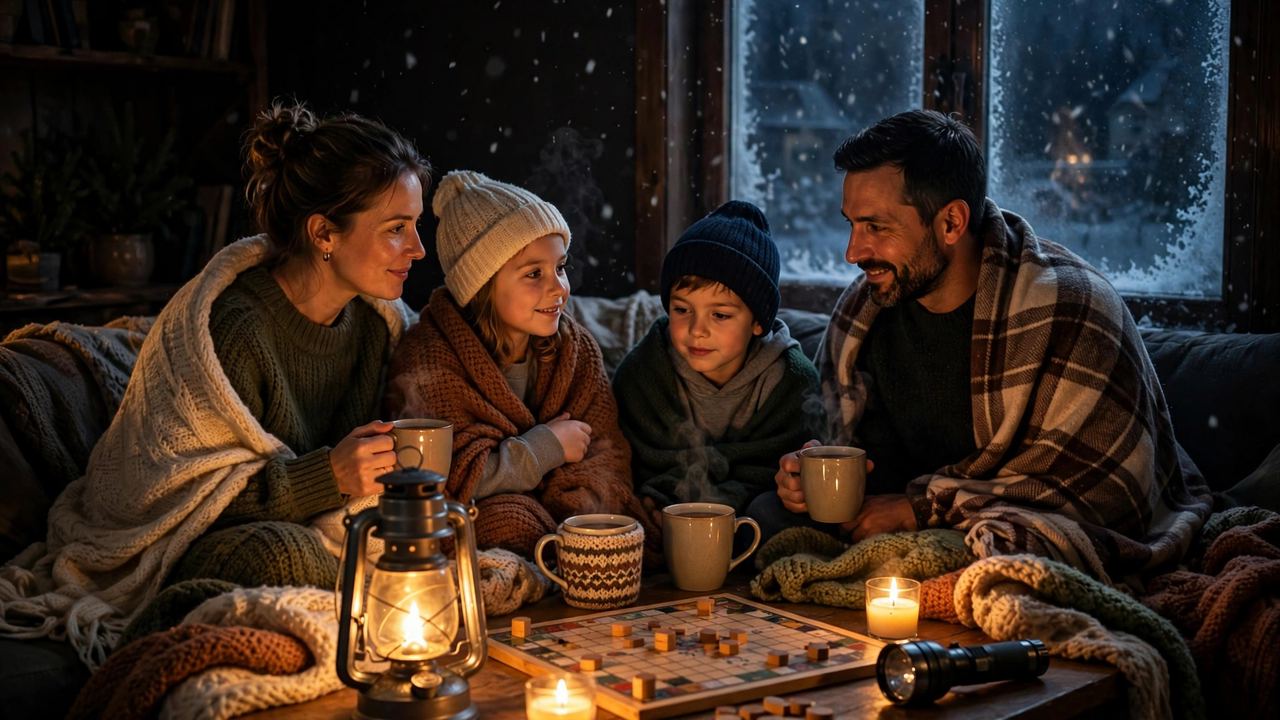
Night is when a winter outage turns serious, because outdoor temperatures bottom out, nobody is moving around generating heat, and the house has been coasting without a furnace for hours. Treat the first night as a planned operation, not as simply going to bed in a cold house.
- Sleep in the warm room, together. Move mattresses or sleeping bags into the closed-off room. The CDC lists extra blankets, sleeping bags and warm winter coats among the heat sources to have ready for an outage, and layering them over and under sleepers matters: insulation underneath the body does as much work as blankets on top.
- Dress for sleep the way you would dress for outdoors. Dry socks, a hat and a base layer. Change out of any clothes that got damp during the day, because damp fabric pulls heat away all night.
- Eat and drink before bed. A warm meal and a hot drink before sleep help everyone settle, and shelf-stable food plus a camping-free method of heating water, used safely outdoors if it burns fuel, keeps the routine normal. Never use a camp stove indoors; the CDC prohibition covers portable camping stoves inside a home.
- Run the pipe routine before bed. Cabinet doors open, faucets on exposed lines dripping, garage door closed. The coldest pipe hours are the small hours, and the drip has to be running before you sleep, not discovered stopped at 3 a.m.
- Set the light and alarm plan. One lantern in the warm room, flashlights within reach of each sleeper, and phones on low-power mode with alarms set. If a carbon monoxide alarm sounds in the night, the rule from the CPSC applies exactly as written: never ignore it, get outside immediately and call 911.
- Do not run a heater unattended while sleeping in a confined space. The CPSC warns against leaving a portable heater running unattended in a confined space. Blankets and layers are the overnight heating system; heaters are for waking hours when someone can watch clearances and cords.
- Bring pets into the warm room. Animals feel the same falling temperatures, and a pet sleeping in the group adds warmth rather than needing a separate cold room checked through the night.
Check the indoor temperature before bed and again on any night waking. A house that is still comfortably cool at midnight is coasting well. A house where you can see your breath indoors before midnight is telling you the plan needs to change in the morning, and possibly tonight, which is what the leaving criteria below are for.
Day two and beyond: running a multi-day outage
By the second day, the outage stops being an event and becomes a routine. The households that do well are the ones that switch to a schedule: fixed times for checking the house, eating, charging and getting information, instead of reacting to each new problem.
The daily circuit
- Morning house check. Walk every room with a flashlight. Check the freezer thermometer against the food timeline, check exposed pipes and under-sink cabinets for leaks or frost, check the warm-room temperature, and clear snow from fuel-burning appliance vents, following the CPSC advice, so carbon monoxide cannot build up.
- Water discipline. The CDC notes that when power goes out, water purification systems may not be functioning fully, and that safe water for drinking, cooking and personal hygiene includes bottled, boiled or treated water, with state, local or tribal health departments making specific recommendations for your area. If you are on a private well, remember the pump needs power, so stored water is your supply until power or a generator runs the pump. Melted clean snow is a backup for flushing and washing, not a first choice for drinking.
- Food by the clock, not by hope. Keep working the table above. Cook or discard freezer items in the order they thaw, eat the most perishable safe food first, and keep a written list on the freezer door of what has been discarded so nobody re-serves it.
- Charging rotation. If you have a power station or a generator running outdoors, charge in a fixed window: phones, power banks, lanterns, medical device batteries, then stop. A rotation prevents the common day-three failure where every battery in the house is flat at once.
- Information once or twice a day. Use the weather radio at set times for restoration estimates, road conditions and warming-center locations, rather than draining phone batteries on outage maps all day.
- Medication check. Apply the Ready.gov rule daily: after more than a day without power, refrigerated medication is discarded unless its label says otherwise, with a doctor or pharmacist consulted for replacement. If a life depends on a refrigerated drug that has been at room temperature, the CDC advises using it only until a new supply is available and replacing all refrigerated drugs as soon as possible.
Decisions that come due on day two or three
- Drain the pipes if the house cannot stay above freezing. This is the point of no return decision. If indoor temperatures are approaching freezing and there is no heat source and no near-term restoration estimate, shutting off the main valve and draining the lines is cheaper than one burst pipe, and the Red Cross drain logic for outdoor lines applies indoors the same way.
- Relocate the cold chain. Food that is still frozen can move to a neighbor’s powered freezer, a cooler with purchased ice, or an unheated secure outdoor space only if it genuinely stays at freezer temperatures and is protected from animals; the thermometer, not the weather report, decides.
- Rotate to a heated base. Many households split the difference: sleep at a warming center, a workplace or a friend’s powered home, and return daily to run the house circuit. Ready.gov advises going to a community location with power if heat or cold is extreme, and local officials can tell you which heating locations are open near you.
- Watch the people, not just the house. The CDC warns that hypothermia is a dangerous condition that can happen in extreme cold, and that if a person’s temperature is below 95 degrees F it is a medical emergency requiring immediate attention. Check on elderly neighbors daily in a multi-day outage, in person if phones fail.
When to leave, and when to call for help
Leaving is not failing. In a winter outage, the correct decision is sometimes to close the door on a cold house, with the water drained and the pipes protected, and sleep somewhere heated. Use these triggers rather than pride or optimism.
- Call 911 immediately if a carbon monoxide alarm sounds and anyone has symptoms, if anyone shows signs of carbon monoxide poisoning as the CDC lists them, if there is a fire, a gas smell or a medical emergency. On gas specifically, the CPSC advises: if you smell gas or hear it leaking, leave immediately and contact local gas authorities from outside the home, without operating electronics such as lights or phones before leaving.
- Leave for a warming center or a heated home when the warm room can no longer be kept at a temperature where layered clothing and blankets are enough, when anyone in the house is very young, elderly, ill or dependent on powered medical equipment you can no longer run, or when you cannot keep water liquid and food safe at the same time.
- Call the utility, not 911, for outage reports, downed lines with no immediate danger to people, and restoration estimates, so emergency lines stay open. Still, never approach a downed line yourself; the CDC instruction is to never touch one.
- Call a licensed plumber when a frozen pipe cannot be located, reached or thawed, or when a pipe has burst and the main valve alone does not stop the water, following the Red Cross guidance.
- Before you leave: shut off the main water valve and drain the lines, turn off or unplug appliances against the return surge, lock up, tell a neighbor or family member where you are going, and take medications, documents, chargers and pet supplies. A drained, dark house survives an outage far better than a heated argument about staying.
Mistakes to avoid in a winter outage
- Running a generator in the garage with the door open. The CPSC states that opening doors or windows will not provide enough ventilation to prevent lethal carbon monoxide buildup. Outside, at least 20 feet away, is the only correct placement.
- Heating with the gas oven or stovetop. Both Ready.gov and the CDC prohibit it, for carbon monoxide and fire risk. A cold kitchen is an inconvenience; a poisoned house is not.
- Opening the refrigerator to check on the food. Every check spends the 4-hour budget. Decide from the note on the door and the thermometer, not from looking.
- Tasting food to decide if it is safe. FoodSafety.gov is explicit: never taste food to determine its safety. Use time, temperature and the discard charts.
- Thawing a pipe with a blowtorch or any open flame. The Red Cross prohibits blowtorches, kerosene and propane heaters, charcoal stoves and other open-flame devices for thawing. Gentle electric heat and hot towels are the method.
- Using candles as the main light source. The CDC recommends battery-powered flashlights and lanterns instead of candles to minimize fire risk, and the CPSC adds that if candles are used they must never be left unattended and must be extinguished when leaving the room or before sleeping.
- Plugging a generator into a wall outlet or refueling it hot. Connect appliances with heavy-duty extension cords as Ready.gov directs, and let the generator cool before refueling so spilled fuel cannot ignite on hot engine parts.
- Waiting until the house is freezing to protect the pipes. Drips, open cabinets and draining only work if they start while the pipes are still liquid. The pipe routine belongs in hour one, not on day three.
- Assuming a sleeping household will notice carbon monoxide. The CDC warns that people who are sleeping can die from carbon monoxide poisoning before ever having symptoms. Working battery-backed detectors are the safeguard, not waking up in time.
Frequently asked questions
How long will food stay safe if I never open the refrigerator?
According to Ready.gov and FoodSafety.gov, a closed refrigerator keeps food cold for about 4 hours without power, a full freezer for about 48 hours, and a half-full freezer for about 24 hours. After those windows, use the 40-degree rule: perishable food held above 40 degrees F for more than 2 hours is discarded.
Can I run a generator in my garage if I open the door?
No. The CPSC states that opening doors or windows will not provide enough ventilation to prevent lethal carbon monoxide buildup, and that a generator must never run in a garage, basement, crawlspace, shed, porch or carport. Run it outside only, at least 20 feet from the house, with the exhaust pointed away.
Should I drip faucets during a power outage, or drain the pipes?
Drip first, while the house still holds heat: the Red Cross notes that running water, even at a trickle, helps prevent pipes from freezing, and open cabinet doors let warmer air reach the plumbing. If the house will stay unheated for days or you are leaving, escalate: shut off the main valve and drain the lines so remaining water has room to expand.
Is it safe to heat the house with my gas oven?
No. Ready.gov and the CDC both say never to use a gas stovetop or oven to heat a home, because of the carbon monoxide risk, plus fire and burn risks. Use layered clothing, blankets and one closed warm room, a properly maintained fireplace, or go to a heated location.
What are the signs of carbon monoxide poisoning?
The CDC lists headache, dizziness, weakness, nausea, vomiting, chest pain and confusion as the most common symptoms, and warns that exposure can cause loss of consciousness and death, and that sleeping people may never show symptoms in time. If you suspect poisoning, get to fresh air, call 911 or Poison Control at 1-800-222-1222, and do not go back inside.
When should we give up and leave the house?
Leave when the warm room cannot be kept livable with layers and blankets, when anyone in the home is medically vulnerable or depends on powered equipment you cannot run, or when you can no longer keep both water and food safe. Ready.gov advises going to a community location with power when cold is extreme. Drain the water lines before you go, so the house you return to has intact pipes.
Conclusion
A winter power outage is won or lost on sequence. In the first hour, you report the outage, unplug against surges, close the refrigerator and freezer, set up one warm room and start the pipe routine. Through the first night, you hold heat with layers and a closed room, keep faucets dripping and let detectors, not hope, stand watch over carbon monoxide. Across a multi-day outage, you run a daily circuit of food, water, pipes, charging and information, and you make the two hard calls early: draining the pipes before they freeze, and leaving for a heated place before the cold becomes dangerous. Keep this timeline where you can find it in the dark, and the next outage becomes a checklist you have already rehearsed, not a crisis you are improvising.










Write Your Review
No reviews yet. Be the first to share your experience!