
Key takeaways
- Store the main firewood pile about 30 feet from your house, off the ground and covered only on top. Compare racks, woodsheds, garages and indoor spots safely.
If you are asking where should you store firewood for winter, the short answer is outdoors, not against the house. Keep the main pile roughly 30 feet from your home, raised off the ground, with only the top covered, and keep just a day or two of wood near the door or indoors. That one arrangement answers almost every problem firewood storage creates: it keeps rodents and insects away from your walls, lets the wood keep drying instead of re-wetting, and still leaves you a small, convenient supply within a few steps of the fire.
The reason this question deserves more than a one-line answer is that the details are where storage succeeds or fails. A pile can be the right distance away and still rot because it sits on bare soil. A stack can be beautifully dry and still be a pest bridge because it leans on the foundation. A garage pile can look tidy and still wake up dormant insects because it warms up indoors. This guide walks through the placement options one by one, puts the distance figures from university extension services and the EPA into a single table you can check against your own yard, and then covers the rack setups, the near-door supply, the indoor rules and the mistakes that undo good placement.
The two-pile system: the setup behind almost every good answer
Nearly all sound firewood advice reduces to two piles, not one. The first is the main pile: the bulk of your winter supply, stored outside, away from the house, where it can season and stay dry. The second is the day supply: a small amount of wood kept close to the door or beside the hearth, sized to what you will actually burn in a day or two and refilled regularly from the main pile.
Nebraska Extension in Lancaster County describes exactly this split. It recommends locating the bulk of your firewood at least 30 feet from your home to reduce the chance of rodents becoming a problem in and around the house, and then, with the main pile 30 feet away, storing small amounts next to the house for easy access — about the amount of wood you would use in one or two days, replenished regularly from the large pile. Cornell Cooperative Extension gives the same shape: keep the pile a small distance from the home, with 30 feet adequate, and note that many people store a small amount in or next to the house that they draw from as needed and replenish regularly.
Purdue Extension’s entomology guidance sets the indoor side of the same rule: bring firewood indoors only as needed, at most a couple of days’ supply at a time, because storing firewood in the home for long periods speeds insect development inside the wood and lets insects emerge inside the home. So the two-pile system is not a compromise between convenience and safety. It is how you get both: distance where the volume is, convenience where the volume is tiny.
How far from the house? The distance table
Different authorities give different numbers because they are solving different problems. Rather than picking one figure and hiding the rest, use the table below the way it is meant to be used: find the row that matches your situation, and let that distance govern your main pile.
| Situation | Distance | Who gives it | Why |
|---|---|---|---|
| Main pile, general default | About 30 feet from the home | Cornell Cooperative Extension; Nebraska Extension | Rodents and bugs live in and around firewood piles, so the bulk supply should not sit close to the house |
| Main pile where rodents are a known problem | At least 30 feet | Nebraska Extension | A pile against the house lets mice and rats search for an entry in perfect shelter; a mouse can squeeze through a hole 1/4 inch in diameter and a rat needs only a 1/2-inch hole |
| Main pile in wildfire country | At least 30 feet, uphill from or at the same elevation as the home, with flammable vegetation removed within 10 feet of the pile | Colorado State Forest Service home ignition zone guidance, reproduced by the Genesee Fire Protection District | A woodpile is fuel; distance and a cleared ring keep it from becoming the thing that carries fire to the structure |
| Absolute minimum gap for any stack near a building | At least 3 feet between firewood and the building | Purdue Extension (publication E-67, Insects in Firewood) | Stacking against a house or garage can cause moisture and insect problems in the building; the gap also improves air circulation so wood dries faster |
| Near-door working supply | Beside the door is fine, but small | Nebraska Extension; Purdue Extension | Limit it to roughly one or two days of burning, and refill it from the main pile rather than letting it grow into a second main pile |
| Under a deck, on a deck, or between trees (wildfire areas) | Do not store there at all | Colorado State Forest Service guidance | Decks are part of the structure’s vulnerable zone, and wood stacked between remaining trees sits inside the fuel you are trying to keep separated |
Read the table as a ladder, not a menu. Thirty feet is the target for the main pile whenever your lot allows it. Three feet is a floor for a small working stack on a tight lot, not a recommendation for the season’s supply. And no distance makes a stack against the foundation acceptable: Purdue Extension is explicit that wood should not be stacked up against the house or garage, and Nebraska Extension calls right next to the house the worst place for firewood storage — with next to the dog pen the next worst, because spilled food and the dog’s water dish give rodents shelter, food and water in one spot.
Placement options, compared honestly
Distance is only half the decision. The type of spot matters just as much, because each option trades drying, pest pressure, convenience and fire risk differently.
| Spot | Best for | Watch out for | Verdict |
|---|---|---|---|
| Open yard stack on a raised base, top covered | The main seasoning pile; the default for most homes | Needs a base off the soil and a top-only cover; a fully wrapped tarp traps moisture | Best all-round choice for the bulk supply |
| Woodshed with a roof and open or slatted sides | Large supplies in wet or snowy climates | Still needs distance from the house and air movement; a closed, unventilated shed slows drying | Excellent if sited like a main pile, not like an extension of the house |
| Covered porch rack | The near-door working supply | Porch is attached to the house, so keep the quantity working-sized, not seasonal | Very good for the day supply; wrong for the whole winter |
| Unheated garage or utility building | A modest buffer supply under a roof | Warmer than outdoors, so insects wake sooner; never let it become the main long-term pile | Acceptable for a limited buffer; Nebraska Extension lists an unheated garage or utility building among cover options for keeping wood dry |
| Indoors beside the hearth | What you will burn in the next day or two | Warmth wakes insects in the wood; keep quantities small and turnover fast | Right for a couple of days, wrong for a season |
| Against the foundation, in a crawlspace, or under a deck | Nothing | Moisture against the building, hidden pest access, and — under a deck in wildfire country — fuel in the most vulnerable zone | Never |
The open yard stack
This is the reference setup the extension services describe. The EPA’s Burn Wise guidance compresses it into one line: store wood outdoors, off the ground, with the top covered, after seasoning it for at least six months. Cornell Cooperative Extension fills in the working details: stack as soon as possible after delivery, always stack off the ground with pallets as a good first layer, stack loosely and no more than two layers deep, and build end caps from alternately stacked firewood or 2x4s to keep the pile together. Cover the pile — metal roofing sheets or plastic tarps both work — but cover only the top, leaving the sides exposed so air can flow through.
Within the yard, favour a spot that drains rather than collects water, and think about your own winter path: you will walk this route in the dark, in snow, carrying an armload, many times a week. A pile that is perfect for the wood and miserable for the person tends to produce a quiet behaviour change — the near-door stack grows and grows until it becomes the de facto main pile against the house. Place the main pile where the refill trip is short, flat and easy, and the two-pile system holds all winter.
The woodshed
A woodshed is the yard stack with better weather protection: a roof large enough to shed rain and snow past the wood, and sides open or slatted enough that air keeps moving. Nebraska Extension lists a woodshed among the covers that keep wood dry, with one detail worth copying whatever cover you use — leave an air space between the wood and the covering. Site a shed with the same distance discipline as an open pile. A shed built against the house wall inherits every problem of a stack against the house wall, plus a roof that hides the pile from casual inspection, which is exactly what rodents and insects prefer.
The covered porch
A covered porch is the natural home of the day supply: roof overhead, steps from the door, and easy to sweep. Because the porch is attached to the structure, treat its rack as a working rack — sized for days, not months — and refill it from the yard. If you are setting one up, our guide to the best firewood log racks with covers for covered porches covers rack sizing, cover styles and how much a four-foot porch rack realistically holds. Keep the porch stack swept underneath: bark and debris hold moisture and give insects a reason to linger next to the door.
The garage and other outbuildings
An unheated garage, carport or utility building can hold a buffer supply — more than the hearth-side day or two, less than the season. Two cautions govern it. First, a garage is warmer than the yard, and warmth is the trigger for insect emergence: Nebraska Extension notes that insects inside firewood stay dormant while the wood is below 50 degrees, but if wood is taken indoors and allowed to warm up for several days, insect activity resumes and they may emerge. A garage sits between those worlds, so turnover matters — burn the garage supply down and rotate it rather than letting the same logs sit from October to March. Second, keep the garage stack off the floor on a rack or pallets and away from the wall, for the same moisture and air-circulation reasons Purdue Extension gives for any building.
Indoors, beside the hearth
The indoor spot has one job: hold tonight’s and tomorrow’s wood. Purdue Extension’s ceiling is a couple of days’ supply at a time, and Nebraska Extension’s advice is to store wood outside in the cold until it is ready to be burned and bring in only a small amount at a time. A dedicated holder keeps that small supply tidy and off the floor; the best fireplace log holders with matching tool sets for living rooms are sized around exactly that one-to-two-evenings rhythm. Keep the indoor holder clear of the appliance itself — the EPA’s safe-practice list includes keeping flammable items away from the wood-burning appliance — and let your stove or fireplace maker’s clearances govern anything placed near the unit, a point that also shapes where your tools should stand, as the guide to fireplace tool sets for wood-burning stoves in small cabins explains for tight hearth corners.
Choosing the exact spot: a step-by-step walk of your yard
With the options clear, choosing the spot itself is a short, deliberate walk rather than a guess. Work through it in this order:
- Start at the house wall and pace out your distances. Find where 3 feet, and then roughly 30 feet, actually land in your yard. Many people discover the 30-foot line falls in a perfectly workable place — the side of a shed, the end of a garden bed, along a fence — once they measure instead of eyeballing.
- Check what the pile would sit next to. Avoid the dog pen (Nebraska Extension’s second-worst spot), garbage storage, compost and bird feeders, all of which supply the food half of a rodent problem. Avoid low ground where water stands, and in wildfire country avoid spots between trees and anywhere under or on a deck.
- Check the ground itself. The spot needs a base — pallets, rails, blocks or a rack — because wood stacked on the ground can become infested with termites, as Purdue Extension warns, and because ground contact wicks moisture into the bottom row all season. If the ground is soft or sloped, level the base first; a leaning stack sheds its cover and then its dryness.
- Check the air. Air has to move through the stack, which is why Cornell Cooperative Extension says to stack loosely and cover only the top. A tight corner between two walls, or a spot sealed in by dense shrubs on every side, dries wood slowly even at the right distance.
- Check your winter route. Walk from the pile to the door as you will in January: Is the path lit, reasonably flat and clear of the things that get buried in snow? If the honest answer is no, move the pile or fix the path now, while the ground is bare.
- Decide the near-door spot in the same walk. Pick the porch corner, the step-side rack or the hearth holder that will hold the day supply, and size it deliberately small. A small rack enforces the system; a large one invites the system to collapse.
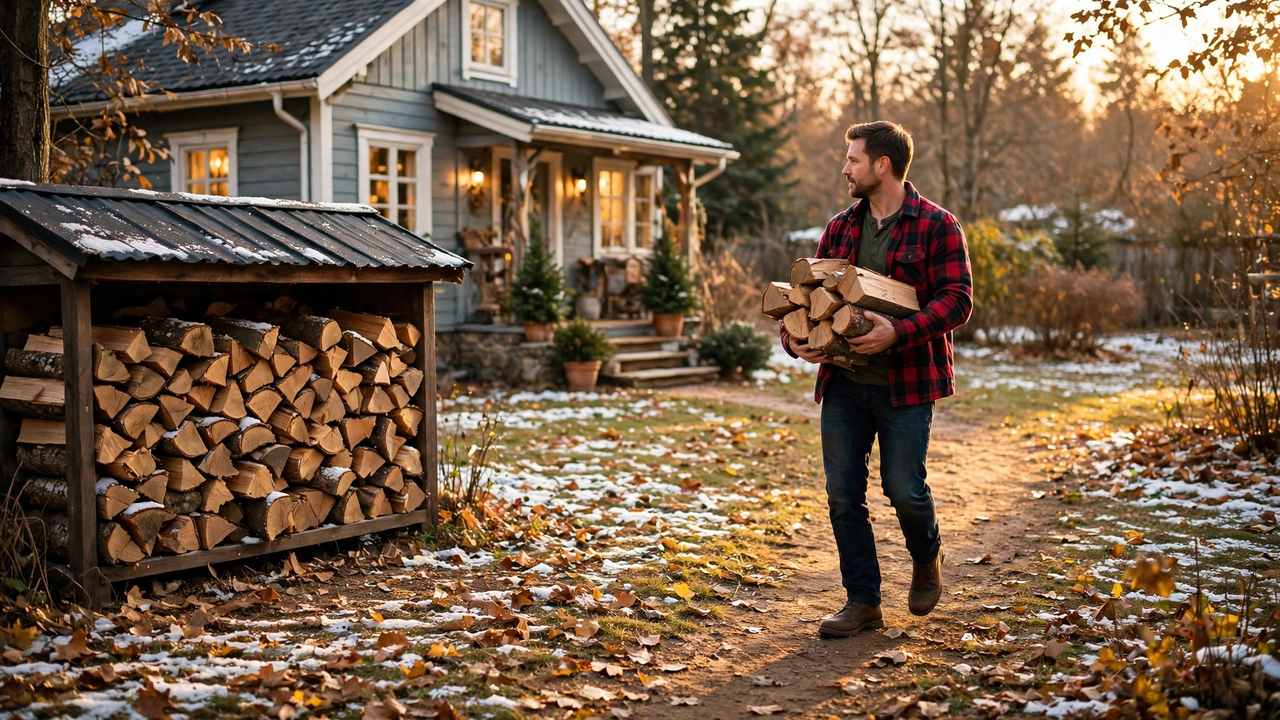
Rack and stack setup: the details that keep stored wood dry
Where you store firewood decides the risks; how you stack it decides whether it is burnable when you get there. The target is set by the EPA: wood burns best at a moisture content of less than 20 percent, and you should test wood with a moisture meter before you burn it. Cornell Cooperative Extension adds the timeline behind that number — getting green wood to less than 20 percent moisture takes at least six months, freshly cut wood can start at 100 percent moisture content or more, and buying your firewood at least a year before you intend to use it gives you sufficient time in most cases. Storage is what makes that drying happen instead of stalling.
The base
Every authority agrees on the first layer: never the ground. Cornell suggests pallets as a good first layer. Purdue Extension says stacking wood off the ground whenever possible increases drying and reduces pest problems, and notes the specific ground risks — termites in wood stacked on the ground, and carpenter ants attacking firewood that sits on the ground for a long time or is not allowed to dry out. A rack, rails, blocks or pallets all satisfy the rule; what matters is an air gap under the bottom row and no soil contact anywhere in the stack.
The rows
Stack loosely, in rows shallow enough for air to pass through — Cornell’s guidance is no more than two layers deep — and keep the ends supported. End caps built from alternately stacked firewood, or simple 2×4 uprights, keep the pile together without sealing its ends. The EPA’s storage guidance adds a useful orientation detail from its firewood handout: stack wood split side down and away from buildings. If you are refining your stacking technique itself — row patterns, criss-cross ends, and how to keep a stack stable as it dries — our sibling guide on how to stack firewood for winter so it stays dry goes through the method step by step.
The cover
Cover the top, only the top. The EPA’s rule — outdoors, off the ground, with the top covered — comes with the reason attached in its guidance: covering the sides traps moisture. Cornell says the same in practical terms: metal roofing sheets or plastic tarps make good covers, but cover only the top and leave the sides exposed so air can flow through. Nebraska Extension adds the finishing detail: leave an air space between the wood and its covering, whether the cover is a woodshed roof, a sheet of plastic or sheet metal roofing. A tarp wrapped down the sides and staked to the ground is the single most common way a well-placed pile goes wrong — it turns the stack into a damp tent that re-wets wood faster than rain would have.
How much wood the spot has to hold
Size the spot to your real burn rate before you build or buy anything. A household that lights evening fires a few times a week and a household heating primarily with wood need footprints that differ by an order of magnitude, and an undersized main pile pushes the overflow against the house — the worst outcome. Our sibling guide on how much firewood you need for a whole winter works through the quantity side, so you can match the storage footprint you set aside to the supply you actually have to fit in it.
Special cases
Small yards and townhouses
If 30 feet does not exist on your lot, work down the ladder honestly rather than abandoning it. Keep the main pile as far from the walls as the lot allows, never below Purdue Extension’s 3-foot minimum gap from any building, keep it off the ground, and shrink the pile itself — a smaller main pile restocked more often beats a season’s worth wedged against the siding. Shift more of the system indoors only within the day-supply rule: a couple of days at a time, burned and replaced. What you should not do is move the bulk supply into a crawlspace or against the foundation for tidiness; those are the placements every source warns against, at any lot size.
Wildfire-prone areas
In wildfire country the pile is fuel first and a convenience second. The Colorado State Forest Service guidance reproduced by the Genesee Fire Protection District is specific: keep firewood stacked uphill from, or at the same elevation as, the home and at least 30 feet away from the home and other structures; do not stack it between remaining trees, underneath the deck or on the deck; and remove flammable vegetation within 10 feet of woodpiles. Follow your local fire district’s current defensible-space rules where they are stricter, and treat the 30-foot figure as a minimum in this context, not a target.
Wood that arrives green
Green wood changes the placement answer: it needs the best drying spot you have, not the most convenient one. Give the seasoning pile your most open, airy outdoor position with its top covered, because the clock the EPA and Cornell describe — at least six months, and realistically a year bought ahead — only runs while air moves and rain stays off. Cornell notes that a shady spot or a spot near a stream or lake can stretch the time to reach 20 percent moisture significantly, and certain hardwoods take longer to season fully. As pieces reach burnable dryness they can graduate to the porch rack and the day supply; green wood should never graduate straight to the garage or the hearth-side holder, where it will dry slowly and shelter insects at room temperature.
Ash and the storage area around the fire
Storage discipline extends to what comes out of the fire as well as what goes in. The EPA advises removing ashes regularly into a covered metal container and storing that container outdoors on a nonflammable surface — not on the porch boards beside the wood rack, and not next to the day supply. A tidy hearth routine helps here too: a grate and ash pan sized to your firebox keep ash contained between clean-outs, as covered in our guide to heavy-duty fireplace grates with ash pans for open hearths. And because dry wood is also cleaner wood — the EPA and Cornell both tie higher moisture to more smoke and more creosote — the pile you stored well pays off in the room as well; if smoke is still an issue in a fireplace room, the best air purifiers for rooms with fireplaces address the room side of the problem, though they are no substitute for dry fuel and a clean flue.
Mistakes to avoid
- Stacking against the house, garage or foundation. The worst placement, per Nebraska Extension, and expressly warned against by Purdue Extension: it shelters rodents against your walls, holds moisture against the building, and gives insects a hidden base next to the structure.
- Stacking directly on the ground. Ground contact invites termites and carpenter ants (Purdue Extension) and wicks moisture into the bottom row all winter. Pallets, rails or a rack are not optional decoration; they are the storage system.
- Wrapping the whole pile in a tarp. Cover only the top, with an air space under the cover. Sides wrapped tight trap moisture — the EPA’s warning — and can leave wood wetter than an uncovered stack.
- Bringing a week’s or a month’s wood indoors. At most a couple of days’ supply inside (Purdue Extension). Warmth wakes the insects in the wood; Nebraska Extension notes they stay dormant below 50 degrees but emerge after several warm days indoors.
- Spraying firewood with insecticide. Both Purdue and Nebraska Extension warn against it: Purdue says homeowners should not make a practice of applying chemicals to firewood because of the harmful fumes produced when the wood is burned, and Nebraska says that if you cannot stand the insects in a piece, take that piece back outside instead.
- Storing under or on a deck. In wildfire guidance this is fuel in the structure’s most vulnerable zone, and anywhere it is a damp, shaded, pest-friendly cavity against the house.
- Moving firewood long distances. The EPA advises buying and burning locally cut firewood to decrease the risk of transporting invasive forest pests to your property — and Purdue Extension likewise recommends firewood not be moved but used on site, because pests such as the emerald ash borer spread in moved firewood.
- Letting the near-door stack grow. The day supply creeping into a second main pile against the wall is how most good systems quietly fail. Keep the near rack small on purpose.
Frequently asked questions
Can I store firewood in my garage all winter?
A modest buffer, yes; the whole season’s supply, preferably not. Nebraska Extension lists an unheated garage among the cover options that keep wood dry, but a garage is warmer than the yard, and warmth is what wakes insects in stored wood. Keep the garage quantity limited, raised off the floor, away from the wall, and rotate it — burn it down and replace it from the outdoor main pile rather than letting the same logs sit for months.
Is it safe to store firewood indoors?
For a day or two, yes — that is the standard day-supply practice. Purdue Extension sets the ceiling at a couple of days’ supply brought in at a time, because longer indoor storage speeds insect development in the wood and lets insects emerge in the home. Keep the indoor holder clear of the stove or fireplace itself, following the appliance maker’s clearances and the EPA’s advice to keep flammable items away from the appliance.
How far should firewood be from the house to avoid pests?
For the main pile, about 30 feet: that is the figure both Cornell Cooperative Extension and Nebraska Extension give, Nebraska specifically for reducing rodent problems. The absolute minimum gap Purdue Extension sets for any firewood near a building is 3 feet, for moisture, insect and air-circulation reasons — treat that as a floor for a small working stack on a tight lot, not as main-pile placement.
Should firewood be covered completely with a tarp?
No. Cover only the top. The EPA’s storage rule is outdoors, off the ground, with the top covered, and its guidance warns that covering the sides traps moisture. Cornell Cooperative Extension gives the same instruction — cover only the top, leaving the sides exposed so air can flow through — and Nebraska Extension adds that you should leave an air space between the wood and the covering.
How long can firewood be stored before it goes bad?
Stored correctly, a long time: Cornell Cooperative Extension notes that, done correctly, firewood can be stored indefinitely, safely and without degrading. The conditions are the ones in this guide — off the ground, top covered, sides open, away from the house. What stored wood must still do before burning is reach the EPA’s target of less than 20 percent moisture, which takes at least six months of seasoning for green wood; check suspect pieces with a moisture meter, and look for the checks in the end grain — Cornell notes seasoned ends usually split open up to a quarter inch — and the crisp, solid sound of two dry pieces knocked together.
What should I do if I find insects in my firewood?
Do not spray the wood, and do not burn sprayed wood — Purdue and Nebraska Extension both warn that chemicals on firewood can produce harmful fumes when burned. Nebraska Extension’s advice is to take a piece you cannot stand back outside; wood containing big black carpenter ants or termites should also be taken back outside. Most insects that emerge indoors from firewood are a nuisance rather than an emergency, and Purdue notes that termites accidentally brought indoors with firewood will not infest structural wood — though their presence in a pile close to the home may warrant a home inspection for termites.
Conclusion
Where should you store firewood for winter? Outside, in two places: a main pile about 30 feet from the house — at least 3 feet from any building even on the tightest lot, and at least 30 feet with a cleared 10-foot ring in wildfire country — raised on pallets, rails or a rack, stacked loosely, and covered on top only with an air space under the cover; and a day supply of one or two days’ wood on the porch or beside the hearth, refilled little and often. Place the main pile on draining ground away from dog pens, feeders and garbage, along a winter path you will actually enjoy walking, and it will do the three jobs storage has to do: keep the wood drying toward the EPA’s under-20-percent target, keep rodents and insects out of your walls, and keep a dry armload within easy reach from first frost to last fire.










Write Your Review
No reviews yet. Be the first to share your experience!