We independently review everything we recommend. When you buy through our links, we may earn a commission. As an Amazon Associate we earn from qualifying purchases.
Best Firewood Log Racks With Covers for Covered Porches
Compare the best firewood log racks with covers for covered porches, from Woodhaven and Sunnydaze to VIVOHOME, by capacity, cover style, steel and porch fit.
Compare the best firewood log racks with covers for covered porches, from Woodhaven and Sunnydaze to VIVOHOME, by capacity, cover style, steel and porch fit.
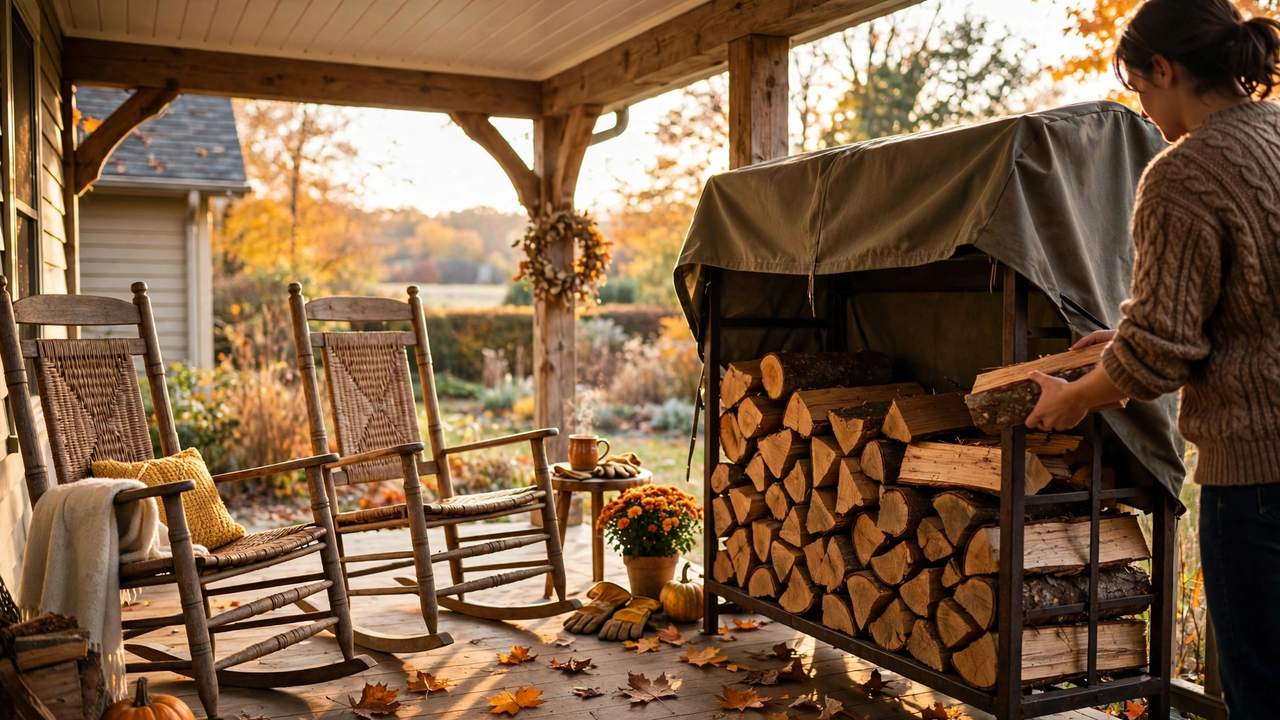
A covered porch changes the firewood problem in a useful way. The roof already blocks the worst of the rain, so the job of a rack and cover on a porch is not to survive an open field in a storm. The job is to keep a working supply of split logs off the porch boards, stacked neatly against a wall or railing, protected from wind-blown rain, drips at the edge of the roofline, and the damp that creeps up from wet flooring after a storm. The best racks for this spot are compact, usually around four feet long, deep enough for standard split logs but shallow enough to leave walking room, and paired with a cover that opens easily because you will be lifting it every single day you burn. This guide to the best firewood log racks with covers for covered porches compares six rack-and-cover sets that are sold together, so the cover is made to fit the frame rather than draped over it as an afterthought.
Porch storage also has its own constraints that a backyard rack never faces. The rack sits close to the house, often close to the door, so appearance matters more. A sagging stack or a torn cover is something you see every time you come home. Clearance matters too: the rack needs to fit under the porch roof without its top corners catching on anything, sit level on boards or concrete, and leave enough depth in front of it for you to pull logs out without stepping backwards off the porch edge. Finally, because the porch is sheltered, airflow is usually worse than in an open yard, which makes a raised frame and a cover that vents rather than seals especially valuable for wood that is still finishing its seasoning.
Quick verdict
For most covered porches, the Woodhaven 4-Foot Raised Firewood Rack with Cover is the strongest long-term choice: the maker lists heavy 16-gauge steel, a quarter-cord capacity, and a short fitted cover that protects the top layer while leaving the sides open for airflow, which suits a sheltered porch well. The Sunnydaze 4-Foot Firewood Rack with Cover is the roomier tubular-steel alternative, with a deeper cover that wraps further down the stack. The Amagabeli and VIVOHOME sets compete closely on covered storage, both pairing powder-coated steel frames with 600D Oxford covers, while the Gtongoko set adds a reinforced base design in the same four-foot footprint. The Brightown set is the pick for anyone who stacks tall, because the maker lists steel chains to secure a high stack and adjustable foot pads for levelling on uneven porch boards.
The products in this guide
Woodhaven 4-Foot Raised Firewood Rack with Cover
The frame as 16-gauge steel with a powder-coated finish, and lists capacity at a quarter cord, described as 32 cubic feet, of 24-inch logs
Best if you want one porch rack for many seasons, you burn longer 24-inch logs
Tall stacks secured with the included steel chains
How we selected
Every pick in this guide is a rack-and-cover set sold as one product, because a cover cut for a specific frame stays put in porch breezes and opens the way the maker intended, instead of sliding off a mismatched stack. Each set was checked on its opened Amazon product page, where it showed a live offer sold new, and its specifications were taken from the maker’s own listing details rather than from roundup sites. Sets that were unavailable, sold without a cover, or too long for a typical porch were set aside, which is why this list concentrates on four-foot racks: that length holds a useful working supply, fits between a door and a porch corner in most homes, and leaves room to walk past with an armful of logs.
Within that size, the comparison focused on the things that decide how a rack behaves on a covered porch over a full burning season. Frame construction matters because a porch rack is loaded and unloaded from the front, so it takes sideways knocks that a yard rack rarely gets. Cover design matters because the porch roof already handles direct rain, so the cover’s real work is stopping wind-driven rain and drips while still letting air move through the stack. Ground clearance matters because porch boards and concrete stay damp after rain, and wood sitting in that damp layer dries slowly and can stain the surface beneath it. Finally, access matters: a cover that needs two hands and a wrestling match will simply be left off, so fasteners, zippers, and sliding covers were weighed heavily.
The Woodhaven is the rack in this group that treats porch storage as a permanent fixture rather than a seasonal accessory. The maker lists the frame as 16-gauge steel with a powder-coated finish, and lists capacity at a quarter cord, described as 32 cubic feet, of 24-inch logs. The rack itself is listed at 34 pounds, which tells you something about the steel in it: this is a noticeably heavier frame than the tubular sets below, and on a porch that weight is a virtue, because the rack stays planted when you pull a log from the middle of the stack or brush past it with a full carrier. The maker lists stainless steel nuts and bolts for the assembly, a detail that matters in the damp air of a covered porch, where ordinary hardware is usually the first thing to rust on outdoor furniture.
The cover is the other half of the design, and it is deliberately different from the full wraps on the other picks. The maker lists the standard cover at 48 inches long, 22 inches wide, and 12 inches tall, so it caps the top of the stack rather than enclosing it. On a covered porch, that is a sensible trade. The porch roof already keeps direct rain off, so the cover’s job is to shed the drips and wind-blown rain that reach the top layer, while the open sides keep air moving through the stack so the wood continues to dry instead of sitting in still, humid air. The cover slides on the uprights, so as the stack shrinks through the week you can lower it to sit on whatever wood remains, and lifting it for a single log takes one hand.
The raised design keeps the bottom row off the porch floor, which protects both the wood and the porch. Boards under a constantly damp stack can stay wet for weeks, and the clearance under this frame lets air reach the underside of the pile and lets you sweep leaves and bark out from underneath. Assembly is listed as straightforward with the included hardware, and the finished footprint, four feet long and a little over a foot deep, tucks against a porch wall without eating the walkway. For a porch that serves as the main wood store for a fireplace or stove, this is the set that asks the least attention once it is in place.
Buy it if: you want one porch rack for many seasons, you burn longer 24-inch logs, and you prefer a top cover that keeps airflow open under a porch roof.
Skip it if: you want a deep cover that wraps most of the stack, or you need to move the rack around often, since the maker lists it at 34 pounds before any wood goes on it.
The Sunnydaze set takes the opposite cover approach to the Woodhaven, and for porches at the wetter end of the spectrum that can be the right call. The maker lists the rack at 48 inches wide, 13.5 inches deep, and 49 inches tall, holding up to a half face-cord of firewood with a listed weight capacity of 850 pounds, and the rack itself is listed at 16 pounds. The frame is tubular steel, with tubes the maker lists at 30 millimetres in diameter and 1 millimetre thick, finished in black powder coat. It is a lighter, simpler structure than the Woodhaven, which makes it easier to carry onto the porch, position, and reposition when you rearrange furniture for the season.
The cover is where this set earns its place. The maker lists the cover at 50 inches wide, 22 inches deep, and 38 inches tall, so it drops well down the sides of the stack rather than just capping it. The maker describes a fabric top with a waterproof PVC undercoating, closed with toggle straps and hook-and-loop fasteners. On a covered porch that sits open to a prevailing wind, rain rarely falls straight down; it arrives at an angle, under the roof edge, and a deeper cover is what stops the upper two-thirds of the stack from taking that weather. The fasteners open quickly, so the depth does not have to mean a daily struggle, and the cover can be folded back over the top when you are loading a fresh delivery.
Because the frame is light, think about placement. Against a wall or in a porch corner it is well supported by its surroundings, and the rack’s open hoop-style ends make it easy to load from either side where space allows. The maker lists all assembly hardware as included, and backs the set with a one-year manufacturer’s warranty. For a renter, or for a porch where the rack comes out in autumn and goes back to the shed in spring, that combination of low weight, deep cover, and simple assembly is hard to beat, and the listed capacity is generous for a four-foot footprint.
Buy it if: your porch catches wind-blown rain, you want a cover that wraps deep down the stack, and you value a light rack you can move and store easily.
Skip it if: you want the heaviest, most rigid frame on this list, or your porch is fully enclosed and a deep weather wrap is more cover than you need.
The Amagabeli set is built around clearance and cover fabric. The maker lists the rack at 48 inches long, 14 inches wide, and 48 inches tall, holding up to a quarter cord of firewood, and lists the firewood sitting 6.7 inches off the ground. That is the highest clearance figure among these picks, and on a porch it solves a specific problem: after rain blows in or a porch is hosed down, the floor stays wet long after the air feels dry, and a bottom row sitting close to that floor wicks moisture and dries last. Lifting the whole stack nearly seven inches puts the lowest logs in moving air and well clear of puddles that gather against a wall.
The frame is listed as steel tubes 2 millimetres thick with a double-layer powder coating, which the maker presents as its rust protection for outdoor use. The cover is listed as 600D Oxford fabric with a PU coating, measuring 48 inches long, 24 inches wide, and 42 inches tall, so like the Sunnydaze it wraps most of the stack, and the maker lists a PU outer layer and PVC inner layer on the fabric. Closure comes from buckle straps and an elastic drawstring, per the maker’s listing, which lets the cover grip stacks of slightly different shapes instead of depending on one fixed line of fasteners. The maker also lists downward air vents on the cover, intended to let moisture escape while limiting how much weather gets driven in.
In daily porch use, this is a set that suits a household that burns most evenings. The drawstring-and-strap closure is quick to loosen, the tall clearance makes sweeping bark and debris out from under the rack easy, and the deep cover keeps a full stack presentable against the house wall, which matters when the rack is effectively part of the porch furniture. The maker lists assembly as a one-person job with the necessary tools and instructions included. If your porch floor is the damp kind, with boards that stay dark after rain, the clearance figure alone puts this set near the top of the shortlist.
Buy it if: your porch floor stays damp, you want the stack lifted well clear of it, and you like a deep 600D cover that straps and cinches to fit the load.
Skip it if: headroom or a low porch ceiling line makes a 48-inch-tall rack awkward, or you prefer a short top-only cover for maximum open airflow.
The VIVOHOME set is the zippered option in this group, and the zipper is more than a styling choice. The maker lists the rack and cover as a combo set, with the rack built from steel tubes the maker lists at 1.2 millimetres thick with a double powder-coated finish, and the cover made from 600D Oxford fabric with a PU coating, plus a PVC inner layer in the maker’s description. The maker lists the rack’s measurements in feet, at 4 feet long and 4 feet tall with a depth of 13.8 inches, and lists the matching cover at 4 feet long, 3.5 feet tall, and 24 inches deep. Capacity is listed at a quarter cord, which is the working-supply size that suits a porch: roughly a week or more of regular fires for many households, without the rack dominating the space.
A zippered cover changes the daily routine in a way that suits a porch by the door. Instead of lifting a whole cover or undoing straps in the dark and cold, you open the zipper, take the logs you need, and close it again with one pull. That convenience is what makes a cover actually get used in February, and a cover that gets used is the whole point of buying a set. The maker also lists downward-facing air vents on the cover, designed to vent moisture while shedding rain, and describes the fabric as resisting cracking in hot and cold weather, which matters on a porch that bakes in afternoon sun even in winter.
The frame keeps the stack off the ground for airflow, in the maker’s description, and the rack and cover are made for each other, so the fit is exact rather than approximate; the maker makes a point of that pairing, since a cover that is too tight tears at the corners and one that is too loose flaps and pools water. On a covered porch the VIVOHOME sits neatly as a self-contained unit, tidy enough for a front porch where guests arrive, and the black finish matches the other picks here. Assembly is listed as straightforward, with the rack and cover designed to go together as a matched set.
Buy it if: you take wood in daily and want zippered access, you want a matched rack-and-cover fit, and your porch is on show at the front of the house.
Skip it if: you burn 24-inch logs as your standard length and want the longer-log capacity the Woodhaven lists, or you prefer a strapped cover you can cinch down over partial stacks.
The Gtongoko set is the compact reinforced option. The maker lists this four-foot model, model CHJ-4FTZZ in the listing details, as storing up to a quarter face cord of firewood, with a heavy tubular steel frame in a powder-coated finish. The maker describes support rods and a reinforced base in the frame design, intended to keep the rack stable under a full load of split hardwood, which is denser and heavier than many buyers expect. On a narrow porch, stability has a second meaning: the rack stands where people pass with laundry baskets, dogs, and grocery bags, and a frame that resists racking sideways when it is knocked is worth having in that traffic.
The cover is listed as 600D Oxford fabric with a waterproof coating, sized to the rack at 48 inches wide, 23 inches deep, and 42 inches tall in the maker’s listing for this set, so it covers the stack down most of its height while the ends of the logs remain accessible when the cover is lifted. The maker describes the elevated design as improving airflow and keeping ground damp away from the wood, the same principle as the other raised racks here, and on a covered porch that elevation also keeps the bottom row clear of the meltwater and tracked-in slush that collects by a door in winter.
This is a sensible set for a smaller porch where a four-foot rack is already the maximum that fits, and where the choice is between this and a loose pile in the corner. It keeps the supply looking intentional, keeps the top and sides of the stack shielded from the weather that gets under the porch roof, and goes together with the included hardware and instructions the maker lists. Households heating mainly with a stove, who refill the porch rack from a larger outdoor store every week or so, will find the quarter-face-cord size matches that rhythm well: fill it, burn it down, refill it, with the cover keeping the working stack in good shape between trips.
Buy it if: your porch is narrow, you refill a working supply regularly from a bigger store elsewhere, and you want a reinforced base in a compact frame.
Skip it if: you want to hold a larger reserve on the porch itself, or you want the highest ground clearance, where the Amagabeli lists a taller lift.
The Brightown set is designed for people who stack high and want the stack secured. The maker lists the rack at 12 inches deep, 48 inches wide, and 48 inches tall, holding up to a quarter face cord of firewood, with a listed shelf weight capacity of 2,500 pounds. The frame is listed as carbon steel with four reinforced beam plates in the maker’s description, and, distinctively, the set includes two steel chains that the maker describes as a way to fasten the stack when wood is piled above the top of the frame. On a porch, where a toppling log can hit a door, a window, or a shin, that is a practical safety feature rather than a gimmick, especially in homes where children fetch the wood.
The cover is listed with a UV-resistant coating and an inner waterproof PU layer, with air vents at the sides in the maker’s description, and a dual-opening hook-and-loop front so you can open part of the cover to take logs instead of removing it entirely. The maker also lists adjustable foot pads, which deserve more attention than they usually get: porch floors are rarely perfectly level, boards cup and concrete slopes for drainage, and a rack that rocks slightly will work its joints loose over a season. Pads you can adjust to take out that rock make the whole set feel solid and keep the frame’s feet from grinding on the porch surface.
Put together, this is the set for a porch that doubles as the main store rather than a top-up point, where the stack is kept full and high and the cover works hard against sun as well as rain. A south- or west-facing covered porch can still deliver hours of direct sun onto a rack, and the maker’s UV-resistant coating addresses the fading and fabric fatigue that follows. The included rack, cover, and user manual are listed as the box contents, and assembly is required, as with the other sets here.
Buy it if: you stack above the frame top and want chains to secure the load, your porch floor is uneven, or your porch gets strong sun despite the roof.
Skip it if: you keep only a low, small stack, in which case the chains and tall frame are more hardware than your routine needs.
Buying guide
Measure the porch before the rack. A four-foot rack needs four feet of clear wall, plus a few inches at each end so the cover can be pulled on and off, plus depth in front for you to stand and load. Check the depth figure as carefully as the length: these racks run roughly 12 to 14 inches deep for the frame, with covers listing up to 24 inches deep because they are cut to slip over the loaded stack. Standard split logs are commonly around 16 inches long, which overhang a shallow frame slightly at each end; racks that list capacity in 24-inch logs, like the Woodhaven here, are built with that longer wood in mind. If your supplier delivers 16-inch splits, any pick here suits; if you cut your own at 20 inches or more, check the listed log length before ordering.
Match the cover style to your porch’s weather. A fully enclosed or three-sided porch needs only a top cover, and the open sides of a seasoning-style cover will keep the stack drying better in still air. An open porch facing the weather needs a deeper wrap, a zipper or straps that hold it in a gust, and fabric with a waterproof layer, because rain will reach the stack at an angle all winter. Covers listed as 600D Oxford with PU or PVC coatings are the heavier fabrics in this group; lighter polyester covers with a PVC undercoating, like the Sunnydaze’s, still shed porch weather well and are easier to handle. Whichever you choose, a cover you can open with one hand, or open partially, is the one that will still be on the rack in the last month of the season.
Take clearance and airflow seriously. Wood should sit off the porch floor on a raised frame, both to stay dry and to protect the floor itself from trapped moisture and staining. Listed clearance varies across these picks, and more clearance helps most on solid floors that hold puddles. Then keep the stack itself airy: do not pack a porch rack so tightly that air cannot move between logs, leave the cover’s vents unobstructed, and resist sealing green wood inside a deep cover. Freshly split wood needs a season of drying, and a covered porch is a good finishing spot for wood that is nearly ready, with the cover keeping the rain off while air does the rest.
Think about the daily routine and the floor. Place the rack where you can reach it in slippers with a log carrier, out of the swing of the door, and close enough to the house wall that the roof’s drip line falls in front of it, not on it. On wooden porch boards, adjustable feet or pads spread the load and stop a heavy rack from marking the surface; on concrete, the same pads stop rocking. Keep the area under and around the rack swept, since bark and debris hold moisture and attract insects toward the house, and bring in only what you will burn over the coming days if you are cautious about pests, keeping the long-term store further from the house. Finally, keep the rack a sensible distance from any porch heater, grill, or fire feature, and never stack wood against a heat source.
FAQ
How much firewood does a four-foot porch rack actually hold? The makers of these sets list between a quarter face cord and a half face cord for four-foot models, with a quarter cord also listed for the Woodhaven. In practice that is a working supply rather than a season’s store: enough for regular evening fires over a week or more, refilled from a main stack elsewhere. If you heat mainly with wood, treat the porch rack as the ready supply and keep the bulk store in the yard.
Is a short top cover enough on a covered porch? Often, yes. The porch roof already blocks direct rain, so a short cover that caps the top layer stops drips and wind-blown rain where they land, while open sides keep air moving through the stack. Choose a deeper wrap instead if your porch is open on the weather side, if the rack stands near the porch edge, or if snow blows in and settles on the stack.
Can firewood finish seasoning on a covered porch? A covered porch is a reasonable finishing spot for wood that is already partly dried, because the roof keeps rain off while the open sides let air circulate, especially on a raised rack with a top cover. Very fresh, green wood dries faster in an open, sunny, windy spot for its first months, and wrapping green wood tightly in a deep cover works against drying, so season the bulk of it outdoors first and bring it to the porch as it approaches ready to burn.
Will a loaded rack damage porch boards? A full four-foot rack carries a substantial load, so spread it where the porch structure is sound, ideally near a wall where support is strongest, and use racks with proper feet or adjustable pads rather than thin tube ends that concentrate weight. Keeping the rack raised also lets the boards beneath dry out, which protects them over the season. If your porch is old or raised high, keep the rack modest in size and refill it more often.
How do I keep the porch stack tidy and free of debris? Stack with the bark side up on the top layer so it sheds drips, keep ends reasonably even so the cover sits properly, and sweep under the rack when you refill it, since the raised frames here all leave room for a brush. Take logs from one end of the stack rather than the middle, so the pile stays stable, and close the cover each time; most of the mess and moisture problems with porch storage come from covers left off and stacks pulled apart.
Conclusion
A covered porch is close to ideal firewood territory: sheltered, convenient, and steps from the fire. The right rack-and-cover set simply organises it. Choose the Woodhaven for the heaviest frame, a top cover that breathes, and long-log capacity. Choose the Sunnydaze for a deep, light cover against wind-blown rain, the Amagabeli for high clearance over damp floors, the VIVOHOME for zippered daily access, the Gtongoko for a compact reinforced frame on a narrow porch, or the Brightown for tall, chained stacks on uneven boards. Measure your wall, check your log length, match the cover to the weather your porch actually gets, and any of these six sets will keep a neat, dry, ready supply waiting by the door all season.
M
Modern Line Home Editorial Team
We compare specs, materials and verified owner reviews before a product earns a spot. Rankings are never paid.
Affiliate disclosure. As an Amazon Associate we earn from qualifying purchases at no extra cost to you. Prices accurate as of the date shown.
House cold even with the heat on? Walk this ordered checklist: thermostat and filter first, then drafts, insulation, leaky ducts and a failing heating system.
Windows fogging up in winter? Check where the fog sits: on the room side it is indoor humidity, outside it is harmless, and between panes the seal has failed.
Store the main firewood pile about 30 feet from your house, off the ground and covered only on top. Compare racks, woodsheds, garages and indoor spots safely.
Place a portable generator outdoors only, at least 20 feet from windows, doors and vents, exhaust pointed away. Exact distances, setup steps and CO rules here.
Keep houseplants in the right winter spot: match window direction to plant type, stay clear of radiators and cold glass, and fix dry air and low light at home.
Mice enter through pencil-width gaps at foundations, pipes, vents, doors and the roofline. Walk this room-by-room winter checklist to find and seal each one.
A winter outage timeline: what to do in the first hour, first night and multi-day outage, with food safety times, pipe protection, heat and CO safety steps.
Size a space heater by room area: 10 watts per square foot at 8-foot ceilings, adjusted for insulation and ceiling height, with full wattage and BTU tables.
Start dripping at about 20 degrees, sooner for exposed pipes. Set a pencil-lead stream, drip the right faucets on both lines, and know when to stop safely.
A fridge needs 800-1,200 starting watts, not just 150-400 running watts. Use the tables to total your fridge plus freezer, lights, furnace fan and more today.











Write Your Review
No reviews yet. Be the first to share your experience!