
Key takeaways
- Start dripping at about 20 degrees, sooner for exposed pipes. Set a pencil-lead stream, drip the right faucets on both lines, and know when to stop safely.
If you are asking when should you drip faucets so pipes do not freeze, start when the forecast low falls to about 20 degrees Fahrenheit for faucets served by exposed pipes, and start sooner — at the first sustained drop below 32 degrees — if a pipe runs through an unheated garage, crawl space, attic, or a drafty exterior wall, or if that pipe has frozen before. Set the flow to a thin, continuous stream about as thick as a pencil lead, not an occasional drop, drip the faucets on the vulnerable runs listed below, and keep it going through the coldest hours until temperatures are back above freezing. The American Red Cross puts the basic rule more simply: when the weather is very cold outside, let the cold water drip from the faucet served by exposed pipes, because running water through the pipe — even at a trickle — helps prevent pipes from freezing.
That short answer is only the trigger. The rest of this guide is the part a forecast cannot tell you: how to decide for your own house rather than for an average house, exactly how the stream should look and how to check it with a measuring cup, which faucets to open and which ones you can leave alone, whether to drip the hot side, the cold side, or both, what to do at the same time with cabinet doors and the thermostat, how much water a night of dripping actually uses, and the situations in which dripping is not enough on its own. Read the trigger table first, set the faucets named for your layout, and then check the flow once with a cup before you go to bed.
The short answer: the temperature, the stream, and the faucets
Three decisions make up the whole technique, and getting any one of them wrong weakens the other two. First, the timing: drip when the cold reaches the alert level for your pipes, which for most exposed indoor pipes is about 20 degrees Fahrenheit outdoors, and earlier for the most exposed runs. Second, the flow: a steady pencil-lead stream that never breaks into separate drops and never stops. Third, the selection: only the faucets served by pipes in cold places — exterior walls, unheated rooms, crawl spaces, attics, and garages — plus, in many houses, the faucet farthest along the run so water moves through the longest stretch of pipe. A strong stream from the wrong faucet does nothing for the pipe that actually freezes, and a perfect faucet choice set to a drop every few seconds can stall and freeze anyway.
Why does an open faucet help at all? The Red Cross explains that water expands as it freezes, and that this expansion puts tremendous pressure on whatever contains it, including metal or plastic pipes, so that no matter the strength of the container, expanding water can cause pipes to break. A dripping faucet works in two linked ways. The moving water is slower to freeze than water sitting still in the pipe, a point the City of Columbia Heights, Minnesota, makes in its frozen-service guidance when it says flowing water freezes slower than standing water. And if ice does begin to form, the open tap gives the pressure that builds behind the ice somewhere to go, instead of trapping it between the ice and a closed faucet. That pressure relief is the reason a modest stream can protect a pipe even on a night when some ice still forms inside it.
When exactly to start: temperature and duration together
Water itself freezes at 32 degrees Fahrenheit, but the pipes inside a heated house are rarely at outdoor temperature. Walls, insulation, and the heat leaking from living spaces keep the air around most pipes a few degrees warmer than the air outside, which is why guidance for indoor pipes does not simply say to drip at 32 degrees. Clemson Extension, writing about sub-20-degree weather in the Piedmont, notes that several sources recommend running a faucet during that kind of cold, and treats a cold snap below 20 degrees as the point at which homeowners should act. That figure — about 20 degrees — is widely used as a temperature alert threshold for uninsulated pipes in unheated spaces such as attics: the point at which you should assume exposed pipes can begin to freeze, not a guarantee that every pipe will freeze at 21 degrees or survive at 19 degrees.
Use the table below as a decision aid, then adjust it for the exposure of your own pipes using the notes that follow it. The forecast number that matters is the overnight low and how many hours the temperature will stay near it, not a brief dip at dawn.
| Forecast situation | Drip? | Which faucets |
|---|---|---|
| Lows stay above 32 degrees Fahrenheit | No, not for freeze protection | None — use the time to insulate exposed pipes instead |
| Lows fall below 32 degrees for a sustained period, and pipes run through an unheated garage, crawl space, attic, or drafty exterior wall, or a pipe has frozen there before | Yes, start before the temperature falls that far | Every faucet served by those exposed runs |
| Lows reach about 20 degrees Fahrenheit or below, even in a house that rarely freezes | Yes | Faucets served by exposed pipes, plus the faucet farthest along the run where that helps move water through the house |
| Lows stay near or below 20 degrees for several hours overnight, or for more than one night in a row | Yes, and check the flow before bed and again in the morning | The same list, kept running continuously through the cold spell |
| Extreme or prolonged cold well below the alert level, with wind driving cold air through cracks | Yes, but do not rely on dripping alone | The same list, plus cabinet doors open, heat held steady, and the paired steps in the section below |
Duration matters as much as the low itself. A pipe freezes because the water inside it loses heat over time. A short dip below freezing on a windy evening, followed by a rapid warm-up, gives a well-placed pipe little time to cool all the way through. Several hours at or below the alert level, and especially a second and third night of the same cold, let the cold work deeper into walls, crawl spaces, and the ground around a service line. That is why the practical rule is to start dripping before the coldest part of the night rather than waiting to see whether the forecast was right, and to keep dripping for the whole cold spell rather than turning the faucets off after the first night because nothing froze.
Exposure can move your personal trigger upward. The Red Cross lists the pipes that freeze most frequently: pipes exposed to severe cold, such as outdoor hose bibs, swimming pool supply lines, and water sprinkler lines; water supply pipes in unheated interior areas like basements and crawl spaces, attics, garages, or kitchen cabinets; and pipes that run against exterior walls that have little or no insulation. If your kitchen sink sits on a poorly insulated outside wall, if a bathroom backs onto an unheated garage, or if you can see supply pipes in the crawl space with no insulation on them, treat a sustained forecast below 32 degrees as your start signal rather than waiting for 20 degrees. Wind makes the same point stronger: cold air moving through a crack, a rim-joist gap, or a vent near a pipe can chill that one section far faster than the still-air forecast suggests.
Your house also gives you its own warning sign. The City of Columbia Heights advises checking the temperature of the cold water itself: let the cold water run until it is fully cold, fill a container, and check it with a thermometer that can be immersed in water, and if the temperature drops below 40 degrees, frost may be getting close to your service line and a freeze-up could be coming. The city says that if the cold water temperature is below 40 degrees, you can help prevent the line from freezing by letting a cold water faucet run at a pencil-size stream throughout the day and night. That test is especially useful for the service line entering the house, and the city adds a caution that surprises many people: as the weather warms up, frost is pushed deeper into the ground, so the risk to buried service lines can continue well into spring, and you should keep monitoring the cold water temperature and run water as needed.
How much of a drip: stream versus drip, shown precisely
This is the detail most advice leaves vague, and it is the detail that decides whether the technique works. A drip that falls as separate, countable drops is not the target. The target is a thin, unbroken stream — the drops have run together into a continuous thread of water that does not break, stall, or slow to a plink every few seconds. Two authority descriptions converge on the same picture. Clemson Extension describes the recommended flow as a pencil-lead-thick stream of water flowing from the faucet. The City of Columbia Heights describes a pencil-size stream for a service line at risk, adding that you do not need a strong flow, just enough to keep the water flowing. Pencil lead is the thinner end of that range and is the right picture for a single indoor faucet on an exposed pipe; the fuller pencil-size stream is the city’s guidance for a service line that is already showing a cold-water temperature below 40 degrees.
Do not trust your eyes alone the first time. Check the flow with a measuring cup, the way Clemson Extension checked it in its own office. Clemson Extension measured a pencil-lead-thick stream and found that it filled a 12-ounce cup in 1.8 minutes, which works out to a flow rate of approximately 3 gallons per hour from that faucet. Use that as your calibration test:
- Place a measuring cup under the faucet and time how long the stream takes to fill 12 ounces.
- If 12 ounces takes roughly 1.8 minutes, you are at the pencil-lead stream Clemson Extension measured — about 3 gallons per hour.
- If the cup fills much faster, ease the handle back toward closed until the stream thins to that continuous thread; you are using more water than the technique needs.
- If the flow is still breaking into drops, or the cup is filling far more slowly, open the handle a little more until the stream is continuous, then time it again.
- Check the drain is open and clear before you leave the faucet running overnight, so the stream drains freely and cannot back up into the sink.
- Look at the faucet once more before bed. Pressure in a house changes as other fixtures are used, and a stream set in the early evening can thin out later.
For comparison, the EPA WaterSense program gives a useful scale for what a true drip means in volume: a faucet dripping at the rate of one drip per second can waste more than 3,000 gallons per year. That figure is about leaks, but it shows why counting drops is the wrong way to set a protective flow — one drip per second is a leak rate, spread thin over time, and a stream set by drops can slow, stall, or stop entirely as the pipe chills and pressure shifts overnight. The protective flow is defined by its shape — a continuous pencil-lead thread — and confirmed by the cup test, not by a number of drops per minute.
There is one more reason to set the stream carefully rather than simply opening the faucet wide. A stream much larger than pencil-lead does not add protection in proportion to the water it uses, because the protection comes from movement and pressure relief, both of which the thin continuous stream already provides. What a wide stream does add is water use, noise, and, on a private well, more frequent pump cycling than necessary. Set it thin, confirm it with the cup, and leave it alone.
Which faucets to open — and which ones to skip
Walk the house and build your drip list from the pipes, not from the fixtures. A faucet needs to drip if the pipe feeding it passes through a cold place, whether or not the room the faucet is in feels warm. Use this list, in this order:
- Kitchen and bathroom sinks on an exterior wall. These are the classic freeze points, especially sinks under a window and cabinets on an outside wall with little insulation behind them. The Red Cross specifically names kitchen cabinets among the unheated areas where supply pipes freeze.
- A tub or shower whose pipes run along an outside wall. If the wall behind the fixture is cold to the touch and the pipes are in it, include that fixture.
- A laundry, utility, or basement sink near a foundation wall, rim joist, or garage. The Red Cross lists basements and garages among the unheated interior areas where supply pipes are at risk.
- Any faucet fed by a pipe you can see in an attic, crawl space, or garage. If you can see the pipe and the space is unheated, that faucet belongs on the list. Our step-by-step guide to how to insulate water pipes in a crawl space covers the longer-term fix for exactly those visible runs.
- Any faucet whose pipes have frozen before. Past freezing is the strongest evidence you have about your own house. That location has already shown it can reach freezing while the rest of the plumbing survives.
- The faucet farthest from where water enters the house. Running that faucet pulls water through the longest stretch of the house’s plumbing, which helps protect the main run feeding the rest.
Skip the fixtures whose pipes stay inside heated, insulated interior walls for their whole run. Dripping every tap in the house does not protect the one vulnerable pipe any better, and it multiplies water use and the chance that a slow drain overflows overnight. If you are unsure about a particular faucet, feel the wall and the pipes under the sink on a cold evening: a cabinet that is noticeably colder than the room, pipes that feel cold to the touch, and a history of slow flow on cold mornings all argue for including it.
Outdoor faucets are not part of the drip list, and treating them as if they were is a mistake. For hose bibs, the Red Cross gives a different routine entirely: remove, drain, and store hoses used outdoors; close the inside valves supplying outdoor hose bibs; open the outside hose bibs to allow water to drain; and keep the outside valve open so that any water remaining in the pipe can expand without causing the pipe to break. A hose left connected traps water in exactly the section that needs to drain. Do that draining before the first hard freeze, not on the night you start dripping the indoor faucets.
If a faucet on your list will not hold a steady stream — it sputters, slows, or stops — do not ignore it and move to the next sink. A change in flow during a freeze is information. Learn to read it with our sign-by-sign guide to how to tell if your pipes are frozen, and treat a faucet that has stopped entirely as a possible freeze already in progress, covered in the section on limits below.
Hot, cold, or both?
The Red Cross guidance names the cold side: let the cold water drip from the faucet served by exposed pipes. That is the starting point, and for a faucet with separate hot and cold handles where only the cold line runs through the cold wall, dripping the cold side protects the line at risk. But hot and cold water travel in separate pipes, and either pipe can freeze if it runs through the same cold place. The Red Cross makes that point in its preparation guidance: look in the garage and under kitchen and bathroom cabinets, because both hot and cold water pipes in these areas should be insulated. Insulation advice and dripping advice follow the same logic — a pipe that is cold enough to need insulating is cold enough to need moving water.
So decide by the run, not by habit. If both supply pipes pass through the exterior wall, the crawl space, or the unheated room, drip both sides. On a two-handle faucet, open each handle enough that its line carries part of the flow. On a single-handle faucet, set the handle in the middle position so the water that comes out is a mix, which means both lines are flowing; then do the cup test on the mixed stream and remember that each individual line is carrying only part of what the cup measures, so do not set a mixed faucet to the slowest rate you would accept for a single line. If only one line is exposed — a cold line crossing a crawl space to a toilet or a single outdoor-fed fixture, for example — drip that line. And remember that a hot-water drip has been heated on its way to the tap, so dripping the hot side for days uses energy as well as water; that is a reason to be precise about which lines are truly exposed, not a reason to leave an exposed hot line still and unprotected on the coldest night of the year.
If you are replacing a worn faucet on one of these exterior-wall sinks, choose the replacement with cold-weather use in mind from our guide to the best faucets for bathroom sinks, and confirm the new fixture holds a fine, steady adjustment rather than jumping from closed to full flow — that fine control is what lets you set and hold a pencil-lead stream.
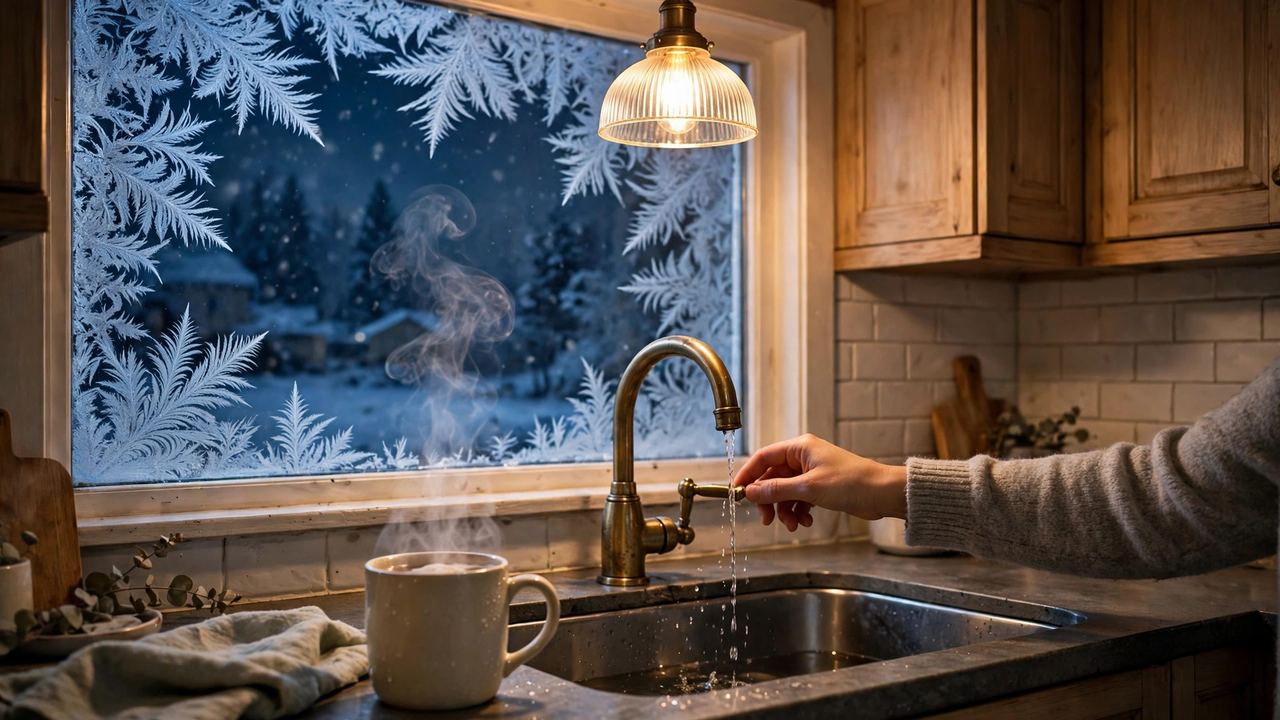
Set it up: a step-by-step for the evening the cold arrives
Step 1: Check the forecast for the low and the duration
Look at the overnight low and how many hours temperatures will stay near it, for tonight and for the following night. A single threshold crossing in a forecast that warms quickly is a different risk from three nights at the same low. Decide your start from the table above before the evening gets busy, and start before the temperature reaches the low, while the pipes are still warm from the day.
Step 2: Walk the drip list and open the cabinets first
Before you touch a faucet, open the kitchen and bathroom cabinet doors on exterior walls. The Red Cross advises opening kitchen and bathroom cabinet doors to allow warmer air to circulate around the plumbing, and adds an important safety note: be sure to move any harmful cleaners and household chemicals up out of the reach of children. Open cabinets are part of the same protection as the drip, because warm room air reaching the pipe raises the temperature the drip has to defend. For the full room-by-room routine that pairs with dripping, see our guide to how to keep pipes from freezing in winter.
Step 3: Hold the house temperature steady
The Red Cross advises keeping the thermostat set to the same temperature both during the day and at night, and notes that by temporarily suspending the use of lower nighttime temperatures, you may incur a higher heating bill, but you can prevent a much more costly repair job if pipes freeze and burst. A nighttime setback lets wall cavities cool at exactly the hours when outdoor temperatures are lowest and no one is awake to notice a problem. If you will be going away during cold weather, the Red Cross says to leave the heat on in your home, set to a temperature no lower than 55 degrees Fahrenheit. A cold room next to a vulnerable pipe also matters: if you use a supplemental heater in that room, place it by the safety guidance in our article on where you should place a space heater in a room, and never aim a heater at a pipe as a substitute for the steps here.
Step 4: Set each faucet and do the cup test
Work through your drip list one faucet at a time. Open the drain, move anything stored in the sink, set the stream to a continuous pencil-lead thread, and time 12 ounces in a measuring cup against the Clemson Extension benchmark of about 1.8 minutes. Adjust, re-time if you changed the handle much, and move on. Note which faucets you opened — on the coldest morning, that list tells you exactly what to check and, later, what to turn off.
Step 5: Close the garage and check the cold spots
The Red Cross advises keeping garage doors closed if there are water supply lines in the garage. Do a final walk: garage door down, cabinet doors open, chemicals moved up, thermostat held at its daytime setting, every faucet on the list running a continuous stream, and every drain clear. That five-minute walk catches most of the failures that happen overnight — a faucet set by someone else back to closed, a cabinet door shut out of habit, a sink full of dishes blocking the drain.
How long to keep dripping, and when to stop
Keep the faucets dripping through the coldest part of the cold spell: overnight, through the early-morning low, and on each successive night that meets your trigger. Do not stop because the sun came out for an afternoon. Walls, crawl spaces, and the ground around a service line warm up more slowly than the air, and a house that survived the first night can freeze on the second or third as the cold soaks deeper. The Columbia Heights guidance makes the same point for service lines in spring: risk can continue after the weather warms because frost is pushed deeper into the ground, so monitoring, not the calendar, should decide when you stop.
Stop when temperatures are consistently back above freezing and the spaces your pipes run through have had time to warm — in practice, when the forecast no longer brings the low anywhere near your trigger and the cold water from the tap no longer runs unusually cold. Then close each faucet on your list, close the cabinet doors if you prefer them closed, and restore your normal thermostat schedule. Take one more minute to look under each sink you dripped: a pipe that froze partway and thawed can leak quietly, and catching a slow drip into a bucket on the day it starts is very different from finding a soaked cabinet floor a week later.
If you will be away for the whole cold spell, dripping alone is a weaker plan, because no one is there to notice a stream that stopped or a heater that failed. The Red Cross away guidance — heat left on at no lower than 55 degrees Fahrenheit — is the baseline, and having someone check the house during a hard freeze is the addition that makes an away plan real. A house where the heat fails and the indoor temperature falls below freezing can freeze throughout, which no faucet setting can prevent.
How much water does a night of dripping use? The math, worked openly
The honest answer depends entirely on the stream you set, which is why the cup test matters for cost as well as for protection. Work from the measured figure, not from a guess. Clemson Extension measured a pencil-lead-thick stream at approximately 3 gallons per hour, because the stream filled a 12-ounce cup in 1.8 minutes and there are 128 ounces in a gallon. From that one measured rate, the arithmetic for your own cold snap is a simple formula:
Water used = 3 gallons per hour × hours of dripping × number of faucets.
Worked example, shown as a formula example rather than a promise about your bill: one faucet at that rate for one 24-hour day uses 3 × 24 = 72 gallons, which is exactly the figure Clemson Extension gives — 3 gallons per hour from one faucet translates into 72 gallons of water per day. Two faucets running for a three-day cold snap use 3 × 24 × 3 × 2 = 432 gallons in total. Clemson Extension puts that in household context: a normal South Carolina household uses about 120 to 150 gallons of water per day per person, so a single running faucet may add about 12 percent more water cost per day for the home, which the Extension calls very minimal since an intense cold front may only last two or three days. To price your own example, read the rate on your own water bill — the charge per 1,000 gallons, or per billing unit — and multiply it by your formula result divided by that unit. The formula is the reliable part; your local rate is the part only your bill can supply.
Compare that with the other measured rate in this guide, and you will see why naming which stream you mean matters. The City of Columbia Heights, advising on a service line whose cold water has already fallen below 40 degrees, describes a pencil-size stream averaging 0.25 gallons per minute, which equals 360 gallons per day. That is a fuller stream, for a different and more serious situation — a buried service line showing signs that frost is close — not the rate for a routine indoor faucet on an exterior wall. Do not use the service-line figure to frighten yourself out of dripping a sink, and do not use the sink figure if a utility has told you to run a service-line stream; follow the instruction that matches your situation, and if your own water utility issues a drip notice during a freeze, follow the utility’s stated rate, because it knows the condition of its own mains and may also tell residents when a whole town dripping is straining the system.
Homes on a private well run the same formula for water volume, but the cost shows up as pump work instead of a water bill. Clemson Extension worked that case too: in a home with a standard well with a 40-gallon bladder tank, the drawdown — the amount that leaves the tank between the pump switching off and switching on again — is about 13 gallons, so one faucet running a pencil-lead stream will probably turn the pump on once every 4.3 hours with no other water use, and typical pump run times to refill a pressure tank are in the 2 to 3 minute range, so the electricity use would be minimal. The Extension concludes that, regardless of the water source, it will be fine to leave one or two faucets running during a sub-20-degree cold snap, and that homeowners may find two faucets flow more adequately to prevent freezing. Note the limit hidden in that reassurance: a well pump needs power. If the power is out, dripping drains the pressure tank and then stops, which is one of the situations in the next section.
One last scale check keeps the numbers in proportion. The EPA WaterSense figure — more than 3,000 gallons per year from a faucet dripping one drip per second — describes a leak running every hour of every day for a year. A protective stream runs for the nights of one cold spell. The waste to avoid is not the three nights of dripping; it is the faucet left dripping for weeks after the cold has passed because no one wrote down that it was opened. Your drip list from the setup steps is also your shut-off list.
When dripping is not enough
Dripping is one layer, and there are conditions under which it cannot carry the whole job. Recognizing them early is the difference between a cold night and a burst pipe.
- The heat is off or has failed. Dripping assumes a heated house defending the pipes from inside. If the heating system fails, or the power goes out for a long stretch in deep cold, indoor temperatures fall toward outdoor temperatures and pipes everywhere in the house are at risk, not just the exposed runs. Keep the faucets open, but treat restoring heat — or draining the system if the house will stay unheated — as the real task.
- The pipe is fully exposed outdoors or in a vented, uninsulated space in extreme cold. A hose bib, an outdoor shower line, or a pipe in a vented crawl space in a hard, windy freeze can freeze even with water moving. Those lines needed draining and insulation before the freeze; dripping an indoor faucet does not move water through a branch that is shut off or drained.
- The faucet has already stopped. If you turn on a faucet and only a trickle comes out, the Red Cross says to suspect a frozen pipe, and the likely places are against exterior walls or where your water service enters your home through the foundation. At that point you are no longer preventing a freeze; you are dealing with one. Keep the faucet open and thaw the pipe only with safe heat — a heating pad, a hair dryer, a space heater kept away from flammable materials, or towels soaked in hot water — and note the Red Cross warning never to use a blowtorch, kerosene or propane heater, charcoal stove, or other open flame device. If you cannot locate the frozen area, cannot reach it, or cannot thaw the pipe, the Red Cross advises calling a licensed plumber.
- A pipe has burst. Dripping cannot help a pipe that has already split. Shut off the main water supply to stop the flooding, keep the affected faucet open, and call a licensed plumber. Check all the other faucets too — the Red Cross notes that if one pipe freezes, others may freeze too.
- The cold is prolonged and the house will be empty. An unattended drip can stop, a drain can block, and a heating fault can go unnoticed for days. An empty house in a long freeze needs the heat held at no lower than 55 degrees and a person checking it, at minimum.
The long-term answer to a pipe that needs dripping every winter is to move it out of the cold or wrap it properly. The Red Cross recommends adding insulation to attics, basements, and crawl spaces to maintain higher temperatures in those areas, and considering products made to insulate water pipes, such as a pipe sleeve, or UL-listed heat tape or heat cable installed to the maker’s directions. Our guide to how much attic insulation you need for winter helps if the cold space above the pipes is part of the problem. Insulation does not make dripping obsolete — an insulated pipe in a hard freeze can still need a drip — but it raises the temperature at which you have to start, and buys time when the power or the heat fails.
Mistakes to avoid
- Waiting for 32 degrees to be the signal for every pipe, or waiting for 20 degrees for the most exposed ones. The alert level depends on exposure. Drafty, uninsulated, exterior-wall and crawl-space pipes deserve action at the first sustained drop below freezing; waiting for a colder number because a general rule mentioned it is how those specific pipes freeze.
- Setting a drip instead of a stream. Separate drops can slow and stall overnight. Set a continuous pencil-lead thread and confirm it with the 12-ounce cup test at about 1.8 minutes.
- Opening the faucet wide. A full stream adds water use without adding protection in proportion. Thin, continuous, and confirmed is the target.
- Dripping only the cold side when the hot line runs through the same cold wall. Each line is its own pipe. If both are exposed, both need to flow; on a single-handle faucet, that means the middle position.
- Dripping every faucet in the house. Interior-wall fixtures gain nothing, and each extra running faucet is another drain to keep clear and another tap to remember to close.
- Forgetting the paired steps. A drip with the cabinets shut, the thermostat set back for the night, and the garage door open is a half-measure. Open the cabinets, move chemicals out of children’s reach, hold the temperature steady, and close the garage.
- Leaving a hose connected. A connected hose traps water in the outdoor faucet and the pipe behind it. Remove, drain, and store hoses, and drain the hose bib as the Red Cross directs.
- Stopping after the first night, or after the first sunny afternoon. Cold soaks deeper over successive nights, and service-line risk can continue as frost moves deeper into the ground. Stop on the temperatures and the cold-water test, not on the sunshine.
- Leaving the faucets dripping after the cold spell. Write the drip list down and close every faucet on it when the spell ends.
- Trying to thaw a frozen pipe with an open flame. Never use a blowtorch, kerosene or propane heater, charcoal stove, or other open flame device. Use a heating pad, a hair dryer, a portable space heater kept away from flammable materials, or towels soaked in hot water — or call a licensed plumber.
Frequently asked questions
At what temperature should I start dripping my faucets?
Start at about 20 degrees Fahrenheit for faucets served by exposed pipes, and start sooner — at the first sustained drop below 32 degrees — for pipes in unheated garages, crawl spaces, attics, or drafty exterior walls, or for any pipe that has frozen before. Clemson Extension treats sub-20-degree weather as the point at which running a faucet is recommended, and the City of Columbia Heights adds a test of your own: if the cold water itself measures below 40 degrees, frost may be close to your service line and the faucet should run.
How fast should the water be running?
A thin, continuous stream about as thick as a pencil lead — not separate drops, and not a wide stream. Check it with a cup: Clemson Extension measured that stream filling a 12-ounce cup in 1.8 minutes, about 3 gallons per hour. If your stream breaks into drops, open the handle a little more; if the cup fills much faster, ease it back.
Should I drip hot water, cold water, or both?
The Red Cross says to let the cold water drip from the faucet served by exposed pipes. Drip both sides when both supply pipes run through the same cold place, because each line can freeze on its own. On a single-handle faucet, set the handle in the middle so both lines flow, and do not set the mixed stream as slow as you would a single line.
Which faucets should I drip, and how many?
Drip the faucets served by pipes in cold places: kitchen and bathroom sinks on exterior walls, a tub or shower on an outside wall, a laundry or utility sink near a foundation or garage, any faucet fed by a visible pipe in an attic, crawl space, or garage, any faucet that has frozen before, and often the faucet farthest from where water enters the house. Clemson Extension notes that one or two faucets running during a sub-20-degree cold snap will be fine for water use, and that two may protect more adequately. Skip fixtures whose pipes stay inside heated interior walls, and do not drip outdoor faucets — drain those instead.
How much water will dripping use overnight?
At the measured pencil-lead rate of about 3 gallons per hour, one faucet uses about 36 gallons in a 12-hour night and 72 gallons in a full day. Use the formula — 3 gallons per hour × hours × faucets — with your own hours and faucet count, and price it from the rate on your own water bill. A fuller pencil-size stream for an at-risk service line is a different case: the City of Columbia Heights puts that at 0.25 gallons per minute, or 360 gallons per day.
When should I stop dripping?
Stop when temperatures are consistently back above freezing and the cold spaces in the house have warmed, not after the first mild afternoon. Keep dripping through each night that meets your trigger, check under the sinks you used once the faucets are closed, and remember that service-line risk can linger into a thaw as frost moves deeper into the ground.
Conclusion
Drip early enough for the pipes you actually have, at a stream you have actually measured, from the faucets that actually feed the cold runs. In practice that means: start at about 20 degrees Fahrenheit, sooner for exposed and previously frozen pipes; set a continuous pencil-lead stream and confirm it fills 12 ounces in about 1.8 minutes; drip the exterior-wall, crawl-space, attic, and garage faucets, on both lines where both lines are exposed; open the cabinets, hold the thermostat steady, and close the garage; and keep it all going until the cold spell is truly over. Do those five things on the evening the forecast turns, and the small, steady stream in the sink is doing exactly the job the Red Cross describes — keeping water moving through the pipe, even at a trickle, so the pipe does not freeze.










Write Your Review
No reviews yet. Be the first to share your experience!