We independently review everything we recommend. When you buy through our links, we may earn a commission. As an Amazon Associate we earn from qualifying purchases.
Best Tri-Fuel Generators for Home Backup Under $2500
Compare six tri-fuel generators for home emergency backup, with running and starting watts by fuel, real load math, runtimes, outlets and CO safety checks.
When the grid goes down in winter, the question is never just how many watts a generator makes. It is whether those watts cover the loads your home actually draws, whether the fuel you have on hand will last the night, and whether the machine can be run safely outside in bad weather. This guide to the best tri fuel generators for home emergency backup under $2500 works through that math first, then compares six tri-fuel models that run on gasoline, propane, or natural gas, each verified on its maker’s pages and its Amazon listing.
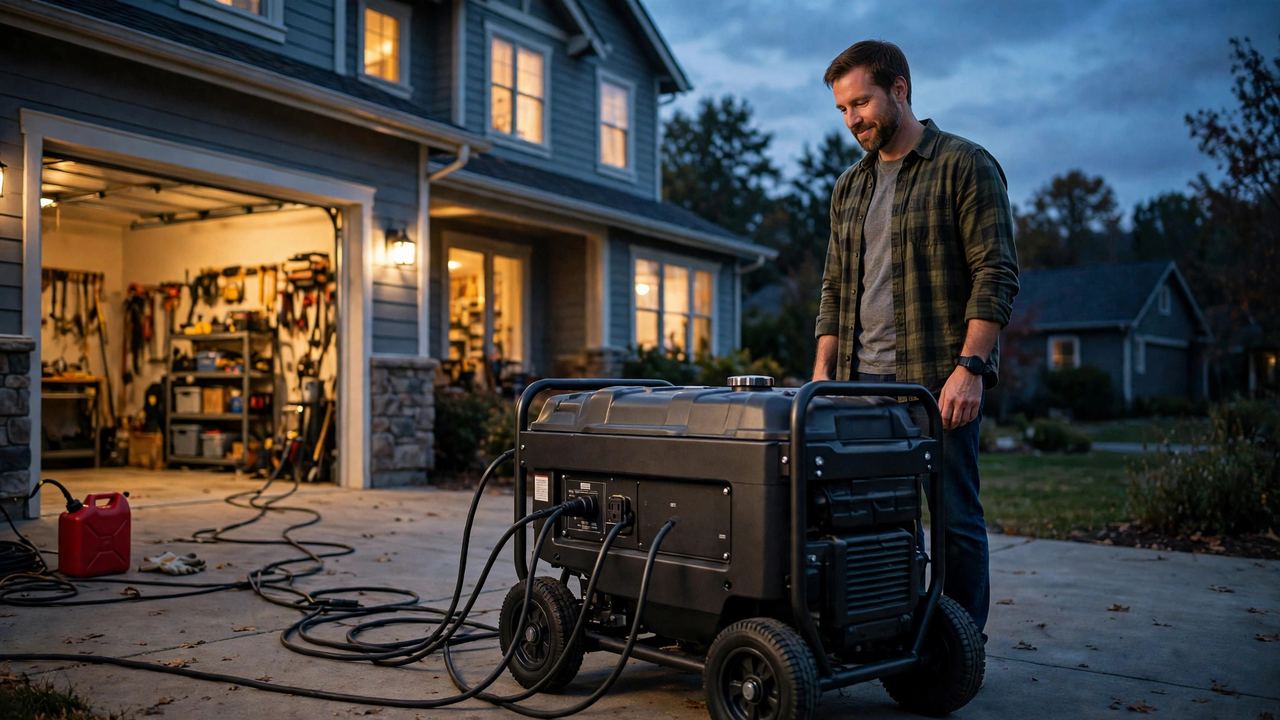
One safety rule frames everything that follows. A fuel-burning generator is an outdoor-only machine. Never run one indoors, in a garage, in a shed, or on a porch close to windows and vents, even with doors open. Carbon monoxide is colorless and odorless, it builds up fast, and every model below carries a CO sensor or CO shutdown system for exactly that reason. Place the generator outside, well away from the house, with the exhaust pointed away from doors, windows, and vents, and let it cool before refueling. If you take nothing else from this guide, take that.
Quick verdict
For most homes, the Westinghouse WGen11500TFc is the strongest all-round pick: the maker lists the highest running output in this group on gasoline, a long gasoline runtime, a transfer-switch-ready 50-amp outlet, and cleaner power than a typical open-frame unit. The Champion Power Equipment 201423 is the pick for quieter, cleaner inverter power, and the Pulsar PGD105TiSCO is the other inverter option, with the lowest listed noise level here. The Westinghouse WGen10500TFc and WGen9500TFc step the output and size down in stages for smaller load lists, and the DuroMax XP13000HXT is the heavy open-frame alternative with a wide outlet panel and a long warranty. None of these machines should be bought on headline watts alone: size yours from the load worksheet in the buying guide, then check the running watts on the fuel you actually plan to use, because every tri-fuel model makes less power on natural gas than on gasoline.
14-50R 50A, L14-30R, GFCI household outlets, 12V DC
CO Shield auto shutoff
All figures above are as the maker lists them for each model. Running watts fall on propane and fall further on natural gas for every model in the table, which is normal for tri-fuel engines and is the single most overlooked number in generator shopping.
How we selected
We started with the fuel definition. A pick had to run on all three fuels — gasoline, propane (LPG), and natural gas — from the factory, with the maker’s own fuel selector and hoses, not a third-party conversion kit. Dual-fuel models that cannot run on natural gas were left out, however good their gasoline numbers look.
Next, each model had to be verified on opened pages: the maker’s product page or manual for wattage by fuel, runtime, tank size, outlets, and CO protection, and its Amazon listing for the exact model, where the listing had to show a live offer for a new unit. Models whose listings showed no live offer were excluded and replaced, even when the model itself is well known. That gate removed at least one popular tri-fuel model from this list.
We then checked output against realistic home loads rather than marketing totals. A useful emergency generator for a house needs 120/240V output and a 30-amp or 50-amp outlet that can feed a transfer switch or an interlock kit installed by an electrician, because that is how a portable generator safely powers hard-wired loads such as a furnace blower, a well pump, or a sump pump. Every pick here has that. Finally, we required a CO sensor or CO shutdown system on every model, an electric or remote start option for cold-weather starting, and published noise and weight figures so you can plan placement and handling honestly.
The maker lists the WGen11500TFc at 14,500 starting watts and 11,500 running watts on gasoline, 10,500 running watts on propane, and 9,500 running watts on natural gas, from a 550cc 4-stroke OHV engine with a cast iron sleeve. That natural gas figure matters: many homes will run this machine on a gas line for days, and 9,500 running watts is still enough for a carefully chosen load list, as the worksheet below shows. The maker lists up to 19 hours of runtime on the 9.5-gallon gasoline tank, a fuel gauge, automatic low oil shutdown, and GFCI outlets.
Two details lift it above a basic open-frame unit. The maker lists total harmonic distortion at less than 5%, which is unusually clean for a conventional generator and is why Westinghouse describes it as suitable for sensitive electronics such as computers, phones, and TVs. And the panel pairs a transfer-switch-ready L14-30R 30-amp outlet with a larger 14-50R 50-amp outlet, so an electrician can connect it to a home’s circuits at either capacity. Push-button electric start and a remote start key fob are included, the VFT data center displays voltage, frequency, and lifetime hours, and a CO sensor shuts the unit down if carbon monoxide reaches dangerous levels. The maker lists the weight at 230 pounds, so plan on its wheel kit, handle, and lift bracket rather than carrying it anywhere.
Buy it if: your load list is large — a well pump, a furnace or air handler, refrigeration, and lighting together — and you want the most running watts on natural gas in this group without stepping outside the budget.
Skip it if: you need genuinely quiet operation near neighbors, or you cannot store and move a 230-pound machine; the inverter picks below are easier to live with on both counts.
The WGen10500TFc is the step-down sibling: the maker lists 13,500 starting watts and 10,500 running watts on gasoline, 9,500 running watts on propane, and 8,500 running watts on natural gas, from a 500cc 4-stroke OHV engine with a cast iron sleeve. The maker lists up to 19 hours of runtime on the same 9.5-gallon tank size as its bigger sibling, along with a fuel gauge and automatic low oil shutdown.
The connection story is the same, which is the point: a transfer-switch and interlock ready L14-30R 30-amp outlet plus a 14-50R 50-amp outlet, GFCI household outlets, push-button electric start with a remote key fob, and a VFT data center showing voltage, frequency, and lifetime hours. A CO sensor provides automatic shutdown protection. At a maker-listed 230 pounds it is no lighter than the model above, so the saving here is in output and purchase cost, not in handling. For a home whose worksheet totals land in the 7,000 to 8,500 running watt range on the fuel they will actually use, this model covers the list without paying for headroom that will never be drawn.
Buy it if: your calculated load list fits comfortably under its natural gas or propane running watts and you want the same 50-amp transfer-switch connection and remote start as the flagship.
Skip it if: your worksheet total is close to its running limit on natural gas; motors draw their surge at the worst moments, and the WGen11500TFc’s extra headroom is the safer buy.
The smallest Westinghouse here still covers a serious essentials list. The maker lists 12,500 peak and 9,500 running watts on gasoline, 11,200 peak and 8,500 running watts on propane, and 9,500 peak and 7,500 running watts on natural gas, from a 457cc OHV 4-stroke engine. The maker lists up to 12 hours of runtime at 25% load and 8 hours at 50% load on the 6.6-gallon tank, and 7 hours at 50% load on propane.
The panel, as the maker lists it, carries two duplex 120V 5-20R GFCI household receptacles, a transfer-switch-ready 120/240V L14-30R, and a 120/240V 14-50R, all with rubber outlet covers, plus ST switch readiness. Starting is electric, remote, or recoil, the choke is automatic, and safety equipment includes automatic low oil shutdown and a carbon monoxide sensor with shutdown. The maker lists noise at 74 dBA, weight at 215 pounds, and a digital readout display. This is the right size for a home that heats with gas, needs the furnace blower, refrigeration, a sump pump, lights, and device charging through an outage, and does not need to start a large central air conditioner.
Buy it if: your essentials list is honest and moderate, your heat is gas-fired so the blower is the big motor load, and you want tri-fuel flexibility in the smallest, simplest package here.
Skip it if: a well pump and a large air conditioner both have to start on the same fuel with reduced output; the surge math gets tight, and a bigger model is the honest answer.
DuroMax lists the XP13000HXT at 13,000 starting watts and 10,500 running watts on gasoline, 12,000 starting and 9,500 running watts on propane, and 10,000 starting and 8,500 running watts on natural gas, from a 500cc OHV engine with a cast iron sleeve and copper windings. The maker lists an 8.3-gallon tank with 8.5 hours of runtime at 50% load on gasoline, and 6.5 hours at 50% load on a 40-pound propane tank, and recommends a propane tank of at least 40 pounds for this model.
The panel is the widest here, as the maker lists it: four 120V 20A GFCI household outlets, a 120V 30A L5-30R, a 120/240V 30A L14-30R, and a 120/240V 50A 14-50R, with a digital command center showing voltage, frequency, fuel level, and lifetime hours. Starting is push-button electric or remote, with recoil backup. DuroMax’s CO Alert technology shuts the generator down if carbon monoxide reaches unsafe levels. The maker lists noise at 74 dBA and weight at 240 pounds, the heaviest in this group, and backs the unit with a 5-year warranty as listed. It is an open-frame, conventional-output machine, so sensitive electronics are better run through the transfer switch panel circuits with care, or left to one of the inverter picks.
Buy it if: you want a long warranty, a four-outlet GFCI panel for running tools and appliances directly, and strong output on all three fuels from a heavy-duty open frame.
Skip it if: weight and noise are constraints, or you plan to power sensitive electronics directly from the generator rather than through house circuits.
The Pulsar is one of two inverter models in this list, and the maker lists it at 10,500 peak and 8,500 running watts on gasoline, 9,500 peak and 8,000 running watts on propane, and 8,400 peak and 6,800 running watts on natural gas, from a 458cc engine. Inverter output is the headline: Pulsar describes the unit as safe for sensitive electronics, which makes it the natural choice when computers, networking gear, and modern appliances will run directly from the generator. The maker lists a 6.9-gallon tank with up to 9 hours of runtime at half load, and a noise level of 62 dB, the lowest listed in this group.
As the maker lists it, the panel carries four GFCI 120V outlets, a 120/240V 30-amp outlet, a 120/240V 50-amp outlet, and USB ports, with a digital display, low idle control, low oil shutoff, and outlet covers. CO Sentry carbon monoxide detection is built in. Remote start with the included fob, plus electric start, suits a machine that must live outside in winter weather: you can start it from indoors rather than standing over it in a storm, while the generator itself stays outdoors where it belongs. The maker lists weight at 247 pounds and CARB compliance, and includes the propane and natural gas hoses with regulator in the box.
Buy it if: quiet running and clean inverter power for electronics matter as much as raw watts, and your load list fits its natural gas running figure with room to spare.
Skip it if: your worksheet needs more than its reduced natural gas output; inverter refinement does not create watts, and the bigger open-frame models carry larger loads.
Champion lists the 201423 at 11,000 starting watts on all three fuels, with running watts of 9,000 on gasoline, 8,100 on propane, and 7,290 on natural gas, from a 459cc engine. Holding the same starting figure across fuels is useful for motor loads: a pump or blower that starts on gasoline will also start on natural gas, even though continuous capacity is lower. As an inverter, the maker lists less than 3% total harmonic distortion, so the output is suitable for sensitive electronics. The maker lists up to 15 hours of runtime on the 6.08-gallon gasoline tank, 8 hours on a 20-pound propane tank, and a noise level of 64 dBA from 23 feet.
Champion’s CO Shield technology automatically shuts the engine off if carbon monoxide reaches unsafe levels, and the unit meets the ANSI/PGMA G300-2023 requirements as the maker lists them. The wireless remote starts and stops the generator from up to 80 feet away as listed, alongside electric and recoil starting. The panel, as listed, includes four GFCI 120V 20A household outlets, a 120/240V 30A L14-30R, a 120/240V 50A 14-50R, and a 12V DC automotive-style outlet, with an Intelligauge display for volts, frequency, and runtime. The box includes a 25-foot natural gas hose kit and a propane hose as listed. The maker lists weight at 212.3 pounds and a 3-year limited warranty.
Buy it if: you want inverter-clean power, remote start, and the longest listed gasoline runtime in this group, and your continuous loads fit its running watts on your chosen fuel.
Skip it if: you need a 50-amp connection to carry a very large continuous load on natural gas; its 7,290 running watts on that fuel is the ceiling, whatever the starting figure says.
Buying guide
Calculate your real loads first
Generator sizing fails in one direction: people add up running watts and forget starting watts. Motors — refrigerator compressors, furnace blowers, well pumps, sump pumps, air conditioners — draw a surge for a few seconds every time they start, and that surge, not the running figure, is what trips breakers and stalls generators. Work through your own list like this, checking each appliance’s nameplate or manual for its actual figures, because individual models vary widely.
List everything that must run at the same time: for example a refrigerator, a freezer, a gas furnace blower, a sump pump, a few lights, a router, and phone charging.
Write down the running watts of each from its nameplate. Typical examples, to be replaced with your own nameplate figures: a refrigerator might draw around 150 to 200 running watts, a furnace blower several hundred watts, a router and lights very little.
For each motor load, note its starting watts too. A refrigerator that runs at 200 watts may need several times that to start; a well pump or sump pump can need two to three times its running watts at startup; a central air conditioner’s starting draw is the largest single number in most homes and must come from its nameplate and its LRA rating, not from a guess.
Add all the running watts that can run together. Then add the single largest starting surge on top, because only one motor usually starts at the worst moment — but assume it starts while everything else is already running.
Compare that total against the generator’s running watts on the fuel you will actually use, and its starting watts for the surge. Keep a margin: running a generator at its absolute ceiling for hours is loud, thirsty, and hard on the engine.
Worked example, using round illustrative figures you should replace with your nameplates: refrigerator 200 running and 800 starting, freezer 150 and 600, furnace blower 800 and 1,600, sump pump 800 and 2,000, lights and router 150. Running total with everything on: about 2,100 watts. Worst moment: the sump pump starts while the rest run, adding its surge above its running draw — roughly 2,100 plus 1,200 extra, about 3,300 watts. Even the smallest pick here covers that easily on any fuel. Now add a 240V well pump at 1,500 running and 4,500 starting, and the worst moment climbs past 7,000 watts: still fine on gasoline for most picks, but on natural gas the Pulsar’s 6,800 running watts and the Champion’s 7,290 become the binding limits. Add central air conditioning and the honest answer is usually the largest model, load management, or leaving the air conditioner off the list. That is how to read this table: your worksheet decides, not the headline.
Fuel choice is a runtime decision
Gasoline gives the highest output and the simplest refueling, but it stores poorly and you will refuel every tank cycle the maker lists. Propane stores indefinitely and runs clean, but output drops and runtime depends on tank size — note that DuroMax recommends at least a 40-pound tank for the XP13000HXT, and a small barbecue tank empties quickly at half load. Natural gas gives the lowest output of the three but, connected to a home gas line, it removes refueling from the emergency entirely. Have a qualified plumber or gas fitter make the natural gas connection, follow the maker’s stated gas pressure requirements, and never improvise a fuel line.
Connection and placement
Backfeeding a house panel through a dryer outlet is dangerous and illegal in many places; the safe routes are a professionally installed transfer switch or interlock kit fed from the generator’s 30-amp or 50-amp outlet, or extension cords run directly to individual appliances. A 50-amp connection carries more of your panel than a 30-amp one, which is why every pick here includes a 14-50R or pairs both outlets. Outdoors, place the unit on a level surface, well away from the home and any opening, exhaust pointed away and preferably downwind, sheltered from direct rain or snow only in a way that keeps full open-air ventilation — never under a closed cover, in a garage with the door open, or in any enclosure. Keep a working carbon monoxide alarm inside the home as a second layer, and treat any CO shutdown as a warning to reposition the generator, not a nuisance to override.
Inverter or open frame?
The two inverter picks — the Pulsar and the Champion 201423 — list cleaner power and lower noise, at lower running watts per model. The open-frame picks list higher output and simpler, heavier construction. If your loads are mostly motors, heat, and refrigeration fed through a transfer switch, open frame output serves well. If laptops, networking equipment, and modern electronics will plug in directly, the inverter models’ listed distortion figures are the safer match.
FAQ
Can a tri-fuel generator power my whole home?
Only if your calculated load list says so. No portable generator should be described as powering a whole home unless the maker states it for that model and your worksheet — running watts plus the largest starting surge, on the fuel you will use — fits under its ratings. Most homes run a selected set of circuits through a transfer switch instead, which is what these machines are built for.
Why does the same generator make fewer watts on natural gas?
Natural gas carries less energy per unit than gasoline or propane, so a tri-fuel engine produces less power on it. Every model in this guide lists separate running and starting watts for each fuel; size your purchase from the figures for the fuel you will actually burn during an outage.
Can I run a generator in my garage with the door open?
No. Never run a fuel-burning generator indoors or in any enclosed or partly enclosed space, including a garage with the door open, a carport, or a porch against the house. Run it outdoors only, well away from windows, doors, and vents, with the exhaust pointed away from the building. The CO sensors on these models are a last line of protection, not permission to run one closer.
What size propane tank do I need?
Bigger than a barbecue tank for any long outage. Runtimes listed on a 20-pound tank are short at half load, and DuroMax lists a 40-pound minimum recommendation for the XP13000HXT. Check the maker’s listed runtime for your model and tank size, and treat natural gas as the no-refuel option where a home gas line exists.
Do I need an electrician to connect a generator to my home?
For a transfer switch or interlock kit, yes — that work belongs to a licensed electrician, and the natural gas connection belongs to a qualified gas fitter. Running individual appliances on properly rated extension cords from the generator’s outlets does not require panel work, but never connect a generator to house wiring any other way.
How do I store a generator between outages?
Follow the maker’s manual: typically that means stabilizing or draining gasoline for long storage, keeping the battery charged where one is fitted, running the unit periodically, and storing it dry and accessible. Propane and natural gas models avoid stale gasoline entirely, which is one reason tri-fuel owners often keep propane as their standby fuel.
Conclusion
Size from your own worksheet, buy for the fuel you will actually use, and place the machine outdoors without exception. On that basis: the Westinghouse WGen11500TFc carries the largest load lists, the WGen10500TFc and WGen9500TFc scale the same formula down for smaller homes, the DuroMax XP13000HXT adds panel width and warranty length, and the Pulsar PGD105TiSCO and Champion 201423 trade some output for quiet, clean inverter power. Any of the six will serve a home whose loads were calculated honestly — and none of them will rescue a load list that was never calculated at all.
M
Modern Line Home Editorial Team
We compare specs, materials and verified owner reviews before a product earns a spot. Rankings are never paid.
Affiliate disclosure. As an Amazon Associate we earn from qualifying purchases at no extra cost to you. Prices accurate as of the date shown.
House cold even with the heat on? Walk this ordered checklist: thermostat and filter first, then drafts, insulation, leaky ducts and a failing heating system.
Windows fogging up in winter? Check where the fog sits: on the room side it is indoor humidity, outside it is harmless, and between panes the seal has failed.
Store the main firewood pile about 30 feet from your house, off the ground and covered only on top. Compare racks, woodsheds, garages and indoor spots safely.
Place a portable generator outdoors only, at least 20 feet from windows, doors and vents, exhaust pointed away. Exact distances, setup steps and CO rules here.
Keep houseplants in the right winter spot: match window direction to plant type, stay clear of radiators and cold glass, and fix dry air and low light at home.
Mice enter through pencil-width gaps at foundations, pipes, vents, doors and the roofline. Walk this room-by-room winter checklist to find and seal each one.
A winter outage timeline: what to do in the first hour, first night and multi-day outage, with food safety times, pipe protection, heat and CO safety steps.
Size a space heater by room area: 10 watts per square foot at 8-foot ceilings, adjusted for insulation and ceiling height, with full wattage and BTU tables.
Start dripping at about 20 degrees, sooner for exposed pipes. Set a pencil-lead stream, drip the right faucets on both lines, and know when to stop safely.
A fridge needs 800-1,200 starting watts, not just 150-400 running watts. Use the tables to total your fridge plus freezer, lights, furnace fan and more today.












Write Your Review
No reviews yet. Be the first to share your experience!