We independently review everything we recommend. When you buy through our links, we may earn a commission. As an Amazon Associate we earn from qualifying purchases.
Best Insulated Food Transport Bags for Large Potlucks
Carry two casseroles or a full family spread in one trip with insulated transport bags built for large potlucks, from double deckers to roomy XXXL totes today.
Carry two casseroles or a full family spread in one trip with insulated transport bags built for large potlucks, from double deckers to roomy XXXL totes today.
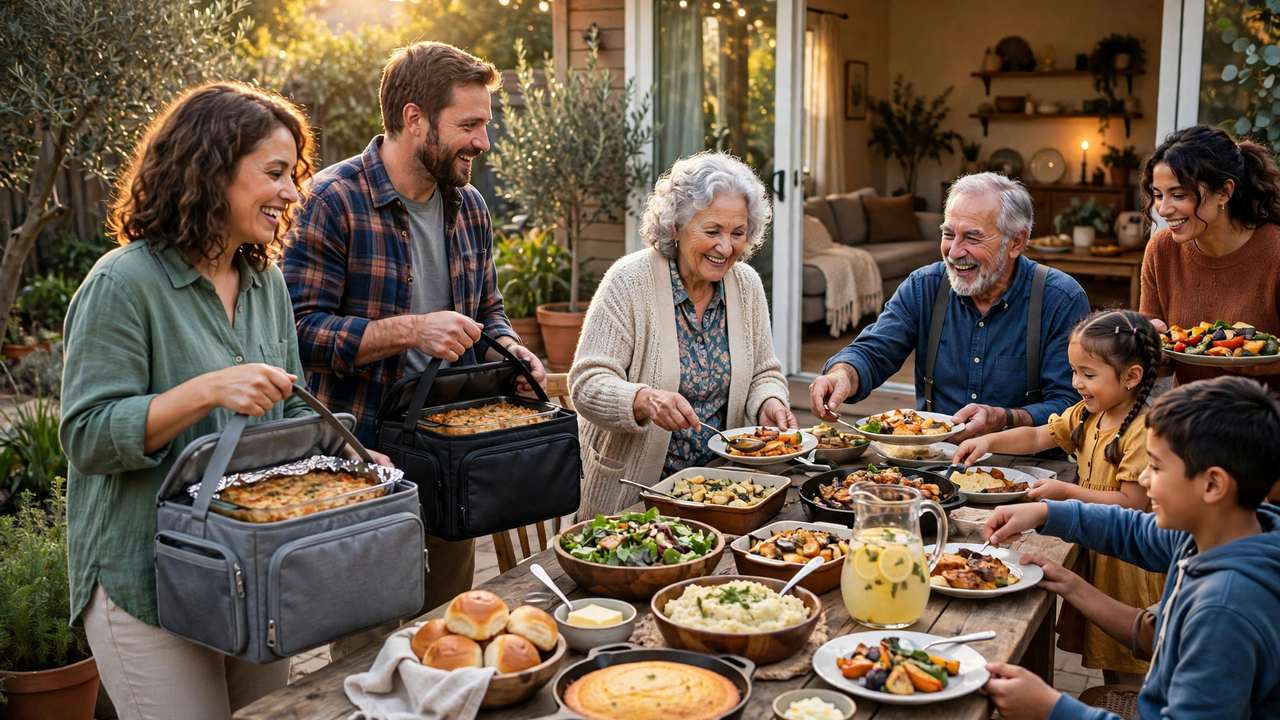
When your family potluck assignment is not one small side dish but a full lasagna, a tray of roasted vegetables, and something cold for dessert, an ordinary lunch tote stops being useful very quickly. Dishes slide, lids lift, hot food cools on the drive, and cold food warms up next to it in the same cramped bag. That is exactly the problem the best insulated food transport bags for large family potlucks are built to solve. The right carrier keeps each dish level, keeps hot and cold food in separate spaces, and lets one person carry what would otherwise take three trips to the car and a second pair of hands at the door.
This guide focuses on two formats that suit large family gatherings best. The first is the double decker casserole carrier, a structured tote sized around the familiar rectangular baking dish, with two stacked insulated compartments so a hot main and a cold side never share air. The second is the extra large insulated delivery style bag, a much bigger soft tote that swallows multiple containers, sheet trays, and pizza boxes at once. Both formats appear below, because a family bringing two signature casseroles needs something very different from a family feeding a reunion with trays of food loaded straight from the oven.
Every pick here is a real product sold new, checked on its product page for size, materials, and compartment layout. Details are phrased the way the maker lists them, so you can match the numbers against your own dishes before you order. Measure your largest pan, including its handles and lid, then read on for the carriers that can actually take it.
Quick verdict
If you bring two baking dishes to most gatherings, start with a double decker. The MIER Insulated Expandable Casserole Carrier is the most flexible of the group because its mid zipper lets it travel as a single carrier or expand into two full compartments. The Lifewit and LUNCIA double deckers follow the same proven layout with thick foam and foil linings, and the Vuudh quilted carrier adds a wet and dry separation pocket that frequent hosts will appreciate. If your potluck load is bigger than two dishes, skip the casserole format entirely and go straight to the Bodaon 2-Pack or the Himal Outdoors 2-Pack, both built around a far larger rectangular footprint that takes multiple trays, boxes, and containers in a single trip, with two bags in the box so hot and cold loads can travel apart.
The products in this guide
MIER Insulated Expandable Casserole Carrier
Two large compartments, the upper one measuring 16 x 11 x 3.2 inches and the lower one 16 x 11 x 4.2 inches, joined by an expandable mid zipper
Selection started with the potluck itself rather than with a brand list. A large family gathering usually means at least two full dishes, often one hot and one cold, carried by one person across a parking lot, up steps, and through a crowded kitchen. Any carrier that could not keep two dishes level and separated, or that could not take a genuinely large load in one trip, was left out no matter how appealing it looked as a general lunch bag.
Size came first. For the casserole carriers, the interior had to accept the standard rectangular baking dish that most family recipes are written for, with enough height in each compartment for a lid. For the delivery style bags, the footprint had to be wide enough for trays and boxes to sit flat rather than tilted, because a tilted tray leaks no matter how good the insulation is. Every dimension quoted in this guide is the dimension the maker lists for that exact model.
Insulation construction came second. We looked for a stated foam thickness, a foil or similar reflective lining, and seams described as heat-welded or leak-proof, because gravy and sauce find weak seams faster than any other failure. Exterior fabric mattered too: a water-resistant or water-repellent shell shrugs off rain on the walk from the car and wipes clean after the inevitable spill.
Carrying comfort and small storage details came third. Two padded handles that meet in the hand, a wide zippered opening that a lidded dish can pass through without tipping, and an exterior pocket for serving spoons and napkins all sound minor until you are the person carrying the food. Finally, each product had to be available new from a current listing with its full details shown, so the bag you read about here is the bag that arrives.
The MIER carrier solves the most common potluck dilemma in this group: sometimes you bring one dish and sometimes you bring two, and you do not want to own two different carriers. The maker lists two large compartments, the upper one measuring 16 x 11 x 3.2 inches and the lower one 16 x 11 x 4.2 inches, joined by an expandable mid zipper. Travel with a single dish and the carrier stays compact; add a second dish and the top section opens up to take it, so the same bag handles a weeknight drop-off and a full Thanksgiving contribution with equal ease.
For insulation, the maker lists a food-grade aluminum foil lining paired with 8mm foam, and suggests the arrangement this guide recommends most often: a hot item in one layer and a cold item in the other, each holding its own temperature because the layers are fully separate. The exterior is a durable polyester, the zippers are the maker own design and are described as smoother and more resistant to snagging than standard zippers, and the interior wipes clean with a damp cloth, which matters after a saucy lasagna ride. A large exterior zippered pocket takes cutlery, napkins, or barbecue tongs, and two padded handles make a two-dish load comfortable to carry one-handed while you open doors with the other.
The maker lists the overall size at 16 x 11 x 7.5 inches and the capacity at 20 liters, with hand washing as the care instruction. Because the compartments are sized around the standard baking dish, measure any oversized or handled pan first; a dish that fits the footprint can still strain the compartment height once its lid is on.
Buy it if: you want one carrier that adapts, travelling flat and compact for a single dish and expanding into a true double decker when the family potluck asks for two.
Skip it if: your usual load is three or more trays or a stack of pizza boxes, because even expanded, a dish-sized carrier cannot match the delivery totes further down this list.
Lifewit takes the double decker layout and stretches it slightly. The maker lists external dimensions of 15.7 x 11.4 x 8.3 inches and compatibility with casseroles and baking dishes ranging from 9 x 13 inches up to 11 x 15 inches, which gives this carrier a little more forgiveness for the larger roasting and lasagna pans that appear at holiday meals. Two full compartments mean the hot dish rides below and the cold dish rides above, or the other way round, with no shared space between them.
The insulation build is clearly stated: the maker lists interior layers of food-grade aluminum foil with 7mm EPE foam, and describes the foil as hot-pressed and leak-proof, so a spill stays inside the compartment and wipes out afterwards instead of soaking through to the car seat. The maker lists temperature keeping of up to six hours for food kept hot, cold, or fresh, which comfortably covers the realistic potluck window of cooking, driving, and waiting for everyone to sit down. Outside, the maker lists 600D rip-stop Oxford fabric with a waterproof coating, a shell that shrugs off both weather and kitchen splashes.
Practical details are well covered. Wide openings and zipper closures make loading a lidded dish straightforward, two carry handles keep the load balanced, and a large exterior zipper pocket holds utensils where you can reach them without opening either insulated compartment. The maker lists capacity at 24.36 liters and weight at 1.3 pounds, light enough that the food, not the bag, is most of what you carry.
Buy it if: your signature dishes sometimes go in a pan larger than the standard size, and you want a double decker with stated room for it plus a leak-proof lining.
Skip it if: you need to move food in bulk containers rather than baking dishes, because the compartment shape is designed around pans, not tubs and boxes.
The Vuudh carrier is the one that looks at home on the table as well as in the car. The maker lists a classic quilted lattice design in 420D quilted Oxford cloth, over two padded layers built around an 8mm EPE insulation foam core, with a lining the maker describes as eco-friendly and leak-proof PEVA. The shell is water-resistant and dirt-resistant, and the maker lists spot cleaning with a wet cloth, cool water, and mild soap for both inside and out.
Function matches the finish. Two insulated sections let you pack hot food separated from cold food so dishes are not piled up and squeezed, and the upper compartment is expandable for a taller dish. The maker lists externally measured dimensions of 15.7 x 11.8 x 8.7 inches, capacity of 26.4 liters, the largest of the casserole carriers here, and compatibility with 9 x 13 inch baking dishes. Heat-welded seams are listed as guarding against spills and leaks, which is the detail to look for if your potluck dishes tend to be saucy.
The thoughtful extra is the wet and dry separation design. Inside the flap of the top zipper compartment, the maker lists a transparent PVC pocket for a wet towel for wiping hands and rims as you serve, while the top compartment itself takes plates, knives, and forks. Two padded wrapped handles and smooth double zippers round out a carrier clearly designed by someone who has actually served from one at a crowded family table.
Buy it if: presentation matters to you and you want the roomiest double decker here, with a serving-friendly top compartment for plates and cutlery.
Skip it if: you prefer a plain utility look and maximum scuff resistance over a quilted finish, or your loads are mostly loose containers rather than dishes.
LUNCIA builds its double decker around generous dish fit and straightforward, durable materials. The maker lists externally measured dimensions of 15.7 x 11.4 x 8.3 inches and a fit for 9 x 13 inch dishes up to 11 x 15 inch casserole and baking dishes, matching the most flexible sizing in this group. For a large family, that extra length is the difference between your biggest roasting pan travelling flat and zipped, or travelling on a lap in the back seat.
Inside, the maker lists a food-grade aluminum foil lining padded with 8mm EPE foam for thermal resistance, the joint thickest foam specification among these casserole carriers alongside the MIER and Vuudh models. Outside, the maker lists 600D Oxford fabric that is water-resistant and dirt-proof, intended for long lasting durability and easy cleaning. The listed capacity is 24.36 liters across two compartments, and the listed weight is 1.4 pounds.
Loading is designed to be uneventful, which is a compliment for food transport. A wide opening and zipper closure let a lidded dish go in level, two carry handles are equipped with padded velcro wrap so they join into one comfortable grip, and a large exterior zipper pocket holds knives, forks, spoons, condiments, and napkins. If your potluck routine is simply two big dishes, carried often, by whoever is free, this is the no-fuss version of the format.
Buy it if: you want a durable, easy-clean double decker with room for oversized dishes and a padded joined handle for heavier loads.
Skip it if: you want an expandable or convertible layout, because this carrier keeps a fixed two-compartment shape whether you fill one deck or both.
When the family potluck load outgrows baking dishes, this is where to land. The Bodaon set includes two insulated bags, and the maker lists each at 23 x 15 x 14 inches with a 79 liter capacity, a single large compartment that takes trays, stacked containers, and pizza boxes that no casserole carrier could close around. Having two bags is the real feature for family cooking: the hot trays go in one, the cold salads and desserts go in the other, and the two never trade temperatures on the drive.
The maker lists the shell as non-woven fabric with an insulated lining, a two-way zipper, and two pairs of hand straps, and describes the bag as easy to clean with a good insulation effect. Just as useful at home, the maker lists a folded size of only 15.5 x 12 x 1.7 inches and a very light weight, so both bags store in a drawer or hang in a pantry between gatherings instead of claiming a shelf of their own. The set arrives as one black bag and one red bag, a small detail that helps when you are telling a helper which bag holds what.
Because the compartment is unstructured, pack it deliberately. Flat trays and boxes sit best on the bottom, lighter containers go on top, and anything in a baking dish should keep its lid secured, since there is no dish-sized pocket holding it in place. Used that way, one of these bags can move the main course for a reunion while the second handles everything else, all in a single trip from kitchen to car.
Buy it if: your family cooks in volume, with multiple trays and boxes per gathering, and you want two large bags so hot and cold food travel separately.
Skip it if: you mainly carry one or two lidded baking dishes, because a structured double decker will hold them more securely than a big open compartment.
Himal Outdoors builds the same extra large idea as the Bodaon set but with a heavier duty shell. The maker lists each bag at 23 x 15 x 14 inches, made of 600D water repellent Oxford with a leak-proof liner, and a 79 liter capacity per bag. That Oxford exterior is the reason to choose this set for frequent or rougher use: holiday loading in the rain, bags riding in a crowded trunk, and repeated trips through the season all punish a shell, and this one is specified for it.
The maker lists a leak-proof and insulated liner intended to keep food hot or cold for more than several hours, a two-way zipper, and one pair of hand straps. A transparent pocket on the outside lets you see labels, dates, or notes without opening the bag, a small feature that earns its keep when two identical black bags are riding side by side and only one of them holds the gravy. The maker also lists the bag as collapsible for storage, folding away when the gathering is over.
As with any large soft tote, how you pack decides how well it works. Keep heavy trays flat at the base, fill gaps with napkins or a folded towel so containers cannot slide, and zip fully so the insulated liner can do its job. For a family that hosts as often as it visits, a pair of these also works in reverse, receiving food from relatives and sending leftovers home safely at the end of the night.
Buy it if: you want the two-bag, extra large format in a tougher water repellent Oxford shell, with a label pocket to tell loaded bags apart at a glance.
Skip it if: your potluck contribution is a single treasured casserole, because a dish-sized carrier will cradle it better than a cavernous tote.
Buying guide
Start with your largest dish, not the bag. Measure the pan you actually use for family recipes, including handles and the height of its lid, and compare those numbers with the compartment dimensions the maker lists. A carrier can list a familiar dish size and still be tight for a deep dish with a domed lid. For delivery style totes, measure your widest tray or box instead and confirm it can sit flat; flat is what keeps sauces where they belong.
Choose the format by load, not by habit. Two baking dishes or fewer points to a double decker, where each dish gets its own insulated, level compartment. Three or more items, mixed container shapes, or pizza boxes point to an extra large tote, ideally a two-bag set so hot and cold loads stay apart. Many large families eventually keep one of each: the double decker for the signature dishes, the tote for everything else.
Read the insulation stack closely. Look for a stated foam thickness, a foil or PEVA lining, and heat-welded or leak-proof seams. Foam thickness is a useful comparison because it is a physical specification rather than a promise. Remember that no soft bag holds temperature forever; preheat or pre-chill the dish itself, load the carrier last before you leave, and keep the car ride as short as the day allows.
Check the carry, the opening, and the clean-up. Padded handles that join together matter under a two-dish load. A wide zippered opening matters when a hot, lidded dish has to go in level. A lining that wipes clean matters the day after. Exterior pockets for serving utensils sound like a bonus until you arrive with a perfect casserole and nothing to serve it with, so count them as a genuine feature for potluck use.
Plan storage before the season starts. Expandable and collapsible designs earn their space in a small kitchen because they fold or zip down between gatherings. If your carrier will live in a pantry or car trunk through the holiday season, confirm the folded size the maker lists suits the spot you have in mind, and store it clean and fully dry with the zipper partly open.
FAQ
How long will food stay hot or cold in an insulated transport bag?
It depends on the dish, the starting temperature, and how often the bag is opened. One maker in this guide lists temperature keeping of up to six hours, and another lists keeping food hot or cold for more than several hours. Treat those as best case figures for a full, closed bag. For a typical family drive and serving window, load hot food straight from the oven, load cold food straight from the refrigerator, and keep the carrier closed until serving.
Can I carry a hot dish and a cold dish in the same carrier?
Yes, if the carrier has two fully separate insulated compartments, as the double deckers here do. The makers of these models describe exactly that arrangement, with a hot item in one layer and a cold item in the other. With single compartment totes, use two separate bags instead, which is why the extra large options in this guide come as two-bag sets.
What size carrier do I need for a standard casserole dish?
Look for a compartment that accepts the standard rectangular baking dish size, and check the listed interior dimensions against your pan including its handles and lid. Several carriers here also list a fit for larger dishes up to 11 x 15 inches, which is worth choosing if your holiday pans run big. When in doubt, the compartment measurements the maker lists are the numbers to trust.
How do I stop dishes sliding or leaking during the drive?
Keep every dish level, lidded, and snug. In a double decker, one dish per compartment does most of the work for you. In a large tote, set trays flat on the bottom, place lighter items on top, and fill empty space with a folded towel so nothing can shift under braking. Leak-proof and heat-welded linings, which several makers list here, contain the small spills that happen anyway.
Are these carriers suitable for holiday meals like Thanksgiving?
Yes. Thanksgiving is the heaviest potluck day of the year for most families, and it is the use case these formats are built around: a hot casserole in one deck, a cold side or dessert in the other, or full trays moved in an extra large tote. The makers of several picks here name Thanksgiving dinners and holiday gatherings among their intended uses. Order and measure early in the season so the first trip is not the test run.
How should I clean and store an insulated food transport bag?
Follow the care the maker lists for your model. Several picks here list hand washing or spot cleaning the interior and exterior with a wet cloth, cool water, and mild soap. Wipe the lining as soon as you get home, let the bag dry fully open, and then store it folded or collapsed in a dry spot so it is ready for the next gathering.
Conclusion
A large family potluck is a logistics problem disguised as a meal, and the right insulated transport bag quietly solves it. Choose a double decker such as the MIER, Lifewit, Vuudh, or LUNCIA when your contribution is one or two baking dishes that deserve their own level, insulated space. Choose the Bodaon or Himal Outdoors two-bag sets when the load becomes trays, boxes, and containers for a crowd. Measure your biggest dish, match it to the dimensions the maker lists, and the food you worked on all morning will arrive at the family table looking and tasting the way it left your kitchen.
M
Modern Line Home Editorial Team
We compare specs, materials and verified owner reviews before a product earns a spot. Rankings are never paid.
Affiliate disclosure. As an Amazon Associate we earn from qualifying purchases at no extra cost to you. Prices accurate as of the date shown.
House cold even with the heat on? Walk this ordered checklist: thermostat and filter first, then drafts, insulation, leaky ducts and a failing heating system.
Windows fogging up in winter? Check where the fog sits: on the room side it is indoor humidity, outside it is harmless, and between panes the seal has failed.
Store the main firewood pile about 30 feet from your house, off the ground and covered only on top. Compare racks, woodsheds, garages and indoor spots safely.
Place a portable generator outdoors only, at least 20 feet from windows, doors and vents, exhaust pointed away. Exact distances, setup steps and CO rules here.
Keep houseplants in the right winter spot: match window direction to plant type, stay clear of radiators and cold glass, and fix dry air and low light at home.
Mice enter through pencil-width gaps at foundations, pipes, vents, doors and the roofline. Walk this room-by-room winter checklist to find and seal each one.
A winter outage timeline: what to do in the first hour, first night and multi-day outage, with food safety times, pipe protection, heat and CO safety steps.
Size a space heater by room area: 10 watts per square foot at 8-foot ceilings, adjusted for insulation and ceiling height, with full wattage and BTU tables.
Start dripping at about 20 degrees, sooner for exposed pipes. Set a pencil-lead stream, drip the right faucets on both lines, and know when to stop safely.
A fridge needs 800-1,200 starting watts, not just 150-400 running watts. Use the tables to total your fridge plus freezer, lights, furnace fan and more today.











Write Your Review
No reviews yet. Be the first to share your experience!