We independently review everything we recommend. When you buy through our links, we may earn a commission. As an Amazon Associate we earn from qualifying purchases.
Best Infrared Electric Fireplace Heaters for Basements
Compare the best infrared electric fireplace heaters for basements, with quartz stoves, log inserts, coverage, thermostats, timers and safety checks in 2026.
Compare the best infrared electric fireplace heaters for basements, with quartz stoves, log inserts, coverage, thermostats, timers and safety checks in 2026.
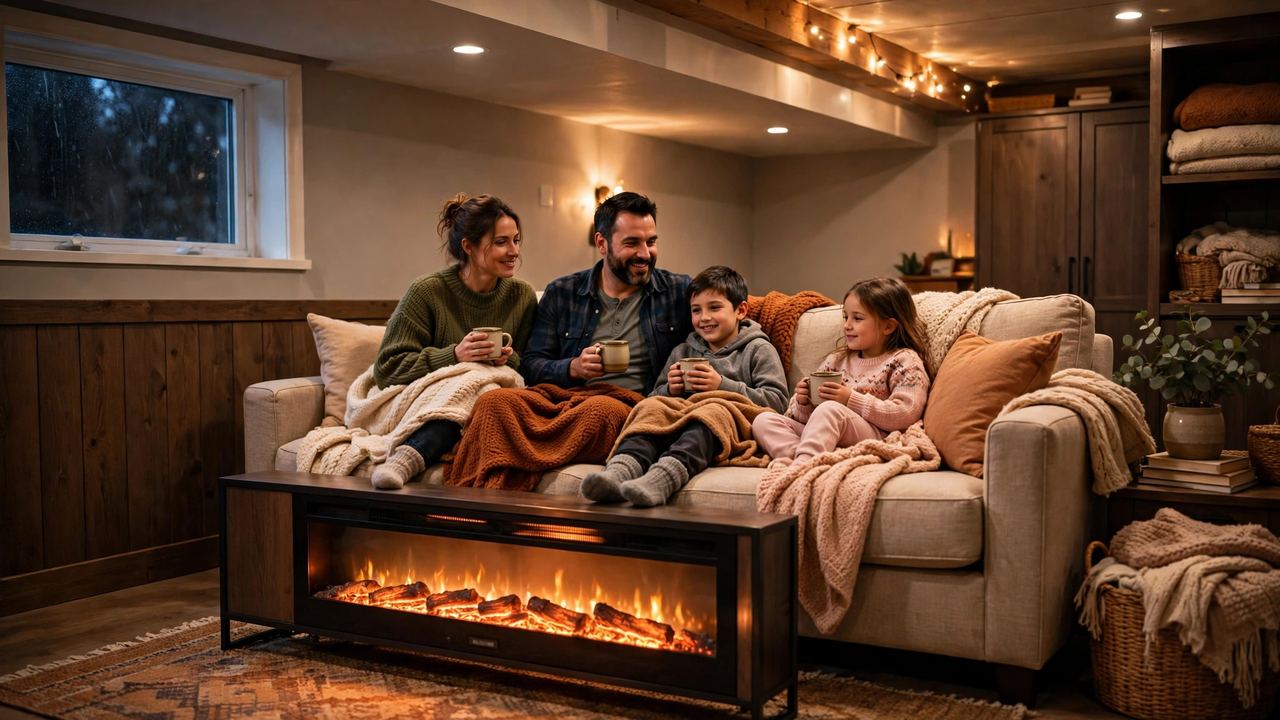
Basements run cold for simple physical reasons. Much of the room sits below grade, surrounded by soil and concrete that hold a steady chill, and warm air from the main heating system rises away from the lowest floor of the house instead of settling into it. The result is a room that can feel several degrees cooler than the rest of the home even when the furnace is working properly, which is a shame, because finished basements often hold the family room, the home theater, the guest space or the office where people actually want to spend time. A fireplace-style heater solves two problems at once: it adds focused supplemental heat exactly where people sit, and it gives a below-grade room a warm visual focal point that concrete walls and small windows rarely provide on their own.
This guide compares the best infrared electric fireplace heaters under $500 for basements that are sold new and verified on opened product pages. Infrared quartz models suit basements particularly well because the maker lists them as warming people and objects directly rather than relying only on blowing heated air toward a cold ceiling, and because every pick here is vent-free, needs no chimney or gas line, and plugs into a standard outlet. The six picks below cover three freestanding stoves, a larger stove with a three-sided flame view, a log insert for an existing basement hearth, and compact models for smaller finished rooms, so you can match the format to the space you actually have.
Quick verdict
For most basements, the Duraflame 3D Infrared Quartz Fireplace Stove Heater DFI-5010-01 is the easiest recommendation: the maker lists the widest coverage figure in this group, a digital thermostat, a remote and a layered 3D flame in a freestanding stove that needs nothing more than its legs attached and an outlet. If your basement already has a fireplace opening, the TURBRO Eternal Flame EF26-PB log heater turns that unused hearth into an infrared heat source without any installation. For smaller finished basements and basement bedrooms, the TURBRO Suburbs TS17Q and the ROVSUN HT-1108 bring the same infrared stove format down to a lighter, more portable size, while the TURBRO Suburbs TS20-SD adds a crackling sound effect and the Electactic S180SD offers the broadest flame color and thermostat range of the group.
The products in this guide
Duraflame 3D Infrared Quartz Fireplace Stove Heater DFI-5010-01
The Duraflame DFI-5010-01 is the pick that fits the widest range of basements, and it earns that position on the strength of the figures the maker
Every product in this guide had to pass the same checks. First, the model had to be a genuine infrared fireplace heater, meaning the maker lists an infrared or infrared quartz heating element behind a flame effect, not a plain fan-forced space heater wearing a fireplace costume. Second, the exact brand, product name and model number had to be verifiable on an opened product page, and the listing had to show the heater sold new with a live offer at the time of checking; models that showed no live new offer were removed and replaced, even when the model itself was well known. Third, the heater had to fit the budget level named in the keyword as a plug-in 120-volt unit, because a basement heater that needs hardwiring, venting or a gas line defeats the purpose of a quick supplemental fix.
Within that verified set, we compared the details that matter most below grade: the coverage figure the maker lists, whether the thermostat is digital or a simple knob, whether a remote and timer are included, how the flame effect is controlled, and which safety features the maker lists, such as overheat protection, tip-over shutoff and cool-to-touch surfaces. Basements also reward portability, because the coldest spot in a finished basement moves with the season and the furniture, so weight and footprint counted too. Coverage figures are the makers’ own ratings for supplemental zone heating, and a cold, poorly insulated basement will always be harder to warm than the room those figures assume, so treat them as a comparison tool rather than a promise.
The Duraflame DFI-5010-01 is the pick that fits the widest range of basements, and it earns that position on the strength of the figures the maker lists: a 1,500-watt infrared quartz heater rated at 5,200 BTU, with supplemental coverage listed for rooms up to 1,000 square feet. That is the largest coverage figure in this guide, which matters in basements because finished below-grade spaces are often one long open room rather than several small ones. Instead of heating the whole zone evenly on day one, think of this stove as the anchor heat source for the seating area, with the infrared element warming the people and furniture in front of it first.
The stove format suits a basement visually as well as thermally. The maker lists a metal body with side viewing windows, a glass door that opens, and a brick-style back panel behind the log set, so the flame reads as a small hearth from more than one angle rather than a flat picture on a box. The patent-pending 3D flame effect is listed with five brightness levels, and the flame can run without heat, which is genuinely useful in a basement media room in summer, when the room is finally comfortable but a movie night still benefits from a fire glow. A digital adjustable thermostat holds a steadier temperature than a simple dial, the included remote means the heat can be adjusted from the sofa without crossing a cold floor, and the maker lists a timer and automatic shutoff among its features.
Setup is part of the appeal for a below-grade room. There is no venting, no flue and no gas work; the stove is freestanding, plugs into a standard outlet, and the main assembly step is attaching the legs. At the weight the maker lists, it is not a unit you will carry around daily, but two people can reposition it when the basement layout changes. In a basement with a dedicated circuit near the seating area, this is the most complete package here: the strongest listed coverage, the most developed flame effect, and controls that do not require you to kneel beside the unit every time the room drifts cold.
Buy it if: your finished basement is one large open space, you want the highest coverage figure the maker lists in this group, and you value a digital thermostat and remote.
Skip it if: your basement room is small and already warms easily, or you need a heater light enough to carry between rooms every day.
Many finished basements inherit a wood-burning fireplace that nobody uses, because hauling logs below grade, cleaning ash out of a hearth and worrying about a flue in an older house is more work than the occasional fire is worth. The TURBRO Eternal Flame EF26-PB is built for exactly that opening. It is a 26-inch log insert with realistic pinewood logs that sits inside an existing fireplace, and the maker lists an infrared quartz tube as its heating element, rated at 1,500 watts with coverage listed for rooms up to 1,000 square feet. There is no installation in any meaningful sense: the unit plugs in, sits in the firebox, and turns a decorative hole in the wall into the room’s supplemental heat source.
The flame presentation is more adjustable than most log sets. The maker lists five flame options and five brightness levels, plus a breathing mode that gently lights the ember bed without a bright flicker, a thoughtful touch for a basement guest room where the fireplace may share the space with someone sleeping. The flame-only option runs the display without heat for year-round use. A remote control and a simplified control panel on the unit adjust temperature and flame output, and the maker lists a thermostat and timer among the controls, so the insert can hold a background temperature in a basement that is used on a schedule, such as a Friday movie room or a weekend guest space.
Two cautions apply before choosing any insert for a basement hearth. Measure the firebox opening carefully, including depth, and confirm the insert will sit flat and that an outlet is reachable without running the cord across a walkway. Also confirm how your household uses the fireplace now: an insert is a commitment to electric-only fires in that opening while it is installed. For basements where the hearth is currently dead space, though, this is the most satisfying transformation in the guide, because it adds heat exactly where the room’s architecture already draws the eye.
Buy it if: your basement has an unused fireplace opening, you want the hearth to work again without wood, ash or flue maintenance, and you like fine control over flame brightness.
Skip it if: your basement has no fireplace opening, or the opening is too shallow for a 26-inch log insert to sit safely inside.
The TS17Q is the small-space specialist in this group. The maker lists a 19-inch freestanding infrared stove with a 1,500-watt heating element, a slimmer and lighter body on four support legs, and a three-sided view design that lets the flame be seen from a wider angle than a flat-front stove allows. That combination suits the way smaller finished basements are actually used: a basement bedroom, a compact office below grade, or the corner of a family room where a full-size stove would crowd the walkway. Its light build means one person can move it from the office corner during the week to the guest room on the weekend, which is a realistic pattern for basement heating.
Controls are deliberately simple. The maker lists a switch for the heating element and a knob for the desired temperature, with the LED flame effect able to run separately from the heat. There is no app and no menu to learn, which some households will count as a feature in a guest space. On safety, the listing states that the heating element sits at the bottom so the stove body stays cool to the touch, and it lists dual overheat protection with an automatic shutoff and a built-in safety fuse, plus CSA certification for North America. In a basement bedroom, where a heater may run near bedding and curtains, those listed protections and the cool exterior are the details that matter most.
The trade-offs are the honest ones for a compact stove. The maker does not headline a large coverage figure for this model, so it should be bought as a personal-zone heater for a smaller room rather than as the sole heat source for a long open basement. The knob thermostat also holds temperature less precisely than the digital controls on the Duraflame. Judged on its own terms, though, the TS17Q does the compact job well: real infrared heat, a flame visible from three sides, and a body that stays cool and light enough to live wherever the cold corner currently is.
Buy it if: your basement room is small, you want a light stove you can move alone, and you prefer simple switch-and-knob controls.
Skip it if: you need to warm a large open basement with one heater, or you want a digital thermostat and timer scheduling.
The TS20-SD steps up from the TS17Q in both size and atmosphere. The maker lists a 20-inch freestanding infrared stove with a quartz heating element, 1,400 watts of power and 4,777 BTU of heat output, with coverage listed for up to 400 square feet. That rating fits the most common basement scenario in this guide: a single finished room, such as a media room, a playroom or a basement living area, rather than an entire open floor. The thermostat is listed as adjustable across a wide range, so the stove can hold a background warmth during the day and be turned up when the room is occupied in the evening.
What separates this model from its smaller sibling is sound. The maker lists a realistic crackling sound effect that replicates burning wood logs, and in a basement media room that detail does real work: the room usually has fewer windows and softer furnishings, so a gentle crackle carries the fireplace illusion further than the flame alone. As with the TS17Q, the flame effect runs separately from the heat, the heating element is positioned so the body stays cool to the touch according to the maker, and overheat protection with automatic shutoff is listed among the safety features. Controls remain switch-and-thermostat simple, which keeps the unit easy for guests and children to understand, though there is no remote to lose or use.
Positioning matters with a 400-square-foot rating in a basement. Place the stove on the cold exterior wall side of the seating area rather than beside the thermostat for the main system, keep the front clear of the soft furnishings basements accumulate, and let the infrared element face the people it is meant to warm. Used that way, the TS20-SD is a well-judged middle option: more presence and atmosphere than the compact TS17Q, without the size or coverage ambitions of the Duraflame.
Buy it if: you heat one finished basement room of moderate size, you want a crackling sound effect for movie nights, and you like simple physical controls.
Skip it if: you need a remote control, or your basement space is well beyond the coverage the maker lists for this model.
The Electactic S180SD is the customization pick. The maker lists a freestanding infrared stove rated at 1,500 watts and 5,100 BTU, with supplemental coverage listed for up to 450 square feet, which places it squarely in single-room basement territory. Where it pulls ahead of the other stoves here is the flame system: the maker lists four flame colors, including a blue and yellow mix, five brightness levels and five flicker speeds. In a basement, where the fireplace is often the main light source during a film or game night, that range lets the display be tuned from a bright orange fire for a family evening down to a dim ember glow that does not compete with the screen.
The heating controls are equally flexible on paper. The maker lists an adjustable thermostat spanning a wide range from cool background warmth to a genuinely hot room, selectable power settings for gentler or full output, an eight-hour timer, and a remote control alongside the controls on the unit. For a basement office or a basement gym, that combination is practical: set a lower power level and a timer for a morning workout, or full power with the thermostat holding temperature through a workday, without heating the rest of the house to match. The maker also lists overheat protection with automatic shutoff, and states that the exterior stays cool to the touch during use.
The brand is less established in this category than Duraflame or TURBRO, so the sensible buying approach is to confirm the exact listing details, the included remote and the return terms at checkout, and to keep the manual’s clearance guidance in view when placing it. On listed specifications alone, however, the S180SD offers the broadest flame and temperature adjustment in this guide, and for a basement entertainment room that flexibility is a genuine advantage rather than a novelty.
Buy it if: flame color and brightness control matter to you, your basement room is a single moderate space, and you want a remote with a timer.
Skip it if: you prefer a long-established fireplace brand, or you need coverage beyond the single-room figure the maker lists.
The ROVSUN HT-1108 closes the group as the straightforward value stove. The maker lists a freestanding electric fireplace stove with a quartz heating element, two heating modes at 1,000 and 1,500 watts, a knob-adjustable thermostat across a listed range suited to normal room temperatures, and coverage listed for up to 400 square feet. The body stands just over twenty-two inches tall and the maker lists a light weight for the class, so like the TS17Q it can follow the cold spot around a finished basement rather than anchoring one corner permanently.
Two listed details suit basement bedrooms and quiet rooms especially well. The maker lists a low-noise design rated below the level of normal conversation, which matters when the heater shares a room with someone sleeping or on a call, and the safety list includes overheat protection plus automatic shutoff if the stove is tilted beyond the angle the maker specifies. That tilt protection is a thoughtful inclusion in basements, where heaters often sit on carpet and can be knocked by pets, children or a vacuum cleaner. The flame effect is controlled with buttons on the unit and can be enjoyed as a visual feature, and the whole control scheme is knob-and-button simple, with no remote to keep track of in a guest room.
As with the other compact stoves, the honest limit is scale: the coverage the maker lists describes one moderate room, and the knob thermostat will not hold a temperature as precisely as a digital model. But for a basement guest room, a small office or a playroom corner, the HT-1108 covers the essentials, namely quartz infrared heat in two output levels, a realistic flame, quiet operation and the safety shutoffs a below-grade bedroom deserves, in a light and simple package.
Buy it if: you want a quiet, simple stove for a basement bedroom or office, with two heat levels and tilt shutoff protection.
Skip it if: you want a remote, a digital thermostat or coverage for a large open basement.
Buying guide
Match the format to the basement you have
Start with the room, not the product. A freestanding stove, like the Duraflame, the two TURBRO Suburbs models, the Electactic and the ROVSUN, can go anywhere a suitable outlet exists and can move when the room changes, which makes stoves the default choice for most finished basements. A log insert, like the TURBRO Eternal Flame EF26-PB, only makes sense when a real fireplace opening already exists, but in that situation it is the most natural fit of all, because the hearth is already the room’s focal point. Measure before you fall for any model: the stove’s footprint plus the clearance the manual requires, the insert’s width, height and depth against the smallest dimensions of your firebox, and the distance to the nearest outlet, because extension cords are not an acceptable answer for a heater of this wattage.
Read coverage figures the right way
Almost every infrared fireplace heater in this class runs at or near 1,500 watts, because that is what a standard household circuit supports, so wattage alone rarely separates them. The coverage figures the maker lists, which range in this guide from a single moderate room to up to 1,000 square feet, describe supplemental zone heating under favorable conditions. A basement works against those conditions: below-grade walls lose heat to the ground, insulation varies enormously between finished basements, and a room over a cold slab will feel harder to warm than the same room upstairs. Use the listed figure to compare models against each other, then buy for the zone you actually sit in. A stove aimed at the seating area of a large basement will feel more effective than its rating suggests, while the same stove expected to hold an entire open floor at one temperature will disappoint.
Thermostats, timers and remotes earn their keep below grade
Basements are visited rooms, which makes controls more important than they are in a living room. A thermostat, digital or knob, stops the heater overshooting once the room reaches temperature. A timer suits scheduled spaces: warm the media room before movie night, or let a basement guest room heater shut itself off after everyone is asleep. A remote matters more than it sounds, because the alternative is crossing a cold floor in the dark. Decide which of these your routine genuinely needs, and note that the simpler knob-controlled stoves in this guide trade that convenience for a lighter body and controls anyone can understand at a glance.
Safety checks specific to basements
Confirm the safety features the maker lists for the exact model you choose, and look for overheat protection on every pick, with tip-over or tilt shutoff especially valuable where a stove sits on carpet. Cool-to-touch surfaces matter in rooms where children play on the floor. Then handle the electrical side properly: plug the heater directly into a wall outlet on a circuit that is not already loaded with a home theater, a space heater’s worst companion, and never run a heater of this size through a power strip. Keep the front and sides clear of the things basements collect, including blankets, storage boxes and upholstered furniture, and follow the clearance distances in the manual for the model you buy. Finally, remember that an electric fireplace heater is a supplemental source: if a basement is persistently damp as well as cold, address the moisture separately, because no heater in this guide is a dehumidifier.
Flame realism is a basement feature, not a gimmick
In an upstairs room, the flame effect is decoration. In a basement with small windows and long evenings, it is often the warmest-looking light in the room, so the quality of the display genuinely affects how the space feels. Layered 3D flames, multiple brightness levels and flame-only operation all earn their place here, and a crackling sound effect, like the one the maker lists for the TURBRO TS20-SD, adds more atmosphere in a quiet below-grade room than it would upstairs. Choose the level of flame control you will actually use: households that host movie nights tend to use brightness control constantly, while a guest room heater may never need more than an on and off switch.
FAQ
Can one infrared fireplace heater warm a whole basement?
It depends on the size and insulation of the space. The maker lists the largest models in this guide for supplemental coverage of up to 1,000 square feet, but that figure assumes favorable conditions, and a cold, open, below-grade floor is rarely favorable. Plan on any single unit warming the zone it faces, such as the seating area, very effectively, and treat whole-basement comfort in a large space as a job for the main heating system with the fireplace heater closing the gap where people sit.
Why choose infrared over a regular fan-forced fireplace heater?
The makers of infrared quartz models list them as warming people and objects directly, in the way sunlight feels warm on skin, rather than only heating air and blowing it around the room. In a basement that means the seating area feels warmer sooner, and the makers also note that infrared heat is gentler on the air’s natural moisture than hot forced air. Fan-forced models can spread warmth across a room faster in some layouts, so the choice is about how you use the space, but for a fixed seating zone below grade, infrared is the natural match.
Is it safe to run one of these heaters in a basement bedroom?
Choose a model whose maker lists the protections that matter for a sleeping space, including overheat protection, tip-over or tilt shutoff, and a cool-to-touch exterior, and several picks in this guide list exactly those features. Plug the heater directly into a wall outlet, keep bedding and curtains clear of the front and sides by at least the distance the manual specifies, and use the timer or thermostat rather than running any heater unattended for long stretches. Follow the manual for the exact model, since clearances differ between stoves.
Do these heaters need venting or a chimney?
No. Every pick in this guide is a vent-free electric unit that plugs into a standard outlet, which is precisely why they suit basements, where adding a flue or gas line is expensive and often impractical. The log insert uses an existing fireplace opening as a home, but it does not use the chimney to operate, and the flame effect is electric. Always confirm the installation requirements in the manual for the model you choose.
Can the flame run without heat in summer?
Yes, for the models whose makers list a flame-only or separate flame control, which includes most of this guide. That matters in basements, which often stay cool enough in summer that the room needs atmosphere rather than warmth. Running the flame alone uses only the display, so a basement media room can keep its fireplace glow through the warm months without adding unwanted heat.
What size circuit does a 1,500-watt basement heater need?
A 1,500-watt heater draws close to the practical limit of a standard 15-amp household circuit, so give it an outlet on a circuit that is not already carrying a heavy load. Basements often share circuits with entertainment equipment, a second heater or laundry appliances, and overloading the circuit will trip the breaker rather than warm the room. If your basement’s circuits are limited, choose one of the models with a lower power setting and run it there, and never use an extension cord or power strip with a heater of this size.
Conclusion
A basement does not need a renovation to feel warm; it needs a heat source aimed at the people in it and a focal point that makes the room feel finished. The Duraflame DFI-5010-01 is the safest all-round choice here, with the largest coverage figure the maker lists, a digital thermostat and a developed 3D flame in a stove that simply plugs in. The TURBRO Eternal Flame EF26-PB is the answer when a dead hearth is waiting to work again, while the TURBRO TS17Q and ROVSUN HT-1108 keep smaller basement rooms comfortable in light, simple packages. The TURBRO TS20-SD adds crackling sound for media rooms, and the Electactic S180SD gives you the most flame and temperature control of the group. Measure your room, check your circuit, confirm the safety features the maker lists for the model you choose, and the coldest room in the house can become the one everyone chooses first.
M
Modern Line Home Editorial Team
We compare specs, materials and verified owner reviews before a product earns a spot. Rankings are never paid.
Affiliate disclosure. As an Amazon Associate we earn from qualifying purchases at no extra cost to you. Prices accurate as of the date shown.
House cold even with the heat on? Walk this ordered checklist: thermostat and filter first, then drafts, insulation, leaky ducts and a failing heating system.
Windows fogging up in winter? Check where the fog sits: on the room side it is indoor humidity, outside it is harmless, and between panes the seal has failed.
Store the main firewood pile about 30 feet from your house, off the ground and covered only on top. Compare racks, woodsheds, garages and indoor spots safely.
Place a portable generator outdoors only, at least 20 feet from windows, doors and vents, exhaust pointed away. Exact distances, setup steps and CO rules here.
Keep houseplants in the right winter spot: match window direction to plant type, stay clear of radiators and cold glass, and fix dry air and low light at home.
Mice enter through pencil-width gaps at foundations, pipes, vents, doors and the roofline. Walk this room-by-room winter checklist to find and seal each one.
A winter outage timeline: what to do in the first hour, first night and multi-day outage, with food safety times, pipe protection, heat and CO safety steps.
Size a space heater by room area: 10 watts per square foot at 8-foot ceilings, adjusted for insulation and ceiling height, with full wattage and BTU tables.
Start dripping at about 20 degrees, sooner for exposed pipes. Set a pencil-lead stream, drip the right faucets on both lines, and know when to stop safely.
A fridge needs 800-1,200 starting watts, not just 150-400 running watts. Use the tables to total your fridge plus freezer, lights, furnace fan and more today.












Write Your Review
No reviews yet. Be the first to share your experience!