We independently review everything we recommend. When you buy through our links, we may earn a commission. As an Amazon Associate we earn from qualifying purchases.
Best Large Carving Boards With Juice Grooves for Turkey
Compare the best large carving boards with juice grooves for turkey, from extra-large teak and maple blocks to a 30-inch bamboo board for Thanksgiving carving.
Compare the best large carving boards with juice grooves for turkey, from extra-large teak and maple blocks to a 30-inch bamboo board for Thanksgiving carving.
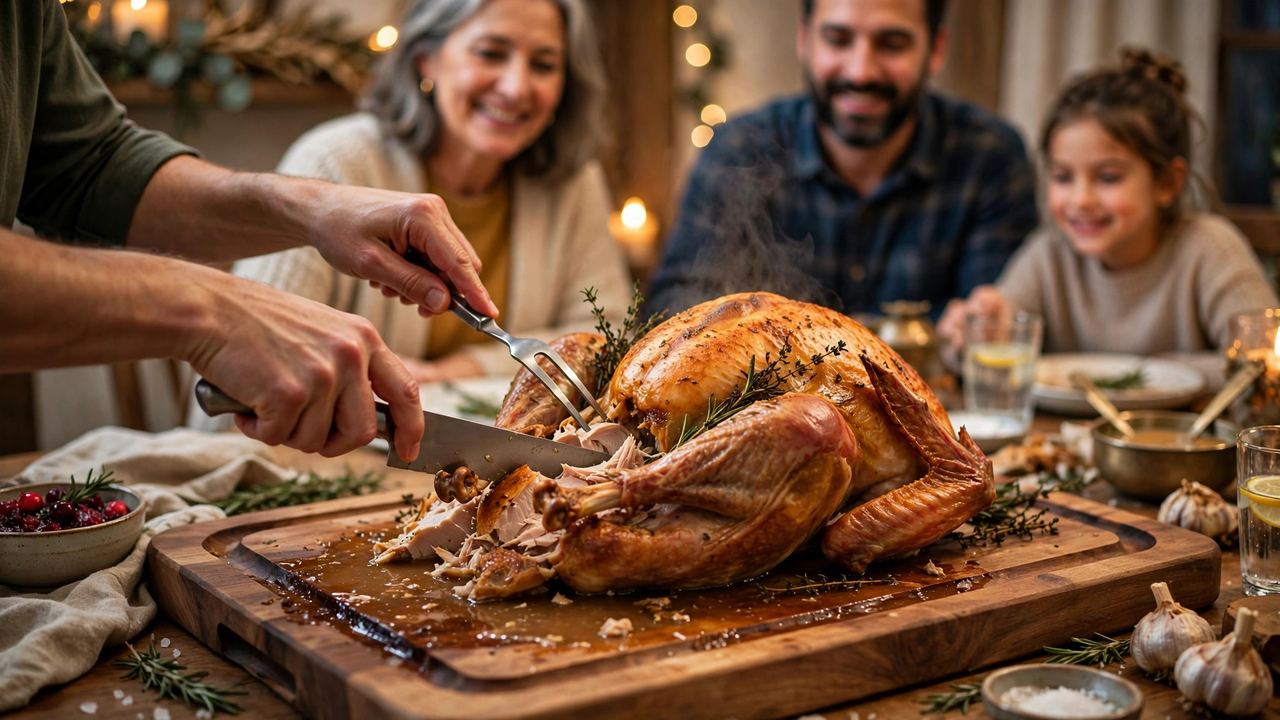
Thanksgiving has a way of exposing the one kitchen tool you thought was fine. A turkey that looked manageable in the roasting pan suddenly takes up every inch of a standard cutting board, the first slice releases a flood of hot juices, and the cook ends up carving at an angle while someone else holds a towel against the counter edge. That is exactly the problem the best large carving boards with juice grooves for turkey are built to solve. A proper carving board gives the bird room to rest and turn, gives the knife a flat and stable place to work, and gives all of those juices somewhere to go other than the floor.
This guide gathers six large boards that were each checked on opened product pages, with dimensions, materials and groove designs taken from what the maker lists for that exact model. The list spans the main materials you will meet in this category: teak, maple, walnut and bamboo. It includes heavy butcher-block style boards that live on the counter all year, lighter boards that come out for the holidays and store away afterwards, and one genuinely oversized board for hosts who carve the biggest birds or who want a carving station that can double as a serving surface for the whole table.
Every board here is large by ordinary cutting board standards, and every one has a juice groove, canal or well as a central design feature rather than an afterthought. Beyond that shared brief, they differ in ways that matter: how the groove handles liquid, whether the reverse side is flat or also grooved, how the board is lifted and moved when it is loaded, and how much care the surface asks for between holidays. Reading those differences honestly is the fastest way to pick the right one, because the best board for a cook who carves a turkey twice a year is not always the best board for a household that roasts a chicken every Sunday.
Quick verdict
For most Thanksgiving hosts, the Teakhaus extra-large edge grain board is the most balanced pick on this list: a full 24 by 18 inch teak surface, a deep juice canal on one side, a flat reverse for everyday prep, and hand grips that make a loaded board easier to move. Teak also handles the moisture of carving work gracefully, which matters when a board sits in turkey juices for the length of a long holiday meal.
If you prefer maple and American-made butcher block tradition, the John Boos Au Jus board answers with the same generous footprint and a sloped groove designed to move juices away from the carving area. Walnut shoppers have two strong routes: the Virginia Boys Kitchens extra-large board for a broad, reversible carving surface at a full 24 by 18 inches, and the Sonder Los Angeles Franklin for a thicker 20 by 15 inch edge grain board with removable non-slip feet and a groove the maker lists as holding up to 4.5 ounces of liquid.
Two boards serve more specialised needs. The J.K. Adams pour spout board is the choice for cooks who save carving juices for gravy, because its groove, pooling well and spout are designed to collect and pour rather than simply contain. And the Greener Chef 30 inch board is the outlier on size alone: at 30 by 20 inches it swallows the largest turkey on this list with room left over for resting slices, and it can span a stovetop or sink to create carving space in a crowded holiday kitchen.
The products in this guide
Teakhaus Edge Grain Carving Board with Juice Groove, Extra Large
This Teakhaus board, model TH108, at 24 by 18 inches and 1.5 inches thick, built from teak in an edge grain construction
Best for Most hosts wanting one board for carving and prep
Selection started with the job itself. A turkey carving board has to fit a whole bird with room around it for the knife to travel and for slices to land, so boards under roughly 20 inches on their long side were only considered when their carving design was exceptional. Most of the final list sits at 24 by 18 inches or larger, which is the footprint that comfortably holds a holiday turkey plus a resting area for carved meat. Thickness and weight were weighed alongside footprint, because a board that skates across the counter under a carving fork is a safety problem, not a style preference.
Juice management was the second filter, and it is the feature named in the keyword for a reason. A rested turkey still releases a surprising volume of liquid once carving starts, and a shallow decorative channel overflows within the first few slices. Each board here was checked for a genuine groove, canal, well or sloped drainage design on its opened product page, and the differences between those designs are described honestly in the individual sections: a perimeter canal contains, a sloped groove drains, and a pour spout lets you recover the juices for the gravy boat.
Verification came third, and it was strict. Every product was confirmed on an opened Amazon listing for that exact model, with the listing showing the board in stock and available to buy new, and the specifications in this article are phrased as what the maker lists rather than as independent measurements. Model numbers were recorded for each pick so you can match the article to the listing precisely. Products whose pages could not confirm the model, the dimensions or current new availability were excluded rather than written up on trust.
Finally, the list was balanced deliberately across materials and care levels. Wood choice changes how a board feels under the knife, how it handles moisture, how heavy it is to wash, and how often it wants oiling. Rather than crowning one material, the guide explains the trade-offs of teak, maple, walnut and bamboo in the buying guide below, so the final choice can follow your kitchen habits instead of a generic ranking.
The maker lists this Teakhaus board, model TH108, at 24 by 18 inches and 1.5 inches thick, built from teak in an edge grain construction. That footprint is the sweet spot for turkey work: long enough for the bird to sit lengthwise with the knife travelling freely, wide enough that carved slices can be parked on the board instead of transferred slice by slice to a platter while the carving is still underway. One face carries the juice canal; the reverse is flat, so the same board handles the morning prep, the afternoon carving and the evening cheese course without a swap.
Teak is the material argument here. The maker notes teak’s natural oils and its resistance to moisture, and carving is the wettest job a board does all year. Where a drier wood can drink turkey juices into the grain during a long meal, teak’s character suits a board that will sit in liquid, be washed, dried and put back to work. The board is also FSC certified according to the maker, which matters to hosts who ask where a tropical hardwood came from before it joins the kitchen.
Practical details are well judged. Hand grips at the ends make a real difference on a board this size, because a 24 inch board loaded with a carved turkey is an awkward two-handed carry from counter to table, and the grips give fingers a purchase that a plain edge does not. The maker lists care as hand wash only, which is standard for a board of this type, and the edge grain surface is described as knife friendly. Used groove-side up for the bird and flat-side up for bread, pies and prep, this is the board on the list that most easily earns permanent counter space.
Buy it if: you want one large board that covers Thanksgiving carving and everyday prep, you like teak’s moisture handling, and you will use both the grooved and flat sides across the year.
Skip it if: you want a board you can put in a dishwasher, you prefer the pale look of maple, or your storage cannot take a 24 inch board standing on edge.
John Boos is the name most cooks meet first in American butcher blocks, and the Au Jus board, model AUJUS, is its purpose-built carving answer. The maker lists it at 24 by 18 inches and 1.5 inches thick in maple with an edge grain build, and the listing gives a weight of 14.4 pounds, which tells you most of what you need to know about stability: a board of that heft does not wander while a fork is holding a turkey steady against the knife.
The defining feature is in the name. Rather than a simple perimeter trench, the groove on this board is sloped, so juices released during carving travel away from the working area instead of pooling under the bird. Anyone who has carved on a flat board knows the alternative: the turkey ends up sitting in its own liquid, slices slide, and the last cuts are made through a puddle. A sloped groove keeps the carving surface clearer and gathers the liquid where it can be spooned up for the pan or poured off afterwards.
The board is reversible, with hand grips worked into the design for moving it, and the maker presents the reverse as a general cutting surface, so like the Teakhaus it is not a one-day-a-year purchase. Maple is the classic carving material for good reason: it is hard, fine-grained and familiar to care for with board oil and cream. Expect the usual wood board routine of hand washing, thorough drying and periodic oiling, and expect the surface to record your carving history in fine knife marks over the years, which most maple owners regard as character rather than damage.
Buy it if: you want a heavy, stable maple carving board from an established American block maker, and the idea of juices draining away from the bird appeals more than a simple containing trench.
Skip it if: a board in this weight class will discourage you from washing and using it, or you specifically want a pour spout for recovering juices into a gravy boat, which is the J.K. Adams board’s party trick instead.
Virginia Boys Kitchens builds this board in the USA from American walnut, and the maker lists the extra-large version at 24 by 18 inches and 1 inch thick, with a listed weight of 9 pounds. That combination is worth pausing on: it matches the two boards above for footprint while coming in noticeably lighter and slimmer, which makes it the easiest of the full-size hardwood boards here to lift to the sink, wash, and stand up to dry after a long holiday meal.
The design is reversible in the classic pattern: a juice groove carved into one side for carving work, and a smooth face on the other for serving and general prep. The maker lists the board as pre-seasoned with fractionated coconut oil, so it arrives ready to work rather than needing a first oiling before the holiday. Walnut is a slightly softer hardwood than maple, and many cooks find it gentle under a carving knife; its dark, rich colour also hides the staining that turkey juices and holiday use leave on paler woods, and it doubles naturally as a handsome serving board for the carved bird or a cheese course.
Because it is thinner than the 1.5 inch blocks on this list, this is the full-size pick for hosts who store their carving board in a cabinet or on a shelf rather than leaving it out. A 24 inch board is still a serious piece of kitchen equipment to house, so measure the intended spot before the holiday, not during it. Hand washing and occasional oiling remain the care pattern, as with every hardwood board here.
Buy it if: you want the full 24 by 18 inch turkey footprint in walnut, you value a lighter board that is easier to wash and store, and you like the idea of carving and serving on the same dark wood surface.
Skip it if: you want maximum block thickness and counter weight for aggressive everyday chopping as well as carving, or you prefer end grain construction.
The Franklin is Sonder Los Angeles’ edge grain walnut board, and the maker lists it at 20 by 15 inches and 1.5 inches thick, with a weight of 10.3 pounds. That is a step down in footprint from the 24 inch boards above, and the right way to read it is as the large board for slightly smaller celebrations: a modest turkey, a turkey breast, a ham or a standing rib roast sits comfortably, and the board remains a plausible everyday cutting board in a kitchen where a 24 inch block would crowd the counter.
Two features set the Franklin apart. First, the maker lists its juice groove as holding up to 4.5 ounces of liquid, a concrete capacity figure that helps you judge it against your cooking: a well-rested bird releases less at the board, and the groove is sized for that reality. Second, it carries removable rubber feet on both sides, which keep this reversible board planted during carving and lift it slightly off the counter. Anyone who has had a board pivot at the worst moment will understand why feet, plus the board’s ten-pound heft and finger grips, make this one of the most confidence-inspiring carving stations on the list.
The maker lists the wood as sustainably sourced American black walnut and the board as made in the USA, and it arrives in a gift box, which makes it the natural holiday gift candidate here for a host who carves every year on something inadequate. Care follows the walnut pattern: hand wash, dry promptly, and oil when the surface starts to look thirsty.
Buy it if: your turkeys are on the smaller side or you often carve breasts and roasts instead, you want non-slip feet and a stated groove capacity, or you are choosing a board as a gift for a Thanksgiving host.
Skip it if: you regularly carve very large birds that need the full 24 inch working length, because slices and bird together will outgrow a 20 by 15 inch surface.
J.K. Adams makes this board, model PSB-2014, in Vermont from maple, and the maker lists it at 20 by 14 inches and 1 inch thick, with a listed weight of 5 pounds. On paper those are the smallest numbers in this guide, and that is precisely why the design deserves attention: this board was shaped around the carving task itself rather than around raw size, and generations of holiday cooks have treated its layout as the reference design for a turkey board.
The layout is the story. The maker describes a reversible board with a pour spout on both sides. One side carries an indentation, a well that cradles poultry or a roast so the bird sits settled instead of rocking on a flat surface, ringed by a juice groove. The reverse is flat with its own juice groove for general carving and prep. The groove system ends in that pour spout, and a pooling well collects the juices so they can be tipped into a pan or jug. For the cook who builds Thanksgiving gravy from the carving juices rather than the roasting pan alone, this is the only board on the list designed to hand those juices back instead of merely trapping them.
At 5 pounds it is also by far the easiest board here to handle one-handed, to wash in a standard sink, and to store in a drawer-adjacent cabinet or a narrow slot. The trade is working room: a very large bird will fill it completely, leaving little space to park slices, so households cooking the biggest turkeys should treat it as a carving-and-transfer board, moving slices to a warmed platter as they go, which is how many cooks prefer to work anyway.
Buy it if: gravy made from carving juices is non-negotiable in your house, you want a Vermont-made maple board that stores easily, and your birds are small to mid-sized or you carve in batches to a platter.
Skip it if: you carve extra-large turkeys and want the bird and all its slices resting on the board at once, or you dislike maple’s pale surface showing holiday stains.
Every list like this needs one board that answers the size question by ending it, and this is that board. The maker lists the Greener Chef 3XL at 30 by 20 inches and 0.75 inches thick, made from Moso bamboo, and describes it as light for its size at around 11 pounds. Thirty inches of length changes the carving experience completely: the largest turkey sits with clear space at both ends, slices can be arranged on the board as they are cut, and a second person can hold and turn the bird without crowding the knife.
Juice handling follows a drain-and-collect pattern. The maker describes a deep juice groove running to a corner collection point holding up to 4 ounces, with a spout for pouring off, so liquid moves away from the carving area and can be saved for sauces and gravy rather than wiped up. Hand grooves help with moving a board of this span, and the maker points out two uses that only a board this big can offer: it can sit over a stovetop as a noodle board to create extra counter space during holiday cooking, and it can span a sink for carving or prep where counter room has run out entirely.
Bamboo brings its own trade-offs, and they should be stated plainly. It is a hard, dense material that is less forgiving of fine knife edges than the hardwoods above, it is thinner than the block-style boards, and like all the boards here it is hand wash only. In exchange you get the biggest carving surface in the guide in a board light enough to store on top of cabinets or against a wall, and a surface that doubles at the table as a generous serving and charcuterie board for a crowd. Measure your storage and your sink before ordering; a 30 inch board surprises people twice, once at the door and once at the dishwasher it will never enter.
Buy it if: you cook the largest turkeys, host big holiday gatherings, need carving space your kitchen does not have, or want one oversized surface that carves, serves and covers the stovetop between meals.
Skip it if: your storage cannot house a 30 inch board, you prioritise the knife feel of maple, walnut or teak, or your celebrations are small enough that a 24 inch board already feels generous.
Buying guide
Size the board to the bird, then to the kitchen
Start with the turkey you actually cook. A board needs to hold the whole bird plus working room: the knife travels beyond the bird on every slice, the fork needs a stance, and carved slices need somewhere to land. For most holiday birds, a 24 by 18 inch board is the comfortable standard, which is why three of the six picks share that footprint. A 20 by 15 inch board suits smaller birds, turkey breasts and roasts, and earns its place by remaining usable every day. A 30 by 20 inch board is a deliberate choice for the biggest birds and biggest gatherings. Then measure the other two places the board must fit: the sink, because a board that cannot lie flat or at least rinse comfortably is a board that gets washed badly, and the storage spot, because a carving board bought in November still needs a home in February.
Read the groove like a plumber
Not all juice grooves do the same job, and the differences decide how your carving session feels. A perimeter canal, like the Teakhaus design, contains liquid around the edge of the board and works well when the bird has rested properly and releases a moderate amount of juice. A sloped groove, like the John Boos Au Jus design, actively moves liquid away from the cutting area toward a low point. A groove with a pooling well and pour spout, the J.K. Adams pattern, is built for recovery: the juices are an ingredient, not a mess. A groove draining to a corner reservoir, as on the Greener Chef board, combines containment with an easy pour-off point. Think about which problem you actually have. If your counters flood, prioritise depth and drainage. If your gravy lacks depth, prioritise the spout. If your bird rests a full half hour before carving, as it should, a good canal is usually enough.
Choose the material for your habits
Teak handles moisture gracefully and suits a board that will sit in juices and be washed often, at the cost of a richer, darker look that not every kitchen wants. Maple is the traditional carving surface: hard, fine-grained, pale and honest, showing its knife marks and stains as a record of use, and rewarding regular oiling. Walnut is gentler in feel, darker in tone, hides staining well and makes the prettiest serving surface of the three hardwoods. Bamboo is the lightweight, oversized option: hard and durable as a surface, less kind to fine edges, and available in sizes solid hardwood rarely reaches. None of these is the correct answer for everyone; the correct answer is the material whose care routine you will actually keep up in December and in July.
Weight, feet and grips decide stability
A carving board must not move. Weight is the simplest stabiliser, which is why the heavy maple and teak blocks feel so planted, but it is not the only one: rubber feet, like those the maker lists for the Sonder Franklin on both sides, grip the counter and keep a reversible board steady, and a simple damp towel under any board achieves a version of the same effect. Grips matter at the other end of the job, when the board is loaded and must travel. Cut-in hand holds, like those on the Teakhaus and John Boos boards, turn a risky carry into a controlled one. Judge the pair together: how the board stays still while you carve, and how it moves when you are done.
Care is part of the purchase
Every board in this guide is hand wash only, and that single fact should be accepted before buying rather than discovered afterwards. Wash with hot soapy water, dry standing up so both faces air, and store dry. Oil a hardwood board when the surface looks pale or feels dry, working the oil in and wiping off the excess; boards used hard at Thanksgiving appreciate oiling before the holiday and again after it. Never soak a wood or bamboo board, never leave it sitting in carving juices overnight, and keep it out of the dishwasher, whose heat and water will undo in one cycle what careful making put into it. Looked after this way, a good carving board is a decades-long purchase, which reframes the whole comparison: you are not choosing for one Thanksgiving, you are choosing for twenty.
Set up the carving station properly
The board is only half the system. Rest the turkey before it ever meets the board, because resting is what keeps most of the juice inside the meat and makes the groove’s job possible. Carve on a stable, well-lit surface at a comfortable height, with a warmed platter within reach, a fork you trust, and a knife long enough to slice rather than saw. Work groove-side up, keep the board’s drainage or spout end pointed where you can reach it with a spoon or jug, and move slices to the platter in batches so the board never becomes a crowded puzzle. When the meal is over, pour the collected juices into the gravy or the stock pot before washing the board, which is the moment the spout and reservoir designs quietly justify themselves.
FAQ
How large should a carving board be for a Thanksgiving turkey?
For most whole turkeys, a board around 24 by 18 inches gives the bird, the knife and the carved slices room to coexist, which is why that size anchors this guide. Smaller birds and turkey breasts carve comfortably on a 20 by 15 inch board, while very large birds and hosts who arrange slices on the board benefit from a 30 by 20 inch surface. Whatever size you choose, confirm it fits your sink and storage before the holiday.
Do juice grooves really make a difference when carving?
Yes, because even a properly rested turkey releases liquid once slicing begins, and on a flat board that liquid has nowhere to go except under the bird and off the edge. A groove contains it, a sloped groove moves it away from the cutting area, and a groove with a well and spout lets you collect it for gravy. The groove also keeps slices from sitting in pooled juice while you finish carving.
Which wood is best for a turkey carving board?
Each material in this guide has a case. Teak suits wet carving work and frequent washing, maple is the hard traditional butcher block surface, walnut is dark, knife-friendly in feel and doubles beautifully as a serving board, and bamboo delivers the largest sizes at a light weight. The best choice is the one whose weight, look and oiling routine fit your kitchen, since all four will carve a turkey well when the board is large and stable.
Can I put a large wooden carving board in the dishwasher?
No. Every board here is listed by its maker as hand wash only, and dishwasher heat and prolonged water exposure can warp, crack and dry out wood and bamboo boards. Wash by hand with hot soapy water, rinse, and dry the board standing on edge so both faces dry evenly, then oil hardwood boards when the surface starts to look dry.
Should I carve the turkey on the board or transfer slices to a platter?
Both patterns work, and board size decides which suits you. On a 24 inch or 30 inch board there is room to park slices beside the bird as you carve and then carry the whole board to the table. On a 20 inch board, carving in batches and moving slices to a warmed platter keeps the working area clear and the meat warm, and it is the approach the pour spout style boards are designed around.
How do I stop a large carving board sliding while I carve?
Start with the board’s own stability: heavy boards resist movement by weight, and the Sonder Franklin adds removable rubber feet on both sides for grip. For any board, placing a damp towel or a sheet of damp paper towel flat underneath is the classic kitchen fix. Carve with the fork holding the bird rather than pressing down through the knife, and the board will have far less reason to travel.
Conclusion
A turkey deserves better than a too-small board and a towel dam against the juices. The six boards in this guide each solve the real Thanksgiving problem in a slightly different way: the Teakhaus brings teak, size and a proper canal in one balanced package; the John Boos Au Jus drains juices away on a heavy maple block; the Virginia Boys Kitchens board delivers the full walnut footprint in a lighter, slimmer form; the Sonder Franklin adds feet and a measured groove to a thick walnut board; the J.K. Adams hands your carving juices back for gravy through its well and spout; and the Greener Chef simply out-sizes the problem altogether. Choose by your bird, your sink, your storage and your care habits, set the board up before the turkey comes out of the oven, and carving turns from the most stressful ten minutes of the holiday into the calm, generous moment it is supposed to be.
M
Modern Line Home Editorial Team
We compare specs, materials and verified owner reviews before a product earns a spot. Rankings are never paid.
Affiliate disclosure. As an Amazon Associate we earn from qualifying purchases at no extra cost to you. Prices accurate as of the date shown.
House cold even with the heat on? Walk this ordered checklist: thermostat and filter first, then drafts, insulation, leaky ducts and a failing heating system.
Windows fogging up in winter? Check where the fog sits: on the room side it is indoor humidity, outside it is harmless, and between panes the seal has failed.
Store the main firewood pile about 30 feet from your house, off the ground and covered only on top. Compare racks, woodsheds, garages and indoor spots safely.
Place a portable generator outdoors only, at least 20 feet from windows, doors and vents, exhaust pointed away. Exact distances, setup steps and CO rules here.
Keep houseplants in the right winter spot: match window direction to plant type, stay clear of radiators and cold glass, and fix dry air and low light at home.
Mice enter through pencil-width gaps at foundations, pipes, vents, doors and the roofline. Walk this room-by-room winter checklist to find and seal each one.
A winter outage timeline: what to do in the first hour, first night and multi-day outage, with food safety times, pipe protection, heat and CO safety steps.
Size a space heater by room area: 10 watts per square foot at 8-foot ceilings, adjusted for insulation and ceiling height, with full wattage and BTU tables.
Start dripping at about 20 degrees, sooner for exposed pipes. Set a pencil-lead stream, drip the right faucets on both lines, and know when to stop safely.
A fridge needs 800-1,200 starting watts, not just 150-400 running watts. Use the tables to total your fridge plus freezer, lights, furnace fan and more today.












Write Your Review
No reviews yet. Be the first to share your experience!