
Key takeaways
- Most portable generators run 8 to 12 hours on one tank, but oil, heat and cool-down breaks set the real limit. Compare runtimes by fuel type and service hours.
Most portable generators run for 8 to 12 hours on one tank at about half load, and with shutdowns for refueling and oil checks you can keep one going for days — but not in one unbroken stretch. That is the honest answer to how long can a portable generator run continuously: one tank at a time, with the oil-change interval acting as the real ceiling on total hours. This guide gives you two tables to check against your own machine — maker-listed runtimes by fuel type, and a maintenance schedule by running hours — so you can plan an outage in hours instead of guesses.
Why the range is so wide is simple. A small inverter sipping fuel at a light load, a large open-frame gasoline model carrying half a house, and a diesel portable with a much bigger tank are three different machines answering the same question. Fuel type matters, tank size matters, and load matters most of all, because a runtime printed on a box is always tied to a load level. Read every runtime number in this article with its load number beside it, and then read your own manual the same way.
The short answer, in one tank and in one outage
On a single tank, plan around the maker-listed examples in the table below. Champion lists its 8000-watt dual-fuel portable at 10 hours at 50% load on gasoline. Honda lists its EU2200i inverter at 3.2 hours at rated load and 8.1 hours at one-quarter load on a tank of less than a gallon. Generac lists its XD5000E diesel portable at 32.4 hours at 50% load from its large tank. Those three numbers — roughly 3 to 8 hours for a small inverter depending on load, about 10 hours for a typical large gasoline portable at half load, and more than a day for that diesel example — frame the realistic spread.
Across a whole outage, the limit changes from fuel to oil. Honda lists a first oil change for the EU2200i at 1 month or 20 hours, then every 6 months or 100 hours. Generac lists, for its portable generators, a first oil change after the initial 20 to 30 hours of operation and every 100 hours after that. A 100-hour interval is about four days of round-the-clock running. You can run through that window if you refuel correctly and check the oil at every stop, but you should not run past it on old oil just because the tank is still full.
If you are still choosing a machine rather than planning around one you own, start with load, not runtime. Our guide to what size generator you need to run a refrigerator helps you work out the load that will decide both the model and the runtime you actually get. Runtime claims mean little until you know whether your real load is closer to one-quarter, one-half, or nearly all of what the generator can produce.
Runtime by fuel type: the table to check against your machine
The table below collects maker-listed runtimes that were checked on the manufacturers’ own product pages or in a compilation of manufacturer-published figures. It is deliberately mixed: gasoline, propane, diesel, dual-fuel, inverter, and conventional open-frame models all appear, because that mix is what shows the pattern. Propane figures are for a standard 20-pound tank where the maker lists that basis. Inverter figures are often listed at one-quarter load, while larger conventional models are often listed at one-half load — the load column is part of the answer, not a footnote.
| Fuel and type | Example model (maker-listed) | Fuel carried | Load | Listed runtime |
|---|---|---|---|---|
| Gasoline, conventional open-frame (as dual-fuel model on gasoline) | Champion 8000W dual-fuel portable | 7.7 gallons gasoline | 50% load | 10 hours |
| Propane, same dual-fuel model | Champion 8000W dual-fuel portable | 20-pound propane tank | 50% load | 5 hours |
| Gasoline, inverter | Honda EU2200i | 0.95 gallon | Rated load | 3.2 hours |
| Gasoline, inverter | Honda EU2200i | 0.95 gallon | 1/4 load | 8.1 hours |
| Gasoline, dual-fuel inverter | Champion 5500W dual-fuel inverter | 3.7 gallons gasoline | 25% load | 20 hours |
| Propane, dual-fuel inverter | Champion 5500W dual-fuel inverter | 20-pound propane tank | 25% load | 15 hours |
| Gasoline, dual-fuel conventional | Westinghouse WGen9500DF | 6.6 gallons gasoline | 50% load | 8 hours |
| Propane, dual-fuel conventional | Westinghouse WGen9500DF | 20-pound propane tank | 50% load | 7 hours |
| Diesel, conventional portable | Generac XD5000E | 12 gallons diesel | 50% load | 32.4 hours |
Read the gasoline rows first if you own the most common kind of portable. Champion lists 10 hours at 50% load for its 8000-watt dual-fuel model on gasoline, from a 7.7-gallon tank. Westinghouse lists 8 hours at 50% load for the WGen9500DF on gasoline, from a 6.6-gallon tank. Two large gasoline portables, two different tanks, and runtimes in the same overnight band: that 8-to-10-hour window at half load is a sensible planning figure for a big gasoline portable, provided your manual agrees.
Read the inverter rows next if you own a small, quiet machine. Honda lists the EU2200i at 3.2 hours at rated load and 8.1 hours at one-quarter load — the same generator, the same 0.95-gallon tank, and a runtime that more than doubles when the load drops. Champion lists its 5500-watt dual-fuel inverter at 20 hours at 25% load on gasoline. Inverters can stretch a tank at light load because the engine does not have to run at one fixed speed the whole time, but that advantage shrinks as you load them harder. If your inverter will carry a refrigerator, lights, and chargers, expect something between the light-load and rated-load figures, not the headline number alone.
For shoppers comparing inverter models for lighter, quieter duty, our roundup of quiet inverter generators for winter camping is a useful companion to this table, because camping loads are exactly the light loads where inverter runtimes look best. Home backup loads are heavier, so discount those light-load runtimes when you move the same machine to outage duty.
Propane: shorter per tank, easier to store
Propane usually gives fewer hours from a 20-pound tank than gasoline gives from a full onboard tank on the same machine, and the table shows it plainly. Champion lists 5 hours at 50% load on a 20-pound propane tank for its 8000-watt dual-fuel model, against 10 hours on gasoline. Westinghouse lists 7 hours at 50% load on a 20-pound tank for the WGen9500DF, against 8 hours on gasoline. Champion’s 5500-watt dual-fuel inverter lists 15 hours at 25% load on propane, against 20 hours on gasoline.
That does not make propane the worse fuel for a long outage. A 20-pound tank is only the starting point: propane can be staged in additional tanks and swapped at a shutdown, and it stores without going stale the way gasoline can. The real propane question is logistics. At 5 to 7 hours per 20-pound tank at half load on the larger models above, a full day of running takes several tanks. Count your tanks, do the division with your own model’s listed figure, and you will know — before the outage — whether propane alone can carry you or whether you need gasoline as the main fuel and propane as the reserve.
If dual-fuel flexibility is the reason you are shopping, our roundup of dual-fuel inverter generators for home outages and our guide to tri-fuel generators for home emergency backup both start from that same trade-off: fewer hours per propane tank, in exchange for fuel you can store and swap.
Diesel: the long-tank exception
Diesel is the outlier in the table, and the reason is tank size as much as fuel. Generac lists the XD5000E diesel portable at 32.4 hours at 50% load from a 12-gallon tank. That is more than three times the half-load runtime of the large gasoline examples, from a tank that is also much larger. Diesel portables are heavier, work-oriented machines, and they are uncommon for ordinary home backup, but they prove the rule: continuous runtime is mostly a fuel-carrying question. Give any engine more fuel it can reach safely, and the single-run number grows.
Do not use the diesel figure to set expectations for a gasoline machine. Use it instead as a reminder to compare like with like: same load level, similar output class, and the actual fuel quantity carried. A runtime without a tank size and a load level is marketing, not planning.
Dual-fuel and inverter versus conventional, in plain terms
Dual-fuel describes what the engine can burn — gasoline or propane — not how long it will run. Inverter versus conventional describes how the machine makes and controls power, and it does affect runtime at light loads. A conventional open-frame generator runs at a steady speed to hold its output, so its fuel use does not fall as dramatically when the load is small. An inverter model can throttle down at light load, which is why Honda’s EU2200i figure stretches to 8.1 hours at one-quarter load and why Champion’s dual-fuel inverter reaches its longest listed hours at 25% load.
At half load and above, the gap narrows. The conventional Champion and Westinghouse models in the table sit at 8 to 10 hours on gasoline at 50% load, which is competitive with anything except the diesel. So choose inverter for quiet, light-load efficiency, and cleaner power for electronics; choose a larger conventional model for maximum output per purchase; and choose dual-fuel if stored propane matters to your plan. In every case, the runtime you will actually see is the one listed at the load closest to yours.
What actually limits continuous running
Fuel is the first limit, but it is rarely the only one. Four things end a continuous run, and a good outage plan names all four before the power goes out.
1. Fuel supply — and the shutdown it forces
A portable runs until the fuel it can reach is gone. For gasoline and diesel models, that is the onboard tank. For propane models, it is the connected tank. Either way, the end of the fuel is also a mandatory shutdown: you do not refuel a running generator, and you do not refuel a hot one. The Red Cross says to turn the generator off and let it cool down before refueling, because gasoline spilled on hot engine parts could ignite. So even a generator that could mechanically run for days is, in practice, a sequence of single-tank runs separated by cool-down stops.
2. Oil level and oil condition
Oil is the limit people miss. Small air-cooled engines can use oil during long runs, especially under heavier load or in hot weather, and old oil protects less as hours accumulate. Many models have a low-oil shutdown, and Honda describes its Oil Alert system as shutting the engine off when low oil is detected — but that is a backstop, not a maintenance plan. By the time a low-oil shutdown stops the machine, you have already lost power and may have been running below a healthy level. The working habit is to check the dipstick at every refuel stop, when the machine is already shut down and cooling, and to change the oil when the maker’s interval arrives, even mid-outage.
3. Heat and airflow
Portable generators for home use are air-cooled. They shed heat to the air around them, which means they need open space, a clear exhaust path, and intakes that are not blocked by debris, snow, or a well-meaning enclosure. A generator tucked into a tight corner, a porch, or an improvised box can overheat even with fuel and oil in good shape. Heat is also why placement and safety point the same direction: outdoors, in the open, with exhaust pointed away. Our companion guide on where you should place a generator during a power outage covers siting in detail, and the safety section below gives the non-negotiable distances.
4. Load level
Load is the multiplier on everything above. The Honda figures make it concrete: 3.2 hours at rated load versus 8.1 hours at one-quarter load from the same tank. A heavier load burns fuel faster, makes more heat, and works the oil harder. Managing load — running the refrigerator, heating controls, lights, and chargers, while cycling large discretionary loads instead of stacking them — is the cheapest way to extend continuous runtime. It also reduces the chance of an overload shutdown, which the Red Cross notes can happen even with a properly connected portable, resulting in overheating or generator failure.
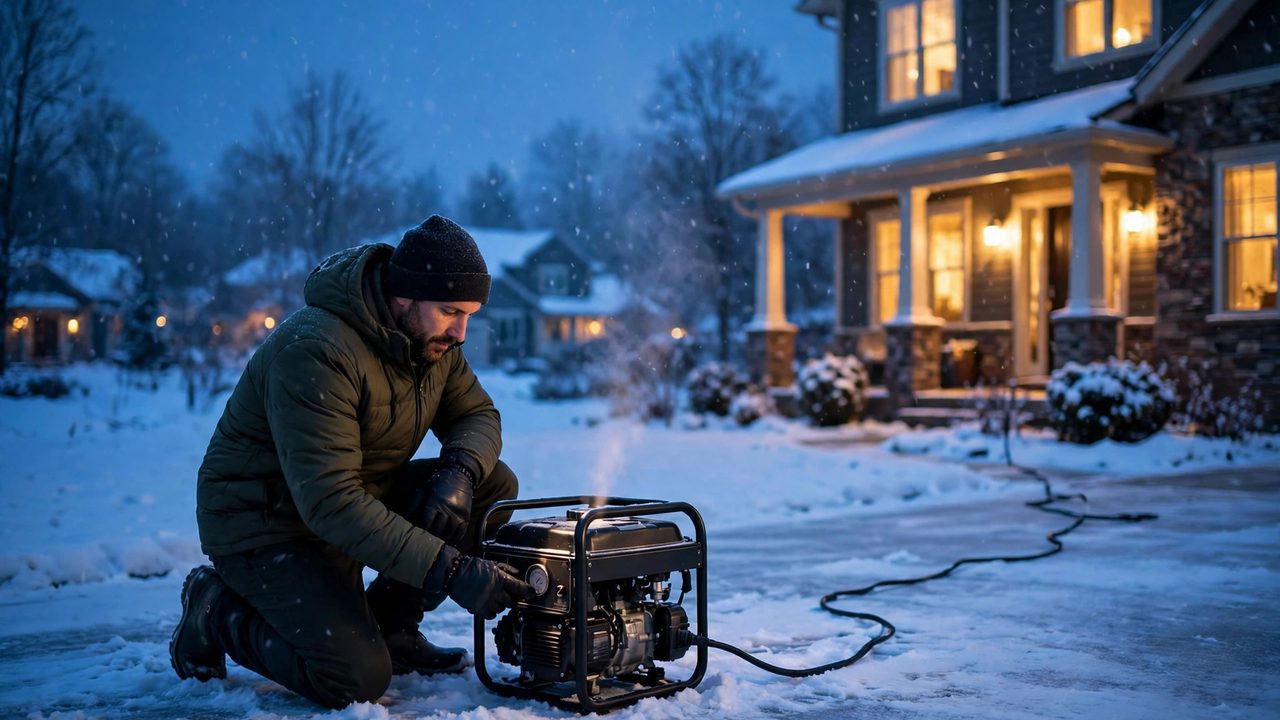
There is one more honest distinction to make. A permanently installed home standby generator is built for longer continuous duty than a portable, and even it has a hard service rhythm: Generac’s support guidance for its air-cooled home standby generators requires a shutdown and inspection after every 24 hours of continuous run time, with the manual’s maintenance schedule followed during extended outages. If a standby machine needs a shutdown and inspection every 24 hours, a portable — which needs fuel stops far more often — should never be treated as a set-and-forget appliance either. Use the 24-hour idea as your own checkpoint rhythm for a portable in a long outage: at least once a day, shut down, cool, inspect, check oil, clear debris, and only then restart.
Maintenance schedule by running hours
This is the second table to keep with your generator. It is built from maker-listed intervals — Honda’s published schedule for the EU2200i and Generac’s published guidance for its portable generators — because those two brands state their intervals clearly. Your own manual may differ, and where it differs, your manual wins. Champion models, for example, state their own break-in and service intervals in their manuals, and Champion’s product pages show hour-tracking displays precisely because service is counted in hours. Treat the table as the shape of a correct schedule, then confirm each number against your model.
| Running hours | What to do | Maker basis |
|---|---|---|
| Before every use, and at every refuel stop | Check the oil level; look for fuel or oil leaks; clear debris from intakes and around the muffler; confirm exhaust path and placement are still clear | Honda lists checking oil level before each use for the EU2200i; Generac guidance likewise puts oil-level checks at each use |
| First 5 to 30 hours (break-in, brand-dependent) | Change the oil at the break-in interval in your manual; keep loads moderate during break-in if your manual says so | Honda lists the first EU2200i oil change at 1 month or 20 hours; Generac lists the first portable oil change after 20 to 30 hours |
| Every 50 hours | Check and clean the air filter; change oil early if running under heavy load, in dust, or in high heat if your manual directs it | Honda’s EU2200i schedule lists air-filter cleaning at 3 months or 50 hours |
| Every 100 hours | Change the oil; check and adjust the spark plug; clean the spark arrester where fitted | Honda lists oil changes every 6 months or 100 hours after the first change, with spark-plug checks at 100 hours; Generac lists portable oil changes every 100 hours after the first |
| Every 200 hours | Replace the spark plug where your manual lists that interval; carry out any 200-hour items in your manual | Honda’s EU2200i schedule lists spark-plug replacement at 1 year or 200 hours |
| Every 24 hours of continuous running | Planned shutdown and inspection: cool down, check oil, inspect for leaks and debris, check cords and connections, then restart | Generac requires shutdown and inspection every 24 hours for its air-cooled standby generators in continuous use; adopted here as a daily checkpoint rhythm for portables in long outages |
Turn those intervals into outage math. If your generator runs about 10 hours per tank at half load, you will make roughly ten fuel stops before a 100-hour oil change comes due. The first oil change on a brand-new machine arrives much sooner — at 20 hours on Honda’s EU2200i schedule, or after 20 to 30 hours on Generac’s portable guidance — which can mean the second day of a first-ever outage. Buyers who unbox a generator the week of a storm should buy oil and a funnel with it, not after it. Cold-weather starting is its own chore as well, and our roundup of electric-start portable generators for cold weather is worth a look if winter outages are your main scenario.
Keep a simple hour log. Note the hour-meter reading — Champion’s Intelligauge, for example, tracks run-time hours specifically so owners can monitor maintenance intervals, and Honda’s app-connected models offer service reminders — or write the start and stop times on paper taped to the fuel can. In a multi-day outage, memory is unreliable, and the difference between 80 hours and 110 hours on the same oil is exactly the kind of detail that gets lost.
Finally, stock the service kit before you need it: the correct oil for your model and season, a funnel, rags, a drain pan, a spare spark plug, and a spare air filter if your manual lists one. None of it helps if it is at a closed store in the middle of a storm.
Refueling and cool-down rules
These rules are not optional technique; they are the difference between a routine fuel stop and a fire. They come from the Red Cross generator safety guidance and the CPSC, and they agree with the warnings printed in maker manuals.
- Shut the generator down first. Never add fuel to a running generator, on any fuel. For propane, shut down before swapping or disconnecting a tank as well.
- Let it cool down before the cap comes off. The Red Cross says to turn the generator off and let it cool down before refueling, because gasoline spilled on hot engine parts could ignite. Do not rush this step because the house is dark; a cool-down pause is part of the runtime plan, so build it into your expectations for overnight running.
- Use the cool-down productively. While the machine cools, check the oil level, look for leaks, clear debris from intakes, and confirm nothing has drifted into the exhaust path. Then refuel, then restart.
- Refuel outdoors, in the generator’s operating position. Keep fuel handling where the generator itself is allowed to be: outside, away from the house, away from ignition sources.
- Store fuel correctly. The Red Cross says to store fuel in an approved safety can, to use the type of fuel recommended in the instructions or on the generator label, and to store fuel outside living areas in a locked shed or other protected area, not near a fuel-burning appliance. The Red Cross also notes that local laws may restrict how much fuel you may store and where, and suggests asking your local fire department if you are unsure.
- Do not top up to stretch a run. A slightly shorter tank that ends with a calm, daylight refuel is better than an overfilled tank or a midnight fuel stop performed in a hurry. Plan fuel stops for when you are awake.
One practical consequence deserves emphasis: a portable generator does not provide truly unbroken power. Every fuel stop is a brief outage. If something in your home cannot tolerate that gap, the correct answer is a battery buffer for that load, not a riskier refuel. Our guide to portable power stations for winter outages explains how households pair a power station with a generator — the station carries small loads quietly and covers refuel gaps, while the generator does the heavy work and recharges it.
Safety: the rules that outrank runtime
No runtime figure in this article matters if the generator is placed wrong. Carbon monoxide is the reason, and the authorities are blunt about it.
The CPSC says portable generators create a risk of carbon monoxide poisoning that can kill in minutes, and that carbon monoxide is called the invisible killer because it is colorless and odorless. The CPSC estimates that about 85 consumers die in the United States each year from carbon monoxide poisoning from portable generators. Exposed people may become unconscious before experiencing milder symptoms such as nausea, dizziness, or weakness. This is not a risk that careful people can smell or sense their way around.
- Outdoors only — never inside. The CPSC says never to operate a portable generator inside a home, garage, basement, crawlspace, or shed, and that opening doors or windows will not provide enough ventilation to prevent the buildup of lethal levels of carbon monoxide. Champion states the same rule on its product pages: generators must always be used outdoors, far away from occupied buildings, with engine exhaust pointed away from people and buildings.
- At least 20 feet from the house. The CPSC directs users to operate portable generators outside only, at least 20 feet away from the house, and to direct the exhaust away from the home and any other buildings someone could enter, while keeping windows and other openings closed in the path of the exhaust.
- Not on a porch or in a carport. The CPSC says not to operate a generator on an outside porch or in a carport, because they are too close to the home.
- Carbon monoxide alarms are the last line of defense. The CPSC directs households to install battery-operated carbon monoxide alarms, or alarms with battery backup, on each level of the home and outside separate sleeping areas, to test them monthly, and never to ignore an alarm: get outside immediately, then call 911. The CPSC also lists the symptoms to know — headache, dizziness, weakness, nausea, vomiting, sleepiness, and confusion — and says that if poisoning is suspected, get outside immediately, then call 911.
- Prefer a model with a carbon monoxide shut-off feature. The CPSC advises looking for portable generators with a safety feature that shuts the generator off automatically when high levels of carbon monoxide are present around it. Honda’s CO-MINDER and Champion’s CO Shield are maker examples of this feature class. A shut-off feature is a backstop, not permission to place the generator closer.
- Electrical safety counts too. The Red Cross warns against backfeeding — never try to power house wiring by plugging the generator into a wall outlet, a practice the Red Cross says puts utility workers, neighbors, and your household at risk of electrocution. The Red Cross also says to keep the generator dry, not to use it in rain or wet conditions, to operate it on a dry surface under an open canopy-like structure, and not to touch it with wet hands. Plug appliances directly into the generator, or use a heavy-duty, outdoor-rated extension cord rated at least equal to the sum of the connected loads.
If you take one sentence from this section, take the CPSC’s placement rule whole: outside only, at least 20 feet away, exhaust pointed away, windows in the exhaust path closed. Every runtime plan in this article assumes that placement. A generator that cannot be sited that way at your home should not be run at all, and a battery power station — which has no exhaust — becomes the safer tool for the loads it can carry.
Planning a multi-day outage, hour by hour
Put the two tables together and a long outage becomes arithmetic instead of anxiety. Work this example with a typical large gasoline portable listed at about 10 hours per tank at half load. Day one is two tankfuls with room to spare. Each fuel stop is a shutdown, a cool-down, an oil check, and a restart. By the end of day two you are near 48 hours — halfway to a 100-hour oil change, and, if the machine was new at the start of the outage, already past its first break-in oil change. By day four you are at the 100-hour service whether you planned for it or not.
Now work the same example on propane at 5 to 7 hours per 20-pound tank at half load. The generator does not care, but you will: three to five tank swaps a day, each one a shutdown, is a real workload, and running out of tanks on day three is a planning failure, not bad luck. This is why many households run gasoline as the primary fuel, keep propane as the clean-storing reserve, and use load discipline to stretch both. It is also why a smaller inverter, run at light load for essentials only, can be the smarter overnight machine: Honda’s 8.1 hours at one-quarter load from less than a gallon is an overnight shift from a very small fuel store.
Build rest into the plan for the machine and for yourself. A generator does not need sleep, but it benefits from the daily shutdown-and-inspection rhythm described above, and you need to be awake and unhurried for fuel stops. Where loads allow, some households shut down overnight and rely on a power station for lights and phones, restarting the generator in the morning. That choice saves fuel, saves oil hours, removes overnight carbon monoxide exposure from a running engine, and concentrates refueling in daylight. Whether it works for you depends on what must stay powered overnight — heating controls and refrigeration usually decide it — but it should be a considered option, not an afterthought.
Frequently asked questions
Can a portable generator run 24 hours straight?
On one tank, usually not: most gasoline portables are listed at about 8 to 10 hours at 50% load, and the diesel Generac XD5000E, listed at 32.4 hours at 50% load, is the exception rather than the rule. Across 24 hours, yes — with fuel stops. Each stop means shutting down, cooling down, checking the oil, and refueling, per the Red Cross guidance. Treat 24 hours as several single-tank runs with inspections between them, not as one unbroken run.
What happens if you run a generator too long without a break?
The risks stack up in order: the tank runs dry, the oil level and condition degrade, and heat builds if airflow is poor. Low-oil shutdown systems, such as Honda’s Oil Alert, can stop the engine to protect it, but losing power that way — and possibly running below a healthy oil level first — is the outcome the refuel-stop oil checks exist to prevent. Running past the maker’s oil-change interval, such as Honda’s 100-hour interval after the first 20-hour change, trades a short service task for accelerated engine wear.
How long can a generator run on propane?
It depends on tank size and load. On a 20-pound tank at 50% load, Champion lists 5 hours for its 8000-watt dual-fuel model and Westinghouse lists 7 hours for the WGen9500DF. At 25% load, Champion lists 15 hours on a 20-pound tank for its 5500-watt dual-fuel inverter. Larger or additional tanks extend the total proportionally, but every swap is still a shutdown, a cool-down, and an oil check.
How often should you change the oil during a long outage?
On the maker’s schedule, not the calendar’s convenience. Honda lists the first EU2200i oil change at 1 month or 20 hours, then every 6 months or 100 hours. Generac lists its portable generators’ first oil change after 20 to 30 hours, then every 100 hours. In continuous running, 100 hours arrives in about four days, so a week-long outage can require one or two oil changes mid-outage. Check the level at every fuel stop in between.
Is it safe to run a portable generator overnight?
Only under the full safety rules: outdoors only, at least 20 feet from the house per the CPSC, exhaust pointed away from the home and other buildings, windows in the exhaust path closed, and working battery-backed carbon monoxide alarms on each level and outside sleeping areas. Never run one in a garage, basement, shed, carport, or on a porch. If you cannot meet those conditions, do not run it overnight — use stored battery power for overnight essentials instead.
Does an inverter generator run longer than a conventional one?
At light load, generally yes, because an inverter can throttle down. Honda lists the EU2200i at 8.1 hours at one-quarter load against 3.2 hours at rated load, and Champion lists its 5500-watt dual-fuel inverter at 20 hours at 25% load on gasoline. At half load, large conventional models are competitive — Champion and Westinghouse list 10 and 8 hours respectively at 50% load on gasoline. Compare runtimes only at the same load level.
Conclusion
So, how long can a portable generator run continuously? One tank at a time: about 8 to 10 hours at half load for a typical large gasoline portable, 3.2 to 8.1 hours for a small inverter depending on load, 5 to 7 hours per 20-pound propane tank at half load on the dual-fuel examples listed here, and 32.4 hours for the large-tank diesel example. Across an outage, you can keep a portable going for days — through shutdowns to cool down and refuel, oil checks at every stop, a daily shutdown-and-inspection rhythm, and an oil change when your maker’s interval arrives, at 20 to 30 hours the first time and every 100 hours after that on the Honda and Generac schedules cited here.
Check the two tables in this article against your own manual, write your model’s numbers on the fuel can, and stock oil before the storm does the scheduling for you. And hold the safety line without exception: outdoors only, at least 20 feet from the house, exhaust away, alarms working. Runtime is a planning problem. Placement is a life-safety rule. Solve the first with arithmetic, and never compromise on the second.










Write Your Review
No reviews yet. Be the first to share your experience!