
Key takeaways
- Most firewood needs 6 months to 2 years to season. See seasoning times by species, the under-20% moisture target, and how to test with a moisture meter safely.
If you are asking how long does firewood need to season before burning, the honest answer is that the calendar helps, but the moisture reading decides. The U.S. Environmental Protection Agency says to season and dry wood outdoors for at least 6 months before burning it, and the Connecticut Department of Energy and Environmental Protection, summarizing EPA Burn Wise guidance, lists at least 6 months for softwood and at least 12 months for hardwood. Dense oak is the main exception to plan around: Cornell Cooperative Extension says many species will drop below 20 percent moisture within a year if properly stacked, while oak can take two years or more of air drying. In short, give most split and stacked firewood 6 to 12 months, give oak up to two years or more, and burn it only when a freshly split face reads below 20 percent moisture.
That short answer leaves out the part that actually determines whether a fire lights easily, heats well, and stays cleaner: species. Ash and oak cut on the same day, split to the same size, and stacked in the same yard do not become ready together. Neither do pine and hickory, or birch and maple. This guide therefore starts with the seasoning-time table by species, then explains how to check moisture content with a moisture meter, how to read the visual and tactile signs without over-trusting them, how splitting and stacking change the timeline, and which mistakes quietly add months to a pile that looked finished.
The short answer: season to a number, not just to a date
Seasoning means allowing cut, split wood to lose water until it burns efficiently. The target repeated across the authorities used for this article is consistent. The EPA lists wood as burning best at a moisture content of less than 20 percent and tells readers to test wood with a wood moisture meter before burning it. Cornell Cooperative Extension says it is important to burn only wood with moisture content below 20 percent, because higher-moisture wood creates more smoke, gives less heat, and forms creosote on the chimney as energy is spent boiling off excess water. The University of Tennessee Extension reaches the same conclusion in its firewood fact sheet, calling properly seasoned wood — moisture content below 20 percent — critical to getting the most from firewood. The University of Illinois Extension likewise says moisture content should be below 20 percent.
Those sources also agree that six months is a floor, not a promise. The EPA says at least 6 months. Illinois Extension says it usually takes at least six to nine months of drying time after cutting fresh wood to lower moisture content to below 20 percent. The University of Tennessee Extension says firewood prepared in the spring should be dry enough to burn the following fall, but it immediately adds a condition that matters more than the season name: the passage of time alone is not enough, because firewood needs to be cut to length, split, stacked, and exposed to drying breezes. A log left whole, a piece touching the ground, or a piece buried deep inside a pile will dry very little, even after many months, according to that same Tennessee guidance.
So the practical rule has two parts. First, use the species table below to plan when a stack might be ready. Second, confirm it with a meter before the first serious fire of the season. If the two disagree — if the calendar says a year has passed but the meter says the inside is still wet — believe the meter. Planning how much wood a household needs is a separate calculation, and it helps to work through how much firewood you need for a whole winter at the same time you plan when each species will be ready, so the driest wood is not used up before the coldest weeks arrive.
Why wet wood burns poorly
Green wood starts far from the target. Cornell Cooperative Extension notes that most dealers sell green, or freshly cut, wood, which could have a moisture content of 100 percent or more, and explains that 100 percent moisture content means half the weight of the wood is water. The University of Tennessee Extension gives a broader range: green moisture content is normally above 60 percent and can range as high as 120 percent for some species, with more than 100 percent meaning there is more water in the wood than dry wood substance. Tennessee lists the green moisture content of oak at approximately 75 percent. Those figures use the forestry convention of expressing water as a percentage of dry wood weight, which is why a figure above 100 percent is possible.
When wet wood goes into a stove or fireplace, the fire must first drive that water out. Cornell Cooperative Extension says higher-moisture wood gives less heat because it takes energy to boil off the excess water. Illinois Extension says burning wood with higher moisture content produces more smoke and less heat, and that the smoke from green wood adds to creosote buildup in chimneys, creating a potential fire hazard. Tennessee Extension makes the same chain explicit: dry wood burns more completely, while incomplete combustion of wet wood produces dirty smoke that can accumulate as creosote in the chimney, and that creosote can eventually ignite and cause a chimney fire.
The Connecticut DEEP page adds another concrete warning from its safe-practices list: do not burn wet or green wood, and burning wet wood will cause you to burn up to 30 percent more wood to generate the same amount of heat. That figure is a useful planning warning rather than a promise for every stove, but the direction is the same across sources. Wet wood wastes fuel, makes more smoke, and leaves more deposit behind. Seasoning is therefore not a ritual for purists. It is the step that decides how much of the wood you bought, cut, split, and stacked actually becomes room heat.
Seasoning time by species: the table to plan around
The table below groups common firewoods by the time they typically need when split and stacked properly. It follows the grouping presented with University of Missouri Extension advice that most dense hardwoods require at least one year to season fully: pine, fir, spruce, and cedar at 4 to 6 months; white ash, poplar, and aspen at 6 to 9 months; maple, birch, cherry, and black locust at 9 to 12 months; beech and hickory at 12 to 18 months; and oak, elm, and sycamore at 18 to 24 months. Read the ranges as planning bands for split, stacked wood exposed to air — not as guarantees for rounds left on the ground, wood stacked in deep shade, or a pile wrapped so tightly that air cannot move through it. Cornell Cooperative Extension adds the important upper-end warning for oak: some oak can take two years or more of air drying, even when other species have dropped below 20 percent within a year.
| Wood species or group | Typical seasoning time, split and stacked properly | How to plan for it |
|---|---|---|
| Pine, fir, spruce, cedar | 4 to 6 months | The fastest group in the table. Plan on the EPA minimum of at least 6 months as the safer household checkpoint, and meter-test before burning. |
| White ash | 6 to 9 months | The fastest common hardwood group in the table, grouped with poplar and aspen. Still test it; ash is not ready simply because it is ash. |
| Poplar, aspen | 6 to 9 months | Grouped with white ash. Useful for earlier-season burning once the meter confirms it is below 20 percent. |
| Maple | 9 to 12 months | Grouped with birch, cherry, and black locust. Give it most of a year rather than a single summer. |
| Birch | 9 to 12 months | Grouped with maple, cherry, and black locust. Split it promptly so the pile is actually drying rather than sitting sealed in rounds. |
| Cherry | 9 to 12 months | Grouped with maple, birch, and black locust. Plan on roughly a year and confirm with a meter. |
| Black locust | 9 to 12 months | Grouped with maple, birch, and cherry in the table, despite being a dense wood. Meter-testing matters because density alone does not set the date. |
| Beech | 12 to 18 months | Grouped with hickory. Allow more than a year in planning, in line with the Missouri advice that most dense hardwoods require at least one year. |
| Hickory | 12 to 18 months | Grouped with beech. Do not assume a hickory stack split in spring is finished that fall. |
| Oak | 18 to 24 months, sometimes more | The slowest common group, grouped with elm and sycamore. Cornell Cooperative Extension warns oak can take two years or more of air drying. |
| Elm | 18 to 24 months | Grouped with oak and sycamore. Budget two drying seasons in your rotation. |
| Sycamore | 18 to 24 months | Grouped with oak and elm. Keep it in the long-seasoning part of the yard, not in the pile you count on first. |
Two cautions keep this table honest. First, the Connecticut guidance that lists at least 6 months for softwood and at least 12 months for hardwood is a simpler, more conservative split than the fastest softwood band in the table. If your climate is damp, your stack is shaded, or your pieces are large, use the longer end of every range and let the meter decide. Second, species is only one variable. A small, well-split piece of maple in a sunny, breezy single row can be ready before a large, unsplit piece of ash buried in the middle of a dense block. The table tells you which stacks to test first, which to leave alone, and which to buy a full season or two ahead.
Oak: the wood that punishes optimistic planning
Oak deserves its own warning because it is both desirable firewood and the species most often burned too early. The University of Tennessee Extension lists the green moisture content of oak at approximately 75 percent, well above the below-20-percent target for seasoned wood. Tennessee also tested bagged firewood sold as seasoned in Knoxville: the wood was all oak, and despite the seasoned label, its average moisture content was 66 percent — only slightly less than the green moisture content of oak at 75 to 80 percent in that report. Properly seasoned firewood, the report repeats, should have a moisture content below 20 percent.
Cornell Cooperative Extension explains why buying ahead matters so much for oak. It advises buying wood at least one whole season ahead, notes that many species will drop below 20 percent within a year if properly stacked in an area of relatively low relative humidity, and singles out oak as a species that can take two years or more. If oak is your main heat wood, the working system is a rotation: this winter you burn the oak split two summers ago, next winter you burn the oak split last summer, and the oak you split now is not counted as available fuel until it has passed both the calendar and the meter.
Ash, maple, and birch: the middle of the table is not instant
Ash has a reputation for being forgiving, and the table shows why: white ash sits in the 6-to-9-month group, ahead of maple and birch at 9 to 12 months. The USDA Forest Products Laboratory green-moisture figures reproduced with those seasoning guides help explain the starting gap. White ash is listed at 46 percent heartwood and 44 percent sapwood, sugar maple at 65 percent heartwood and 72 percent sapwood, and paper birch at 89 percent heartwood and 72 percent sapwood. White oak, by comparison, is listed at 64 percent heartwood and 78 percent sapwood. Those are typical green figures, not readings for your particular tree, but they show why two hardwoods felled on the same day start the race in different places.
The lesson is not that ash can be burned green. It cannot be judged ready without a test, and Tennessee Extension is clear that all wood species can be acceptable firewood if they are dry, while wet wood of any species makes poor firewood. The lesson is sequencing. Test the ash first, then the maple and birch, and leave the oak and hickory for later checks. When you restack or bring wood indoors, keeping species in separate rows makes that sequence possible. Mixed piles hide the slow wood inside the fast wood and invite the mistake of burning the whole pile on the fast pile’s schedule.
Pine and other softwoods: fast to dry, still not ready green
Pine, fir, spruce, and cedar occupy the fastest band in the table, at 4 to 6 months when split and stacked properly. That speed should not be stretched into permission to burn them fresh. The EPA minimum is at least 6 months, and Connecticut’s summary lists at least 6 months for softwood. Tennessee Extension notes that even low-density species such as poplar and softwoods such as pine will burn well when properly dried — the condition is the drying, not the species label. Green softwood sapwood can also start very wet: the USDA Forest Products Laboratory figures reproduced with the seasoning guides list longleaf pine at 31 percent heartwood but 106 percent sapwood. A pine split therefore contains parts that start at very different moisture levels, which is another reason a surface reading can mislead and a fresh-split test matters.
How to check moisture content with a moisture meter
A moisture meter turns seasoning from an opinion into a measurement. The EPA tells readers to test wood with a wood moisture meter before burning it. Connecticut DEEP notes that moisture meters allow you to test the moisture level in wood, can be bought at hardware stores or on the internet, and that properly dried wood should have a reading of 20 percent or less. Tennessee Extension likewise lists a moisture meter reading below 20 percent as one of the ways to judge whether firewood is properly seasoned, and notes that hardware stores and woodworking suppliers sell meters for checking lumber and firewood.
The method matters as much as the tool, because the outside of a piece dries first. A reading taken on a weathered end, on bark, or on the outside face of a split can describe the driest layer of the wood rather than the part that will hiss in the stove. Use the fresh-face method below, which follows the EPA instruction to test before burning and the extension principle that time since cutting is not, by itself, a reliable indicator.
Step-by-step: the fresh-split test
- Choose pieces from inside the stack. Take several pieces from the middle of the pile, not only the top row or the sunny outer face. The outer pieces have had the most sun and air and will flatter the whole stack if they are the only ones tested.
- Split each test piece open. Split a piece in half immediately before testing so you expose a fresh face from the interior of the wood. This is the face that was protected from sun and wind, and it is the face that best represents what the fire will meet.
- Test the fresh face right away. Push the meter pins into the newly exposed interior face, following the meter maker’s instructions for pin depth and orientation, and read the percentage before the fresh surface has time to dry in the air.
- Test more than one piece and respect the wettest result. A single dry split does not season its neighbors. If most pieces read below 20 percent and one thick piece from the center reads well above it, that thick piece is not ready, and the stack needs sorting or more time.
- Compare the reading with the target, not with last month. Below 20 percent is the seasoned target given by the EPA, Cornell, Tennessee, and Illinois sources used here. A drop from very wet to still above 20 percent is progress, not readiness.
Tennessee Extension also describes the oven-dry method as the best way to determine wood moisture content: a small sample, about 1 inch thick, is cut from the middle of a firewood section, weighed, placed in an oven at about 220 degrees until it reaches a constant weight after roughly 12 to 24 hours, then re-weighed so moisture content can be calculated from the original and dry weights. Most households will never need that laboratory-style check for a woodpile, but it explains what a meter is estimating. The meter is a practical shortcut to the same question: how much of this piece is still water?
When you bring a day’s or a weekend’s wood inside, a covered rack keeps the tested, ready wood separate from the still-drying outdoor stack. Options such as firewood log racks with covers for covered porches are useful for that staging role, while indoor holders serve a different, short-term purpose. The key distinction is time: indoor storage is for wood that has already passed the meter test, not a place to finish seasoning a wet stack.
Visual and tactile signs: useful clues, weaker proof
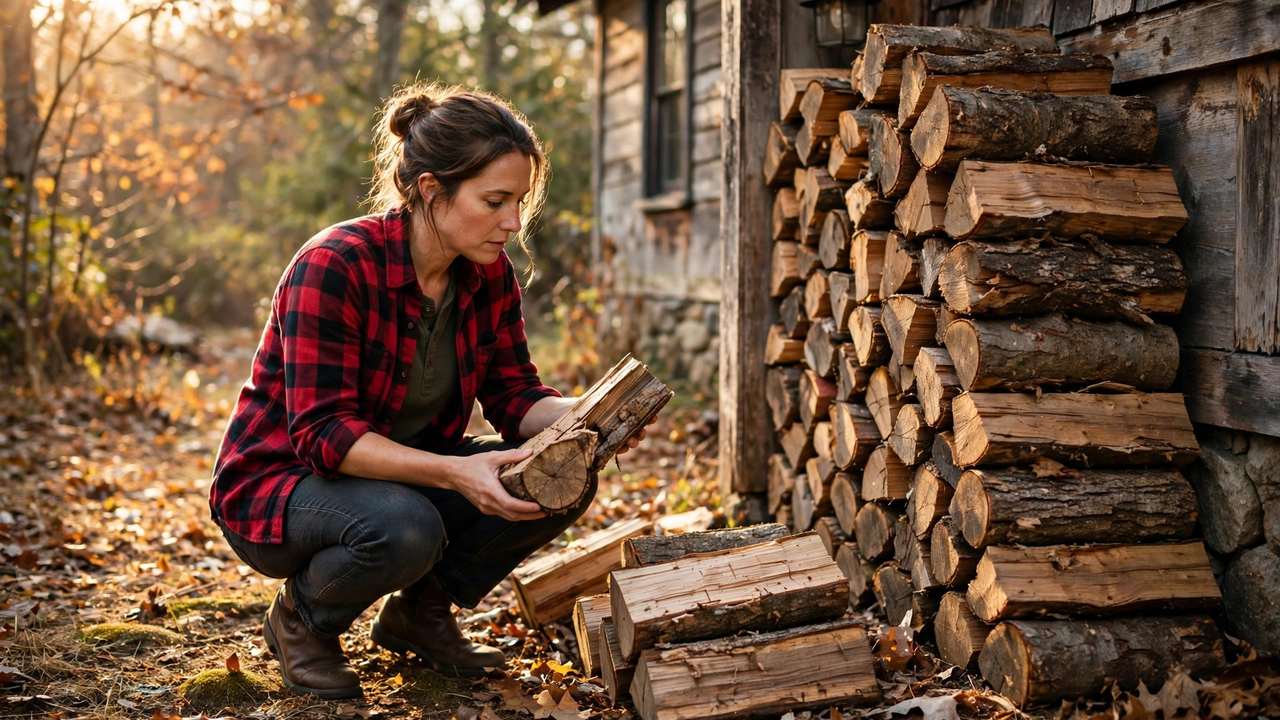
Long before meters were common, wood burners judged a pile by eye, ear, hand, and nose. The extension sources still list those signs, but they present them as estimates and clues, not as replacements for a reading. Used together, they help you sort a stack and decide which pieces to meter first. Used alone, they can mislead, especially on species whose ends check early or whose weight is naturally heavy.
- End checks. Illinois Extension says one way to estimate moisture content is to look at the ends of the pieces: small splits in the ends are a good indicator that moisture content is low. Tennessee Extension is more cautious, saying dry firewood may, but may not, have many drying checks or cracks on the ends. Treat checks as a reason to test a piece, not as proof by themselves.
- Sound when knocked together. Illinois Extension says dried wood has a distinct clinking sound, while green wood has a more subdued sound. Tennessee Extension puts it as a contrast between a dull thud from wet wood and a hollow sound from dry wood. The EPA, in its best-practices summary reproduced by Connecticut DEEP and other agencies, describes properly seasoned wood as darker, weighing less, and sounding hollow when hit against another piece.
- Weight in the hand. Tennessee Extension says dry firewood will be lighter than green wood, but warns that natural density differences between species can make that difference difficult to judge. Comparing two pieces of the same species and similar size is far more informative than comparing a dry hickory split with a green pine split.
- Color and surface. The EPA description of seasoned wood as darker is a general clue, and Illinois Extension’s garden guidance describes seasoned ends as checked and gray in color. Weathering, however, grays the outside of wood that can still be wet inside, which is why color belongs low on the list of evidence.
- Bark and feel. A piece that feels cool and damp, shows a dark wet-looking center when split, or still smells strongly of fresh sap is telling you to wait and to meter it. None of those impressions gives you a percentage, and the percentage is the standard the sources use.
The right order is therefore signs first, meter second. Walk the stack, look for checked ends, knock pieces together, and lift a few. Pull the pieces that look and sound driest, split one or two open, and meter the fresh face. If the meter confirms the signs, you have ready wood. If it contradicts them, you have learned something valuable about that stack before the stove did. For the hearth itself, keeping ready wood in fireplace log holders with matching tool sets makes it easier to keep a small, tested supply by the fire without dragging in untested pieces from the outdoor pile.
What speeds seasoning up — and what slows it down
Splitting is the single biggest lever
Tennessee Extension states the rule plainly: firewood needs to be cut to length, split, stacked, and exposed to drying breezes, and logs or unsplit firewood will dry very little even after many months. The field result reproduced with the seasoning guides makes the point concrete: University of Maryland Extension tracked live hickory left in unsplit rounds, about 16 to 18 inches, and found it still held over 30 percent moisture after a full year, while split pieces dried far faster. A year on the calendar therefore means very different things for a split stack and for a pile of rounds. Seasoning time in the table at the top of this article assumes the wood has been split.
Size matters after splitting, too. Connecticut DEEP, following EPA guidance, lists splitting wood into pieces 6 inches in diameter or smaller for faster drying. Smaller pieces expose more surface for their volume and give interior moisture a shorter path out. Oversized pieces intended for long overnight burns will be the slowest pieces in any stack, so test those specifically rather than assuming the kindling-sized splits beside them speak for them.
Sun, wind, and spacing
Drying breezes are part of the Tennessee definition of seasoning for a reason. A stack in an open, breezy spot loses moisture to moving air; a stack in a still, shaded corner keeps its own damp air around it. Stack in loose rows with air space rather than as a solid block, keep the rows off damp ground, and avoid pushing the pile tight against a wall where one face never dries. Illinois Extension’s garden guidance adds that wood should not be stacked directly on the ground, because the bottom layer will attract decay fungi and insects, and that stacking away from the house increases airflow. It also advises not bringing in more firewood than can be burned in about a week, because insects overwintering in wood kept indoors for more than a few days can become nuisance pests inside the house.
A sturdy outdoor rack helps with both airflow and ground clearance. The covered firewood racks for porches and yards covered elsewhere on this site are one version of that raised, organized approach; pallets and rails serve the same basic purpose when they lift the first course off the soil and let air pass underneath. What matters is the gap and the airflow, not the brand of rack.
Cover the top, not the whole pile
The EPA instruction reproduced by Connecticut DEEP is to store wood outdoors, off the ground, with the top covered. Connecticut’s own list adds: stack off the ground, split side down, and cover the stack to protect the wood from rain and snow. Covering the top sheds rain while leaving the sides open so drying air can still move through the rows. Wrapping a pile tightly on all sides works against that movement and can hold damp air in. Illinois Extension’s guidance on covering makes a similar practical point: firewood will need covering to keep rain and snow from being reabsorbed after the wood is dry, and the covering should be secured so it does not blow off, without making the pile inaccessible.
Inside the firebox, dry wood still benefits from good airflow and the right grate. Heavy-duty fireplace grates for open hearths lift burning wood so air reaches it, but no grate can compensate for wet fuel. Season first, then let the hearth equipment do its smaller job.
Start early in the year
Tennessee Extension’s spring example is a useful calendar anchor: firewood prepared in the spring should be dry enough to burn the following fall. That works because the stack gets the warm, breezy part of the year rather than starting its clock in autumn rain. Cornell’s advice to buy at least a whole season ahead applies the same logic to purchased wood. If you cut or buy in spring, split immediately, stack off the ground with the top covered, and test in fall, you have used the calendar the way the sources intend. If you start in October, the same species may need the following winter, especially if it is oak, hickory, or beech.
Keeping a simple rotation is the household version of that advice. Label rows by species and split date, burn the oldest tested row first, and refill the back of the rotation rather than the front. A set of fireplace tool sets sized for wood stoves in small cabins will not dry wood faster, but a tidy hearth routine — tested wood in, ash managed, tools at hand — makes it less tempting to grab the nearest untested split on a cold night.
Buying wood sold as seasoned: test the delivery
The word seasoned on a delivery is a claim, not a measurement. Tennessee Extension’s bagged-firewood test is the cautionary tale: oak pieces labeled as seasoned firewood averaged 66 percent moisture by the oven-dry method, far above the below-20-percent standard, apparently because the wood had not been exposed to the drying conditions that allow proper seasoning even though it may have been cut long ago. Tennessee draws the broader lesson that the length of time since a tree was cut is not a reliable indicator of how dry the firewood is.
Cornell Cooperative Extension suggests asking a dealer direct questions, including how long ago the wood was split, how it was stored before it was split, what kind of wood it is, and where the trees came from. The split date matters because, as the Tennessee guidance shows, unsplit logs dry very little. When a load arrives, meter several pieces from different parts of the load using the fresh-split method before you stack it as ready fuel. If it reads above 20 percent, stack it as drying wood, give it air and a covered top, and do not count it in this winter’s ready supply until it tests below the target. Cornell also advises buying and burning locally cut firewood and warns about moving firewood long distances because of invasive insects; its New York guidance notes a 50-mile limit in that state, and the EPA likewise advises buying and burning locally cut firewood to decrease the risk of transporting invasive pests.
Common mistakes and safety points
- Burning on the calendar alone. Six months, nine months, and a year are planning ranges from the EPA and extension sources. A stack that has sat unsplit, on the ground, or deep in a pile can remain wet through all of them, as Tennessee Extension warns.
- Testing only the outside. The surface dries first. A reassuring reading or a dry feel on the outside can hide a wet interior, which is why the meter test belongs on a freshly split face from the middle of the piece.
- Stacking on bare ground. Ground contact keeps the bottom course damp and, as Illinois Extension notes, invites decay fungi and insects into that layer. Raise the stack and keep air moving under it.
- Covering the sides tightly. The EPA pattern is top covered, sides open. A fully wrapped pile sheds rain but also traps the damp air the stack needs to lose.
- Burning the wrong materials. The EPA says never burn garbage, plastic, or pressure-treated wood, which can produce harmful chemicals when burned. Connecticut DEEP’s what-not-to-burn list also includes coated, painted, and pressure-treated wood, household trash, and wet, rotted, diseased, or moldy wood. Start fires with clean newspaper and dry kindling, as the EPA advises, never with gasoline, kerosene, or charcoal starter, according to Connecticut DEEP’s safe-practices list.
- Letting creosote build up. Illinois Extension calls chimney fires one of the biggest safety concerns with wood burning, explains that creosote forms when exhaust gases cool and condense on chimney walls, and lists using seasoned wood and having hot fires among the ways to decrease buildup. It also says chimneys should be inspected and cleaned annually, and ashes should be kept in a metal container with a lid, placed outdoors and not on or next to combustible materials. The EPA likewise advises having a certified technician inspect and service the appliance annually and having the chimney cleaned annually by a certified chimney sweep.
- Smoldering wet wood through the night. Connecticut DEEP advises building hot fires and notes that, for most appliances, a smoldering fire is not safe or efficient. Wet wood encourages exactly that low, smoky burn, which is the pattern the creosote warnings are about.
Wood heat also produces fine ash and dust around the hearth, which is a housekeeping issue separate from seasoning. Households that burn regularly sometimes look at air purifiers for wood stove dust and ash particles for the living space, but filtration is not a substitute for dry fuel, a hot fire, and an inspected chimney. Fix the moisture first; the other measures support that fix rather than replacing it.
Frequently asked questions
How long does firewood need to season before burning, in one sentence?
At least 6 months for softwood and at least 12 months for hardwood under the Connecticut summary of EPA guidance, up to two years or more for oak according to Cornell Cooperative Extension — and in every case, only until a freshly split face reads below 20 percent moisture, which is the target the EPA, Cornell, Tennessee, and Illinois sources all use.
Can I burn firewood that reads 22 or 25 percent moisture?
The sources used here set the seasoned line at below 20 percent, and Illinois Extension says wood with higher moisture produces more smoke and less heat. Wood a few points above the target is therefore not seasoned wood by that standard, even if it will catch in an already hot fire. The safer course is to give it more time in a split, raised, top-covered stack and test it again, rather than making it your main fuel.
Does firewood season while it is still in rounds?
Very little, according to the University of Tennessee Extension, which says logs and unsplit firewood will dry very little even after many months. The Maryland field result reproduced with the seasoning guides found unsplit hickory rounds still over 30 percent moisture after a full year. Split rounds before you start counting months.
Is ash really ready faster than oak?
In the species grouping used in the table, yes: white ash is placed at 6 to 9 months and oak at 18 to 24 months, with Cornell warning that oak can take two years or more. The USDA Forest Products Laboratory green figures reproduced with those guides also show white ash starting drier than white oak. Faster does not mean instant, so meter the ash before burning it.
How can I tell if firewood is seasoned without a meter?
Use the extension signs together: small splits in the ends, a distinct clinking or hollow sound when two pieces are knocked together rather than a dull thud, lighter weight than a comparable green piece of the same species, and a darker, checked end, as described by Illinois Extension, Tennessee Extension, and the EPA. Tennessee cautions that end checks may or may not appear, so treat the signs as a way to choose pieces to burn first — and buy or borrow a meter when you can, because it is the test the EPA recommends before burning.
Can firewood be seasoned too long?
Tennessee Extension says there is no danger in over-seasoning wood and that drier is better. The practical limit is storage, not dryness: wood left on bare ground or in damp contact can decay, which is a storage failure rather than over-seasoning. Keep seasoned wood raised, top-covered, and in rotation, and it remains ready until you burn it.
Conclusion
Firewood needs to season long enough to stop being a water problem and start being fuel. For most households that means at least 6 months for softwoods such as pine, 6 to 9 months for white ash, 9 to 12 months for maple and birch, 12 to 18 months for beech and hickory, and 18 to 24 months — sometimes more — for oak, elm, and sycamore, always assuming the wood was split promptly, stacked off the ground, given moving air, and covered only on top. Those ranges come from the EPA minimum, the extension timelines, and the species grouping set out above, and every one of them ends at the same finish line: below 20 percent moisture on a freshly split face.
Build your winter around that finish line. Split early, stack for airflow, label rows by species and date, test from the middle of the stack, and keep the slow oak in its own long rotation. Do that, and the question stops being a guess about how many months have passed. It becomes a quick meter reading on a cold morning — and a fire that lights cleanly, heats as it should, and leaves far less behind in the chimney.










Write Your Review
No reviews yet. Be the first to share your experience!