We independently review everything we recommend. When you buy through our links, we may earn a commission. As an Amazon Associate we earn from qualifying purchases.
Best Windshield Snow Covers for Cars Parked Outside
Six verified windshield snow covers for cars parked outside, compared on maker-listed size, fit range and wind resistance: magnets, door flaps, straps, hooks.
Six verified windshield snow covers for cars parked outside, compared on maker-listed size, fit range and wind resistance: magnets, door flaps, straps, hooks.
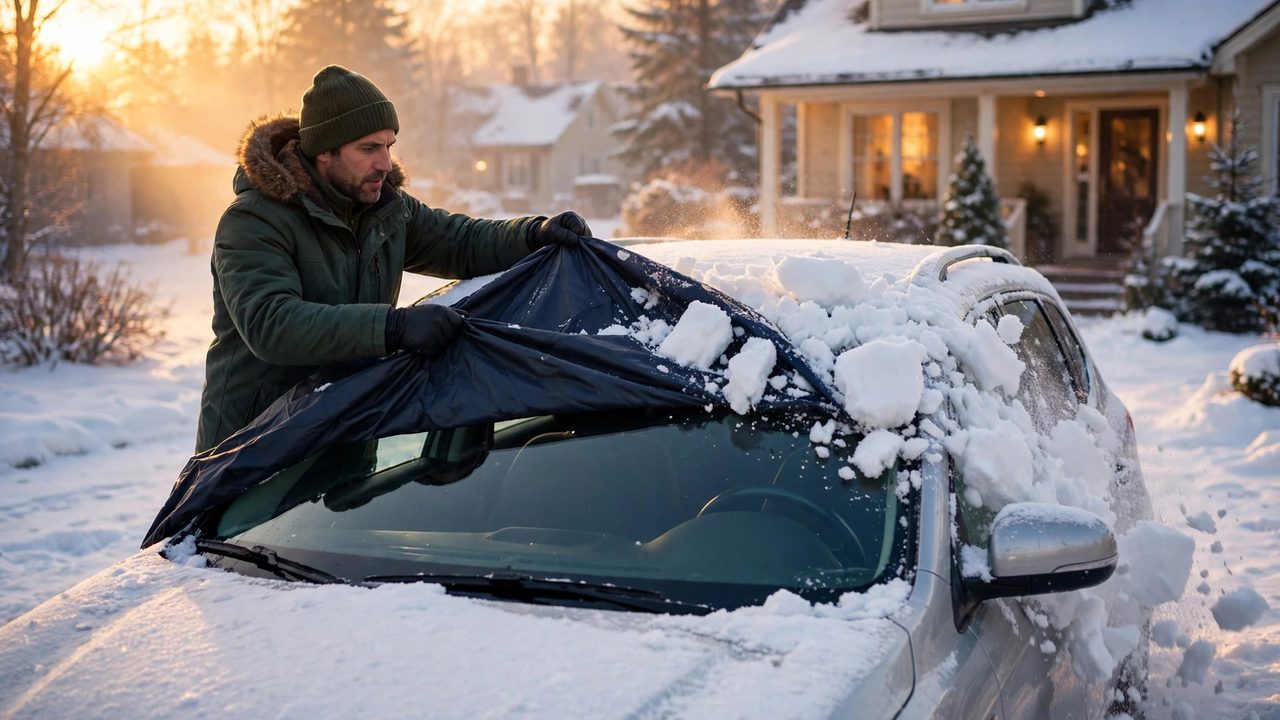
If your car sleeps in a driveway, on a street, or in an open lot, the windshield takes the full force of every overnight frost and snowfall. A cover you fit the evening before turns the morning routine into a peel-and-go job instead of a scraping session, but only if two things are right: the panel actually matches your windshield’s size, and the attachment system holds the edges down when the wind picks up. Those two axes — dimensions and fit range on one side, and the wind-resistance mechanism on the other — are what separate the covers in this guide. We compared the best windshield snow covers for cars parked outside on exactly those points, checking every dimension, material, and attachment method against the maker’s own listing before a product earned a place here.
The six covers below use four different ways of staying put. Two rely on security panels or flaps that shut inside the front doors, one adds elastic straps and rigid side poles to that door-tuck design, one holds on with embedded magnets, one combines straps with side flaps, and one stretches over the roof and hooks to the wheels. Sizes run from a compact 59 by 41 inches up to a 72 by 49.6 inch panel, plus one wrap-over design that covers the side windows as well. Every cover here is sold new on Amazon US, and every specification is reported the way the maker lists it — no cover can promise that it will never lift in a gust or that ice can never form underneath, and this guide does not pretend otherwise.
Quick verdict
For most sedans, compact cars, and crossover SUVs, the FrostGuard Plus in Standard size is the balanced pick: the maker lists a 59 by 41 inch panel, two security panels that tuck into the doors, side poles for a snug edge fit, wiper coverage, and a pair of mirror covers. If wind is your main worry and your car has steel bodywork around the windshield, the Tevlaphee cover is the magnet option, with five embedded magnets and the largest flat panel here at 72 by 49.6 inches. Drivers of larger vehicles who want door-tuck security should look at the CAT cover, which the maker lists at 68 by 45 inches with side window flaps that close inside the doors. The AstroAI 4-Layer is the coverage maximalist, draping over the side windows and part of the roof and anchoring with elastic straps that hook to the wheels. The EcoNour Small suits compact cars and small sedans with its straps-and-flaps hold, and the FrostGuard Vortex adds Fit-Fast elastic straps and folding side poles to the door-tuck formula.
The products in this guide
FrostGuard Plus Winter Windshield Cover (Standard)
The Standard size at 59 x 41 inches and positions it for compact cars, sedans, and crossover SUVs, covering the main viewing area of the windshield
Best if you want a door-tuck anchor that works on any body material
Waterproof all-weather fabric; the maker lists it as machine washable
Most cars, minivans, trucks, and SUVs
How we selected
Every product in this guide had to pass the same checks before it was written up. First, the exact model had to be verifiable on an opened product page, with the brand, model name, and specifications visible — anything we could not open and confirm was excluded entirely rather than described from guesswork. Second, the Amazon US listing had to show a live offer for the cover sold new; a page with no featured offer did not count as verified. Third, and most important for this keyword, the maker’s listing had to state the cover’s dimensions, its fit range, and its attachment method in plain terms, because size and wind resistance are the two decisions that decide whether a windshield cover works on a car parked outside.
We deliberately spread the picks across attachment systems. Magnets, door-tuck panels, elastic straps, side flaps, and wheel hooks behave differently in wind and suit different vehicles, so a guide that only listed magnet covers would fail drivers whose cars have aluminum body panels, and a guide that only listed strap covers would fail drivers who want a ten-second morning removal. We also spread the size range, from the 59 by 41 inch standard panels up to the 72 by 49.6 inch Tevlaphee and the wrap-over AstroAI, so both a compact hatchback and a full-size truck have a plausible match. Finally, we held every claim to what the maker lists: dimensions, materials, and fit are reported as listed, and where a maker states a limitation — such as magnets not adhering to aluminum — we pass that limitation on to you rather than softening it.
The FrostGuard Plus is the door-tuck benchmark in this group. The maker lists the Standard size at 59 x 41 inches and positions it for compact cars, sedans, and crossover SUVs, covering the main viewing area of the windshield and the wiper blades below it. The material is a durable polyester backed with a stick-resistant PVC lining, a combination the maker uses across its range to keep the cover from freezing onto the glass. Two mirror covers are included, so the side mirrors get the same overnight protection as the windshield itself.
Wind resistance comes from two security panels and a set of side poles. The panels tuck inside the front doors and are held when the doors close, which anchors the cover’s sides without relying on the bodywork being magnetic, and the maker lists the poles as providing an extra-snug fit against winter winds. Because the panels are shut inside the car, the same feature doubles as theft deterrence — the cover cannot simply be lifted off by a passerby. The maker includes a quick-dry storage pouch, and describes removal as rolling the cover up and sliding it into the pouch so a wet cover does not soak the back seat. An XL size is also listed for larger vehicles, so check the maker’s size guidance against your windshield before choosing between them.
Buy it if: you want a door-tuck anchor that works on any body material, your car is a compact, sedan, or crossover, and you value the included mirror covers and storage pouch.
Skip it if: your windshield is substantially larger than 59 x 41 inches and the XL size still falls short, or you would rather not open and close your doors on the panels each night.
The Vortex takes the same basic recipe as the Plus — the maker lists the same 59 x 41 inch Standard panel, the same durable polyester with a stick-resistant PVC lining, wiper coverage, and a pair of side mirror covers — and then adds a second and third holding system on top of the door-tuck panels. Alongside the security panels, the maker lists two Fit-Fast elastic straps and side poles, so the cover is held by the doors, tensioned by elastic, and kept flat along its edges by the poles. That layered approach is aimed squarely at cars parked in exposed, windy spots where a single attachment method can leave one edge free to flap.
The trade-off is a little more setup. The maker notes that simple assembly is required, and the side poles fold down when the cover comes off, after which it rolls into the included quick-dry storage pouch. Fit is listed for compact cars, sedans, and crossover SUVs, and an XL size is listed for bigger windshields. As with the Plus, the security panels shut inside the doors, so the cover is anchored against casual theft as well as wind. If your driveway catches gusts and you have watched lighter covers lift at the corners, the Vortex’s combination of straps, panels, and poles is the most belt-and-braces arrangement in this guide at this size.
Buy it if: your car parks in a windy, exposed spot, you want elastic straps plus door-tuck panels plus edge poles working together, and your vehicle is a compact, sedan, or crossover.
Skip it if: you want the fastest possible on-and-off with zero assembly, or your windshield needs a larger panel than the Standard or XL sizes provide.
The Tevlaphee is the magnet pick, and it is also the biggest flat panel here. The maker lists the size at 72 x 49.6 inches, cuts it from 600D Oxford fabric, and lines it with a soft inner layer that the maker says protects the windshield surface. Five magnets are embedded in the cover, and the maker presents them as the wind-resistance system: they grip the steel around the windshield so the edges stay seated without straps to route or panels to tuck. Side mirror protectors are included, and the cover folds into an included pouch for storage.
The maker is commendably direct about the limitation of this design, and we will be too: the listing states that the magnets will not adhere to aluminum hoods. The same caution applies to any vehicle with aluminum or composite panels around the windshield frame — if a fridge magnet will not stick to the metal surrounding your glass, this cover’s holding system will not work as intended, and one of the door-tuck or strap designs in this guide is the safer choice. The maker lists the fit as most cars, SUVs, vans, and trucks, and advises measuring your windshield before purchase to confirm coverage, which matters at this size: a 72 inch panel on a small car leaves a lot of overhang to manage. For steel-bodied vehicles with large windshields, though, the peel-off removal is the quickest of any pick here — there is nothing to unhook or untuck.
Buy it if: your vehicle has steel bodywork around the windshield, you want the largest flat panel in this guide, and you like the idea of lifting the cover straight off in the morning with no straps to undo.
Skip it if: your car has aluminum or composite panels near the windshield, or your windshield is small enough that a 72 x 49.6 inch panel would bunch and overhang badly.
EcoNour’s cover in the Small size is the compact-car specialist. The maker lists it at 64 x 42 inches and names the fit as compact cars, small sedans, and small SUVs. The fabric is 600D Oxford, which the maker describes as tough and waterproof, with a PU coating in the material specification and a PVC insulated bottom layer against the glass. A storage pouch is included in the box.
The holding system pairs dual mount straps with side flaps. The maker presents the combination as what keeps the cover firmly in place in strong winds: the straps tension the panel while the flaps secure the sides, giving you two mechanisms without any dependence on magnetic bodywork and without shutting anything inside the doors. That makes the EcoNour a useful middle path for drivers whose cars have aluminum panels — ruling out the Tevlaphee — but who do not want the door-tuck routine of the FrostGuard and CAT designs. Because this listing is the Small, measure before ordering; the 64 x 42 inch panel is aimed at smaller windshields, and a mid-size sedan with a wide, raked windshield may run past its edges.
Buy it if: you drive a compact car, small sedan, or small SUV, and you want straps plus side flaps rather than magnets or door-tuck panels.
Skip it if: your windshield is wider or taller than the 64 x 42 inch panel, or you want mirror covers included — the maker does not list them for this model.
The AstroAI is the maximalist option: instead of a flat panel sized to the glass alone, it is a wrap-over cover. The maker lists the coverage as the windshield, the wipers, the side windows, and part of the roof, and lists the item dimensions as 94.5 x 78.7 x 59.1 inches, which reflects that draped footprint rather than a flat rectangle. The construction is four layers — PEVA aluminum foil, spray cotton, spunlace cotton, and black oxford cloth — which the maker describes as waterproof, wear resistant, and UV resistant for year-round use.
Wind resistance comes from four adjustable elastic straps with wheel hooks: the straps run down to the wheels and hook on, tensioning the whole cover from its corners, and the maker adds a built-in anti-theft buckle to the design. Side mirror covers are included, with a reflective warning stripe that the maker lists as a night-time safety feature. A storage pouch is included, and the maker lists a one-year warranty. The obvious trade-off is effort and bulk — routing four straps to the wheels takes longer than laying down a magnet panel, and the cover is a larger item to shake off and stow. In exchange, you get the most coverage of any pick here, including side glass that flat windshield-only covers leave exposed to frost.
Buy it if: you want the side windows and wipers covered as well as the windshield, your car parks somewhere windy enough to justify wheel-hook straps, and you do not mind a two-minute fitting routine.
Skip it if: you only need the front glass covered, want the smallest possible item to store, or your wheels and arches make hook attachment awkward.
The CAT cover, model CAFG-200, is the large door-tuck option. The maker lists it at 68 inches wide by 45 inches high and names the fit as most cars, minivans, trucks, and SUVs, which makes it the natural step up from the 59 inch FrostGuard panels for drivers of bigger vehicles. The maker describes the cover as waterproof and all-weather, lists it as machine washable — a rarity in this group, and handy after a muddy slush season — and notes that it also covers the wiper blades.
Its wind-resistance and security system is the simplest here: side window flaps that tuck inside the vehicle’s doors. Closing the doors on the flaps anchors both sides of the cover, and the maker lists those flaps as an anti-theft feature, since the cover cannot be removed without opening a door. There are no magnets to worry about on aluminum-bodied trucks, no straps to route, and no poles to assemble — the routine is lay, tuck, close. What you give up versus the FrostGuard designs is the extra hardware: no side poles tensioning the edges and no separate mirror covers are listed for this model, so the mirrors stay exposed. For a truck or minivan parked outside all winter, the combination of the 68 by 45 inch panel, door-tuck flaps, and washable fabric is a practical, low-fuss package.
Buy it if: you drive a truck, minivan, SUV, or larger car, want door-tuck security with no straps or assembly, and like that the maker lists the cover as machine washable.
Skip it if: you want mirror covers or pole-tensioned edges, or your windshield is small enough that a 68 x 45 inch panel would overhang excessively.
Buying guide
Start with a tape measure, not a vehicle category. Fit labels such as “universal” or “fits most SUVs” are starting points, not guarantees. Measure your windshield’s width at its widest point and its height from the base of the glass to the top, then compare those numbers with the maker-listed dimensions of the cover. The picks in this guide span 59 x 41 inches (both FrostGuard Standard models), 64 x 42 inches (EcoNour Small), 68 x 45 inches (CAT), and 72 x 49.6 inches (Tevlaphee). A cover a few inches larger than the glass in each direction is normal and lets the edges reach the bodywork where magnets, flaps, or straps do their work; a cover far larger than the glass bunches, traps folds against the paint, and gives the wind more loose material to grab. A cover smaller than the glass leaves the edges and wiper area exposed, which defeats much of the purpose.
Match the wind-resistance mechanism to your car and your parking spot. Magnets, as on the Tevlaphee, are the fastest to fit and remove, but they only hold on steel — the maker itself notes they will not adhere to aluminum, so check your vehicle’s body panels first. Door-tuck security panels and flaps, as on the FrostGuard Plus, FrostGuard Vortex, and CAT, work on any body material and double as theft deterrence, at the cost of opening and closing the doors on the fabric each time. Elastic straps add tension that helps in gusts: the Vortex pairs them with its panels and side poles, the EcoNour pairs dual mount straps with side flaps, and the AstroAI goes furthest with four straps that hook to the wheels. The more exposed and windy your parking spot, the more value there is in a second holding system; a sheltered driveway may need nothing more than a single mechanism fitted carefully.
Be honest about what a cover can and cannot do. A well-fitted cover keeps snow and frost off the glass it covers, so the covered area needs little or no scraping. No cover seals perfectly, though: wind-driven snow can work under a loose edge, and moisture trapped beneath a cover on a marginal night can still freeze. Fit the cover snugly, seat every magnet, strap, or flap the maker provides, and treat any uncovered glass — side windows on the flat-panel designs, for example — as glass you may still need to clear. Covers also do not replace checking that wipers are free before switching them on.
Consider the morning routine and storage. A cover comes off wet or snow-loaded. Designs with an included storage pouch — the maker lists one for the FrostGuard Plus, Vortex, Tevlaphee, EcoNour, and AstroAI — keep that moisture off your seats and make the cover easy to grab the next evening. Shake snow off away from the car, let the cover dry when you can, and avoid sealing a soaking cover in its pouch for days at a time. If your car is parked at a workplace or on a street where theft is a real concern, weight the door-tuck and buckle designs more heavily, since a magnet-only cover can be lifted off by anyone.
Materials, briefly. The maker-listed fabrics here are polyester with PVC lining (FrostGuard), 600D Oxford in plain, PU-coated, and insulated-layer forms (Tevlaphee and EcoNour), and a four-layer laminate (AstroAI). Higher denier numbers and layered builds generally mean a heavier, stiffer cover that drapes less and folds bulkier; single-layer polyester covers are lighter and pack smaller. None of that changes the two decisions that matter most — measure the glass, then choose the holding system that suits your car and your weather.
Frequently asked questions
How do I know which size of windshield snow cover my car needs?
Measure the windshield itself: the width across its widest point and the height from the base of the glass to the top edge. Then compare your numbers with the maker-listed dimensions — in this guide, 59 x 41 inches for the FrostGuard Standard models, 64 x 42 inches for the EcoNour Small, 68 x 45 inches for the CAT, and 72 x 49.6 inches for the Tevlaphee. Slightly larger than the glass is fine and usually necessary for the attachment system to reach; much larger or smaller causes problems.
Which holds better in wind: magnets, straps, or door-tuck panels?
Each works when it is used as the maker intends, and none can promise to hold in every gust. Magnets are fastest but only grip steel — the Tevlaphee listing itself notes its magnets will not adhere to aluminum. Door-tuck panels and flaps, used by the FrostGuard Plus, Vortex, and CAT, anchor the cover with the car’s own doors and resist theft as well. Straps add adjustable tension; the AstroAI’s wheel hooks are the most involved and the most tenacious arrangement here. For exposed, windy parking, a design with two holding systems is the safer bet.
Will a snow cover stop ice from forming on my windshield completely?
No cover can honestly promise that. A snug cover keeps snowfall and frost off the glass it covers, which is most of the battle, but snow can drift under a loose edge and moisture already on the glass can freeze beneath a cover. Fit the cover tightly, use every attachment the maker provides, and expect to clear any glass the cover does not reach.
Can someone steal a windshield cover off a car parked on the street?
A magnet-held cover can be lifted straight off, which is worth knowing for street parking. Door-tuck designs resist this: the FrostGuard Plus and Vortex shut security panels inside the doors, the CAT tucks side window flaps inside the doors, and the AstroAI adds an anti-theft buckle to its strap system. The maker lists these features as anti-theft measures; they make casual removal much harder, though no fabric cover is a lock.
Do these covers protect the wipers and mirrors too?
Most of the picks here cover the wiper area at the base of the windshield — the maker lists wiper coverage for the FrostGuard Plus, FrostGuard Vortex, AstroAI, and CAT. Mirror covers are listed as included with the FrostGuard Plus, the FrostGuard Vortex, and the AstroAI, and the Tevlaphee includes side mirror protectors. The EcoNour and CAT listings do not include separate mirror covers, so on those designs the mirrors stay exposed.
How should I store the cover between uses?
Shake off loose snow before removal, and use the storage pouch the maker includes where one is listed — the FrostGuard models, Tevlaphee, EcoNour, and AstroAI all list a pouch. Let a wet cover dry out when you get the chance rather than leaving it sealed and damp for days, and fold or roll it the same way each time so fitting it becomes a quick habit on cold evenings.
Conclusion
For a car parked outside, the right windshield snow cover is the one whose maker-listed dimensions match your glass and whose holding system suits your body panels and your weather. The FrostGuard Plus is the all-round door-tuck pick for compact cars, sedans, and crossovers; the Vortex adds straps and poles for windier spots; the Tevlaphee brings the biggest panel and the fastest magnet removal for steel-bodied vehicles; the EcoNour Small covers compact cars with straps and flaps; the AstroAI wraps the side windows in and hooks to the wheels; and the CAT gives trucks, minivans, and SUVs a large, washable, door-tuck design. Measure first, choose the mechanism second, and the morning scrape becomes the exception rather than the routine.
M
Modern Line Home Editorial Team
We compare specs, materials and verified owner reviews before a product earns a spot. Rankings are never paid.
Affiliate disclosure. As an Amazon Associate we earn from qualifying purchases at no extra cost to you. Prices accurate as of the date shown.
House cold even with the heat on? Walk this ordered checklist: thermostat and filter first, then drafts, insulation, leaky ducts and a failing heating system.
Windows fogging up in winter? Check where the fog sits: on the room side it is indoor humidity, outside it is harmless, and between panes the seal has failed.
Store the main firewood pile about 30 feet from your house, off the ground and covered only on top. Compare racks, woodsheds, garages and indoor spots safely.
Place a portable generator outdoors only, at least 20 feet from windows, doors and vents, exhaust pointed away. Exact distances, setup steps and CO rules here.
Keep houseplants in the right winter spot: match window direction to plant type, stay clear of radiators and cold glass, and fix dry air and low light at home.
Mice enter through pencil-width gaps at foundations, pipes, vents, doors and the roofline. Walk this room-by-room winter checklist to find and seal each one.
A winter outage timeline: what to do in the first hour, first night and multi-day outage, with food safety times, pipe protection, heat and CO safety steps.
Size a space heater by room area: 10 watts per square foot at 8-foot ceilings, adjusted for insulation and ceiling height, with full wattage and BTU tables.
Start dripping at about 20 degrees, sooner for exposed pipes. Set a pencil-lead stream, drip the right faucets on both lines, and know when to stop safely.
A fridge needs 800-1,200 starting watts, not just 150-400 running watts. Use the tables to total your fridge plus freezer, lights, furnace fan and more today.












Write Your Review
No reviews yet. Be the first to share your experience!