We independently review everything we recommend. When you buy through our links, we may earn a commission. As an Amazon Associate we earn from qualifying purchases.
Best Outside Rugs for Snow Absorbance: Top Entry Mats
Compare the best outside rugs for snow absorbance: WaterHog, Gorilla Grip, NoTrax and Muddy Mat entry mats that trap slush and hold meltwater at your door.
Compare the best outside rugs for snow absorbance: WaterHog, Gorilla Grip, NoTrax and Muddy Mat entry mats that trap slush and hold meltwater at your door.
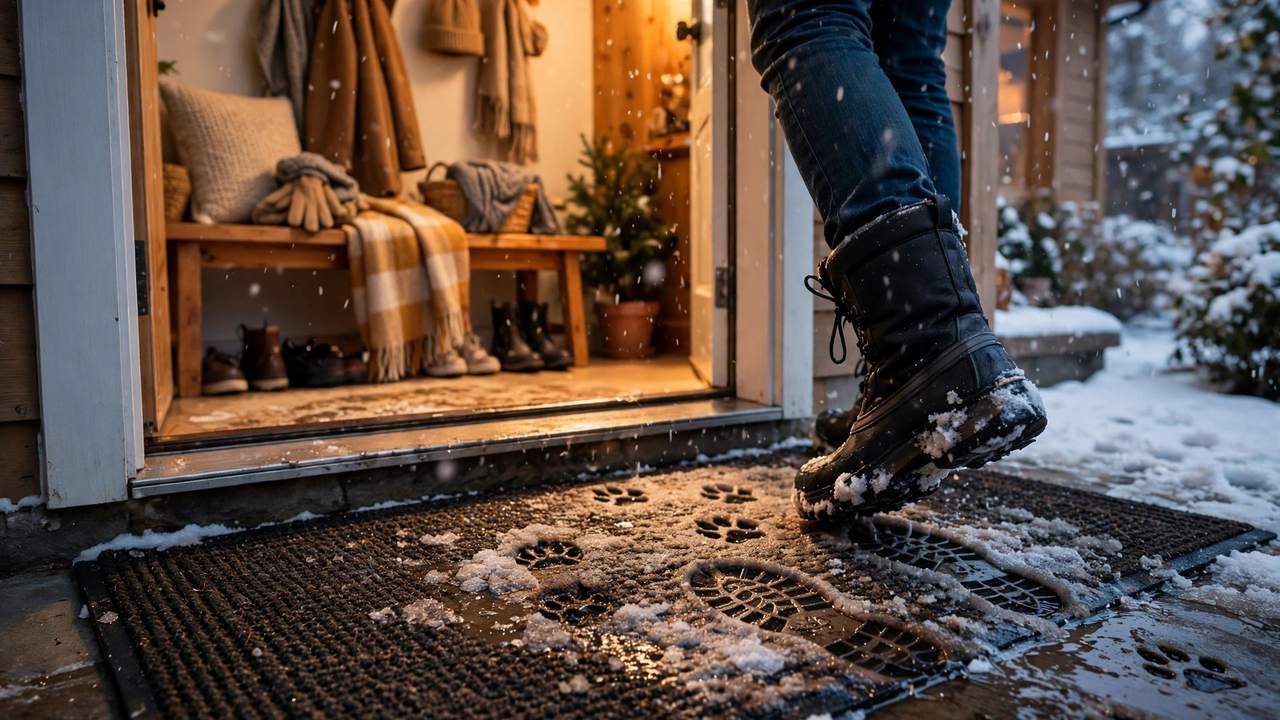
Snow looks harmless on a boot tread until it crosses the threshold. A single pair of winter boots can carry a surprising amount of packed snow into an entryway, and once indoor heat gets to it, that snow becomes meltwater mixed with road salt, sand, and grit. The puddle spreads across hardwood, seeps into grout lines, and leaves white salt rings that are far harder to remove than the snow was to track in. That is why the best outside rugs for snow absorbance are not decorative porch accessories. They are working mats, built to scrape boots clean and then hold the meltwater somewhere other than your floor.
The mats in this guide fall into two broad families. The first is the scraper-absorber: a bi-level mat with raised nubs or ribs that strip snow and slush off soles, plus recessed channels and a raised border — often called a water dam — that contain the liquid until it evaporates or gets vacuumed out. The second is the true absorber: a plush fiber mat, usually chenille microfiber, that drinks water into its pile the way a towel does. Both approaches work for snow, but they suit different doors. An exposed front step in a snow belt needs containment and a backing that stays flexible in the cold. A covered porch or a mudroom door just inside the garage may do better with a soft absorbent mat that can go in the washing machine.
Every absorbency figure in this article is a figure the maker itself lists on an opened product or specification page. Where a maker publishes a capacity — gallons per square yard held inside a water dam border, or cups of water absorbed by a fiber top — we quote that figure and name it as the maker’s own. Where a maker does not publish a number, we describe the construction that does the work instead of guessing at a capacity. Snow performance is not a single spec, so read the construction details as carefully as the headline numbers.
Quick verdict
For most snowy doorways, the WaterHog Classic Entrance Mat (No. 200) is the benchmark pick: the maker lists a water dam border that holds up to 1.5 gallons of water per square yard, a bi-level waffle surface that scrapes and traps below foot level, and a heavy rubber backing that tolerates indoor and outdoor placement. If you want the same WaterHog idea in a smaller, more decorative residential format, the Bungalow Flooring WaterHog Squares Door Mat brings the raised water dam border and recycled PET fiber surface down to a 2 by 3 foot door mat size.
Shoppers who prefer a soft, low-profile mat should look at the two Gorilla Grip options. The GORILLA GRIP HydroABSORB Doormat is the absorbency specialist of the line — the maker lists it as holding up to 5.7 cups of water in the 35 by 23 inch size — while the GORILLA GRIP WeatherMax Doormat leans harder on deep grooves, a beveled rubber border, and a retention dam for all-season scraping. Households with dogs and heavy boot traffic just inside the door may prefer the Muddy Mat Original Chenille Door Mat, a plush microfiber mat the maker lists as soaking up to five times its weight in water, and one that can be machine washed when the salt season ends. Finally, the NoTrax 109 Brush Step Entrance Mat is the commercial-style option: a ribbed polypropylene carpet surface on a vinyl moisture-barrier backing, sized up to runner lengths for busy mudrooms, garages, and covered porches.
The products in this guide
WaterHog Classic Entrance Mat (No. 200)
Around the edge, the maker lists a raised rubber water dam border, and it publishes the number that matters for snow season — the border allows the
Absorbent carpet surface pulls moisture from boots
Vinyl moisture barrier
3 x 5 ft
Covered porches, garages, and busy mudrooms
How we selected
We started with the job description rather than a brand list. A mat earns a place here only if it is built to handle snowmelt and slush at a doorway: it must scrape or wipe boots, it must give the resulting water somewhere to go, and it must keep that water off the floor underneath. Decorative coir mats, thin printed rugs, and drainage-only rubber mats were left out, because coir saturates and freezes stiff in sustained cold, and a drainage mat by design lets meltwater run off rather than absorbing or containing it.
Each product below was verified on opened pages — the maker’s own product or specification material, an opened Amazon listing, or both. We recorded the brand, the exact product name, and the model or item number from those pages, and we only kept products whose construction and snow-relevant features could be confirmed there. Absorbency claims are quoted only where the maker publishes them; a mat with no published capacity figure is described by its construction instead. Products that could not be verified on opened pages were excluded entirely rather than written up from secondhand summaries.
We also weighed the practical details that decide whether a snow mat actually gets used all winter: thickness against door clearance, backing behavior on hard floors versus carpet, whether the mat is rated by its maker for outdoor or covered-outdoor placement, and how it is cleaned once it is full of salt and grit. A mat that has to be dragged inside and hosed down every day will be skipped by real households, so vacuum- and hose-friendly designs scored well.
The WaterHog Classic is the mat that defined this category, and its specification sheet explains why it still anchors a snowy entryway better than most. The maker lists a bi-level surface: raised, rubber-reinforced nubs stand above recessed channels, so boot soles get scraped at the top level while snow, slush, and grit fall into the valleys below foot level, where the next pair of boots cannot pick them back up. Around the edge, the maker lists a raised rubber water dam border, and it publishes the number that matters for snow season — the border allows the mat to hold up to 1.5 gallons of water per square yard. On a 3 by 6 foot mat, that is a substantial reservoir for a day of meltwater from a busy household.
The surface fiber matters as much as the border. The maker lists a 24 ounce per square yard solution-dyed polypropylene surface that is anti-static, dries quickly, and will not fade or rot, with a nub height of one quarter inch and an overall thickness of three eighths of an inch — low enough for most door swings, though tight door sweeps should still be measured. The backing is listed as 100 percent SBR rubber with 20 percent recycled content, offered in a cleated version for carpet and a smooth version for hard floors, and the maker lists the mat as certified slip resistant by the National Floor Safety Institute. Sizes run from small 2 by 3 foot mats up to 6 by 20 foot runners, with custom lengths available, so a long mudroom or a garage-side entry can be covered in one piece instead of two mats with a gap between them.
For snow specifically, the Classic’s strengths compound. Polypropylene does not drink water into the fiber the way natural fibers do, so the mat does not turn into a frozen, waterlogged board after a freeze-thaw cycle; the meltwater sits in the channels and the dam until it evaporates or is extracted. Cleaning matches that design — the maker lists vacuuming, hosing off, or steam cleaning — which makes the end-of-storm salt purge a five-minute job rather than a laundry project.
Buy it if your door takes direct weather, your household cycles through it in boots all winter, and you want the largest maker-published water capacity in this guide.
Skip it if your door clearance is under three eighths of an inch, or you want a soft, plush feel underfoot rather than a firm commercial surface.
Bungalow Flooring takes the WaterHog concept and packages it as a residential door mat, and the Squares version is the one sized for an ordinary front door. The reference listing is the 2 by 3 foot mat in Camel (actual dimensions listed as 23 by 35.5 inches), with a needle-punched polyester surface in a checkered squares pattern. The maker lists an anti-static PET fiber surface made from up to 90 percent recycled content, and — the feature that earns it a place in a snow guide — the exclusive Water Dam raised border that traps dirt and moisture on the mat instead of letting meltwater sheet across the entry floor.
The backing is listed as skid-resistant SBR rubber crafted from 20 percent recycled rubber, and the maker lists the mat as supported by the National Floor Safety Institute for slip resistance. At a listed thickness of one quarter inch, the Squares mat sits lower than the commercial Classic, which helps under residential doors with tight sweeps, and the listed weight of about four pounds in this size keeps it easy to pick up, shake out, and hose down. The maker lists it for both indoor and outdoor use and describes the commercial-grade construction as resisting crushing and breakdown over time, which is the failure mode of cheap foam-backed mats after one winter of boot traffic.
Choose this over the No. 200 when the door is a standard single residential entry and a 3 by 6 foot commercial mat would overwhelm the space. You give up total water capacity — a smaller mat with a smaller dam simply holds less meltwater — but you keep the same scrape-trap-contain logic in a size and a set of decorative patterns that look at home on a porch. In heavy snow country, pair it with a second absorbent mat just inside the door and the two-stage system handles what either mat alone would miss.
Buy it if you want WaterHog-style water dam containment in a standard door mat size with a decorative pattern and a lower profile.
Skip it if your entry is wide, double-doored, or mudroom-sized — step up to the Classic’s larger sizes instead of undersizing the mat.
Gorilla Grip describes the HydroABSORB as its most absorbent door mat, and it is the one model in the line where the maker puts a household-scale absorbency number on the listing: the 35 by 23 inch mat is listed as holding up to 5.7 cups of water. That is a different kind of figure from the WaterHog’s gallons per square yard — it describes a soft polyester topside that pulls moisture in on contact, backed by a water dam border and a bi-level design with deep grooves and raised square textures that scrape boots while the fiber drinks. For a covered porch or a door just inside a garage, where snow arrives on boots rather than falling on the mat itself, that contact absorbency is exactly the mechanism you want.
The maker lists a textured rubber backing to keep the mat planted on hard floors, a low profile of three tenths of an inch so doors swing over it freely, and a topside that is stain, weather, and fade resistant for indoor or outdoor use. The soft surface is also the comfort pick of this guide: unlike the firm nubbed WaterHog surface, the HydroABSORB feels like a textile mat under stocking feet, which matters at a door that doubles as a mudroom pass-through used all day. Raised textures in the surface do the scraping, so it gives up some of the aggressive grit-stripping of a commercial bi-level mat in exchange for absorbency and softness.
Keep its limits in mind. A fiber absorber has a finite capacity — once the topside is saturated, additional meltwater has only the border dam to rely on — so on the stormiest days it benefits from a shake-out or a swap. It is best understood as the high-absorbency second stage or the primary mat for a sheltered door, rather than the lone defense on an exposed step in a blizzard.
Buy it if your door is covered or just inside the garage, you want the strongest maker-listed absorbency in a soft mat, and your door clearance is tight.
Skip it if your mat will sit fully exposed to falling snow all winter; a dam-and-channel scraper mat handles direct accumulation better.
The WeatherMax is Gorilla Grip’s original all-season doormat, and its design splits the snow job between three features the maker lists: deep patterned grooves in a woven topside that capture dirt, mud, and moisture; a beveled rubber border; and a retention dam that helps keep excess water on the mat rather than on the floor. Where the HydroABSORB leads with absorbency, the WeatherMax leads with scraping and containment, which makes it the better of the two for an uncovered door where boots arrive carrying packed snow that needs to be stripped off mechanically before it can melt.
The maker lists a durable natural rubber backing — noting that natural rubber provides higher tensile strength and tear resistance — and a waterproof, stain, weather, and fade resistant construction intended for all conditions from snow and rain to mud and sand. The reference size here is 35 by 23 inches, with a listed thickness of three tenths of an inch, so like its sibling it clears most door swings. The maker lists it for high-traffic indoor and outdoor use, and the soft woven topside is comfortable enough that the same mat works inside the door as a second stage during the worst weeks of winter.
The trade-off is absorbency capacity: the maker does not publish a cups-or-gallons figure for the WeatherMax, rating its absorbency qualitatively instead, so if your primary problem is volume of meltwater rather than grit and packed snow, the HydroABSORB or a WaterHog is the more accountable choice. If your problem is the gray slush paste of salt, sand, and half-melted snow that boots grind into a mat, the WeatherMax’s grooves and dam are built precisely for that mixture, and its all-season rating means it simply stays in place when the season turns to mud and then to summer dust.
Buy it if you want one all-season mat that scrapes packed snow and slush, contains meltwater behind a retention dam, and stays out year-round.
Skip it if you need a published absorbency capacity to size your mat — the maker lists this model’s strength as capture and containment, not a measured volume.
The Muddy Mat takes the opposite approach from the scraper mats above: instead of channels and dams, it uses a thick layer of plush chenille microfiber — the maker lists a one inch pile — that the maker lists as soaking up to five times its weight in water. Snow on boots and paws meets thousands of soft microfiber fingers that wick meltwater down into the pile and hold it there, which is why the brand built its name on muddy dog paws. The reference listing is the 18 by 28 inch mat in Charcoal, and the maker lists this version for both indoor and outdoor use, with a textured thermoplastic rubber backing for grip on tile and hardwood.
Two practical features set it apart for winter duty. First, it is machine washable: the maker lists cold washing on a gentle cycle and low-heat drying, so the gray salt crust that builds up by February can be laundered out instead of hosed into the driveway. Second, it is soft and quiet — no rubber nubs, no scraping noise — which suits a door inside a mudroom, a laundry room entry from the garage, or any spot where people cross in socks as often as in boots. The maker also lists the mat as OEKO-TEX Standard 100 certified, and it carries the brand’s positioning as the official anti-mud mat of the American Kennel Club, a hint at the pet traffic it was designed around.
Its snow limits are honest ones. A one inch plush pile will not fit under a low-swinging door, and a soft absorber does not scrape packed snow out of deep boot treads the way a bi-level nub surface does; it catches what melts and what wipes off, not what is frozen into the lug pattern. Use it as the inside partner to an outdoor scraper mat, or as the primary mat at a sheltered door, and it excels. Ask it to be the only line of defense on an exposed step and the scraper mats above will outlast it.
Buy it if dogs and boots cross a sheltered or indoor-side door all day, and you want maximum wipe-off absorbency plus machine washing.
Skip it if your door clearance is under an inch, or the mat must scrape packed snow from deep boot treads outdoors.
NoTrax comes from the commercial matting world, and the 109 Brush Step shows it: a heavyweight polypropylene carpet surface with a double-rib pattern, built to scrape shoes, trap debris, and pull moisture off boots across thousands of passes. The maker lists the absorbent carpet surface as the moisture mechanism — the ribbed pile wipes soles and holds water in the fiber — while a sturdy vinyl backing underneath acts as a waterproof moisture barrier, so what the carpet absorbs stays in the mat instead of reaching hardwood or tile. The reference size is 3 by 5 feet in Charcoal, and the line runs to runner lengths such as 3 by 10 feet for long mudrooms and garage entries.
The maker lists beveled edges and a low profile that will not interfere with door swing, a vinyl back that limits sliding on hard floors, and construction in the USA. It also positions the mat honestly for placement: ideal indoors or outdoors in a covered area. That covered-area guidance is worth respecting in snow country. A carpeted wiper mat under a porch roof or inside a garage handles boot meltwater beautifully and dries quickly because, as the maker notes, the surface does not retain moisture for long. Left fully exposed, the same carpet face would take on falling snow faster than it can dry between storms.
Think of the Brush Step as the high-capacity wiper stage of an entry system. Put a scraper outside the door if the door is exposed, then let this mat’s ribbed carpet finish the job across a long walking path — its runner sizes are the real advantage, because every extra step on an absorbent surface is more meltwater that never reaches the floor. For a busy household mudroom, a farmhouse back entry, or a small business door, that commercial logic translates directly to residential winter.
Buy it if you need long runner coverage in a mudroom, garage entry, or covered porch, with a vinyl barrier protecting the floor beneath.
Skip it if the mat will sit fully exposed to snowfall; the maker positions this carpeted design for indoor or covered placement.
Buying guide
Match the mechanism to the door. Snow reaches a mat in two ways: carried in on boots, or falling on the mat itself. Carried-in snow melts on contact with indoor warmth and needs absorbency or containment at the point of entry. Falling snow needs a scraper surface and a dam, because the mat must hold accumulation until someone shakes it off. Exposed doors should start with a bi-level scraper mat with a water dam border — the WaterHog pattern — while covered doors can lead with an absorbent fiber mat.
Read absorbency figures in their own units. Makers publish capacity three ways: gallons per square yard held inside a border, total cups a fiber top can absorb, and multiples of the mat’s own weight. These numbers are not directly interchangeable, because a dam figure describes containment while a fiber figure describes uptake. What you can compare is scale against your traffic: a household of two with a garaged car produces a fraction of the meltwater of a farmhouse door with kids, dogs, and a bus stop. When a maker publishes no figure at all, judge the mat on construction — groove depth, border height, fiber type — and on placement guidance.
Size for steps, not for the door slab. A mat only absorbs what boots actually touch. One step on a small mat removes some snow; two full steps remove most of it. As a working rule, give each regular user at least two footfalls on the mat — that usually means a mat at least three feet deep at a busy door, or a runner where the walking path is long. Undersized mats are the most common reason a good product gets blamed for a wet floor.
Check thickness against door clearance. The mats in this guide range from about a quarter inch to a full inch of plush pile. Measure the gap under your door at its lowest point, including any sweep or weatherstrip, and leave a small margin for the mat to sit slightly unevenly on stone or concrete. Low-profile rubber-backed mats around three tenths of an inch clear most modern doors; plush chenille belongs at doors with generous clearance or on the indoor side.
Plan the drying cycle. Every absorbent mat eventually fills up. Mats that can be vacuumed with a wet-capable vacuum, hosed off, or machine washed get reset to full capacity in minutes; mats that can only air-dry need a rotation partner in storm weeks. Rubber and SBR backings also protect the floor under the mat, but lift any mat periodically in a long winter to let the surface beneath dry — trapped moisture under a waterproof backing is the one puddle a good mat can create by accident.
Consider a two-mat system. Commercial buildings solve snow with stages: scraper outside, wiper inside. Homes can copy the pattern cheaply — a WaterHog or WeatherMax at the exposed side, a Muddy Mat or Brush Step just inside — and the combination outperforms any single mat, because each stage only has to do the half of the job it is built for.
FAQ
Can an outdoor rug really absorb snow, or does the snow need to melt first?
Both mechanisms are at work. Scraper surfaces strip packed snow off boot treads mechanically, before it melts. The meltwater that follows is what absorbency figures describe: fiber mats drink it into the pile, while dam-border mats contain it in recessed channels. A good snow mat does the scraping and the water handling in sequence, which is why bi-level designs dominate this category.
How much water can a water dam border actually hold?
It depends on the mat, and the honest answer comes from the maker’s own listing. For the WaterHog Classic, the maker lists the raised rubber water dam border as holding up to 1.5 gallons of water per square yard. Smaller residential mats hold proportionally less, which is one reason sizing the mat to your traffic matters more than any single headline figure.
Will a plush absorbent mat freeze stiff outdoors?
Natural fibers such as coir are the most prone to saturating and freezing into a board. Synthetic piles — polyester, polypropylene, and microfiber chenille — absorb water into the pile structure rather than the fiber itself and stay more flexible, but any fully saturated mat left in hard frost will stiffen. In sustained sub-freezing weather, plush absorbent mats perform best at covered doors or just inside the entry, with a scraper mat outside.
How do I clean salt and grit out of a snow mat?
Start dry: shake the mat out and vacuum it to remove grit and dried salt before adding water, so you are not grinding abrasive grit into the pile. Rubber-backed scraper mats can then be hosed off and left to dry. Machine-washable mats such as the Muddy Mat follow the maker’s listed care — cold water, gentle cycle, low-heat drying. Whatever the type, let the mat dry fully before it goes back into service, and check the floor beneath it at the same time.
What size mat do I need for a snowy entryway?
Size for footfalls: each person should get at least two steps on the mat. For a standard single door, that points to a mat around 3 feet deep and as wide as the door plus its trim; for mudrooms and garage entries, a runner of 5 to 10 feet gives boots, paws, and stroller wheels repeated contact with the absorbent surface. When in doubt, go one size up — unused mat area costs nothing, but a too-small mat fails at its only job.
Can I use one of these mats on carpet or only on hard floors?
Most rubber-backed mats in this guide are listed for both indoor and outdoor placement, but backing style matters on carpet: the WaterHog Classic, for example, is offered with a cleated backing for carpeted surfaces and a smooth backing for hard floors. On hard floors, a textured or cleated underside limits sliding; on carpet, choose the cleated option where the maker offers one so the mat does not creep under traffic.
Conclusion
Snow at the door is a water-management problem wearing a winter costume. The mats that solve it pair a scraping or wiping surface with somewhere for the meltwater to go — a water dam border holding a maker-listed volume, a fiber pile with a published absorbency, or a carpet face over a moisture-barrier backing. Start with the WaterHog Classic if your door faces the weather head-on, choose the Bungalow WaterHog Squares for a standard residential door, lean on the Gorilla Grip HydroABSORB or WeatherMax for low-profile absorbency and scraping, add the Muddy Mat where dogs and washable softness matter, and run the NoTrax Brush Step long in mudrooms and covered entries. Match the mechanism to your door, size for two footfalls, and keep up the drying cycle, and the only snow in your entryway this winter will be the kind that stays on the mat.
M
Modern Line Home Editorial Team
We compare specs, materials and verified owner reviews before a product earns a spot. Rankings are never paid.
Affiliate disclosure. As an Amazon Associate we earn from qualifying purchases at no extra cost to you. Prices accurate as of the date shown.
House cold even with the heat on? Walk this ordered checklist: thermostat and filter first, then drafts, insulation, leaky ducts and a failing heating system.
Windows fogging up in winter? Check where the fog sits: on the room side it is indoor humidity, outside it is harmless, and between panes the seal has failed.
Store the main firewood pile about 30 feet from your house, off the ground and covered only on top. Compare racks, woodsheds, garages and indoor spots safely.
Place a portable generator outdoors only, at least 20 feet from windows, doors and vents, exhaust pointed away. Exact distances, setup steps and CO rules here.
Keep houseplants in the right winter spot: match window direction to plant type, stay clear of radiators and cold glass, and fix dry air and low light at home.
Mice enter through pencil-width gaps at foundations, pipes, vents, doors and the roofline. Walk this room-by-room winter checklist to find and seal each one.
A winter outage timeline: what to do in the first hour, first night and multi-day outage, with food safety times, pipe protection, heat and CO safety steps.
Size a space heater by room area: 10 watts per square foot at 8-foot ceilings, adjusted for insulation and ceiling height, with full wattage and BTU tables.
Start dripping at about 20 degrees, sooner for exposed pipes. Set a pencil-lead stream, drip the right faucets on both lines, and know when to stop safely.
A fridge needs 800-1,200 starting watts, not just 150-400 running watts. Use the tables to total your fridge plus freezer, lights, furnace fan and more today.












Write Your Review
No reviews yet. Be the first to share your experience!