We independently review everything we recommend. When you buy through our links, we may earn a commission. As an Amazon Associate we earn from qualifying purchases.
Best All-Weather Floor Mats for Snowy Climates: 6 Picks
Find the best all-weather floor mats for snowy climates, with custom-fit picks by vehicle, verified materials, raised edges and honest universal-fit limits.
Find the best all-weather floor mats for snowy climates, with custom-fit picks by vehicle, verified materials, raised edges and honest universal-fit limits.
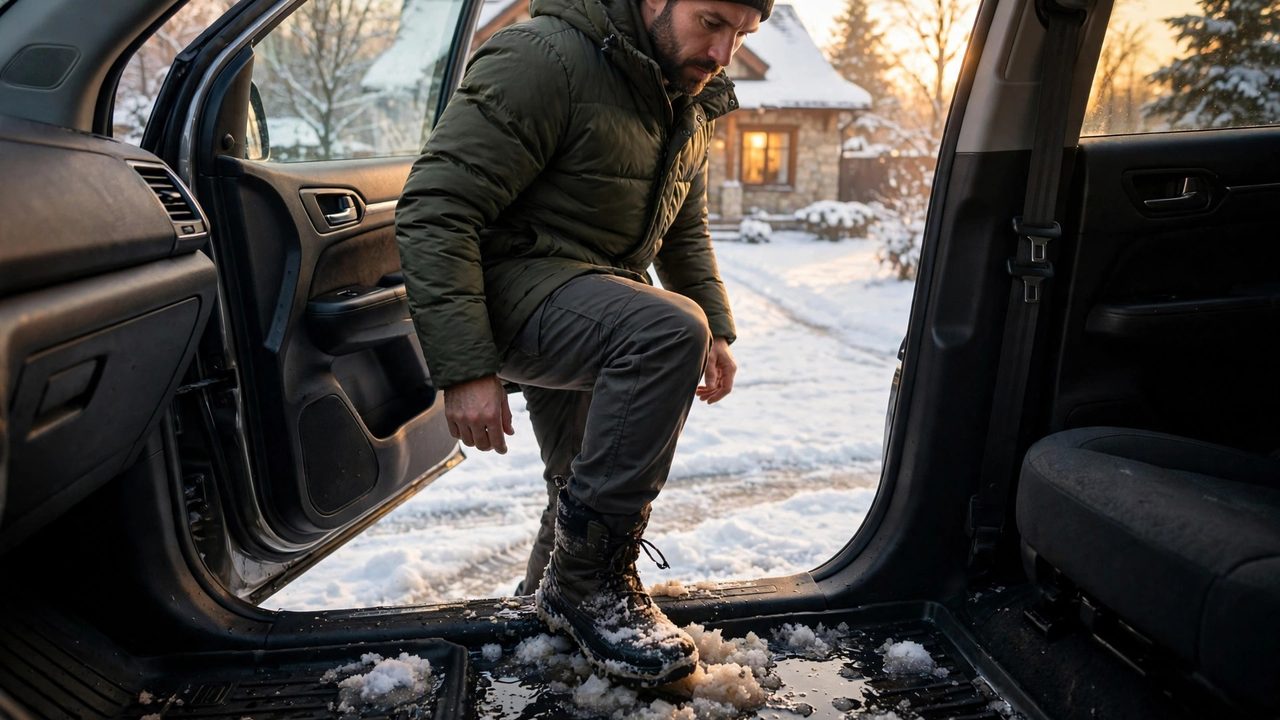
Snow changes what a floor mat has to do. In dry weather a flat mat mostly catches dust and grit. In a snowy climate it has to catch melting snow, road salt, sand and slush carried in on boots, hold that liquid until you can empty it, and stay in place on a carpet that may already be damp. It also has to keep working when temperatures fall, because a material that stiffens, curls or cracks in the cold leaves gaps exactly where meltwater runs. Choosing the best all weather floor mats for snowy climates therefore starts with fit, not with colour or tread pattern.
That is why this guide is organised by vehicle. Five of the six picks below are custom-fit liners made for one named vehicle, cab style or seating layout. They are not interchangeable. A liner moulded for a Toyota Tundra CrewMax does not fit a Ford Super Duty, and a liner for a Tesla Model Y from one model year should not be assumed to fit another year or seating layout. The sixth pick is different on purpose: it is a universal trim-to-fit set, and it is labelled as universal everywhere it appears. A universal mat can be useful, especially for an older vehicle or a second car, but it is not custom-fit, it will not follow the footwell walls in the same way, and it should never be bought expecting the coverage of a laser-measured liner.
Read each pick by its exact fitment first. Check the year range, the cab or body style, the row coverage and any storage or seat conditions the maker lists. Only after that match is confirmed does it make sense to compare materials, edge design, cleaning and how many rows are included. If your exact vehicle is not named in a pick, that pick is not for you, however good the material sounds. Use the buying guide at the end to apply the same checks to the correct listing for your own vehicle.
Quick verdict
For the closest, most complete footwell coverage in snow, start with a custom-fit liner made for your exact vehicle. The WeatherTech FloorLiner HP listed here, for the Buick Envista and Chevrolet Trax first row, is the clearest example of a laser-measured thermoplastic elastomer liner shaped to the front, back and sides of the footwell. Truck owners have two distinct Husky Liners routes: the Weatherbeater set for the Toyota Tundra CrewMax covers the front and second rows, while the X-act Contour set for Ford Super Duty trucks covers the front row only in the listing checked. The LASFIT set is specific to Chevrolet Silverado and GMC Sierra crew cabs with a particular rear storage condition, and the 3D MAXpider Kagu set is specific to the five-seat Tesla Model Y named on its listing, with a layered build that differs from a single-sheet liner.
If none of those vehicles is yours, do not force the fit. Either find the same product line in the listing made for your vehicle and verify that listing separately, or consider the Motor Trend FlexTough set as an honestly universal, trim-to-fit option and accept its limits. In snowy use, a correctly fitted mid-level liner will protect carpet better than a premium liner bought for the wrong cab.
The products in this guide
WeatherTech FloorLiner HP Custom Fit Floor Mats for Buick Envista, Trax 1st Row (4418221IM)
This is a custom-fit, first-row-only liner set for the Buick Envista and the Chevrolet Trax named on the listing, with part number 4418221IM
Best if you drive the Buick Envista or Chevrolet Trax named on the listing
No single vehicle; trimmed by the owner for cars, trucks and SUVs
Front and rear set
Rubber
The table makes the central point of this guide visible at a glance. Five rows name a vehicle. One row does not, because it cannot. If you remember nothing else, remember to shop in that order: vehicle first, row coverage second, material third.
How we selected
Products were included only when their identity, fitment and basic specifications could be verified on opened pages. Each pick below was checked on its Amazon product page for a live offer for a new product, and the model number, fit type and material in this article are taken from that listing as the maker and seller present them. Products whose pages could not be opened, whose fitment could not be pinned to an exact model, or whose offer was not live were excluded rather than described from memory or from a search snippet.
Fit was the first filter. For custom-fit picks, the listing had to name the vehicle, the relevant year range and, where the maker states it, the cab style, seating layout or storage condition. That level of detail matters for floor mats more than for most accessories, because two trucks with the same name can have different rear floors, and a mat that is correct for a crew cab can be wrong for another cab. Where a listing adds a condition, such as a rear under-seat storage box, that condition is repeated in the pick rather than smoothed away.
Material was the second filter, reported only as listed. Thermoplastic elastomer, the ProGard and ProCore formulas named on the Husky Liners listings, thermoplastic rubber over a foam core, and the rubber used in the universal Motor Trend set are described in the makers’ own terms. This article does not invent a numeric temperature rating for a product whose opened page does not state one. Where a maker says a material is made to stand up to extreme weather, or that a liner will not crack, curl or break down in extreme conditions, that claim is attributed to the maker. Where no specific low-temperature limit is listed, the honest advice is to treat cold flexibility as a question to confirm for your climate, not as a number you can assume.
Snow-specific design was the third filter. Raised edges, a formed edge that helps contain liquid, channels or a deep-dish shape, and a backing or nib system intended to keep the liner from shifting were all relevant, because meltwater management is the main winter job. Coverage was also considered: a first-row-only set can be the right purchase, but it leaves the second row unprotected, and this guide says so for each pick instead of implying full-cabin coverage.
Finally, universal mats were kept in a separate category. One universal set is included because many readers need a lower-commitment option or drive a vehicle for which they have not found a custom listing. It is presented as universal and trim-to-fit from its heading onward, with its limits stated plainly. It is not ranked as if trimming a flat mat with scissors produced the same result as a laser-scanned liner.
This is a custom-fit, first-row-only liner set for the Buick Envista and the Chevrolet Trax named on the listing, with part number 4418221IM. That narrow scope is a strength if it matches your car and a complete disqualifier if it does not. The maker lists the fit type as vehicle specific, and describes the FloorLiner HP as laser measured for the vehicle, shaped to protect the carpeted floor and the front, back and sides of the footwell. For snowy use, that side coverage matters, because meltwater does not stay politely in the middle of the mat. It runs toward the edges, toward the sill and toward the carpet at the side of the footwell, which is exactly the area a flat mat leaves exposed.
The maker lists the material as an advanced rubber-like thermoplastic elastomer compound, described as soft and durable, and states that it is made to stand up to extreme weather conditions without cracking, curling or breaking down. The maker also lists the material as recyclable and free from latex and PVC. No specific numeric low-temperature limit is stated in the material checked for this guide, so do not read a particular degree figure into that extreme-weather description. What is verified is the material type, the custom moulding and the first-row scope.
Because this listing covers the first row only, Envista and Trax owners who regularly carry rear passengers in winter will need separate second-row protection. That is not a flaw in the liner; it is the boundary of this particular part number. Other FloorLiner HP part numbers exist for other vehicles and rows, but each has its own listing and its own fitment, and each would need to be verified on its own page before ordering.
Buy it if: you drive the Buick Envista or Chevrolet Trax named on the listing and you want a laser-measured, custom-fit first-row liner in thermoplastic elastomer for snow and slush.
Skip it if: your vehicle is a different model or year, or you need second-row coverage included in the same set.
The Weatherbeater set with model number 99481 is a custom-fit, three-piece set for the front and second rows of the Toyota Tundra CrewMax, listed for 2022-2027. The cab condition is essential: the listing is for the CrewMax cab only. A Tundra with a different cab is a different floor, and this set should not be ordered for it. Within that fitment, the two-row coverage is well suited to snowy family or work use, because rear passengers track in as much snow as the driver does.
The maker lists the material as its ProGard formula and describes the Weatherbeater as combining a laser-tight fit with durability, a FormFit Edge that helps keep spills contained, and hundreds of StayPut Nibs on the backing to anchor the liner and reduce slipping and sliding. The maker also lists the material as free from latex, PVC, cadmium, lead and other harmful substances named on the page. Those details address the two common winter failures of cheaper mats: liquid escaping over a low or poorly fitted edge, and the liner creeping forward under wet boots.
The maker presents the Weatherbeater line as its original all-weather liner, ready for rain and snow, with construction intended to avoid edge curl. As with the WeatherTech pick, the opened listing checked here does not turn that cold-weather positioning into a single numeric temperature limit that this article can quote, so none is invented. Judge it on the verified points: exact CrewMax fitment, two-row coverage, the named ProGard material, the formed edge and the nib backing.
Cleaning is part of winter value. A liner that contains slush is only useful if you can lift it out, empty it and put it back without a struggle. A moulded set covering both rows gives Tundra owners that routine for the whole cabin in one purchase, rather than protecting the front footwells and leaving rear carpet to absorb salt water all season.
Buy it if: you drive a 2022-2027 Toyota Tundra CrewMax and you want custom-fit protection for both rows in one three-piece set.
Skip it if: your Tundra has a different cab, your truck is a different model, or you only want a front-row set.
Model number 52731 is a custom-fit, front-row, two-piece X-act Contour set for Ford Super Duty trucks. The listing names the F-250, F-350 and F-450 Super Duty, in SuperCrew and SuperCab configurations, for 2017-2027. Read that fitment carefully before ordering, because Super Duty floors vary by cab, and the listing’s own scope is the authority. The maker lists the product dimensions for this set as 33 inches long by 24 inches wide by 2 inches thick, and the fit type as vehicle specific. Those dimensions belong to this front-row set; they are not a universal size to apply to other trucks.
The maker lists the material as its ProCore formula, a different named formula from the ProGard material on the Weatherbeater pick above, which is why the two Husky Liners products are not treated as the same mat in different boxes. For the X-act Contour, the maker describes a precision, laser-scanned contour fit that lies flat, a FormFit Edge along the perimeter to help capture water, debris and spills before they reach the carpet, and hundreds of StayPut Nibs for a stable, no-shift foundation. The maker describes the cleaning routine simply: remove the liners, rinse them, and return them.
For a work truck in a snowy region, the front row is where the worst of winter lands: the driver’s boots, repeated in and out trips, and grit carried from yards and sites. A front-row custom set can therefore be a deliberate, sufficient purchase for a Super Duty used mainly by a driver and one passenger. It is not, however, a full-cabin solution. If rear-seat passengers are regular in winter, budget for the correct second-row liner for your cab separately, in its own listing.
The maker also lists this material as free from latex, PVC, cadmium, lead and other harmful substances named on the page. No numeric low-temperature rating is quoted here because the opened page checked does not state one in a form this guide can verify as a limit. The verified winter case rests on fit, edge, backing and the maker’s all-weather positioning for the line.
Buy it if: you drive a 2017-2027 Ford Super Duty in one of the cab styles named on the listing and you want a custom-fit front-row set with a formed perimeter edge.
Skip it if: you need second-row mats included, or your Ford truck is a different series or cab from the fitment listed.
The LASFIT set, model LL-CH01, shows why the storage condition in a listing cannot be skipped. The maker lists it for Chevrolet Silverado and GMC Sierra 1500 models from 2019-2026 and for 2500 HD and 3500 HD models from 2020-2027, crew cab and bucket seats only, made to fit with the rear under-seat storage box and not to fit the second-row plastic storage configuration named on the page. Two trucks that look the same from outside can therefore need different mats. Confirm the cab, the front seat type and the rear storage arrangement before anything else.
Within that fitment, the maker lists the material as thermoplastic elastomer and describes the use of 3D laser scanning to capture the interior for edge-to-edge coverage based on the exact make, model and year. The maker lists raised edges all the way around, upgraded to help shield the floor from dirt, mud, salt, rain and snow, and describes the surface as waterproof and anti-slip, with the set easy to install and remove. The maker lists the product dimensions as 35.4 inches long by 28.7 inches wide by 3.9 inches thick for the set as presented on the page. Salt is named explicitly in that protection list, which is relevant for snowy climates where treated roads leave white residue that works into carpet if meltwater escapes.
The maker also presents the thermoplastic elastomer as an eco-friendlier material choice in its listing copy and notes support and returns terms on the page; check those terms on the listing itself if they matter to your purchase, because they can change. This guide does not convert the maker’s all-weather and summer-heat references into a numeric temperature range, because no verified numeric low limit for this set is stated in the material checked.
This is the most condition-heavy pick in the guide, and that is precisely why it is useful as an example. A correct LL-CH01 order is a genuinely custom fit. An order placed without checking the storage condition is a guess, and in a crew cab the second-row piece is where a wrong guess shows first.
Buy it if: your Silverado or Sierra matches every condition on the listing, including crew cab, bucket seats and the rear under-seat storage arrangement.
Skip it if: your truck has a different cab, different front seats, the plastic second-row storage named as excluded, or any year outside the ranges listed.
This Kagu set, model L1TL01701509, is a custom-fit full set for the Tesla Model Y five-seat model named on the listing for 2020, covering the first and second rows. Model Y fitments are year and seating specific, so the five-seat and year details are part of the product, not fine print. A Model Y with a different seating layout, or from a different model-year group, needs its own Kagu listing, verified separately.
The Kagu build differs from the single-material liners above. The maker describes a premium multi-layer design: thermoplastic rubber for waterproof protection, a cross-linked polyethylene foam layer for comfort and noise reduction, and a backing intended to grip the carpet and keep the mat in place. The listing describes raised side edges to help protect against dirt, mud, rain and snow, and presents the series as designed for all-weather protection from dirt, mud, salt, rain and snow. The maker lists the material on the page as rubber and thermoplastic elastomer, and the fit type as vehicle specific.
That layered construction is the reason to consider this pick beyond fit alone. In an electric vehicle used through winter, the foam core is listed by the maker as adding comfort and helping with noise, while the top layer handles the waterproof job. This article does not claim a measured noise reduction or a temperature limit, because the opened page does not state verified figures for either that can be quoted responsibly. What is verified is the three-part construction as described, the raised edges, the full-set scope and the exact Model Y fitment.
Because the set covers both rows, it suits a Model Y that carries passengers through the snow season, not just a driver commuting alone. As with every custom pick here, confirm the listing title against your car before ordering, and read the model number back: L1TL01701509 for this set.
Buy it if: you drive the five-seat Tesla Model Y named on the listing and you want a full, two-row custom set with a layered, foam-core build.
Skip it if: your Model Y has a different seating layout or year group, or you prefer a single-material moulded liner without a foam layer.
This final pick is universal. It is not custom-fit for any vehicle, and nothing in this section should be read as suggesting otherwise. The Motor Trend FlexTough set, model MT-923-BK_NMM, is a trim-to-fit rubber set for cars, trucks and SUVs, designed to be cut with scissors along its trim lines to suit the floor contours of the vehicle you put it in. The maker lists the fit type as universal and the front mat dimensions as 27 inches long by 20 inches wide by 1 inch thick. Measure your footwells against those dimensions before ordering, because a universal mat that starts too small cannot be trimmed into a larger one, and a rear floor that is unusually wide or narrow may not be covered well.
The design is a deep-dish shape, which is the winter-relevant feature here. A deeper dish and raised channels give meltwater somewhere to sit instead of running straight off a flat surface, and the maker presents the set as waterproof, all-weather protection for the interior. The rubber construction is heavy duty in the maker’s description, and the set includes front and rear pieces, so one purchase covers both rows in a general way rather than in a moulded, vehicle-specific way.
The limits need equal emphasis. Trimming follows straight or stepped trim lines, not the exact curve of your transmission tunnel, seat rails or footwell walls. Edges that a custom liner climbs, a universal mat may leave partly exposed. The mat may need checking for pedal clearance after trimming, and it should never be allowed to bunch or ride up near the pedals. Fit it, trim it conservatively, re-check it, and confirm it lies flat and secure before driving. For a snowy climate, treat it as basic, broad protection, best for an older vehicle, a temporary car, or a driver who understands the trade and accepts it.
Where a custom listing exists for your exact vehicle and you plan to keep the car through several winters, the custom route is the stronger protection. Where it does not, or where the vehicle changes often, this universal set is an honest fallback, as long as it is bought as a fallback and not as a substitute with the same coverage.
Buy it if: you need universal, trim-to-fit coverage for both rows, you have measured your footwells against the listed dimensions, and you accept that the fit will be approximate.
Skip it if: you want laser-measured, edge-to-edge custom coverage for a specific vehicle, or your footwells are larger than the untrimmed mat dimensions listed.
Buying guide
Start with the vehicle, and be exact. Write down the year, make, model, cab or body style, seating layout and, for trucks, the rear storage arrangement. Then match that full description against a listing title and fitment notes. If any element differs, stop. Floor mats are one of the easiest purchases to get almost right and completely wrong at the same time, because almost right still leaves a raised edge sitting in the wrong place and a corner of carpet exposed to salt water.
Next, decide how many rows you actually need to protect in winter. A driver-only commuter car may be well served by a first-row custom set. A family SUV or a crew cab that carries passengers, children, dogs or work crews will soak its second row too. Compare sets by row coverage before comparing materials, and do not let a low headline scope hide the cost of adding the missing row later in a separate, correctly fitted listing.
Then look at containment. For snowy climates, the shape that holds liquid matters more than a decorative tread. Look for raised edges that run around the mat, a formed perimeter edge, or a deep-dish design, and for channels that keep meltwater away from the heel area. Think about emptying as well: a liner you can remove, tip out and rinse will be emptied often, while an awkward mat that traps slush in the car will be left full until it overflows.
Material comes after shape. Thermoplastic elastomer liners are moulded to hold a perimeter and are listed by their makers as standing up to extreme weather. Named proprietary formulas such as the ProGard and ProCore materials on the Husky Liners picks should be judged by what the maker lists for that exact product, not by assuming they are identical to each other or to another brand’s material. Layered mats such as the Kagu add a foam core that the maker lists for comfort and noise. Rubber universal mats are simpler and trimmable. In every case, if a specific low-temperature limit matters to you, look for that limit stated by the maker for that exact model. If it is not stated, do not invent one, and do not transfer a figure from a different product.
Check retention. A liner that slides on damp carpet is a nuisance and, near the pedals, a safety problem. Look for the backing system the maker lists, such as nibs that grip the carpet, compatibility with factory floor anchors where the maker states it, and a shape that lies flat without curling at the edges. After fitting any mat, custom or universal, confirm it sits flat, does not interfere with pedal movement, and does not bunch under the driver’s feet.
Measure if you are buying universal. Compare the untrimmed dimensions the maker lists with your footwells, allowing for the fact that trimming only removes material. Plan the trim in small steps, test the fit between cuts, and leave margin around pedals and seat rails. If the universal mat is too small in any direction that matters, return to the custom search rather than accepting exposed carpet in the highest-splash area.
Finally, plan winter care. Shake or empty liners before meltwater reaches the edge, rinse salt off regularly so it does not dry into the surface or transfer back onto boots and carpet, and let mats dry before refitting them over damp carpet. Store a summer set flat rather than folded if the maker advises flat storage for that material. A good liner makes this routine quick, which is a large part of why it protects better over a whole season than a mat that is technically adequate but unpleasant to handle.
FAQ
Are custom-fit mats really better than universal mats in snow?
For containment, generally yes, because a custom liner is moulded to the footwell and can carry its raised edge up the sides where meltwater runs. A universal trim-to-fit mat can hold slush in its dish, but its trimmed edges will not follow the vehicle as closely. The Motor Trend pick in this guide is included as a universal option with that limit stated, not as an equivalent to the custom picks.
How do I know which listing fits my truck?
Match the full description: year range, model, cab style, seat type and any storage condition the maker lists. The LASFIT pick, for example, is limited to crew cabs with bucket seats and a particular rear under-seat storage arrangement, and explicitly excludes another storage configuration. If your truck differs on any point, find the listing made for your configuration.
Do these mats have a minimum temperature rating?
The makers of the picks above describe extreme-weather or all-weather performance, but the opened listings checked for this guide do not state a single numeric low-temperature limit that can be quoted for each set. Do not assume a degree figure. If your climate regularly reaches extreme cold, confirm the limit with the maker for the exact model number before ordering.
Is a first-row-only set enough for winter?
It can be, if the second row is rarely used in winter. The WeatherTech and Husky Liners X-act Contour picks here are first-row sets for their named vehicles, and they protect the area that receives the most snow. If rear passengers ride regularly, add correctly fitted second-row protection rather than expecting a front set to cover the cabin.
Can I move a custom-fit set to my next vehicle?
Only if the next vehicle is the same fitment the set was made for. Custom liners are vehicle specific, so a set for a Tundra CrewMax should not be expected to fit another cab, another truck or another brand. Universal trim-to-fit mats are the transferable option, with the coverage limits described above.
How should I clean mats during the snow season?
Remove the liner, tip out meltwater and grit away from the car, rinse off salt, and let the mat dry before refitting it. The Husky Liners listings describe that remove, rinse and return routine for their liners. Regular rinsing matters in salted-road regions, because dried salt is abrasive and transfers back onto carpet and footwear.
Conclusion
The best protection in a snowy climate comes from matching the mat to the vehicle first. If you drive one of the vehicles named here, the corresponding custom pick gives you a verified route: WeatherTech FloorLiner HP for the Envista and Trax first row, Husky Liners Weatherbeater for the Tundra CrewMax in both rows, Husky Liners X-act Contour for the Super Duty front row, LASFIT for the Silverado and Sierra crew cabs that meet its storage condition, and 3D MAXpider Kagu for the five-seat Model Y named on its listing. If your vehicle is different, use the same checks on the listing made for it, and verify that listing on its own page.
Choose the universal Motor Trend FlexTough set only with its category clear in mind: measured, trimmed and fitted carefully, it gives broad front and rear protection, but it does not become custom-fit by being trimmed well. Keep that distinction, confirm temperature claims only where a maker states them, and check row coverage before you buy. Do those three things, and your carpet stands a far better chance of coming through winter without the salt stains and damp that outlast the snow itself.
M
Modern Line Home Editorial Team
We compare specs, materials and verified owner reviews before a product earns a spot. Rankings are never paid.
Affiliate disclosure. As an Amazon Associate we earn from qualifying purchases at no extra cost to you. Prices accurate as of the date shown.
House cold even with the heat on? Walk this ordered checklist: thermostat and filter first, then drafts, insulation, leaky ducts and a failing heating system.
Windows fogging up in winter? Check where the fog sits: on the room side it is indoor humidity, outside it is harmless, and between panes the seal has failed.
Store the main firewood pile about 30 feet from your house, off the ground and covered only on top. Compare racks, woodsheds, garages and indoor spots safely.
Place a portable generator outdoors only, at least 20 feet from windows, doors and vents, exhaust pointed away. Exact distances, setup steps and CO rules here.
Keep houseplants in the right winter spot: match window direction to plant type, stay clear of radiators and cold glass, and fix dry air and low light at home.
Mice enter through pencil-width gaps at foundations, pipes, vents, doors and the roofline. Walk this room-by-room winter checklist to find and seal each one.
A winter outage timeline: what to do in the first hour, first night and multi-day outage, with food safety times, pipe protection, heat and CO safety steps.
Size a space heater by room area: 10 watts per square foot at 8-foot ceilings, adjusted for insulation and ceiling height, with full wattage and BTU tables.
Start dripping at about 20 degrees, sooner for exposed pipes. Set a pencil-lead stream, drip the right faucets on both lines, and know when to stop safely.
A fridge needs 800-1,200 starting watts, not just 150-400 running watts. Use the tables to total your fridge plus freezer, lights, furnace fan and more today.












Write Your Review
No reviews yet. Be the first to share your experience!