We independently review everything we recommend. When you buy through our links, we may earn a commission. As an Amazon Associate we earn from qualifying purchases.
Best Slim Shoe Cabinets with Flip Drawers for Entryways
Compare the best slim shoe cabinets with flip drawers for entryways, from 9-inch-deep picks for tight halls to tall cabinets with boot storage and top drawers.
Compare the best slim shoe cabinets with flip drawers for entryways, from 9-inch-deep picks for tight halls to tall cabinets with boot storage and top drawers.
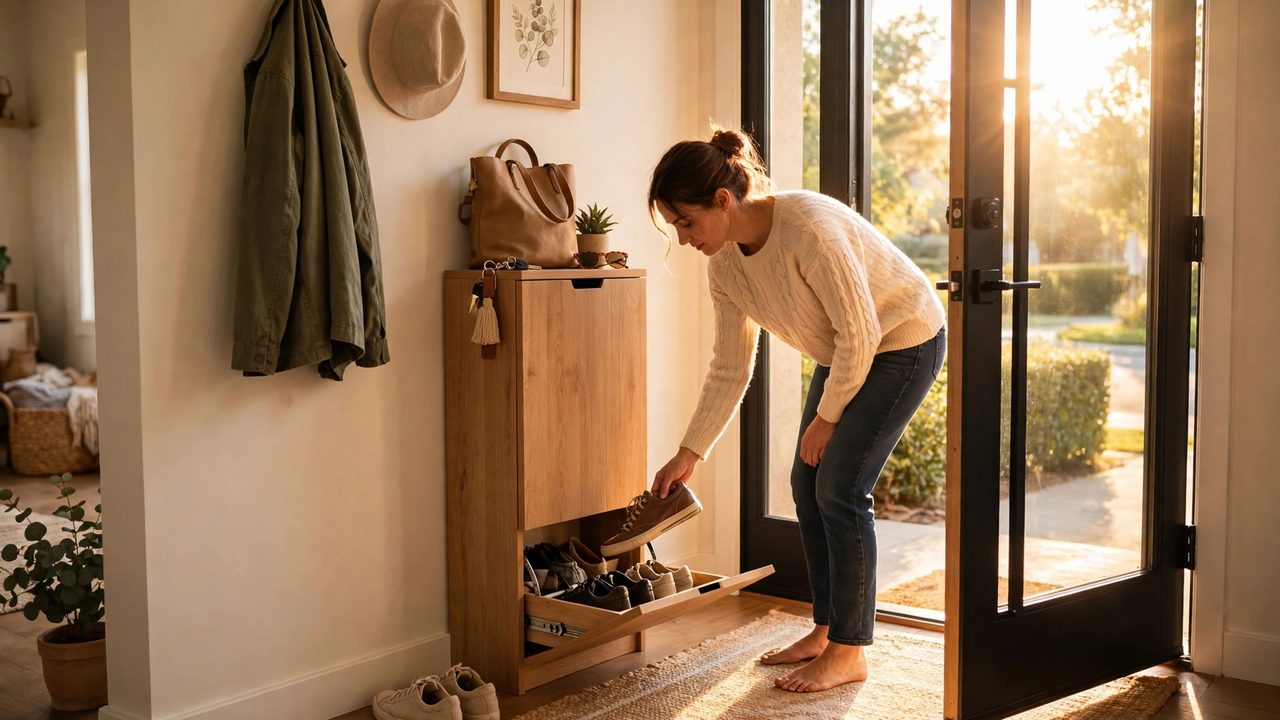
An entryway has very little patience for loose shoes. A few pairs by the door quickly become a pile that blocks the door swing, collects dust, and makes the whole room look unfinished, even when the rest of the home is tidy. Open racks solve the pile but not the appearance, and deep cabinets solve the appearance but steal the walking space that a small hall simply does not have. That is exactly the gap that flip-drawer, or tip-out, cabinets fill. The shoes sit upright inside shallow compartments that pivot forward when you pull the front, so the cabinet can be only about nine inches deep and still hide a full household rotation of everyday footwear behind a flat, furniture-like front. If you are shopping for the best slim shoe cabinets with flip drawers for entryways, this guide compares six real, currently available models side by side, explains the measurements that actually decide whether one fits your shoes and your hall, and helps you match drawer count, width, and finish to the way your household comes and goes.
Every cabinet in this roundup uses the same basic trick, but the details differ in ways that matter day to day. Some are wide and low, with two large flip drawers and a broad top that works as a landing strip for keys and mail. Others are narrow and tall, stacking three drawers so they hold more pairs on a smaller patch of floor. One adds a dedicated boot compartment, another adds an open rack underneath for the pair you wear every day, and another keeps the width down to under two feet for the tightest halls. None of them is the right answer for everyone, and the sections below are organised so you can find the one that fits your wall, your shoe sizes, and your patience for assembly.
Quick verdict
For most households, the VASAGLE LIRY Collection cabinet with three flip drawers is the balanced pick: it is under ten inches deep, holds the most everyday pairs in this group, and its adjustable shelves handle everything from flats to trainers without drama. If your wall space is measured in inches rather than feet, the HOMCOM three-drawer cabinet is the narrowest option here at under two feet wide, and it still hides a respectable rotation. Households that need somewhere for tall boots should look at the GlouMod cabinet, which pairs three flip drawers with a dedicated boot compartment and ventilated fronts. The Xixini cabinet is the straightforward, handle-free option with the largest stated capacity in a clean flat-front design. The AVZEAR cabinet suits anyone who wants a softer, fabric-panelled look plus an open bottom rack for daily shoes. And the two-drawer VASAGLE organiser is the one to choose when you want a lower profile, side hooks for keys and bags, and a raised-edge top that keeps small items from sliding off.
Selection started with the format itself. A cabinet only qualified if it was genuinely slim, meaning a depth around ten inches or less, and if its main storage came from flip or tip-out drawers rather than ordinary hinged doors or open shelves. That single rule removes most shoe cabinets on the market, because conventional cabinets need enough depth for shoes to lie flat on a shelf, while a flip drawer stores shoes angled inside the moving compartment itself. Each candidate then had to be a real, named model from an identifiable brand, sold new, with its specifications published on an opened product page so that dimensions, materials, and capacity claims could be checked rather than assumed.
Availability was treated as a hard gate, not a preference. A cabinet that could not be bought new at the time of checking did not stay in the list, however well it scored on paper, and one otherwise suitable model was dropped from this roundup for exactly that reason. Where a maker publishes a capacity figure, this guide reports it as the maker’s own figure and flags the obvious caveat: capacity counts depend heavily on shoe size and style, so a household of large trainers will fit fewer pairs than a household of flats in the same cabinet. Dimensions are quoted as the maker lists them, and the buying guide below explains how to translate those numbers into a real fit check against your own wall, skirting boards, and door swing before you order anything.
Finally, the six were chosen to span the realistic decision space rather than to repeat one design six times. The set covers two-drawer and three-drawer layouts, widths from under two feet to just under three feet, heights from a low console profile to a tall tower, and finishes from rustic farmhouse white to natural linen panels and ventilated slatted fronts. If none of the six fits your space, the measurements and trade-offs described here should still tell you exactly what to look for in the next model you consider.
The three-drawer VASAGLE from the LIRY Collection is the easiest cabinet in this group to recommend to a household that has not measured anything yet, because it gets the fundamentals right in a footprint that suits most entryways. The maker lists the overall size at 9.4 inches deep, 34.3 inches wide, and 48.7 inches high, which is tall enough to make the storage worthwhile and shallow enough to sit against a hall wall without narrowing the walkway in any meaningful way. The recessed panels and barn-door styling give it a farmhouse character that looks like furniture rather than storage equipment, and the flat top doubles as a landing surface for keys, post, and a small plant or framed photo.
Inside, each of the three flip drawers carries an adjustable shelf. With the shelves in place, the maker lists capacity at up to 21 pairs of men’s shoes or up to 24 pairs of women’s shoes, which is the strongest everyday figure in this roundup. Removing a shelf lets a drawer take boots instead, with the obvious trade-off that the pair count for that drawer roughly halves. That flexibility is the real strength here: a family can run two drawers of everyday shoes and one drawer of taller footwear, and reconfigure later as the collection changes. The open space underneath fits slippers and makes vacuuming underneath straightforward, which sounds minor until you have lived with a cabinet that traps dust along a plinth you cannot reach.
Buy it if: you want the largest hidden capacity in a standard three-drawer format, you like a farmhouse look, and you want the option to convert a drawer for boots by removing its shelf.
Skip it if: your wall is narrower than about 35 inches, you need a dedicated tall-boot compartment without sacrificing a drawer, or you want the quickest possible assembly, since the maker indicates a full build takes a while with all tools to hand.
Specifications the maker lists: 9.4 x 34.3 x 48.7 inches; three flip drawers, each with an adjustable shelf; capacity up to 21 pairs of men’s shoes or 24 pairs of women’s shoes with shelves fitted; MDF and particleboard construction; item weight 50.9 pounds; anti-tip kit and non-slip foot pads included; rustic white finish with barn-door style fronts
Pros: highest stated everyday capacity in this group; shelves adjust or remove for taller footwear; open base for slippers and cleaning; furniture-like farmhouse styling
Cons: one of the wider cabinets here, so it needs a clear stretch of wall; boot storage costs you a drawer’s shelf and halves that drawer’s capacity; assembly is a longer job than the two-drawer models
Width, not depth, is the limiting measurement in many real entryways: the wall beside the door may be interrupted by a light switch, a radiator, a doorway, or the door’s own swing. The HOMCOM cabinet is built for exactly that problem. The maker lists it at just 23.6 inches wide and 9.3 inches deep, with a height of 45.3 inches, making it the narrowest three-drawer cabinet in this roundup by a clear margin. It still stacks three flip drawers, so going narrow does not mean dropping to a token amount of storage, and the clean white finish with a light oak wood-grain top and round silver handles reads as a small modern side cabinet rather than a shoe product.
Each drawer has a two-level shelf that adjusts or removes, and the maker lists capacity at 12 to 18 pairs of shoes up to US size 11. That range is honest about the format: narrower drawers hold fewer pairs across, so this is a cabinet for one or two people’s daily rotation rather than a whole family’s collection. The particleboard body has a melamine coating that the maker lists as resisting scratches and stains, which suits a high-traffic spot where bags, keys, and wet shoes brush against the surface daily. The maker lists overall weight capacity at 88 pounds and the top at 22 pounds, so the top surface is fine for a key bowl and decor but should not become a seat or a step.
Buy it if: your usable wall is under two feet wide, you are storing for one or two people, and you want a compact modern look with a contrasting wood-tone top.
Skip it if: your household wears larger than US size 11, you need to store more than about eighteen pairs, or your entryway wall is wide enough that a broader cabinet would use the space better.
Specifications the maker lists: 23.6 inches wide x 9.3 inches deep x 45.3 inches high; three flip drawers with two-level adjustable and removable shelves; capacity 12 to 18 pairs up to US size 11; particleboard with melamine coating; weight capacity 88 pounds overall and 22 pounds on top; item weight 44 pounds; anti-tipping hardware included; white finish with light oak wood-grain top
Pros: narrowest cabinet in this group; genuine three-drawer storage in a sub-two-foot width; wipeable coated surface; clear published load limits for the top
Cons: lowest stated pair capacity here; shoe size ceiling of US 11 will exclude some households; narrow drawers suit everyday shoes better than bulky footwear
The Xixini cabinet takes the opposite styling route from the farmhouse models: flat fronts, no visible handles, and an embedded grip that keeps the face completely flush. In a modern hall or a living-room corner, that plain front is the point, because the cabinet disappears into the room instead of announcing what it stores. The maker lists the dimensions at 31.5 inches wide, 9.06 inches deep, and 47.24 inches high, so it is also the shallowest cabinet in this roundup on paper, if only by a small margin. Three flip drawers stack inside, each with two layers of storage separated by a panel that adjusts or removes entirely.
Capacity is listed by the maker at up to 24 pairs, with the sensible caveat that the real number varies with shoe size and style. In practice, the two-layer drawers suit a mixed household collection: flats, sandals, and low trainers stack efficiently, while removing a panel creates the height for heels or ankle boots in that drawer. The body is P2 engineered wood, and the maker lists an anti-tipping device in the package for fixing the cabinet to the wall, which matters for any tall, shallow unit and especially in homes with children who will pull a drawer front towards themselves. The broad top platform gives the usual landing strip for wallets, keys, and accessories.
Buy it if: you want a minimal, handle-free front that blends into a modern room, you value the shallowest listed depth here, and your collection is mostly everyday shoes with a few taller pairs.
Skip it if: you prefer a visible handle to pull, since the embedded grip is a matter of taste; you want a dedicated boot compartment rather than a converted drawer; or you dislike flat-pack assembly, which the maker notes goes faster with two people or power tools.
Specifications the maker lists: 31.5 x 9.06 x 47.24 inches; three flip drawers, each with an adjustable or removable middle panel and two storage layers; capacity up to 24 pairs depending on shoe size and style; P2 engineered wood construction; item weight 58 pounds; weight limit 50 pounds as listed; anti-tipping device included; white finish with embedded door handles
Pros: cleanest, most minimal front in the group; shallowest listed depth; strong stated capacity; panels convert drawers for taller shoes
Cons: heaviest cabinet in this roundup, so positioning it takes care; handle-free grip will not suit everyone; no separate boot or open storage section
Most slim cabinets are unmistakably wooden boxes. The AVZEAR model softens that with natural linen panels on the drawer fronts, which gives the piece a warmer, more upholstered feel that sits comfortably in a living room or a bedroom doorway as well as a hall. The maker lists the size at 31.5 inches wide, 9.25 inches deep, and 39.37 inches high, so it keeps the lower, console-like profile of a two-drawer cabinet. Two flip drawers do the hidden storage, each with two levels and a centre divider that adjusts or removes to suit different shoe sizes.
What sets this model apart in daily use is the open shoe rack at the bottom. Every household has one or two pairs in constant rotation, and opening a flip drawer twice a day for the same trainers gets old; the open rack keeps those pairs grabbable while the drawers hide everything else. The trade-off is that the open section shows its shoes, so the completely concealed look is softened. The frame is MDF with metal legs, the maker notes the frame uses FSC-certified wood, and an anti-tipping device is included. Round metal handles keep the front friendly for households that found the handle-free style of some rivals awkward.
Buy it if: you want a softer, fabric-fronted look, you like the idea of an open rack for your most-worn pair, and a two-drawer height suits the wall or window line in your entryway.
Skip it if: you want every pair fully hidden, you need three drawers of capacity, or your entryway is rough on fabric surfaces, since linen panels ask for gentler treatment than melamine or painted fronts.
Specifications the maker lists: 31.5 inches wide x 9.25 inches deep x 39.37 inches high; two flip drawers, each with two levels and an adjustable or removable centre divider; open shoe rack at the bottom; natural linen panel fronts; MDF construction with metal legs; frame made with FSC-certified wood as listed by the maker; item weight 40.8 pounds; anti-tipping device included; natural finish
Pros: distinctive linen-panel styling; open bottom rack for daily pairs; lightest cabinet in this group; clear two-level drawer layout
Cons: open rack means not all shoes are concealed; two drawers hold less than the three-drawer models; fabric fronts need more care in a muddy entryway
Boots are the awkward squad of shoe storage: too tall for standard shelves, too bulky for most flip drawers, and usually left standing by the door as a result. The GlouMod cabinet is the only model in this roundup designed around that problem. Alongside its three flip drawers it has a dedicated side boot compartment that the maker lists as fitting boots up to 15 inches tall, kept upright rather than folded or squeezed. The maker lists the overall size at 9.84 inches deep, 35.5 inches wide, and 51.89 inches high, making it both the tallest and the widest cabinet here, and the deepest by a fraction, though still under ten inches.
The drawer fronts use laser-cut slats, which the maker positions as ventilation: air circulates around stored shoes instead of trapping the dampness that closed cabinets can hold after a wet day. The shelves adjust, with the maker listing a default shelf height of 4.3 inches and a maximum of 8.9 inches, covering flats through to heels and high-tops. Each shelf is listed as holding up to 30 pounds, the flip doors are soft-close, and a small top drawer adds a home for keys, gloves, and the other small items that otherwise colonise the cabinet top. An anti-tip device for wall anchoring is included, and the maker lists assembly at roughly half an hour to an hour and a half with the necessary tools in the box.
Buy it if: tall boots are a permanent part of your entryway, you want ventilated fronts for shoes that come home damp, and you have the wall width and height for the largest cabinet in this group.
Skip it if: your wall is narrow or your ceiling line is interrupted, since this is the biggest footprint here; you never store boots, in which case the boot compartment is wasted width; or you prefer a completely plain, unvented front.
Specifications the maker lists: 9.84 x 35.5 x 51.89 inches; three flip drawers plus a dedicated boot compartment for boots up to 15 inches tall; laser-cut ventilated slatted fronts; adjustable shelves, listed at 4.3 inches default and 8.9 inches maximum; each shelf holds up to 30 pounds as listed; soft-close flip doors; small top drawer; reinforced engineered wood construction; anti-tip device included; white finish
Pros: only dedicated boot compartment in this group; ventilation helps with damp shoes; soft-close doors suit flats and shared walls; useful top drawer for small items
Cons: largest and one of the deepest cabinets here; boot section is wasted if you own no tall boots; slatted fronts show a hint of what is inside, unlike solid fronts
The two-drawer VASAGLE organiser is the lower, friendlier sibling of the three-drawer LIRY model. The maker lists it at 9.4 inches deep, 32.7 inches wide, and 40 inches high, a height that sits comfortably below most window sills, picture rails, and thermostat lines, and that makes the top surface easy to use as a genuine console. The barn-door fronts and metal accents carry the same farmhouse styling as its bigger sibling, in rustic white. Two flip drawers hold, as the maker lists, 14 to 16 pairs of shoes up to US size 11, which is a strong figure for a two-drawer cabinet and enough for a couple’s full everyday rotation.
Each drawer has an adjustable shelf with three positions, so a drawer can be tuned for slippers and flats or opened up for heels, and removing the shelf allows boot storage at half capacity, as with its sibling. Two details lift it above a plain box. The raised-edge top panel keeps keys, coins, and decor from sliding off the back or sides, a small thing that prevents a daily irritation. And two side hooks hold keys and bags within reach, turning the cabinet into a small departure station: shoes below, bag on the hook, keys on top. The open space underneath again fits slippers and lets a vacuum or mop pass underneath without moving the furniture.
Buy it if: you want a lower console profile, a top surface that actually corrals small items, side hooks for bags and keys, and farmhouse styling in a two-drawer size.
Skip it if: you need three drawers of storage, your shoes run larger than US size 11, or your entryway wall is tall and empty enough that a higher cabinet would use it better.
Specifications the maker lists: 9.4 x 32.7 x 40 inches; two flip drawers, each with an adjustable shelf with three positions; capacity 14 to 16 pairs up to US size 11; MDF and particleboard construction; raised-edge top panel; two side hooks; item weight 42.1 pounds; anti-tip kit and non-slip foot pads included; rustic white finish with barn-door style fronts
Pros: strong capacity for a two-drawer cabinet; raised-edge top and side hooks add real entryway function; lower height fits under sills and shelves; matches the three-drawer LIRY styling for a paired look
Cons: two drawers will fill quickly in a family household; US size 11 ceiling as listed; boot storage requires removing a shelf and halves that drawer
Buying guide
Measure depth, then measure the open drawer. The closed depth of these cabinets, roughly nine to ten inches, is the number everyone checks, and it is genuinely small enough for most halls. The number people forget is the space a flip drawer needs while open. The compartment pivots forward and down, so for a few seconds the drawer front and your hands occupy space well in front of the cabinet. Stand where the cabinet will go, imagine pulling the lowest drawer open while holding a pair of shoes, and check that the front door, a stair newel, or an opposite wall does not crowd that motion. In most halls this is a non-issue, but in the very tightest spaces, a cabinet placed directly opposite a door that opens inward deserves a second look.
Count drawers by household, not by hope. A two-drawer cabinet in this group holds roughly a dozen to sixteen pairs on the makers’ figures; a three-drawer cabinet holds roughly eighteen to twenty-four. Work out your real entryway population: count only the shoes that genuinely live by the door, not the whole wardrobe, since seasonal and occasional footwear can stay in a closet. One person usually needs one drawer for a daily rotation. A couple is comfortable with two drawers. A family, or anyone whose entryway serves as the home’s only shoe storage, should start at three drawers and treat any extra, such as a boot compartment or an open rack, as the overflow that keeps the system working in winter.
Check your largest shoe size against the listing. Flip drawers are shallower inside than the cabinet’s outside depth suggests, because the shoe sits angled within the pivoting compartment. Several makers in this group state a maximum of US size 11, and that figure deserves respect: larger trainers and work boots are longer and taller, and forcing them in stresses the drawer mechanism and stops the front closing flush. If your household wears larger sizes, favour cabinets whose makers state a higher ceiling or a boot compartment, measure your longest shoe, and be sceptical of any listing that promises to fit everything. Removing a drawer’s middle panel helps with height, not with length.
Plan for boots separately. Standard flip drawers handle flats, trainers, heels, and ankle boots well. Knee-high and tall winter boots are a different shape entirely. Your options are a dedicated boot compartment, as on the GlouMod cabinet; a drawer with its shelf removed, accepting half capacity in that drawer; or keeping tall boots elsewhere and letting the cabinet do what it does best. Decide before you buy, because a cabinet chosen on its headline pair count can disappoint the first time a pair of tall boots comes home.
Treat wall fixing as part of the product. Every cabinet in this roundup is tall relative to its depth, which makes it inherently tippy until fixed, and every maker here includes an anti-tip kit or device. Use it. A shallow cabinet pulled open by its top drawer, especially by a child using the front as a handle, has real leverage to come forward. Fixing to a stud or with appropriate wall anchors takes minutes during assembly and is the difference between a stable piece of furniture and a hazard. Also check your skirting boards: a cabinet that must sit flush to the wall for its fixing may sit slightly proud over deep skirting, which is normal and manageable, but worth knowing before you position it.
Think about air and water. Entryway shoes arrive wet, muddy, and warm. Solid-front cabinets hide everything, including the damp, while ventilated or slatted fronts, like the GlouMod’s laser-cut doors, let air move. If your household stores shoes straight off wet pavements daily, ventilation or the habit of leaving the day’s pair on the AVZEAR’s open rack to dry will keep the cabinet fresher. A wipeable finish, such as a melamine coating, also earns its keep in a muddy hall, while fabric panels look softer and ask for gentler treatment. Match the finish to your climate and your tolerance for cleaning, not just to the photograph.
Use the top surface deliberately. All six cabinets offer a flat top, and it will become your landing strip whether you plan it or not. Raised edges, as on the two-drawer VASAGLE, keep small items contained; a small top drawer, as on the GlouMod, hides them entirely; a plain top, as on the HOMCOM and Xixini, suits a tray or bowl that does the same job. Decide which system you will actually use, because an unmanaged cabinet top becomes the new clutter surface the cabinet was bought to eliminate.
FAQ
How many pairs does a slim flip-drawer cabinet really hold?
On the makers’ own figures, the two-drawer cabinets in this guide hold roughly 14 to 16 pairs and the three-drawer cabinets roughly 12 to 24 pairs, depending on the model. Treat those as best-case counts for average-sized everyday shoes. Large trainers, high-tops, and heels take more room, so a household of bigger footwear should expect fewer pairs and choose a cabinet with a stated size ceiling above its largest shoe.
Will a flip-drawer cabinet fit large men’s shoes?
It depends on the model. Several cabinets here list a maximum of US size 11, which covers many households but not all. If your shoes are larger, check the maker’s stated ceiling before ordering, favour a model with a boot compartment or removable drawer panels, and remember that removing a panel adds height but not length. A shoe that is too long for the compartment will stop the drawer closing properly.
Do these cabinets have to be fixed to the wall?
Yes, in practice. Every cabinet in this roundup is much taller than it is deep, and every maker includes an anti-tipping kit or device for that reason. Fixing the cabinet to the wall during assembly is quick, prevents the unit tipping when a loaded drawer is pulled open, and is especially important in homes with children or large pets. Skipping the fixing to save ten minutes is the most common and most avoidable mistake with this format.
Can flip drawers store boots?
Ankle boots usually fit, especially with a drawer’s middle panel removed. Tall boots are harder: the practical options are a dedicated boot compartment like the GlouMod’s, which the maker lists for boots up to 15 inches tall, or a drawer with its shelf removed, which roughly halves that drawer’s pair capacity. If tall boots are everyday footwear in your home, choose the cabinet around them rather than hoping a standard drawer will cope.
What is the difference between a flip drawer and a normal shoe cabinet door?
A normal door opens onto fixed shelves, so the cabinet must be deep enough for shoes to lie flat, which usually means a much deeper unit. A flip drawer’s front is the drawer: it pivots forward and the shoes sit angled inside the moving compartment, which is why these cabinets can be around nine inches deep. The trade-off is capacity per drawer and a firm limit on shoe length and height, in exchange for a far slimmer profile.
How hard are these cabinets to assemble?
All six are flat-pack furniture with labelled parts and illustrated instructions. Makers’ guidance in this group ranges from under an hour to around two hours depending on drawer count and model, and two people make the taller three-drawer units noticeably easier to handle. Build the cabinet close to where it will stand, fix the anti-tip hardware as part of the same job, and check each flip drawer opens and closes cleanly before loading it with shoes.
Conclusion
A slim flip-drawer cabinet succeeds when it disappears: shoes hidden, walkway clear, and a calm surface by the door instead of a pile. For most entryways, the three-drawer VASAGLE LIRY cabinet offers the best balance of capacity, flexibility, and furniture-like looks. Narrow walls point to the HOMCOM, minimal modern rooms to the Xixini, and boot owners to the GlouMod with its dedicated tall compartment. The AVZEAR brings a softer linen look and an open rack for the pair you live in, while the two-drawer VASAGLE turns its top and side hooks into a small, organised departure point. Measure your wall, count your door-side shoes honestly, check your largest size against the maker’s ceiling, and fix whichever you choose to the wall. Do those four things and any cabinet in this guide will quietly do its job for years.
M
Modern Line Home Editorial Team
We compare specs, materials and verified owner reviews before a product earns a spot. Rankings are never paid.
Affiliate disclosure. As an Amazon Associate we earn from qualifying purchases at no extra cost to you. Prices accurate as of the date shown.
House cold even with the heat on? Walk this ordered checklist: thermostat and filter first, then drafts, insulation, leaky ducts and a failing heating system.
Windows fogging up in winter? Check where the fog sits: on the room side it is indoor humidity, outside it is harmless, and between panes the seal has failed.
Store the main firewood pile about 30 feet from your house, off the ground and covered only on top. Compare racks, woodsheds, garages and indoor spots safely.
Place a portable generator outdoors only, at least 20 feet from windows, doors and vents, exhaust pointed away. Exact distances, setup steps and CO rules here.
Keep houseplants in the right winter spot: match window direction to plant type, stay clear of radiators and cold glass, and fix dry air and low light at home.
Mice enter through pencil-width gaps at foundations, pipes, vents, doors and the roofline. Walk this room-by-room winter checklist to find and seal each one.
A winter outage timeline: what to do in the first hour, first night and multi-day outage, with food safety times, pipe protection, heat and CO safety steps.
Size a space heater by room area: 10 watts per square foot at 8-foot ceilings, adjusted for insulation and ceiling height, with full wattage and BTU tables.
Start dripping at about 20 degrees, sooner for exposed pipes. Set a pencil-lead stream, drip the right faucets on both lines, and know when to stop safely.
A fridge needs 800-1,200 starting watts, not just 150-400 running watts. Use the tables to total your fridge plus freezer, lights, furnace fan and more today.












Write Your Review
No reviews yet. Be the first to share your experience!