We independently review everything we recommend. When you buy through our links, we may earn a commission. As an Amazon Associate we earn from qualifying purchases.
Best Rolling Laundry Carts for Narrow Washer Gaps Guide
Compare the best rolling laundry carts for narrow gaps beside washers, with slim widths, tier counts, caster locks and load limits checked on maker listings.
Compare the best rolling laundry carts for narrow gaps beside washers, with slim widths, tier counts, caster locks and load limits checked on maker listings.
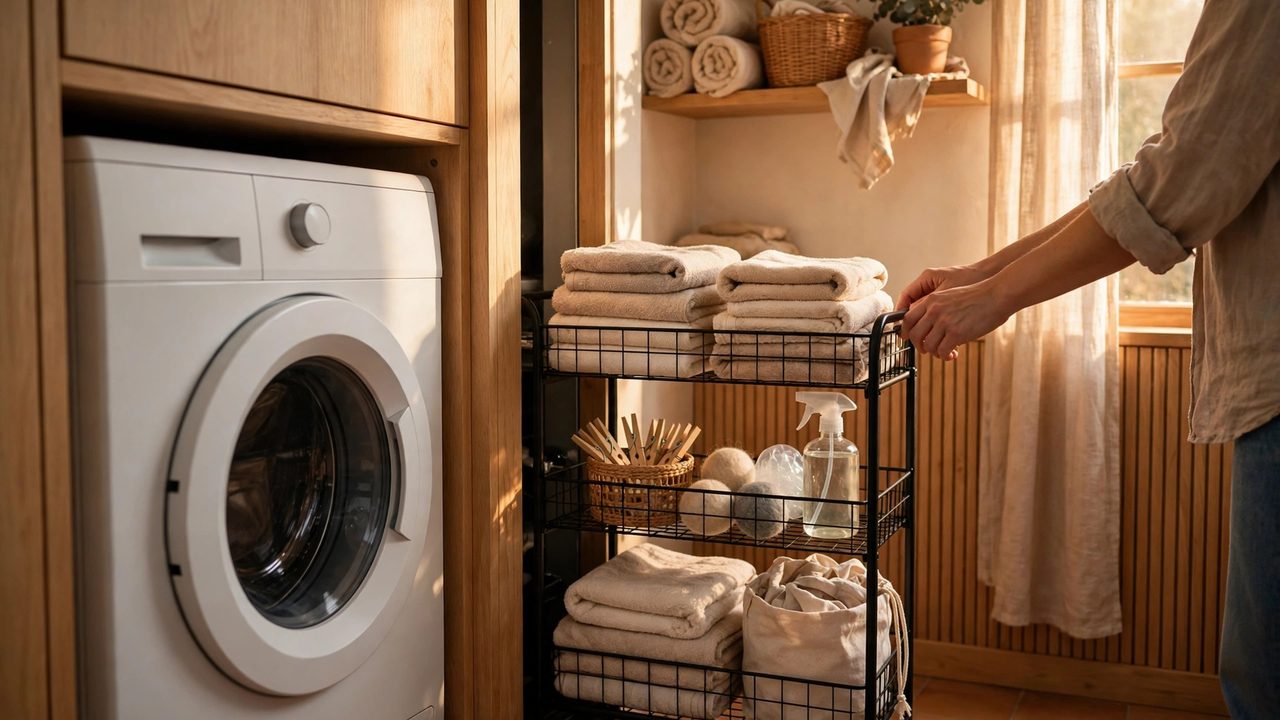
The strip of floor beside a washer is usually wasted. It is too narrow for a hamper, too deep to reach into comfortably, and just wide enough to swallow stray socks, dryer sheets and the measuring cap from the detergent bottle. A slim rolling cart turns that dead strip into pull-out storage: park it in the gap, load it with the bottles and boxes you reach for on every wash day, and roll it forward when you need something from the back. This guide to the best rolling laundry carts for narrow gaps beside washers compares six carts that are genuinely narrow on at least one side, from a cart under five inches wide to metal basket carts around seven inches wide, so you can match one to the gap you actually have rather than the gap you wish you had.
Every cart below was checked on its opened Amazon listing, including the availability block, and only carts showing a live offer sold new are included. Four other carts that looked promising on paper were left out because their listings showed no featured offer or only a resale offer, and they are named in the selection notes so you know the shortlist was filtered, not padded. Dimensions, materials and load limits are the figures the maker lists on each product page, and where a maker gives a figure in more than one place with slightly different wording, the product page figure is the one used.
Quick verdict
If your gap is truly tight, start with the SPACEKEEPER 4 Tier cart in white. The maker lists it at 4.9 inches on its narrow side, which is the slimmest profile in this group, and its four tiers run taller than most rivals, so it stores more in the same sliver of floor. If you want the same idea in a shorter, darker cart, the SPACEKEEPER 3 Tier in black keeps the same narrow footprint and waterproof plastic shelves but stops lower, which suits gaps under a counter overhang. For a metal cart with open baskets that let air move around damp laundry supplies, the LIWNYRK 3 Tier and the Household Essentials Slim Line 05121 are the two steel-frame options, both around 7.1 and 7 inches wide respectively. The Pipishell 3 Tier is the pick when you want hooks and a cup on the side for brushes and tools, and the Lavish Home cart is the long, low option for a gap that runs beside a machine rather than between two machines, with the tallest shelf spacing in the group for big detergent bottles.
The products in this guide
SPACEKEEPER Slim Rolling Storage Cart, 4 Tier, White (SPKSC401)
The assembled size as 4.9 inches by 15.3 inches by 38.7 inches, and the 4.9 inch narrow side is the slimmest in this guide, slim enough for the slot
Best when your gap is under 6 inches wide and you want the most tiers
Read the narrow side first. That is the dimension that has to pass through your gap, and on every cart here it is the depth figure in the maker’s dimension line. The long side matters second: a cart that is 25 inches long, like the Lavish Home, needs a gap that runs deep beside the machine, while the shorter 14.9 to 15.75 inch carts suit the shallower slot between a washer and a wall. Height matters third, because a 38.7 inch cart will catch on a folding counter or a low shelf that a 25.2 inch cart slides under without thinking.
How we selected
The starting point was the gap itself. Candidate carts had to be designed for narrow spaces, with a narrow side of about seven inches or less, wheels or casters fitted as standard, and a shape that works beside or between laundry appliances rather than a general-purpose trolley that happens to be small. Laundry-specific fit mattered too: shelves or baskets sized for detergent bottles, dryer sheet boxes, stain removers and peg bags, and materials that tolerate a damp room.
Each candidate was then opened on its Amazon product page and checked in three passes. The first pass confirmed the product itself: brand, model, dimensions, tier count, materials and any load figure the maker lists. The second pass checked the variation map on the page, so the ASIN recorded for each pick is the exact colour and tier combination named in its heading, not a sibling variant. The third pass was the availability gate: the listing had to show a live featured offer for a new cart, in stock, on the opened page. Listings that rendered no featured offers, or whose featured offer was a resale listing rather than a new cart, were excluded even when the cart itself looked ideal.
That gate removed four carts from the shortlist. A slim Asgolion four-tier cart and an expandable Moryimi laundry cart both showed no featured offers on their opened pages, a Honey-Can-Do three-tier cart showed the same, and a Tribesigns slim cart whose featured offer was sold by a resale channel rather than as a new cart was also set aside. What remains is six carts that passed all three passes at the time of checking. Availability changes, so the linked listing is always the final word, but no cart below was included on the strength of a search snippet alone.
A note on load figures: makers do not report them consistently. One maker lists a maximum weight recommendation for the whole cart, another lists a per-shelf limit, and some list nothing at all. The figures below are quoted exactly as each maker lists them, in the maker’s own terms, and they are not directly comparable across brands. Treat them as a guide to intended use, light laundry supplies rather than stacked storage bins, instead of as a lab ranking.
This is the cart for the gap you measured twice because you did not believe it was usable. The maker lists the assembled size as 4.9 inches by 15.3 inches by 38.7 inches, and the 4.9 inch narrow side is the slimmest in this guide, slim enough for the slot that opens up when a washer sits a hand’s width from the wall. Four tiers run up that tall frame, so the storage stacks vertically instead of asking for floor space you do not have. The maker lists the shelves as waterproof PP plastic, which suits a laundry room: a dripped detergent cap or a damp cloth can be wiped off, and the hollow shelf design lets water drain rather than pool. Four side hoops hang on the frame for brushes, peg bags or a dusting cloth, and the maker lists two wheels with brakes, so the cart can be locked in place once it is parked in the gap.
Assembly is part of the appeal. The maker describes a snap-together build with no tools, and the shelf count is flexible: the listing notes the cart can be reduced to fewer shelves and used without casters as a countertop organiser, which is a sensible second life if you move house and the new laundry room has a different gap. The maker lists a maximum weight recommendation of 20 pounds, which frames this as a light-load cart: detergent, softener, dryer sheets, stain sticks and a roll of bags, rather than bulk refill jugs stacked four high.
Maker-listed specs: 4.9 x 15.3 x 38.7 in assembled size; 4 tiers; PP plastic shelves; 4 side hoops; 2 wheels with brakes; maximum weight recommendation 20 lb, as listed; snap-together assembly, no tools listed
Buy it if: your gap is under 6 inches wide and you want the most tiers that will fit in it, in a waterproof plastic that shrugs off laundry drips
Skip it if: your gap has a low counter or shelf above it, because at 38.7 inches tall this is the tallest cart here, or you plan to store heavy bulk bottles on every tier
Pros: slimmest narrow side in the group; four full tiers; brakes on two wheels; side hoops add hanging storage; tool-free assembly
Cons: plastic shelves suit light loads best; tall frame needs clear headroom in the gap; white finish shows detergent drips until wiped
The three-tier SPACEKEEPER keeps the same 4.9 inch narrow side as its taller sibling but stops at 26.1 inches high, and that shorter stance is exactly what some gaps need. If a folding counter, a water pipe or the underside of a wall cabinet crosses your gap partway up, the four-tier cart will not pass and this one will. The maker lists the same waterproof PP plastic construction, resistant to warping and humidity, with a hollow design that drains and wipes clean, which is the right material family for a room that steams up on every hot wash.
The shelves are removable, so the layout can be rearranged around what you actually store: three tiers for mixed supplies, or a taller opening for a spray bottle that will not stand on a fixed shelf. The maker lists two lockable 360-degree casters, and notes the cart rolls on hardwood and tile, with thick carpet needing more effort, which matches the laundry rooms most of these carts will live in. The black finish is the practical choice beside a dryer, where lint and dust show less than on white. The maker lists a maximum weight recommendation of 44 pounds for this model, the highest whole-cart figure in this guide, though as with all these figures it should be read as the maker’s own listing figure rather than a cross-brand test result.
Maker-listed specs: 4.9 x 15.3 x 26.1 in assembled size; 3 removable tiers; PP plastic, waterproof as listed; 2 lockable 360-degree casters; side hoops; maximum weight recommendation 44 lb, as listed; no tools required for assembly, as listed
Buy it if: your gap is under 6 inches wide but has limited headroom, or you prefer a dark finish that hides lint and dust between cleans
Skip it if: you need four tiers of storage in the gap, or your laundry floor is thick carpet, which the maker flags as harder rolling
Pros: same ultra-slim footprint as the 4 Tier in a shorter frame; removable shelves adapt to tall bottles; lockable casters; waterproof plastic
Cons: one tier less than the 4 Tier version; plastic build feels less rigid than the metal carts; black shelves show white detergent powder spills
The Pipishell takes a different approach to the gap: at 7.08 inches on its narrow side it needs a slightly wider slot than the SPACEKEEPER carts, but it is the shortest cart in this guide at 25.2 inches high, and it adds the small extras that laundry corners actually use. The maker lists one cup and six hooks that hang on the side of the cart, which gives the lint brush, the peg bag, a pair of scissors and the stain-treatment brush a home instead of a permanent residence on top of the dryer. The listing specifically names the gap between washer and dryer as a intended spot, alongside the toilet-and-sink gap and the fridge-and-counter gap.
The maker lists the cart as high-quality ABS material with ventilation holes, which allow drainage and air movement around anything damp stored on the shelves. The caster wheels are removable, so the same unit can stand as a fixed under-sink or counter organiser if you stop needing it on wheels. At 15.75 inches on its long side it is a mid-depth cart: deep enough for standard detergent bottles standing upright, short enough to pull fully out of a shallow gap without the back end catching the wall. For a household that wants one small cart to solve the gap and hold the odd-shaped tools as well as the bottles, this is the most thought-through design of the plastic carts here.
Maker-listed specs: 7.08 x 15.75 x 25.2 in, as listed; 3 tiers; ABS material with ventilation holes; 1 cup and 6 hooks included, as listed; removable caster wheels
Buy it if: your gap is a little over 7 inches wide, headroom is limited, and you want hooks and a cup for brushes and small laundry tools
Skip it if: your gap is under 7 inches, because this cart will not pass, or you want locking casters, which the maker does not list for this model
Pros: shortest cart in the group for low gaps; hooks and cup included; ventilated shelves suit damp items; wheels can be removed for fixed use
Cons: wider narrow side than the slimmest rivals; only three tiers; no locking casters listed
The Lavish Home cart is built for the other kind of laundry gap: not the slot between two machines, but the long run beside a washer where the wall, a laundry sink or a run of cabinets stretches back. The maker lists it at just over 5 inches wide, 25 inches long and 34.25 inches tall, so it slides into a narrow slot and then keeps going, with three shelves running the full length. The maker lists a 15 pound weight limit per shelf, and gives the shelf spacing too: the top shelf section is listed at 7.3 inches, the middle at 10.6 inches and the bottom at 12.2 inches. That bottom spacing is the detail that matters for laundry, because bulk detergent and softener bottles are tall, and a cart whose shelves cannot take them upright is a cart that stores everything except what you bought it for.
The maker lists the construction as MDF with a traditional design, four smooth-rolling wheels and a handle for pulling the cart out of tight spaces, and notes the wheels run on carpeted, tiled and concrete floors. A handle sounds minor until you picture retrieving a 25 inch cart from a deep slot: you pull the handle, not the top shelf, and the load stays put. The trade-off is the material. MDF is a solid, furniture-style board, but it is not the wipe-and-forget waterproof plastic of the SPACEKEEPER carts, so this one suits a dry laundry room better than a steamy utility corner, and spills should be wiped rather than left to soak in.
Maker-listed specs: 25 x 5.7 x 34.25 in (L x W x H), as listed; 3 shelves; MDF construction; 15 lb weight limit per shelf, as listed; shelf spacing 7.3 in top, 10.6 in middle, 12.2 in bottom, as listed; 4 wheels and a handle
Buy it if: your gap runs long beside one machine, and you need tall bottom spacing for bulk detergent bottles plus a handle to pull the cart out
Skip it if: your gap is short front-to-back, because 25 inches of length needs a deep slot, or your laundry room is very steamy and you prefer waterproof plastic
Pros: longest storage run in the group; tallest listed bottom-shelf spacing; per-shelf limit clearly listed; pull handle suits deep gaps
Cons: MDF dislikes standing moisture; needs a deep gap to fit its length; no locking wheels listed
If plastic carts feel too light for a working laundry room, this is the metal alternative sized for the same job. The maker lists the LIWNYRK at 7.1 inches wide, 14.9 inches long and 28.7 inches high, a compact footprint that fits between washer and dryer, with a metal frame the maker positions as the durability upgrade over plastic organisers. The baskets are ventilated mesh, which the maker notes promotes airflow and limits dust build-up; in laundry terms that means damp cloths and sponges stored on the cart dry out instead of staying clammy, and lint does not settle into a solid shelf surface.
The maker lists 360-degree quiet-swivel casters, two of them lockable, and describes the wheels as heavy-duty, moving over carpets and uneven floors. Assembly is listed as a manual-guided build a first-time user can finish in under 10 minutes. The proportions are the most balanced of the metal carts here: shorter than the Household Essentials on its long side, so it suits the shallower gap beside a machine in a smaller laundry room, and tall enough at 28.7 inches to keep three useful tiers without looming over the top of a standard washer. For anyone who has had a plastic cart crack at a corner joint, the metal frame and mesh baskets are the reason to pick this one.
Maker-listed specs: 7.1 x 14.9 x 28.7 in (W x L x H), as listed; 3 tiers; metal frame with ventilated mesh baskets; 360-degree swivel casters, 2 lockable, as listed; assembly listed at under 10 minutes
Buy it if: you want a metal cart for a gap a little over 7 inches wide, with mesh baskets that air out damp laundry supplies
Skip it if: your gap is under 7 inches wide, or you store fine powders that could sift through mesh basket bases
Pros: metal frame and mesh baskets; lockable swivel casters; compact long side suits shallow gaps; quick listed assembly
Cons: mesh bases do not suit powders or tiny items without a liner; no per-shelf load figure listed by the maker; black finish only in this variant
The Household Essentials 05121 is the long-running design in this category, a steel-frame cart the maker describes as storing supplies in just 7 inches of space. The maker lists it at 30 inches high by 20 inches wide by 7 inches deep in the summary line, with the detailed dimension given as 7 by 19.5 by 29.88 inches, and lists three storage baskets sized for standard laundry bottles and boxes. That basket sizing is the quiet strength of the design: the most common bottles in a laundry room were the template, so detergent, bleach alternatives and softener stand upright instead of lying on their sides.
The maker lists a sturdy steel frame with four rolling casters for mobility and stability, a white finish, and a light 3 pound item weight, so the cart itself adds almost nothing when you pull it out of the gap loaded. The listing names the two classic placements directly: between washer and dryer, or in a narrow bathroom. There is no locking caster and no per-shelf load figure in the maker’s listing, so this is a park-it-and-leave-it cart for a level floor, best treated as light-to-medium storage. For a straightforward metal basket cart from an established storage brand, with no assembly surprises and a size that has fitted laundry gaps for years, the 05121 remains the safe, simple choice.
Maker-listed specs: 7 x 19.5 x 29.88 in, as listed; 3 tiers; steel frame with 3 storage baskets; 4 rolling casters; item weight 3 lb, as listed; white finish
Buy it if: you want a simple steel basket cart sized around standard laundry bottles, from an established storage brand
Skip it if: your floor slopes and you need locking casters, or your gap is shorter than about 20 inches front to back
Pros: steel frame and baskets; sized for standard laundry bottles; very light to pull out; proven, simple design
Cons: no locking casters listed; no per-shelf load figure listed; open baskets do not contain small items as well as solid shelves
Buying guide
Measure the gap three ways before anything else
Every cart in this guide lives or dies on one number: the width of your gap at its narrowest point. Measure at floor level and again at the height of the washer’s widest panel, because machines bulge, hoses bow out and skirting boards steal space at the bottom. Then measure the depth of the gap from the front face of the machines to the wall, and the clear height up to the first obstruction, which might be a counter, a shelf, a window sill or a water shut-off valve. Compare those three numbers with the maker’s listed size in the same order used in the table above: narrow side against gap width, long side against gap depth, height against headroom. Leave a small margin on the width. A cart listed at 4.9 inches in a 5 inch gap will technically fit and practically scrape, and a cart you have to force in is a cart you will stop pulling out.
Plastic shelves or metal baskets
The material split in this guide is real. Plastic carts, the two SPACEKEEPER models and the Pipishell, give you solid shelves that contain drips, wipe clean and, in the SPACEKEEPER listings, are described as waterproof and resistant to warping in humidity. They are the better choice for a steamy laundry room and for storing anything that leaks. Metal carts, the LIWNYRK and the Household Essentials, give you open baskets. Bottles stand more securely in a basket with a rim, air moves around damp items, and the frames feel sturdier under a full load of liquid detergent, which is heavier than most people expect. The cost is containment: a leaking bottle drips through a basket onto the tier below, and small items need a tray or liner. Neither family is better in the abstract; match the material to whether your gap storage is mostly sealed bottles, where metal baskets shine, or mixed supplies with spill risk, where solid plastic shelves earn their place.
Tier count versus shelf spacing
Four tiers sound better than three until a bulk detergent bottle refuses to stand on any of them. What decides usefulness is the vertical spacing on at least one tier. The Lavish Home is the only cart here whose maker lists shelf spacing, 7.3, 10.6 and 12.2 inches from top to bottom, and its tall bottom tier is a deliberate answer to tall bottles. On carts without listed spacing, the overall height divided by the tier count is a rough guide: the 38.7 inch four-tier SPACEKEEPER averages more room per tier than the 25.2 inch three-tier Pipishell. A practical approach is to measure your tallest bottle, then your second tallest, and check that the cart you are considering can plausibly stand the tallest on its most open tier. Removable shelves, listed on the three-tier SPACEKEEPER, are the flexible fix: drop one shelf and the spacing doubles where you need it.
Casters, locks and handles
A gap cart is pulled straight out and pushed straight back dozens of times a week, so caster quality matters more than it does on a cart that mostly sits still. Swivel casters, listed on the SPACEKEEPER 3 Tier and the LIWNYRK, let the cart correct its line as it comes out of a tight slot instead of crabbing into the machine beside it. Locks matter when the floor slopes, when a dryer vibrates the whole row of appliances, or when the cart parks on tile at the top of a fall toward a drain: two of the carts here list lockable casters or braked wheels, and if your floor is uneven they should be at the top of your shortlist. A handle, listed on the Lavish Home, is worth more than it sounds on a long cart, because it gives you a pull point that does not disturb the top shelf load. Finally, check the floor itself: every maker here describes rolling on hard floors, and thick carpet is flagged as harder going, so a carpeted laundry room argues for the metal carts with larger casters or for accepting a slower, heavier pull.
What to store in the gap, and what not to
The gap cart earns its keep with the supplies you use every wash: detergent, softener, stain remover, dryer sheets, a peg bag, a lint brush and a small hand towel. Those are light, tall and awkward in a cupboard, which is exactly the profile these shelves suit. Keep bulk refill jugs, stacked storage bins and anything you would not want to lift down from a moving cart on the floor or a fixed shelf instead, and respect each maker’s listed load figure in the maker’s own terms. Keep anything that must stay dry, such as powder detergent boxes, on an upper tier away from floor-level splashes, and wipe drips off plastic shelves and MDF promptly rather than letting them sit. A gap cart also needs a clear run: if the slot beside your washer is where the mop, the ironing board and the spare hose already live, the cart will not fix the clutter, it will join it.
FAQ
How narrow a gap can a rolling laundry cart fit?
The slimmest carts in this guide are listed at 4.9 inches on their narrow side, so a gap a little over 5 inches wide can take a cart. Carts around 7 inches wide, the more common size, need a gap a little over 7 inches. Measure at the narrowest point, including skirting boards and hoses, and leave a small margin so the cart rolls freely instead of scraping through.
Will a slim cart fit between a washer and dryer, or only beside them?
Both, as long as the three measurements work. Several makers here name the between-washer-and-dryer slot directly in their listings. The deciding factors are the same: the gap width against the cart’s narrow side, the depth against its long side, and clear headroom against its height. A between-machines gap is often shallower than a beside-machine run, which favours the shorter carts in the table.
Are plastic or metal carts better for a laundry room?
Plastic carts suit damp rooms and spill-prone supplies: the SPACEKEEPER listings describe waterproof shelves that resist warping and wipe clean. Metal basket carts feel sturdier under heavy liquid bottles and let air circulate around damp cloths, but drips fall through to the tier below. Choose by what you store most, not by which material sounds stronger.
Do I need locking casters on a laundry cart?
Only if your floor gives the cart a reason to move: a slope, smooth tile, or a dryer that vibrates the floor on its spin cycle. On a level laundry floor a parked cart stays parked. Two carts in this guide list lockable casters or braked wheels, and they are the safer picks for uneven or sloping floors.
How much weight can a slim rolling cart hold?
Makers report it inconsistently, so read each figure in its own terms. In this guide, one maker lists a 20 pound maximum for the whole four-tier cart, another lists 44 pounds for its three-tier model, and the Lavish Home maker lists 15 pounds per shelf. Others list no figure. All of them point the same way: these are light-supply carts for bottles and boxes, not bulk storage.
Can these carts be used without their wheels?
Two of them, yes, as listed. The Pipishell maker lists removable wheels so the cart can stand as a fixed organiser, and the SPACEKEEPER four-tier listing notes the shelves can be reduced and used without casters on a countertop. The metal carts are designed around their casters and are best left rolling.
Conclusion
The gap beside your washer is small, but it is prime laundry real estate, and the right slim cart makes it work every single wash day. Start with the tape measure: under 6 inches of width points to the SPACEKEEPER carts, with the 4 Tier for full-height gaps and the 3 Tier for low headroom or a lint-hiding black finish. A little over 7 inches opens the field to the Pipishell, with its hooks and cup for laundry tools, and to the two metal basket carts, the compact LIWNYRK and the bottle-sized Household Essentials 05121. A long run beside one machine is the Lavish Home’s home ground, with the tallest listed shelf spacing for bulk bottles. Whichever you choose, every cart here was verified on its opened listing with a live offer for a new cart, so the pick you make from the table is a pick you can actually order, sized from the maker’s own figures for the gap you measured.
M
Modern Line Home Editorial Team
We compare specs, materials and verified owner reviews before a product earns a spot. Rankings are never paid.
Affiliate disclosure. As an Amazon Associate we earn from qualifying purchases at no extra cost to you. Prices accurate as of the date shown.
House cold even with the heat on? Walk this ordered checklist: thermostat and filter first, then drafts, insulation, leaky ducts and a failing heating system.
Windows fogging up in winter? Check where the fog sits: on the room side it is indoor humidity, outside it is harmless, and between panes the seal has failed.
Store the main firewood pile about 30 feet from your house, off the ground and covered only on top. Compare racks, woodsheds, garages and indoor spots safely.
Place a portable generator outdoors only, at least 20 feet from windows, doors and vents, exhaust pointed away. Exact distances, setup steps and CO rules here.
Keep houseplants in the right winter spot: match window direction to plant type, stay clear of radiators and cold glass, and fix dry air and low light at home.
Mice enter through pencil-width gaps at foundations, pipes, vents, doors and the roofline. Walk this room-by-room winter checklist to find and seal each one.
A winter outage timeline: what to do in the first hour, first night and multi-day outage, with food safety times, pipe protection, heat and CO safety steps.
Size a space heater by room area: 10 watts per square foot at 8-foot ceilings, adjusted for insulation and ceiling height, with full wattage and BTU tables.
Start dripping at about 20 degrees, sooner for exposed pipes. Set a pencil-lead stream, drip the right faucets on both lines, and know when to stop safely.
A fridge needs 800-1,200 starting watts, not just 150-400 running watts. Use the tables to total your fridge plus freezer, lights, furnace fan and more today.












Write Your Review
No reviews yet. Be the first to share your experience!