We independently review everything we recommend. When you buy through our links, we may earn a commission. As an Amazon Associate we earn from qualifying purchases.
Best Toy Storage Cabinets With Doors for Living Rooms
Six toy storage cabinets with doors that pass as living room furniture, from wide cube bookcases to a fluted sideboard, compared by size, doors and layout.
Six toy storage cabinets with doors that pass as living room furniture, from wide cube bookcases to a fluted sideboard, compared by size, doors and layout.
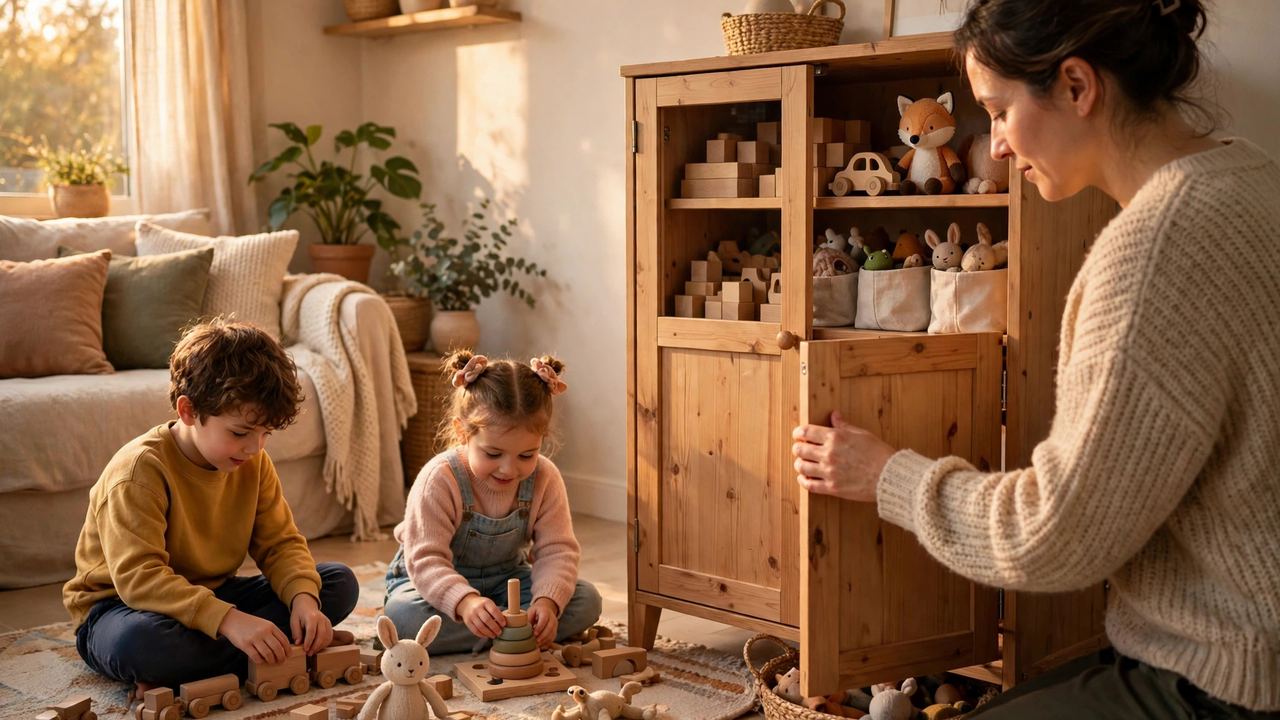
A living room that doubles as a playroom has one recurring problem: the toys are easy to get out and somehow never easy to put away, and open bins leave the whole collection on display even after cleanup. A cabinet with doors solves the second half of that problem. The doors close, the clutter disappears, and the room reads as a living room again instead of a playroom with a sofa in it. This guide to the best toy storage cabinets with doors for living rooms compares six cabinets that hide toys completely out of sight while still looking like furniture an adult would choose on purpose.
The six picks fall into two families. The first family is the low cube bookcase with doors fitted over some of its cubes: the FATORRI, Flrrtenv and OSCHF models below all follow that pattern, mixing open cubes for books and display with doored cubes for the toy pile. The second family is the classic two-door cabinet: the SICOTAS fluted sideboard and the Iwell storage cabinet look like ordinary living room furniture, while the tall Costzon cabinet adds open compartments above a doored base for households that want one dedicated kids’ unit. Every pick was checked on its opened Amazon product page for a live offer sold new, and every specification below is phrased the way the maker lists it.
Quick verdict
For most living rooms, the FATORRI 8 Cube Bookcase with 4 Doors is the strongest all-round pick: it is the widest cabinet here, its four doors can be fitted to whichever cubes you want hidden, and the walnut finish reads as grown-up furniture. If you want the same cube idea in white and at a smaller width, the Flrrtenv organizer is the natural alternative, and the OSCHF bookcase splits the difference with solid wood legs and handles. If you would rather have a piece that gives no hint it holds toys at all, the SICOTAS fluted sideboard is the pick, with the Iwell cabinet as the simpler two-door option. The Costzon is the one to choose when the cabinet is mainly for the children and you want open, kid-height compartments above the doored section.
The products in this guide
FATORRI 8 Cube Bookcase with 4 Doors, 57 Inch Walnut
Overall dimensions of 57.17 inches wide, 11.85 inches deep and 30.12 inches high, arranged as eight cubes in a low, horizontal frame that can sit
Every cabinet in this guide had to pass the same checks. First, it had to have real doors: hinged or pop-up doors that fully close over the storage space, not open cubbies, fabric bins or drawers alone, because the whole point of the keyword is hiding the toy collection from view. Second, it had to suit a living room: a finish and silhouette that can sit next to a sofa without announcing itself as nursery furniture, or, in the Costzon’s case, a clean-lined design that works in a shared family room. Third, each product was verified on its opened Amazon product page, where it had to show a live featured offer sold new; listings showing no featured offer were excluded and replaced, which is why a couple of well-known kids’ organizers did not make this list. Fourth, the specifications had to be confirmable on the opened page: dimensions, door count, materials and any capacity figures below are the figures the maker lists, and nothing has been filled in from guesswork.
Within those gates, we spread the picks across the shapes households actually ask for: wide and low cube bookcases that can double as a TV bench or sit under a window, a deeper sideboard-style cabinet for bulkier toys and games, a shallow two-door cabinet for narrow walls, and one tall unit that trades width for vertical storage. Door placement matters more than door count, so the guide notes exactly which part of each cabinet is hidden and which part stays open.
The FATORRI is the widest cabinet in this guide, and width is exactly what a serious toy collection needs. The maker lists overall dimensions of 57.17 inches wide, 11.85 inches deep and 30.12 inches high, arranged as eight cubes in a low, horizontal frame that can sit under a window, along a sofa wall or under a television. Four doors are included, and the detail that sets this model apart is that the doors are adjustable in position: you fit them to whichever cubes you want concealed and leave the rest open, so the split between hidden storage and display is your decision rather than a fixed factory layout. In a living room, that usually means doors across the bottom row for toys and open cubes above for books, plants and the things you are happy to see.
The construction is aimed at family use. The maker lists the bookcase as crafted from high-grade MDF boards with a reinforced wooden frame, with a thickened tabletop, a reinforced bottom shelf and an additional support leg underneath. The maker lists the top shelf weight capacity at up to 240 pounds and each cube at up to 60 pounds, which is generous for board games, toy vehicles and stuffed animals alike. The edges are smoothly curved, a small detail that matters when toddlers use the cabinet as a cruising rail, and the walnut finish gives the piece a warm, furniture-first look. The maker lists assembly at approximately 40 minutes with labeled parts and step-by-step instructions.
Buy it if: you have a wide wall to fill, a large and growing toy collection, and you want to decide yourself which cubes get doors.
Skip it if: your space is narrow, since at over 57 inches wide this is the biggest footprint here, or you need storage deeper than cube compartments allow.
Dimensions: the maker lists 57.17 x 11.85 x 30.12 in overall
Doors: the maker lists 4 doors, installable on any cubes
Capacity: the maker lists up to 240 lb on the top shelf and 60 lb per cube
Material: the maker lists MDF boards with a reinforced wooden frame, FSC-certified
Finish: walnut, with smooth curved edges
Pros: widest storage here; door positions are flexible; high listed capacities; curved edges suit homes with small children
Cons: shallow cube depth will not take oversized toys; the wide frame needs a long, clear wall
The Flrrtenv organizer takes the same eight-cube idea in a cleaner, fixed layout: four doors across the bottom cubes hide the toys, cables and general clutter, while the four open cubbies on top are left for books and display. The maker lists overall dimensions of 47.2 inches wide, 11.8 inches deep and 28.3 inches high, so it gives you most of the FATORRI’s storage in about ten fewer inches of wall. Each cubby is listed at 11.2 by 11.1 inches, which means standard 11 inch fabric bins and baskets slide straight in — useful if your current toy storage already lives in bins of that size and you want to move them behind doors rather than replace them.
Two structural details stand out. The maker lists a full back panel, which keeps items from slipping out behind the unit and makes the whole frame more rigid than backless cube organizers. Five wood legs raise the cabinet 4.7 inches off the floor, which keeps the base clear of dust and floor moisture and gives the piece a lighter, furniture-like stance in a living room. The maker describes the unit as suitable across rooms — kids’ storage cabinet, living room side cabinet, home office bookshelf or entryway console — and the plain white finish is the easiest of these six to blend into a bright, modern scheme. Parts are numbered and the maker lists assembly as a one-person job with the included instructions.
Buy it if: you want the cube-and-doors layout in white, you already own 11 inch bins, and a fixed doors-below, open-above split suits how you tidy up.
Skip it if: you want to choose which cubes get doors, since the door row here is fixed along the bottom, or you prefer a wood finish over white.
Dimensions: the maker lists 47.2 x 11.8 x 28.3 in overall; each cubby 11.2 x 11.1 in
Doors: the maker lists 4 doors on the bottom cubes
Structure: the maker lists a full back panel and 5 wood legs raising the unit 4.7 in
Bin fit: the maker lists compatibility with standard 11 in fabric bins
Weight: the maker lists 45 lb
Pros: tidy fixed layout; full back panel adds rigidity; raised legs suit living rooms; fits the most common bin size
Cons: door positions cannot be rearranged; white finish shows scuffs from toy traffic sooner than walnut
The OSCHF bookcase is the third take on the eight-cube formula, and its angle is materials and hardware. The maker lists the cabinet as constructed from MDF covered with veneer, paired with solid wood legs and solid wood door handles, so the parts you touch and see up close are real wood. The layout matches the Flrrtenv: the bottom four cubes are fitted with doors for dust-proof, private storage of the things you do not want on display, and the four cubes above stay open. The maker lists overall dimensions of 46.6 inches wide, 11.2 inches deep and 28.3 inches high, with each cube at a 28 centimeter side length that accepts the general run of storage bins on the market.
Capacity is a strong point. The maker lists each cube as holding up to 60 pounds and the top panel at up to 240 pounds, and credits the complete back panels with reinforcing the structure — the maker notes that backless cabinets carry less and deform more easily, which is a fair warning about cheaper cube units. The solid wood legs stand 12 centimeters high, enough clearance for a robot vacuum to pass underneath, which is a genuinely practical touch in a room where toy cleanup and floor cleanup happen in the same sweep. In walnut, this is the cube cabinet most likely to be mistaken for a regular low bookcase, and the maker suggests it for the living room as a showcase, the dining room as a side cabinet or a child’s room alike.
Buy it if: you like the cube layout but want solid wood legs and handles, walnut veneer, and clearance underneath for a robot vacuum.
Skip it if: you need the widest possible storage, since the FATORRI gives you roughly ten more inches of cubes, or you want doors on the upper row too.
Dimensions: the maker lists 46.6 x 11.2 x 28.3 in overall
Doors: the maker lists 4 doors on the bottom cubes, with solid wood handles
Capacity: the maker lists up to 60 lb per cube and 240 lb on the top panel
Material: the maker lists MDF with veneer, solid wood legs, and complete back panels
Weight: the maker lists 40.7 lb
Pros: solid wood legs and handles; strong listed capacities; full back panels; vacuum-friendly leg height
Cons: doors are fixed to the bottom row; the shallowest depth of the three cube cabinets
The SICOTAS is the pick for anyone who wants the toys to vanish into a piece of furniture that looks entirely adult. It is a fluted buffet cabinet: two doors with a distinctive waveform panel design and a pop-up, press-to-open mechanism, so there are no protruding handles and the front stays sleek and seamless. Nothing about its silhouette says toy storage, which is precisely the point in a living room that hosts guests after the children are in bed. Behind the doors, the maker lists two adjustable shelves, so the interior can be divided for board game boxes, building sets and art supplies, or opened up for bulkier items that would never fit a cube.
It is also the deepest cabinet in this guide. The maker lists overall dimensions of 30.9 inches wide, 15.6 inches deep and 34.1 inches high, and that extra depth over the cube bookcases is what swallows ride-on toys’ accessories, large vehicles and the awkward shapes that defeat shallow storage. The maker lists the frame as FSC-certified engineered wood with a thickened board and scratch-proof, water-resistant surfaces, plus adjustable feet for leveling on uneven floors. At just under 31 inches wide it fits the short wall beside a sofa or the gap beside a fireplace where a wide cube unit cannot go, and the maker positions it as a sideboard, media console or accent cabinet for living rooms, dining rooms and hallways. Assembly is listed as straightforward with clear, detailed instructions.
Buy it if: your priority is a cabinet that reads as a mid-century sideboard, you have bulkier toys that need depth, and your available wall is short rather than long.
Skip it if: you need open display space for books and decor in the same unit, since this cabinet is fully enclosed, or your toy volume is large enough to need a wide cube unit.
Dimensions: the maker lists 30.9 x 15.6 x 34.1 in overall
Doors: the maker lists 2 pop-up doors with a fluted waveform panel design
Interior: the maker lists 2 adjustable shelves
Material: the maker lists FSC-certified engineered wood with scratch-proof, water-resistant surfaces
Feet: the maker lists adjustable leveling feet
Pros: deepest storage here; fully enclosed, furniture-first looks; adjustable shelves handle bulky and boxed toys; handle-free fluted front
Cons: no open display section; narrower total volume than the wide cube cabinets; pop-up doors need a clear press, which very small children may find tricky
The Iwell is the straightforward option: a white two-door cabinet with open shelving, sized for the narrow strip of wall that the bigger units cannot use. The maker lists overall dimensions of 35.4 inches wide, 11.8 inches deep and 31.7 inches high. The layout combines two open shelves — handy for the books, remotes and display pieces that live in a living room permanently — with a doored section whose interior shelves adjust across three heights, so the hidden part of the cabinet can be arranged around game boxes and toy bins rather than the other way round. The maker describes the cabinet as multi-functional across the home: a coffee bar, an entryway cabinet for hats and gloves, or a TV stand for media boxes and accessories, and that same flexibility is what makes it easy to place as toy storage now and repurpose later.
The maker lists the cabinet as built from engineered wood with an eco-friendly waterproof paint finish, and an anti-tip kit is included to secure it to the wall — a detail worth using in any home where children climb or pull themselves up on furniture. The maker lists the item weight at 37.6 pounds, the lightest cabinet in this guide, and assembly at around 30 minutes following the included instructions. The plain white finish and simple lines will not fight with existing furniture, and the shallow 11.8 inch depth keeps it from crowding a walkway. If your living room needs one modest cabinet that hides the daily toy pile without dominating the room, this is the proportion to look at.
Buy it if: you have a narrow wall, want a light and simple two-door cabinet with a couple of open shelves, and value the included anti-tip kit.
Skip it if: you need maximum hidden volume, since the open shelves and modest width mean less enclosed space than the cube cabinets or the SICOTAS.
Dimensions: the maker lists 35.4 x 11.8 x 31.7 in overall
Doors: the maker lists 2 doors over the enclosed section
Shelves: the maker lists 2 open shelves and interior shelves adjustable to 3 heights
Material: the maker lists engineered wood with a waterproof paint finish
Safety: the maker lists an included anti-tip kit; item weight 37.6 lb
The Costzon takes the opposite approach to the sideboards: instead of disguising the toy storage as adult furniture, it organizes a child’s whole collection in one tall, narrow unit and puts the doors exactly where the mess is worst. The maker lists overall dimensions of 23.5 inches wide, 11.5 inches deep and 47.5 inches high. Five open compartments and a wide top shelf hold the books, display pieces and current favorites at reachable heights, while the bottom section is a two-door enclosed cabinet for the jumble — loose bricks, vehicles, dress-up pieces — that you want out of sight at the end of the day. The top shelf has raised edges to keep items from sliding off, a small but sensible touch on a tall unit.
The doors are the well-thought-out part. The maker lists magnetic catches and round handles, so the doors open conveniently for small hands and close tightly enough to stay shut, and the panels have smooth edges without burrs. The maker lists the cabinet as crafted from thick engineered wood with a smooth, anti-scratch surface that wipes clean, and lists the item weight at 42 pounds. The natural finish and simple lines keep it calm enough for a shared living room corner, and the maker suggests it can also serve as a display shelf, console table or buffet in other rooms once the toy years pass. Assembly follows the detailed included instruction. For a small living room where floor width is the constraint, going tall like this is often the only way to get a doored cabinet and open storage in a single footprint.
Buy it if: floor space is tight, you want one dedicated kids’ unit with open compartments children can reach and a doored cabinet for the messy overflow, and magnetic catches appeal.
Skip it if: you want storage that blends invisibly with adult furniture, or you need width more than height — the cube cabinets hold more per glance and sit lower.
Dimensions: the maker lists 23.5 x 11.5 x 47.5 in overall
Doors: the maker lists 2 doors with magnetic catches and round handles over the bottom cabinet
Open storage: the maker lists 5 open compartments plus a top shelf with raised edges
Material: the maker lists thick engineered wood with an anti-scratch, wipe-clean surface
Weight: the maker lists 42 lb
Pros: smallest footprint here; kid-friendly magnetic door catches; open compartments teach sorting; raised top edges keep items in place
Cons: most of the storage is open, so only the bottom section hides clutter; tall units should be wall-anchored around climbing toddlers
Buying guide
Measure depth before width. Most toy storage failures are depth failures. The cube cabinets in this guide are around 11 to 12 inches deep, which suits books, board games, bins and most boxed toys, but ride-on toys, big vehicles and chunky toddler toys need the deeper interior of a sideboard-style cabinet like the SICOTAS at 15.6 inches deep. Measure your three bulkiest toys and let the largest one set the minimum depth, then check width against the wall you actually have, leaving room for skirting boards and door swings.
Decide your open-to-hidden ratio. Doors hide clutter, but a fully enclosed cabinet is slower for a child to use at cleanup time, and open sections are where books and current favorites naturally live. The cube cabinets split roughly half open and half doored, the Iwell keeps two open shelves, the Costzon is mostly open with a doored base, and the SICOTAS hides everything. Match the ratio to your household: the more the room doubles as adult space in the evening, the more hidden storage you will appreciate.
Check how the doors work. Hinged doors with handles, like the FATORRI, Flrrtenv and OSCHF cubes, are the easiest for children to open and the most forgiving of rough use. Magnetic catches, as on the Costzon, keep doors shut against a stuffed interior. Pop-up press doors, as on the SICOTAS, give the cleanest front but need a deliberate press that very young children may not manage — which can be a feature or a frustration depending on the child. Also confirm doors can be fitted where you want them: the FATORRI’s doors install on any cube, while the other cube cabinets fix the door row along the bottom.
Look at the back and the base. A full back panel, listed on the Flrrtenv and OSCHF, stops small toys escaping behind the cabinet and stiffens the frame; backless cube organizers flex and shed contents. Raised legs make cleaning underneath possible and keep the base off damp floors, and a 12 centimeter leg height, as the OSCHF lists, lets a robot vacuum pass. Whatever you choose, use the anti-tip hardware if it is included, and anchor any tall or climbable unit to the wall — a cabinet full of toys is an invitation to climb.
Plan for the bins you already own. If your toys already live in standard 11 inch fabric bins, the Flrrtenv’s cubbies are listed to fit them exactly, and the OSCHF’s 28 centimeter cubes accept the general run of bins. Buying a cabinet that swallows your existing bins is cheaper and tidier than starting a new storage system from scratch.
FAQ
Are cabinets with doors better than open toy bins in a living room?
For a shared living room, usually yes. Open bins are faster for toddlers to use, but they leave the collection visible all evening. Doors give you both: children can still reach the toys during the day, and one pass at cleanup time closes everything away so the room looks like a living room again. A mixed layout — open cubes for books, doored cubes for the jumble — is the practical middle ground most families land on.
What size cabinet do I need for a typical toy collection?
Start from your bulkiest toys, not the count. A low eight-cube cabinet around 47 to 57 inches wide holds a substantial collection of games, vehicles and stuffed toys in standard bins. If your toys include large or awkward shapes, depth matters more than width: look for an interior depth closer to 15 inches, as on the SICOTAS, rather than the 11 to 12 inches of a cube bookcase.
Can a low cube cabinet with doors double as a TV stand?
The makers of low horizontal bookcases like the FATORRI list high top capacities — up to 240 pounds on the top shelf in that case — and position them for use under a television. Check the listed top capacity and the height against your screen and seating, keep the television itself anchored, and remember that doored cubes below the screen are an excellent place for games consoles’ accessories and the toy overflow alike.
How do I keep a storage cabinet safe around toddlers?
Anchor it. Use the anti-tip kit where one is included, as with the Iwell, and wall-anchor tall units such as the Costzon as a matter of routine. Prefer smooth or curved edges where the maker lists them, keep heavy toys in the lowest compartments so the unit stays bottom-heavy, and check that door catches close positively so doors do not swing into a crawling child’s path.
Will a white cabinet survive toy traffic?
White finishes show scuffs sooner, but the wipe-clean surfaces the makers list on these cabinets handle most marks, and white is also the easiest finish to touch up. If your living room sees heavy daily play, a walnut finish such as the FATORRI or OSCHF hides minor wear better while still reading as adult furniture.
Conclusion
The right toy storage cabinet for a living room is the one whose doors close over your particular clutter and whose front you are happy to look at every evening. Choose the FATORRI for maximum width and flexible door placement, the Flrrtenv for the same idea in white with bins you already own, or the OSCHF for solid wood hardware and vacuum-friendly legs. Choose the SICOTAS when the cabinet must pass as a sideboard and swallow bulky toys, the Iwell for a light, shallow two-door fit on a narrow wall, and the Costzon when one tall, kid-organized unit in the corner is the honest answer. Measure the bulkiest toy, decide how much of the collection must disappear behind doors, and the shortlist above narrows to one cabinet quickly.
M
Modern Line Home Editorial Team
We compare specs, materials and verified owner reviews before a product earns a spot. Rankings are never paid.
Affiliate disclosure. As an Amazon Associate we earn from qualifying purchases at no extra cost to you. Prices accurate as of the date shown.
House cold even with the heat on? Walk this ordered checklist: thermostat and filter first, then drafts, insulation, leaky ducts and a failing heating system.
Windows fogging up in winter? Check where the fog sits: on the room side it is indoor humidity, outside it is harmless, and between panes the seal has failed.
Store the main firewood pile about 30 feet from your house, off the ground and covered only on top. Compare racks, woodsheds, garages and indoor spots safely.
Place a portable generator outdoors only, at least 20 feet from windows, doors and vents, exhaust pointed away. Exact distances, setup steps and CO rules here.
Keep houseplants in the right winter spot: match window direction to plant type, stay clear of radiators and cold glass, and fix dry air and low light at home.
Mice enter through pencil-width gaps at foundations, pipes, vents, doors and the roofline. Walk this room-by-room winter checklist to find and seal each one.
A winter outage timeline: what to do in the first hour, first night and multi-day outage, with food safety times, pipe protection, heat and CO safety steps.
Size a space heater by room area: 10 watts per square foot at 8-foot ceilings, adjusted for insulation and ceiling height, with full wattage and BTU tables.
Start dripping at about 20 degrees, sooner for exposed pipes. Set a pencil-lead stream, drip the right faucets on both lines, and know when to stop safely.
A fridge needs 800-1,200 starting watts, not just 150-400 running watts. Use the tables to total your fridge plus freezer, lights, furnace fan and more today.











Write Your Review
No reviews yet. Be the first to share your experience!