We independently review everything we recommend. When you buy through our links, we may earn a commission. As an Amazon Associate we earn from qualifying purchases.
Best Oven Safe Probe Thermometers for Thanksgiving
Compare the best oven safe probe thermometers for Thanksgiving turkey, with leave-in probes, oven-rated cables, alarms and dual-probe options for roasting.
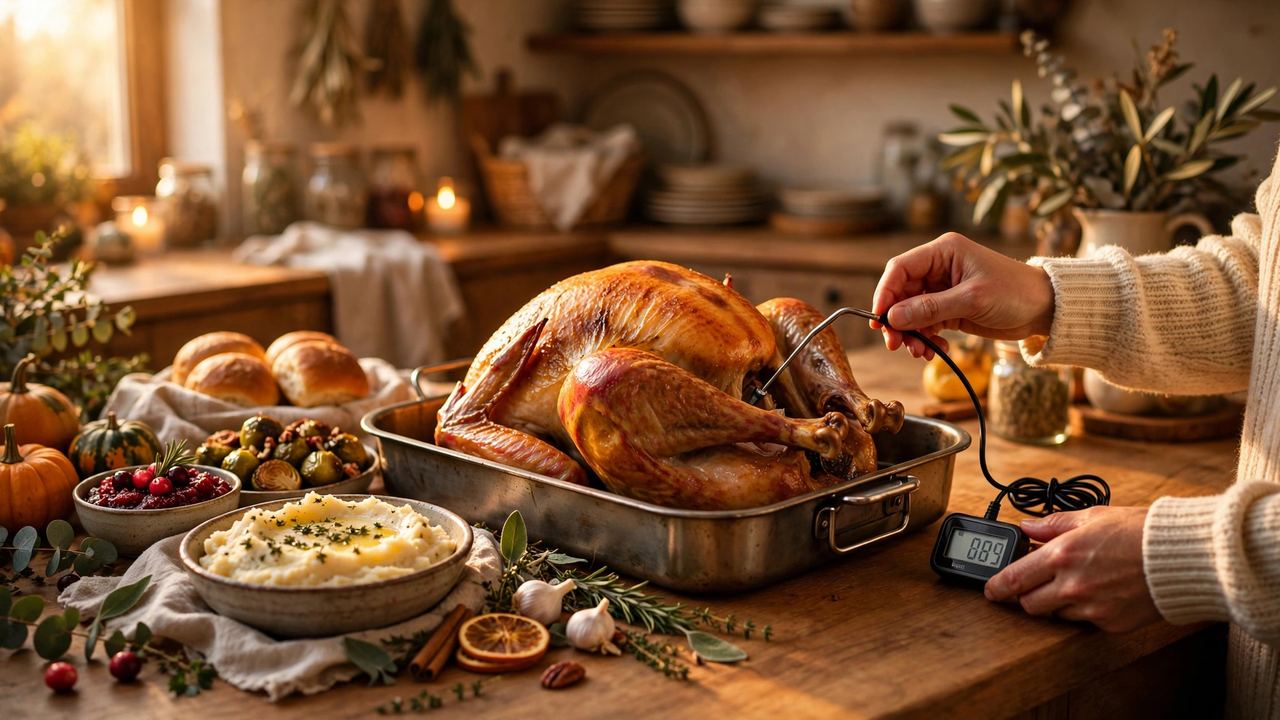
A Thanksgiving turkey punishes guesswork. The bird is large, the breast and the thigh finish at different moments, the oven door loses heat every time it opens, and the rest of the meal is competing for your attention in the same hour. A leave-in probe thermometer solves the central problem: the probe stays in the thickest part of the turkey, the cable runs out through the oven door, and the display sits safely outside the heat, reporting the temperature continuously while the door stays closed. That is why choosing among the best oven safe probe thermometers for thanksgiving turkey cooking is less about gadgets and more about a calm, predictable roast.
This guide compares six real leave-in models, each built around a probe and a heat-rated cable that the maker lists for oven use. They range from a deliberately simple single-probe alarm unit to dual-probe wireless systems and a four-probe Bluetooth model for hosts who are roasting a turkey and monitoring side dishes or a second protein at the same time. Every specification below is phrased as the maker lists it, because cable ratings, temperature ranges and probe lengths differ in ways that matter when a cable is pinched in an oven door for three or four hours.
Read the quick verdict first if you are short on time, then use the comparison table to narrow the field by probe count, cable rating and alarm style. The buying guide at the end explains probe placement in a whole turkey, why breast and thigh readings differ, how carryover heat during resting affects when you should pull the bird, and how to route a cable so it survives the cook and many cooks after it.
Quick verdict
For most Thanksgiving cooks, the ThermoWorks DOT Simple Alarm Thermometer is the easiest recommendation: one probe, one target temperature, a loud alarm, and a cable the maker lists to a high oven rating, with no app and no pairing. If you want to leave the kitchen and carry the reading with you, the ThermoPro TP20 Wireless Meat Thermometer adds a separate receiver and a second probe, so one probe can sit in the turkey while the other tracks oven air or a second dish. Hosts cooking several items at once should look at the TempPro TP25 Bluetooth Meat Thermometer, which monitors four probes through a phone app.
The remaining three picks are straightforward wired timers with alarms. The Polder Classic Digital Thermometer and Timer is a long-running single-probe design with a silicone cord and a combined timer display. The CDN Programmable Probe Thermometer/Timer DTP482 adds preset and programmable settings and a vessel clip. The Taylor Programmable Wired Probe Digital Thermometer is the simple, magnet-mounted option with a silicone-coated probe lead. None of these tools needs to be complicated; the best one is the one whose alarm style matches how you actually cook on the day.
The products in this guide
ThermoWorks DOT Simple Alarm Thermometer
The DOT is built around restraint
Best if you want the simplest reliable leave-in alarm for a turkey
Use the table as a filter, not a ranking. A four-probe Bluetooth system is not better for a cook who only needs one reliable alarm, and a simple wired timer is not worse for a cook who stays in the kitchen. Match the probe count to the number of things you genuinely need to watch, match the cable rating to your roasting temperature, and match the display style to where you will be when the turkey approaches its target.
How we selected
Selection started with a strict definition. A qualifying product had to be a leave-in probe thermometer: a metal probe designed to stay in food while it cooks, connected by a cable rated for oven use to a display that remains outside the oven, or to a transmitter that sends the reading elsewhere. Instant-read thermometers were excluded, however good they are for spot checks, because they require opening the oven. Truly wireless probes with no cable were also set aside for this guide, because the keyword and the cooking task point to the proven probe-and-cable format that works through a closed oven door.
Each product then had to be verified on opened pages. The maker product page or an Amazon listing with full details had to confirm the brand, the exact model, the temperature range, and the probe and cable arrangement. Specifications in this article are stated only as the maker lists them. A product whose existence or specifications could not be confirmed on an opened page was excluded entirely rather than described with filler. Availability was checked on the Amazon product page as well: a pick had to show a live featured offer sold new, and a page showing no such offer did not count as verified.
Finally, the six were balanced as a set. Thanksgiving cooking covers at least three different styles: the focused cook who wants one alarm and nothing else, the host who wants to monitor breast and thigh or turkey and oven air at once, and the multi-dish cook who wants several probes feeding one screen. The set includes options for each style, plus wired timer models that combine a countdown with a temperature alarm, which is useful when the same tool must also time stuffing, rolls or a resting period.
The DOT is built around restraint. The maker lists it as a single-channel alarm thermometer: set a target temperature with simple up and down buttons, insert the included Pro-Series probe into the thickest part of the turkey breast or thigh, close the oven door on the cable, and let the alarm tell you when the target is reached. There is no app to install, no account, and no pairing step to fail an hour into the roast. For a holiday cook who already has enough moving parts, that simplicity is a feature rather than a limitation.
The maker lists a measurement range from -58 to 572 degrees Fahrenheit
The maker lists accuracy of plus or minus 1.8 degrees Fahrenheit from -4 to 248 degrees Fahrenheit
The maker lists the included Pro-Series probe cable to a maximum of 700 degrees Fahrenheit, with a cable length of 47 inches
The maker lists the probe length as 4.5 inches
The maker lists an alarm volume of 70 decibels, an IP65 splash-resistant rating excluding the probe connector, and battery life up to 5,000 hours on two AAA batteries
The maker lists a NIST-traceable calibration certificate as included
In turkey terms, the 47-inch cable is long enough to reach from the center of a large bird to a display magnet-mounted on the oven front or standing on the counter, and the cable rating gives comfortable headroom above normal roasting temperatures. The display shows current and alarm temperature together, so a glance tells you both where the bird is and where it is going. Because there is only one channel, plan your placement: many cooks put the probe in the thigh for the main cook, then confirm the breast with a separate spot check near the end, or place it in the breast and watch the thigh separately. Either approach works if it is decided before the bird goes in.
Buy it if: you want the simplest reliable leave-in alarm for a turkey, you prefer physical buttons to an app, and one well-placed probe matches how you cook.
Skip it if: you need to track breast and thigh simultaneously, or you want alerts delivered to another room or to your phone.
The TP20 splits the job in two. Its probes plug into a transmitter that stays near the oven, and a separate wireless receiver carries the readings with you. That arrangement suits Thanksgiving well: one probe can sit in the turkey while the second, fitted with the included grill clip, reads oven air temperature, revealing whether your oven runs hot or cool without opening the door. Alternatively, use both probes in the bird, one in the breast and one in the thigh, and watch the two zones converge.
The maker lists a temperature range from 32 to 572 degrees Fahrenheit
The maker lists temperature accuracy of plus or minus 1.8 degrees Fahrenheit
The maker lists the probe and wire as able to withstand up to 716 degrees Fahrenheit
The maker lists a food probe length of 6.5 inches and a cable length of 40 inches of stainless steel mesh cable
The maker lists a remote range of up to 300 feet in the product specifications, with the current listing describing a longer remote range for the receiver
The maker lists countdown and count-up timer options and four AAA batteries in the package contents
The preset temperature settings give a starting point for poultry and other meats, and every preset can be reset to your own target, which matters if you pull your turkey a few degrees early to allow for carryover during resting. The receiver and transmitter are pre-paired, so setup is a matter of inserting batteries, plugging in probes and placing them carefully. Keep the transmitter itself out of the oven and away from direct heat; only the probes and their cables belong inside.
Buy it if: you want two probes and a pocketable receiver, you plan to leave the kitchen during a long roast, and you value an oven-air reading alongside the turkey reading.
Skip it if: you want phone graphs and app alerts, or you know a single counter display will never be left behind or misplaced in a busy house.
The TP25 is the multi-dish option. Four color-coded wired probes run to a transmitter with its own backlit display, and Bluetooth sends the readings to a phone app. On Thanksgiving that can mean a probe in the turkey breast, one in the thigh, one in a second protein or a pan of stuffing cooked outside the bird, and one clipped at the rack to watch oven air. Color coding reduces the classic multi-probe confusion about which line belongs to which dish.
The maker lists four color-coded stainless steel probes
The maker lists a wide temperature range from 14 to 572 degrees Fahrenheit
The maker lists Bluetooth monitoring up to 650 feet away through the app on the current listing
The maker lists a step-down probe tip design and a backlit display on the transmitter
The maker lists the unit as rechargeable, with probe winders for tidier storage
The maker lists two grill clips among the included components for ambient readings
More probes only help if placement stays disciplined. Label which color is in which food before the oven door closes, route the cables together so they are not trapped at different points, and set a separate target or timer for each probe in the app. The transmitter display means the cook is not entirely phone-dependent; a glance at the base still shows the four readings. Remember that Bluetooth range in a real house is shaped by walls and appliances, so keep the phone within a sensible distance during the final approach to target temperature, when minutes matter most.
Buy it if: you routinely cook several items at once, you like app alerts and a temperature graph, and four labeled channels will reduce rather than add to your workload.
Skip it if: you cook one bird and one or two sides, dislike managing an app during a meal, or prefer replaceable batteries to recharging.
The Polder Classic is a familiar single-probe format: a stainless steel probe on a long silicone cord, a split-screen display that shows timer, current temperature and set temperature together, and an optional alert when the set temperature is reached. A memory function saves the last used temperature, a small convenience if your turkey target is the same every year. Magnets let the unit sit on an oven door, or it can stand on the counter with its display angled for reading.
The maker lists a temperature range from 32 to 392 degrees Fahrenheit
The maker lists an upper temperature rating of 392 degrees Fahrenheit
The maker lists a 40-inch long, high-heat silicone cord
The maker lists a 24-hour countdown timer
The maker lists one AAA battery as required and included
The maker lists the item model number as THM-362-86
The listed range covers roasting comfortably, since the probe reads the internal temperature of the turkey rather than the oven air, and internal targets sit far below the top of the range. What the range does signal is intent: this is an in-oven roasting tool, not a high-heat searing or flame tool, and the cord should be kept away from elements and burners. The combined timer is genuinely useful on Thanksgiving, when the same display can count down a side dish while the probe watches the bird, though you should decide in advance which alarm you are listening for at any moment.
Buy it if: you want a proven, simple probe-and-timer unit, you like a split screen that shows everything at once, and your cooking is oven roasting rather than high-heat grilling.
Skip it if: you need a second probe, wireless monitoring, or a listed range that extends well beyond roasting temperatures.
CDN builds measurement tools, and the DTP482 reflects that background. It offers both preset meat and taste temperatures and a programmable alert mode, displays actual and set temperatures, and includes an adjustable stainless steel vessel clip that can hold the probe in a pan, which extends its life beyond Thanksgiving into candy making, deep frying and sauce work. Mounting is flexible: magnet, stand or hang.
The maker lists a measurement range from 32 to 482 degrees Fahrenheit
The maker lists probe heat resilience to 482 degrees Fahrenheit and the high-heat sensor cable to 400 degrees Fahrenheit for 3 hours
The maker lists a 5.5-inch probe and a 3-foot sensor cable in its instructions
The maker lists a timer that counts up or down over 24 hours by hours and minutes
The maker lists one AAA alkaline battery as included, with a battery life of 1 year at 2 hours of use per day
The maker lists a 5-year limited warranty
Pay attention to the cable figure, because it is stated differently here: the maker lists the sensor cable to a lower temperature than the probe itself, for a stated duration. For a turkey roasted at a moderate temperature for a few hours, route the cable so it is not pressed against a rack or element, and avoid using this probe for very high-heat jobs beyond the cable listing. Used within its listed limits, the DTP482 is a precise, preset-driven option, and the temperature guide on the case is a handy reference when several cooks are sharing the kitchen.
Buy it if: you like preset plus programmable modes, you will also use a probe for pans, candy or frying, and you value a long stated warranty from a measurement specialist.
Skip it if: your cable will see sustained temperatures near the top of its listing, or you want wireless or multi-probe monitoring.
Taylor is one of the oldest names in home thermometers, and this programmable wired model keeps the formula direct. Program the unit to a desired cooking temperature, insert the stainless steel probe, and monitor the cook without opening the oven. Mounting magnets and an adjustable display help it live on the oven front where it can be read at a glance, and the listing describes a silicone-coated probe lead, which many cooks find easier to handle and wipe clean than bare mesh.
The maker lists a temperature range from 32 to 392 degrees Fahrenheit
The maker lists a 4-foot silicone-coated probe
The maker lists two AAA batteries as required and included
The maker lists mounting magnets and an adjustable display
The maker lists the item model number as 1478-21
The maker lists a 1-year limited warranty in the product details
Like the other 392-degree models in this guide, this Taylor is a roasting instrument: the probe measures the inside of the food, so the range is more than sufficient for turkey, while the display unit itself must stay outside the oven and away from direct heat. The four-foot lead is generous for a home oven, giving you freedom to place the display where the cook actually stands. Its strength is familiarity; if you have used a Taylor timer before, the controls and layout will feel known on a day when learning a new interface is unwelcome.
Buy it if: you want a simple programmable probe from an established thermometer brand, a longer silicone-coated lead, and a magnet-mounted display.
Skip it if: you need readings above its listed range, a second probe, or alerts away from the kitchen.
Buying guide
Understand what oven safe actually means. In a probe thermometer, oven safe applies to the probe and its cable, not to the display, transmitter or receiver. The electronics stay outside the oven in every model in this guide. Each maker lists a maximum for the cable, and those figures differ: some cables are listed to around 700 degrees Fahrenheit, while others are listed lower, in one case with a time limit attached. Compare the cable listing, not just the headline temperature range, with the temperature at which you roast. A moderate roasting temperature leaves generous headroom for a high-rated cable and a thinner margin for a lower-rated one.
Place the probe where the decision is made. For a whole turkey, the two places that matter are the thickest part of the breast and the innermost thigh. Insert the probe slowly, aim for the center of the thickest muscle, and keep the tip away from bone, because bone conducts heat differently and can distort the reading. If your model has one probe, choose the zone you will use to decide doneness and check the other zone separately near the end. If it has two or more probes, use one in each zone from the start and expect them to move at different speeds; that difference is information, not a fault.
Plan for carryover and resting. A large turkey continues to rise in temperature after it leaves the oven. Many cooks set the alarm a few degrees below their final target, tent the bird, and let resting carry it the rest of the way while juices redistribute. Whatever target you follow from your recipe or food safety guidance, set it deliberately in the thermometer before the bird goes in, rather than doing arithmetic beside a hot oven later. A probe that stays in during the early part of resting lets you watch the rise and confirm the peak.
Route the cable with care. Close the oven door gently on the cable rather than letting it slam, keep the cable away from heating elements and oven racks where possible, and avoid sharp kinks at the probe handle. Do not pull the probe out by its cable; grip the probe itself, with a mitt, because it will be hot. After cooking, wipe the probe clean, let the cable cool fully, and store it loosely coiled rather than tightly wound, which helps cables last through many holiday seasons.
Choose alarms for your house, not a spec sheet. A loud counter alarm suits a cook who stays nearby. A wireless receiver suits a host who must greet guests, set a table in another room or manage a second oven. An app suits a cook who wants a graph, multiple named timers and alerts on a device already in a pocket. All three approaches read the same probe; they differ only in how insistently and how distantly they get your attention. Pick the one you will actually hear and act on during the busiest twenty minutes of the meal.
Check the tool before the day. Put fresh batteries in, or charge the unit, a day or two before Thanksgiving. Confirm the probe reads sensibly in a glass of ice water and in boiling water if your maker gives that procedure, check that the cable has no visible damage, and make sure the alarm volume is set high enough to hear over conversation and a vent hood. A two-minute check in advance is far better than discovering a weak battery with a raw turkey on the counter.
FAQ
Can the display unit go inside the oven?
No. In every model here, only the probe and its rated cable are listed for oven exposure. The display, transmitter and receiver stay outside, which is exactly why the cable length matters: it must reach from the center of the bird to a safe, readable position outside the door.
Where should the probe go in a Thanksgiving turkey?
Into the thickest part of the breast or the innermost thigh, with the tip centered in the meat and not touching bone. With a dual-probe or multi-probe model, use one probe in each zone. With a single probe, monitor one zone continuously and check the other separately as the bird nears its target.
Why do models list different maximum temperatures?
Because the headline range, the probe limit and the cable limit are three different figures. A thermometer may read to a high temperature while its cable is listed lower, sometimes for a limited duration. Always compare the cable listing from the maker with your roasting temperature, and keep cables away from elements, racks and flames, which can be hotter than the oven setting.
Is a wireless receiver or Bluetooth model worth it for one turkey?
It depends on where you will be during the roast. If you stay in the kitchen, a simple counter alarm such as the DOT or a wired Taylor or Polder model does the whole job. If you will be in another part of the house, a receiver model such as the TP20 or an app model such as the TP25 keeps the reading with you and reduces door opening by everyone who wants a progress report.
Can I use the same probe thermometer after Thanksgiving?
Yes. The same leave-in format suits roasts, whole chickens, pork shoulder, brisket and other long cooks, and models with a vessel clip or a wide range also help with candy, frying and sauces. Store the probe clean and the cable loosely coiled, and check batteries before each major cook.
What should I do if two probes in the same turkey disagree?
Trust placement before you distrust the tool. Breast and thigh genuinely finish at different times, and a tip touching bone or sitting in a fat pocket will read differently from one centered in muscle. Reposition the probe that looks wrong, give it a minute to settle, and judge doneness by the zone your recipe or guidance specifies.
Conclusion
A good oven-safe probe thermometer turns Thanksgiving turkey from a timed guess into a monitored cook: probe in, door closed, target set, and an alarm that arrives before the moment passes. Choose the ThermoWorks DOT for single-probe simplicity, the ThermoPro TP20 for two probes and a carry-around receiver, or the TempPro TP25 for four app-monitored channels. Choose the Polder Classic, the CDN DTP482 or the Taylor programmable model if a wired display with a timer is the shape that fits your kitchen. Whichever you pick, respect the cable rating the maker lists, place the probe with care, and check batteries before the day. The result is a calmer host, a closed oven door, and a turkey pulled at the temperature you intended.
M
Modern Line Home Editorial Team
We compare specs, materials and verified owner reviews before a product earns a spot. Rankings are never paid.
Affiliate disclosure. As an Amazon Associate we earn from qualifying purchases at no extra cost to you. Prices accurate as of the date shown.
House cold even with the heat on? Walk this ordered checklist: thermostat and filter first, then drafts, insulation, leaky ducts and a failing heating system.
Windows fogging up in winter? Check where the fog sits: on the room side it is indoor humidity, outside it is harmless, and between panes the seal has failed.
Store the main firewood pile about 30 feet from your house, off the ground and covered only on top. Compare racks, woodsheds, garages and indoor spots safely.
Place a portable generator outdoors only, at least 20 feet from windows, doors and vents, exhaust pointed away. Exact distances, setup steps and CO rules here.
Keep houseplants in the right winter spot: match window direction to plant type, stay clear of radiators and cold glass, and fix dry air and low light at home.
Mice enter through pencil-width gaps at foundations, pipes, vents, doors and the roofline. Walk this room-by-room winter checklist to find and seal each one.
A winter outage timeline: what to do in the first hour, first night and multi-day outage, with food safety times, pipe protection, heat and CO safety steps.
Size a space heater by room area: 10 watts per square foot at 8-foot ceilings, adjusted for insulation and ceiling height, with full wattage and BTU tables.
Start dripping at about 20 degrees, sooner for exposed pipes. Set a pencil-lead stream, drip the right faucets on both lines, and know when to stop safely.
A fridge needs 800-1,200 starting watts, not just 150-400 running watts. Use the tables to total your fridge plus freezer, lights, furnace fan and more today.












Write Your Review
No reviews yet. Be the first to share your experience!