We independently review everything we recommend. When you buy through our links, we may earn a commission. As an Amazon Associate we earn from qualifying purchases.
Best Portable Induction Cooktops for Thanksgiving Prep
Six portable induction cooktops for Thanksgiving meal prep compared on burners, power, timers and pan fit, so sides and gravy never wait for a range burner.
Six portable induction cooktops for Thanksgiving meal prep compared on burners, power, timers and pan fit, so sides and gravy never wait for a range burner.
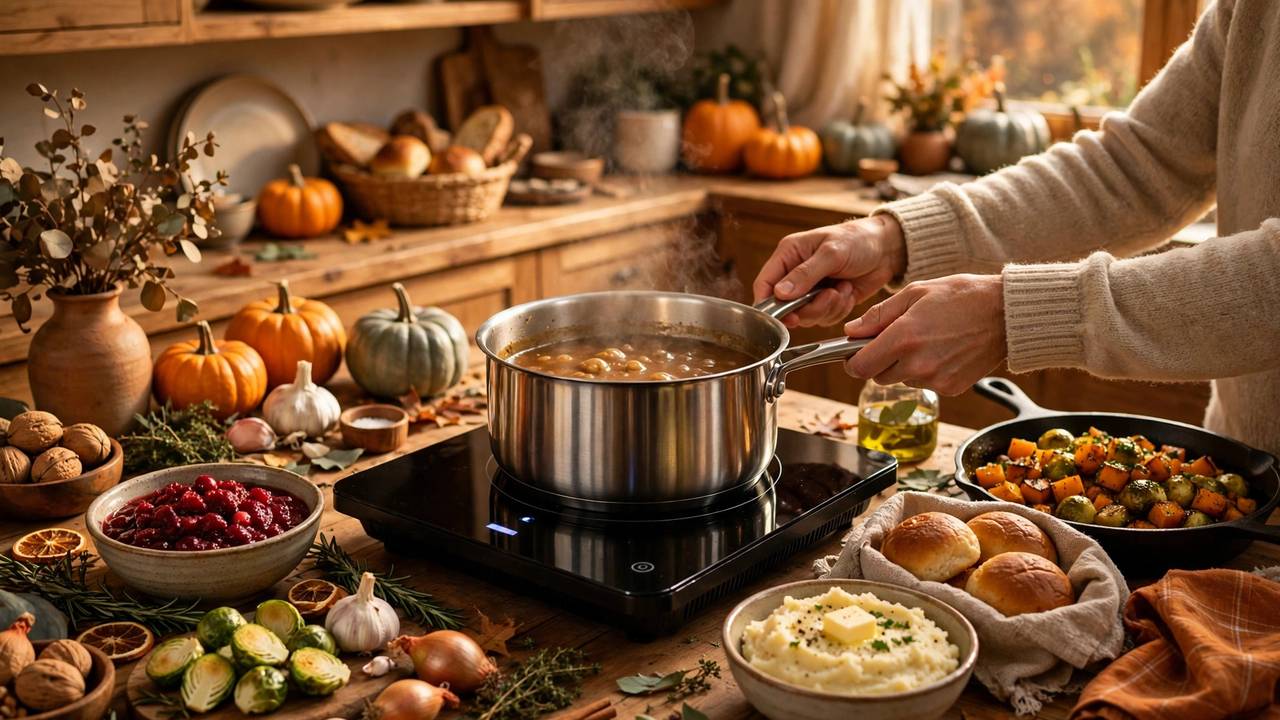
Thanksgiving dinner is a traffic jam on four burners. The turkey owns the oven, the range is holding mashed potatoes, green beans, gravy and a cranberry sauce that needs watching, and something always ends up cooling on the counter while it waits for a free spot. A portable induction burner breaks that logjam: it plugs into a standard outlet, sits on any clear stretch of counter, heats only the pan on it, and goes back into a cabinet when the holiday is over. This guide to the best portable induction cooktops for thanksgiving meal prep under $200 compares six countertop models that are sold new and listed by their makers as portable induction cooktops, so you can add one or two extra cooking zones exactly where the meal needs them.
The six picks below cover the main shapes this category takes. There are full-power single burners with fine power and temperature steps for sauces and gravy, a double burner that runs two pots at once for hosts who know one extra zone will not be enough, a lower-wattage precision model that can share a circuit more politely and hold delicate temperatures, and simpler button-controlled burners for cooks who want to set a level and get back to carving. Every specification in this guide is phrased the way the maker lists it, and every pick was checked on its product pages for the details that matter on a holiday: burner count, wattage, temperature range, timer length, pan size limits and the safety shutoffs that keep a busy kitchen calm.
Quick verdict
For most Thanksgiving hosts, the Duxtop 9600LS is the extra burner to buy first: the maker lists twenty power levels and twenty temperature settings, a timer that runs up to ten hours, and dedicated boil and keep-warm functions, which maps neatly onto a day that starts with stock and ends with gravy held warm for second helpings. If your menu genuinely needs two more zones, the Nuwave PIC Double puts two independently controlled burners in one countertop unit and shares its wattage between them. The Duxtop 9100MC covers the same full-power ground as the 9600LS with a larger display and a simpler brief, the Nuwave Flex is the precision pick for candy, sauces and chocolate work thanks to its small temperature steps and selectable lower wattage, the Mueller RapidTherm leans on presets and a four-hour timer for set-and-walk-away sides, and the Duxtop 8100MC is the straightforward push-button option for cooks who prefer physical controls under floury hands.
The products in this guide
Duxtop 9600LS Portable Induction Cooktop
The 9600LS, model BT-200DZ, is the single burner we would hand to a first-time Thanksgiving host, because its control set matches the rhythm of the
Best if you want one extra burner that can do everything from a ten-hour stock
We started with the job, not the spec sheet. Thanksgiving meal prep needs burners that can do four things well: bring a large pot of water or stock up to heat without drama, hold a sauce or gravy at a gentle simmer for a long stretch, keep a finished side warm while the turkey rests, and shut down safely in a kitchen full of guests, children and distractions. Models that could not cover that spread on their published specifications did not make the list.
Every pick is a countertop portable induction cooktop as its maker lists it, sold new on Amazon in the United States, and verified on opened product pages, including the availability block on its Amazon listing, before it was written up. Built-in induction ranges, drop-in RV units, infrared hot plates and electric coil burners were excluded, because they solve different problems and do not drop onto a Thanksgiving counter for one weekend and store away after. Where a brand sells several look-alike models, we pinned the exact model number from the listing itself rather than borrowing specifications from a sibling, because power levels, temperature steps and timer lengths genuinely differ between near-identical housings in this category.
We also weighted the unglamorous details. A ten-hour timer matters when a stock starts in the morning. A keep-warm function matters when the meal runs late, as Thanksgiving meals do. A minimum pan size matters because a small saucepan of gravy should register on the burner just as reliably as a big Dutch oven of potatoes. And a child lock plus automatic pan detection matters when the kitchen doubles as the family gathering point. Finally, we kept the set honest about circuits: these burners draw real power, and the buying guide below explains how to plan outlets so two burners and a range do not fight over the same circuit on the day.
The 9600LS, model BT-200DZ, is the single burner we would hand to a first-time Thanksgiving host, because its control set matches the rhythm of the day so closely. The maker lists twenty preset power levels running from 100 to 1800 watts and twenty preset temperature settings from 100 to 460 degrees Fahrenheit, so the same burner can push a stockpot hard in the morning and then step down through fine increments to hold a gravy without scorching it. The maker lists a built-in countdown timer programmable up to ten hours, which comfortably covers a slow stock, a long braise of greens, or a mulled cider that should stay ready from the first guest to the last slice of pie.
Two dedicated functions do quiet, useful work here. The maker lists a keep warm button that holds 140 degrees Fahrenheit with a thirty-minute timer, a sensible holding pattern for mashed potatoes or a finished sauce while the turkey rests and the table is set. The maker lists a fast boil button that switches the burner to its top power level with a ten-minute timer, made for the moment someone realises the pasta water, the blanching water or the kettle for after-dinner coffee has not been started. The control panel is a sensor-touch LCD with a child safety lock, and the maker lists auto-pan detection, overheat protection and a diagnostic error message system among its safety features, along with low and high voltage warnings.
Practical fit is well documented. The maker lists a minimum cookware base diameter of five inches, a footprint of 11.4 by 14 inches, a weight of 6.2 pounds, and operation on a standard 120-volt, 15-amp outlet, with an 83 percent energy efficiency rating as listed. That footprint slides onto the counter beside the range without crowding the carving board, and at that weight it stores on a pantry shelf in January. For Thanksgiving specifically, picture it as the gravy and sauce station: one burner, close to the range, doing the attentive work while the range burners handle volume.
Buy it if: you want one extra burner that can do everything from a ten-hour stock to a held-warm gravy, with the finest power and temperature steps in this set of single burners.
Skip it if: you know one extra zone will not be enough for your menu, or your key pans are smaller than the five-inch minimum base the maker lists.
Some Thanksgiving menus do not need a better burner; they need two more burners. The PIC Double, model 30601 as listed on its product page, is the only double in this guide: the maker lists two large eight-inch heating zones under shatter-resistant ceramic glass, each with its own independent controls, so green beans can blanch on one side while a cranberry sauce simmers on the other. The maker lists 106 precise temperature settings running from 50 to 575 degrees Fahrenheit in five-degree increments, the widest and finest temperature control in this guide, which suits everything from a low hold to a hard sear on Brussels sprouts.
The defining engineering choice is power sharing. The maker lists selectable wattage options of 900, 1500 and 1800 watts for the unit, with its dynamic wattage management allocating energy between the two zones according to your settings rather than splitting it evenly by default. In plain terms, one zone can take the larger share when a pot needs to come up to heat, while the other ticks over at a simmer. The maker lists a weight capacity of 25 pounds per side, which covers a filled stockpot or a heavy cast-iron Dutch oven on each zone, and memory slots on each side for saving favourite settings, which a repeat host can use for the exact gravy and glaze settings that worked last year.
The trade-offs are size and circuit planning. A double burner is a bigger piece of counter, roughly the width of a small range top, so measure the stretch of counter you actually have once the stand mixer, carving board and serving dishes are out. It also draws from one outlet for both zones, so it belongs on its own circuit, away from wherever the range and any second portable burner are plugged in. Judged as a Thanksgiving tool, though, it is the pick that most changes what the meal can be: two true extra cooking zones turn a four-burner traffic jam into something closer to a six-burner kitchen.
Buy it if: your menu regularly overwhelms the range and you have the counter width and a suitable circuit for a two-zone unit.
Skip it if: your counter is already crowded, or a single extra burner plus better timing would solve your Thanksgiving bottleneck.
The 9100MC, model BT-M20B, is Duxtop’s long-running full-power countertop burner, and its current listing gives it the same headline control figures as its newer sibling: the maker lists twenty preset power levels from 100 to 1800 watts and twenty preset temperature settings from 100 to 460 degrees Fahrenheit. That granularity is what Thanksgiving sides ask for. Sweet potatoes can come up to a boil at full power and then settle into a covered simmer, a pan gravy can be held just below bubbling while the turkey is carved, and a pot of mulled cider can sit at a low setting through the whole afternoon without turning harsh.
Where this model differs is presentation. The listing describes an oversized glass cooktop with a large display screen, which is genuinely useful mid-service: across a busy kitchen, a big readout you can check at a glance beats squinting at a small panel with your hands full. The maker lists auto-pan detection that shuts the unit off after sixty seconds if no cookware is detected, a built-in countdown timer, and the same family safety set of overheat protection and low and high voltage warnings. The maker lists a minimum magnetic cookware diameter of five inches, a weight of 6.2 pounds and a two-year manufacturer warranty.
Think of the choice between this and the 9600LS as a choice of extras rather than of cooking ability. This burner covers the full-power work with the same twenty-step control, while the 9600LS adds the LCD sensor-touch panel with its dedicated boil and keep-warm buttons and the ten-hour timer ceiling. For a host whose Thanksgiving plan is a sequence of boils, simmers and reheats rather than one very long cook, the 9100MC’s simpler brief is not a compromise at all; it is the same core tool, presented plainly.
Buy it if: you want full 1800-watt power and twenty-step control with a large, easy-to-read display for a crowded holiday kitchen.
Skip it if: the dedicated keep-warm and fast-boil buttons or the longest possible timer are central to your menu plan.
The Flex is the deliberate exception in this guide: where the other singles chase full power, this one chases precision and politeness. The maker lists three wattage settings of 600, 900 and 1300 watts, and that lower ceiling is a feature on Thanksgiving, not a flaw. A burner that can run at 600 or 900 watts is far easier to place on a kitchen circuit that is already feeding a range, a refrigerator and perhaps a second burner, and it is the natural choice for an apartment, a dorm-style guest setup or a buffet-side warming station in another room.
Control is where the Flex earns its name. The maker lists 45 temperature settings from 100 to 500 degrees Fahrenheit in five-degree increments, adjusted on a 10.25-inch shatter-proof ceramic glass surface over a 6.5-inch heating coil. Five-degree steps are the difference between a chocolate sauce that stays glossy and one that seizes, between caramel that deepens evenly and caramel that catches, and between a hollandaise-style sauce held in its narrow happy band and one that splits while you answer the door. The maker also lists the ability to adjust temperature or time mid-cooking without restarting the program, which suits the constant small corrections of sauce work.
Set expectations on volume, though. At its listed wattage ceiling, this is not the burner for bringing the largest stockpot to a rolling boil in a hurry, and the 6.5-inch coil suits small and medium pans best. Assign it the jobs it is built for: the cranberry sauce, the glaze for the ham or the carrots, the gravy finished and held, the butter and chocolate melted gently for dessert. On a day when the range is doing the heavy lifting, a precision burner doing the delicate work is often the more valuable second player.
Buy it if: your Thanksgiving gaps are delicate sauces, candy or chocolate work, or you need a burner that can share a busy circuit at a lower wattage setting.
Skip it if: your main need is boiling large pots quickly at full power.
The RapidTherm, model IC-711, takes the opposite approach to the twenty-step Duxtops: fewer, clearer choices, plus presets. The maker lists 1800 watts across eight power levels and eight temperature settings from 140 to 460 degrees Fahrenheit, with four preset programs that the listing names as Hot Pot, Slow Cook, Boil and Keep Warm. For a host who is coordinating an oven schedule, a guest list and a table setting at the same time, there is real appeal in pressing one preset for the mashed-potato hold or the slow-cooked greens and walking away.
The supporting specifications fit that set-and-monitor style. The maker lists a four-hour timer, a pause function, auto shut-off, child lock, auto pan detection and overheat protection, and compatibility with magnetic cookware between 4.7 and 10.2 inches in base diameter, a slightly more forgiving minimum than the five-inch floor on the Duxtop singles, which helps small saucepans register. The listing gives dimensions of 14.3 by 11.3 by 2.2 inches and a weight of 5.9 pounds, so it is among the easier picks here to slide into a cabinet after the holiday, and its touch panel and LED display keep settings visible without a deep menu structure to learn on the day.
The honest limit is granularity. Eight temperature settings cannot land on as many in-between points as twenty settings or five-degree steps, so a sauce that wants a very specific low heat gives you less to work with. For the cooking most Thanksgiving sides actually need, boiling, simmering, slow cooking and keeping warm, the steps on offer cover the ground, and the presets cover it faster. This is the pick for the host who values a calm, simple control panel over maximum adjustability.
Buy it if: you want full power with one-touch presets, a four-hour timer and the simplest control scheme in this guide.
Skip it if: you regularly cook sauces or candy that reward very fine temperature steps.
The 8100MC, model BT-180G3 in its gold finish, is the veteran of this set and the pick for cooks who distrust touch panels. Its controls are physical push buttons, which work with wet hands, floury hands and oven mitts in a way that a glass sensor panel sometimes does not on the busiest cooking day of the year. The maker lists fifteen power levels from 200 to 1800 watts and fifteen temperature settings from 140 to 460 degrees Fahrenheit, a step count that sits between the Mueller’s eight and the newer Duxtops’ twenty, and a built-in countdown timer of up to 170 minutes.
That timer length frames its best Thanksgiving assignments: boiling potatoes before they are mashed, blanching beans, reheating a casserole filling, cooking the sausage for the stuffing, or keeping a pot of coffee-adjacent cider moving through a long afternoon in shorter sessions. The maker lists an 83 percent energy efficiency rating, auto-pan detection, overheat protection and a low and high voltage warning system, and the glass surface has no open flame or exposed element, so spills wipe off rather than baking on. The maker lists a two-year manufacturer warranty for the model.
It gives up the longest timers and the dedicated keep-warm button of the 9600LS, and its temperature floor starts higher, which matters only if your menu leans on very low holding temperatures for hours at a time. As a second burner bought to boil, simmer and reheat through one long holiday, with buttons a helper can operate without a tutorial, it remains a very easy tool to justify, and its long production run means the design is a known quantity rather than a first-year experiment.
Buy it if: you prefer physical push-button controls and need a proven full-power burner for boiling, simmering and reheating through the day.
Skip it if: you want a ten-hour timer, a dedicated keep-warm function or the lowest possible holding temperatures.
Buying guide
Start with zones, not watts
Almost every full-power portable induction burner in this category lists the same 1800-watt ceiling, because that is what a standard 120-volt, 15-amp household circuit supports. So the first decision is not power but zones: one extra burner solves a sequencing problem, letting dishes take turns more gracefully, while a double burner like the PIC Double solves a simultaneity problem, letting two dishes genuinely cook at once. Walk your menu hour by hour and count how many pots need heat at the same moment at the busiest point, usually the last forty minutes before serving. That count, not the wattage headline, tells you which shape to buy.
Plan the circuits before the day
Two 1800-watt burners on one kitchen circuit will trip it, and Thanksgiving is the worst day to learn where your circuits run. Put a single portable burner on a different circuit from the range where you can, keep a double burner on a circuit of its own, and be careful with the usual holiday circuit-mates: slow cookers, electric kettles, toasters and coffee makers all draw heavily. A lower-wattage option such as the Flex, with the 600 and 900-watt settings the maker lists, exists precisely for kitchens where a full-power burner has nowhere polite to plug in. Test your layout the weekend before with water pots, not on the day with dinner.
Check your pans with a magnet
Induction heats the pan itself, and only magnetic pans work. Before ordering, run a fridge magnet across the base of every pot and pan you plan to use: if it sticks firmly, the pan should register; if it slides off, it will not, whatever the pan is made of. Then check base sizes against the limits the makers list, five inches minimum on the Duxtop singles, 4.7 to 10.2 inches on the Mueller, and the smaller coil of the Flex, which suits small and medium pans. Flat bases matter too, since a warped or rounded base makes poor contact. Doing this audit early leaves time to borrow or buy one induction-ready workhorse, a large Dutch oven or stockpot, if your set comes up short.
Match the timer to your longest dish
Timer ceilings in this guide run from 170 minutes on the 8100MC to ten hours on the 9600LS, with the Mueller’s four hours in between and programmable staged cooking on the Nuwave models. Match that to your real menu. A stock that starts at breakfast and a cider that holds all day want the long timers. A burner assigned to potatoes, beans and reheats never needs more than a few hours. Also look for a keep-warm function if your serving time tends to drift, as it lets finished dishes wait gracefully instead of cooling or overcooking.
Think about who else is in the kitchen
Thanksgiving kitchens have helpers, children and guests drifting through with drinks. The safety features the makers list across this set, child locks, automatic pan detection that shuts a burner down when the pan lifts away, overheat protection and automatic shut-off, are worth weighing if your extra burner will sit on an island or a side counter within everyone’s reach. Induction’s other safety trait is structural: with no open flame and no glowing element, the surface away from the pan stays comparatively cool, and spills do not bake onto a hot coil, which makes the mid-service wipe-down a ten-second job.
Plan storage and the rest of the year
A portable burner earns its keep beyond one Thursday. The singles here weigh around six pounds and stand only a few inches tall, so they store in a cabinet, a pantry or a closet and come back out for summer canning, a dorm or first apartment, an RV trip, a buffet warming station at Christmas, or simply as the fifth burner on any busy weeknight. If storage is tight, favour the slimmer, lighter singles; if the burner will live on the counter year-round as a genuine range extension, the double’s footprint is easier to justify.
FAQ
Will a portable induction cooktop work with my existing pots and pans?
Only with magnetic cookware. The makers of every pick in this guide specify magnetic, flat-bottomed pans, such as cast iron, enamelled iron and steel, and stainless steel with a magnetic base. Aluminium, copper, glass and ceramic pans without a magnetic base will not heat. The fridge-magnet test on the pan base is the reliable check, and each model also lists a minimum base size, so confirm both before the holiday.
Can I run two portable induction burners at the same time on Thanksgiving?
Yes, if they are on different circuits. Each full-power burner can draw up to the 1800 watts its maker lists, which is most of a standard 15-amp circuit, so two on one circuit will likely trip the breaker. Spread them across circuits, keep other heavy appliances off those circuits while cooking, or choose a double burner that manages both zones from one plug, or a lower-wattage model for the second station.
Is one extra burner enough, or should I buy the double?
It depends on your busiest half hour. If your problem is sequencing, dishes waiting in line for a burner, one extra zone plus a keep-warm function usually clears it. If two dishes genuinely must cook at the same time while the range is full, the double earns its counter space. Many hosts also find that better timing, starting the stock early and holding finished sides warm, shrinks the bottleneck more than a second unit would.
Can these burners hold food warm safely through a long meal?
Several picks list dedicated keep-warm functions or low temperature settings suited to holding, such as the 9600LS keep-warm button the maker lists at 140 degrees Fahrenheit and the Mueller’s Keep Warm preset. Use the setting the maker provides for holding, keep lids on, and treat the burner as a holding station for the meal service rather than an all-day storage device; refrigerate leftovers after the meal as you normally would.
Do portable induction cooktops need special installation or ventilation?
No installation: the models here plug into standard household outlets as their makers list, sit on the counter, and need only reasonable clearance around them for their cooling fans, plus a flat, stable surface. There is no open flame and no combustion, so no range hood is required for the burner itself, though normal kitchen ventilation still helps with steam and cooking smells from the food.
What should I do if the burner shows an error or will not start?
Start with the pan: the auto-pan detection the makers list will refuse or stop heating if the pan is not magnetic, is too small for the listed minimum, or is badly off-centre. Then check that the unit has clearance for its fan and has not overheated after long full-power use. The Duxtop models list diagnostic error messages to point you at the cause. Working through those checks with a pot of water the weekend before Thanksgiving is far better than meeting an error code for the first time beside a raw turkey.
Conclusion
Thanksgiving does not fail for lack of cooking talent; it frays for lack of burners at four in the afternoon. One well-chosen portable induction cooktop removes that pinch point, and the right choice depends on your menu’s shape. The Duxtop 9600LS is the all-round extra burner for most hosts, the Nuwave PIC Double is the answer when two more zones are genuinely needed, the Duxtop 9100MC brings the same full power with a big, glanceable display, the Nuwave Flex handles the delicate and the circuit-friendly work, the Mueller RapidTherm keeps things simple with presets and a four-hour timer, and the Duxtop 8100MC offers proven push-button service. Check your pans with a magnet, plan your circuits, give the new burner a test run before the holiday, and the only traffic jam left on Thanksgiving will be around the table.
M
Modern Line Home Editorial Team
We compare specs, materials and verified owner reviews before a product earns a spot. Rankings are never paid.
Affiliate disclosure. As an Amazon Associate we earn from qualifying purchases at no extra cost to you. Prices accurate as of the date shown.
House cold even with the heat on? Walk this ordered checklist: thermostat and filter first, then drafts, insulation, leaky ducts and a failing heating system.
Windows fogging up in winter? Check where the fog sits: on the room side it is indoor humidity, outside it is harmless, and between panes the seal has failed.
Store the main firewood pile about 30 feet from your house, off the ground and covered only on top. Compare racks, woodsheds, garages and indoor spots safely.
Place a portable generator outdoors only, at least 20 feet from windows, doors and vents, exhaust pointed away. Exact distances, setup steps and CO rules here.
Keep houseplants in the right winter spot: match window direction to plant type, stay clear of radiators and cold glass, and fix dry air and low light at home.
Mice enter through pencil-width gaps at foundations, pipes, vents, doors and the roofline. Walk this room-by-room winter checklist to find and seal each one.
A winter outage timeline: what to do in the first hour, first night and multi-day outage, with food safety times, pipe protection, heat and CO safety steps.
Size a space heater by room area: 10 watts per square foot at 8-foot ceilings, adjusted for insulation and ceiling height, with full wattage and BTU tables.
Start dripping at about 20 degrees, sooner for exposed pipes. Set a pencil-lead stream, drip the right faucets on both lines, and know when to stop safely.
A fridge needs 800-1,200 starting watts, not just 150-400 running watts. Use the tables to total your fridge plus freezer, lights, furnace fan and more today.












Write Your Review
No reviews yet. Be the first to share your experience!