We independently review everything we recommend. When you buy through our links, we may earn a commission. As an Amazon Associate we earn from qualifying purchases.
Best Electric Roaster Ovens for 20-Pound Turkeys in 2026
Compare the best electric roaster ovens for 20 pound turkeys, from an 18-quart model rated for 24 pounds to 26-quart models with headroom for Thanksgiving.
Compare the best electric roaster ovens for 20 pound turkeys, from an 18-quart model rated for 24 pounds to 26-quart models with headroom for Thanksgiving.
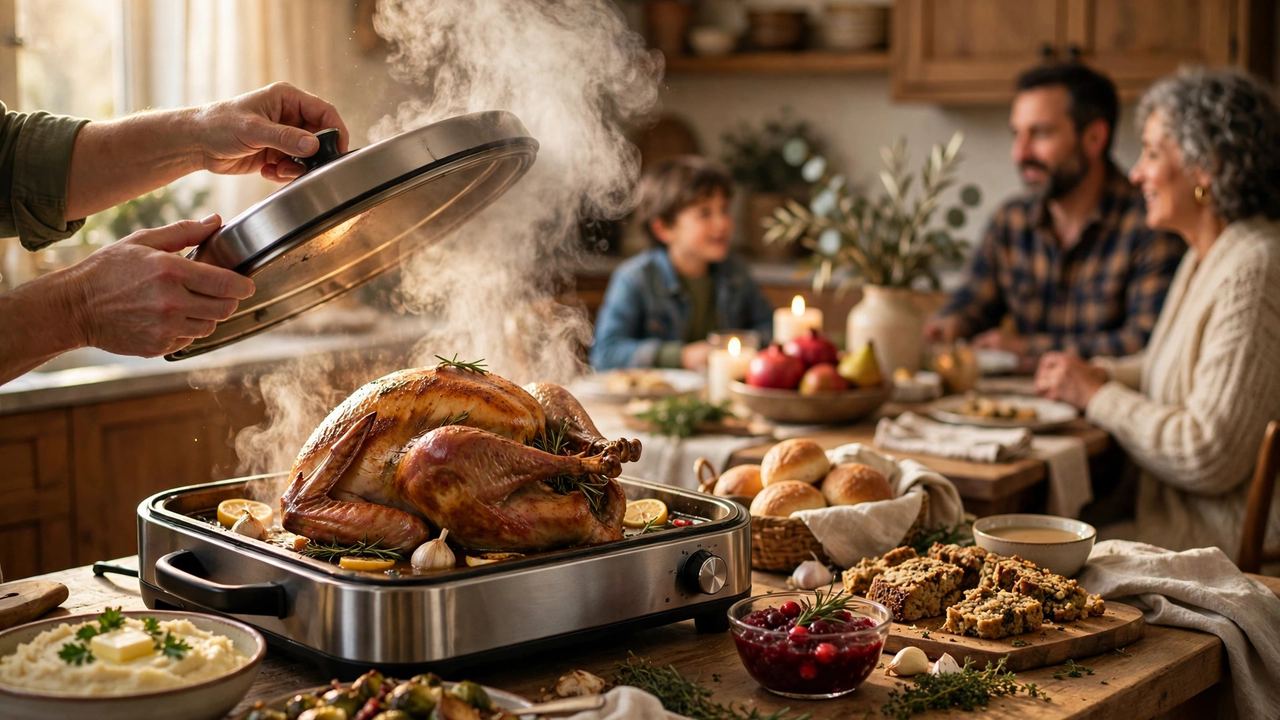
A 20-pound turkey is the bird that breaks a normal Thanksgiving plan. It is big enough to feed a full table with leftovers, big enough to monopolize the main oven for hours, and just awkward enough that a shallow roasting pan in a crowded oven becomes a juggling act of side dishes, timing, and basting. That is exactly the problem a countertop roaster oven solves. Move the turkey into its own appliance, and the wall oven is suddenly free for dressing, casseroles, rolls, and pies, while the bird cooks in a smaller, enclosed space that holds heat and moisture around it. This guide to the best electric roaster ovens for 20 pound turkeys compares six models that are each rated by their makers to handle a bird of at least 20 pounds, so a 20-pound turkey fits with room to spare rather than pressed against the lid.
Capacity is the first filter, and it is also where shoppers get misled. Quart ratings alone do not tell you whether a turkey fits, because the shape of the bird, the height of the domed lid, and the rack all matter. A tall, narrow 20-pound bird behaves differently from a wide, flat one of the same weight. That is why every pick below is included on the strength of a maker-stated turkey weight, not just a quart number. The smallest roaster here is an 18-quart model that the maker lists for a 24-pound turkey, and the largest are 26-quart models with even more headroom. If your bird is exactly 20 pounds, any of these six has clearance on paper, and the real choice comes down to lid style, temperature range, extra functions like defrost and keep warm, and how much counter and storage space you can give a large seasonal appliance.
Quick verdict
For most Thanksgiving hosts, the Hamilton Beach 22-Quart Roaster Oven 32235 is the safest all-around choice: the maker lists a 28-pound turkey capacity in a 22-quart body, with a wide temperature dial that starts low enough for gentle warming. The AROMA 22-Quart Roaster Oven ART-712SB is the straightforward stainless alternative, rated for a 26-pound turkey with a self-basting lid and a removable enameled pan. If you want the smallest footprint that still clears a 20-pound bird comfortably, the Proctor Silex 18-Quart Roaster Oven 32211 is rated for 24 pounds and starts its dial at a lower temperature than most rivals. The Sunvivi 24-Quart Roaster Oven with Viewing Lid adds a window so you can check browning without lifting the lid, the VEVOR 26-Quart Electric Roaster Oven YORO-24N-L is the pick for the biggest birds and the most headroom, and the HEYNEMO 26-Quart Roaster Oven with Viewing Lid pairs a large body with defrost, heat, and warm modes for a flexible holiday workflow.
Selection started with the turkey itself. A model only qualified if its maker states a whole-turkey capacity of at least 20 pounds, because a 20-pound bird needs clearance under the lid for hot air to circulate and for the lid to seat properly. Models whose published turkey rating fell below 20 pounds were excluded, however good their other features looked, and models whose capacity could not be confirmed on an opened maker page or a full product listing were excluded as well. Every specification in this guide comes from an opened page for that exact model, and specifications are phrased as what the maker lists, because roaster ovens are a category where the same brand sells several near-identical sizes side by side.
Next, each candidate had to be a genuine countertop electric roaster oven: a lidded, rectangular cookwell with a removable pan and a roasting rack, not a toaster oven, air fryer, or slow cooker wearing a roaster label. We compared the details that change how a big turkey actually cooks. A self-basting lid, with inner bumps or channels that return condensation to the food, reduces how often you need to open the lid and baste by hand. A removable pan matters twice, once when you lift a heavy bird out on its rack and again when you wash up. Temperature range matters at both ends: a low starting point helps with warming and gentle slow cooking, while a 450-degree top end supports browning and baking. Extra modes such as defrost and keep warm were treated as useful bonuses for holiday timing, not as substitutes for capacity.
Finally, we checked the buying reality for each exact model. A roaster that exists only as a discontinued listing does a Thanksgiving host no good, so each pick was confirmed as a current product sold new, in its exact size and configuration. Where a brand sells the same roaster in several quart sizes under similar names, the pick is tied to the specific model and size described in its section, and the buying guide below explains how to double-check the size on the box before a holiday deadline makes returns awkward.
Hamilton Beach is the name most shoppers meet first in this category, and the 32235 shows why. The maker lists this 22-quart roaster for a turkey up to 28 pounds, which gives a 20-pound bird generous clearance under the domed lid, with space for air to move around the breast instead of the lid resting close above it. That headroom is the main reason to choose a 22-quart body over an 18-quart one when the bird is the centerpiece: trussing, a rack, and a plump breast all take vertical room, and this model has it. The maker lists dimensions of about 23.15 inches wide, 15.63 inches deep, and 14.51 inches high, so measure your counter run and your storage shelf before ordering, because this is a wide appliance.
The controls stay deliberately simple. The maker lists a single dial running from 125 to 450 degrees F, a wider low end than most roasters here offer, which makes the same appliance useful for keeping sides warm or slow cooking outside the holiday season. The maker lists a removable insert pan and an included lifting rack, the two pieces that matter most on the day: the rack gives you handles to raise a hot, heavy turkey out of its juices without tearing the skin, and the pan lifts out for washing instead of forcing you to scrub the whole base at the sink. The maker describes the roaster as able to roast, bake, cook, steam, and keep food warm, so after Thanksgiving it can take a ham, a batch of meatballs, or a cheesecake without feeling like a one-meal purchase.
Capacity: the maker lists 22 quarts, for a turkey up to 28 pounds
Temperature: the maker lists 125 to 450 degrees F on a single dial
Lid: domed lid for extra height over a large bird
Included: removable insert pan and lifting rack, as the maker lists
Dimensions: the maker lists about 23.15 x 15.63 x 14.51 inches
Buy it if: you want the most headroom from a familiar brand and a dial that goes low enough for warming and slow cooking as well as roasting.
Skip it if: your counter or storage space is tight, because a 22-quart body is wide, or if you want a viewing window to check the bird without lifting the lid.
The AROMA ART-712SB takes the same 22-quart formula and dresses it in stainless steel. The maker lists an extra-large 22-quart capacity able to hold and roast a 26-pound turkey, so a 20-pound bird sits comfortably with the lid seated and room around it. The maker lists a self-basting lid that catches steam as it builds and returns it over the food, which is the feature hosts notice most on a long roast: the turkey bastes itself in its own moisture while you get on with everything else the meal demands. A removable metal inner rack makes lifting heavy food out simpler, and the maker lists a removable enameled steel baking pan for easier cleaning once the meal is over.
Temperature control is a dial that the maker lists from 150 to 450 degrees F, covering slow roasting at the bottom and firm browning heat at the top. The maker also lists a Keep Warm setting, which solves the classic timing problem where the turkey finishes before the guests sit down: hold the bird warm in the roaster while the main oven, now free, finishes the sides that need last-minute heat. AROMA also publishes model-specific support for this roaster, including an instruction manual and individual replacement parts such as the insert pan and rack, which is a practical advantage for an appliance you may only haul out a few times a year and want to keep serviceable for many seasons.
Capacity: the maker lists 22 quarts, able to hold a 26-pound turkey
Temperature: the maker lists adjustable control from 150 to 450 degrees F
Lid: self-basting lid, as the maker lists
Pan and rack: removable enameled steel baking pan and removable metal inner rack, as the maker lists
Extras: Keep Warm setting, as the maker lists; stainless steel exterior
Buy it if: you want a stainless finish, a self-basting lid, and published replacement parts support for a roaster you plan to keep for years.
Skip it if: you need a temperature setting below 150 degrees F for very gentle warming, or a viewing window in the lid.
The Proctor Silex 32211 is the efficiency pick: the smallest roaster in this guide that still clears a 20-pound turkey with margin. The maker lists an 18-quart capacity large enough to cook a 24-pound turkey, which surprises shoppers who assume quart count and turkey weight track one to one. They do not, because lid height and pan shape decide the fit, and this model’s domed, self-basting lid is shaped to use its volume for a tall bird. If your kitchen is small, your storage is a single cabinet, or the roaster will live most of the year on a shelf, those saved quarts are a real advantage every time you move the appliance.
The maker lists variable temperature control from 125 to 450 degrees F, matching the widest low end in this guide, and a power rating of 1450 watts. The maker lists a removable cooking pan and a lift-out rack, a domed self-basting lid that circulates moisture back over the food, and dimensions of about 23.15 inches wide, 15.63 inches deep, and 12.93 inches high, so it is lower than the 22-quart models even though its footprint is similar. The maker lists a limited three-year warranty for this model, longer coverage than is typical in this category and worth noting for a seasonal appliance. For a 20-pound turkey, this is the pick that proves you do not need the biggest box on the shelf, you need the right rating and a lid with enough dome.
Capacity: the maker lists 18 quarts, large enough for a 24-pound turkey
Temperature: the maker lists 125 to 450 degrees F variable control
Power: the maker lists 1450 watts
Lid: domed self-basting lid, as the maker lists
Dimensions and weight: the maker lists about 23.15 x 15.63 x 12.93 inches and about 13 pounds
Warranty: the maker lists a limited three-year warranty
Buy it if: storage space is your limiting factor and you want a 24-pound turkey rating, a low 125-degree starting point, and longer warranty coverage.
Skip it if: your 20-pound bird is unusually tall or you regularly cook birds well above 20 pounds, where a 22 or 24-quart body gives more forgiving clearance.
The Sunvivi 24-quart roaster answers the most common roaster-oven frustration: not being able to see the food. Its lid carries a transparent, heat-resistant viewing window, so you can watch the skin brown and judge progress without lifting the lid and dumping the heat and steam that a roaster depends on. Every lid lift on a long turkey roast costs temperature and moisture, so a window is more than a novelty for a 20-pound bird that will cook for hours. The maker lists a 24-quart capacity for turkeys up to 28 pounds, a self-basting lid design that continuously circulates moisture over the food, and a removable pan and rack for serving and cleanup.
The maker lists a full-range temperature control from 150 to 450 degrees F, a wattage of 1450 watts, and two settings aimed squarely at holiday timing: a defrost setting intended to take a turkey from frozen toward roasting in hours rather than days of planning, and a warming setting that keeps dinner at serving temperature when the meal runs late. Treat defrost as a planning aid rather than a rescue plan, and always follow the maker’s instructions and a food thermometer for doneness. Dimensions on the listing run about 23.8 x 15.7 x 15 inches, so like the other large models here, it needs a clear stretch of counter and a real storage plan. For hosts who check their food often, this is the roaster that lets you look without opening.
Capacity: the maker lists 24 quarts, for turkeys up to 28 pounds
Temperature: the maker lists 150 to 450 degrees F full-range control
Power: the maker lists 1450 watts
Lid: viewing, self-basting lid with a transparent window, as the maker lists
Extras: defrost and warming settings, removable pan and rack, as the maker lists
Buy it if: you like to monitor browning visually and want defrost and warming settings for flexible Thanksgiving timing.
Skip it if: you prefer a long-established brand’s parts support, or your storage cannot take one of the largest bodies in this guide.
VEVOR’s 26-quart roaster is the maximum-capacity pick, built for hosts whose turkey is not the only large thing on the menu. The maker lists the 26-quart size for turkeys up to 30 pounds, so a 20-pound bird has abundant room, and the extra volume also suits a large ham, multiple chickens, or a deep batch of chili for a crowd. The maker lists a self-basting lid with a viewing window, a removable pan and rack, and a temperature range from 150 to 450 degrees F driven by a 1450-watt heating element. Defrost and warm functions round out the holiday toolkit, letting the roaster thaw, roast, and then hold the meal in one appliance.
That capacity comes with the expected trade-offs. A 26-quart roaster is the biggest footprint in this guide, and it earns its place only if you actually cook for a crowd more than once a year or your Thanksgiving bird regularly pushes past 20 pounds. The maker lists product dimensions in the region of 23.3 x 15.7 x 13 inches for this roaster family and a weight of about 14 pounds, so it is movable when empty but deserves a permanent storage home rather than a high shelf. If your gatherings are growing, or you host beyond Thanksgiving, this is the model with the most future headroom, and its wide temperature range keeps it useful for baking and slow cooking between holidays.
Capacity: the maker lists 26 quarts, for turkeys up to 30 pounds
Temperature: the maker lists 150 to 450 degrees F
Power: the maker lists 1450 watts
Lid: self-basting lid with viewing window, as the maker lists
Extras: defrost and warm functions, removable pan and rack, as the maker lists
Buy it if: you host the biggest gatherings, cook birds above 20 pounds in some years, or want one roaster that doubles as a crowd-sized cooker year-round.
Skip it if: a 20-pound turkey is your ceiling and storage is limited, where a 22-quart model gives you everything you need in less space.
The HEYNEMO 26-quart roaster pairs a big body with a viewing lid and a simple three-mode approach to holiday timing. The maker lists a 26-quart capacity that accommodates a 22-pound turkey, which clears a 20-pound bird, and a 1450-watt heating element. The lid combines a viewing window with a self-basting design, so you can watch the roast and let condensation cycle back over the food instead of opening the lid to baste. The maker lists a removable pan and a removable roasting rack in the box, along with a one-year warranty.
Where this model distinguishes itself is its mode dial. The maker lists a defrost mode, a high-temperature heat mode reaching 450 degrees F, and a warm mode at the low end that holds food at serving temperature, with the maker’s stated settings spanning 150 to 450 degrees F for cooking. That spread suits a host who wants one knob to handle thawing support, roasting, and holding without menu-diving. At about 15 pounds and in a stainless and white finish, it is a presentable appliance to leave on the counter through the holiday weekend. Its listed turkey rating is the closest to 20 pounds in this guide, so if your birds tend to run a few pounds over the label weight, consider one of the higher-rated models above; for a true 20-pound turkey, the rating fits.
Capacity: the maker lists 26 quarts, accommodating a 22-pound turkey
Temperature: the maker lists cooking control up to 450 degrees F, with defrost and warm modes
Power: the maker lists 1450 watts
Lid: viewing, self-basting lid, as the maker lists
Included: roaster base, removable pan, removable roasting rack, and lid, as the maker lists
Buy it if: you want a large, presentable roaster with a viewing lid and simple defrost, heat, and warm modes for a 20-pound turkey.
Skip it if: your turkey often runs well over 20 pounds, where the 26, 28, or 30-pound ratings above give you a bigger safety margin.
Buying guide
Match the turkey rating, not just the quarts. Quart capacity measures the cookwell volume, but the number that decides your Thanksgiving is the maker’s stated turkey weight, because it accounts for the lid dome and pan shape. For a 20-pound turkey, look for a rating of at least 22 to 24 pounds so the lid seats with clearance; a bird that touches the lid cooks unevenly and makes the lid hard to keep closed. Remember that a broad, flat bird and a tall, narrow bird of the same weight fit differently, so when in doubt, choose the next rating up. Every model in this guide is rated at 22 pounds or more, and most are rated well above that.
Measure twice: counter and storage. These are large appliances, typically around 23 to 24 inches wide and 15 to 16 inches deep, and they need clearance around them while running, plus headroom to lift a tall domed lid. Measure the counter run where the roaster will sit, check the distance to upper cabinets with the lid open, and measure the shelf or cabinet where it will live for the other eleven months. A roaster that does not fit your storage becomes a roaster you dread using. If space is your constraint, the 18-quart Proctor Silex shows that a smaller body can still carry a 24-pound rating.
Understand lid styles. A plain domed lid gives the most interior height. A self-basting lid adds bumps or channels underneath that drip condensation back over the food, reducing manual basting. A viewing lid adds a window so you can check color without opening the roaster, at the cost of a slightly more complex lid to clean. None of these changes the turkey rating, so choose based on how you cook: frequent checkers benefit from a window, hands-off cooks from self-basting, and anyone with a very tall bird from maximum dome height.
Check the temperature range at both ends. All six picks here reach 450 degrees F, which supports browning and baking. The low end varies: models starting at 125 degrees F offer gentler warming and slow cooking than those starting at 150 or 200 degrees F. If you plan to hold a finished turkey while sides cook, or to slow cook in the roaster during the year, a lower starting point is worth having. Single-dial controls are the norm in this category and are genuinely easy to use with oven mitts on, which matters mid-meal.
Value the removable pan and rack. A 20-pound turkey plus its juices is heavy and awkward. A lift-out rack with handles is a safety feature, not a convenience extra, and a removable pan turns cleanup from a sink wrestling match into a normal wash. Check that both are included for the exact model you order, and note the pan material: enameled steel and porcelain-enamel cookwells are common, clean well, and can chip if struck, so handle them like the long-term parts they are. Brands that sell replacement pans and racks extend the life of the whole appliance.
Plan the electrical side. Most full-size roasters here are listed at 1450 watts, which is a substantial draw on a kitchen circuit that may also be running a coffee maker, a microwave, or a second appliance on Thanksgiving morning. Give the roaster its own outlet on a circuit that is not already loaded, keep the cord clear of the hot body, and never run a roaster on an extension arrangement the maker does not allow. A tripped breaker an hour into the roast is an avoidable holiday story.
Think beyond Thanksgiving. A roaster oven earns its storage space if it works all year: hams at other holidays, a big batch of pulled pork, baked potatoes for a party, steamed vegetables, or a cheesecake baked on the rack. Models with keep warm or warm modes double as serving and buffet warmers for gatherings. If you will only ever roast one turkey a year, the smaller, simpler picks make sense; if you host often, the larger models with defrost and warm functions repay their footprint quickly.
FAQ
Will a 20-pound turkey really fit in an 18-quart roaster oven?
It depends on the model, not the quart number alone. The 18-quart pick in this guide is listed by its maker for a 24-pound turkey, because its domed lid and pan shape are designed around a tall bird. Other 18-quart roasters carry lower ratings, so always check the maker-stated turkey weight for the exact model, and leave clearance so the lid seats fully.
How long does a 20-pound turkey take in a roaster oven?
Cooking time depends on the temperature you set, whether the bird is stuffed, and its shape, and roaster ovens often cook a turkey somewhat faster than a conventional oven because the heat is enclosed close to the bird. Follow the time and temperature guidance in your roaster’s manual for a bird of your weight, and always judge doneness with a food thermometer in the thickest part of the thigh rather than by the clock alone.
Do I still need to baste a turkey in a self-basting roaster?
A self-basting lid returns condensation to the surface of the food as it cooks, which reduces how often you need to open the lid and baste by hand. Opening the lid less also keeps heat and moisture in the roaster. You can still baste occasionally if you like, but the design is meant to make it optional rather than constant.
Can I cook a frozen turkey in a roaster with a defrost setting?
Some models here list a defrost setting intended to move a turkey from frozen toward cooking more quickly than refrigerator thawing. Treat it as a feature to use exactly as the maker directs in the manual, not as a last-minute rescue, and plan your thaw whenever you can. Whatever method you use, verify the final internal temperature with a food thermometer before serving.
What else can I cook in a roaster oven besides turkey?
The makers of these models list roasting, baking, cooking, steaming, slow cooking, and warming among their uses. In practice, hosts use them for hams, roasts, chickens, large batches of chili or meatballs, baked potatoes, and desserts baked in a dish set on the rack. The removable pan also works as a serving vessel and, on models with a warm setting, as a buffet warmer.
How do I store a roaster oven between holidays?
Clean and dry the pan, rack, and lid fully, nest the rack and lid with the pan inside the base, and store the roaster in its measured spot rather than on a high shelf, since these appliances weigh roughly 13 to 15 pounds empty. Keeping the manual with the roaster means the turkey timing charts are where you need them next year.
Conclusion
A 20-pound turkey deserves an appliance chosen by turkey rating, not by guesswork. The Hamilton Beach 32235 is the balanced default, with a 28-pound rating and the widest low-end temperature control. The AROMA ART-712SB adds stainless style, a self-basting lid, and strong parts support. The Proctor Silex 32211 proves an 18-quart body can still be rated for 24 pounds, in the smallest package here. The Sunvivi viewing-lid model suits cooks who want to watch the bird brown, the VEVOR 26-quart offers the most capacity for growing gatherings, and the HEYNEMO 26-quart keeps things simple with defrost, heat, and warm modes. Pick the rating that fits your bird, the footprint that fits your kitchen, and the lid that fits how you cook, and Thanksgiving’s hardest job becomes the easiest one in the room.
M
Modern Line Home Editorial Team
We compare specs, materials and verified owner reviews before a product earns a spot. Rankings are never paid.
Affiliate disclosure. As an Amazon Associate we earn from qualifying purchases at no extra cost to you. Prices accurate as of the date shown.
House cold even with the heat on? Walk this ordered checklist: thermostat and filter first, then drafts, insulation, leaky ducts and a failing heating system.
Windows fogging up in winter? Check where the fog sits: on the room side it is indoor humidity, outside it is harmless, and between panes the seal has failed.
Store the main firewood pile about 30 feet from your house, off the ground and covered only on top. Compare racks, woodsheds, garages and indoor spots safely.
Place a portable generator outdoors only, at least 20 feet from windows, doors and vents, exhaust pointed away. Exact distances, setup steps and CO rules here.
Keep houseplants in the right winter spot: match window direction to plant type, stay clear of radiators and cold glass, and fix dry air and low light at home.
Mice enter through pencil-width gaps at foundations, pipes, vents, doors and the roofline. Walk this room-by-room winter checklist to find and seal each one.
A winter outage timeline: what to do in the first hour, first night and multi-day outage, with food safety times, pipe protection, heat and CO safety steps.
Size a space heater by room area: 10 watts per square foot at 8-foot ceilings, adjusted for insulation and ceiling height, with full wattage and BTU tables.
Start dripping at about 20 degrees, sooner for exposed pipes. Set a pencil-lead stream, drip the right faucets on both lines, and know when to stop safely.
A fridge needs 800-1,200 starting watts, not just 150-400 running watts. Use the tables to total your fridge plus freezer, lights, furnace fan and more today.












Write Your Review
No reviews yet. Be the first to share your experience!