
Key takeaways
- Store patio furniture for winter by material: clean, dry and stack wood, metal, wicker, plastic and cushions so nothing cracks, rusts or mildews by spring.
Learning how to store patio furniture for winter starts with one short answer: clean everything, let it dry completely, fix small finish damage now, bring cushions and natural wicker indoors, and then store or cover each frame according to what it is made of — not according to a single rule for the whole set. Teak, cast aluminum and HDPE can often stay outside with preparation, while painted steel, natural wicker, ordinary plastic and every foam cushion need much more protection. The rest of this guide is the part a quick answer cannot give you: a material-by-material stacking and wrapping plan, with a decision table you can check piece by piece, the exact cleaning mixes makers publish, and the mistakes that turn a dry patio in October into rust, cracks and mildew in April.
Work on a dry stretch of fall weather, before the first hard freeze and before snow is sitting on the set. You need time for washing, time for repairs to cure, and — most importantly — time for drying. YardTheory, in its winter storage guide, stresses that everything must be completely dry before it goes into storage and that trapping moisture is the single most common cause of winter storage damage. POLYWOOD makes the same point from the maker side: cover furniture only once it is fully dry, otherwise trapped residual moisture becomes an ideal mold and mildew environment. If you remember nothing else, remember that sequence — clean, repair, dry, then store — because covering or binning a damp piece is worse than leaving it out for one more dry day.
Start With the Decision Table: What Comes In, What Can Stay Out
Do not start by dragging everything toward the garage. Start by sorting. Walk the patio with a notebook or phone and label every piece by material and by destination. Mixed sets are the trap: a dining set may have an aluminum frame, a glass top, fabric slings and separate cushions, and each part has a different winter answer. A sectional may be resin wicker over aluminum, which behaves nothing like natural rattan over wood. Identify the frame material, the surface material and the soft parts separately, then apply the strictest rule among them to the piece as a whole.
| Material or part | Best winter destination | Can it stay outside? | The main winter risk |
|---|---|---|---|
| Teak wood | Uncovered outside, or a dry unheated garage or shed | Yes, per the Kingsley Bate care guide | Surface blackening if moisture collects under an outdoor cover; silver-gray weathering if left exposed |
| Other wood, including acacia and softer woods | Indoors or under a roof, covered | Only with protection and a sound finish | Cracking or warping if moisture and freezing temperatures reach unprotected wood |
| Cast and powder-coated aluminum | Outside covered, or stacked indoors | Generally yes | Oxidation at chips in the coating; wind moving lightweight frames; water trapped inside hollow tubes |
| Steel and wrought iron | Indoors if at all possible | Only if the coating is intact, touched up, and covered with a breathable cover | Rust starting at any chip, scratch or joint and spreading under the finish |
| Natural wicker and rattan | Indoors only | No | Brittleness, cracking and loosening of the weave from moisture and freezing temperatures |
| Resin wicker, including HDPE wicker | Indoors, or outside under a breathable cover | Generally yes, with a cover | Weave trapping moisture and debris; strands turning brittle in sustained cold |
| HDPE lumber, such as POLYWOOD furniture | Outside, covered or uncovered | Yes — the maker says its frames can be left outside and uncovered year-round | Very little from cold itself; mainly dirt, snow load on flat surfaces and salt on metal hardware |
| Ordinary plastic and lightweight resin | Indoors | Not recommended below freezing | Turning brittle in cold and cracking, especially if water freezes in crevices or weight is stacked on top |
| Cushions, seat pads, throw pillows and fabric | Always indoors, dry and with airflow | No | Mildew growing in damp foam; permanent compression if heavy items are stacked on top |
| Glass tabletops | Indoors, stored upright on edge and padded | No | Cracked glass expanding in fluctuating temperatures; breakage from stacking |
| Patio umbrella canopy and pole | Indoors, closed, in a sleeve or bag | No | Wind snapping ribs on an open canopy; mildew on fabric; corrosion at pole joints |
YardTheory groups the same decision in plain language: cast aluminum, powder-coated aluminum, teak and HDPE are generally safe to leave outside with proper preparation; resin wicker, painted or powder-coated steel with any chips, lightweight resin and non-teak wood are better off indoors or under serious protection; and cushions, seat pads, throw pillows, fabric umbrellas and outdoor rugs must come indoors. Its practical rule for an unidentified piece is worth copying onto your list: if a piece is heavy, solid and made of a corrosion-resistant material, it can probably stay outside with a cover; if it has foam, fabric, a wicker weave or a painted surface that is not in perfect condition, bring it in.
Use that table to plan space before you clean anything. Measure the garage, shed or basement corner you actually have, not the one you wish you had. Indoors space should go first to the pieces that cannot survive outside — cushions, natural wicker, glass and umbrellas — then to chipped steel and ordinary plastic, and only then to the tolerant materials. If space runs out, teak, aluminum and HDPE are the pieces to leave out, in that order of confidence, because their makers and care guides support it.
Step 1: Clean Every Piece the Way Its Material Requires
Cleaning is not cosmetic. Dirt left on a surface all winter feeds the very problems you are trying to prevent. Jensen Outdoor, in its Sunbrella cushion care guide, notes that while Sunbrella fabrics do not naturally promote mildew growth, mildew may grow on dirt or other substances that collect on the fabric and are not promptly removed. The Kingsley Bate teak guide says the same about wood: teak itself will not mildew, but mildew sometimes grows on dirt and foreign substances left on the surface. Storage.com adds that bird droppings left on metal can cause corrosion. In short, a dirty piece stored in the dark is a piece stored with its spring problem already attached.
The universal cleaning sequence
- Brush first, dry. Remove leaves, twigs, cobwebs and loose grit with a soft brush or cloth, including the undersides of tables and chairs and the seams and piping of cushions, before any water touches the piece.
- Wash with mild soap and water. For most hard frames, YardTheory recommends washing with mild soap and water, rinsing thoroughly and wiping down with a dry cloth, paying attention to joints, crevices and any area where water pools. POLYWOOD gives the same basic kit: mild dish soap, a bucket of warm water and a sponge for most materials.
- Skip the pressure washer on wood and wicker. Storage.com warns against power washers on the majority of materials because the pressure is too extreme, and the Kingsley Bate guide specifically says to avoid spraying teak with a high-pressure hose because high pressure can erode the surface of the timber.
- Rinse until no soap remains. Soap residue attracts dirt. Rinse frames and fabrics thoroughly with clean water.
- Inspect while you clean. POLYWOOD notes that cleaning is the best repair check because you are already up close to the piece. Look for chips, rust spots, cracked fibers, loose joints, soft spots in wood and tears in fabric, and write them down before you move on.
Cleaning mixes the sources actually publish
For teak, the Kingsley Bate care guide published through Harlow and MacGregor gives a specific general-cleaning method: hose the furniture down with fresh water, then scrub the wet furniture with a soft bristle brush and a solution of 2/3 cup laundry detergent and 1/4 cup bleach in 1 gallon of warm water, then rinse the entire piece with more fresh water to remove any remaining cleaning solution. Treat that as a teak-specific recipe from that maker, not as a mix for every material, and follow the safety notes in the mistakes section below before using any bleach solution.
Storage.com publishes a simpler per-material cheat sheet that is useful at the sink: non-teak wood gets warm water mixed with a few drops of oil-based soap, scrubbed gently along the grain with a soft brush or rag; plastic gets a little laundry detergent mixed with warm water, scrubbed, rinsed and left to dry; metal gets detergent and water, with bird droppings cleaned off because they can cause corrosion; and natural wicker gets mild oil-based soap and a soft cloth, while synthetic wicker is more durable and can simply be hosed down. For wicker, YardTheory adds the technique detail: use a soft brush or vacuum to remove debris from the weave first, then wipe down with a damp cloth and mild soap, rinse carefully without soaking the material, and let it dry completely — wicker holds moisture in the weave longer than it appears to on the surface.
For cushion fabric, Jensen Outdoor publishes two Sunbrella methods. For hand washing, prepare a cleaning solution of 1/4 cup mild soap per gallon of warm water, spray or sponge it over the fabric, gently break up stains with a sponge, clean towel or very soft-bristled brush, rinse completely to remove all soapy residue, and let the fabric air dry completely. For removable covers that you choose to machine wash, the same guide says to remove the covers, close all zippers, machine wash in cold water on the delicate cycle with a regular amount of mild laundry detergent, and let the fabric air dry completely — do not dry it in an automatic dryer. The guide also cautions that although Sunbrella fabrics machine wash fine, hand washing the cushions themselves is recommended because of the fitted nature of the fabric and the difficulty most people have re-covering cushions.
Step 2: Dry Completely — and Give It Longer Than You Think
Drying is the step people rush, and it is the step that decides whether the rest of the work matters. YardTheory recommends allowing at least 24 to 48 hours of dry conditions before sealing anything in storage when furniture has been sitting in shade or the weather has been humid, and suggests bringing items inside to air out in a garage or basement for a day before stacking or covering them when in doubt. A sunny afternoon is not always enough, especially for wicker weave, cushion foam and the inside of hollow metal tubes.
- Stand cushions on edge. YardTheory recommends standing cushions on edge in the sun so both sides dry fully, noting this may take a full day or longer after rain. Jensen Outdoor is blunt about the threshold: make sure cushions are genuinely dry when you store them, because if they go away wet or even a little moist, a plastic storage bag provides the perfect environment for fungal growth and upholstery damage.
- Dry steel immediately and thoroughly. YardTheory advises drying steel right after rinsing to prevent surface rust from forming before storage. Towel-dry joints, feet and any place water collects.
- Drain hollow frames. POLYWOOD recommends removing foot caps from aluminum furniture to let out any accumulated water before storage. Tip chairs and tables so trapped water can run out, then leave them until the dripping stops entirely.
- Do not cover damp furniture. Every source agrees here. YardTheory calls covering damp furniture the most common cause of mildew on frames that were otherwise fine going into storage, and POLYWOOD warns that uncured coatings will also stick to covers.
- Check the hidden places last. Before anything is stacked, bagged or covered, press a dry hand into cushion centers, run a finger inside the wicker weave, and check under table aprons and inside umbrella folds. If any of those feel cool or damp, the piece is not ready, whatever the surface feels like.
Step 3: Fix Small Damage Now, While It Is Still Small
Winter does not create most finish damage — it expands damage that was already there. A chip that looks harmless in October gives moisture a way under a coating, and months of wet and freeze-thaw cycles do the rest. POLYWOOD frames the repair pass as four quick material checks, and they are worth doing in its order while the pieces are clean and dry.
- Wood: replace pieces with soft spots, holes, severe cracks or splinters, and use wood filler to cover minor dents and smooth out scratches, per POLYWOOD. Storage.com adds that a wood sealant or oil such as tung or linseed oil can be applied to prevent water from seeping in — but only after the wood has dried out completely, so you do not trap moisture under the treatment.
- Wrought iron and steel: remove rust with a wire brush, then cover the area with touch-up paint, per POLYWOOD. Storage.com gives the fuller version for rust spots: scrape them off and apply primer and rust-resistant paint. Let any repair coating cure fully before a cover goes on.
- Aluminum: remove foot caps to drain accumulated water and brush touch-up paint over scratches, per POLYWOOD. YardTheory likewise recommends touching up chips in powder-coated aluminum with a matching paint pen before storage to prevent the underlying metal from oxidizing over winter.
- Wicker: repair or replace broken fibers to prevent snagging and further damage, per POLYWOOD.
- Glass: discard cracked tabletops, per POLYWOOD, because fluctuating temperatures can cause the fissures to expand and eventually break. Do not store a cracked top hoping it survives.
- Fabric: sew up tears in cushions, pillows and seats before storage, per POLYWOOD, so a small split does not become a burst seam under stacking pressure.
POLYWOOD also adds a caution that protects you: check the manufacturer warranty before making modifications, because a planned repair could void the warranty — or the repair might actually be covered under it. That matters most for teak. The Kingsley Bate guide does not recommend oiling teak furniture or using oil-based products, warning that improper oiling can cause mildew or irregular coloring and is not covered under warranty. So for teak, ignore the generic wood advice to oil everything: clean it, dry it, and follow the teak-specific section below instead.
Wood: Stack It Dry, Off the Ground, and Treat Teak Differently
Wood is not one material, and winter storage goes wrong when all wood is treated the same. Start by naming the wood. Teak is dense and naturally oily, which is why its makers give it permission other woods do not get. Acacia, eucalyptus and other hardwoods sit in the middle: durable, but they benefit from a sound finish and a roof. Softer woods and any wood with a worn, flaking finish belong indoors or under serious cover, because Storage.com warns that wood furniture may crack or warp if it is not properly protected from moisture and freezing temperatures.
Teak: the exception with its own rules
The Kingsley Bate care guide is explicit: teak furniture may be left outside all year round, and snow and freezing temperatures will not harm the furniture. If you prefer to store it, the guide recommends a dry, unheated garage or garden shed. Note the word unheated — YardTheory adds that very dry indoor air can cause teak to crack over a long winter, so a heated, bone-dry room is not the upgrade it sounds like. If you are choosing a set with this in mind, the construction details in our guide to teak outdoor dining sets for eight show what well-built teak looks like before you ever have to store it.
Two teak warnings from the same maker guide deserve their own lines. First, do not oil it by default: Kingsley Bate does not recommend oiling teak or using oil-based products, as noted above. If you want to maintain the golden-brown color rather than letting the wood weather, the guide recommends Teak Protector, applied seasonally or when you begin to see the color changing — and it explains that left outdoors, teak forms a silver-gray patina over about nine months depending on sunlight and rain exposure. That patina is a color change, not damage. Second, think twice before covering teak that stays outdoors: the Harlow and MacGregor version of the guide warns that if you cover teak furniture and leave it outdoors, moisture will collect under the cover and will leave the surface blackened in the spring. For teak staying out, uncovered and clean is a legitimate, maker-supported choice; for teak going into a shed, no cover is needed either. Save your covers for the materials that actually need them.
Non-teak wood: protect the finish, then protect the piece
- Clean along the grain. Use warm water with a few drops of oil-based soap and a soft brush or rag, scrubbing gently along the grain, per Storage.com.
- Dry fully before any treatment. Apply sealant or oil only to completely dry wood, so moisture is not sealed in.
- Renew the protective finish if it is worn. POLYWOOD recommends sanding and reapplying exterior paint, stain and sealant to wood furniture as part of winter protection. Work only on the finish system the piece already has, and let it cure before covering.
- Store under a roof or indoors. Storage.com recommends keeping wooden furniture covered and indoors in climate-controlled areas where possible. At minimum, get it under a roof, off bare ground, and covered with a breathable cover.
- Stack with padding and airflow. Stack chairs seat-to-seat or back-to-back with a soft cloth or cardboard between finished surfaces so wood does not rub wood all winter. Leave small gaps between stacked pieces rather than compressing them into a solid block, and keep the stack off the floor on blocks or a pallet so air can move underneath.
- Keep feet out of standing water. Whether the piece winters in a shed or under a cover outside, raise the legs on blocks. End grain at the feet wicks moisture upward faster than any other part of the frame.
Metal: Aluminum Can Stay Out, Steel and Iron Want to Come In
Metal splits into two winter stories. Aluminum does not rust, handles cold well and is one of the lowest-maintenance materials to store, as YardTheory puts it. Steel and wrought iron are the opposite: YardTheory calls steel the most vulnerable common patio furniture material in winter, because powder coating protects it only until a chip, scratch or worn area becomes an entry point for moisture. Your storage plan should therefore spend its indoor space and its effort on steel first, and treat aluminum as the flexible piece that can go either way.
Aluminum, including cast and powder-coated frames
- Clean, rinse and towel dry. A quick wipe with a dry cloth after rinsing is usually sufficient, per YardTheory, but check joints and hollow sections for trapped water.
- Drain the tubes. Remove foot caps so accumulated water can escape, per POLYWOOD, and tip each piece until it stops dripping.
- Touch up every chip. Use a matching paint pen or the maker-approved touch-up on powder-coating chips and scratches before storage, to prevent oxidation over winter.
- Add a moisture barrier if you like. Storage.com notes that car wax provides further protection against moisture for aluminum pieces, and POLYWOOD lists fine car wax among the protective coatings for aluminum. Apply it to clean, dry metal only.
- Stack it — but secure it. Aluminum stacks well indoors: lean folding chairs against walls, slide them beneath tables or hang them on hooks, following POLYWOOD’s garage layout advice. Outdoors, its lightness becomes the problem, so stack pieces tightly, group them against a wall, and secure or anchor lightweight pieces to heavier ones so winter wind cannot move them, as POLYWOOD recommends for outside storage.
- Mind the salt. If you spread rock salt on nearby walks, POLYWOOD advises periodically rinsing nearby metal furniture with warm water and towel-drying it to prevent rust or corrosion, and moving furniture away from salted areas where you can.
Steel and wrought iron
- Inspect the whole frame, not just the top. Check legs, joints, welds, undersides of seats and arms — the places water sits and coating wears first.
- Repair rust before storage, never after. Wire-brush rust spots, then prime and repaint with rust-resistant paint, per POLYWOOD and Storage.com. A spot left bare will be a larger, deeper spot by spring.
- Store indoors if at all possible. A dry garage or shed is the recommendation from both YardTheory and Storage.com. Give steel your best indoor corner, ahead of aluminum and HDPE.
- If it must stay out, elevate and cover it properly. YardTheory recommends a well-fitted breathable cover with the legs elevated off the ground to prevent moisture wicking, plus a check once or twice during winter. Raise the feet on rubber feet, wooden blocks or plastic risers, and brush snow off the cover after storms so meltwater does not sit against the frame.
- Do not stack iron on top of anything delicate. Storage.com warns against loading a heavy item onto a more fragile one such as wicker when stacking in a garage or shed. Iron goes at the bottom of any stack or, better, stands on its own feet with nothing resting on it and nothing fragile beneath it.
If your set mixes metal frames with a fire feature, treat the fire parts separately before the frame goes anywhere: POLYWOOD advises disconnecting propane tanks and gas lines from fire pit tables before storage. YardTheory adds that propane tanks should be disconnected, inspected and stored upright in a well-ventilated outdoor area — never stored indoors — and that a wood-burning fire pit should be cleaned of ash before winter because ash absorbs moisture and becomes corrosive over time. Our guides to patio sectionals with fire pit tables and outdoor fire pit tables for sectional sofas show the kinds of combined sets where this extra step applies.
Wicker: Natural Rattan Comes In, Resin Wicker Gets a Cover and Careful Stacking
Wicker is where the photograph in your head matters most — picture the weave up close before you decide anything. Natural wicker and resin wicker look similar from across the patio and behave oppositely in winter. YardTheory is direct: natural rattan wicker should always come indoors for winter, because it is not designed for outdoor exposure in cold or wet climates and will deteriorate quickly. Storage.com agrees that natural wicker can easily become brittle and crack. Resin wicker is more durable, but YardTheory notes it still benefits from indoor storage, because the weave traps moisture and debris and sustained cold can make the resin brittle over time.
How to prepare any wicker piece
- Empty the weave first. Vacuum the weave with a brush attachment or work it over with a soft brush to get leaves, grit and cobwebs out of the intersections. Dirt left in the weave holds moisture against every strand.
- Wipe, do not soak, natural wicker. Use mild oil-based soap and a soft cloth for natural wicker, per Storage.com, and rinse carefully without soaking, per YardTheory. Synthetic wicker is tougher — Storage.com says it can simply be hosed down.
- Dry it longer than the surface suggests. YardTheory warns that wicker holds moisture in the weave longer than it appears to on the surface. Let it dry completely in the sun or in moving air, and check deep in the weave before covering.
- Fix broken fibers now. Repair or replace broken fibers to prevent snagging and further damage, per POLYWOOD. A broken strand left under stacking pressure will keep unraveling.
- Store it off the ground. Storage.com recommends storing wicker off the ground using blocks or a raised surface to prevent moisture creeping up into the legs. The same applies indoors: a pallet or shelf beats a concrete floor.
- Stack nothing heavy on it — and stack wicker itself last. Wicker should be the top layer of any arrangement, never the bottom. If you stack wicker chairs, nest identical chairs only if they were designed to stack, pad contact points with cloth, and keep the stack low. When in doubt, stand wicker pieces side by side with space between them instead of stacking at all; the weave crushes and distorts under months of uneven weight.
- Cover resin wicker that stays out. If indoor storage is not possible for resin wicker, YardTheory recommends covering it thoroughly with a breathable cover and checking it after major storms. Storage.com likewise recommends a cover for synthetic wicker to protect it from snow and moisture buildup, and a cover plus indoor storage for natural wicker — though indoors is the real requirement for the natural material.
Frame material matters underneath the weave, too. Many resin wicker sets are woven over aluminum, which tolerates winter well, while others use steel frames that rust at chips under the weave where you cannot see them. Check the frame at the feet and joints before you decide a wicker piece can stay out. The sets in our guide to all-weather wicker sectionals for large patios are a useful reference for how resin-wicker-over-frame construction is described when you are trying to identify your own set.
Plastic and Resin: HDPE Is the Exception, Ordinary Plastic Goes Indoors
The word plastic covers two very different winter outcomes, and confusing them is expensive in both directions — people haul indestructible HDPE chairs into a crowded garage while leaving a brittle bargain chair outside to crack. Separate them before you store anything.
HDPE lumber furniture
POLYWOOD, which makes HDPE furniture, states that its furniture is designed to handle harsh elements and can be left outside and uncovered year-round, and YardTheory describes HDPE the same way: it does not absorb moisture, does not crack in freezing temperatures and requires no special treatment before winter. For genuine HDPE lumber pieces, the whole winter routine is: clean with mild dish soap, warm water and a sponge; rinse salt and grit off, especially around metal hardware, which POLYWOOD notes sidewalk salt can damage over time even though it will not harm the HDPE itself; brush heavy snow off flat surfaces to reduce weight; and either cover the pieces or leave them uncovered. Stacking is optional and space-driven — if you do stack, stack only identical, stackable pieces, and keep the stack upright so snow and ice cannot put extra pressure on joints, following POLYWOOD’s outside-storage advice.
Ordinary plastic and lightweight resin
- Bring it in below freezing. Storage.com recommends storing plastic furniture indoors when the temperature outside is below freezing, because low temperatures weaken plastic over time and repeated cold exposure makes it brittle and prone to cracking.
- Dry every crevice. Storage.com specifically warns to dry plastic thoroughly after cleaning, because water left in the material’s crevices can freeze, expand and cause cracks. Tip chairs so seat wells and hollow legs drain, then towel the joints.
- Stack loosely and lightly. Stack matching chairs in a low stack indoors, with nothing heavy placed on top. Cold plastic under load is plastic waiting to crack, and a stack that was fine in a warm garage in October can split when the garage drops below freezing in January.
- Keep it off cold concrete if you can. A pallet, mat or shelf reduces direct contact with a freezing, damp floor and makes the stack easier to check mid-winter.
- If it truly must stay out: stack the chairs tightly together, secure them against wind so they cannot blow over and crack on impact, raise them off the ground, and cover the stack with a breathable cover, following YardTheory’s advice for resin pieces left outside. Treat this as a compromise, not an equivalent — indoor storage is the recommendation.
- Do not knock ice off frozen plastic or resin wicker. Brittle material breaks under impact when it is coldest. Brush loose snow off gently and leave adhered ice to melt on its own during a thaw.
Cushions and Fabric: Always Indoors, Bone Dry, and Never Crushed
Cushions are the most damage-prone part of any set, and they are also the easiest to store well — the rules are simple and, as YardTheory puts it, non-negotiable. Even cushions marketed as weather-resistant will develop mildew if stored damp, and foam cores that stay wet through a winter often cannot be fully salvaged. Jensen Outdoor’s winter storage instruction for Sunbrella cushions is the whole method in one line: wash, dry, then store the cushions safely away from harsh winter conditions. Sets upholstered in performance fabric, like those in our guide to outdoor patio sets with swivel chairs and Sunbrella fabric, still follow exactly this routine — performance fabric resists weather in use, it is not a license to winter cushions outside.
The cushion routine, in order
- Brush and vacuum first. Brush off loose debris on both sides and vacuum seams and piping, where grit collects. Jensen Outdoor’s first care rule is to brush off dirt before it becomes entrenched.
- Wash the fabric. Hand wash with the Jensen Outdoor mix of 1/4 cup mild soap per gallon of warm water, rinse completely to remove all soapy residue, and air dry. For mildew stains on Sunbrella fabric, Jensen Outdoor publishes a stronger solution — 1/4 cup dishwashing liquid and 1 cup bleach per gallon of water, sprayed over the entire surface, left to penetrate for 15 minutes, cleaned with a towel, sponge or very soft-bristled brush, rinsed well and air dried completely. That bleach mix is for that fabric only; read the safety section below and the care label before using it on anything else.
- Wash removable covers separately if the label allows. Close zippers, machine wash in cold water on the delicate cycle with mild detergent, and air dry completely — never in an automatic dryer, per Jensen Outdoor.
- Dry until the core is dry, not just the cover. Stand cushions on edge so both faces get air, and allow a full day or longer after wet cleaning or rain, per YardTheory. Squeeze the center: if it feels cool or gives at all like a damp sponge, keep drying.
- Choose a dry, sheltered, rodent-aware spot. Jensen Outdoor lists the basement, attic or garage, or even the top shelf of a closet, as suitable, provided the spot stays cool and dry. The same guide warns to beware of rodents: if there is a known mouse problem near the storage space, consider traps, or wrap cushions in old sheets or blankets for extra protection, because nesting mice can ruin upholstery and fill quickly.
- Bag or bin only when bone dry — and prefer breathable. Here the sources differ in emphasis, so follow the logic they share. Jensen Outdoor advises sealing genuinely dry, clean cushions inside plastic bags for storage. YardTheory advises the opposite container for anything less than certain: store cushions somewhere dry with airflow, avoid airtight plastic bins unless you are certain the cushions are bone dry, prefer breathable fabric storage bags, and if you use a plastic bin, leave the lid slightly ajar or drill a few small holes in the bottom so residual moisture can escape. The shared rule underneath both is the dryness test — if there is any doubt at all, choose the breathable option. If you are comparing container options, our guide to waterproof storage boxes for outdoor patio cushions covers the deck-box style of storage many households use for exactly this job; whichever box you use, the cushions going into it must be completely dry first, and the box itself needs drainage or ventilation rather than a hermetic seal around damp foam.
- Stack loosely, off the ground, with nothing heavy on top. Storage.com recommends storing cushions in a dry area indoors, stacking them loosely to allow air circulation and keeping them off the ground to prevent pests finding a home. YardTheory adds: do not stack heavy items on top of cushions, because compression over several months can permanently deform foam cores. Store cushions flat in a loose stack, on edge like books, or hung in a breathable bag — never under the table, the umbrella base or a bin of tools.
Umbrellas, rugs and other fabric pieces
Close the umbrella, always. YardTheory warns that an umbrella left open or partially open through winter is almost certain to be damaged, because wind loads on an open canopy can snap ribs, bend the pole or tear the fabric, and even a closed umbrella left outside will fade, mildew and corrode at the pole joints. Wipe down the pole and hardware, dry steel poles thoroughly, remove the umbrella from its base, and store it in its sleeve or a breathable bag, horizontally or vertically somewhere it will not be knocked over or crushed. Empty a water-filled plastic base before winter — YardTheory notes that water left inside will freeze, expand and crack the base — while sand-filled bases can stay filled but should be moved indoors or covered. Outdoor rugs follow the fabric rule too: YardTheory recommends rolling the rug up, cleaning it if needed, drying it completely and storing it indoors or in a dry shed, rolled rather than folded to avoid permanent crease lines, because a rug left on a deck traps moisture against the surface underneath and can stain concrete or damage wood decking. Throw pillows and outdoor blankets get the same clean-dry-indoor routine as cushions, in breathable containers rather than plastic, per Storage.com.
How to Stack, Wrap and Cover What Stays Outside
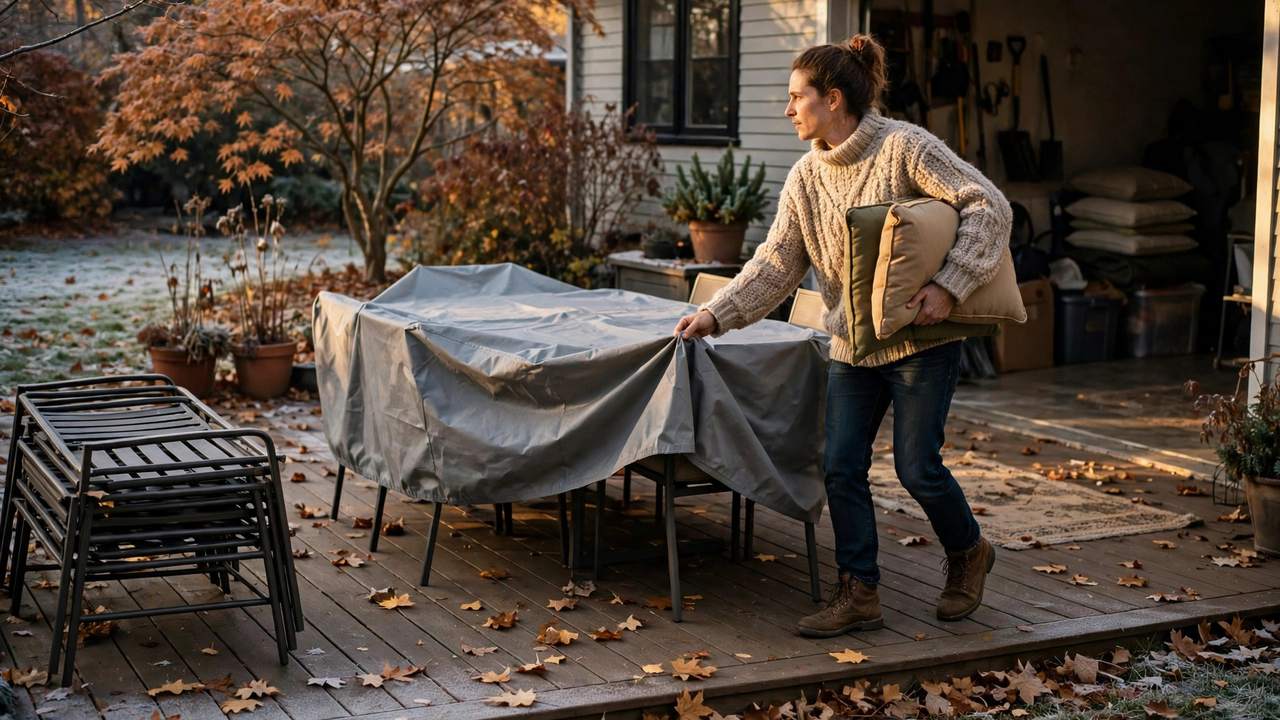
If a piece is staying outside, the goal changes from storage to arrangement: group it, lift it, cover it so water runs off, and leave a way for air to move. Picture the finished setup before you start — frames grouped tightly in the most sheltered corner of the patio, feet up on blocks, cushions gone indoors, one well-fitted breathable cover per group pulled snug and strapped, with a slight high point in the middle so rain and meltwater shed instead of pooling. That picture, which the assignment for this guide describes as stacking and wrapping piece by piece by material, is exactly what the sources recommend when their individual tips are put together.
The outdoor arrangement, step by step
- Group by material, not by where the pieces sat all summer. Keep steel together under your best cover in the most sheltered spot, aluminum and resin wicker under the next covers, and teak and HDPE where they are, uncovered or lightly covered. Grouping by material lets one cover failure hurt only the pieces that can tolerate it.
- Elevate everything. YardTheory recommends placing furniture legs on rubber furniture feet, wooden blocks or plastic risers to keep the bottom of the frame off the ground and prevent moisture wicking up through contact with wet concrete or wood decking — especially important for steel and wicker. POLYWOOD gives the same advice as pallets or blocks to keep furniture off the ground and prevent water pooling and freezing around the legs.
- Keep pieces upright. POLYWOOD warns against putting furniture in an awkward position outside, because accumulating snow and ice can put extra pressure on joints and cause cracks, warping or breakage. A table stored on its side or a chair tipped onto its arms is a spring repair.
- Stack only what is stackable. POLYWOOD’s rule is to only stack pieces the manufacturer labels as stackable. Nest identical chairs, pad contact points, keep stacks low and stable, and never rest a stack on a glass top — POLYWOOD advises putting glass tables and decor inside and not stacking anything on them, and storing a detached glass top upright on its edge, padded, where nothing will lean against it.
- Bag the hardware with its frame. If you remove bolts, pins or connectors to fold or dismantle a piece, put each piece’s hardware in a small labeled bag and tape it to the underside of that frame, so spring assembly does not start with a mystery jar of screws.
- Choose breathable covers and fit them snugly. YardTheory recommends covers made from breathable fabrics that allow moisture vapor to escape while blocking rain and snow, sized to the furniture, with vents, drawcords and buckle straps used to secure them. Storage.com’s cover checklist agrees: durable weather-resistant fabric, sloped angles to help snow and water slide off, buckles and straps to keep covers snug, and vents to allow airflow and prevent mold and mildew. POLYWOOD adds that a secure fit is crucial because loose covers can trap snow and ice in folds, adding weight that can tear fabric.
- Never use a plain plastic tarp as a long-term cover. YardTheory warns that solid plastic tarps and non-breathable materials trap condensation against the furniture surface, which is exactly the condition that causes mildew and corrosion, and that a loose, non-breathable cover can cause more damage than no cover at all. A tarp is a short storm measure, not a winter system.
- Secure lightweight pieces. Anchor lightweight furniture and decor to heavier pieces so strong winds cannot blow them away or over, per POLYWOOD, and strap covers down so they cannot flap, pool water or blow off entirely.
- Check after storms, all winter. YardTheory recommends a quick check after any significant storm: wind shifts covers, and snow load pushes covers into contact with surfaces where they trap moisture. POLYWOOD likewise advises regularly brushing away snow and removing icicles to reduce excess weight, and Storage.com suggests keeping an extra snow brush near the closest door so the job actually gets done. Brush snow off; do not chip ice off brittle resin, wicker or plastic.
When there is no garage or shed
Lack of indoor space does not change the priorities, it just moves them. Cushions still need a dry indoor home — a closet shelf, under a bed in a breathable bag, or a deck box brought into a sheltered spot — because no cover system makes outdoor cushion storage safe. Natural wicker and glass still need to come in, even if that means a hallway corner. What stays outside gets the full arrangement above: grouped, elevated, upright, breathable-covered and strapped. YardTheory confirms that homeowners without a garage or shed have real options in deck boxes, breathable covers with elevation and strategic stacking, and POLYWOOD notes that benches and console tables with built-in storage compartments can hold smaller pieces and cushions out of the worst weather. A rented storage unit is the last resort for high-value wood, wicker and metal sets, and Storage.com notes that climate-controlled units suit those materials best — while reminding readers that a storage unit is not the right place for propane tanks.
Mistakes to Avoid and Safety Notes
- Covering or binning anything damp. The most common and most damaging mistake in every source. If you run out of dry days, delay covering rather than sealing in moisture.
- Using a pressure washer on wood or wicker. High pressure erodes teak’s surface, per Kingsley Bate, and Storage.com warns against power washers on most materials. A soft brush and patience do the same job without the damage.
- Oiling teak because wood advice said to. Kingsley Bate does not recommend oiling teak or oil-based products; improper oiling can cause mildew or irregular coloring. Generic wood steps do not override a maker’s instruction for its own material.
- Leaving rust, chips and broken fibers for spring. Small finish damage is the entry point for a winter of moisture. Repairing it in fall takes minutes; repairing what it becomes takes a refinishing project.
- Stacking heavy on fragile. Never load a heavy item onto wicker, glass or cushions, and never stack pieces the maker does not label stackable. Compression and point loads do slow damage all winter.
- Storing propane indoors. Disconnect tanks from fire tables and grills and store them upright in a well-ventilated outdoor area, per YardTheory. Never bring a propane tank into a garage, shed, basement or storage unit.
- Leaving water in bases, tubes and crevices. Water freezes and expands. Empty water-filled umbrella bases, drain aluminum foot caps, and tip every piece until trapped water stops running out.
- Using bleach mixes carelessly or on the wrong fabric. The bleach solutions cited in this guide are maker-published for specific materials — Kingsley Bate’s teak wash and Jensen Outdoor’s Sunbrella mildew treatment. Jensen Outdoor’s own safety hints apply whenever you use cleaning solutions: wear eye protection and rubber gloves, work in a well-ventilated area, read the instructions on the bottle before proceeding, and keep cleaning solutions in a dry, temperature-controlled space away from children and pets. Never mix bleach with ammonia or other cleaners, never use a bleach mix on a fabric whose care label forbids it, and test any solution on a hidden area first.
- Forgetting the mid-winter check. Storage is not a single October event. A two-minute check after major storms — covers in place, snow brushed off, no water pooling, no pests moving in — prevents the small problems that become spring surprises. Storage.com also recommends checking stored furniture for mildew during winter and wiping early growth clean with a mild detergent solution right away.
- Storing cushions where rodents nest. Jensen Outdoor warns that mice can ruin upholstery and fill quickly. If the storage spot has any rodent history, wrap cushions in old sheets or blankets for extra protection and address the pest problem rather than offering it a padded nest.
Frequently Asked Questions
Can patio furniture stay outside all winter with just a cover?
Some can. Teak, cast and powder-coated aluminum and HDPE can stay outside with cleaning, touch-ups where the coating is chipped, elevation off the ground and a fitted breathable cover, per YardTheory and the maker guides. Painted steel with any coating damage, natural wicker, ordinary plastic, glass and all cushions should not rely on a cover alone — they belong indoors. A cover also has to be breathable and snug; a loose plastic tarp can cause more damage than no cover.
How long should furniture dry before I cover or store it?
Until it is completely dry, including inside weaves, joints and cushion foam. YardTheory recommends allowing 24 to 48 hours of dry conditions before sealing anything in storage when conditions have been shaded or humid, and standing cushions on edge for a full day or longer after rain. When in doubt, give it another day indoors with air moving around it.
Should teak furniture be covered or oiled for winter?
Neither, by default. The Kingsley Bate guide says teak may be left outside all year round and that snow and freezing temperatures will not harm it, recommends a dry unheated garage or shed if you prefer to store it, warns that covering teak outdoors can collect moisture and blacken the surface by spring, and does not recommend oiling teak or oil-based products. To keep the golden color, the guide recommends Teak Protector applied seasonally; left exposed, teak weathers to a silver-gray patina over about nine months.
Can I store cushions in a sealed plastic bin or bag?
Only if they are genuinely, completely dry — Jensen Outdoor advises sealing clean, fully dry cushions in bags for winter, but warns that even a little remaining moisture turns a plastic bag into an environment for fungal growth. YardTheory’s safer default is a dry spot with airflow and a breathable bag, avoiding airtight bins unless you are certain the cushions are bone dry. If there is any doubt, choose breathable storage and keep heavy items off the cushions so the foam is not permanently compressed.
What should I do with a patio umbrella and its base in winter?
Close the umbrella, wipe and dry the pole and hardware, remove it from the base, and store it indoors in a sleeve or breathable bag where it will not be knocked over, per YardTheory. Never leave an umbrella open outside in winter wind. Empty a water-filled plastic base before freezing weather, because the water will freeze, expand and crack it; a sand-filled base can stay filled but should be moved indoors or covered.
What if I have no garage or shed at all?
Bring only the non-negotiables inside the house — cushions, natural wicker, glass tops and the umbrella — and store the tolerant frames outside using the full arrangement: grouped by material, elevated on blocks or pallets, kept upright, covered with fitted breathable covers, strapped against wind, and checked after storms. YardTheory lists deck boxes, breathable covers with elevation and strategic stacking as workable options, and HDPE, teak and aluminum are the materials best able to winter this way.
Conclusion
Storing patio furniture for winter is really five small jobs done in the right order: sort every piece by material using the decision table, clean it with the method its material requires, repair the chips, rust spots and broken fibers you find while cleaning, dry everything completely — longer than feels necessary — and then give each material its own winter home. Wood goes dry and off the ground, with teak following its maker’s no-oil, no-cover-outdoors rules. Aluminum stacks almost anywhere once its tubes are drained and its chips are touched up, while steel and wrought iron earn the best indoor corner you have. Natural wicker comes in, resin wicker comes in or gets a breathable cover, HDPE can face winter uncovered, ordinary plastic comes in before freezing weather, and cushions live indoors, bone dry, loosely stacked and uncrushed. Do that on one dry fall weekend, check the covers after each big storm, and the set you uncover in spring will be the set you put away — clean, sound and ready to use, instead of a season’s worth of avoidable repairs.










Write Your Review
No reviews yet. Be the first to share your experience!