We independently review everything we recommend. When you buy through our links, we may earn a commission. As an Amazon Associate we earn from qualifying purchases.
Best Weatherstripping for Old Wooden Exterior Doors
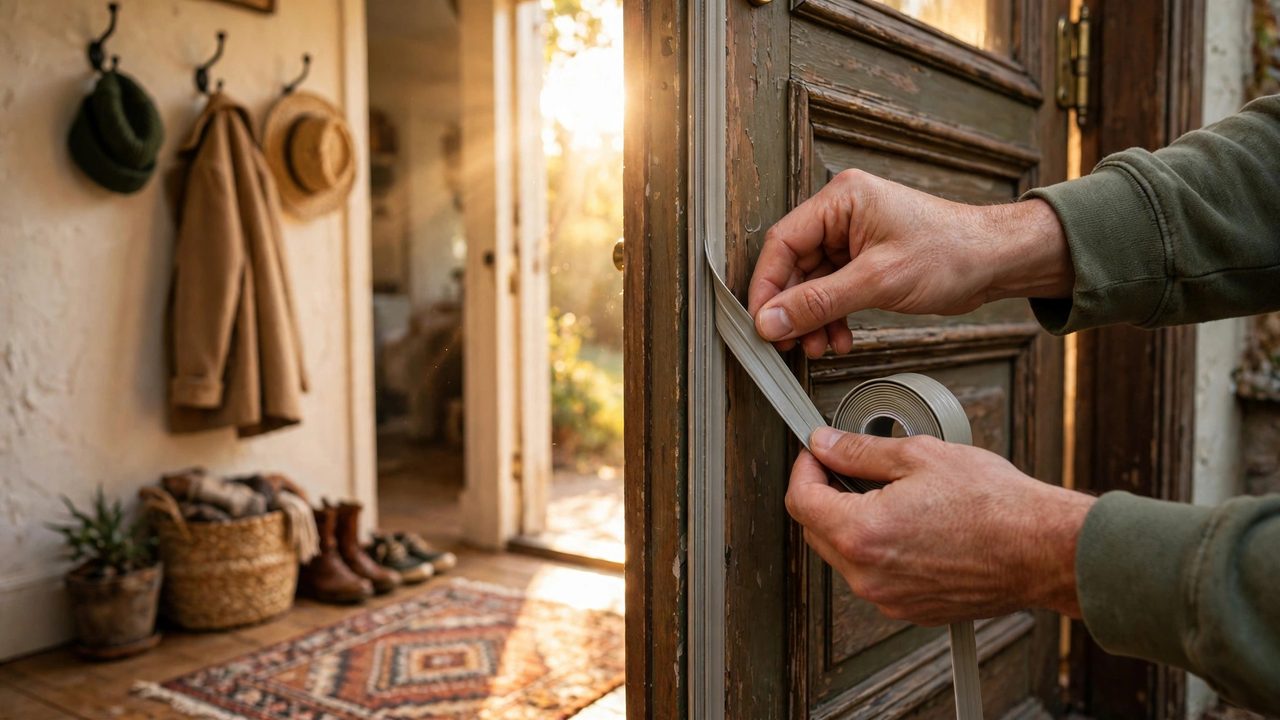
Seal drafts on old wooden exterior doors with V-strip, spring bronze, kerf and foam picks matched to gap thickness, adhesion on wood and clean removability.
Old wooden exterior doors rarely fail all at once. They shrink a little in dry winters, swell a little in humid summers, settle on their hinges, and slowly open up thin gaps along the stop, the lock side and the head jamb. Those gaps are where cold air pours in, where rain finds a path, and where a door that once closed with a soft thud starts to rattle in its frame. Choosing the best weatherstripping for old wooden exterior doors is therefore less about buying the thickest seal on the shelf and more about matching three things to your specific door: the thickness of the gap you actually have, the way the seal attaches to wood, and how easily the seal can be removed or replaced later without damaging an older frame.
That last point matters more on old wood than on a new prehung unit. A modern door often has a factory-cut kerf slot in the jamb, so a replacement seal simply presses in and pulls out. An older wooden door may have no slot at all, may have paint built up over decades, or may have a stop that is slightly wavy from years of movement. A seal that depends entirely on adhesive can struggle on a painted or uneven stop, while a nail-on metal strip does not care whether the surface is glossy, matte or slightly rough, because the fasteners do the holding. At the same time, a homeowner who wants a reversible, low-commitment fix may prefer a self-stick foam or V-strip that can be peeled away when the season changes or when the door is repainted.
This guide works through six real products that suit those different situations. It includes a traditional spring bronze strip that nails to the jamb, a bronze-finish nail-on aluminum weatherseal, a self-stick V-strip, a self-stick EPDM rubber D-section tape, a press-in kerf seal for doors that do have a slot, and a self-adhesive foam tape for medium gaps. Every pick was checked on an opened product page, and every specification below is reported only as the maker lists it. No energy savings figures are promised anywhere in this guide, because how much a seal helps depends on the door, the gap and the house, and the makers of these products do not put a single number on that outcome that could honestly be applied to every old door.
Quick verdict
For a traditional old wooden door with no kerf slot and a narrow, fairly even gap, start with the Pemko P51B17 Spring Bronze Weatherstrip. It is made for wood doors, it nails in place so adhesion on wood is not a concern, and the maker lists it in a 17-foot roll at 1-1/8 inches wide. For a similar nail-on approach in a bronze finish with the nails included in the box, the M-D Building Products 52000 Bronze Nail-On Weatherseal covers the same 17-foot, 1-1/8-inch format in aluminum. If you want no fasteners at all, the Frost King M13WH V-Seal Weatherstrip folds into a V and sticks to the stop, while the Frost King V25BK EPDM Rubber D-Section Weatherseal gives you a hollow rubber profile that compresses against the door. If your old door was later fitted with a slotted jamb, or you are replacing a worn press-in seal, the BISOTHAI Kerf Door Weather Stripping is the one pick here built around a rigid flange that pushes into that slot, and the maker lists it for noticeably wider gaps than the tapes. Finally, for a simple, removable first attempt on a medium gap, the Duck Brand 284425 Self-Adhesive Foam Weatherstrip Seal is a foam tape the maker lists for gaps from 1/8 inch to 5/16 inch, with clean removal noted by the maker.
The products in this guide
Pemko P51B17 Spring Bronze Weatherstrip
Spring bronze is the classic answer for an old wooden door, and the Pemko P51B17 is the most direct expression of it in this guide
Selection started with the door, not the product catalog. Old wooden exterior doors fall into a few distinct situations, and a useful shortlist has to cover each of them. Some doors have a plain wooden stop with no slot, and they need a surface-mounted seal. Some have a kerf slot, either original or added later, and they need a flange-style seal that locks into that slot. Some gaps are narrow and even, and some are wide at the lock corner and tight at the hinge side, which calls for a seal with more compression range. The six picks were chosen so that each of those situations has at least one honest option.
Every product then had to pass a verification step. Each pick was checked on an opened Amazon product page showing full details for that exact model, and the page had to show a live offer for the product sold new. Products whose pages showed no live featured offer were excluded and replaced, even when the product itself was well known. That is why some familiar screw-on door seal kits do not appear here: their pages did not present a live new offer at the time of checking, so they failed the gate regardless of their reputation.
Specifications were taken only from what the maker lists on the product page or in the maker’s own catalog material. Widths, lengths, gap ranges, materials and fastening methods below all come from those listings. Where a maker does not list a gap range for a product, this guide says so in effect by describing the product’s listed size and profile instead of inventing a range. No product was credited with a performance figure, a lifespan or an energy outcome that its maker does not state.
Finally, each pick had to genuinely suit an old wooden exterior door. That meant favoring formats with a long track record on wood: spring bronze and other nail-on metal strips, V-strip tension seals, kerf-in foam seals for slotted jambs, and self-adhesive foam and rubber tapes that can be applied to a wooden stop and later removed. Products designed only for steel doors, garage doors or vehicles were left out, even when they share a brand name with a pick that made the list.
Spring bronze is the classic answer for an old wooden door, and the Pemko P51B17 is the most direct expression of it in this guide. The maker lists this product for use on wood doors and wood casement windows, which is exactly the application at hand. The strip comes in a 17-foot roll and the maker lists its width at 1.125 inches, or 1-1/8 inches. In the maker’s catalog material, this type of cushion and spring weatherstrip is described as made from hemmed spring bronze, and the listing states that the strip is packaged with nails. The maker also gives a fastening rhythm: nails should be approximately 1-1/2 inches on center. That spacing detail is worth paying attention to, because a spring strip only works when it is held consistently along the jamb so the free edge can press evenly against the door.
Why does this suit an old door so well? Because it sidesteps the weakest link of tape-style seals on old wood, which is adhesion. Painted stops, varnished stops and stops with years of wax or grime can all undermine a self-stick backing, but a nailed bronze strip does not rely on the surface finish at all. The nails go into the jamb, the strip stays where it was placed, and the spring edge flexes each time the door closes. It also handles the slight unevenness of an older frame gracefully in one specific sense: because the strip is fastened at close intervals, you can follow a stop that is not perfectly straight instead of bridging over its low spots the way a stiff, pre-formed seal might.
There are honest trade-offs. Nailing a strip every inch and a half along both jambs and the head is slow, careful work, and it leaves small nail holes in the wood if you ever remove it, so it is not the pick for someone who wants a fully reversible trial. Cutting bronze to length and working around hinges and the strike plate also takes more patience than trimming foam with scissors. The listing also notes that returns will not be honored on this closeout item, which is a practical point worth knowing before you order: measure your door first, and be sure the 1-1/8-inch width suits your jamb before committing.
Buy it if: your old wooden door has no kerf slot, you want a traditional metal seal made for wood doors, and you are comfortable with careful nailing work in exchange for a fastening method that does not depend on adhesive holding to an old painted stop.
Skip it if: you want a reversible, no-holes trial, you are sealing a door you may repaint soon, or you do not want to work around hinges and lock hardware with a metal strip and a hammer.
The M-D Building Products 52000 takes the same nail-on idea and packages it as a consumer weatherseal roll. The maker lists it at 17 feet long by 1-1/8 inches wide, in a bronze color, and states that it is made of durable aluminum. The maker lists the purpose plainly: it seals to protect against drafts, moisture, dust and insects. Nails are included, according to the maker, and the strip is cut to the desired length with a hacksaw. That last detail tells you something useful about working with it: you will need a hacksaw rather than household scissors, and you should plan your cuts around the head jamb and the two side jambs before you start fastening.
For an old wooden exterior door, the appeal is the combination of a traditional format and a finish that sits comfortably against older woodwork. A bronze color against a stained or dark-painted door looks intentional rather than like an afterthought, which matters on a front door you see every day. Like the Pemko strip, it fastens mechanically, so adhesion on wood is not part of the equation at all. If your stop is painted, slightly chalky or uneven in finish, the nails still hold the strip in the line you chose. The maker lists this model, 52000, as a metal weatherstrip, and the roll format means one purchase covers the top and both sides of a typical single door with length to spare for careful fitting at the corners.
The cautions mirror the format. A metal roll needs to be unrolled, straightened and held in position while you fasten it, which is easier with a helper or with a few temporary fasteners placed first. Corners need thought: the strip has to turn or be mitered at the head jamb without leaving a gap at exactly the spot where drafts are often worst. And because it is a nail-on product, removing it later means filling or ignoring small holes in the jamb. None of that is a flaw; it is simply the nature of a mechanical seal, and it is why this guide also includes peel-and-stick options for readers who want to test a seal before committing to fasteners.
Buy it if: you want a nail-on metal seal in a bronze finish that suits older woodwork, with the nails included as the maker lists, and you have a hacksaw for cutting the roll to length.
Skip it if: you want a tool-light installation, you need a seal for a slotted kerf jamb, or you expect to remove and refit the seal regularly.
The Frost King M13WH is the V-strip in this lineup, and V-strip works on a different principle from foam. Instead of a soft block that squashes flat, the maker lists this strip at 7/8 inch wide by 17 feet long, and it folds along its center into a V. One leg of the V sticks to the stop or jamb, and the other leg springs outward so it presses against the edge of the door as it closes. The listing for this ASIN is a pack of 2 rolls, so the maker lists 34 feet in total across the pack, in white. The model is M13WH, and the maker lists it for doors and windows.
On an old wooden door, that spring action is valuable in a specific situation: a gap that is not perfectly uniform. A V-strip can open a little wider where the gap is wider and close down where the door sits tighter, following the kind of gentle waviness that old frames develop. It is also a discreet seal. Fitted on the stop, it is largely hidden when the door is closed, and in white it blends with the painted trim found around most older front doors. Installation is a peel-and-stick job with no fasteners, so there are no holes in historic woodwork, and if you position a length badly you can lift and refit it before the bond fully sets, within reason.
The limits are about adhesion and gap size, and both deserve honesty. Because this is a self-stick product, the surface has to be clean and dry for the backing to hold, and the maker’s own guidance for this type of strip is not to apply it in deep cold. On an old stop with flaking paint, the right first step is to scrape and clean the line where the strip will sit, or the strip will be bonded to loose paint rather than to wood. The maker does not list a specific gap range for this V-Seal, so this guide does not assign it one: treat it as a seal for the narrow, sliding-contact gaps that V-strips are shaped for, and choose one of the foam or kerf picks below if your gap is wide enough to see daylight through.
Buy it if: your gap is narrow and slightly uneven, you want a hidden, paint-friendly seal with no fasteners, and your stop can be cleaned well enough for a self-stick backing to hold.
Skip it if: your gap is wide, your stop paint is flaking and you cannot prepare the surface, or you want a mechanical fixing that ignores surface condition entirely.
The Frost King V25BK is a self-stick tape with a shaped profile rather than a flat one. The maker lists its material as EPDM rubber, its size as 5/16 inch wide by 1/4 inch thick by 17 feet long, and its color as black. The D-section name describes the cross-section: a flat back that carries the adhesive, and a rounded, hollow front that meets the door. When the door closes, that rounded section compresses and spreads slightly, which is how a profiled rubber tape seals against a surface that is not perfectly flat. The maker lists its recommended uses as insulation, weatherstripping, sealing gaps and sub-zero temperature resistance, which reflects the reason EPDM is chosen for exterior work: it is a rubber formulated to stay flexible in cold weather rather than stiffening the way some basic foams can.
For an old wooden exterior door, the practical case is a narrow to moderate gap on a door that opens and closes many times a day. A hollow D profile has a forgiving contact patch, so it can keep contact along a stop that undulates slightly, and the black color can disappear against a dark-stained door or a shadowed jamb where a white tape would stand out. At 17 feet, one roll covers the head and both sides of a standard single door, and trimming is a scissors job, which keeps the installation simple. Because it sticks rather than nails, it also suits a door where you do not want to add fastener holes to the frame.
The same adhesion caveat applies here as with every self-stick pick in this guide, and on old wood it is the main thing to get right. The stop needs to be clean, dry and sound; adhesive pressed onto dust, loose paint or a damp surface will let go, usually starting at the ends and at the lock side where the door’s movement works the tape most. End the runs neatly at the corners and press the full length firmly as you go rather than stretching the tape into place, because a stretched rubber tape will try to shrink back and can pull away at the ends. If your door’s gap is wider than the compression this 1/4-inch profile can offer, the door will either leak past it or need excessive force to latch, and a thicker pick from this list will serve you better.
Buy it if: you want a flexible rubber profile for a narrow to moderate gap, in black, with a simple self-stick fitting and a material the maker lists for sub-zero temperature resistance.
Skip it if: your stop surface cannot be cleaned to sound paint or bare wood, or your gap is wide enough that a 1/4-inch-thick profile would be fully flattened and still not fill it.
The BISOTHAI pick is the one kerf-in seal in this guide, and it exists for a specific version of an old door: one whose jamb has a slot. Some older doors were built with a kerfed jamb, and many more have had a slot added during a later refurbishment, so do not assume your door lacks one until you have looked closely at the stop and pulled at the edge of any existing seal. The maker lists this product at 26 feet in total, made from polyurethane foam covered with a polyethylene coating, with a rigid PVC flange. Instead of sticking or nailing, you push that flange into the slot, and the foam body sits proud of the jamb to meet the door. The maker lists it as suitable for the groove in the top and side of the door, and for door gaps from about 3/10 inch to 4/5 inch, which is a wider stated range than any tape in this guide claims.
That wide stated range is exactly why it earns its place for old doors. Age rarely widens a gap evenly; the lock-side corner of a settled door can stand noticeably further from the jamb than the hinge side. A long-reach kerf foam gives that wider section something to close against without forcing the tighter sections. The maker also notes that the seal can be cut with scissors or a utility knife, and that installation is a push-in job with no adhesive involved. Removability is the other quiet advantage: a kerf seal can be pulled back out of the slot when it eventually flattens or when the door is repainted, leaving the jamb itself unmarked, with no adhesive residue and no nail holes.
The condition is absolute, though: no slot, no seal. If your jamb is a plain wooden stop with no groove, this product has nothing to grip, and one of the nail-on or self-stick picks above is the right format instead. Measure before ordering in two places, as the maker itself advises: the width of the slot, so the flange will fit it, and the gap between door and jamb at several heights, so you can confirm your widest point sits inside the maker’s stated range. Also note that this is a seal for the top and sides of the frame; the bottom of the door, against the threshold, is a separate problem that none of the frame seals in this guide are designed to solve on their own.
Buy it if: your jamb has a kerf slot, your gap is wide or uneven within the maker’s stated range, and you want a seal that presses in and pulls out again without adhesive or fasteners.
Skip it if: your jamb has no slot, or your gap is narrow enough that a long-reach foam would make the door hard to close and latch.
The Duck Brand 284425 is the straightforward foam tape of the group, and its listing is unusually clear about the numbers that matter. The maker lists the seal as 3/8 inch wide by 5/16 inch thick, supplied as two rolls of 10 feet for 20 feet in total, in black, under model number 284425. The maker states that the foam is 0.3125 inches thick, for medium gaps around doors and windows, and that it can be used for gaps from 0.125 inches to 0.3125 inches. That stated range gives you a simple test before you buy: if a gap gauge, a stack of cards or a careful ruler shows your gap sitting inside that window at its widest point, this tape is dimensionally suited to it; if your gap is wider, it is not, and no amount of careful fitting changes that.
The maker describes the seal as a self-stick adhesive foam that forms a barrier against drafts and outside air, and lists what it keeps out: dust, insects and pollen are named, along with minimizing noise. For old wooden doors, two further points in the maker’s listing stand out. First, the maker notes clean removal, and describes the seal as safe for renters, leaseholders and temporary living spaces. Translated to an old house, that means this is the lowest-commitment way in this guide to find out whether sealing the frame solves your draft: fit it, live with it through a cold week, and peel it away cleanly if you decide a permanent metal strip is the better long-term answer. Second, the maker gives an application condition: apply adhesive tape products to clean and dry surfaces when the temperature is above 50 degrees Fahrenheit, as the maker lists. On a winter job, that may mean warming the room and the jamb, or waiting for a milder day, rather than pressing tape onto a cold stop and hoping.
Foam tape is also the most perishable format here, and it is fair to say so. A foam that is compressed every time the door closes will gradually take a set, and a self-adhesive backing on an exterior stop lives a harder life than one indoors. Treat this pick as an effective, inexpensive and reversible seal with a finite life, not as a fit-and-forget fixture like a nailed bronze strip. The maker’s own fitting instructions are simple: remove the liner, apply the tape to the surface, trim with scissors and press firmly in place. Work in short lengths, keep the tape relaxed rather than stretched, and pay extra attention to firm pressure at the ends and corners, where peel-away failures begin.
Buy it if: your measured gap falls inside the maker’s stated 1/8-inch to 5/16-inch range, and you want a reversible, clean-removing seal to solve a draft now or to test the frame before a permanent fitting.
Skip it if: your gap is wider than the maker’s stated range, the jamb is too cold or damp to meet the maker’s application conditions, or you want a seal you can fit once and ignore for years.
Buying guide
Measure the gap before you choose a format. Everything in this category follows from gap thickness. Close the door on a strip of card or paper at several points around the frame: if the card slides freely, note where; if it grips, note that too. Then measure the actual gap at the head, the lock side at handle height, and near the hinges. Old doors commonly show three different gaps on one frame. A seal must be thick enough, in its uncompressed state, to fill the widest point without being so thick at the tightest point that the door will not latch. That is why the stated gap ranges matter: the Duck Brand tape lists 1/8 inch to 5/16 inch, and the BISOTHAI kerf seal lists about 3/10 inch to 4/5 inch. Products whose makers do not list a range, such as the V-Seal, should be matched by profile and judgment on narrow gaps rather than by a number nobody stated.
Check whether your jamb has a kerf slot. Run a fingernail or a thin blade along the stop where a seal would sit, and look at any existing seal: if it disappears into a narrow groove, you have a kerf. A kerf jamb opens up the cleanest replacement route of all, because a flange-style seal presses in, can be trimmed with scissors, and pulls out again for painting or replacement. If there is no slot, do not try to force a kerf product onto a flat stop; choose a surface-mounted format instead, either nail-on or self-stick.
Decide how the seal will hold to old wood. Adhesion on wood is the recurring weak point of tape-style seals, and it is a surface problem, not a product mystery. Self-stick backings need a stop that is clean, dry and sound. Flaking paint must come off the line of contact, gloss paint may need a light scuff and a wipe-down, and several makers state a minimum application temperature, so a freezing jamb is a reason to wait. Nail-on seals, such as the Pemko spring bronze and the M-D 52000, bypass all of that: the fasteners hold the strip regardless of finish, which is why metal strips have been the default on wooden doors for generations. The trade is permanence and effort against convenience and reversibility.
Think about removability before you fit, not after. Old doors get repainted, rehung and adjusted. A kerf seal pulls out of its slot. The Duck Brand foam lists clean removal. A V-strip or rubber tape can be peeled away, though adhesive residue may need cleaning from the stop. A nailed metal strip comes off too, but it leaves a line of small holes to fill. None of these outcomes is wrong; the mistake is choosing a permanent fitting for a door you plan to strip and repaint next spring, or choosing a temporary tape for a door you never want to think about again.
Match the material to the exposure. The makers list distinct materials here for a reason. Spring bronze and aluminum are metal strips that flex rather than compress, and they suit doors where a long-lived, fastened seal is the goal. EPDM rubber, as in the Frost King V25BK, is listed by its maker with sub-zero temperature resistance, which suits an exposed exterior door in a cold climate. The BISOTHAI kerf seal pairs a polyurethane foam body with a polyethylene coating, as the maker lists, so the foam is skinned rather than open to the weather. Plain foam tape is the simplest and most replaceable option, and it is best treated as such. What this guide deliberately does not do is rank these materials by promised energy savings, because the makers do not state a comparable figure and your result will depend on the gap you started with.
Plan the corners and the hardware. Drafts concentrate where seals are interrupted: at the top corners, at the strike plate, and around hinges. Whichever format you choose, fit the head piece and side pieces so they meet tightly at the corners without overlapping into a lump that holds the door off its latch. Cut metal strips with the tool the maker names, a hacksaw for the M-D roll, and trim tapes and kerf foam with scissors or a utility knife as their makers list. Work around hinges and the strike by cutting the seal to end and restart either side of the hardware rather than bending it over an obstruction.
Remember the bottom of the door is a separate seal. Every pick in this guide seals the top and sides of the frame. If daylight shows under the door, that gap belongs to a door sweep or a threshold seal, which is a different product fitted to the door bottom or the sill. Sealing the frame first is still the right order of work, because it lets you feel how much of the draft was coming around the sides, but a complete job on an old door often means a frame seal from this list plus a separate answer at the bottom.
FAQ
Can I use kerf weatherstripping on an old wooden door?
Yes, if the jamb has a kerf slot. Kerf seals such as the BISOTHAI pick in this guide hold by a rigid flange pressed into that slot, so the slot is a requirement, not an option. Check your jamb first: many older doors have no slot, and some have had one added later. If there is no slot, use a nail-on or self-stick surface-mounted seal instead.
Why does foam tape keep peeling off my wooden door frame?
Usually because of the surface, not the tape alone. Adhesive needs the stop to be clean, dry and sound; loose or flaking paint gives the backing nothing solid to hold. Makers also state application conditions, and the Duck Brand listing, for example, says to apply its tape to clean and dry surfaces above 50 degrees Fahrenheit, as the maker lists. Preparing the line of contact, and pressing the tape firmly along its full length without stretching it, solves most early failures.
What gap thickness should I measure before buying?
Measure at several points, because an old door rarely has one uniform gap. Compare your widest measurement with the range the maker lists: the Duck Brand 284425 lists gaps from 1/8 inch to 5/16 inch, and the BISOTHAI kerf seal lists about 3/10 inch to 4/5 inch. If your widest point is beyond a product’s stated range, choose a thicker format rather than hoping compression will make up the difference.
Is spring bronze a good choice for a historic wooden door?
It is the traditional choice, and the Pemko P51B17 is listed by its maker for wood doors and wood casement windows, packaged with nails. It avoids any reliance on adhesive holding to old paint, which suits historic woodwork. The consideration is that nailing leaves small holes if the strip is ever removed, so owners who need fully reversible work sometimes start with a clean-removing tape and move to bronze once the door’s final finish is settled.
How removable are these seals when I repaint the door?
It depends on the format. A kerf seal pulls out of its slot. The Duck Brand foam lists clean removal. Self-stick V-strip and rubber tapes peel away, possibly leaving residue to clean. Nail-on metal strips unfasten but leave nail holes to fill. If repainting is already planned, either seal after painting or choose one of the easily removed formats for the interval.
Will weatherstripping the frame stop a draft under the door?
No. The picks in this guide seal the head and the two sides of the frame. A gap under the door needs a door sweep or threshold seal fitted at the bottom. It is common for an old door to need both, and sealing the frame first helps you judge how much air was actually coming through the bottom gap.
Conclusion
An old wooden exterior door does not need the newest seal; it needs the right seal for its gap, its jamb and its finish. If your door has a plain wooden stop and you want the traditional, fastened answer, the Pemko P51B17 Spring Bronze Weatherstrip and the M-D Building Products 52000 Bronze Nail-On Weatherseal both nail in place at the same listed 17-foot, 1-1/8-inch format, in spring bronze and in bronze-finish aluminum respectively. If you would rather stick than nail, the Frost King M13WH V-Seal springs against the door edge on narrow, uneven gaps, and the Frost King V25BK brings a hollow EPDM D profile to a narrow to moderate gap. If your jamb is slotted and your gap has widened with age, the BISOTHAI Kerf Door Weather Stripping is listed for the widest gaps here and removes as cleanly as it installs. And if you want to solve the draft this week with a seal you can peel away later, the Duck Brand 284425 states its gap range and its clean removal plainly. Measure first, prepare the wood honestly, and match the format to the door in front of you: that, more than any single product, is what seals an old door well.
M
Modern Line Home Editorial Team
We compare specs, materials and verified owner reviews before a product earns a spot. Rankings are never paid.
Affiliate disclosure. As an Amazon Associate we earn from qualifying purchases at no extra cost to you. Prices accurate as of the date shown.
House cold even with the heat on? Walk this ordered checklist: thermostat and filter first, then drafts, insulation, leaky ducts and a failing heating system.
Windows fogging up in winter? Check where the fog sits: on the room side it is indoor humidity, outside it is harmless, and between panes the seal has failed.
Store the main firewood pile about 30 feet from your house, off the ground and covered only on top. Compare racks, woodsheds, garages and indoor spots safely.
Place a portable generator outdoors only, at least 20 feet from windows, doors and vents, exhaust pointed away. Exact distances, setup steps and CO rules here.
Keep houseplants in the right winter spot: match window direction to plant type, stay clear of radiators and cold glass, and fix dry air and low light at home.
Mice enter through pencil-width gaps at foundations, pipes, vents, doors and the roofline. Walk this room-by-room winter checklist to find and seal each one.
A winter outage timeline: what to do in the first hour, first night and multi-day outage, with food safety times, pipe protection, heat and CO safety steps.
Size a space heater by room area: 10 watts per square foot at 8-foot ceilings, adjusted for insulation and ceiling height, with full wattage and BTU tables.
Start dripping at about 20 degrees, sooner for exposed pipes. Set a pencil-lead stream, drip the right faucets on both lines, and know when to stop safely.
A fridge needs 800-1,200 starting watts, not just 150-400 running watts. Use the tables to total your fridge plus freezer, lights, furnace fan and more today.












Write Your Review
No reviews yet. Be the first to share your experience!