We independently review everything we recommend. When you buy through our links, we may earn a commission. As an Amazon Associate we earn from qualifying purchases.
Best Vacuums for Sanders: 6 Portable Dust Extractors
Compare the best vacuums for sanders portable setups: tool-triggered dust extractors and compact HEPA vacs from Festool, Fein, DEWALT, Makita and Milwaukee.
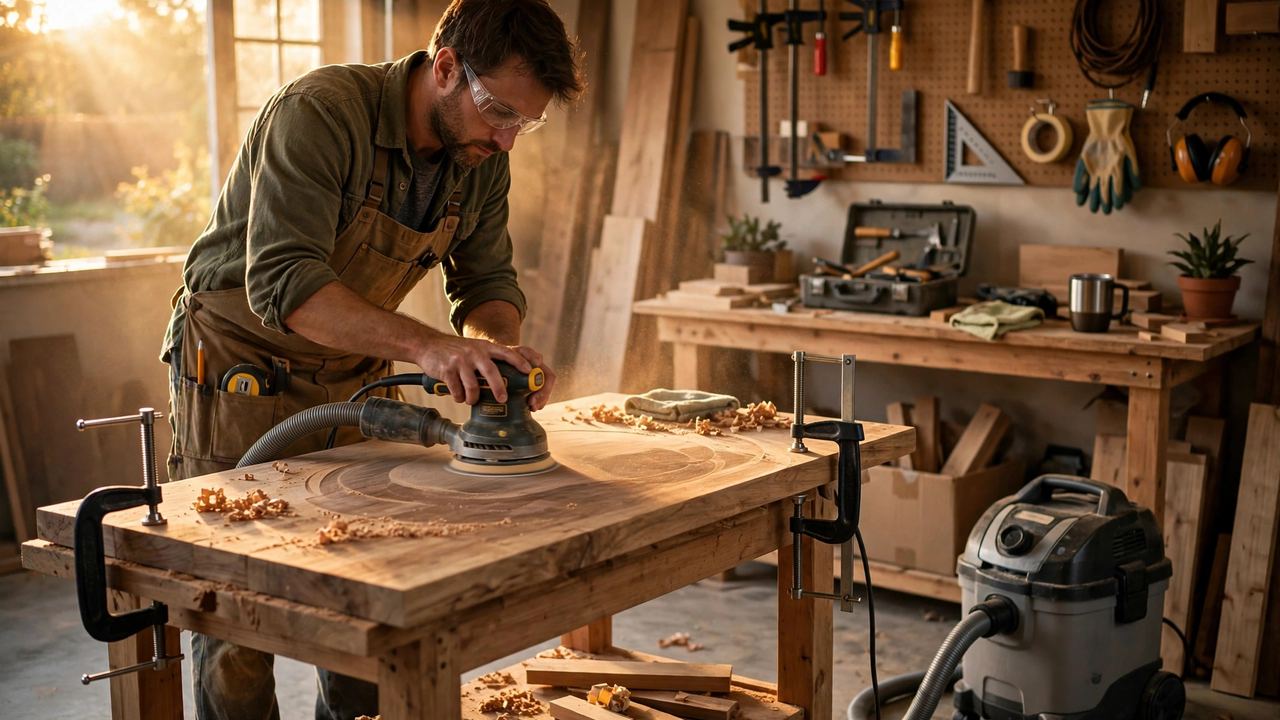
Sanding produces the finest, most persistent dust in any workshop. It hangs in the air, settles on every surface, coats the workpiece you are trying to finish, and works its way into the sander’s own bearings and pads. The fix is not a bigger shop vacuum parked in the corner — it is a vacuum that connects directly to the sander’s dust port, starts when the sander starts, and travels with you from bench to jobsite. That is exactly what this guide covers: the best vacuums for sanders portable enough to carry in one trip, with the hose connections, filtration and automatic switching that sander work actually demands.
The six picks below split into two families. The first family is the true dust extractor: corded machines from Festool, Fein and DEWALT with tool-triggered outlets, long anti-static hoses and serious airflow, built to run for hours behind a random orbit, belt or drywall sander. The second family is the compact cordless box vac from Makita, Milwaukee and DEWALT — smaller tanks and lower airflow, but genuinely portable, happy on a ladder or in a finished room, and perfectly capable of keeping up with a palm sander or a detail sander on trim work. Every specification in this guide is phrased the way the maker lists it, because extractor ratings are not measured the same way across brands and the honest comparison is maker figure against maker figure.
Quick verdict
For most woodworkers who sand every week, the Festool CT MIDI I is the extractor to beat: full HEPA certification, Bluetooth or outlet-based automatic start, a smooth anti-static hose that does not snag on bench edges, and a flat top that stacks with tool cases for transport. The Fein Turbo I is the quiet alternative, with the strongest airflow figure in this group and a long cord-and-hose reach that lets it sit in one spot while you work a whole room. The DEWALT DWV010 is the capacity pick, an 8-gallon machine with automatic filter cleaning that suits drywall and renovation sanding where dust volume is the problem. Among the cordless boxes, the Makita XCV11Z is the most extractor-like, with a proper HEPA filter and an anti-static hose sized for tool ports; the Milwaukee PACKOUT vacuum wins on transport if your tools already ride in that storage system; and the DEWALT DCV581H is the flexible budget-friendly option because it runs from a battery or a wall outlet.
The products in this guide
Festool CT MIDI I HEPA Dust Extractor (578512)
A maximum suction capacity of 130 CFM with 96 inches of static water lift, a container capacity of 3.96 gallons with a 3.3-gallon filter bag, and
Best if you sand weekly with corded or cordless tools and want automatic start, certified HEPA
Portability was the first filter. Every machine here can be carried or rolled by one person without a dolly, and none needs a fixed dust-collection run to be useful. A full-size drum collector or a heavy contractor vac that lives under a bench did not qualify, however strong its numbers, because the keyword is portable: these are vacuums that follow the sander.
The second filter was the sander connection itself. A vacuum earns its place in this guide only if it can work attached to a sander, not merely clean up after one. That means at least one of the following, as the maker lists it: a tool-triggered or autostart outlet that switches the vacuum with the sander, a Bluetooth or remote start for cordless tools, an included power tool adapter, or a small-diameter anti-static hose of the size that actually fits sander dust ports. Standard shop vacs with a fat hose and no adapter path were left out.
Third, we checked the published figures that matter for sanding: airflow in cubic feet per minute, sealed water lift, tank or bag capacity, hose length and diameter, filter type, noise level and weight. Sanding dust is fine and light, so filtration quality matters more than raw debris capacity; a HEPA filter or a certified extractor counts for more here than it would for a vacuum bought to pick up screws and offcuts. Finally, every product had to be a current, real model sold new through normal retail channels, with specifications confirmed on the maker’s own pages or detailed retailer listings. Models that could not be verified that way were excluded rather than described loosely.
The CT MIDI I is the extractor most purpose-built for sanders in this group. The maker lists a maximum suction capacity of 130 CFM with 96 inches of static water lift, a container capacity of 3.96 gallons with a 3.3-gallon filter bag, and power consumption adjustable between 350 and 1,200 watts — that variable suction matters for sanding, because full power against a random orbit sander can make the tool stick and skate, while dialled-back suction lets it glide. The unit carries full unit HEPA certification, and the maker lists a noise level of 62 dBA on the low setting and 72 dBA at maximum, which is quiet enough that the sander itself is usually the louder tool.
Automatic starting is handled two ways. Plug a corded sander into the on-board outlet and the extractor starts and stops with the tool. For cordless sanders, integrated Bluetooth lets the extractor start from a Bluetooth battery pack or the optional remote control, so there is no cord tethering the pairing at all. The included smooth anti-static suction hose, listed at 27 mm by 3.5 m, has a conical shape and a smooth exterior that slides over workpiece edges instead of catching, and the CLEANTEC bayonet fitting locks onto Festool sander ports without tape or friction-fit guesswork. Touch controls on the lid work with gloves on, the flat top accepts a Systainer case locked on with the T-LOC coupling, and the whole unit is listed at about 20 pounds, so extractor and sander travel as one stacked carry.
The trade-offs are capacity and ecosystem. A 3.3-gallon bag fills quickly behind a belt sander or a planer, and the fleece bags are a running cost that the bagless cordless boxes below do not have. The 27 mm hose is ideal for Festool ports and fits many European sander ports, but some sanders need a stepped adapter. Within its intended job — hours of clean, quiet, automatic extraction behind finish sanders — it is the most complete package here.
Buy it if: you sand weekly with corded or cordless tools and want automatic start, certified HEPA filtration and the quietest running in the group.
Skip it if: you produce dust by the bucket with a belt sander or drywall sander and need a big tank, or you do not want ongoing filter-bag costs.
The Fein Turbo I is the strong, quiet workhorse of the corded group. The maker lists a high-performance turbine moving 151 CFM with 98.4 inches of static water lift, a maximum power input of 1,100 watts, and a 5.8-gallon capacity — the largest airflow figure and the second-largest tank among the portables here. The maker lists the operating volume at just 66 dB(A), which makes a real difference on installation work in occupied homes, where a screaming shop vac behind a sander is not acceptable for long.
For sander hookup, the Turbo I has an autostart outlet with a power-on delay that prevents current spikes when the sander and extractor start together, and the package includes a tool coupling with suction control, so you can bleed off suction at the handle when a random orbit sander starts to stick to the workpiece. The included suction hose is listed at 13 feet with a 35 mm diameter, and the power cord at 19 feet, giving the longest combined working reach in this guide — park the Fein in a corner and sand a whole room of trim without moving it. The maker lists approval for dust class L, a flat-fold filter and a fleece filter bag, plus large wheels that rotate 360 degrees for manoeuvring in tight rooms. Anti-static operation is available with the maker’s optional conductive hose and coupling.
What you give up versus the Festool is the sealed HEPA certification and the wireless start: the standard filter setup is a class L arrangement rather than a certified HEPA system, and cordless sanders cannot trigger it, so you switch it manually or use the outlet with corded tools. It is also a touch heavier in the hand than its listed weight suggests once the tank carries dust. For corded sander work where quiet strength and reach matter most, it is an excellent value in engineering terms.
Buy it if: you run corded sanders on site or in finished rooms and want the strongest airflow here, low noise and a long hose-and-cord reach.
Skip it if: you need certified HEPA filtration for regulated dust work, or you want a cordless sander to trigger the vacuum automatically.
The DWV010 is the capacity and endurance pick. The maker lists an 8-gallon tank, a 15-amp motor delivering 150 CFM of airflow and 81 inches of water lift, all in a unit listed at 21 pounds with heavy-duty wheels and casters — the biggest tank here paired with a weight the smaller corded extractors barely beat. That combination suits drywall sanding, renovation prep and long floor-sanding sessions where stopping to empty a small bag every hour is the real productivity loss.
Two features keep that airflow honest over a long session. The automatic filter clean pulses every 30 seconds to knock dust off the filters without stopping work, which matters because fine sanding dust blinds filters faster than any other common dust. And power tool actuation switches the extractor on and off with the connected sander, so the machine is only running — and only wearing its filters — while you are actually sanding. Filtration is by twin HEPA filters, and the maker states the unit meets the EPA Lead Related Renovations, Repair and Painting (RRP) rule for HEPA vacuums when used with the specified DWV9330 filters. The included anti-static hose is listed at 15 feet, with a universal hose connector that swivels, and the 8-foot power cord is the one short reach figure in an otherwise generous package.
The DWV010 is the least refined sander partner here in the small details: there is no variable suction dial on this model, so delicate finish sanding with a small orbit sander needs care at the tool coupling, and at a listed 80 dB it is plainly the loudest machine in the group. It is a jobsite extractor first and a furniture-shop extractor second. If your sanding is measured in rooms and sheets of drywall rather than in drawer fronts, that is the right priority.
Buy it if: you sand drywall, plaster or whole rooms and need an 8-gallon tank, automatic filter cleaning and tool actuation in one machine.
Skip it if: you want quiet running, variable suction for fine finish sanding, or the lightest possible carry between rooms.
The XCV11Z is the cordless pick that behaves most like a real dust extractor rather than a cleanup vac. The maker lists a brushless motor delivering 57 CFM and 27 inches of water lift, a HEPA filter that captures 99.97 percent of particulates 0.3 microns and larger, and a 2-gallon dry capacity with 1.2 gallons of wet capacity. Crucially for sander work, the included hose is a flexible anti-static hose listed at 1 inch by 6.5 feet — a tool-port size, not a floor-cleanup size — so it couples to palm sanders, detail sanders and small random orbit sanders the way an extractor hose should, and the two-speed push-button control lets you drop suction for delicate work.
Portability is the headline: the maker lists 10.1 pounds with a 5.0Ah battery fitted, up to 60 minutes of continuous run time on that battery, and a working sound level of 76 dB(A). There is no cord to drag across a finished floor and no outlet to hunt for on a ladder, which makes it the natural partner for a cordless sander on trim, doors and built-ins. It converts to a blower for clearing a bench, stores its nozzles on board, and accepts an optional shoulder strap for carrying between rooms. It is sold as a bare tool, so the battery and charger are separate purchases for anyone not already on the 18V LXT platform.
The limits are the honest ones of its class. At 57 CFM it will not keep up with a belt sander or a wide drum the way the corded extractors will, there is no automatic start — you switch the vacuum on, then sand — and a 2-gallon tank fills fast on renovation dust. Used as intended, tethered to a small sander for finish work away from the bench, it is the most convincing cordless extractor here.
Buy it if: you run cordless sanders on the Makita 18V LXT platform and want HEPA filtration and a proper anti-static tool hose in a 10-pound carry.
Skip it if: you need automatic tool-triggered start, all-day runtime from one battery, or airflow for belt and drywall sanders.
The Milwaukee 0970-20 solves the transport problem better than anything else here: it is a vacuum built into the PACKOUT modular storage footprint, so it clicks onto the same rolling stack as the rest of your kit and rides to the job as one tower. The maker lists a POWERSTATE brushless motor delivering 50 CFM and 47 inches of water lift, a 2.5-gallon canister, a washable HEPA filter, a sound power level of 87 dB(A) and a bare-tool weight of 11.3 pounds. A high and low switch lets you trade suction for run time, and the maker lists up to 30 minutes on a HIGH OUTPUT 8.0 battery in high mode and over 50 minutes in low mode.
For sander work specifically, the detail that matters is in the box: a vacuum power tool adapter is included alongside the flexible hose, crevice tool and utility nozzle, and all of it stores in the lid compartment. That adapter is what turns a toolbox vac into a sander vac — couple it to a palm or random orbit sander’s port and the HEPA filter handles the fine dust, while the blower port clears offcuts and dust from the bench between passes. The maker also lists OSHA objective data compliance for select silica dust producing applications, which reflects how seriously the filtration is engineered for a box this size.
Like the Makita, it is a bare tool with no automatic start, and its 50 CFM is clean-up-and-finish-sander airflow, not production sanding airflow. The 87 dB(A) sound level is the highest listed here, though the maker positions the tone as less harsh than traditional jobsite vacs. If your sanders already travel in PACKOUT cases, no other vacuum disappears into your transport system this neatly.
Buy it if: your tools ride in the PACKOUT system and you want a HEPA vacuum with an included power tool adapter that stacks onto the same tower.
Skip it if: you are not on the M18 platform, or you need tool-triggered start and corded endurance for long sanding sessions.
The DCV581H is the flexible generalist: it runs on a DEWALT 20V MAX battery when you are moving around, or plugs into an AC outlet when the sander work stays at one bench, so it is the only pick here that never has to stop for a flat battery mid-session. The maker lists a 2-gallon tank, a washable and reusable HEPA-rated wet/dry filter that traps dust with 99.97 percent efficiency at 0.3 microns, and a heavy-duty crush-resistant hose listed at 5 feet by 1-1/4 inches. Retailer listings of the maker’s figures put airflow at 140 CFM with 52 inches of water lift, strong numbers for a unit listed at about 11 pounds with on-board hose, cord and accessory storage.
In sander terms, this is the spot-extraction and small-job pick. The 1-1/4 inch hose is the common small-tool diameter, so it couples to many sander ports directly or with an inexpensive stepped adapter, the HEPA filter keeps fine sanding dust out of the room air, and the dual power means a morning of cordless trim sanding can become an afternoon of corded bench sanding without changing machines. A wide nozzle and crevice tool are included for the cleanup work around the sanding, and there is a blower port for clearing dust from details and corners.
It is not a true extractor in the Festool or Fein sense: there is no tool-triggered outlet, no automatic filter cleaning, and the 5-foot hose is the shortest here, so the unit needs to stay close to the work — fine at a bench, limiting across a room. The 2-gallon tank is a small-job tank. As a second vacuum that lives wherever the sanding happens to be, rather than the one extractor a production shop is built around, it earns its place.
Buy it if: you want one compact vacuum that runs cordless for quick jobs and corded at the bench, with a washable HEPA filter and no bags to buy.
Skip it if: you want automatic start with the sander, a long hose for room-scale work, or capacity for heavy dust volume.
Buying guide
Start with the trigger, not the tank. The single feature that separates a sander vacuum from a cleanup vacuum is automatic starting. A tool-triggered outlet (Fein, DEWALT DWV010, Festool with corded tools) or a Bluetooth start (Festool with cordless tools) means extraction runs exactly while dust is being made, and stops a few seconds after the sander stops. With a manual cordless box you must remember to switch on before every pass — workable for short jobs, easy to forget on long ones. Decide honestly which rhythm fits your work before comparing any other figure.
Match airflow to the sander, not to the room. A palm, detail or 5-inch random orbit sander produces a modest stream of fine dust that a 50 to 60 CFM cordless vac handles comfortably through a short hose. A 6-inch sander, a belt sander or a drywall sander moves far more air and dust and wants the 130 to 151 CFM class of corded extractor. Water lift matters at the other end of the scale: higher lift keeps suction strong through small ports and longer hoses, which is why the Fein’s listed 98.4 inches and the Festool’s 96 inches feel different in use from the cordless boxes’ 27 to 47 inches.
Get the hose connection right. Sander dust ports are not standardised. Festool’s CLEANTEC bayonet locks onto its own tools; the Fein ships a 35 mm coupling with suction control; the Makita’s 1-inch anti-static hose suits small tool ports; the Milwaukee includes a power tool adapter; and 1-1/4 inch hoses like the DEWALT DCV581H’s fit many ports directly or through a stepped rubber adapter. Check your sander’s port diameter before buying, and budget for the adapter if your pairing needs one — a leaky friction fit wastes more suction than any spec difference in this guide.
Filtration is the point of the exercise. Sanding dust is the fraction that stays airborne longest, so the filter is not a footnote. A HEPA filter rated at 99.97 percent at 0.3 microns (Makita, Milwaukee, the DEWALT boxes) or a fully certified HEPA extractor (Festool) keeps the finest dust in the machine. Bags help any system: a fleece bag acts as a pre-filter, keeps the main filter clean longer and makes emptying a sealed, dust-free job, at the cost of buying replacements. Bagless boxes save that cost but ask you to tap or wash filters and empty dusty canisters outdoors.
Capacity and weight trade against each other. Two to two and a half gallons is the sweet spot for a vacuum that genuinely travels — roughly 10 to 11 pounds in the cordless picks here. Step up to 5.8 or 8 gallons and you gain hours between emptying but the machine becomes a roll-it-there extractor rather than a carry-it-there one. For finish sanding, small tanks rarely fill before the battery or the job ends; for drywall and floor work, tank size is the spec that decides your day.
Suction control is a sanding feature. Too much suction pins a random orbit sander to the work and leaves swirl marks; too little leaves dust in the scratch pattern. Variable suction at the machine (Festool) or a suction-control coupling at the handle (Fein) lets you tune the pairing, and a high/low switch (Makita, Milwaukee) gives cordless users a basic version of the same control. If you do a lot of fine finish sanding, put this high on your list.
FAQ
Can I use a regular shop vacuum with a sander instead?
You can, with an adapter, and for occasional work it is a reasonable stopgap. What you give up is automatic start, anti-static hoses in tool-port sizes, suction control, and usually HEPA-level filtration — a standard shop vac filter passes much of the finest sanding dust back into the room. The picks in this guide exist because those four gaps are exactly what sander work exposes.
How much CFM does a sander actually need?
Small palm and random orbit sanders work well with the 50 to 60 CFM that compact cordless vacs list, because their ports are small and the hose run is short. Larger orbit sanders, belt sanders and drywall sanders are better matched to the 130 CFM and above that the corded extractors list. When in doubt, the maker’s listed figure for the vacuum should meet or exceed the airflow the sander maker recommends for its dust port.
Do I need HEPA filtration for wood sanding dust?
For ordinary wood dust, a good filter and a bag already capture most of what a sander produces, but HEPA filtration captures the finest fraction that stays airborne and is the fraction worth keeping out of a home or a client’s house. Regulated work — lead paint renovation under the EPA RRP rule, for example — requires a HEPA vacuum used as the maker specifies, which is why the DEWALT DWV010’s stated RRP compliance with its specified filters matters to renovators.
Will these vacuums fit my sander’s dust port?
Usually, but check the diameter first. Common pairings: 27 mm and 35 mm extractor hoses for European-style ports, 1-inch hoses for small tool ports, and 1-1/4 inch hoses for many North American tools. The Milwaukee includes a power tool adapter in the box, and stepped rubber adapters exist for almost every other pairing. A snug, sealed connection matters more than the vacuum’s headline airflow.
Corded extractor or cordless box vac — which is better for sanders?
For long sessions at a bench or on drywall, the corded extractor: more airflow, automatic start, bigger capacity, no battery management. For short jobs, finished rooms, ladders and punch-list sanding, the cordless box: it is already where you are, with no cord across the floor. Many workshops end up with one of each, which is why this guide includes both families rather than crowning a single type.
Conclusion
Portable sander extraction comes down to three honest choices. If sanding is core work, buy the trigger and the filtration first: the Festool CT MIDI I for automatic start in both corded and cordless form, the Fein Turbo I for quiet strength and reach, or the DEWALT DWV010 when dust volume and filter endurance rule the job. If sanding is mobile and intermittent, buy the carry: the Makita XCV11Z for the most extractor-like cordless performance, the Milwaukee PACKOUT vacuum if your kit already stacks that way, or the DEWALT DCV581H when one machine must run from a battery on site and a cord at the bench. Match the hose to your sander’s port, keep the filter clean, and the dust problem that makes sanding unpleasant largely disappears.
M
Modern Line Home Editorial Team
We compare specs, materials and verified owner reviews before a product earns a spot. Rankings are never paid.
Affiliate disclosure. As an Amazon Associate we earn from qualifying purchases at no extra cost to you. Prices accurate as of the date shown.
House cold even with the heat on? Walk this ordered checklist: thermostat and filter first, then drafts, insulation, leaky ducts and a failing heating system.
Windows fogging up in winter? Check where the fog sits: on the room side it is indoor humidity, outside it is harmless, and between panes the seal has failed.
Store the main firewood pile about 30 feet from your house, off the ground and covered only on top. Compare racks, woodsheds, garages and indoor spots safely.
Place a portable generator outdoors only, at least 20 feet from windows, doors and vents, exhaust pointed away. Exact distances, setup steps and CO rules here.
Keep houseplants in the right winter spot: match window direction to plant type, stay clear of radiators and cold glass, and fix dry air and low light at home.
Mice enter through pencil-width gaps at foundations, pipes, vents, doors and the roofline. Walk this room-by-room winter checklist to find and seal each one.
A winter outage timeline: what to do in the first hour, first night and multi-day outage, with food safety times, pipe protection, heat and CO safety steps.
Size a space heater by room area: 10 watts per square foot at 8-foot ceilings, adjusted for insulation and ceiling height, with full wattage and BTU tables.
Start dripping at about 20 degrees, sooner for exposed pipes. Set a pencil-lead stream, drip the right faucets on both lines, and know when to stop safely.
A fridge needs 800-1,200 starting watts, not just 150-400 running watts. Use the tables to total your fridge plus freezer, lights, furnace fan and more today.












Write Your Review
No reviews yet. Be the first to share your experience!