We independently review everything we recommend. When you buy through our links, we may earn a commission. As an Amazon Associate we earn from qualifying purchases.
Best Towels to Dry a Car With: 6 Drying Towels Ranked
The best towels to dry a car with, ranked by absorbency, size and weave: six dedicated drying towels from plush and twisted-loop to waffle weave, compared.
The best towels to dry a car with, ranked by absorbency, size and weave: six dedicated drying towels from plush and twisted-loop to waffle weave, compared.
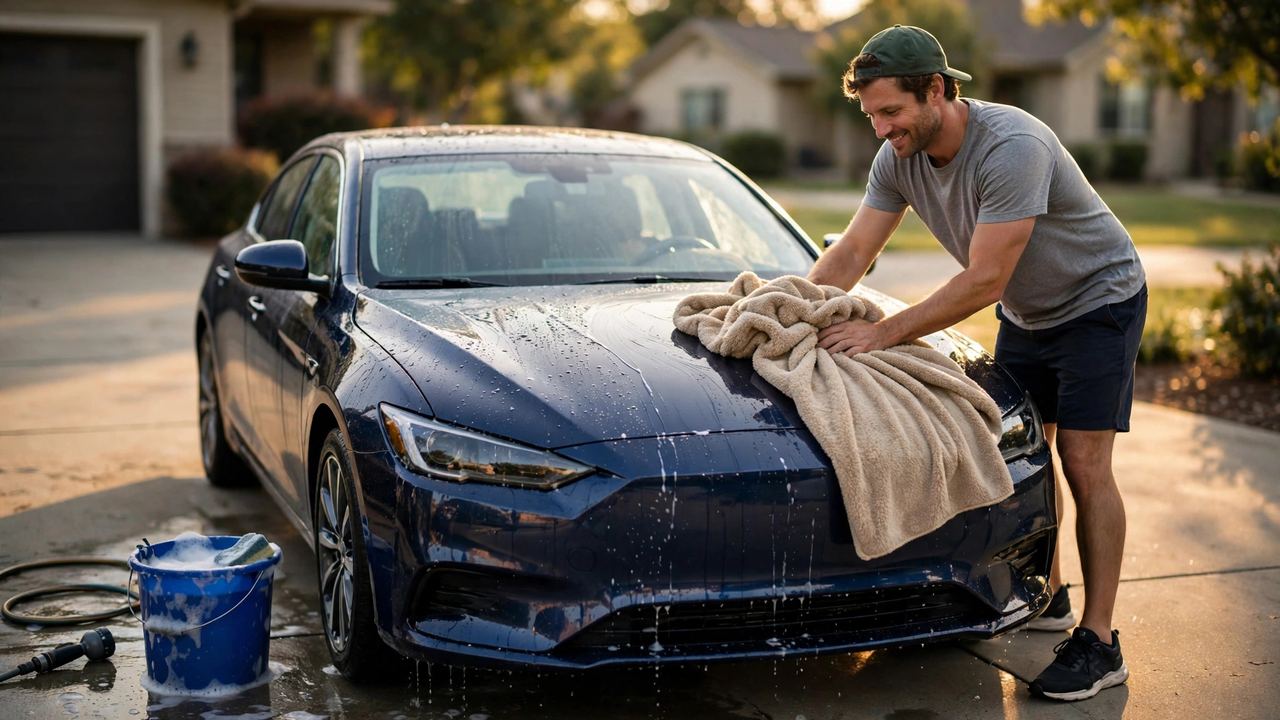
Drying is the step where a clean wash can still go wrong. Rinse water left sitting on paint dries into mineral spots, and dragging a thin bath towel or an old cotton rag across a wet panel is one of the easiest ways to add fine swirl marks to clear coat. A dedicated drying towel solves both problems at once: it is built to pull a large volume of water off the surface in as few passes as possible, and its fibers are soft and deep enough to lift that water away from the paint instead of smearing it around. If you are shopping for the best towels to dry a car with, the real decision is not about brand loyalty. It is about matching three things to your vehicle and your habits: how much water the towel can hold before it needs wringing out, how large a panel it can cover in one pass, and which weave suits the way you like to work.
This guide focuses strictly on drying performance. Every pick below is a towel designed and sold specifically for drying a vehicle after a wash, not a general-purpose cleaning cloth. We compare a deep plush oversized towel, a twisted-loop hybrid, a heavyweight terry weave towel, a classic waffle weave, a midweight plush two-pack, and a double-twist towel with hidden edges. Between them they cover compact cars, family SUVs, trucks, dark paint, ceramic-coated finishes, and owners who would rather use two smaller towels than wrestle one saturated giant. Read the quick verdict for the short answer, then use the per-towel breakdowns and buying guide to fine-tune the choice.
Quick verdict
For most drivers, The Rag Company Gauntlet in the 20 x 30 inch size is the most balanced drying towel here: its hybrid twisted-loop and plush construction pulls water quickly, its density is high without being unwieldy, and the size suits everything from a compact hatchback to a mid-size SUV. If you dry a large truck, a three-row SUV, or anything with a big flat hood and roof, the Chemical Guys Woolly Mammoth and the Griot’s Garage PFM Terry Weave Drying Towel cover more ground per pass, with the Woolly Mammoth winning on sheer footprint and the PFM winning on listed density and water capacity per towel. Meguiar’s X2000 Water Magnet remains the waffle weave benchmark for owners who prefer a thinner towel that wrings out fast and works beautifully on glass. Adam’s Polishes Ultra Plush Drying Towel is the gentle midweight option for delicate or freshly corrected paint, and the Autofiber Dreadnought is the pick for twisted-loop fans who want serious pickup in a mid-size towel with no exposed edge stitching to drag across the finish.
The products in this guide
Chemical Guys Woolly Mammoth Large Microfiber Drying Towel
Model: MIC1995 Size: the maker lists 36 x 25 inches Weave: thick, deep plush microfiber pile Capacity: the maker lists that the plush fibers hold
We started by limiting the field to towels whose entire purpose is drying a vehicle after washing. General microfiber cleaning packs, glass cloths, and wash mitts were set aside, because a towel that is merely absorbent is not the same as a towel engineered to clear a whole wet panel in one or two passes. Each candidate then had to be a real, currently sold product from an established car care brand, with its specifications confirmed on an opened product page rather than copied from roundup articles. Where a maker publishes a density figure, we recorded it exactly as listed; where a maker does not publish one, we say so instead of estimating, because GSM numbers are only comparable when they come from the maker.
Three performance factors drove the ranking. The first is absorbency in practice: a combination of the water capacity the maker lists, the density of the pile, and the weave style, since twisted-loop and deep plush constructions hold water inside the pile while waffle weave holds it in its pockets and releases it quickly when wrung. The second is usable size. A drying towel earns its keep by covering a hood, door, or roof section before it saturates, so larger formats scored well for larger vehicles, while mid-size formats scored well for control, folding, and working around mirrors and trim. The third is paint safety: soft edging, suede or silk borders, hidden seams, and fine split fibers all reduce the chance that the towel itself becomes the thing that marks the finish.
We also weighed ownership factors that show up after the first wash. A towel that is miserable to wring out, takes forever to dry on the line, or sheds lint after two washes will end up abandoned in a bucket, so handling weight when wet, edge construction, and washability all factored in. Finally, pack configuration matters: a two-pack or three-pack lets you rotate a fresh towel onto the lower panels, which collect the most grit, while keeping a cleaner towel for the hood and roof. The six towels below are the ones that covered the widest range of vehicles, budgets of effort, and drying styles without asking you to compromise on the basics.
Capacity: the maker lists that the plush fibers hold over a gallon of water
Surfaces: the maker lists it as safe for paint, glass, chrome, and plastics
Pack: single towel
The Woolly Mammoth is built around one idea: cover as much wet vehicle as possible before you have to stop. Its 36 x 25 inch footprint is the joint-largest in this guide, and the deep plush pile gives rinse water somewhere to go the moment the towel touches the panel. The technique it rewards is the lay-and-drag method. You lay the towel flat across a wet hood or roof, let the pile drink for a few seconds, then pull it slowly toward you. Done this way, a single pass clears most of the water from a large flat panel, which is exactly what you want on a truck or SUV where reaching the center of the roof already takes effort.
Because the pile is plush rather than twisted-loop, the Woolly Mammoth feels especially gentle in the hand and glides well on soft or dark paint that shows every mark. The trade-off is management. A towel this large and this thirsty gets heavy as it loads up, and on a small car it can feel like drying a bicycle with a bath sheet. Folding it into quarters restores control for doors and fenders, and the maker lists it as durable through repeated washes, so it is a towel you buy once and keep in rotation for years. For owners of big vehicles who currently go through three ordinary towels per wash, this single towel is the most direct upgrade in the guide.
Buy it if: you dry a truck, SUV, or van and want the fewest possible passes and wring-outs per wash.
Skip it if: you drive a compact car and prefer a smaller towel you can fold tightly and control with one hand.
Size: the maker lists 20 x 30 inches, 1-pack, Ice Grey/Grey
Density: the maker lists 900 GSM
Blend: the maker lists a 70/30 AA-grade Korean split microfiber blend
Weave: the maker lists a patented twist-loop hybrid weave with alternating twist-loop and plush stripes
Edge: the maker lists a ButterSoft suede microfiber border
Fiber count: the maker lists over 500,000 fibers per square inch
The Gauntlet takes a different route to the same goal. Instead of relying on plush depth alone, it combines twisted-loop stripes, which are exceptionally good at pulling water off a surface, with plush stripes that add cushion and glide. The result is a towel that grabs rinse water aggressively on the first pass but does not drag or grab at the paint the way some pure twisted-loop towels can when they are nearly dry. At 900 GSM in a 20 x 30 inch format, it hits a sweet spot: dense enough to dry most of a mid-size car without wringing, small enough to fold into a manageable pad for vertical panels.
The details are well judged for drying work. The suede border gives you a soft edge all the way around, so the perimeter of the towel is as paint-friendly as the middle. The 70/30 blend the maker lists is the finer, more absorbent split used in premium Korean microfiber, and the maker rates the construction to withstand hundreds of washes, which matters because a drying towel is laundered after nearly every use. If you own one car and want one towel that behaves well on paint, glass, and trim alike, this is the most versatile tool in the guide, and it is the towel we would hand to someone who asked for a single recommendation without any qualifiers.
Buy it if: you want one balanced drying towel for a sedan, hatchback, or crossover and value fast first-pass pickup.
Skip it if: you regularly dry oversized vehicles and would rather have maximum footprint than maximum maneuverability.
Weave: the maker lists a long-loop terry weave, double-sided
Capacity: the maker lists that it holds up to 5 pounds of water
Edge: the maker lists radiused corners with soft satin edging
PFM stands for Pure Freaking Magic in Griot’s Garage catalog copy, and the spec sheet explains the confidence. At 1,120 GSM, this is the densest towel in the guide, and the long-loop terry weave gives it a different feel from both plush and twisted-loop rivals: thick, cushioned, and noticeably thirsty, with the maker listing a capacity of up to 5 pounds of water. The 25 x 35 inch format is nearly as large as the biggest towels here, and because the towel is double-sided with the same terry weave on both faces, flipping it over genuinely gives you a fresh, dry working surface rather than a thin backing.
That density shapes how you use it. The thick fibers reduce drag, so the towel pulls across panels smoothly instead of sticking, and the satin edging with radiused corners keeps the perimeter soft where a stitched square corner might catch. It is a heavy towel when saturated, and it asks a little more of your wrists on vertical panels than the midweight options do. In return, it is the closest thing here to a one-towel solution for a large vehicle: hood, roof, and both flanks are realistic before the first wring. Owners who wash big vehicles weekly and are tired of rotating through a stack of lesser towels will understand the appeal immediately.
Buy it if: maximum absorbency per towel is your priority and you dry large panels on SUVs, trucks, or wagons.
Skip it if: you find heavy towels tiring when wet, or you mostly dry small cars where its capacity is wasted.
Absorbency: the maker lists that it absorbs up to two times the water of traditional terry towels
Pack: 3-pack
Care: the maker lists it as reusable and machine washable
The Water Magnet is the long-running waffle weave answer to car drying, and its strengths are the mirror image of the big plush towels. The waffle pockets hold a surprising amount of water for such a comparatively slim towel, and the maker lists absorption at up to twice that of a traditional terry towel. What waffle weave really buys you is release: a quick twist over the wash bucket sheds most of the collected water, so the towel comes back to the panel ready to work again in seconds. On a small or mid-size car, that fast cycle can be quicker in practice than one huge towel that slowly saturates.
Waffle weave is also the classic choice for glass, where its structure tends to leave a clean, streak-free finish, and the maker lists exactly that spot-free result as the design goal. The three-pack format suits a rotation system: one towel for the roof and hood, a second for the sides, and a third kept clean for glass and final touch-ups around mirrors and door jambs. It will not match the one-pass water removal of the 900-plus GSM towels on a soaked SUV, and the thinner profile offers less cushion over sharp body lines. As an affordable, proven, easy-handling drying system, though, it remains easy to recommend, especially for smaller vehicles and for owners who wash in warm weather and want towels that also dry quickly afterward on the line.
Buy it if: you prefer a lighter towel that wrings out fast, you dry a compact or mid-size car, or you want a dedicated towel for glass.
Skip it if: you want maximum one-pass absorbency on a large, heavily soaked vehicle.
Size: the maker lists a generous 29 x 36 inch footprint in its product details
Density: the maker lists 540 GSM
Weave: plush microfiber
Edge: the maker lists premium silk banding along all four edges
Capacity: the maker lists that one towel can absorb over a gallon of water and dry an entire car by itself
Pack: 2-pack
The Ultra Plush is the gentlest option in this guide, and its spec sheet explains why. At 540 GSM it is deliberately midweight: plush enough to cushion the contact patch and trap water away from the paint, but light enough to stay easy to handle when fully wet, which is when heavy towels start to feel clumsy around mirrors, badges, and door handles. Adam’s finishes all four edges with silk banding, so there is no rough stitched perimeter to drag across a freshly washed panel, and the maker positions the towel squarely at owners of delicate finishes who worry about swirls every time anything touches the car.
The two-pack format is the practical heart of the offer. Drying with two towels, one in each hand or one for upper panels and one for the dirtier lowers, is how experienced detailers work, and this pack is built for exactly that routine. The maker lists capacity at over a gallon of water per towel and describes the towel as able to dry an entire car by itself, so the pair gives you generous headroom for larger vehicles too. You give up the extreme density of the Gauntlet or the PFM, which means a very wet, unprotected car may need an extra pass. If your paint is soft, dark, freshly polished, or ceramic coated and your priority is the softest possible contact, that is a trade worth making.
Buy it if: your paint is delicate, dark, or freshly corrected and you want a lighter, silk-edged towel in a ready-made two-pack.
Skip it if: you want the densest possible pile for one-pass drying of large, heavily soaked vehicles.
Size: the maker lists 20 x 30 inches, Gray, 1-pack
Weave: the maker lists a double-twist pile
Edge: the maker lists soft, inside-sewn hidden edges with no exposed non-microfiber edge
Use: the maker lists it for one-pass vehicle drying on cars, trucks, and SUVs
Glass: the maker lists a lint-free, streak-free finish suited to windows
The Dreadnought is Autofiber’s twisted-loop specialist. Its double-twist pile is engineered for the quality that defines this weave family: the twisted loops present a huge amount of fiber surface to the water, so the towel picks up rinse water on contact rather than pushing a bow wave of it ahead of the towel. In the 20 x 30 inch format listed here, it matches the Gauntlet’s footprint but with its own distinct construction, and the maker positions it as a one-pass drying towel for everything from cars to trucks and SUVs.
Its signature detail is the edge. Instead of an exposed stitched or banded perimeter, the Dreadnought’s edges are sewn inside, so what touches the paint is microfiber all the way to the border. The maker also notes the beefed-up edge is useful in moderately tight spaces like door handles, which is a small but real convenience during the detail phase of drying. Autofiber adds that the towel can be hung to dry and reused between washes when it has only been used on a clean vehicle, which suits owners who wash frequently. If twisted-loop pickup is what you are after and you prefer your towels without any separate edge material at all, this is the most focused expression of that idea in the guide.
Buy it if: you want twisted-loop absorbency in a mid-size towel and like the idea of hidden edges with no separate border material.
Skip it if: you prefer a plusher, more cushioned feel under your hand than twisted-loop pile provides.
Buying guide
Weave decides how the towel handles water
The three weave families in this guide behave differently, and choosing between them matters more than choosing between brands. Twisted-loop towels, like the Gauntlet’s hybrid construction and the Dreadnought’s double-twist pile, pull the most water off a panel per pass because the twisted loops expose enormous fiber surface area and wick water into the pile. They are the default choice for fast, low-pass drying. Plush towels, like the Woolly Mammoth and the Adam’s Ultra Plush, hold water in deep, soft fibers and feel the gentlest against paint; they reward the lay-and-drag technique and suit owners who prioritize a cushioned contact patch. Waffle weave, represented by the Water Magnet, holds water in its recessed pockets rather than in a deep pile. It absorbs less per pass than the heavyweights but releases water far more readily when wrung, and its structure is a natural fit for glass.
Read GSM as density, not as a score
GSM, grams per square meter, tells you how much fiber is packed into the towel. In this guide the listed figures run from 540 GSM for the Adam’s Ultra Plush to 1,120 GSM for the Griot’s PFM, with the Gauntlet at 900 GSM. Higher density generally means more water held before saturation and a plusher feel, but it also means a heavier towel when wet and a longer dry time afterward on the line. Treat GSM as one input alongside size: a 900 GSM towel at 20 x 30 inches and a 540 GSM towel at 29 x 36 inches can end up moving similar total water per load, just with different handling. And only compare GSM figures that makers actually publish; where a maker does not list one, as with the Woolly Mammoth, Water Magnet, and Dreadnought here, judge the towel on its listed capacity, weave, and size instead.
Match size to the vehicle, not to your ambition
A drying towel should be big enough to cover your largest panel in a couple of passes and small enough that you can control its corners. For compact cars and small crossovers, a 20 x 30 inch towel folded into quarters is easy to manage and rarely saturates before the job is done. For mid-size SUVs and sedans, 25 x 35 or 29 x 36 inch formats cut the number of passes on hoods and roofs. For full-size trucks and three-row SUVs, the largest formats, 36 x 25 and 25 x 35 inches here, earn their keep, and many owners pair one large towel for the broad panels with a smaller one for mirrors, pillars, and jambs. Remember that every extra square inch is also extra weight once the towel is loaded with water.
Edges and borders are a paint-safety feature
More drying damage is done by towel perimeters than by towel faces. Look for soft edge treatments: the suede border on the Gauntlet, satin edging and radiused corners on the PFM, silk banding on the Adam’s towel, and fully hidden inside-sewn edges on the Dreadnought all exist to keep anything rough from crossing your clear coat. Whatever you choose, fold the towel so the edges sit inside your hand or trail behind the contact patch on delicate paint, and keep the towel off the ground, where a single piece of grit can turn it into sandpaper.
Build a small rotation instead of one hero towel
Lower panels, rocker areas, and wheels carry the most residual grit after a wash, so experienced owners dry from the top down and switch to a second towel for the lower third of the car. Two-packs like the Adam’s set and three-packs like the Water Magnet make that system easy, and pairing one large plush or twisted-loop towel with one waffle towel for glass covers nearly every drying task. Wash drying towels separately from household laundry, skip fabric softener, which coats the fibers and kills absorbency, and dry them on low heat or on a line to protect the split fibers that do the work.
FAQ
What size drying towel is right for my car?
For a compact car or small crossover, a 20 x 30 inch towel is usually enough to dry the whole vehicle with one or two wring-outs. Mid-size sedans and SUVs are served well by 25 x 35 or 29 x 36 inch formats, and full-size trucks dry fastest with the largest towels, around 36 x 25 inches, ideally paired with a smaller towel for mirrors and trim. When in doubt, choose control over coverage: a towel you can fold neatly and guide with confidence will leave a better finish than an oversized towel that bunches and drags.
Is twisted-loop or waffle weave better for drying a car?
Twisted-loop towels remove more water per pass and are the better choice for the main drying job on paint, especially on larger vehicles. Waffle weave towels hold less water overall but release it quickly when wrung, handle easily, and are excellent on glass, where they tend to leave a clean, streak-free result. Many owners use both: a twisted-loop or plush towel for the body and a waffle towel reserved for windows and final touch-ups.
How many drying towels do I need for one wash?
One large, high-capacity towel can dry an average car on its own, and several makers in this guide list capacities of a gallon or more per towel. In practice, two towels make the job easier and safer: one for the roof, hood, and upper panels, and a second for the lower panels that carry the most grit. Add a third smaller towel if you want a dedicated one for glass and door jambs.
Can a drying towel scratch paint?
Any towel can mark paint if it is dirty, dropped on the ground, or dragged over grit that the wash missed, which is why drying towels should be washed after use, stored clean, and retired from paint duty if they pick up debris. Quality microfiber drying towels are designed to minimize risk: fine split fibers, deep pile that traps particles away from the surface, and soft edge treatments like suede borders, satin edging, silk banding, or hidden seams. Using light pressure and letting the towel’s absorbency do the work, rather than scrubbing, keeps the finish safe.
How should I wash and store car drying towels?
Wash them separately from cotton household laundry to avoid lint transfer, use a liquid detergent without fabric softener or bleach, and choose warm rather than hot water. Fabric softener is the main enemy because it coats the split fibers and sharply reduces absorbency. Tumble dry on low or hang them to dry, and store them in a clean, closed container so they do not collect dust and grit between washes. A towel that stops absorbing is usually coated, not worn out, and a softener-free wash often restores it.
Do I still need a drying towel if my car is ceramic coated?
Yes. Coated cars shed water dramatically, which makes drying faster, but the water that remains still carries minerals that will spot if left to evaporate. A soft, high-absorbency towel clears that remaining water in very few passes on a coated car, and gentle constructions like plush piles and suede or silk edges are a sensible match for a finish you have invested in protecting. Many coated-car owners find a mid-size twisted-loop or plush towel is all they need, because the coating does so much of the sheeting work for them.
Conclusion
The right drying towel turns the last step of a wash from a chore into a quick, satisfying pass or two. Choose The Rag Company Gauntlet if you want the single most balanced towel for an everyday car. Choose the Chemical Guys Woolly Mammoth or the Griot’s Garage PFM if your vehicle is large and you want maximum coverage and capacity. Keep the Meguiar’s Water Magnet in mind for fast wring-outs and glass, the Adam’s Ultra Plush for the gentlest touch on delicate paint, and the Autofiber Dreadnought for twisted-loop pickup with nothing but microfiber touching the finish. Match the weave, size, and density to your vehicle and your technique, keep the towel clean and softener-free, and the water spots and drying swirls that used to appear after every wash simply stop being part of the routine.
M
Modern Line Home Editorial Team
We compare specs, materials and verified owner reviews before a product earns a spot. Rankings are never paid.
Affiliate disclosure. As an Amazon Associate we earn from qualifying purchases at no extra cost to you. Prices accurate as of the date shown.
House cold even with the heat on? Walk this ordered checklist: thermostat and filter first, then drafts, insulation, leaky ducts and a failing heating system.
Windows fogging up in winter? Check where the fog sits: on the room side it is indoor humidity, outside it is harmless, and between panes the seal has failed.
Store the main firewood pile about 30 feet from your house, off the ground and covered only on top. Compare racks, woodsheds, garages and indoor spots safely.
Place a portable generator outdoors only, at least 20 feet from windows, doors and vents, exhaust pointed away. Exact distances, setup steps and CO rules here.
Keep houseplants in the right winter spot: match window direction to plant type, stay clear of radiators and cold glass, and fix dry air and low light at home.
Mice enter through pencil-width gaps at foundations, pipes, vents, doors and the roofline. Walk this room-by-room winter checklist to find and seal each one.
A winter outage timeline: what to do in the first hour, first night and multi-day outage, with food safety times, pipe protection, heat and CO safety steps.
Size a space heater by room area: 10 watts per square foot at 8-foot ceilings, adjusted for insulation and ceiling height, with full wattage and BTU tables.
Start dripping at about 20 degrees, sooner for exposed pipes. Set a pencil-lead stream, drip the right faucets on both lines, and know when to stop safely.
A fridge needs 800-1,200 starting watts, not just 150-400 running watts. Use the tables to total your fridge plus freezer, lights, furnace fan and more today.












Write Your Review
No reviews yet. Be the first to share your experience!