We independently review everything we recommend. When you buy through our links, we may earn a commission. As an Amazon Associate we earn from qualifying purchases.
Best Storage Sheds for Riding Lawn Mowers: Top 6 Picks
Compare the best storage sheds for riding lawn mowers by door width, floor strength and interior room, with six verified resin and steel picks for US yards.
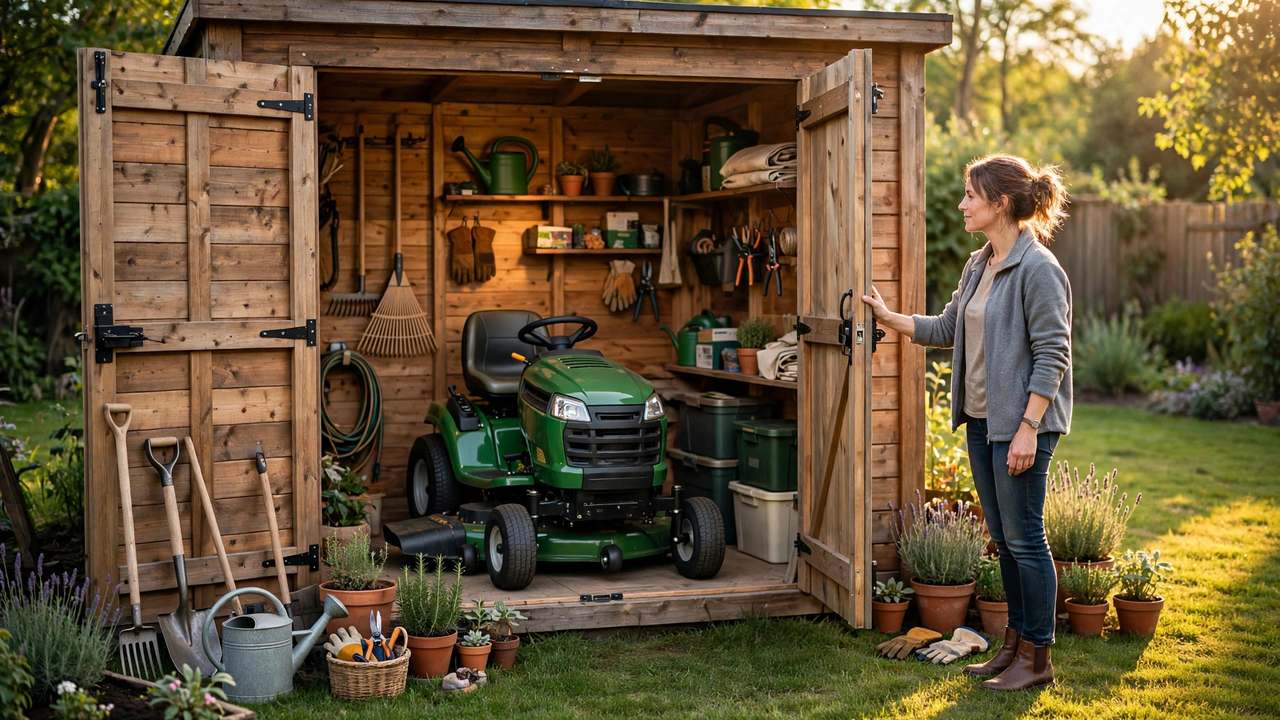
A riding lawn mower is usually the most expensive machine in the yard, and it is also the hardest to store well. It is wide, long and heavy, it carries a cutting deck that sticks out on both sides, and it needs to roll in and out without scraping a door frame or high-centering on a floor lip. A shed that looks big enough on a spec sheet can still fail at the doorway, and a shed with a wide doorway can still disappoint if the floor flexes under the machine or the interior leaves no room to walk around it. That is why choosing among the best storage sheds for riding lawn mowers starts with three measurements rather than a headline size: the clear door opening, the true interior length and width, and the strength of the floor the mower will park on every day.
This guide compares six sheds that are genuinely sized for a riding mower rather than a push mower and a few rakes. The group spans reinforced resin, high-density polyethylene and galvanized steel, footprints from a compact seven-foot square up to a ten-by-twelve, and door styles from wide hinged doubles to sliding steel panels. Every pick below is sold new on Amazon in the United States, and every specification is taken from the maker’s own listing or product documentation, phrased the way the maker lists it. Measure your mower first — overall width across the deck, overall length with any bagger fitted, and height to the top of the seat or steering wheel — then match those numbers against the door opening and interior dimensions of each shed before you fall for a footprint.
Quick verdict
For most owners, the Suncast Tremont 8 x 10 is the easiest recommendation: the maker lists a reinforced floor built for lawnmowers and small tractors, a wide double-door opening and more than five hundred cubic feet of walk-in room, so the mower parks in the middle and everything else arranges around it. The Lifetime 60005 and Lifetime 60371 are the strongest alternatives for buyers who want steel-reinforced polyethylene walls, heavy roof trusses and a slip-resistant floor that shrugs off oil drips. The Rubbermaid Easy Install 7 x 7 is the compact-yard answer, with doors that swing a full half circle so a smaller riding mower or lawn tractor can angle in without a fight. The Keter Newton Plus 7.5 x 11 suits snow country and anyone who wants a wood-look finish, while the Arrow Classic 10 x 12 is the big steel option for owners who also need workshop or seasonal storage space beside the mower.
The products in this guide
Suncast Tremont 8 x 10 Storage Shed
A capacity of 547 cubic feet, an exterior measuring 8 feet 4.5 inches wide by 10 feet 2.25 inches deep by 8 feet 7 inches high, and a double-door
We started with the mower, not the shed. A typical riding mower or lawn tractor needs a clear door opening wide enough for the cutting deck with room to spare on each side, an interior long enough for the machine plus a comfortable step-in zone, and headroom that clears the seat and steering column without ducking the machine under a low header. Any shed whose doorway, interior or floor could not plausibly handle that job was cut, however good it looked as general garden storage.
Next, every candidate had to be a real, current product sold new on Amazon in the United States, with its identity pinned to an exact brand and model number on an opened product page. Listings that showed no live offer for a new unit were excluded and replaced, because a shed you cannot actually buy is not a recommendation. Specifications in this guide come from the maker’s listing and documentation for that exact model — dimensions, capacities, door sizes, floor construction and warranty terms are reported as the maker lists them, and nothing has been borrowed from a sibling size in the same range.
Finally, we balanced the six survivors across the ways real yards differ. Some buyers need the strongest possible floor under a heavy zero-turn; others need the smallest footprint a building inspector or a tight side yard will allow; others again need roof strength for snow or steel walls for a workshop feel. The picks below are ordered by how completely they answer the core riding-mower brief, and each one names the buyer it fits and the buyer it does not, so you can shortlist honestly instead of forcing the wrong shed onto your site.
The Tremont is the rare resin shed that talks about riding mowers in its own specification rather than leaving you to guess. The maker lists a capacity of 547 cubic feet, an exterior measuring 8 feet 4.5 inches wide by 10 feet 2.25 inches deep by 8 feet 7 inches high, and a double-door opening of 60 inches wide by 72 inches high set into the eight-foot side, so the shed runs ten feet deep from the doorway. That depth matters: a riding mower rolls straight in, and there is still floor left behind and beside it for a trimmer, a fuel can stored safely away from heat, and the charger or battery tender the machine needs over winter.
The floor is the headline. The maker lists a reinforced resin floor built to support heavy loads such as lawnmowers and small tractors, which is exactly the duty cycle a riding mower imposes — the same four contact patches, loaded and unloaded hundreds of times a year, often with damp tires after a wet cut. The walls are multi-wall resin panels reinforced with steel, and the maker lists six skylights plus large door windows and vents, so the interior gets daylight and airflow instead of the dark, fume-heavy box that makes owners dread opening the doors in July. Two corner shelves are included for the small items that otherwise migrate onto the mower seat.
Assembly is a labeled, pre-cut kit that the maker describes as a minimal-tool build, and the resin shell needs no painting, sealing or rust treatment afterward. The maker lists a 10-year limited warranty. Two planning notes: the shed must sit on a proper, level foundation for its ratings to hold, and at roughly 384 pounds as listed, the delivered kit is a two-person handling job from the start.
Buy it if: you want the most complete riding-mower package in one kit — reinforced floor, wide doors, deep interior and daylight — and you have room for an eight-by-ten footprint.
Skip it if: your yard cannot give up a full eight-by-ten site, or your mower’s deck is so wide that even a 60-inch opening leaves no margin; measure the deck before you commit.
Lifetime builds this shed from high-density polyethylene panels in a double-wall system with steel supports, and the maker lists exterior dimensions of 120 inches long by 96 inches wide by 96 inches high, with an interior of 114 inches long by 89 inches wide and a height ranging from 71 to 95 inches under the pitched roof. Parked lengthwise, a riding mower takes the middle of that interior and leaves a genuine walkway — the difference between a shed you use daily and one you only open on mowing day.
The roof is a practical strength here: the maker lists heavy-duty steel trusses providing additional roof strength, which is the part of a shed that snow country and storm-prone regions should interrogate first. The floor is slip-resistant high-density polyethylene that the maker lists as protecting against oil, solvents and stains — a small sentence that matters a great deal under a machine that will eventually drip something. The doors are steel-reinforced and lockable, the exterior is UV-protected to help prevent fading and cracking, and the maker lists a customizable shelving and storage system, with windows and skylights bringing in light.
Because the ten-foot dimension is the length rather than the width, site planning differs from the Tremont: this shed suits a yard with a deeper, narrower slot along a fence line. The stain-resistant exterior never needs painting, in the maker’s words, so annual upkeep is a wash rather than a weekend project. As with every kit here, a flat, level foundation of wood or concrete is the assumed starting point, and the wide interior only stays wide if you discipline the shelving to the walls instead of letting boxes colonize the mower’s turning space.
Buy it if: you want steel-truss roof strength, an oil-resistant floor and real shelving organization around the mower, on a deeper and narrower site.
Skip it if: your available site is wider than it is deep, or you want the absolute widest door opening in this group; check the door clearance against your deck width first.
The 60371 is Lifetime’s other eight-by-ten answer, and it leans into light and air. The maker lists interior dimensions of 90 inches wide by 114 inches long, with interior height from 70 to 94 inches and 71.7 square feet of floor space. Into that footprint the maker lists four skylights, two screened vents and one shatter-proof window, so the shed stays bright enough to find a shear pin or a belt part number without a flashlight, and the screened vents move air while keeping pests out — a quiet virtue in a building that stores a fuel-powered machine.
Construction follows the family pattern: the maker lists a double-wall system of high-density polyethylene panels with steel wall supports, a high-pitched roof on heavy-duty steel trusses for quick drainage of rain and snow, and steel-reinforced lockable doors. The included floor is high-density polyethylene that the maker lists as slip resistant, with a beveled edge and resistance to oil and stains; that beveled edge is worth noticing, because the transition from ground to floor is where mower decks scrape and where front wheels hesitate. One height-adjustable wall shelf, listed at 8 by 90 inches, runs nearly the length of a wall — ideal for the long, awkward items like trimmer shafts and hedge tools that otherwise lean against the mower.
The maker is explicit that this shed must be assembled on a flat, level foundation of wood or concrete, so budget the base into the project rather than treating it as an afterthought. Set up that way, the 60371 is the choice for owners who will spend time inside the shed — servicing the mower, swapping blades, organizing the season’s tools — rather than simply parking and closing the doors.
Buy it if: you work on your mower inside the shed and want skylights, screened ventilation and a long adjustable shelf in an eight-by-ten footprint.
Skip it if: you cannot build the flat wood or concrete foundation the maker requires, or you need a larger margin around a particularly wide deck.
Not every riding mower lives on an acre. For a compact lawn tractor on a suburban lot, this seven-by-seven Rubbermaid is the space-efficient answer, and its party trick is access: the maker lists doors that open a full 180 degrees, folding back against the walls so the whole front of the shed becomes the doorway. That geometry lets you angle a smaller mower in and out without the three-point shuffle a narrow hinged door imposes, and it makes loading bulky extras — a bagger, a spreader, a cart — far less of a wrestling match.
The maker lists double-wall resin construction with robust wall-connector pins, and describes the design as delivering substantially more wall strength and a stronger roof than its earlier seven-by-seven models, with the roof listed as supporting snow loads up to 15 pounds per square foot. An integrated rain gutter manages runoff at the roof edge, a floor is included, and the shed is lockable, with the lock itself sold separately. The maker also lists increased ventilation over its earlier models, which helps a shed that will house a warm engine at the end of a mowing session.
Assembly is the other selling point: the maker lists a design with a third fewer parts than other seven-by-seven models, aimed squarely at owners who would rather spend the weekend mowing than building. Be honest about capacity, though — at seven feet square, the mower is the tenant and everything else is a guest. This shed fits a lawn tractor and a modest tool collection; it will not swallow a zero-turn, a snow blower and a patio set at once. Measure your machine’s length carefully, because the interior diagonal becomes your friend only if the doors can still close behind it.
Buy it if: your yard is tight, your machine is a compact lawn tractor, and the fold-back doors solve an awkward approach angle.
Skip it if: your mower is a wide-deck zero-turn or you expect the shed to double as general family storage; step up to an eight-by-ten instead.
The Newton Plus takes the long, narrow route to mower storage: the maker lists assembled dimensions of 137.7 inches deep by 90.5 inches wide by 96.8 inches high, so the shed reads as a seven-and-a-half-by-eleven building that tucks along a boundary while still swallowing a riding mower lengthwise with room to spare at the far end. That spare length is genuinely useful — it becomes the service bay, the fuel and battery corner, or the home for a second machine like a snow blower when the seasons trade places.
Keter builds the walls as an engineered double-wall construction with steel bar reinforcement, and the maker lists a snow load capacity of up to 30 PSF — the strongest roof claim in this group, and the reason this shed belongs on shortlists in lake-effect and mountain country. The finish is made to give the look and feel of natural wood without the maintenance, and the maker lists that the shed will not rust or rot. A skylight and window bring in daylight, built-in ventilation moves air, the walls are customizable for hooks and shelving layouts, and the double doors are lockable.
At a listed weight of about 491 pounds, this is a substantial kit that rewards a carefully prepared, level base and a patient two-person build. Before ordering, confirm the current kit contents for the floor arrangement and any anchoring hardware, since long resin sheds depend on their base for door alignment. Set up properly, the Newton Plus is the pick for owners who want the mower shed to look like a small garden building rather than a plastic box, and who need a roof specification that takes winter seriously.
Buy it if: snow load, a wood-look finish and extra length for a second machine or a service zone top your list.
Skip it if: your site is square rather than long, or you want the simplest possible assembly; the big Lifetime and Suncast kits go together with less fuss.
Sometimes the mower is only the anchor tenant. The Arrow Classic gives you the largest floor in this guide: the maker lists 115 square feet of floor space and 674 cubic feet of storage volume in a ten-by-twelve footprint, with assembled dimensions of 123.25 inches wide by 145.75 inches deep by 75.88 inches high. A riding mower parks on one side and still leaves a full bay for a workbench, seasonal furniture, bikes and the overflow that garages shed every spring.
The building is galvanized steel treated against rust and corrosion, finished with a hard-wearing Sherwin-Williams paint finish, in the maker’s listing. Walls are 65 inches tall with a low gable roof designed to reduce water pooling. Access is through padlockable double sliding doors on large glides, with a listed door opening of 55.5 inches wide by 63 inches high; sliding doors earn their keep where a hinged door’s swing would hit a fence, a slope or the mower itself, and they cannot be caught by the wind mid-entry. Check that 55.5-inch opening against your deck width with particular care — it is the tightest doorway in this group relative to the building’s size.
Two ownership realities come with steel. First, the maker lists the floor kit as a separate accessory, so the mower will park on your slab, deck or the optional kit rather than an included floor; plan the base as part of the purchase. Second, assembly is a pre-cut, pre-drilled, two-person project with many panels and fasteners — methodical rather than difficult, but not an afternoon’s casual work. In return, the maker lists a 12-year limited warranty, the longest coverage named here.
Buy it if: you want maximum floor area, steel construction and sliding doors, and you are happy to provide the floor or slab yourself.
Skip it if: your mower’s deck is close to the listed door width, or you want an included floor and the fastest possible build.
Buying guide
Measure the machine, then the doorway. The single most common shed mistake is buying by footprint. A riding mower’s cutting deck is wider than its body, and any bagger or collector adds length behind it. Record three numbers — width across the widest point of the deck, length from front tire to the back of any attachment you leave fitted, and height to the top of the seat back or steering wheel — then compare them with the shed’s listed door opening and interior dimensions, not its exterior. Leave a margin of a few inches on each side of the doorway; you will be driving through it at an angle, on damp grass, for years.
Interrogate the floor. A riding mower concentrates several hundred pounds onto four small tire patches, rolls that load across the floor on every entry, and occasionally drips oil or fuel. Look for a floor the maker explicitly describes as reinforced for mowers or heavy equipment, or a dense polyethylene floor listed as resistant to oil and stains. If a steel shed lists its floor kit separately, price the complete building — shed plus base — before comparing it with resin kits that include the floor. Whatever the material, the shed belongs on a flat, level foundation; an unlevel base shows up as doors that drift, bind or refuse to latch.
Match the roof to your sky. Roof construction decides how a shed ages in your climate. Steel trusses, reinforced bars and a stated snow-load figure matter where winters load the roof; a high-pitched or gabled profile sheds rain and snow faster everywhere. In hot regions, vents and skylights are not decoration — a sealed shed bakes its contents and turns fuel storage into a bad idea, so screened ventilation that moves air without admitting pests is a functional requirement, not a luxury.
Think about the approach, not just the parking spot. The best shed on paper fails if the mower cannot reach it. You need a route the machine can drive — no tight gate, no steep lip, no soft corner that ruts in spring — and a threshold transition gentle enough for the deck to clear. Hinged double doors need swing room in front of the shed; sliding doors need none but usually offer a narrower opening. Fold-back doors, like the Rubbermaid’s, are a clever middle path for tight aprons. Stand where the shed will go and mime the entry before you order.
Plan the interior around the mower. Reserve the center for the machine and its turning arc, then assign the walls: long tools on one side, the charger and battery gear near the door, seasonal items at the far end. Shelving and customizable walls pay for themselves immediately, because every box on the floor is a box in the mower’s path. Finally, lock it. A riding mower is a high-value, easily moved asset; a lockable door is the baseline, and anchoring the shed to its foundation protects both the building and everything inside it.
FAQ
What size shed do I need for a riding lawn mower?
For most lawn tractors and riding mowers, an eight-by-ten-foot shed is the comfortable minimum, giving the machine room to park with walking space around it. A seven-by-seven can work for a compact lawn tractor if the doors open wide and attachments are stored elsewhere, while a ten-by-twelve suits owners adding a workbench or a second machine. Always confirm the listed door opening against your deck width, since the doorway — not the footprint — is the usual limiting factor.
Will a riding mower fit through a shed’s double doors?
Usually, yes, provided the clear opening exceeds your deck width by a few inches. In this group, listed openings range from about 55.5 inches on the Arrow Classic to 60 inches on the Suncast Tremont. Measure your deck at its widest point, including any discharge chute you leave raised or lowered, and choose a shed whose listed opening beats that number with margin to spare for angled entries.
Does the shed floor need to be reinforced for a riding mower?
It is strongly preferable. A mower’s weight concentrates on four small contact patches and rolls across the floor on every use, so a floor the maker lists as reinforced for mowers or heavy equipment, or a dense polyethylene floor, will age far better than a thin panel. Steel sheds that list the floor kit separately expect the machine to park on your slab or deck instead, which is equally sound if the base is flat, level and well drained.
Can I store fuel in the same shed as my riding mower?
Only with ventilation and common sense. Choose a shed with vents or screened airflow, keep fuel in an approved sealed container away from the engine and any battery charger, and never refuel a hot machine inside the shed. If your shed has no ventilation, store fuel elsewhere; several picks in this guide list screened vents or built-in ventilation precisely because mower sheds house fuel-powered equipment.
Do I need a foundation or permit for a mower shed?
Most makers in this guide require or assume a flat, level foundation of wood or concrete for the shed’s dimensions, door alignment and ratings to hold, so treat the base as part of the project. Permit and setback rules vary by municipality and by shed size, and some areas treat larger footprints differently; check your local rules and any homeowners’ association requirements before the kit arrives, not after.
Resin, polyethylene or steel — which is best for mower storage?
Resin and high-density polyethylene sheds need almost no upkeep, will not rust or rot, and usually include the floor, which suits most mower owners. Steel sheds offer the largest footprints and a workshop feel, but typically list the floor separately and take longer to assemble. The right answer is the one whose door opening, floor arrangement and roof specification match your machine and your climate; material comes second to those three checks.
Conclusion
The right shed for a riding lawn mower is decided at the doorway and under the tires. Start with the Suncast Tremont if you want the most complete mower-first package, consider the two Lifetime models for trussed roofs, oil-resistant floors and serious interior light, and look at the Rubbermaid when the yard — not the mower — is the constraint. Choose the Keter Newton Plus for snow country and a longer service bay, or the Arrow Classic when the mower shares its home with half the garage. Measure the deck, confirm the opening, build the level base, and the machine that earns its keep all summer will finally have a home that fits it.
M
Modern Line Home Editorial Team
We compare specs, materials and verified owner reviews before a product earns a spot. Rankings are never paid.
Affiliate disclosure. As an Amazon Associate we earn from qualifying purchases at no extra cost to you. Prices accurate as of the date shown.
House cold even with the heat on? Walk this ordered checklist: thermostat and filter first, then drafts, insulation, leaky ducts and a failing heating system.
Windows fogging up in winter? Check where the fog sits: on the room side it is indoor humidity, outside it is harmless, and between panes the seal has failed.
Store the main firewood pile about 30 feet from your house, off the ground and covered only on top. Compare racks, woodsheds, garages and indoor spots safely.
Place a portable generator outdoors only, at least 20 feet from windows, doors and vents, exhaust pointed away. Exact distances, setup steps and CO rules here.
Keep houseplants in the right winter spot: match window direction to plant type, stay clear of radiators and cold glass, and fix dry air and low light at home.
Mice enter through pencil-width gaps at foundations, pipes, vents, doors and the roofline. Walk this room-by-room winter checklist to find and seal each one.
A winter outage timeline: what to do in the first hour, first night and multi-day outage, with food safety times, pipe protection, heat and CO safety steps.
Size a space heater by room area: 10 watts per square foot at 8-foot ceilings, adjusted for insulation and ceiling height, with full wattage and BTU tables.
Start dripping at about 20 degrees, sooner for exposed pipes. Set a pencil-lead stream, drip the right faucets on both lines, and know when to stop safely.
A fridge needs 800-1,200 starting watts, not just 150-400 running watts. Use the tables to total your fridge plus freezer, lights, furnace fan and more today.












Write Your Review
No reviews yet. Be the first to share your experience!