We independently review everything we recommend. When you buy through our links, we may earn a commission. As an Amazon Associate we earn from qualifying purchases.
Best Slippers for Rheumatoid Arthritis: 6 Easy Fits
Find the best slippers for rheumatoid arthritis with easy hook-and-loop straps, wide fits, soft uppers and cushioned soles that are simple to put on daily.
When your hands are stiff or sore in the morning, the hardest part of a slipper can be the slipper itself: a tight collar you have to pull, a narrow opening you have to push through, or a strap that needs two pinching fingers to fasten. That is why choosing the best slippers for rheumatoid arthritis is mostly a question of fit and fastening, not fashion. The pairs in this guide were picked for practical, everyday features: wide openings, large hook-and-loop straps that can be pressed closed with a palm rather than pinched, soft uppers that do not dig in, cushioned soles for hard floors, wide width options, and light builds that are easy to lift and carry.
A plain note before the picks: slippers are footwear, not a treatment. Nothing in this guide claims that a slipper can treat, relieve, or improve rheumatoid arthritis or any symptom of it, and no pair here should be read that way. Footwear choices sit alongside, never instead of, the guidance of your own clinician. If your clinician has advised a particular type of footwear, an insole, or an orthotic, follow that advice first and use this guide to compare the everyday comfort and fit features of pairs that fit within it.
Quick verdict
Start with the Orthofeet Charlotte if you want the most complete package: an adjustable strap, a wide toe box, and a removable insole in wide and extra-wide fits. Choose the Propét Cush ‘n Foot if the opening matters most, because the maker lists an extra-large opening with an extra-large strap over a stretch upper. The Silverts Adaptive Easy Close is the dressing-first option, with dual straps that open the shoe up wide. The Vionic Gemma II and Vionic Relax II are the plush mule options with a single adjustable strap each, while the Acorn Adjustable Spa Wrap is the softest, lightest wrap-style pair for shorter, gentler wear around the home.
The products in this guide
Orthofeet Charlotte Slippers
The Charlotte is the most shoe-like slipper in this guide, and that is its strength
Best if you want an adjustable strap, genuine width choice
Every pair in this guide had to pass the same practical tests on paper, based on the maker’s own listed features and the details shown on its Amazon listing. First, getting the slipper on had to be genuinely easy: a wide opening, a pull-on shape with room to slide in, or a large hook-and-loop strap that opens the upper up instead of asking the wearer to force a foot through a tight collar. Closures that need grip strength, such as small buttons, tight elastic laces, or narrow buckles, counted against a pair.
Second, the upper had to be soft and forgiving. Stiff, narrow uppers concentrate pressure on one spot; soft fabrics, stretch panels, faux fur, terry, and plush linings spread contact more evenly and are kinder to wear with socks or without. Third, width choice mattered: pairs offered in wide or extra-wide fits, or with straps that let the fit change through the day, ranked above one-width pairs. Fourth, the sole had to offer real cushioning and a treaded outsole, because most home wear happens on hard kitchen, bathroom, and hallway floors. Finally, weight mattered: a light slipper is easier to lift, carry upstairs, and pack, and it asks less of tired legs at the end of the day.
Just as importantly, each pair had to be a real, current product with its features stated by its maker. Where a feature is described below, it is phrased as the maker lists it, and readers should check the current listing for sizes, widths, and colours before ordering, because ranges change. Pairs whose listings showed no live offer, or whose features could not be confirmed on an opened page, were left out entirely rather than described from guesswork.
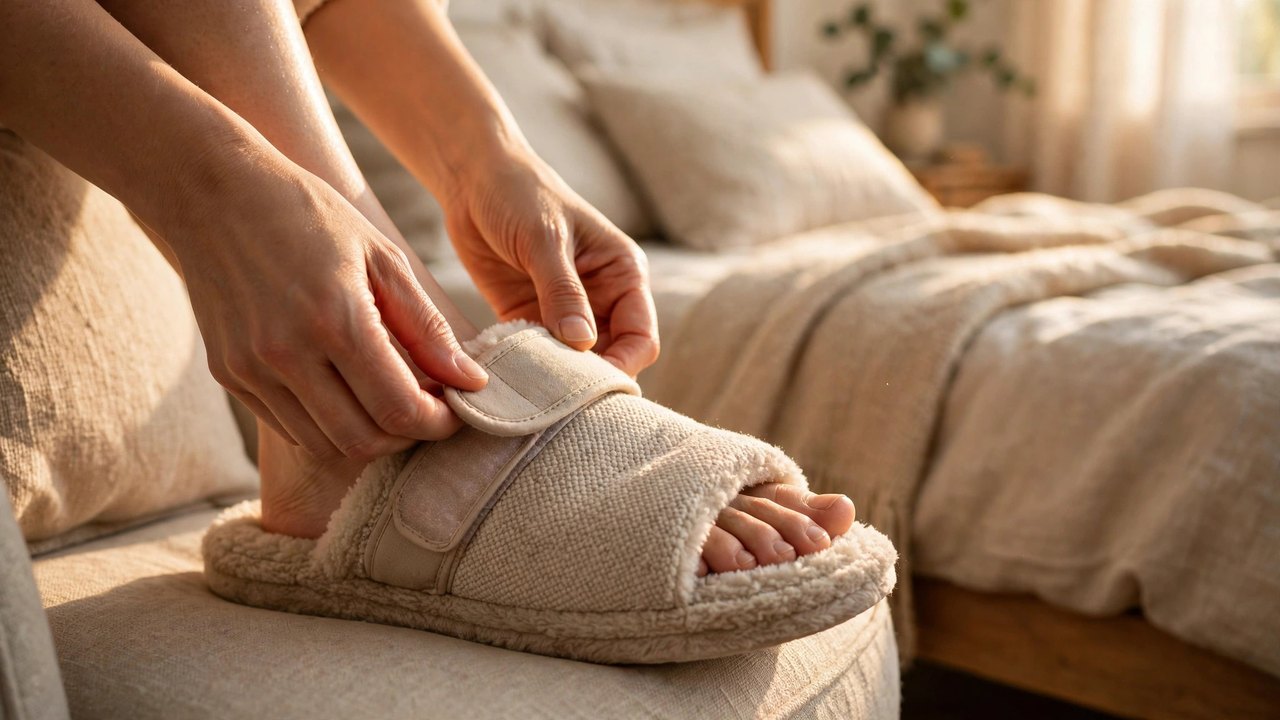
The Charlotte is the most shoe-like slipper in this guide, and that is its strength. The maker lists a faux fur lined upper with an adjustable strap, a wide toe box, and a removable orthotic insole, in medium, wide, and extra-wide widths. The strap is the headline feature for this audience: instead of pulling a tight collar over the heel, you open the strap, place the foot in, and press the strap closed. That sequence can be done with a flat palm and does not depend on pinch strength or on bending a small fastener into place.
The removable insole adds flexibility that the other pairs here mostly do not offer. If your clinician has suggested a particular insert, or you already use one, the maker lists the insole as removable to accommodate custom orthotics. The wide toe box leaves room for toes to sit naturally rather than squeezed, and the faux fur lining keeps the inside soft against bare feet. The maker lists a synthetic sole, so the pair handles trips across a kitchen or onto a porch better than a purely fabric-soled slipper would.
There are trade-offs. The faux fur lining that makes the Charlotte cosy in winter can feel warm in a heated home or a summer climate. It is also a structured slipper rather than a featherweight one, so if you want the lightest possible pair for travel, look further down this list. Sizing deserves care: with three widths on offer, measuring your foot and matching it to the maker’s size chart is worth the two minutes it takes.
Buy it if: you want an adjustable strap, genuine width choice, and a removable insole in one pair, and you mostly wear your slippers on hard floors through the colder months.
Skip it if: you run warm and want a breathable, open pair, or you want the lightest slipper you can find.
The Cush ‘n Foot, model W0206 in the women’s version, is built around one idea: the opening should do the work, not your hands. The maker lists a soft, accommodating neoprene and stretchable corduroy upper with an extra-large opening and a secure hook-and-loop closure, and describes getting the slipper on and off as super easy. A strap that large can be gripped across its whole width or pressed down with the heel of a hand, which is a meaningful difference on mornings when fine finger movements are the slowest part of getting dressed.
The stretch in the upper matters too. Rather than a fixed shape the foot must conform to, the maker lists stretchable panels that give as the foot slides in and as its shape changes through the day. The maker lists a removable footbed, so the pair can accommodate a custom orthotic if that is part of your clinician’s advice, and the style is offered in a wide range of sizes and widths, including extra-wide fits. The maker also lists this style as Medicare coded A5500; that is a listing detail about the product’s coding, stated here as the maker lists it, and it is not a claim about what the slipper does for any condition.
The Cush ‘n Foot looks more like a recovery shoe than a lounge slipper, and its soft, stretchy build gives a less structured feel than the Charlotte. If you like a firm, held feeling around the foot, this may feel too relaxed. If, on the other hand, the daily battle is simply getting a slipper on without a struggle, this is the pair designed most directly around that moment.
Buy it if: the opening and the strap are your top priorities, you want a stretch upper, or you need room for an orthotic.
Skip it if: you want a firm, structured slipper or a dressier lounge look.
Silverts is an adaptive clothing maker, and this slipper shows it. The maker lists dual easy-close straps that fully open, so the slipper can be laid open, the foot placed in from above, and the straps closed over the top. That open-up design is the easiest dressing sequence in this guide: there is no collar to pull, no heel to push past, and no need to bend and tug at the same time. It is also the design that works best when someone else is helping, because the helper can see and reach everything.
The maker lists an adjustable fit that runs from regular to extra-wide, intended to accommodate swelling and sensitive feet, plus a slip-resistant sole and a lightweight build. Because the fit is set by two straps rather than one, you can close the front strap and the rear strap differently, which helps when the front and back of the foot need different amounts of room. The maker lists these as suitable for indoor and outdoor surfaces, so a trip to the mailbox does not require a shoe change.
Two practical notes from the maker: the style runs large, so consider sizing down if you are between sizes, and the open sandal-style shape gives less warmth and coverage than a closed slipper. In a cold house in winter, that openness is a real drawback; in a warm house, or for wear with thick socks, it can be a plus. This is a function-first pair, and it makes no attempt to look like anything else.
Buy it if: you want the easiest possible dressing sequence, a fit that adjusts at two points, or a pair a caregiver can help with.
Skip it if: you want a warm, closed slipper for cold floors, or a snug fit without sizing down.
The Gemma II is a plush mule with one well-placed adjustment: the maker lists an adjustable hook-and-loop closure across the top, so a slip-on shape gains the fit control that most mules lack. You slide the foot in, then set the strap once to your preferred snugness; on most days after that, it behaves like a simple slip-on, and on days when your feet feel different, the strap moves with them. That set-and-forget quality suits anyone who does not want to fasten something fiddly every single time.
The maker lists uppers in faux-shearling, wool, or flannel, a flexible EVA midsole, a durable synthetic outsole for indoor and outdoor use, and a built-in footbed with contoured arch support and a deep heel cup, with a heel height the maker lists at 1.4 inches. The maker also lists the style as having received the APMA Seal of Acceptance. The mule shape keeps the heel open, which makes the pair easy to step into hands-free, and the plush upper keeps the top of the foot warm.
The open heel is also the limitation: a mule can slide on stairs or when you hurry, and it offers no heel hold for anyone who feels unsteady in backless footwear. The raised heel height will not suit readers whose clinician has advised flat footwear. Treat this as a comfortable, adjustable lounge pair for level floors, worn at a relaxed pace.
Buy it if: you want a plush slip-on you can step into, with a strap you set once and adjust only when you need to.
Skip it if: you need a closed heel for stairs or stability, or you have been advised to wear flat footwear.
The Spa Wrap takes the wrap idea literally: a soft terry upper that wraps across the foot and fastens with a hook-and-loop strap. The maker lists a soft terry cloth fabric inside and out, a contoured footbed, and an adjustable strap for a custom fit, plus an elastic band at the heel that helps hold the slipper on. Terry is one of the gentlest upper materials in this guide against skin, and the wrap shape means the opening is as wide as you choose to make it before you close it.
This is the pair that feels most like loungewear and least like a shoe. The maker lists the style as machine washable, which is a genuine everyday advantage: a washable slipper is easier to keep fresh when it is worn all day, every day. The maker lists a durable rubber sole with tread, suitable for indoor wear and brief outdoor steps. Because the upper is fabric and the build is soft, the whole pair is light and packs flat, which also makes it a sensible second pair for travel or for keeping by a chair.
The softness cuts both ways. A terry wrap offers less structure and less underfoot firmness than the Orthofeet or Vionic pairs, and the heel elastic that keeps it on can be felt at the back of the heel, which some wearers dislike. Readers who spend long stretches standing on hard floors will likely prefer a more cushioned, structured sole; readers who mostly sit, elevate their feet, and shuffle short distances may prefer exactly this softness.
Buy it if: you want the softest upper, a washable pair, and a light slipper for mostly seated, gentle wear.
Skip it if: you stand for long periods on hard floors or dislike any pressure from a heel elastic.
The Relax II updates Vionic’s Relax design with an adjustable cross strap. The maker lists faux-fur or faux-shearling uppers, an adjustable hook-and-loop strap, a plush padded footbed, a flexible EVA midsole, and a durable synthetic outsole for indoor and outdoor use, with a heel height the maker lists at 1.4 inches and a built-in footbed with contoured arch support and a deep heel cup. The cross-strap layout spreads the fastening across a wider area of the top of the foot than a single narrow strap, so closing it is a broad press rather than a precise pinch.
Compared with the Gemma II, the Relax II has a more open, slide-like feel and a strap position that sits further forward. Which you prefer depends on where you like to feel a slipper hold: the Gemma II closes over the midfoot in a mule shape, while the Relax II reads as a padded slide with adjustment. Both share the same maker-listed footbed approach and the same listed heel height, so the choice between them is about upper style and warmth, not about a different sole.
As with the Gemma II, the open back and the listed heel height are the cautions: this is a pair for level indoor floors and unhurried movement, and it is not the choice for anyone advised to wear flat, closed-heel footwear. Within those limits, it is a soft, easy pair whose strap makes the fit forgiving from one day to the next.
Buy it if: you prefer an open slide shape with a wide cross strap and a padded, plush footbed.
Skip it if: you need a closed heel, a flat sole, or maximum warmth around the heel.
Buying guide
Start with the closure. For hands that cannot pinch or grip reliably, the closure is the whole ballgame. Large hook-and-loop straps are the easiest fastening in footwear: they open wide, they close with pressure from a palm or the side of a hand, and they can be re-set in seconds. Dual straps, as on the Silverts pair, give the most control. A single wide strap, as on the other pairs here, is nearly as easy and looks more like an ordinary slipper. Avoid small buckles, buttons, and tight lace or toggle systems, and be wary of very snug elastic collars that must be pulled open with both hands.
Match the opening to your routine. A slipper that opens fully and lets you place your foot in from above is the easiest to manage seated, and the easiest for a helper. A mule or slide is the easiest to step into standing, but holds the heel least securely. A closed slipper with a strap, like the Charlotte or the Cush ‘n Foot, sits between the two: a little more effort than a mule, much more hold once it is on. Think about where you will actually put your slippers on, in bed, on a chair, or standing at a door, and choose the shape that suits that moment.
Take width seriously. Feet change shape across a day and across a season. A pair offered in wide and extra-wide widths, or with a strap that effectively changes the width, gives you room to adapt instead of enduring a fit that was only right at breakfast. Measure both feet later in the day, when they are at their largest, and use the maker’s own size chart for the specific model, because sizing is not consistent between brands, and at least one maker in this guide states plainly that its style runs large.
Check the sole, not just the softness. A slipper can feel wonderful in the hand and still be a poor choice for a hard kitchen floor. Look for a cushioned footbed with some structure, a treaded outsole rather than a smooth fabric bottom, and a sole that flexes at the front rather than folding in the middle. If you step outside in your slippers, even briefly, a rubber or synthetic outsole matters. If your clinician has advised a particular heel height or a flat shoe, treat that advice as a filter before any of the preferences above.
Think about warmth, washing, and weight. Faux fur and shearling-style linings are cosy but warm; terry breathes better and, on the Acorn pair, can go in the wash. A washable pair is easier to live with as an everyday staple. Weight is easy to overlook in a product photo and impossible to overlook on your feet at the end of the day, so favour lighter builds if you will wear the pair for hours. Finally, buy from a listing with a clear returns route, try the pair indoors on clean floors first, and keep the packaging until the fit is proven over a full day, not just a first step.
Keep footwear in its place. Comfortable, easy footwear can make daily routines simpler and more pleasant, and that is a worthwhile goal in itself. It does not change the course of a medical condition, and it is not a substitute for medical care. Keep following your clinician’s guidance on footwear, insoles, and activity, and raise any new foot problems, skin breaks, or changes in sensation with them promptly rather than trying to solve them with a different slipper.
FAQ
What type of slipper closure is easiest if I cannot grip well?
A large hook-and-loop strap is generally the easiest, because it opens the upper wide and closes with palm pressure rather than a pinch. Dual straps give the most adjustment, while a single wide strap is simpler and quicker for daily use.
Should I choose a wide width even if I do not usually wear wide shoes?
Consider it if your feet change shape during the day or you wear thick socks at home. An adjustable strap over a standard width can also work. Measure later in the day and follow the specific maker’s size chart, since at least one style in this guide is listed by its maker as running large.
Are backless mules and slides a good choice?
They are the easiest to step into and work well on level floors at a relaxed pace. They hold the heel least securely, though, so a closed-heel or strap-backed pair is the more careful choice for stairs, uneven floors, or anyone who feels unsteady in backless footwear.
Can I use my own insole or orthotic in these slippers?
Two pairs in this guide, the Orthofeet Charlotte and the Propét Cush ‘n Foot, list removable insoles or footbeds, which is the feature to look for if you use an insert. Check the depth of the slipper with your insert fitted, and follow your clinician’s advice about using it.
Do these slippers help with rheumatoid arthritis?
No slipper treats or improves a medical condition, and none is presented that way here. These pairs were selected for everyday comfort and fit features, including easy closures, soft uppers, cushioned soles, and wide fits. For anything beyond footwear comfort, follow your clinician’s guidance.
How should I care for plush or terry slippers?
Follow the maker’s care instructions for the specific model. The Acorn Spa Wrap is listed by its maker as machine washable. For lined pairs that are not washable, airing them out, rotating with a second pair, and keeping them dry will help them stay fresh.
Conclusion
The right pair here is the one that removes friction from an ordinary routine: it opens wide, fastens without a pinch, feels soft against the foot, cushions a hard floor, and fits the same in the evening as it did in the morning. The Orthofeet Charlotte is the most complete all-rounder, the Propét Cush ‘n Foot and the Silverts Adaptive Easy Close put dressing ease first, the Vionic Gemma II and Relax II offer plush adjustable mules and slides, and the Acorn Spa Wrap is the soft, washable lightweight. Choose by closure first, width second, and sole third, keep your clinician’s advice ahead of any product claim, and let comfort, not promises, make the decision.
M
Modern Line Home Editorial Team
We compare specs, materials and verified owner reviews before a product earns a spot. Rankings are never paid.
Affiliate disclosure. As an Amazon Associate we earn from qualifying purchases at no extra cost to you. Prices accurate as of the date shown.
House cold even with the heat on? Walk this ordered checklist: thermostat and filter first, then drafts, insulation, leaky ducts and a failing heating system.
Windows fogging up in winter? Check where the fog sits: on the room side it is indoor humidity, outside it is harmless, and between panes the seal has failed.
Store the main firewood pile about 30 feet from your house, off the ground and covered only on top. Compare racks, woodsheds, garages and indoor spots safely.
Place a portable generator outdoors only, at least 20 feet from windows, doors and vents, exhaust pointed away. Exact distances, setup steps and CO rules here.
Keep houseplants in the right winter spot: match window direction to plant type, stay clear of radiators and cold glass, and fix dry air and low light at home.
Mice enter through pencil-width gaps at foundations, pipes, vents, doors and the roofline. Walk this room-by-room winter checklist to find and seal each one.
A winter outage timeline: what to do in the first hour, first night and multi-day outage, with food safety times, pipe protection, heat and CO safety steps.
Size a space heater by room area: 10 watts per square foot at 8-foot ceilings, adjusted for insulation and ceiling height, with full wattage and BTU tables.
Start dripping at about 20 degrees, sooner for exposed pipes. Set a pencil-lead stream, drip the right faucets on both lines, and know when to stop safely.
A fridge needs 800-1,200 starting watts, not just 150-400 running watts. Use the tables to total your fridge plus freezer, lights, furnace fan and more today.












Write Your Review
No reviews yet. Be the first to share your experience!