We independently review everything we recommend. When you buy through our links, we may earn a commission. As an Amazon Associate we earn from qualifying purchases.
Best Slim Panel Heaters for Small Apartments (2026)
Compare the best slim panel heaters for apartments with limited floor space, from low-watt wall panels to smart 1500W models, with mounting and safety checks.
Compare the best slim panel heaters for apartments with limited floor space, from low-watt wall panels to smart 1500W models, with mounting and safety checks.
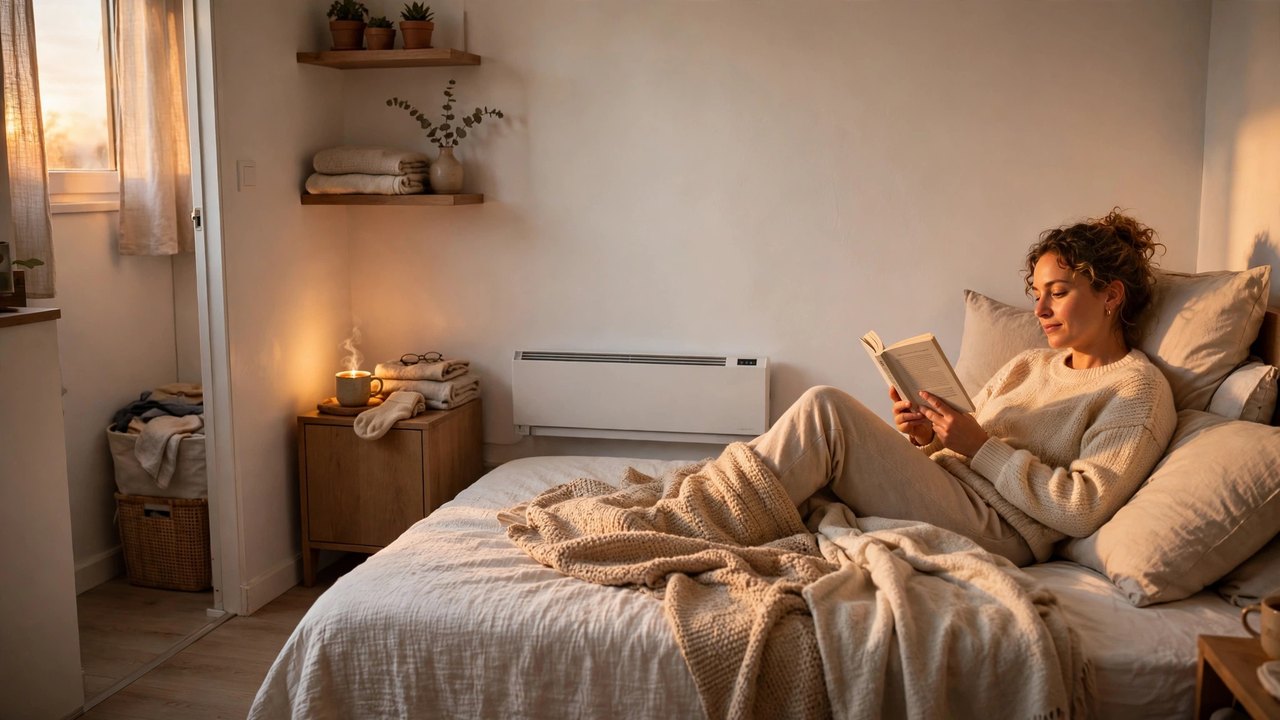
Apartment heating has a geometry problem before it has a temperature problem. The room that feels coldest is usually the room with the least spare floor: a studio where the bed, desk and sofa already negotiate every square foot, a narrow bedroom where a tower heater would block the closet door, or a living room where the only free corner is already doing duty as a walkway. A bulky fan heater or an oil-filled radiator solves the cold and creates a new obstacle. A slim panel heater takes the opposite approach. It spreads its heating surface across a wide, flat panel only a few inches deep, so it can hang on a wall like a picture frame or stand on low feet in the shallow strip of floor along a wall, and the room keeps its usable shape.
This guide compares the best slim panel heaters for apartments with limited floor space, chosen for renters and small-home owners who need real warmth without surrendering floor area. The six picks below split into two families. The first is the true flat panel: fanless convection panels from Envi and EconoHome that mount on the wall, draw between 250 and 500 watts, and are sized by their makers for single small rooms. The second family is the slim convector: taller, still-narrow panels from De’Longhi, Heat Storm and Ballu that run at up to 1,500 watts, stand on feet or casters or hang on a bracket, and are rated by their makers for larger rooms. Every product here was checked on its maker’s listing and its Amazon product page for the details that matter in a small apartment: how it mounts, whether feet or a stand are included, what safety certification and shut-off features the maker lists, and the room-size coverage the maker claims.
One boundary runs through the whole guide. Panel heaters are space heaters, and space heaters demand respect for clearance and supervision. Nothing in this article recommends or implies running any heater while you sleep, placing one against bedding, or treating a low surface temperature as permission to ignore the manual. Where a maker lists a safety feature, we report exactly that feature, in the maker’s terms, and nothing beyond it.
Quick verdict
If your apartment room is small and your lease allows a few screw holes, start with the Envi LE5012P: a two-inch-thick, fanless wall panel that draws only 500 watts, carries a wall-sense sensor that cuts power if the panel is pulled off its mount, and is rated by its maker for rooms up to 150 square feet. If you want the thinnest panel in the group and a paintable finish that disappears into a rental wall, the EconoHome 400-watt panel is a quarter-inch-thick calcium silicate board rated for 120 square feet, with a plug-in thermostat in the box; its smaller 250-watt sibling suits a bathroom or a tiny den of about 100 square feet and carries an IP44 splash-proof rating from the maker. If one slim unit has to heat a bigger living room, the De’Longhi SlimStyle HCX9115E and the Ballu Convection Smart both run at 1,500 watts, stand on feet or casters and wall-mount with included hardware, and add digital thermostats and timers. The Heat Storm HS-1500-PHX-WIFI is the connected pick: a wall-only infrared panel with Wi-Fi control, a touchscreen thermostat and a cord that hides inside the unit when it is mounted over the outlet.
The products in this guide
Envi Plug-in Electric Panel Wall Heater LE5012P
The Envi is the panel that defines this category for apartment use
Best when your room is at or under the maker’s 150-square-foot rating
Freestanding on casters, or wall mount with included hardware
1,500 watts
250 sq ft primary, over 500 sq ft supplemental
Tip-over and overheat protection per maker; V0 flame-retardant cord
How we selected
We started with the constraint in the keyword itself: limited floor space. A pick only qualified if its heating body is a slim panel, meaning a wide, flat unit whose depth is a small fraction of its width, and if it can either hang on a wall or stand in the shallow band of floor along one. Conventional tower fans, oil radiators on deep frames and cube heaters were excluded even when their listings mention small rooms, because they spend floor area the way this buyer cannot afford to spend it.
Next, every candidate had to be a real, current product sold new on Amazon US, verified on its opened product page, with a live offer at the time of checking. We then read the maker’s own listing for the four facts this category lives or dies by. First, mounting: does the panel wall-mount, and if it also stands, are the feet, casters or stand included in the box or sold separately. Second, safety certification: we recorded the exact mark or standard the maker lists, whether that is a cETL approval, conformity to UL and CSA standards, or an ETL Intertek certification, and we did not upgrade any claim beyond the maker’s wording. Third, shut-off behaviour: overheat protection, thermal shutoff, tip-over switches and, in the Envi’s case, a wall-sense sensor are reported per model, because they differ. Fourth, room-size coverage, always in the maker’s own figure and always labelled as such, because a 250-watt panel and a 1,500-watt convector are honest tools for very different rooms.
Finally, we weighted apartment practicality. Renters need plug-in installation and minimal wall damage, so hardwired-only panels were passed over, and the two EconoHome panels are included with their hardwiring option stated plainly rather than hidden. Noise mattered because small apartments put the heater in the same room as the desk and the sofa, which is why four of the six picks are fanless. Circuit load mattered too: a 500-watt panel drawing a little over four amps leaves an older apartment circuit far more headroom than a 1,500-watt unit drawing twelve and a half amps, and both figures are listed per product so you can plan around your breakers.
The Envi is the panel that defines this category for apartment use. The maker lists it at just two inches thick, in a body roughly nineteen inches wide and twenty-two inches tall that weighs about ten pounds, and it is wall-mount only: there are no feet and no stand, because the design assumes the wall does the work and the floor stays completely clear. It plugs into a standard outlet, installs with the included mounting kit and a screwdriver, and the maker describes a two-minute install with no drill or contractor needed. For a renter measuring a narrow strip of wall between a door frame and a window, that shallow profile is the entire point.
Heat comes from what the maker calls Stack Convection: cold air enters at the base, warms as it rises through the panel and leaves at the top, with no fan at all. The maker lists 500 watts of output at 120 volts and 4.17 amps, and rates the panel for rooms up to 150 square feet. That low draw is a genuine apartment advantage. Older buildings often put a whole room, or two, on one fifteen-amp circuit, and a heater that sips a little over four amps can share that circuit with a lamp, a laptop and a television in a way a full-power heater cannot. The trade-off is speed and ceiling: 500 watts maintains comfort in a small, reasonably insulated room, and the maker positions it as targeted, continuous background heat rather than a blast heater for a freezing space.
On safety, we report only what the maker lists. The listing states that the panel surface operates at a cool 90 degrees Fahrenheit, that a Wall-Sense safety sensor cuts power if the heater is removed or knocked off the wall, and that the Amazon listing’s feature set includes overheat protection. The maker also states that the Envi conforms to UL and CSA safety standards. A built-in thermostat controls temperature, the power light auto-dims, and the maker backs the unit with a three-year warranty and makes it in the USA. None of that changes the standing rule for any space heater: mount it exactly as the manual directs, keep the clearances the manual specifies, and keep soft furnishings and bedding away from it.
Buy it if: your room is at or under the maker’s 150-square-foot rating, you can put a few screws in the wall, and you want silent, low-draw background heat that uses zero floor space.
Skip it if: you cannot mount anything on the wall, you need a heater that also stands on the floor, or your room is large and draughty enough that a 500-watt panel would run flat out and still feel weak.
If the Envi is slim, the EconoHome 400-watt panel is nearly two-dimensional. The maker lists the panel at 23.5 by 23.5 inches and a quarter of an inch thick, a flat calcium silicate board that mounts on the wall with the included hardware and a heat reflector sheet that fits behind it. The finish is paintable, which is a small thing that matters a lot in a rented apartment: painted to match the wall, the panel reads as part of the room rather than an appliance parked in it. There are no feet and no floor stand; this is a wall panel in the strictest sense, and the floor beneath it stays entirely usable.
The maker lists 400 watts at 120 volts and 3.33 amps, and rates the panel for a room up to 120 square feet. Temperature is set on the included plug-in thermostat, with a range the maker lists as 41 to 86 degrees Fahrenheit. Like the Envi, this is a fanless convection panel, so it runs silently and does not blow dust around the room. One installation fact needs to be said plainly, because the maker says it plainly: this unit may be hardwired. The listing includes a plug-in thermostat and mounting hardware, but if your situation requires a hardwired connection, that is electrician territory, and renters should confirm both the connection method and their landlord’s position before ordering.
For safety and construction, the maker lists cETL approval and compliance with the UL-2021 standard and RoHS, plus overheat protection. The current version is described as triple reinforced and triple insulated, built from crack-resistant calcium silicate, and the maker offers a three-year warranty. The maker also notes the exterior casing feels warm in use and describes the panel as safe for adults only, which is worth repeating here without softening: a warm panel is still a heater, it belongs on the wall with its clearances respected, and it is not a surface to lean cushions, laundry or bedding against.
Buy it if: you want the flattest possible wall panel for a room at or under the maker’s 120-square-foot rating, you like the paintable finish, and the plug-in thermostat arrangement suits your outlet layout.
Skip it if: you need any kind of floor-standing option, your room is bigger than the maker’s rating, or the possibility of hardwiring is a problem for your lease or your skills.
The 250-watt EconoHome is the specialist of the group: a smaller panel, listed by the maker at 24 by 18 inches and 0.40 inches thick, built for the smallest heated spaces in an apartment. The maker rates it for a room of about 100 square feet and specifically names the bathroom among its settings, supported by an IP44 splash-proof rating in the maker’s listing, with the maker’s own instruction that the unit should sit twelve inches away from water. In a small apartment bathroom with no central heat vent, or in a tiny den or entryway that the building’s radiators never quite reach, a dedicated low-watt panel like this is often a better fit than borrowing heat from a big unit in another room.
The numbers are modest on purpose. The maker lists 250 watts at 120 volts and just 2.08 amps, the lowest draw in this guide, controlled by a thermostat with a listed range of 41 to 86 degrees Fahrenheit. At that draw, the panel is a background comfort device: it takes the chill off a small, enclosed space and holds it, rather than reheating a cold room quickly. It shares the family construction, a crack-resistant calcium silicate panel that is triple reinforced and triple insulated per the maker, with mounting hardware and a heat reflector included, a paintable surface, and silent fanless convection. As with its 400-watt sibling, the maker notes the unit may be hardwired, so check the connection requirements for the exact version before you plan the install.
The maker’s safety listing for this model includes cETL approval and compliance with UL-2021 and RoHS. We found no separate tip-over claim for this wall panel, which is expected: tip-over switches belong to heaters that stand on floors, and a screwed-to-the-wall panel addresses the same risk by being fixed in place. Follow the maker’s placement rules, including that twelve-inch distance from water, and treat the IP44 rating as splash resistance for a bathroom wall, never as permission to mount the panel where it can be soaked.
Buy it if: the cold spot is a bathroom, entryway or small den at or under the maker’s 100-square-foot rating, and you want the lowest possible circuit draw in a silent wall panel.
Skip it if: the room is a bedroom or living space of any real size, since 250 watts is a background heat level, or if you need a freestanding heater you can move between rooms.
The De’Longhi SlimStyle answers the renter’s dilemma directly: what if you want a slim panel but cannot, or will not, put screws in the wall. The maker lists both paths in the box. The feet come pre-assembled, so the panel stands on the floor in a slim footprint along a wall, and a wall-mount kit is included for the day you have a wall you are allowed to use. That dual arrangement is the most flexible mounting story in this guide, and it makes the SlimStyle the natural pick for a first apartment where the heater may move rooms, or move homes, within the year.
It is also a different class of heater from the flat panels above. The maker lists 1,500 watts of output and rates this asphalt gray version for coverage up to 300 square feet, with a dual lateral fan system that pushes warmed air out sideways to distribute it faster than passive convection alone. Digital controls, an adjustable thermostat, a delayed on and off 24-hour timer and multiple heat settings are all on the panel, and the maker’s ECO PLUS function automatically adjusts heat and power settings to hold comfort with less waste. The fan means this is the one pick here that is not silent, and the 1,500-watt draw, twelve and a half amps at full power, means it wants a circuit that is not already busy. In exchange, it is the pick that can take a cold living room from chilly to comfortable as the main event, not as background support.
The maker’s listed safety features are a thermal shutoff to prevent overheating and an internal tip-over switch that turns the unit off if it falls over, the second of which matters precisely because this heater can stand on feet. The controls are cool touch per the maker, so adjusting or relocating the unit is more comfortable. We did not find a UL or ETL mark stated on the opened listing for this model, so we make no certification claim for it here; what we can say is limited to the shut-off features the maker itself lists. As with every pick, keep the front and sides clear, never drape anything over a convector, and give a fan-assisted unit the open air its vents are designed around.
Buy it if: you want one slim heater that can stand on pre-assembled feet today and wall-mount later, and your room is large enough to need the maker’s 300-square-foot rating and a fan’s faster warm-up.
Skip it if: absolute silence is non-negotiable, your circuit is already loaded, or a two-inch wall panel would solve your room at a third of the power draw.
The Heat Storm takes the wall-only idea and adds the two things the flat panels lack: full 1,500-watt power and connected controls. It is an infrared panel that mounts on the wall and only on the wall; the maker is explicit that feet are not included with this Wi-Fi version, so floor-standing is not an option and your wall has to commit. In return, the installation has one elegant trick for small apartments: mount the unit over the outlet and the cord hides inside the heater, so there is no cable trailing down the wall to a socket, which keeps both the look and the walkway clean.
The maker lists three power modes: full power at 1,500 watts, half power at 750 watts, and an Eco mode that switches between the two automatically, delivering 5,200 BTU of infrared heat. Coverage is listed as up to 150 square feet as a primary heat source in a well-insulated room, and up to 750 square feet as a supplemental source. Control is the headline: Wi-Fi connectivity lets you run the heater from a phone app, a touchscreen with a digital thermostat sits on the unit, and a remote is included. For an apartment dweller, the practical use of that app is scheduling and adjusting the room you are in without crossing it, and checking the heater’s status from the sofa. The maker also lists washable lifetime filters and a one-year warranty.
On safety, the maker’s materials describe the design as certified by ETL Intertek, and retail listings for the model record a cETLus safety listing. The maker lists a tip-over safety shut-off, a child lock, an internal thermostat for overheat protection, and a grill that stays safe to touch. The manual’s clearance instruction deserves repeating in full because it is the rule for every heater in this guide: keep combustible materials such as furniture, pillows, bedding, papers, clothes and curtains at least three feet from the front of the heater and away from the sides and rear, and plug the heater directly into a wall outlet, never through an extension cord or power strip.
Buy it if: you want wall-mounted infrared heat with app and remote control, your room fits the maker’s 150-square-foot primary rating, and the hidden-cord installation over an outlet suits your layout.
Skip it if: you need any floor-standing option, you do not want another app-connected appliance, or your wall has no outlet position that works for the over-outlet mounting trick.
The Ballu is the big-room convection panel that refuses to behave like a radiator. Its heating core is what the maker calls a Hedgehog Heating Element, an all-aluminum element with a listed 36 percent larger air-contact surface, inside an all-metal body. The maker says warmth begins in as little as thirty seconds and circulates by natural convection, with no fan and no blowing air. Crucially for this guide, the mounting is genuinely dual: the panel stands freestanding on portable casters, so it rolls along a wall rather than squatting in the middle of the floor, and it wall-mounts with included hardware when you want the floor back entirely. Few heaters in this size class offer both without extra purchases.
The maker lists 1,500 watts at 120 volts and 12.5 amps, rates the panel as a primary heat source for rooms up to 250 square feet, and as supplemental heat for spaces over 500 square feet. The thermostat range is listed as 40 to 86 degrees Fahrenheit, with a programmable thermostat, a 24-hour timer, and three ways to drive it: the digital panel on the unit, the included remote, and an app with Alexa voice control. An exposed temperature sensor feeds the thermostat so the panel responds to the room rather than to its own housing. The maker backs it with a two-year warranty. In a studio apartment, that combination, casters for today, wall bracket for later, app control from the bed-side chair, is about as adaptable as a slim heater gets, provided it is used while you are awake and present, as any space heater should be.
The maker’s listed safety set is tip-over protection, overheat protection and a V0-rated flame-retardant power cord, with the all-metal body and flame-resistant construction also named in the listing’s feature set. We did not find a UL or ETL certification stated on the opened listing for this model, so we report the protections above and make no certification claim beyond them. The manual’s mounting cautions are worth honouring literally: wall-mounted units belong on heat-resistant walls that meet current building regulations, with the clearances the manual specifies from side walls and ceilings.
Buy it if: you heat a room in the maker’s 250-square-foot primary range, want silent fanless convection with smart control, and value the choice between rolling casters and a wall bracket.
Skip it if: your room is small enough that a 400 or 500-watt wall panel would do, since this unit’s size, draw and output are all aimed at bigger spaces.
Buying guide: choosing a slim panel heater for a small apartment
Start with the wall, not the wattage
In a small apartment the first question is where the heater is allowed to live. Measure the free wall strips before you shop: the space under a window, the run of wall beside a door, the section behind where a door swings. A wall panel needs a continuous flat area roughly its own width, an outlet within cord reach, and the clearances its manual specifies. If you have that wall, a wall-only panel like the Envi or either EconoHome returns one hundred percent of your floor. If your walls are spoken for by shelves, radiators and art, a dual-mount panel like the De’Longhi or the Ballu lets you start on feet or casters and reclaim the floor later. If you cannot drill at all, check your lease before assuming a few small screw holes are fine, and favour the freestanding modes.
Match the maker’s coverage figure to your room, honestly
Every coverage number in this guide is the maker’s own rating, and makers test in reasonably insulated rooms. Measure your room, then be honest about its insulation, ceiling height and exterior walls. A 250-watt panel rated for 100 square feet is a background heater for a bathroom or den, not a bedroom solution. The 400 and 500-watt panels suit single small rooms in the 120 to 150-square-foot range their makers claim. Open-plan studios and living rooms push you toward the 1,500-watt convectors, whose makers rate them between 250 and 300 square feet as primary heat. Oversizing wastes nothing but wall space and circuit capacity; undersizing leaves a panel running constantly at maximum and a room that never quite arrives.
Count the amps before you count the features
Apartment circuits are shared circuits. The low-watt panels here draw between about two and a little over four amps, which coexists peacefully with lights, chargers and a television. The 1,500-watt models draw twelve and a half amps at full power, close to the practical limit of a standard fifteen-amp circuit, so whatever else shares that circuit has to be small. The makers’ manuals repeat the same electrical rules, and they are worth following exactly: plug the heater directly into a wall outlet, never into an extension cord or power strip, and do not run another high-draw appliance on the same circuit at the same time. If your panel may be hardwired, as both EconoHome listings note, that is a job for a licensed electrician and, in a rental, for written landlord permission first.
Read the safety listing the way an inspector would
Look for three things on any panel you consider. First, a certification or standards claim in the maker’s own words: in this group that ranges from cETL approval and UL-2021 compliance on the EconoHome panels, to the Envi maker’s statement of conformity to UL and CSA standards, to the ETL Intertek certification described in Heat Storm’s materials. Second, automatic shut-off behaviour: overheat protection or a thermal shutoff on every pick here, plus a tip-over switch on the models designed to stand on a floor. Third, the clearance rules in the manual, which are not decoration. Keep the front of any heater clear of furniture, curtains and bedding by at least the distance the maker specifies, keep cords out of walkways, and never drape clothing or towels over a panel to dry. And to state the boundary one final time: no heater in this guide is recommended for use while sleeping, or placed against or under bedding, whatever its surface temperature, because that is not a use any of these makers’ listings asks us to endorse.
Fanless or fan-assisted, thermostat or app
Fanless convection panels, the Envi, both EconoHomes and the Ballu, are silent and do not stir dust, which suits bedrooms, desks and anyone sensitive to moving air; their warmth builds gradually and evenly. The De’Longhi’s lateral fan trades a little noise for noticeably faster distribution in a bigger room. Controls split the group too. The EconoHome panels use a plug-in thermostat, simple and separate from the panel. The Envi and De’Longhi put thermostats and timers on the unit. The Heat Storm and Ballu add remotes, apps and voice control, which earn their keep when the heater is mounted high or across the room, and matter much less when it stands beside your chair. Choose the control style you will actually use daily, not the longest feature list.
Frequently asked questions
Can a slim panel heater heat a whole studio apartment?
It depends on the studio’s size and insulation, and on which panel. The makers of the 1,500-watt De’Longhi and Ballu panels rate them as primary heat for rooms up to 300 and 250 square feet respectively, which covers many studios on paper. The low-watt wall panels are rated by their makers for 100 to 150 square feet, so in a studio they work as zone heat for the area you occupy most, alongside the building’s main heating, rather than as the only source. Treat every figure as the maker’s rating for a reasonably insulated room, and size up rather than down if your studio has high ceilings or exterior walls on two sides.
Are wall-mounted panel heaters renter-friendly?
Mostly, with two checks. Installation for the plug-in panels here is a mounting kit, a screwdriver and a small number of screws, and the Envi’s maker describes a drill-free install; patching a few screw holes at move-out is normal tenancy wear in many leases, but your lease is the authority, so read it or ask. The second check is electrical: the EconoHome listings note their panels may be hardwired, and hardwiring is not a renter modification. If there is any doubt, choose a plug-in model or a dual-mount panel and use its feet or casters.
How much clearance does a panel heater need?
Follow the manual for your exact model, because the makers differ. As a concrete example, Heat Storm’s manual instructs keeping combustible materials, including furniture, pillows, bedding, papers, clothes and curtains, at least three feet from the front of the heater and away from the sides and rear. Ballu’s manual specifies minimum clearances from side walls and ceilings for wall mounting. The shared principle is that a panel heater, however slim and however cool its marketing sounds, needs open air on its faces and nothing soft resting against it.
Is a 400 or 500-watt panel cheaper to run than a 1,500-watt heater?
A lower-wattage panel draws less power at any given moment, roughly a third or less of a full-power heater’s draw, and the amp figures in this guide show the gap. What it costs to keep a room comfortable depends on how long the heater runs, and a small panel holding a small room at temperature can run for long stretches by design. The honest comparison is per room: the right-sized panel for your space, running under thermostat control, rather than a big heater cycling hard or a small one straining. We list no prices or running-cost figures here because tariffs and listings change; the wattage and amperage the makers list are the stable numbers to plan with.
Can I leave a panel heater on while I sleep or while I am out?
This guide does not recommend it for any model. Makers design thermostats, shut-off switches and sensors to reduce risk during attended use, and some listings describe panels as suitable for continuous background heating, but a listing phrase is not a safety guarantee and it does not change the standard advice for space heaters: run them while you are awake and in the home, keep their clearances clear, and switch them off when you sleep or leave. If a room needs overnight warmth, the safer route is the building’s heating system or a hardwired, professionally installed solution discussed with your landlord, not a portable panel left running against bedding.
Conclusion
Slim panel heaters solve the apartment problem in the right order: they give the floor back first, then they heat. For a small room and a drill-friendly wall, the Envi LE5012P is the benchmark, two inches thick, silent and gentle on an old circuit. The EconoHome panels go thinner still and add a paintable finish, with the 400-watt model for small rooms and the 250-watt IP44 model for bathrooms and tiny dens. When one panel has to do heavier work, the De’Longhi SlimStyle and the Ballu Convection Smart bring 1,500 watts, thermostats and timers in bodies that stand slim on feet or casters and mount on the wall when you are ready, while the Heat Storm HS-1500-PHX-WIFI adds infrared heat, a hidden cord and full app control to a wall-only design. Pick by your wall, your room size and your circuit, verify the maker’s safety listing for the exact model, respect its clearances, and the coldest corner of your apartment stops being the one you plan the furniture around.
M
Modern Line Home Editorial Team
We compare specs, materials and verified owner reviews before a product earns a spot. Rankings are never paid.
Affiliate disclosure. As an Amazon Associate we earn from qualifying purchases at no extra cost to you. Prices accurate as of the date shown.
House cold even with the heat on? Walk this ordered checklist: thermostat and filter first, then drafts, insulation, leaky ducts and a failing heating system.
Windows fogging up in winter? Check where the fog sits: on the room side it is indoor humidity, outside it is harmless, and between panes the seal has failed.
Store the main firewood pile about 30 feet from your house, off the ground and covered only on top. Compare racks, woodsheds, garages and indoor spots safely.
Place a portable generator outdoors only, at least 20 feet from windows, doors and vents, exhaust pointed away. Exact distances, setup steps and CO rules here.
Keep houseplants in the right winter spot: match window direction to plant type, stay clear of radiators and cold glass, and fix dry air and low light at home.
Mice enter through pencil-width gaps at foundations, pipes, vents, doors and the roofline. Walk this room-by-room winter checklist to find and seal each one.
A winter outage timeline: what to do in the first hour, first night and multi-day outage, with food safety times, pipe protection, heat and CO safety steps.
Size a space heater by room area: 10 watts per square foot at 8-foot ceilings, adjusted for insulation and ceiling height, with full wattage and BTU tables.
Start dripping at about 20 degrees, sooner for exposed pipes. Set a pencil-lead stream, drip the right faucets on both lines, and know when to stop safely.
A fridge needs 800-1,200 starting watts, not just 150-400 running watts. Use the tables to total your fridge plus freezer, lights, furnace fan and more today.












Write Your Review
No reviews yet. Be the first to share your experience!