We independently review everything we recommend. When you buy through our links, we may earn a commission. As an Amazon Associate we earn from qualifying purchases.
Best Rugs for Satillo Tile: 6 Flat, Low-Pile Picks
The best rugs for Satillo tile bridge uneven terracotta and wide grout lines: six flat, low-pile picks, plus pad, sizing and care advice for sealed floors.
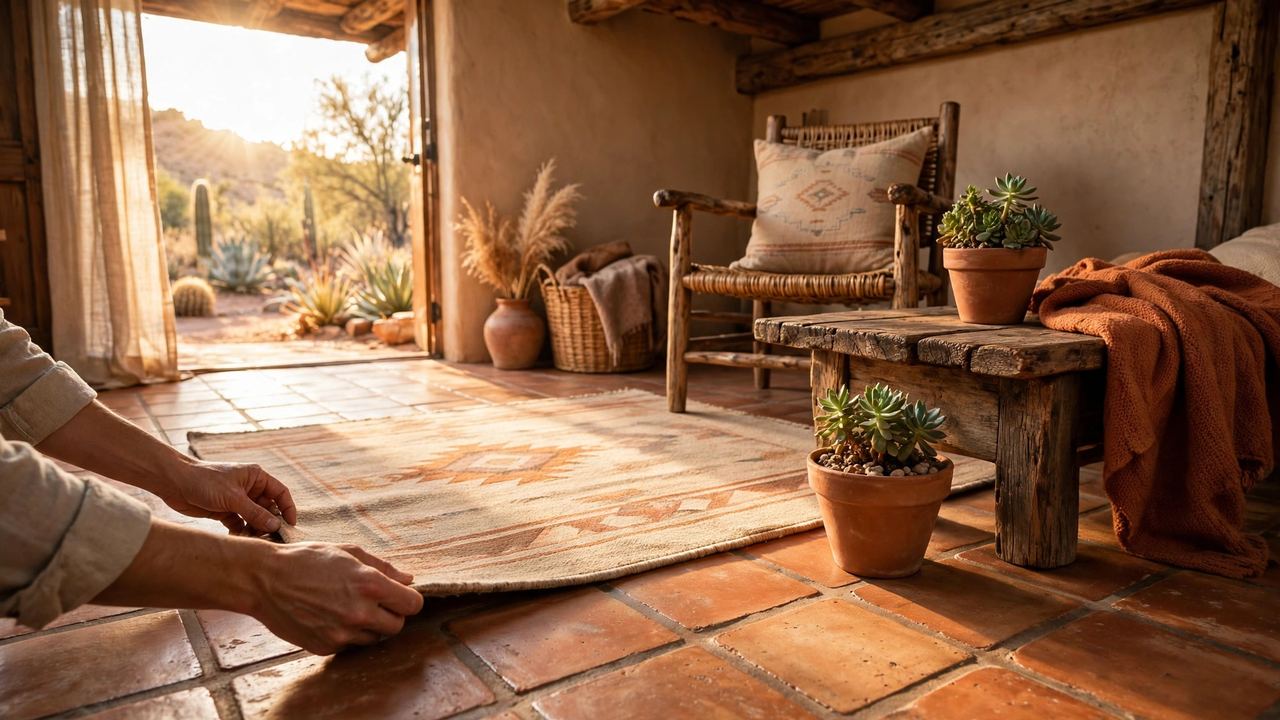
Saltillo tile is beautiful and unforgiving at the same time. The handmade terracotta pavers are thick, slightly domed and set with wide, sunken grout joints, so the floor you walk on is never perfectly flat. A rug that works on smooth ceramic can rock on a high tile, catch on a grout line, or wear thin where a furniture leg presses it into a dip. That is why the best rugs for satillo tile share a specific profile: a flat weave or very low pile that drapes over small height changes instead of bridging them, enough body to stay put, and a construction that tolerates the grit that terracotta floors seem to attract. This guide explains how Saltillo differs from machine-made tile, what that means for pile height, backing and pads, and then walks through six rugs that fit the brief in different ways, from a printed low-pile classic to a hand-loomed jute kilim and a hose-clean indoor-outdoor design.
One warning before the picks. Saltillo is porous, and most installations rely on a sealer to keep the clay from drinking in spills. Anything you lay over it, rug backing or pad, sits against that sealer for months at a time. Choose pads and backings that the maker describes as floor-safe, lift the rug periodically to let the floor dry and breathe, and never let a wet rug sit on Saltillo. With that habit in place, a good rug does more than soften the room: it protects the high spots of the tiles from chair legs and grit, quiets a hard echoing surface, and ties the rust, salmon and honey tones of the clay into the rest of your decor.
Quick verdict
If you want one answer, start with the Loloi Layla LAY-03. The maker lists a pile of just 0.13 inches, so it lies almost flat over domed tiles, and its distressed traditional pattern hides the dust and pet hair that show so quickly on terracotta. If your room leans Southwestern or rustic, the SAFAVIEH Kilim KLM750A in natural and charcoal is the closest match in spirit: a hand-loomed jute and cotton flatweave with tribal geometry that looks native next to Saltillo. For a casual, light-filled room, the SAFAVIEH Montauk MTK715B brings hand-woven cotton stripes in ivory and light blue, while its sibling, the SAFAVIEH Striped Kilim STK513N, offers a deeper navy ground in a cotton and wool flatweave. The nuLOOM Wynn is the braided, solid-color option for people who want texture without pattern, and the Nourison Aloha ALH05 is the practical pick for kitchens, entries and covered patios, because the maker lists it for indoor and outdoor use with a hose-rinse care routine. Every pick below is flat or low enough to sit over uneven pavers, and every one needs a proper pad underneath on tile, which the buying guide covers in detail.
The products in this guide
Loloi Layla LAY-03 Olive and Charcoal Rug
The Layla LAY-03 is the flattest rug in this guide, and on Saltillo that is a genuine advantage
Best when Living rooms that need the flattest profile
We started from the floor itself. Saltillo pavers vary in thickness from tile to tile, the surfaces are hand-formed rather than pressed flat, and the grout joints are wider and deeper than on modern ceramic. A rug for this floor has to flex. Thick, stiff, high-pile rugs bridge from high tile to high tile and leave the low tiles unsupported, which makes furniture wobble and wears the pile unevenly. So the first filter was profile: only flatweaves and low-pile designs made the list, and every pick below is listed by its maker at roughly a third of an inch or less in pile or thickness.
The second filter was construction honesty. For each candidate we opened the maker’s or retailer’s product page and worked from the specifications actually listed there: fiber, weave type, pile height, backing, care instructions and country of manufacture. Where a listing gave a pile height, a size range or a care method, that is what we report, phrased as what the maker lists. Candidates whose pages were thin, contradictory or missing basic construction details were dropped rather than padded out with guesses.
The third filter was availability. Each pick was checked on its Amazon product page, and only rugs showing a live featured offer for a new rug were kept. A listing that had slipped to unavailable, or that only offered the rug through scattered third-party remnants in the wrong size, did not count. Sizes and colorways change, so confirm the exact size you need on the page before ordering, but at the time of checking, all six rugs below could actually be bought new.
Finally, we spread the list across the ways people actually use rugs on Saltillo. A formal living room, a kitchen runner zone, a covered patio and a bedroom do not want the same fiber. Natural fibers such as cotton, wool and jute suit dry rooms and match the handmade character of the floor. Synthetics such as polyester and polypropylene handle tracked-in grit, chair traffic and damp mopping better. The six picks cover both families, in patterns that work with terracotta rather than against it: warm neutrals, deep navy, soft ivory and one multicolor floral for covered outdoor space.
The Layla LAY-03 is the flattest rug in this guide, and on Saltillo that is a genuine advantage. The maker lists the pile at 0.13 inches, with a power-loomed construction and a printed design, so the surface is essentially a smooth sheet that settles over domed pavers and into shallow grout dips instead of standing stiffly across them. Dining chairs slide rather than snag, doors with tight clearances pass over it, and a robot vacuum crosses the tile-to-rug transition without climbing a ledge. The size verified for this guide is the 7 foot 6 inch by 9 foot 6 inch rug, a useful near-8-by-10 footprint for a living room seating group, and the maker lists a wide range of other sizes in the same collection.
The face is polyester, which the maker lists as durable, shed resistant and stain resistant, with a cotton backing. Polyester holds its printed pattern well, and the Layla pattern matters here: it is a distressed, vintage-look traditional design in olive and charcoal, and that mottled, faded character is forgiving in a way a solid rug is not. Saltillo rooms track in fine dust, and terracotta sheds a little of its own surface over time. On a distressed print, that everyday film disappears into the pattern instead of announcing itself. The olive and charcoal palette also cools a very warm floor nicely, giving you contrast without fighting the clay tones.
Care is the trade-off. The maker lists spot clean only for this rug, so it suits living rooms and bedrooms better than the splash zone in front of a kitchen sink. It is also listed for indoor use only, and it is not water resistant, so mop water should not be sloshed across it. Use a felt or felt-and-rubber pad underneath: the pad cushions the thin rug over grout lines, keeps it from creeping on sealed tile, and protects the sealer from the cotton backing. With a pad, the Layla feels more substantial than its slim profile suggests.
Buy it if: you want the lowest, flattest profile for a very uneven floor, a pattern that hides dust, and a traditional look that calms a warm terracotta palette.
Skip it if: you need to machine wash or hose down your rug, or the rug will sit where water regularly reaches it.
Kilim flatweaves and Saltillo tile come from the same design world: handmade, geometric and comfortable with variation. The Striped Kilim STK513N is hand-woven in India, and the maker lists its fiber as cotton and wool with a flat woven construction and a low pile of about a quarter inch. That blend is worth noting. Cotton keeps the rug light and flexible, so it drapes over uneven pavers, while the wool content adds resilience and a slightly richer hand than an all-cotton weave. The size verified here is 6 by 9 feet, a good scale for a seating area or under a bed, and the collection is listed in several other sizes including runners and larger rectangles.
The design is simple in the best way: stripes in blue across a navy ground. Against terracotta, deep blue is the classic complementary move, cooling the orange-red clay and giving the room a deliberate, finished feel. Stripes also help on an irregular floor because they give the eye a rhythm to follow, which makes the natural waviness of both the rug and the tiles read as texture rather than error. The maker positions this rug for kitchens, baths and bedrooms as well as living rooms, and notes that packing creases relax flat within a few days, which matters on Saltillo, where a curled edge over a grout joint is a trip point.
Care instructions from the maker are unusually practical for a natural-fiber flatweave: regular vacuuming on a normal setting, and the listing describes machine washing cold on a gentle cycle with a low tumble dry, while noting the rug may relax slightly with washing. Even so, treat that as an occasional deep clean rather than a weekly habit, and never leave the rug damp on the tile. A rug pad is recommended by the maker, and on Saltillo it is close to mandatory: the pad stops the lightweight weave from migrating across sealed pavers and cushions the grout ridges so they do not print through and wear the weave from below.
Buy it if: you want a true flatweave with natural fibers, a navy palette that balances terracotta, and a flexible rug that settles onto uneven tiles.
Skip it if: you need a completely carefree synthetic for a wet or muddy zone, or you dislike the slight softening and relaxation natural flatweaves develop with washing.
The Montauk MTK715B is the large-room option. The verified size is 9 by 12 feet, big enough to hold a full seating arrangement with all furniture legs on the rug, or to sit under a king bed with a border showing on three sides, as the maker describes. The maker lists it as hand-woven in India from cotton, with a low pile of about a quarter inch and a flat, plain weave. An all-cotton flatweave at this size stays comparatively light and flexible, which is exactly what a big rug on Saltillo needs: it can follow the gentle hills and valleys of the pavers instead of tenting over the high spots.
The pattern is alternating striped columns in ivory and light blue, a calm grid that brightens a terracotta room considerably. Saltillo can pull a space dark and heavy, especially in smaller or north-facing rooms, and a pale rug is the fastest way to lift it. The blue striping keeps the ivory from feeling stark against the warm clay, and the regular geometry of the stripes plays well with the offset grid of the tiles. Because the rug is cotton, the surface is soft and breathable underfoot, with a casual, almost beach-house ease that suits bedrooms and relaxed living rooms.
The maker lists care as regular vacuuming, with machine washing cold on a gentle cycle and low tumble dry described in the listing, plus the note that the rug may relax slightly with washing. At 9 by 12, home washing is unrealistic for most machines, so plan on vacuuming, prompt spot cleaning and professional cleaning when needed. The maker recommends its own rug pad for this size, and the reasoning doubles on Saltillo: a pad keeps a large, light cotton rug from creeping, evens out the feel of grout joints underfoot, and puts a protective layer between the cotton weave and your sealer. Rotate the rug a half-turn twice a year, as the maker suggests, so sun and traffic wear it evenly.
Buy it if: you need a genuinely large flatweave, want to lighten a dark terracotta room, and prefer natural cotton underfoot.
Skip it if: your household generates heavy spills and pet messes that demand a hose-down synthetic, or a pale ivory field worries you in a high-traffic path.
If your Saltillo is in a Southwestern, adobe or rustic room, this is the rug that looks like it was chosen by the same hand as the floor. The Kilim KLM750A is hand-loomed in India from jute and cotton, and the maker lists a flat woven construction with a low pile of about a quarter inch. The verified size is 8 by 10 feet, which the maker describes as seating a sofa and two chairs with their front legs on the rug. The design uses zigzag bands and nested geometric diamonds in natural and charcoal, a tribal pattern language that sits comfortably beside hand-formed terracotta.
Jute gives this rug a firmer, chunkier texture than the cotton flatweaves above. That firmness has a practical side on Saltillo: the rug holds its shape, resists the bunching that soft weaves can develop over grout lines, and gives a grounded, textured footing that layers well under furniture. The natural fiber tones echo the variation in the clay itself, so the small color differences the maker warns about, since plant fiber harvests vary, read as part of the handmade character rather than a defect. Expect a little fiber and dust shedding at first, which the maker also notes; a few weeks of regular vacuuming settles it.
Water is the limit here. The maker is explicit that jute browns if it stays wet, advises keeping the rug dry, and lists care as vacuuming on a low setting without a beater bar, blotting spills rather than soaking, and drying any damp spot quickly. On porous Saltillo that advice matters twice over, because a damp jute rug can hold moisture against the tile and its sealer. Keep this rug in dry living rooms, entries with a mat outside the door, and offices, and use the rug pad the maker recommends for grip, cushion and floor protection. Rotating it twice a year evens out sun and traffic, as with the other natural flatweaves.
Buy it if: you want the most authentically Southwestern pairing for Saltillo, a firm textured flatweave, and natural jute and cotton fibers.
Skip it if: the rug will see wet shoes, pet accidents or kitchen splashes, or you want a soft, plush step out of bed.
The Wynn takes a different route to the same problem. Instead of a flat weave, it is braided, and the maker lists it in polypropylene with a thickness of 0.3 inches and no backing. A braid is made of interlocked strands rather than a rigid sheet, so it flexes in every direction and settles into the shallow dips between Saltillo pavers instead of bridging them. The verified size is the 8 by 10 foot rug in ivory, and the solid, pattern-free surface makes it the quietest option in this guide: all texture, no motif, which lets the tile’s own color and pattern stay the star of the room.
Polypropylene is the workhorse fiber here. The maker lists the rug as stain resistant and water resistant, suitable for indoor and outdoor use, and describes cleaning it by hosing it down outside and spot treating mild stains. In a Saltillo home that translates to a rug that tolerates the dining room, where chairs scrape and crumbs fall, and the family room, where dogs come in from the yard. The ivory colorway brightens terracotta the same way the Montauk does, but the braided texture hides crumbs and grit between the strands better than a flat cotton weave, so it can go longer between cleanings without looking tired.
Two cautions. The maker lists hand wash only in its care specifications alongside the hose-down guidance in its description, so treat the hose routine as an outdoor deep clean and let the rug dry completely, off the tile, before it comes back inside; a polypropylene rug put back damp can trap moisture against sealed Saltillo. And because the rug has no backing, a pad is not optional on tile. A felt-and-rubber pad gives it grip, adds the cushion the slim braid lacks over grout ridges, and keeps the braid from shifting under a dining table. With a pad, this is the most forgiving everyday rug in the list.
Buy it if: you want solid texture without pattern, a synthetic that shrugs off dining and pet traffic, and a flexible braid that follows uneven pavers.
Skip it if: you want a defined tribal or traditional pattern, or you plan to skip the rug pad, because an unbacked braid will wander on sealed tile.
Saltillo often continues onto covered patios, sunrooms and kitchen terraces, and those spaces need a rug that treats water as a routine event rather than an emergency. The Aloha ALH05 is that rug. The maker lists it as power-loomed polypropylene with a flat weave and a raised, cut high-low pattern, a pile of 0.25 inches, serged edges, and indoor and outdoor use. The verified size is 7 by 10 feet in the multicolor floral colorway, a tropical pattern that looks entirely at home against terracotta, stucco and outdoor furniture.
The high-low construction deserves a word on uneven tile. The flat woven ground keeps the rug flexible and close to the floor, while the raised floral motifs are cut pile islands rather than a full plush surface, so the rug still drapes over domed pavers. The maker lists the rug as stain resistant, water resistant and non-shedding, and describes it as easy cleaning and suited to high traffic areas. For a Saltillo kitchen, where the floor runs from the cooking zone to a breakfast nook, that combination of low profile, synthetic fiber and floral pattern that camouflages crumbs is hard to beat.
Care is the simplest in this guide. The maker lists vacuuming regularly without a beater bar, spot cleaning with a damp cloth, and rinsing with a hose and air-drying both sides, with the advice to bring the rug indoors during extreme weather to extend its life. Drying both sides matters on Saltillo: flip it, let the underside dry fully, and let the tile dry too before relaying it. The maker recommends a rug pad, and on smooth sealed tile a pad also keeps this light rug from skating when someone steps on it at speed. Indoors or on a covered patio, it is the most weather-tolerant pick here.
Buy it if: your Saltillo runs through a kitchen, entry or covered patio, and you want a hose-clean rug with a lively pattern that hides everyday mess.
Skip it if: your room is formal and wants a quiet, traditional design, or your patio is fully exposed to harsh weather year-round.
Buying guide: rugs on Saltillo tile
Understand the floor first. Saltillo is unglazed terracotta clay, formed by hand, dried and fired at relatively low temperatures. Three consequences follow. The tiles are uneven, so flexibility beats thickness. The clay is porous, so the sealer is doing real work and anything that traps moisture against it is a risk. And the surface is softer than glazed ceramic, so grit trapped under a rug or furniture leg can scratch and dull the high spots. Every choice below, pile, fiber, pad and cleaning, flows from those three facts.
Keep the profile low. Flatweaves and piles up to roughly a third of an inch drape over domed tiles and settle into grout dips. Thick rugs bridge the high spots, rock under furniture, and concentrate wear where legs press the rug against a tile edge. Low rugs also keep door clearances workable, which matters in older Saltillo homes where doors were trimmed for bare tile. If you love the feel of a plush rug, get the cushion from the pad rather than the pile: a dense felt pad under a flatweave gives a soft step while keeping the flexible surface the floor needs.
Choose fiber by room, not by looks alone. Cotton flatweaves are light, soft and easy to move for cleaning, and they suit bedrooms and living rooms. Wool blends add resilience and a richer texture for seating areas. Jute brings firm, rustic texture to dry rooms and must be kept dry. Polyester prints, like the Layla, hide dust brilliantly in living spaces. Polypropylene, in the Wynn and the Aloha, is the fiber for dining rooms, kitchens, entries and covered patios, because the makers list it as stain and water resistant with simple wash or hose care. Match the fiber to the wettest, grittiest thing the room will do to the rug.
The pad is part of the rug. On Saltillo, a pad does four jobs: it stops the rug creeping on sealed tile, cushions grout ridges so they do not wear the rug from beneath, protects the tile’s high spots from abrasion, and adds the softness a low-pile rug lacks. A felt or felt-and-rubber pad is the usual answer. Check that the pad maker describes it as safe for sealed or natural-stone-style floors, avoid cheap pads that can stick to or discolor sealers, and cut the pad an inch or two smaller than the rug on each side so it stays hidden. Replace a pad that starts to crumble, because pad dust ground into porous tile is a mess you do not want.
Size for the furniture, then check the tiles. In a living room, choose a rug that takes at least the front legs of the sofa and chairs; the 8 by 10 and 9 by 12 sizes in this guide cover most seating groups. In a dining room, the rug should extend beyond the table enough that chairs stay on it when pulled out. Then walk the room and look at where the rug edges will fall. An edge that lands exactly on a raised grout ridge will curl and wear; shifting the rug a few inches so its border crosses the tiles at a flatter point can make a real difference. Runners deserve the same check along their full length.
Clean for two surfaces at once. Vacuum regularly, because grit is the enemy of both the rug and the soft clay beneath it, and use suction without a beater bar on flatweaves and jute, as the makers advise. Blot spills immediately; on a porous floor, liquid that passes through a rug can reach the sealer and the tile. Lift rugs periodically, especially after mopping or any leak, and let the tile dry fully before relaying them. Rotate natural-fiber rugs a half-turn twice a year to even out sun fade and traffic. Followed consistently, these habits keep both the rug and the Saltillo looking like themselves for years.
FAQ
What type of rug is best on Saltillo tile? A flatweave or low-pile rug, roughly a third of an inch thick or less, because it flexes over the domed, uneven pavers instead of bridging them. Pair it with a felt or felt-and-rubber pad for grip, cushion and sealer protection. The six rugs in this guide all meet that profile in different fibers and patterns.
Can a rug damage Saltillo tile? It can if it traps moisture or grit. A wet rug left on porous, sealed clay can cloud or lift the sealer, and grit under a rug scratches the soft tile surface as the rug shifts. Keep rugs dry, vacuum under them regularly, lift them after any leak or mopping, and use a pad the maker describes as floor-safe.
Do I need a rug pad on Saltillo tile? Yes, in almost every case. Sealed Saltillo is smooth enough that rugs creep, and its grout joints are deep enough to wear a rug from below. A pad solves both problems and adds cushion. Choose felt or felt-and-rubber, confirm it is described as safe for sealed floors, and size it slightly smaller than the rug.
Are jute rugs a good idea on Saltillo? In dry rooms, yes: a jute flatweave like the Kilim KLM750A matches the handmade character of the floor and holds its shape well. The maker warns that jute browns if it stays wet, so keep jute away from sinks, entries without a door mat, and any spot where a spill might sit unnoticed.
What colors work with terracotta Saltillo floors? Deep navy and blue cool the warm clay, ivory and natural tones lighten it, olive and charcoal ground it, and tribal natural-and-charcoal patterns echo its handmade variation. Because Saltillo ranges from salmon to deep rust, bring the rug decision to the floor itself: a pattern with several tones, like the Layla’s distressed print, usually settles in more easily than a single flat color.
How do I stop a rug sliding on sealed tile? Use a felt-and-rubber pad cut slightly smaller than the rug, make sure both the tile and the pad are clean and dry when you lay them, and choose a rug with some weight or body for large open areas. If a corner still curls over a grout ridge, shift the rug a few inches so the edge rests on a flatter part of the floor.
Conclusion
Saltillo rewards rugs that respect what the floor is: handmade, uneven, porous and warm. Keep the profile flat, match the fiber to the room, put a proper pad underneath, and keep everything dry, and the right rug will make the floor more comfortable, quieter and better protected at the same time. For most living rooms, the Loloi Layla LAY-03 is the easiest recommendation, with the SAFAVIEH Kilim KLM750A close behind for Southwestern rooms. The Montauk and the Striped Kilim cover the natural-fiber flatweave brief at two scales and palettes, the nuLOOM Wynn brings quiet braided texture to busy dining spaces, and the Nourison Aloha takes the whole idea into kitchens and covered patios. Measure your room, check where the edges will land on the tiles, and pick the construction your household will actually enjoy living with.
M
Modern Line Home Editorial Team
We compare specs, materials and verified owner reviews before a product earns a spot. Rankings are never paid.
Affiliate disclosure. As an Amazon Associate we earn from qualifying purchases at no extra cost to you. Prices accurate as of the date shown.
House cold even with the heat on? Walk this ordered checklist: thermostat and filter first, then drafts, insulation, leaky ducts and a failing heating system.
Windows fogging up in winter? Check where the fog sits: on the room side it is indoor humidity, outside it is harmless, and between panes the seal has failed.
Store the main firewood pile about 30 feet from your house, off the ground and covered only on top. Compare racks, woodsheds, garages and indoor spots safely.
Place a portable generator outdoors only, at least 20 feet from windows, doors and vents, exhaust pointed away. Exact distances, setup steps and CO rules here.
Keep houseplants in the right winter spot: match window direction to plant type, stay clear of radiators and cold glass, and fix dry air and low light at home.
Mice enter through pencil-width gaps at foundations, pipes, vents, doors and the roofline. Walk this room-by-room winter checklist to find and seal each one.
A winter outage timeline: what to do in the first hour, first night and multi-day outage, with food safety times, pipe protection, heat and CO safety steps.
Size a space heater by room area: 10 watts per square foot at 8-foot ceilings, adjusted for insulation and ceiling height, with full wattage and BTU tables.
Start dripping at about 20 degrees, sooner for exposed pipes. Set a pencil-lead stream, drip the right faucets on both lines, and know when to stop safely.
A fridge needs 800-1,200 starting watts, not just 150-400 running watts. Use the tables to total your fridge plus freezer, lights, furnace fan and more today.












Write Your Review
No reviews yet. Be the first to share your experience!