We independently review everything we recommend. When you buy through our links, we may earn a commission. As an Amazon Associate we earn from qualifying purchases.
Best Rugs for Mid-Century Modern Homes: 6 Top Picks
Find the best rugs for mid century modern rooms: geometric and atomic patterns, warm retro palettes, wool and washable low-pile picks for living rooms today.
Find the best rugs for mid century modern rooms: geometric and atomic patterns, warm retro palettes, wool and washable low-pile picks for living rooms today.
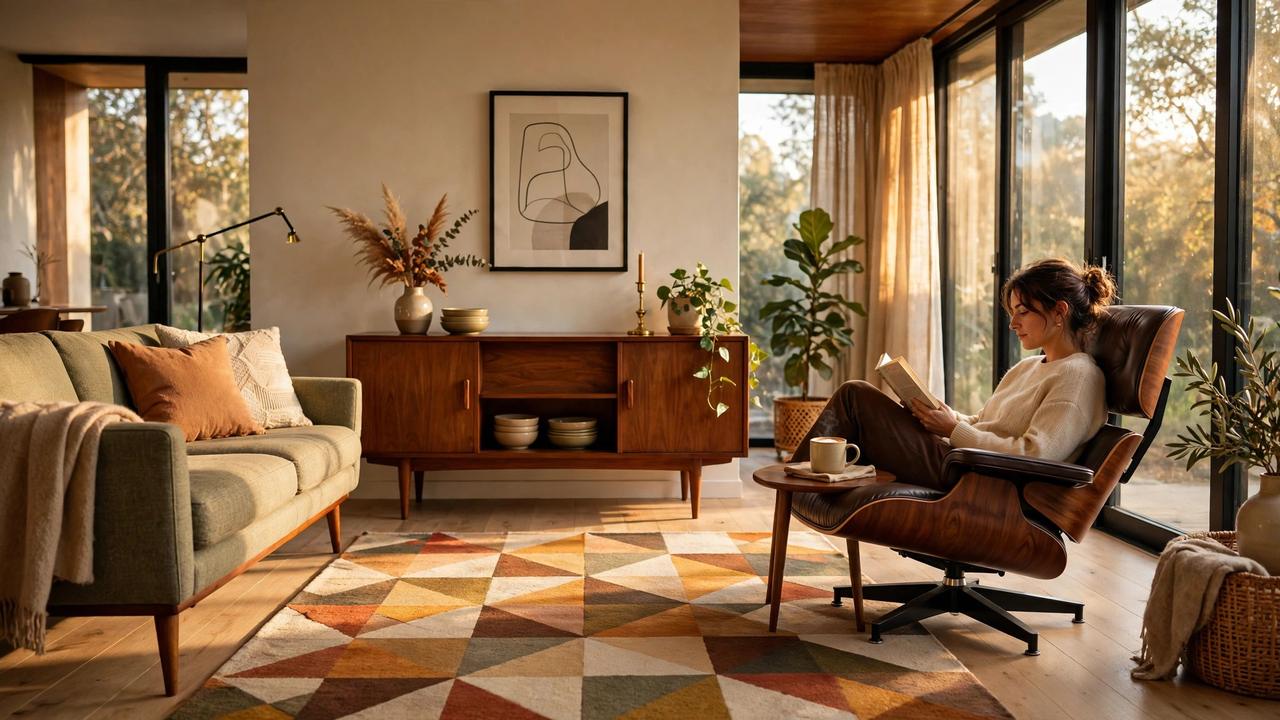
A mid-century modern room lives or dies at floor level. The furniture in this style sits low, with tapered legs, clean planes, and warm wood, which means far more of the floor stays visible than in a traditional scheme. A rug is not background here; it is the largest single pattern in the room, and it either reinforces the period look or quietly fights it. The best rugs for mid century modern interiors share a recognizable vocabulary: geometric and atomic motifs, arches and overlapping circles, color-blocked planes, and a warm retro palette built around mustard, teak orange, teal, olive, and warm neutrals. Pile tends to stay low or medium, because a deep shag swallows furniture legs and blurs the crisp silhouettes the style depends on, while flatweave and low-pile designs let a credenza or lounge chair read as a clean shape against the floor.
This guide gathers six rugs that genuinely speak that language, from a hand-tufted wool color-block design to washable arch-pattern rugs for busy family rooms. Each pick was chosen for a maker-listed design, colorway, and construction that suits mid-century furniture, and each section below explains where the pattern works hardest, which palette it supports, and what kind of household it fits. Whether your room leans Palm Springs bright, Scandinavian calm, or warm walnut and brass, one of these six should anchor it without tipping into costume.
Quick verdict
If you want one rug that covers the most mid-century ground, start with the SAFAVIEH Rodeo Drive RD868A. It is the only hand-tufted wool pick in this roundup, its interlocking geometric planes deliver the architectural color-blocking the period is known for, and wool brings the natural resilience and sound softening that synthetic fibers imitate. For a large room on an easier-care brief, the Abani Ivy Collection Green Arch Rug pairs the era’s signature arch motif with a machine-washable, non-shedding build in a soothing green and beige palette. Households that need washability above all else should look at the DCX Blue and Yellow Arch Rug, the largest pick here, or the compact RoomTalks Mid Century Modern Washable Rug for bedrooms and entryways. The Abani Deco Collection Geometric Circle Rug is the softest, most playful option, with overlapping circles in cream, pink, and beige, while the SAFAVIEH Hollywood HLW703B brings a botanical leaf pattern in ivory and blue for rooms that want pattern without geometry homework.
The products in this guide
Abani Ivy Collection Green Arch Rug
Design: the maker lists a double arch pattern in green and beige tones, in the Ivy Collection Construction: the maker lists this rug as power-loomed
Selection started with the design brief, not with bestseller lists. A rug qualified only if its maker-listed pattern and colorway read as mid-century modern on their own terms: geometric or atomic shapes, arches, circles, color-blocked planes, or the stylized botanical motifs that softened many period interiors. Generic modern rugs with no period vocabulary were passed over, however popular they might be, because a rug that could sit in any contemporary room does not answer this keyword. Warm retro palettes earned priority, since mustard, teak orange, teal, olive, and related tones are what tie a rug to walnut furniture, brass accents, and the upholstery colors of the era.
Construction mattered next. Mid-century furniture has low clearance and slim legs, so every pick here is a flatweave, low-pile, or medium-pile design that chairs can slide across and doors can clear. Materials were weighed for honesty to the period and for daily life: wool for buyers who want the natural fiber many original mid-century rugs used, and power-loomed synthetics for buyers who need stain resistance, non-shedding behavior, or machine washability. Each product also had to be a real, currently listed rug with maker-listed specifications we could open and read, in a size that maps to a real room rather than a novelty mat. Finally, the six were balanced as a set, spanning large statement sizes and small accent sizes, bold color and quiet neutrals, and hand-tufted and washable builds, so that different rooms and different tolerances for upkeep each have a genuine option.
The arch is one of the most durable motifs in mid-century design, repeated across doorways, mirrors, and textiles of the period, and this rug builds its whole field from a double arch pattern in green and beige. The effect is graphic without being loud: the arches give a low-slung sofa and tapered-leg chairs a rhythmic backdrop, and the green sits comfortably beside walnut, teak-look finishes, and brass. Because the palette leans calm rather than saturated, this is the pick for rooms that want the period reference at conversational volume, such as a living room that also has patterned cushions or a busy bookshelf wall competing for attention.
Design: the maker lists a double arch pattern in green and beige tones, in the Ivy Collection
Construction: the maker lists this rug as power-loomed and machine washable
Size in this listing: the maker lists dimensions in the 8 x 10 ft class, at 7 ft 9 in by 10 ft 2 in
Behavior: the maker lists non-shedding construction and fade-resistant colors
Model: the maker lists model IVY100A-8
Pros
Signature arch motif that pairs naturally with mid-century furniture shapes
Machine washable, which is rare in a rug of this size
Muted green and beige palette that supports walnut and brass without clashing
Cons
The calm palette will not deliver a bold mustard or teak-orange statement
Large washable rugs still need a machine with enough capacity, or a hose-down approach outdoors
Buy it if you want a large, calm, unmistakably mid-century pattern that can survive family life and be washed rather than professionally cleaned. Skip it if your room needs a saturated retro color hit, or your space is small enough that an 8 x 10 class rug would run wall to wall.
Where the Ivy rug works in arches, the Deco rug works in circles. The maker describes a design of geometric circular patterns intertwined across a cream field, with beige and pink as the accent colors, built to create a minimalist modern look with mid-century roots. Overlapping circles and orbs were everywhere in period textiles and wallpaper, and at the 4 x 6 ft size listed here the pattern reads as an accent rather than a takeover, which makes this rug a smart choice under a reading chair, beside a bed, or in a small seating nook where a full-room rug would overwhelm the furniture.
Design: the maker lists geometric circular patterns in cream, beige, and pink
Construction: the maker lists a power-loomed weave in durable synthetic fibers
Origin: the maker lists this rug as Turkish made, from the Deco Collection
Size in this listing: the maker lists 4 x 6 ft
Model: the maker lists model DEC120A
Pros
Circle motif is a genuine period pattern, scaled for smaller rooms
Soft cream, beige, and pink palette brightens darker wood furniture
Power-loomed synthetic build is made for easy, stress-free maintenance
Cons
The pink accent will not suit every retro palette, particularly teal-heavy rooms
At 4 x 6 ft it accents a zone rather than anchoring a full living room
Buy it if you want a smaller mid-century accent with a softer, lighter color story for a bedroom, nursery-adjacent space, or reading corner. Skip it if you need a rug to anchor a full sofa arrangement, or if pink has no place in your palette.
This is the connoisseur pick of the six. The maker describes the design as an architectural assemblage of interlocking geometric planes, which is exactly the color-blocked abstraction that hung in period living rooms, and the construction matches the design’s ambition: the maker lists this rug as hand-tufted in India from wool, with a medium pile of about half an inch. Wool is the fiber most original mid-century rugs were woven from, and the maker notes that it is naturally resilient and soil-resistant and that it softens sound in a room, a real consideration in open-plan spaces with hard floors and low furniture. In the 6 x 9 ft size listed here, the rug fits an apartment living room with the sofa’s front legs and coffee table on the rug, which is the classic mid-century arrangement.
Design: the maker lists interlocking geometric planes in a multi-color field
Construction: the maker lists hand-tufted wool, made in India
Pile: the maker lists a medium pile of about 0.5 in
Size in this listing: the maker lists 6 x 9 ft
Model: the maker lists model RD868A-6, from the Rodeo Drive Collection
Care: the maker lists vacuuming with the beater bar off and professional cleaning for the whole rug
Pros
Real wool and hand-tufted construction, the most period-authentic build here
Architectural color-blocking that anchors a room on its own
Wool resilience suits living rooms, bedrooms, and dining rooms
Cons
The maker notes light shedding in the first weeks while loose finishing fibers clear
Wool care is more deliberate: no beater bar, blot rather than rub, professional cleaning
Not machine washable, unlike the synthetic picks in this guide
Buy it if material authenticity matters to you and you want the one rug here that a period buyer could plausibly have owned. Skip it if you need to throw the rug in a wash cycle, or if a multi-color field would fight an already colorful room.
Not every mid-century interior is built from hard geometry. Period designers also used stylized botanicals, and the Hollywood Collection leans into that softer branch of the style. The maker describes overlapping botanical leaf silhouettes with layered veining, in ivory and blue, giving an airy graphic statement that reads mid-century without a single straight line. The construction is thoroughly practical: the maker lists this rug as power-loomed in Turkey from polypropylene with a medium pile, virtually non-shedding, and stain resistant, aimed at the rooms that see the most traffic. In the size listed here, around 5 x 8 ft, it defines the coffee-table zone in front of a sofa or sits at the foot of a bed.
Design: the maker lists overlapping botanical leaf silhouettes in ivory and blue
Construction: the maker lists power-loomed polypropylene, made in Turkey
Pile: the maker lists a medium pile, with the listing showing about 0.59 in thickness
Size in this listing: the maker lists 5 ft 3 in by 7 ft 6 in
Model: the maker lists model HLW703B, from the Hollywood Collection
Care: the maker lists regular vacuuming and spot cleaning with mild soap and water
Pros
Botanical pattern offers the period look without hard-edged geometry
Polypropylene resists stains and holds color, suiting busy family rooms
Virtually non-shedding, so it stays tidy under daily vacuuming
Cons
Ivory fields show dark spills sooner than deeper colorways
The leaf motif is softer and less atomic than purists may want
Buy it if your mid-century room mixes plants, organic shapes, and curved furniture, and you want pattern that breathes. Skip it if you are after strict geometric or atomic starburst patterning, or a deep saturated palette.
The RoomTalks rug takes the botanical branch of mid-century style in a warmer direction, with abstract tropical leaves in the terracotta and black colorway shown in this listing. Terracotta is one of the most useful retro tones because it flatters both warm woods and black metal accents, and at 5 x 7 ft this rug is sized for the rooms where a statement needs to stay contained: a bedroom, a dining nook, an entryway, or a dorm-style space. The build is unapologetically practical. The maker lists a low-pile faux wool surface of about 0.2 in, a non-slip thermoplastic rubber backing that holds the rug firmly in place, and machine washable care with cold water and a low tumble dry.
Design: the maker lists an abstract tropical leaf design, in terracotta and black in this listing
Material: the maker lists a faux wool surface
Pile: the maker lists a low pile of about 0.2 in
Backing: the maker lists a non-slip thermoplastic rubber backing
Size in this listing: the maker lists 5 x 7 ft
Care: the maker lists machine washing in cold water and tumble drying low
Pros
Warm terracotta palette that flatters walnut, teak tones, and black accents
Thin low pile clears doors and slides under furniture easily
Built-in non-slip backing, so no separate pad is needed for grip
Fully machine washable for bedrooms and entryways that collect dirt
Cons
The thin profile offers little cushion underfoot compared with medium-pile picks
The tropical leaf design leans boho, which may drift from a strict mid-century brief
Buy it if you want a warm, washable accent for a bedroom or entry and value grip and easy care over plushness. Skip it if you want a cushioned living-room anchor, or a strictly geometric pattern.
Scale is this rug’s argument. At 9 x 12 ft, the largest size in this guide, it can carry a full mid-century living room arrangement, sofa, lounge chairs, coffee table, and side tables, on one field, which is how the style’s open-plan rooms were meant to read. The design keeps the period thread with streamlined arches in muted blue and yellow tones; yellow is the mustard family, the single most recognizable retro accent color, and pairing it with blue cools it into something livable at large scale. The maker lists this rug as machine made from polyester with a low pile of about a quarter inch, non-slip backing, stain resistance, and full machine washability, with reinforced edges for daily use around kids and pets.
Design: the maker lists streamlined arch designs in blue and yellow
Material: the maker lists polyester, machine made
Pile: the maker lists a low pile of about 0.27 in
Size in this listing: the maker lists 9 x 12 ft
Features: the maker lists non-slip backing, stain resistance, and machine washable care
Edges: the maker lists reinforced edges for daily use
Pros
True room-scale size that unifies a whole seating arrangement
Mustard-family yellow with blue is a classic retro pairing, kept muted
Low pile resists pet hair build-up and lets chairs move freely
Washable and stain resistant, built for high-traffic family rooms
Cons
A 9 x 12 ft rug needs a large-capacity machine or an alternative wash plan
The maker notes folded rugs arrive creased and need time, or light steam, to relax flat
Low pile gives pattern and color, not plush comfort
Buy it if you have a big open room, a full mid-century furniture set to unify, and a household that needs washable, stain-resistant practicality. Skip it if your room is modest in size, or you want natural fiber underfoot.
Buying guide
Start with the pattern vocabulary. Mid-century modern rugs draw from a short list of motifs: geometric grids and color blocks, atomic starbursts and boomerangs, arches and overlapping circles, and stylized botanicals. Pick the motif family that matches your furniture. Angular walnut pieces with straight lines pair naturally with geometry and color-blocking, like the Rodeo Drive and Deco rugs above. Curved pieces, kidney tables, and plant-heavy rooms pair better with arches and leaves, like the Ivy, Hollywood, and RoomTalks rugs. Mixing one strong pattern family per room is the period-correct instinct; a geometric rug under a starburst lamp and atomic curtains is a theme park, not a living room.
Get the palette relationship right. The warm retro palette, mustard, teak orange, terracotta, teal, olive, and warm browns, works because it echoes the materials of the furniture: wood tones, brass, and leather. A reliable method is to let the rug carry one saturated retro color and keep the rest of its field neutral, then repeat that color once or twice in cushions or art. The DCX rug demonstrates the balance, with muted yellow against blue, while the Abani Ivy keeps green quiet against beige. If your furniture is already strongly colored, reverse the formula and choose a rug whose field is mostly neutral with the retro color as an accent, as the Deco rug does with pink on cream.
Size the rug to the furniture, not the room. The classic mid-century arrangement puts at least the front legs of the sofa and chairs on the rug, with the coffee table fully on it. Measure your seating footprint first, then choose the smallest rug that holds that footprint with a border of bare floor around it. Accent sizes like 4 x 6 ft and 5 x 7 ft belong beside beds, under reading chairs, and in entries, not stretched under a full sofa. Room-scale sizes like 9 x 12 ft earn their keep in open-plan spaces where separate small rugs would chop the floor into islands and break the style’s long, low sightlines.
Match pile to legs and doors. Low pile and flatweave designs are the natural partners for mid-century furniture: dining chairs slide instead of catching, tapered legs sit level, and doors swing clear. Medium pile, around half an inch as on the Rodeo Drive and Hollywood rugs, adds softness in living rooms and bedrooms where chairs move less. Deep shag fights the style twice over, hiding the leg lines that define the furniture and dating the room to a later decade. If sound softening matters in a hard-floored open space, remember the maker’s note on the wool pick: natural fiber and medium pile absorb more room echo than a thin washable rug will.
Choose the fiber for your household, honestly. Wool is the period-authentic fiber, resilient and naturally soil-resistant, but it asks for gentler care: no beater bar, blot spills, professional cleaning. Power-loomed polypropylene and polyester trade some of that character for stain resistance, non-shedding behavior, and easy spot cleaning. Machine-washable low-pile rugs, three of the six picks here, are the pragmatic choice with young children, pets, or an entryway’s worth of tracked-in dirt, provided your machine can handle the rug’s size. None of these is the wrong answer; the wrong answer is buying wool for a mudroom or a thin washable rug for a formal living room where comfort is the point.
Plan the pad and the placement. Rugs without a non-slip backing should sit on a rug pad, which the Safavieh listings explicitly recommend in matching sizes; a pad adds grip, a measure of cushion, and protection for the floor beneath. Washable rugs with rubber or thermoplastic backings, like the RoomTalks and DCX picks, build that grip in. Whichever you choose, rotate the rug about twice a year, as several makers here advise, so sunlight and traffic wear the pattern evenly, and give a folded washable rug a day or two to relax flat before judging its fit.
FAQ
What patterns make a rug read as mid-century modern?
Geometric color blocks, arches, overlapping circles, atomic starbursts, and stylized botanical leaves are the core vocabulary. The six picks here cover each family: interlocking planes on the Rodeo Drive rug, double arches on the Abani Ivy, circles on the Abani Deco, and leaves on the Hollywood and RoomTalks rugs. A rug with one of these motifs in a retro palette will read as mid-century even in a room with only a few period furniture pieces.
Which colors should I look for in a mid-century modern rug?
Mustard and muted yellow, teak orange and terracotta, teal, olive green, and warm browns are the classic choices, usually set against cream, beige, or ivory fields. The safest formula is one saturated retro color balanced by neutrals, as in the DCX rug’s blue and yellow or the Ivy rug’s green and beige, then echo that color in one or two small accessories.
Is wool or synthetic better for a mid-century style rug?
Wool is the more period-authentic material and, as the maker of the Rodeo Drive rug notes, it is naturally resilient and soil-resistant and softens sound. Synthetics such as polypropylene and polyester offer stain resistance, non-shedding behavior, and, in several picks here, machine washability. Choose wool for authenticity and longevity in living rooms, and synthetics where spills, pets, and washing machines are part of daily life.
What rug size works best under a mid-century sofa?
Aim for a rug that holds the coffee table fully and at least the front legs of the sofa and chairs. For many living rooms that means an 8 x 10 ft class rug like the Abani Ivy, or a 6 x 9 ft like the Rodeo Drive in a smaller apartment arrangement. In open-plan rooms, a 9 x 12 ft rug like the DCX pick can hold the entire seating group on one field, which suits the style’s long sightlines.
Can a mid-century modern rug be machine washable?
Yes. Three picks in this guide, the Abani Ivy, the RoomTalks rug, and the DCX rug, are listed by their makers as machine washable, all in low-pile synthetic constructions with non-slip backings. Washable versions trade plushness for practicality, so they suit family rooms, bedrooms, and entries best, while wool and medium-pile rugs remain the comfort choice for formal living spaces.
How do I stop a retro rug from making the room look like a themed set?
Let the rug be the room’s one loud pattern and keep other textiles quiet. Pair a geometric or arch-pattern rug with solid upholstery, plain cushions in the rug’s accent color, and the warm wood and metal finishes the style is built on. The rug supplies the period signal; everything else just needs to not argue with it.
Conclusion
The right mid-century modern rug does three jobs at once: it speaks the period’s pattern language, it carries the warm retro palette that ties wood, brass, and leather together, and it respects the low, leggy furniture by staying low or medium in pile. For the most authentic combination of design and material, the SAFAVIEH Rodeo Drive RD868A, hand-tufted in wool with interlocking geometric planes, is the standout. For large rooms and easy care, the Abani Ivy Green Arch and the DCX Blue and Yellow Arch bring the signature arch motif in washable builds at two different scales. The Abani Deco adds a soft circle pattern for smaller spaces, the SAFAVIEH Hollywood HLW703B offers botanical pattern with stain-resistant practicality, and the RoomTalks rug delivers warm terracotta color and washable grip for bedrooms and entries. Measure your seating footprint, pick your pattern family, and let one of these six lay the foundation your furniture has been waiting for.
M
Modern Line Home Editorial Team
We compare specs, materials and verified owner reviews before a product earns a spot. Rankings are never paid.
Affiliate disclosure. As an Amazon Associate we earn from qualifying purchases at no extra cost to you. Prices accurate as of the date shown.
House cold even with the heat on? Walk this ordered checklist: thermostat and filter first, then drafts, insulation, leaky ducts and a failing heating system.
Windows fogging up in winter? Check where the fog sits: on the room side it is indoor humidity, outside it is harmless, and between panes the seal has failed.
Store the main firewood pile about 30 feet from your house, off the ground and covered only on top. Compare racks, woodsheds, garages and indoor spots safely.
Place a portable generator outdoors only, at least 20 feet from windows, doors and vents, exhaust pointed away. Exact distances, setup steps and CO rules here.
Keep houseplants in the right winter spot: match window direction to plant type, stay clear of radiators and cold glass, and fix dry air and low light at home.
Mice enter through pencil-width gaps at foundations, pipes, vents, doors and the roofline. Walk this room-by-room winter checklist to find and seal each one.
A winter outage timeline: what to do in the first hour, first night and multi-day outage, with food safety times, pipe protection, heat and CO safety steps.
Size a space heater by room area: 10 watts per square foot at 8-foot ceilings, adjusted for insulation and ceiling height, with full wattage and BTU tables.
Start dripping at about 20 degrees, sooner for exposed pipes. Set a pencil-lead stream, drip the right faucets on both lines, and know when to stop safely.
A fridge needs 800-1,200 starting watts, not just 150-400 running watts. Use the tables to total your fridge plus freezer, lights, furnace fan and more today.












Write Your Review
No reviews yet. Be the first to share your experience!