
Key takeaways
- Find the best rugs for dogs and mud with dirt-trapping chenille, absorbent microfiber, non-slip backing, and machine-washable care for busy entryways at home.
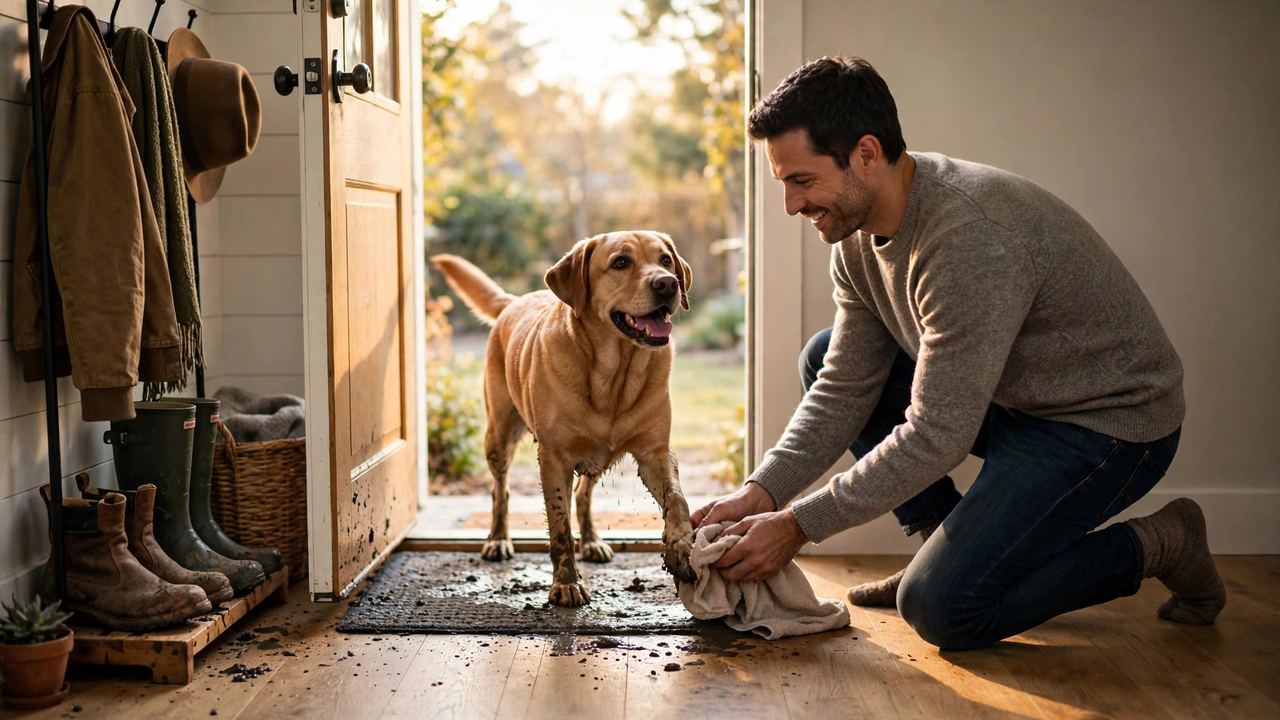
Mud season with a dog is not really about the yard. It is about the four seconds after the door opens, when wet paws cross your clean floor faster than you can reach for a towel. The best rugs for dogs and mud slow that moment down. They give paws a surface that traps dirt, holds moisture, and stays in place long enough for a dog to take several steps on the mat instead of on the hardwood, tile, or carpet beyond it. A good mud rug is therefore not a decorative afterthought. It is a working piece of entryway equipment, chosen by size, fiber, backing, and wash care, in that order.
This guide focuses on six mats and runners that approach mud duty in different ways. Some use thick chenille that the maker describes as highly absorbent. Some use a firmer, low polyester pile that brushes debris from paws and clears a tight door. Two are long runners, because for many dogs the most useful feature is not thickness at all but distance: more steps on the mat means fewer muddy steps in the house. Every product below was selected from its opened listing, and every absorbency or care claim is phrased as the maker lists it, because mud performance depends on honest, comparable details rather than invented figures.
Quick verdict
For most single-door homes, start with the Gorilla Grip SoakSTOPPER or the OLANLY Dog Door Mat, both in a versatile 30 by 20 inch chenille format with textured rubber backing and machine-washable care as the makers list it. If your entry is compact, the Muddy Mat at 30 by 19 inches is the tidy fit. If your dog walks a hallway after entering, skip the small mats and look at the HOMEK 72 by 24 inch runner or the PURRUGS 31.5 by 70 inch runner, which turn the whole entry route into the trapping zone. If door clearance is your main problem, the Buganda, listed at just 0.6 inches thick, and the PURRUGS, listed at 0.4 inches thick, are the low-profile answers. The right choice is the one that covers your dog’s actual path, fits under your actual door, and washes in a way your household will actually keep up with.
Comparison table
| Product | Maker-listed highlight | Format |
|---|---|---|
| Gorilla Grip SoakSTOPPER Dog Door Mat 30×20 | The listing presents this mat as a soft | Single door |
| Muddy Mat Microfiber Dog Door Mat 30×19 | Muddy Mat calls this product the Official Anti-Mud Mat of the American Kennel Club | Single door |
| OLANLY Dog Door Mat for Muddy Paws 30×20 | The OLANLY listing says its dense chenille pile absorbs moisture and traps water | Single door |
| HOMEK Chenille Dog Door Mat 72×24 | Length is the whole argument for the HOMEK. Most door mats give a dog one or two steps; a 72-inch runner gives a dog a full walking path from the door toward the room | Runner |
| Buganda Dog Door Mat for Muddy Paws 30×20 | Buganda takes the opposite approach from the thickest chenille mats: the maker emphasizes a low profile that will not get jammed or curled when doors open and close | Single door |
| PURRUGS Dirt Trapper Door Mat 31.5×70 | PURRUGS offers the firm | Runner |
How we selected
Selection started with the job, not the brand. A rug for dogs and mud has to do four things at once. First, its surface has to trap dirt: chenille and microfiber piles hold debris between fibers, while firmer cut pile brushes it from paw pads. Second, it has to handle moisture as the maker states it, whether that is a dense absorbent pile, a quick-drying fabric, or a specific absorbency claim printed on the listing. Third, it has to stay put, because a mat that slides or bunches becomes a trip hazard and stops trapping anything. That is why textured rubber, TP rubber, TPE, and TPR backings feature throughout this guide. Fourth, it has to be cleanable on a realistic schedule. Mud mats get dirty by design, so shake-out care, machine washing, and drying instructions matter as much as the first day’s performance.
We also weighted size honestly. A beautiful mat that covers only half a doorway, or that jams under a low door, will fail in daily use no matter how good its fibers are. So this guide includes a deliberate spread: three single-door mats around 30 by 20 inches, one compact 30 by 19 inch mat, and two long runners for hallways and multi-dog routes. Products whose listings could not be opened and checked, or that did not show a live new offer, were excluded rather than described from summaries. Specs below are phrased as the maker lists them, and where a maker gives a number, such as a pile thickness or an absorbency multiple, that number is attributed to the maker rather than presented as an independent measurement.
Gorilla Grip SoakSTOPPER Dog Door Mat 30×20
The maker lists dense chenille pile that the maker describes as almost one inch thick, with a textured TP rubber backing. The listing presents this mat as a soft, plush chenille surface built to capture moisture from paws and shoes at an indoor entrance. The maker lists the pile as quick drying and fade resistant, and says the microfiber fabric is OEKO-TEX Standard 100 certified. Care is central to its appeal: the maker says it can be machine washed and dried as often as needed, and that the TP rubber backing has been third party tested to withstand repeated washing and drying, unlike backings the maker describes as PVC or hot glue. At 30 by 20 inches, it covers a single doorway landing zone where a dog first steps inside, which is exactly where the first and wettest paw prints land.
Placement is where this pick earns its keep. Put it flat on a clean, dry floor, give it the full doorway width if you can, and leave enough length in the direction your dog actually walks, which is usually straight ahead and then toward the room where you spend time. Dogs rarely wipe their paws deliberately, so the mat has to do the work passively, through contact, friction, and absorbency across ordinary steps. A mat that is slightly too large for the prettiest layout is usually the better mud tool, provided the door still swings freely and the edges lie flat so nobody, human or dog, catches a toe on a curled corner.
Care should match the listing rather than habit. Follow the maker’s stated washing and drying directions for this model, shake loose grit outside before washing so the machine is not grinding sand through the pile, and let the backing dry fully before putting the mat back down, since several makers in this guide specifically advise a dry floor and a dry backing for grip. Rotating a second inexpensive mat into the doorway on wash day is a simple trick many dog households use, because the door never goes unprotected during the muddiest weeks, when protection matters most.
Buy it if: a single, heavily used back or front door where one dog comes in at a time and you want the thickest-feeling chenille underfoot.
Skip it if: you need a long runway for several dogs, a very low door clearance, or coverage for a wide double doorway in one piece.
Muddy Mat Microfiber Dog Door Mat 30×19
The maker lists a thick layer of plush 1-inch chenille that the maker says soaks up to 5X its weight, with a textured TPE backing. Muddy Mat calls this product the Official Anti-Mud Mat of the American Kennel Club, and the listing frames it plainly as a welcome trapper mat for wiping paw prints and sludge from boots and shoes. The maker lists double stitching for durability and gives specific care: for deep cleaning, machine wash cold on the gentle or delicates cycle and dry on low heat on the gentle or delicates cycle, with a simple shake for everyday debris. At 30 by 19 inches it is the most compact pick here, sized for a standard single door, a crate front, or a tight apartment entry where a larger mat would crowd the swing of the door or the furniture beside it.
Placement is where this pick earns its keep. Put it flat on a clean, dry floor, give it the full doorway width if you can, and leave enough length in the direction your dog actually walks, which is usually straight ahead and then toward the room where you spend time. Dogs rarely wipe their paws deliberately, so the mat has to do the work passively, through contact, friction, and absorbency across ordinary steps. A mat that is slightly too large for the prettiest layout is usually the better mud tool, provided the door still swings freely and the edges lie flat so nobody, human or dog, catches a toe on a curled corner.
Care should match the listing rather than habit. Follow the maker’s stated washing and drying directions for this model, shake loose grit outside before washing so the machine is not grinding sand through the pile, and let the backing dry fully before putting the mat back down, since several makers in this guide specifically advise a dry floor and a dry backing for grip. Rotating a second inexpensive mat into the doorway on wash day is a simple trick many dog households use, because the door never goes unprotected during the muddiest weeks, when protection matters most.
Buy it if: a compact entry, an apartment door, or a crate-side spot where a smaller mat fits better and gentle-cycle washing suits your routine.
Skip it if: your dog needs several strides to dry off, your door opens onto a wide hallway, or you want the longest possible dirt-trapping path.
OLANLY Dog Door Mat for Muddy Paws 30×20
The maker lists dense chenille pile with a textured thermoplastic rubber backing, listed as suitable for hardwood, tile, laminate, and vinyl. The OLANLY listing says its dense chenille pile absorbs moisture and traps water, mud, dirt, dust, grit, grass, sand, sleet, slush, and snow from paws and shoes, which is a thorough description of ordinary mud-season debris rather than a laboratory absorbency figure. The maker lists the chenille as OEKO-TEX Standard 100 certified, describes the mat as machine washable and quick drying, and advises placing it on a clean, dry, smooth floor with the backing kept dry for best grip. At 30 by 20 inches it matches the most common single-door footprint in this guide, and the maker also positions it for use indoors, in a crate, or in the car, which suits households that move one mat between the back door and travel duty.
Placement is where this pick earns its keep. Put it flat on a clean, dry floor, give it the full doorway width if you can, and leave enough length in the direction your dog actually walks, which is usually straight ahead and then toward the room where you spend time. Dogs rarely wipe their paws deliberately, so the mat has to do the work passively, through contact, friction, and absorbency across ordinary steps. A mat that is slightly too large for the prettiest layout is usually the better mud tool, provided the door still swings freely and the edges lie flat so nobody, human or dog, catches a toe on a curled corner.
Care should match the listing rather than habit. Follow the maker’s stated washing and drying directions for this model, shake loose grit outside before washing so the machine is not grinding sand through the pile, and let the backing dry fully before putting the mat back down, since several makers in this guide specifically advise a dry floor and a dry backing for grip. Rotating a second inexpensive mat into the doorway on wash day is a simple trick many dog households use, because the door never goes unprotected during the muddiest weeks, when protection matters most.
Buy it if: hardwood, tile, laminate, or vinyl entries where you want a certified chenille surface and clear placement guidance from the maker.
Skip it if: you need runner length, you plan to place a mat on a damp floor, or you want a stiff scraper surface rather than soft chenille.
HOMEK Chenille Dog Door Mat 72×24
The maker lists a 1-inch thick chenille layer with a textured TP rubber backing and double stitching, in a long 72 by 24 inch runner format. Length is the whole argument for the HOMEK. Most door mats give a dog one or two steps; a 72-inch runner gives a dog a full walking path from the door toward the room, so more paw contacts happen on the mat and fewer happen on your floor. The maker lists premium shaggy chenille with a high-density, plush surface, says the mat is machine washable with air drying or tumble drying for convenience, and positions it for entryways, front and back doors, laundry rooms, living rooms, and car use. The maker also notes the low-profile design is intended to keep the door from getting stuck, which matters with a runner that lives directly in the door swing. For multi-dog homes, that extra length is often worth more than extra thickness.
Placement is where this pick earns its keep. Put it flat on a clean, dry floor, give it the full doorway width if you can, and leave enough length in the direction your dog actually walks, which is usually straight ahead and then toward the room where you spend time. Dogs rarely wipe their paws deliberately, so the mat has to do the work passively, through contact, friction, and absorbency across ordinary steps. A mat that is slightly too large for the prettiest layout is usually the better mud tool, provided the door still swings freely and the edges lie flat so nobody, human or dog, catches a toe on a curled corner.
Care should match the listing rather than habit. Follow the maker’s stated washing and drying directions for this model, shake loose grit outside before washing so the machine is not grinding sand through the pile, and let the backing dry fully before putting the mat back down, since several makers in this guide specifically advise a dry floor and a dry backing for grip. Rotating a second inexpensive mat into the doorway on wash day is a simple trick many dog households use, because the door never goes unprotected during the muddiest weeks, when protection matters most.
Buy it if: a long hallway entry, a multi-dog household, or a back-door route where dogs walk several steps before reaching bare floor.
Skip it if: your entry is a small square landing, your door clearance is extremely tight, or a six-foot runner would block furniture or a second doorway.
Buganda Dog Door Mat for Muddy Paws 30×20
The maker lists plush microfiber pile in a low-profile design the maker lists at just 0.6 inches thick, with a strong anti-shift backing. Buganda takes the opposite approach from the thickest chenille mats: the maker emphasizes a low profile that will not get jammed or curled when doors open and close, while still listing the microfiber pile as soft underfoot and warm for pets on chilly floors. The listing says the mat is crafted to remove dirt and absorb moisture from water, dust, grit, muck, sand, sleet, grass, slush, rain, and snow, and that care is a shake for loose debris or a machine wash for a deeper clean, with quick drying afterward. The maker lists fade-resistant fabric and reinforced edges, and gives a clear warning to place the mat only on a clean, dry, smooth floor and keep the bottom dry. That honesty about placement is useful, because low-profile mats live or die by door clearance and floor contact.
Placement is where this pick earns its keep. Put it flat on a clean, dry floor, give it the full doorway width if you can, and leave enough length in the direction your dog actually walks, which is usually straight ahead and then toward the room where you spend time. Dogs rarely wipe their paws deliberately, so the mat has to do the work passively, through contact, friction, and absorbency across ordinary steps. A mat that is slightly too large for the prettiest layout is usually the better mud tool, provided the door still swings freely and the edges lie flat so nobody, human or dog, catches a toe on a curled corner.
Care should match the listing rather than habit. Follow the maker’s stated washing and drying directions for this model, shake loose grit outside before washing so the machine is not grinding sand through the pile, and let the backing dry fully before putting the mat back down, since several makers in this guide specifically advise a dry floor and a dry backing for grip. Rotating a second inexpensive mat into the doorway on wash day is a simple trick many dog households use, because the door never goes unprotected during the muddiest weeks, when protection matters most.
Buy it if: a low-clearance door that jams on thicker mats, or a household that wants the simplest shake-or-wash care routine.
Skip it if: you want the plushest possible pile, your floor under the mat stays damp, or you need coverage wider or longer than a single-door mat.
PURRUGS Dirt Trapper Door Mat 31.5×70
The maker lists polyester microfiber cut pile listed at 0.4 inches thick, with a strong non-slip TPR backing and reinforced bound edges. PURRUGS offers the firm, brushing alternative to soft chenille. The maker says the low-profile design with reinforced edges delivers a firmer brushing action and lets doors open smoothly, with enough give to clear doors with as little as a quarter inch of clearance as the listing states. The listing says countless polyester fibers catch water and dirt from the bottom of shoes, describes the polyester microfiber as durable and absorbent, and positions the size range for front and back doors, entryways, pet areas, kitchens, laundry rooms, and bathrooms. At 31.5 by 70 inches, this navy runner combines width and length, covering both the landing and the first stretch of hallway. The maker describes the construction as pet friendly, with bound edges less likely to catch, which is a practical detail for paws crossing the edge many times a day.
Placement is where this pick earns its keep. Put it flat on a clean, dry floor, give it the full doorway width if you can, and leave enough length in the direction your dog actually walks, which is usually straight ahead and then toward the room where you spend time. Dogs rarely wipe their paws deliberately, so the mat has to do the work passively, through contact, friction, and absorbency across ordinary steps. A mat that is slightly too large for the prettiest layout is usually the better mud tool, provided the door still swings freely and the edges lie flat so nobody, human or dog, catches a toe on a curled corner.
Care should match the listing rather than habit. Follow the maker’s stated washing and drying directions for this model, shake loose grit outside before washing so the machine is not grinding sand through the pile, and let the backing dry fully before putting the mat back down, since several makers in this guide specifically advise a dry floor and a dry backing for grip. Rotating a second inexpensive mat into the doorway on wash day is a simple trick many dog households use, because the door never goes unprotected during the muddiest weeks, when protection matters most.
Buy it if: a wide, long entry route where you prefer a firmer, low brushing pile over plush chenille and need door clearance above all.
Skip it if: you want a soft resting spot for your dog, a small single-door footprint, or a thick pile that feels cushioned under bare feet.
Buying guide
Measure the path, not just the door
Start with a tape measure and your dog’s real route. Note the door width, the depth of the landing, and how far the dog walks before reaching carpet, a rug you care about, or furniture. A single-door mat around 30 by 20 inches suits a dog that pauses at the door, perhaps while a lead is unclipped. A runner of 70 inches or more suits a dog that walks straight down a hallway. Width matters too: a wider mat catches the sideways step dogs take when they shake, and that shake is often when the most mud leaves the coat. Leave a small margin from walls and furniture so the mat lies completely flat.
Choose fiber by mud type
Wet, fine mud and rain-soaked paws favor absorbent chenille and microfiber, which hold moisture inside the pile as the makers describe. Sandy soil, grit, and dried clods favor a firmer brushing pile that knocks debris loose so it can be shaken out. Many homes deal with both across a year, which is why a layered approach works well: a scraper-style surface outside or a firm low-pile runner inside, backed by an absorbent mat at the busiest door. Think about drying as well. Quick-drying fabrics, as listed by several makers here, return to duty faster after washing and feel less damp underfoot on the second rainy walk of the day.
Check backing and floor fit
Backing is a safety feature, not a footnote. Textured rubber-style backings are listed across this guide because they help resist shifting on hard floors. Follow each maker’s placement guidance: most advise a clean, dry, smooth floor, and warn that water trapped under a mat can reduce grip. If your entry floor is textured, very uneven, or often wet from a leaking door seal, fix the underlying issue first or choose the heaviest, most stable format that fits. Always test the door swing after placing a new mat, and re-check after the first wash, when some mats settle differently.
Make wash care a routine you will keep
The best mud rug is the one that gets washed. Read the care line before buying: gentle cold cycles, low-heat drying, air drying, and shake-out maintenance all appear in these listings, and they suit different households. A large runner may need a larger machine, so check the mat size against your washer honestly. Establish a rhythm, such as a shake outside after dry days and a wash after wet weeks, and inspect edges and backing as you go. Reinforced edges and double stitching, where the maker lists them, are good signs for a mat that will be washed often, but no stitching survives being folded, jammed, or dried against the maker’s directions.
Plan for more than one dog, and for guests
Multi-dog homes should scale coverage, not just thickness. Two dogs arriving together spread across a wider area, turn in circles, and often overtake each other at the door, so width and length both help. Guest traffic matters too: a mat that only works for a careful adult will be tested by boots, delivery drivers, and excited dogs at the same moment. Darker, heathered colors hide everyday soil between washes, which keeps an entry looking respectable without pretending the mud is not there. Finally, consider a second location, such as a car boot, crate front, or side door, because mud rarely respects your plan to use only one entrance.
FAQ
How big should a rug be for a dog that comes in muddy?
Big enough for at least three or four paw contacts in a row. For many dogs that means a mat around 30 inches long at a single door, or a runner of 70 inches or more along a hallway route. Measure your dog’s path and door clearance first, then choose the largest format that lies flat and lets the door swing freely.
Is chenille or low-pile polyester better for mud?
They do different jobs. Chenille and microfiber piles are presented by their makers as absorbent and soft, suited to wet paws and rain. Firmer low-pile polyester brushes grit and dried mud from paws and clears low doors more easily. Choose by your soil, your door clearance, and whether you value softness or scraping action more.
How often should a mud mat be washed?
Shake it outside whenever loose debris builds up, and wash it when it looks or smells dirty, following the maker’s stated cycle and drying directions for that model. In wet weeks that may be frequent, which is why quick-drying fabrics and a backup mat are practical. Always let the mat and the floor dry before relaying it.
Can these mats be used outside the door as well?
Only as each maker states for that model. Some listings in this guide position their mats for indoor entry use, and some mention wider indoor or sheltered use. A mat designed for indoor absorbency is not the same as a weatherproof outdoor scraper, so follow the listing’s stated indoor or outdoor usage rather than assuming.
Why does my mat slide, and how do I stop it?
The most common causes are a damp floor, a damp backing, dust under the mat, or a mat too light for the traffic it receives. Clean and dry the floor, dry the backing, relay the mat flat, and follow the maker’s placement warnings. If sliding continues, choose a heavier or larger format with a textured rubber-style backing as listed.
Will a mud rug protect carpet beyond the entry?
It reduces what reaches the carpet, especially when it covers the dog’s full entry path, but no single mat removes every trace of mud. Longer coverage, prompt shaking and washing, and a towel for very muddy legs on the worst days work together. Think of the rug as the main line of defense, not a guarantee.
Conclusion
Mud will keep coming through the door; the question is whether it stops there. Choose coverage that matches your dog’s path, a fiber that matches your soil, a backing that keeps the mat flat and steady, and care instructions your household will follow week after week. The Gorilla Grip and OLANLY chenille mats are the versatile single-door starting points, the Muddy Mat and Buganda solve compact and low-clearance entries, and the HOMEK and PURRUGS runners protect the long routes where small mats simply run out of steps. Measure once, place carefully, wash on schedule, and your entry can stay the hardest-working few feet in the house, quietly catching the mud before the rest of your floors ever see it.
More from Amazon
Programs that pair well with the guide above. Offers and eligibility are set by Amazon and may change.
Collect the home and kitchen items you want in one registry that guests can shop from.
Create a wedding registrySet up recurring deliveries of everyday items on eligible products. Terms and savings are set by Amazon.
Explore Subscribe & SaveFree shipping on eligible items, Prime Video and more. Eligible new members can start with a free trial.
Start a Prime free trialAudiobooks and podcasts to listen to on the go. Eligible new members can start with a free trial.
Try Audible freeAs an Amazon Associate we earn from qualifying purchases.










Write Your Review
No reviews yet. Be the first to share your experience!