We independently review everything we recommend. When you buy through our links, we may earn a commission. As an Amazon Associate we earn from qualifying purchases.
Best Rugs for Bunnies to Dig: 6 Natural Woven Mats
Find the best rugs for bunnies to dig, from Peter's and Oxbow hay mats to SunGrow seagrass, PINVNBY, Hamiledyi and Sukh woven mats for digging and chewing.
Find the best rugs for bunnies to dig, from Peter's and Oxbow hay mats to SunGrow seagrass, PINVNBY, Hamiledyi and Sukh woven mats for digging and chewing.
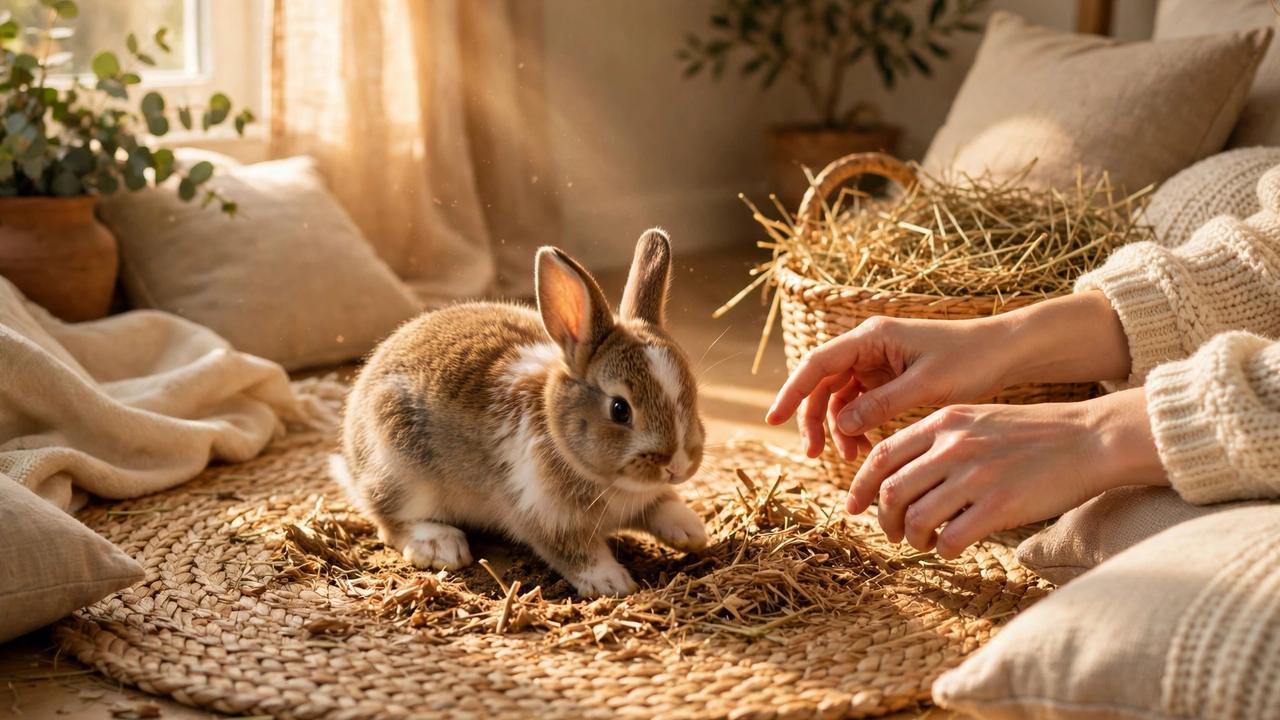
A pet rabbit does not dig at your carpet because it is being difficult. Digging is a normal, everyday behaviour for rabbits, and an indoor rabbit that has nowhere appropriate to use it will usually find somewhere inappropriate instead: a carpet corner, the base of a sofa, a rug you actually like, or the flooring of its own enclosure. The simplest fix is not to try to stop the digging. It is to give the rabbit a surface that is meant to be dug at, pulled apart, chewed and eventually replaced. That is exactly what a woven grass, straw, hay or seagrass mat is for, and it is why this guide to the best rugs for bunnies to dig is really a guide to sacrificial digging mats rather than to household rugs in the usual sense.
That distinction matters before you buy anything. A household rug, a bath mat or a piece of carpet tile may look like a digging surface, but the makers of those products do not list them for rabbits, and a rabbit that chews and swallows synthetic fibres, rubber backing or carpet pile is working against materials that were never intended to be eaten. Every product in this guide is the opposite kind of object. Each one is a mat that its maker lists for rabbits and other small pets, made from a natural plant fibre the maker describes as chewable, and sized to sit flat inside an enclosure, a pen or a digging corner. When a rabbit destroys one of these mats, it has not ruined a furnishing. It has used the product exactly as its maker describes it being used.
The six picks below cover the main shapes this product type takes. There is a single large woven grass mat from a long-established small-pet brand, a hand-woven timothy hay mat from a specialist hay company, a single seagrass mat that can be tied to a wire cage, and three multi-packs of smaller straw or grass mats in counts of three, twelve and eighteen. Between them they cover the lone rabbit in a cage, the pair in a pen, the determined digger who works through a mat quickly, and the owner who would rather lay several mats edge to edge to create one larger digging rug. Read the size of each mat carefully, because that, more than the fibre, is what decides whether a pick suits your setup.
Quick verdict
If you want one mat and you want it to cover a meaningful area, start with the Peter’s Woven Grass Mat for Rabbits, the largest single mat in this guide, or the Oxbow Timothy Hay Mat Large, which is hand-woven from timothy hay and is the pick most clearly built around a named hay rather than a generic grass. If your rabbit is a committed digger who shreds a mat rather than nibbling at it, the multi-packs are the practical answer: the PINVNBY Hay Mats for Rabbits 12 Pack and the Hamiledyi Hay Mats for Rabbits 18 Pack both give you a stack of same-sized replacement mats, so a finished mat is swapped out in seconds instead of becoming a bare patch of floor. The Sukh Bunny Mat for Rabbits 3 Pack is the smaller commitment in the same idea, useful if you want to find out whether your rabbit takes to woven mats at all before buying a bulk pack. The SunGrow Grass Chew Mat sits slightly apart from the rest: it is a single seagrass mat the maker describes as something you can zip tie to a wire cage, fold into shapes or use flat, which makes it the most adaptable pick here for owners who like to build enrichment rather than simply lay a mat down.
None of these mats is a permanent rug, and none should be bought expecting it to survive. They are consumable enrichment. The real choice is between fibre, footprint and pack size, and the sections below work through each pick on those terms so you can match a mat to your rabbit’s digging style and your enclosure’s floor space.
The products in this guide
Oxbow Timothy Hay Mat Large
It as hand-woven from 100 percent premium timothy hay, and lists it for rabbits, guinea pigs, chinchillas and rats
Every product in this guide had to pass the same checks. First, the product had to be a mat or rug format that a rabbit can dig at while it lies flat, not a house, a tunnel, a ball or a hanging toy. Some of the mats below can be rolled or folded into other shapes, and their makers say so, but each one is sold and sized as a flat mat first, which is what this keyword asks for. Second, the maker had to list the product for rabbits specifically, not merely for small animals in general, and had to list a natural plant material: grass, straw, timothy hay or seagrass. Third, the maker had to publish usable specifications, meaning at minimum the material, the dimensions and the intended pets, so that a buyer can judge fit before ordering. Products whose pages gave no dimensions or no material were left out entirely rather than written up from guesswork.
Fourth, each pick had to be a real, currently listed product with an identifiable brand, product name and model reference where the listing provides one. Where a listing gives a model number, that number is recorded in the product list that accompanies this article. Fifth, we spread the final six across different buying situations instead of filling the guide with near-identical packs. That is why there are two single mats of different sizes and fibres, one single seagrass mat with a different set of listed uses, and three packs of three, twelve and eighteen. A guide that listed six bulk straw packs would be accurate and useless; the differences in footprint and pack count are the differences that change what an owner actually does day to day.
One more note on language. Throughout this article, specifications are phrased as what the maker lists, because those listings are the source. Where a maker describes a mat as edible, chewable or suitable for a particular animal, that is the maker’s description of its own product. We have not added claims of our own about any mat, and we have not treated any mat as a food, a medicine or a substitute for the hay that should already form the bulk of a rabbit’s diet.
The Peter’s mat is the most straightforward product in this guide and, for a lot of owners, the most useful starting point. It is a single flat mat of natural woven grass, and the maker lists it for rabbits, for use inside or outside the cage. The maker’s own product sheet for this model describes it as a natural woven grass mat for rabbits and most small animals, lists it as safe to chew in the maker’s words, and describes it as a way to cover a wire cage bottom. That wire-bottom use is worth understanding, because it explains the mat’s shape: it is a floor covering first and a toy second, so it lies flat and stays a defined rectangle for a rabbit to work at with its front paws.
Size is this pick’s clearest advantage. The maker lists product dimensions of 12 x 18 inches, which is a substantially bigger single footprint than the roughly 11 x 8 inch mats that make up most of the multi-packs below. One mat therefore covers a digging corner on its own, rather than needing three or four mats butted together with gaps a rabbit can catch a claw in or push apart. For a larger rabbit, or for a bonded pair who dig side by side, that single continuous surface is a genuine practical difference, and it also makes the mat a reasonable choice as a defined digging rug on a hard floor in a pen, where it marks out the spot the rabbit is invited to dig.
Brand: Peter’s, manufactured by Marshall Pet Products
Model: RGP-529
Material the maker lists: natural woven grass; the maker’s product sheet lists the ingredient as orchard grass
Dimensions the maker lists: 1 x 12 x 18 inches
Intended pets the maker lists: rabbits and most small animals
Listed uses: inside or outside the cage, covering wire-bottom cages, chewing
Pros
Largest single-mat footprint in this guide, so one mat makes a complete digging area
Made by an established small-pet manufacturer with a published product sheet for the model
Simple single-fibre woven grass construction with no extra parts or attachments
Listed for use both inside and outside the cage, so it works in a pen as well as a hutch
Cons
Sold as a single mat, so a fast digger means reordering rather than reaching for a spare
No multi-pack option in this listing for owners who get through mats quickly
Thin woven format offers digging and chewing texture rather than cushioning
Buy it if: you want one generously sized digging rug for a cage, hutch or pen corner and you would rather replace a single mat occasionally than store a stack of them.
Skip it if: your rabbit demolishes a mat in a day or two, in which case a twelve or eighteen pack will suit your routine better.
Oxbow is a hay specialist, and this mat is the one pick here built around a single named hay. The maker lists it as hand-woven from 100 percent premium timothy hay, and lists it for rabbits, guinea pigs, chinchillas and rats. Where several other mats in this guide are described by their makers simply as grass or straw, this one’s material is the same hay many owners already feed, which makes it an easy product to understand: it is a woven slab of timothy hay that a rabbit can rest on, dig at, pull apart and chew.
The maker also lists construction details that are not present on most competing listings. It states that the mat is made without wires, threads or synthetic additives, which matters for a product designed to be pulled apart strand by strand, because there is no internal structure left behind once the hay is gone. The maker lists the mat as versatile in placement too: laid flat, folded as a tunnel shape, or hung for enrichment. For digging specifically, flat is the configuration that counts, and at the listed large size it gives a broad area. The maker lists product dimensions of 15.75 x 11.42 x 0.75 inches, so this is also the thickest mat in the guide on paper, with a depth that gives a rabbit’s paws something to work into rather than a flat sheet to slide around.
Brand: Oxbow, manufactured by Oxbow Animal Health LLC
Model: 744845403168
Material the maker lists: 100 percent timothy hay, hand-woven
Dimensions the maker lists: 15.75 x 11.42 x 0.75 inches
Intended pets the maker lists: rabbits, guinea pigs, chinchillas and rats
Listed construction: no wires, threads or synthetic additives, per the maker
Pros
Single named material, timothy hay, rather than an unspecified grass mix
Thickest listed profile in this guide, giving more material to dig into
Maker explicitly lists the absence of wires, threads and synthetic additives
Can be laid flat, folded or hung, per the maker, so one product covers several enrichment jobs
Cons
Single mat only, so there is no spare when a rabbit works through it
Hay construction is loose compared with tightly woven seagrass, so determined diggers may spread it widely
Loose strands travel, so expect hay debris beyond the mat’s edges
Buy it if: you prefer a mat from a hay specialist, made from a hay you can name, and you want the thickest digging surface in this guide.
Skip it if: you want a tightly woven mat that holds its shape for a long time, or you need several mats at once for a large enclosure floor.
The SunGrow mat is the seagrass pick. The maker lists it as hand-woven seagrass and nothing else, describes it as edible in the maker’s own words, and lists it for rabbits and other small pets including guinea pigs. Seagrass is the fibre to look at if you have handled the straw mats and found them too loose: a seagrass weave tends to be presented by its makers as a tighter, flatter mat, and this listing describes a mat that stays flat and intact when placed as an additional flooring pad inside a cage.
What really separates this product is the range of uses its maker lists for a single small mat. The listing describes zip tying the mat to a wire cage, using it as a flat cage or floor mat, hiding treats between sheets, and putting strings at the ends to make a hammock shape. That makes it less of a floor rug and more of a building material for enrichment, which will appeal to owners who rotate setups. As a digging rug specifically, the honest limitation is size. The maker lists the mat at 7.8 x 11 inches, which is a modest footprint for a rabbit’s front paws, closer to a personal digging patch than a digging area. Owners with a large rabbit, or a rabbit who digs with its whole body, will likely want two side by side or should look at the Peter’s or Oxbow mats instead.
Brand: SunGrow, manufactured by Luffy Pets Collection
Model: 4334833796
Material the maker lists: seagrass, hand-woven
Dimensions the maker lists: 7.8 x 11 x 0.1 inches
Intended pets the maker lists: rabbits, guinea pigs and other small pets
Listed uses: cage flooring pad, chew mat, zip tied to a wire cage, treat hiding, hammock shape
Pros
Seagrass rather than straw or hay, for owners who want a different fibre and weave
Widest range of listed uses in this guide, including attaching it to a wire cage
Single mat format suits adding one digging patch to an existing setup
Thin, flat profile sits neatly under other enclosure furniture
Cons
Smallest footprint among the single mats here, so big diggers may find it limiting
Sold singly, so covering a pen floor means buying several individual mats
Very thin listed profile gives less material depth to dig into than the Oxbow mat
Buy it if: you like to build and change enrichment, want a seagrass mat you can fix to a cage as well as lay flat, and your rabbit is small to medium sized.
Skip it if: you want maximum digging area from one purchase, or a thick mat with a lot of material to pull apart.
PINVNBY’s twelve pack is the workhorse option. The maker lists each mat as made from 100 percent natural dry straw, handwoven, and lists the pack as twelve mats each measuring approximately 11 x 8.3 x 0.2 inches. The maker’s description is unusually direct about what rabbits do with these mats, describing them napping on a mat and spending time chewing it, digging at it, biting it and pulling it apart. That is precisely the behaviour this guide is about, and a twelve count is a sensible quantity for it: enough mats to lay three or four at once as a tiled digging rug and still hold a stock of replacements.
The maker also notes that the mats can be cut freely and placed inside a pet cage, which is a genuinely useful detail for owners with oddly shaped enclosures, litter corner cut-outs or a digging box with internal dimensions that no standard mat matches. The maker lists the mats for guinea pigs, rabbits, chinchillas, hamsters, cats, hedgehogs and other small animals, so in a mixed small-pet household one pack covers several enclosures. The trade-offs are those of any thin straw mat. At a listed 0.2 inches thick there is less to dig into than the Oxbow mat offers, and straw mats soften and break down once they get damp, so they belong in the dry part of an enclosure rather than beside a water bowl or in a litter area.
Brand: PINVNBY
Model: 12 Pack
Material the maker lists: 100 percent natural dry straw, handwoven
Dimensions the maker lists: 11 x 8.3 x 0.2 inches per mat
Intended pets the maker lists: rabbits, guinea pigs, chinchillas, hamsters, hedgehogs and other small animals
Listed uses: cage bedding and resting mat, chewing, digging, nesting; maker lists that mats can be cut to fit
Pros
Twelve same-sized mats let you tile a larger digging rug and keep spares ready
Maker lists that the mats can be cut, which helps with awkward enclosure shapes
Maker’s own description names digging and pulling apart as expected uses
One pack can serve several different small-pet enclosures
Cons
Thin listed profile, so each individual mat is a short-lived digging surface
Individual mats are modest in size, so a single mat alone is a small digging patch
Straw needs a dry spot in the enclosure and will not suit a damp corner
Buy it if: your rabbit digs enthusiastically and often, and you want a ready stack of replacements plus enough mats to tile a bigger digging area.
Skip it if: you only want to try one mat to see whether your rabbit is interested at all.
Hamiledyi’s eighteen pack is the largest count in this guide, and it is aimed squarely at households that go through mats as a routine consumable. The maker lists the mats as natural straw, hand-woven, with each mat measuring approximately 11.02 x 7.87 x 0.35 inches, and describes the set as usable as a cage lining and as a chew toy, with pets digging at a mat, biting it and pulling it apart. With eighteen in hand, an owner can line a whole enclosure floor, set up a dedicated digging corner in a pen, and still not be counting the remaining mats.
Two listed details add flexibility. The maker describes tying rope to the end of a mat to make a hammock shape, or rolling a mat into a tunnel shape, so the same stock of mats can be rotated between floor duty and other enrichment rather than sitting in one role until it is finished. The maker also lists simple care for these mats: if a pet urinates on one, rinse it quickly with water and air dry it. That is the maker’s instruction for this product, and it is worth following literally rather than soaking or scrubbing a woven straw mat, which would loosen the weave. The maker lists the mats as suitable for guinea pigs, rabbits, chinchillas, hamsters, hedgehogs and squirrels, so this is also the pack to consider if several species share your home and you are tired of buying different mats for each.
Brand: Hamiledyi
Model: 18 Pack
Material the maker lists: natural straw, hand-woven
Dimensions the maker lists: 11.02 x 7.87 x 0.35 inches per mat
Intended pets the maker lists: rabbits, guinea pigs, chinchillas, hamsters, hedgehogs and squirrels
Listed uses: cage lining, chew toy, digging, rolling into a tunnel shape, tying as a hammock shape
Pros
Biggest pack count here, which suits heavy diggers and multi-pet households
Slightly thicker listed profile than the other straw multi-pack in this guide
Maker lists rinse and air dry care for a soiled mat
Mats can be redeployed as tunnel or hammock shapes, per the maker
Cons
Eighteen mats need storage space, and straw should be stored dry
Individual mat size is still modest, so a digging rug means laying several together
More mats than a rabbit with only a mild interest in digging will ever need
Buy it if: you have a determined digger, more than one rabbit, or several small pets, and you want mat replacement to be a non-event for a long stretch.
Skip it if: storage is tight or your rabbit has never shown interest in a woven mat, in which case start with the three pack below.
The Sukh three pack fills the gap between buying a single mat and committing to a bulk box. The maker lists the product as a woven grass rabbit mat in a pack of three, with each mat at 7.8 x 11 inches, and lists it for rabbits, guinea pigs and chinchillas, as well as for birds, kittens and puppies. The maker describes a smooth surface that is comfortable to step on, and describes the mats as breathable and ventilated, positioning them as cage bedding as much as as a toy. For digging, the maker’s own description is the relevant part: it says that if a pet loves to dig and chew, these straw mats are ideal, and that small birds forage on them too.
Three mats is a well-judged trial quantity. One mat goes down as the digging rug, the second is a spare for the day the first is finished or soiled, and the third tells you, by whether you reach for it quickly, whether your rabbit is a mat rabbit at all. The maker is also candid about a limitation worth repeating: because this is a hand woven product, each mat is not exactly the same size, and the maker says the size may vary by up to an inch or less. Plan for that if you intend to tile mats edge to edge in a measured space, and treat the listed dimensions as approximate rather than exact. Hand woven variation is normal across this whole product category, but Sukh is the maker here that states it plainly, which makes planning easier.
Brand: Sukh
Model: GrassMat-03
Material the maker lists: woven grass
Dimensions the maker lists: 7.8 x 11 inches per mat, with the maker noting hand woven size variation of up to an inch or less
Intended pets the maker lists: rabbits, guinea pigs, chinchillas and other small animals
Listed uses: cage bedding, digging, chewing and foraging surface
Pros
Three mats is an ideal trial quantity with a built-in spare
Maker states the hand woven size variation openly, so expectations are realistic
Listed as breathable bedding as well as a digging and chewing surface
Small pack is easy to store and easy to move between enclosures
Cons
Only three mats, so a committed digger will exhaust the pack quickly
Size variation makes precise tiling in a measured enclosure less predictable
Individual footprint is at the smaller end of this guide
Buy it if: you are introducing a digging mat for the first time and want to learn your rabbit’s habits before buying in bulk.
Skip it if: you already know your rabbit shreds mats fast, in which case the twelve or eighteen packs are the more sensible routine.
Buying guide
Start with footprint, not fibre. Digging is a whole-body behaviour. A rabbit braces, reaches forward with both front paws and pulls material back toward itself, often turning as it works. A mat that is only slightly wider than the rabbit gives it a patch to scratch at; a mat with room around the rabbit gives it a place to dig. Measure the space you actually have, whether that is the floor of a cage, a corner of a pen or the inside of a digging box, and then work out how many mats of a given listed size fill it without leaving large gaps. For a single-mat solution, the Peter’s mat at a listed 12 x 18 inches and the Oxbow large mat at a listed 15.75 x 11.42 inches are the two picks here designed to do that job alone. For everything else, plan on tiling.
Understand the fibres as their makers describe them. Timothy hay, as in the Oxbow mat, is a feed hay woven into a mat, so it is the option that most closely resembles the material a rabbit already eats and pulls at in a hay rack. Straw, used in the PINVNBY and Hamiledyi packs, is a drier, stiffer stalk material that makers weave into thinner, flatter mats sold in quantity. Grass, in the Peter’s and Sukh mats, is the general woven plant fibre of this category. Seagrass, in the SunGrow mat, is listed by its maker as a hand-woven mat that stays flat, with a wider range of listed ways to fix and fold it. None of these is objectively correct. A rabbit that ignores a straw mat may work enthusiastically at a hay mat, and the only reliable way to find out is to offer one and watch. That is the practical argument for starting with a three pack or a single mat rather than a bulk box.
Match pack size to digging intensity. Owners tend to underestimate how fast a motivated rabbit finishes a thin woven mat. If your rabbit already digs at carpet, digs in its litter or rearranges bedding into piles, treat mats as a weekly consumable and buy the twelve or eighteen pack. If your rabbit is calmer and mostly chews edges, a single larger mat may last far longer and the multi-packs become unnecessary storage. Also think about how many separate places you want a digging surface. Many owners find that one mat in the enclosure and one in the exercise pen solves most unwanted digging, because the rabbit has an approved place to dig in each area it spends time in.
Place the mat where the digging already happens. Rabbits are creatures of chosen corners. If your rabbit digs at one end of the pen, put the mat there rather than where it looks tidy. Inside an enclosure, put the mat in a dry area away from the water bowl and the litter corner, since woven plant mats soften and break down when they stay damp. On a hard floor, a mat also gives a rabbit purchase for its paws, which is part of why a mat in a pen gets used: digging on a slippery surface is unsatisfying. If a mat slides, place it inside a shallow box or tray with low sides. A digging box arrangement, with a mat at the bottom, contains the strands a rabbit pulls loose and turns a mat into a dedicated digging station that can be lifted out and shaken clean.
Introduce, observe and replace. Put the mat down and let the rabbit investigate it in its own time. Some rabbits dig immediately; others chew an edge first, drag the mat to a preferred spot, or sit on it and ignore it for a day. All of that is normal. Check the mat daily. Remove and replace it when it is pulled into loose strands, heavily soiled or damp, rather than leaving a disintegrating mat in the enclosure. Follow the individual maker’s care wording where it is given, as Hamiledyi gives for its mats, and otherwise keep woven mats dry, shake loose debris off outdoors, and store spares somewhere dry so they do not pick up damp or odours before they are used.
Keep expectations and boundaries clear. A digging mat is enrichment and flooring, not food and not a health product. Your rabbit still needs unlimited hay available separately, and a mat should never be the only thing it has to chew. Equally, a digging mat will redirect a lot of digging but it will not reprogram a rabbit. Expect some digging at other surfaces to continue, especially in new spaces, and treat the mat as the main tool rather than a complete solution. Finally, supervise first use with any new material, and if your rabbit is eating large amounts of any mat very quickly rather than digging and nibbling, remove it and talk to your rabbit’s vet about the behaviour, because that pattern is about your individual rabbit rather than about the product.
FAQ
Is a woven grass mat really a rug for a bunny?
In practical terms, yes. It is a flat, defined floor covering that a rabbit stands on, rests on and digs at, which is the job a rug does in this context. It is not a decorative household rug, and it is not meant to last. Think of it as a disposable rug whose whole purpose is to be dug, chewed and replaced, so that your actual rugs and carpets are not.
How long does one digging mat last?
There is no honest single answer, because it depends on the rabbit and on the mat’s thickness and size. A thin straw mat offered to a determined digger can be pulled apart quickly, while a thicker or larger mat offered to a calmer rabbit can remain in service far longer. That spread is exactly why this guide includes single mats and packs of three, twelve and eighteen: buy the quantity that matches the rabbit you actually have.
Can I put several small mats together to make one big digging rug?
Yes, and it is one of the best reasons to buy a multi-pack of same-sized mats. Lay them edge to edge in a pen corner or inside a shallow box or tray, which keeps the edges from separating as the rabbit works. Bear in mind the size variation that Sukh lists for its hand woven mats, and expect small differences between individual mats in any hand woven pack.
Where in the enclosure should a digging mat go?
In a dry spot, away from the water bowl and the litter area, and ideally in the corner your rabbit already favours for digging or resting. Woven plant fibres soften when they stay damp, so a dry placement keeps a mat in usable condition for longer and makes it more pleasant for the rabbit to lie on.
What is the difference between a hay mat and a seagrass mat for digging?
The material and the way the maker describes it. The Oxbow pick is hand-woven from timothy hay, a feed hay, and its maker lists it as made without wires, threads or synthetic additives. The SunGrow pick is hand-woven seagrass, and its maker lists extra ways to use it, including zip tying it to a wire cage and folding it into other shapes. Both are listed by their makers for rabbits to chew and dig at; the choice usually comes down to size, thickness and whether you want those extra fixing options.
My rabbit drags the mat around instead of digging on it. Is that a problem?
No. Dragging, rearranging, sitting on and chewing a mat are all normal ways rabbits interact with a new object in their space, and many rabbits start digging at a mat after they have moved it to a spot they prefer. If the movement itself bothers you, place the mat inside a shallow box or tray so it stays roughly where you put it while still being fully available to dig at.
Conclusion
A good digging rug for a bunny is a mat the maker built to be destroyed: natural woven fibre, sized for the space, listed for rabbits, and cheap in effort to replace. Choose the Peter’s Woven Grass Mat for Rabbits for the biggest single footprint, the Oxbow Timothy Hay Mat Large for a thick mat woven from a named hay, the SunGrow Grass Chew Mat for seagrass versatility, the PINVNBY 12 Pack or the Hamiledyi 18 Pack for a steady supply of replacements, and the Sukh 3 Pack if you are finding out what your rabbit likes. Put the mat where your rabbit already wants to dig, keep it dry, replace it when it is finished, and the digging goes where you chose instead of into your carpet.
M
Modern Line Home Editorial Team
We compare specs, materials and verified owner reviews before a product earns a spot. Rankings are never paid.
Affiliate disclosure. As an Amazon Associate we earn from qualifying purchases at no extra cost to you. Prices accurate as of the date shown.
House cold even with the heat on? Walk this ordered checklist: thermostat and filter first, then drafts, insulation, leaky ducts and a failing heating system.
Windows fogging up in winter? Check where the fog sits: on the room side it is indoor humidity, outside it is harmless, and between panes the seal has failed.
Store the main firewood pile about 30 feet from your house, off the ground and covered only on top. Compare racks, woodsheds, garages and indoor spots safely.
Place a portable generator outdoors only, at least 20 feet from windows, doors and vents, exhaust pointed away. Exact distances, setup steps and CO rules here.
Keep houseplants in the right winter spot: match window direction to plant type, stay clear of radiators and cold glass, and fix dry air and low light at home.
Mice enter through pencil-width gaps at foundations, pipes, vents, doors and the roofline. Walk this room-by-room winter checklist to find and seal each one.
A winter outage timeline: what to do in the first hour, first night and multi-day outage, with food safety times, pipe protection, heat and CO safety steps.
Size a space heater by room area: 10 watts per square foot at 8-foot ceilings, adjusted for insulation and ceiling height, with full wattage and BTU tables.
Start dripping at about 20 degrees, sooner for exposed pipes. Set a pencil-lead stream, drip the right faucets on both lines, and know when to stop safely.
A fridge needs 800-1,200 starting watts, not just 150-400 running watts. Use the tables to total your fridge plus freezer, lights, furnace fan and more today.












Write Your Review
No reviews yet. Be the first to share your experience!