We independently review everything we recommend. When you buy through our links, we may earn a commission. As an Amazon Associate we earn from qualifying purchases.
Best Rolling Storage Bins for Bulky Winter Bedding
Rolling bins that swallow thick duvets and wool blankets, then glide away. Compare wheeled Sterilite, Budding Joy and large-capacity totes for winter bedding.
Rolling bins that swallow thick duvets and wool blankets, then glide away. Compare wheeled Sterilite, Budding Joy and large-capacity totes for winter bedding.
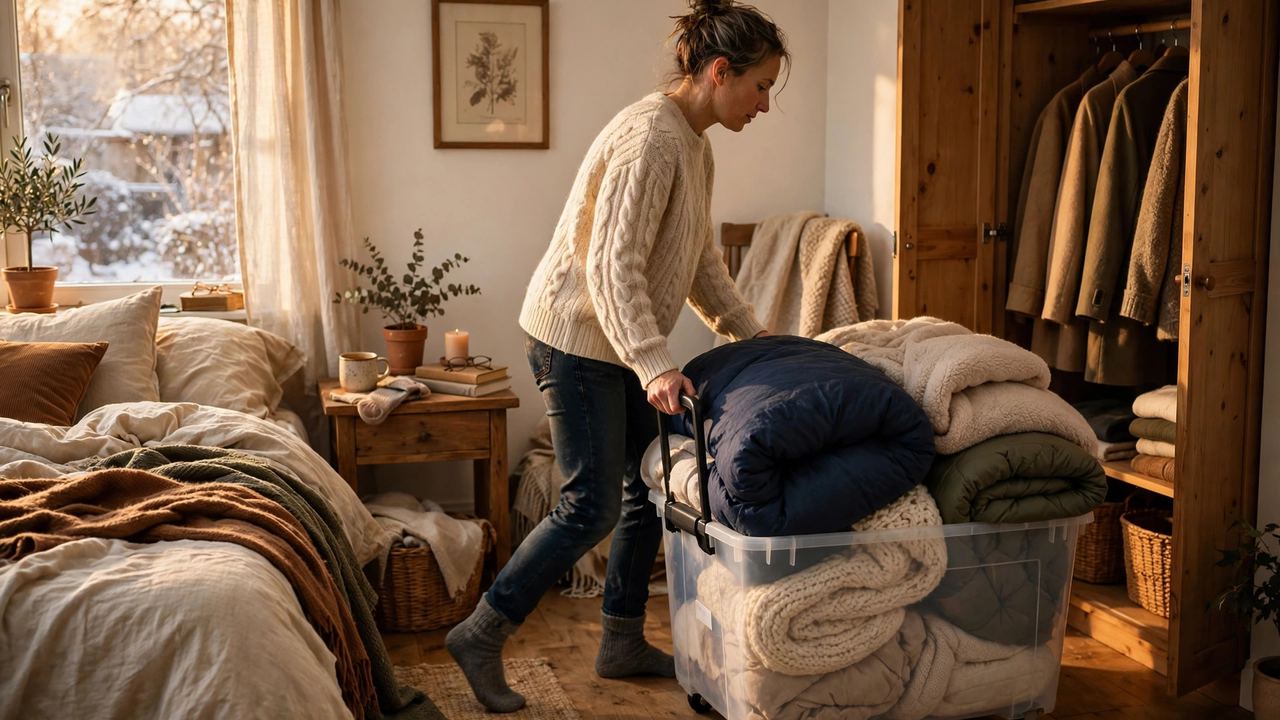
Winter bedding is the hardest soft storage in the house. A single thick duvet can fill a standard tote on its own, wool blankets arrive in heavy stacks, and spare pillows refuse to compress into the neat rectangles that closet shelves seem designed for. Dragging all of that in a rigid box across a bedroom floor, or lifting it onto a high shelf twice a year, is exactly the job wheels were invented for. This guide to the best rolling storage bins for bulky winter bedding focuses on bins that do three things at once: they open wide enough to accept genuinely bulky loads without a wrestling match, they hold their shape when those loads are heavy, and they roll — under a bed, across a closet floor, or down a hallway to a basement or attic — instead of needing to be carried.
Two broad families appear in the picks below, and choosing between them is the first real decision. Low, long wheeled boxes are made to slide under a bed frame, turning dead space into a seasonal store that you can pull out with one hand when the temperature drops. Tall, large-capacity rolling totes take the opposite approach: they stand in a closet, garage, basement or spare room, swallow several bedding sets at once, and roll to wherever the load needs to go on bigger wheels and pull handles. Both approaches beat a soft bag you have to haul, but they suit different homes, different floors and different amounts of bedding, and the sections that follow are organised to help you match the format to your space before you match a model to your budget of room.
Quick verdict
For most bedrooms, start with a wheeled underbed box. The Sterilite 56 Qt Wheeled Latching Box is the most straightforward pick: a clear, latched, low-profile box that the maker lists at 56 quarts, sized to roll under beds and across closet floors while keeping blankets, linens and seasonal clothing visible and contained. If you want the same idea with a little more room per box and a clear lid as well as a clear base, the Sterilite 60 Qt ClearView Latch Wheeled Underbed Box steps up to a figure the maker lists at 60 quarts, in a similarly low 7-inch profile.
If your bed frame sits higher, or you would rather adjust a bin to the clearance you actually have, the Budding Joy 80L Adjustable Under Bed Storage with Wheels is the flexible option. The maker lists an 80-litre capacity per bin, a height that adjusts upward from its wheeled base height, six rotating casters with locking wheels among them, and a clear window so you can see which bedding set is inside without unzipping it. It is a fabric-bodied bin rather than rigid plastic, so it folds flat when empty — a real advantage if storage for the storage is also tight.
Households packing away bedding for several beds at once should look at the standing totes. The JBBTOOL 180L Extra Large Storage Box with Wheels is a tall fabric chest that the maker lists at 180 litres, built for whole-household loads rather than one duvet at a time. The YHNNH 40 Gallon Industrial Storage Tote with Wheels is the rigid, heavy-duty route: the maker lists a 40-gallon capacity, channeled walls, grip latches and large wheels on a metal axle, in a set of two. The Ratoyal 160 Quart Extra Large Wheeled Storage Boxes close the list with the largest rigid figure here — the maker lists 160 quarts per box in a two-pack of clear, latching, wheeled containers with a pull handle, aimed at garages, basements and attics as much as bedrooms.
The products in this guide
Sterilite 56 Qt Wheeled Latching Box
The Sterilite 56 Qt Wheeled Latching Box is the classic answer to winter bedding that needs to disappear under the bed until the cold returns
Large wheels on a metal axle, ergonomic pull handle, latching lids
The biggest rigid loads, stacked in storage rooms
How we selected
Every pick in this guide had to pass the same gates, starting with the most basic one: the product had to be a real, named model from an identifiable brand, sold new, with a live offer on its Amazon product page at the time of checking. Listings that showed no live featured offer were excluded and replaced, however good the specifications looked on paper, because a bin you cannot actually buy in new condition is not a useful recommendation. Each model was then checked on its opened product page for the details that matter to this job — capacity, outside dimensions, wheel type, lid or closure type, and the materials the maker lists — and only details stated on those opened pages are reported here, phrased as what the maker lists rather than as measurements taken in a home.
Capacity alone did not earn a place. Bulky winter bedding needs usable, wide-mouthed volume, so we favoured bins whose openings and interior dimensions let a folded duvet go in flat rather than being forced through a narrow slot, and we treated headline capacity as a starting point rather than a promise: a soft, lofty load fills a bin very differently from the same weight of folded sheets. Wheel design mattered just as much. Small glide wheels suit a low box that only travels a few feet out from under a bed, while large wheels on a metal axle and a proper pull handle are what make a fully loaded 40-gallon tote realistic to move across a garage floor. Locking casters earned credit for bins that will stand on hard floors, where a loaded bin that creeps is a nuisance.
We also balanced the list deliberately across formats and rooms. A household with one guest duvet and a low platform bed needs something completely different from a household stripping four beds every spring and stacking the results in a basement. So the final six include two low rigid underbed boxes from the same long-running storage maker in two sizes, one adjustable fabric underbed bin, one tall fabric chest, and two large rigid rolling totes at different capacities. If a format is missing — vacuum storage bags, for example — that is because a vacuum bag does not roll, and rolling is the whole point of this keyword: the load moves on wheels, not on your back.
The Sterilite 56 Qt Wheeled Latching Box is the classic answer to winter bedding that needs to disappear under the bed until the cold returns. The maker lists a 56-quart capacity, outside dimensions of 33 7/8 by 18 3/4 by 7 inches, and interior dimensions of 30 1/8 by 15 7/8 by 6 1/4 inches. That long, low interior is the right shape for this job: a folded winter duvet, a pair of heavy blankets, or a stack of flannel sheets and a spare pillow can lie flat instead of being rolled into a tight ball, which keeps loftier bedding in better condition and makes the contents far easier to survey when you pull the box out in autumn.
The clear construction does quiet, everyday work here. Because the base is transparent, you can identify which box holds the guest bedding and which holds your own without opening either lid — a small thing in March that becomes a large thing on the first cold night of the year. The maker lists a latching lid, and describes it as opening smoothly for one-handed access while keeping stored items protected and contained. For bedding, that latch matters more than it might for shoes or paperwork: a lid that merely rests on top can be pushed up by a springy duvet, while a latched lid stays shut and keeps dust off fabric that will sit against skin months later.
Rolling is the headline feature, and the maker describes smooth-rolling wheels that let the box glide out from under a bed and roll on closet floors. In practice, that changes how the storage gets used. A box you can pull out with one hand gets opened, checked and reorganised; a box you have to drag tends to become a sealed time capsule. The maker positions this model for lightweight household storage — shoes, folded clothing, blankets, bed linens, accessories and seasonal items — and that positioning is honest guidance for bedding use: fill it with duvets and blankets, which are bulky but not especially heavy, rather than treating it as a crate for dense loads. Sold in a multi-pack format on the listing we checked, it also suits the natural way people store winter bedding, which is rarely one box but two or three, sorted by bed.
Buy it if: you want a proven, low, clear underbed box for one or two beds’ worth of winter bedding, you value seeing the contents without opening the lid, and your bed clearance can accept a box the maker lists at 7 inches high.
Skip it if: your bed frame sits lower than that profile, you need to move bedding between rooms or floors rather than just out from under a bed, or your load is a whole household’s bedding that would be better served by one of the large standing totes below.
The Sterilite 60 Qt ClearView Latch Wheeled Underbed Box is the step-up sibling in this list: a little more capacity in a very similar footprint. The maker lists assembled dimensions of 34 5/8 inches long, 18 3/4 inches wide and 7 inches high, and a 60-quart capacity. That extra length and volume over the 56-quart box is not dramatic on paper, but bedding is exactly the category where a small dimensional gain decides whether a thick duvet lies flat or has to be forced — and forcing is what strains lids, bulges sides and makes a box unpleasant to close twice a year.
What distinguishes the ClearView design is visibility from every side. The maker lists a transparent base and a clear lid, so contents can be viewed from any angle, and describes colourful latches that firmly snap the lid to the base to keep contents contained and protected from dust and debris. For winter bedding, that combination — see it, then trust the lid to stay shut on it — is the whole underbed proposition. You can slide the box partway out, confirm through the lid that this is the wool blanket set rather than the summer quilts, and push it back without breaking the seal or letting a season of dust in.
The wheeled underbed format is central to this model as well: the maker describes smooth-gliding wheels on the underbed box that make it easy to slide out from under beds or furniture to reach stored items without lifting. A fully loaded 60-quart box of winter bedding is not heavy in the way a book box is heavy, but it is awkward — wide, soft and resistant to being gripped — so rolling rather than carrying is a genuine ergonomic gain, particularly on the spring and autumn changeover days when several boxes move at once. The maker also notes the ClearView line is made with BPA-free and phthalate-free materials, and that the indexed style of lid in this family supports stacking, which helps if you prefer to stack filled boxes in a closet during the months when the bed itself is dressed for summer and the underbed space is doing other work.
Buy it if: you like the underbed format but want the clearest possible view of what is inside, a clear lid as well as a clear base, and the slightly larger of the two Sterilite boxes compared here.
Skip it if: your underbed clearance is under the 7-inch height the maker lists, you store bedding somewhere with rough floors where a larger-wheeled tote would roll better, or a fabric bin that folds away when empty fits your space better.
The Budding Joy 80L Adjustable Under Bed Storage with Wheels solves the problem that defeats many underbed purchases: not knowing, or not being able to change, the exact clearance under the bed. The maker lists dimensions of 31.5 by 15.75 by 9.45 inches with wheels, a height that adjusts from 9.45 inches up to 11.02 inches to fit most bed frames, and an 80-litre capacity per bin in a two-pack. That adjustability cuts both ways in a useful direction — set it low for a standard frame, or raise it to use the full depth under a higher frame instead of wasting the top few inches, which is where an extra folded blanket either fits or does not.
Its rolling gear is the most elaborate in this guide. The maker lists six 360-degree rotating casters that glide on hardwood, tile or carpet, with two wheels having a locking function. Six casters spread a soft, shifting load better than four small glide wheels, the full rotation means the bin can be steered sideways out of a tight underbed bay rather than only pulled straight, and the locks stop a loaded bin creeping on a hard floor when you are packing it. For winter bedding — light for its size, but prone to shifting its weight as you push it — that steering control is worth more than raw speed.
The body is fabric rather than rigid plastic, and the maker describes a non-woven fabric that is tear-resistant and waterproof, reinforced handles with double-stitched edges, a PVC transparent lid so contents can be identified without opening, labels for marking what is inside, and sturdy zippers on the top. It assembles without tools, the wheels are removable, and the bin folds flat when not in use. Those traits make it the natural pick for renters, dorm-style rooms and anyone whose storage needs change with the season: in summer, when the winter bedding is in the bin, it works hard; in the months when a bin is empty, it disappears instead of occupying a closet corner. The trade-off to accept is structure — a fabric bin relies on being reasonably well filled to hold its shape, so it rewards packing a duvet in fully rather than storing one thin blanket rattling around inside.
Buy it if: your bed frame is higher than a rigid 7-inch box can exploit, you want locking, steering casters, and you value a bin that folds flat and assembles without tools when the season turns.
Skip it if: you want rigid walls that protect bedding from being crushed by anything stacked on top, your clearance is genuinely low, or you prefer a latched hard lid to a zippered fabric top.
The JBBTOOL 180L Extra Large Storage Box with Wheels changes the scale of the conversation. The maker lists a capacity of 180 litres — by far the largest figure in this guide — with dimensions in the product specifications of 31.5 by 15.7 by 23.2 inches, an Oxford cloth body, and wheels for rolling the loaded chest rather than lifting it. This is not an underbed bin and does not pretend to be: it is a tall, standing chest for a closet, spare room or storage corner, sized for the household that strips several beds at once and wants the winter duvets, blankets, towels and spare pillows in one place instead of distributed across four underbed boxes in four rooms.
That single-chest approach has real organisational advantages for bulky bedding. One large volume accepts items in the order you will want them back — the maker describes the extra-large chest as providing ample space for books, clothes, towels and blankets while keeping a room and floor tidy — and a tall opening lets you lower a folded duvet in flat and stack the next one on top, rather than feeding bedding through the long, shallow slot of an underbed box. When the chest is full, the wheels take the strain of the one journey it actually needs to make: from the room where you packed it to the corner where it will spend the season, and back again in autumn.
Because the body is Oxford cloth rather than rigid plastic, the same fabric caveats apply as with the Budding Joy bin, at a larger scale. It will flex around an oddly shaped load, which helps with pillows, and it will not crack if knocked in a crowded storage room. It will not, however, serve as a base for stacking other heavy boxes, and it offers no latched hard lid against a dusty garage environment. Treat it as indoor furniture-grade storage — a bedroom closet, a linen cupboard, a spare-room corner — and its capacity advantage is decisive. Treat it as a garage tote, and one of the rigid picks below is the honest recommendation instead.
Buy it if: you pack away winter bedding for several beds at once, you have closet or spare-room floor space for a tall chest, and you want the largest single capacity here in a body that flexes around pillows and duvets.
Skip it if: you need underbed storage, a rigid stackable body, or a sealed hard lid for a dusty basement, attic or garage.
The YHNNH 40 Gallon Industrial Storage Tote with Wheels is the heavy-duty rigid option, sold as a set of two. The maker lists a 40-gallon capacity per tote, overall assembled dimensions of 36.75 by 21.375 by 18 inches, and interior dimensions of 30.5 by 16 by 17.125 inches. Read those interior figures as a bedding buyer: a 30.5-inch-long, 17-inch-deep cavity takes folded king and queen duvets without folding them into thirds, and takes them in a stack, so a pair of these totes can absorb a household’s winter bedding with room left for the blankets and mattress toppers that never seem to fit anywhere.
Construction is where this tote separates itself from bedroom underbed boxes. The maker lists channeled walls for added strength, robust non-slip grip latches, and a tight-fitting drip-resistant lid. Channeled walls matter when a tote is filled, lifted by its ends, stacked, and rolled season after season; grip latches that bedding cannot push open matter when a springy load presses upward on the lid; and a drip-resistant lid is a sensible safeguard in the basements and garages where large totes realistically live. The maker also describes deep recessed lids that provide secure stacking, so the two totes in the set can stand as a stable column in a storage room rather than sprawling across its floor.
Its mobility is built for distance and imperfect floors, not for sliding a few feet on carpet. The maker lists large wheels with a metal axle that enable smooth rolling over rough surfaces, plus an ergonomic handle that rotates up for comfortable pulling. That is the right specification for the real winter-bedding journey in many homes: pack the tote in the bedroom, pull it along a hallway, across a garage floor or down to a basement, and stack it. A tote this size, fully loaded with dense wool blankets, is a two-handed carry at best and an injury risk at worst; on large wheels with a pull handle, it is a one-person job. Accept the obvious trade-off — at 18 inches high it goes nowhere near a bed frame — and this is the most workmanlike pick in the guide.
Buy it if: your winter bedding lives in a garage, basement or storage room, you move it a real distance twice a year, and you want rigid, latching, stackable totes with large wheels and a pull handle in a set of two.
Skip it if: you need underbed storage, you store bedding in a finished bedroom closet where an industrial tote looks and feels out of place, or your loads are small enough that a 40-gallon tote would travel half empty.
The Ratoyal 160 Quart Extra Large Wheeled Storage Boxes offer the largest rigid capacity in this guide, in a two-pack. The maker lists 160 quarts per box, dimensions of 36.75 by 21.35 by 18 inches, a clear plastic body with latching lids, and materials described as BPA-free and phthalate-free. That combination — very large, rigid, and clear — is distinctive. The industrial tote above hides its contents behind opaque walls, which is fine when you label it well; these boxes let you see at a glance, across a basement or attic, which one holds the duvets and which holds the blankets, without popping a single latch.
The maker describes these as jumbo boxes providing ample space for camping gear, bedding and seasonal items, with a rugged, stackable design, secure latches and deep recessed lids that enable safe stacking. For winter bedding, that stackability is the difference between a storage room that works and one that merely contains things: two boxes of this size, stacked, hold a great deal of bedding in the floor footprint of one. The clear base the maker lists adds a second visibility angle, useful when a stacked box can only be inspected from the side rather than from above.
Rolling hardware matches the scale. The maker lists an ergonomic pull handle and large wheels with a metal axle that allow smooth transport even on rough surfaces. As with the other large tote, the realistic use is seasonal migration: load the box where the bedding is, pull it to its storage place, stack it, and leave it until the weather turns. Large rigid boxes are not at their best being opened daily, and bedding does not ask them to be — it asks for volume, a lid that stays latched against a springy load, protection from dust, and a way to move the whole thing without emptying it first. On those four counts, this is the most complete large-format answer in the list, provided your storage space can accept an 18-inch-high box and your doorways and turns are wide enough for its length.
Buy it if: you want the biggest rigid, clear, latching boxes here, you store bedding in a garage, basement or attic, and you value seeing the contents of a stacked box without opening it.
Skip it if: you need low underbed storage, your storage route involves narrow turns or stairs that a long, loaded box cannot manage, or a fabric chest that flexes around awkward loads suits your space better.
Buying guide
Measure clearance before you measure capacity. The single most common failed storage purchase is a bin that does not fit the space bought for it. For underbed bins, measure from the floor to the lowest part of the bed frame or side rail — not to the mattress — and compare that figure with the wheeled height the maker lists, because wheels and casters add height that a headline box height may not include. The rigid Sterilite boxes here are listed at 7 inches high; the adjustable Budding Joy bin starts higher and adjusts upward, which makes it a pick for higher frames rather than lower ones. Leave a small margin: a bin that only just fits will scrape, stick, and eventually stop being used.
Match capacity to beds, not to ambition. As a working approach, think in terms of one bedding set at a time. A single thick winter duvet, or a duvet plus its matching blanket, is a realistic load for one underbed box in the 56- to 60-quart range or an 80-litre fabric bin. A household changing over three or four beds should either buy underbed boxes in the multi-packs they are sold in and sort by bed — the system that makes autumn easiest, because each box goes straight to its room — or consolidate into the large standing formats, the 180-litre chest or the 40-gallon and 160-quart totes, and accept one central store. What rarely works is the middle path of one medium bin expected to swallow everything: it ends up overfilled, its lid strained, and its contents creased.
Choose wheels for the floor they will actually cross. Small glide wheels and multiple small casters are designed for short, smooth journeys: out from under a bed, across a bedroom floor, back again. They steer well and keep a low profile. Large wheels on a metal axle, paired with a pull handle, are designed for distance and for thresholds, concrete, and the expansion joints of a garage floor. Neither is better in the abstract. A large-wheeled tote cannot go under a bed, and an underbed box should not be expected to tour a basement. Decide where the bin will live and how far it will travel on changeover day, and let that journey choose the wheel type. If a bin will stand on hard flooring while you pack it, locking casters — as listed on the Budding Joy bin — are a small feature you will appreciate every single time.
Rigid or fabric is a decision about what happens around the bin. Rigid plastic boxes protect their contents from being crushed, stack predictably, wipe clean, and keep a latched barrier against dust. They also occupy their full volume whether they are full, half full or empty. Fabric bins flex around pillows and odd shapes, often offer clear windows and labels, and fold flat when empty — but they depend on their contents for structure and should not have heavy boxes stacked on them. For a dedicated linen closet or storage room, rigid usually wins. For a rented room, a dorm-style space, or a home where storage needs swell and shrink with the seasons, fabric earns its place.
Pack bedding so the bin can do its job. Wash and fully dry winter bedding before it goes away, because a sealed or latched bin preserves whatever condition the fabric was in when the lid closed. Fold duvets flat to the interior dimensions of the box rather than rolling them tightly, keep one bed’s set together so a box maps to a room, and resist the temptation to sit on a lid to force it shut — a lid strained by an overfilled load is the lid that pops open in storage. Leave lofty items a little room: bedding that is stored with some air around it comes back fresher and regains its shape faster than bedding that spent six months compressed to the limit of a latch. Finally, label every bin, even a clear one. Clear walls show you fabric; a label tells you whose fabric, in which size, washed when — and that is the information you actually need on the first cold night.
FAQ
How many rolling bins do I need for a household’s winter bedding?
Plan on roughly one underbed-sized bin per bed for a duvet and blanket set, then adjust for how thick your bedding runs. Very lofty duvets may need a bin to themselves, while children’s bedding and spare blankets pack more densely. Households with three or more beds often find a pair of large standing totes or one extra-large chest simpler than a fleet of small boxes, because everything lives in one store and rolls in one or two journeys.
Will a wheeled underbed box fit under a low platform bed?
Only if the clearance is genuinely there. Measure from the floor to the lowest rail and compare it with the full wheeled height the maker lists — 7 inches for the rigid Sterilite boxes in this guide, and more for the adjustable fabric bin. If your frame sits lower than that, do not force it: use the floor space in a closet with a standing rolling tote instead, or store the bedding on a closet shelf and keep wheels for the journey with a large tote.
Are fabric rolling bins sturdy enough for heavy wool blankets?
They can be, within the role they are designed for. The fabric picks here use reinforced construction — a metal-reinforced approach in the underbed category and an Oxford cloth body in the large chest — and they roll rather than being carried, which removes the lifting strain that tests seams hardest. What fabric bins should not do is carry heavy loads stacked on top of them, or be dragged by one handle when fully loaded. Roll them, keep loads bedding-weight rather than book-weight, and they are well matched to the job.
Should winter bedding be compressed before it goes into a bin?
Gentle folding is better than hard compression for most duvets and blankets. Folding a duvet flat to the shape of the box keeps it organised, protects its loft, and lets the lid close without strain. Squeezing a season’s worth of loft out of bedding to save a few inches usually costs more in flattened, slow-to-recover filling than it saves in space. If space is truly desperate, the better answer is a larger-capacity bin from this guide, not a smaller bin closed by force.
Can these rolling totes live in a garage or attic?
The rigid, latching totes are the appropriate picks for those spaces: the YHNNH tote lists a tight-fitting drip-resistant lid and channeled walls, and the Ratoyal boxes list secure latches and a rugged stackable design, and both roll on large wheels made for rougher floors. Fabric bins are better kept indoors in closets and spare rooms. Whichever you choose, store bedding clean and completely dry, and keep bins off a bare concrete floor if the space is prone to damp, so air can circulate beneath them.
What is the advantage of a clear bin if I label everything anyway?
Labels tell you what you intended to put in the box; clear walls confirm what is actually there, months later, after a set has been borrowed, washed and put back in the wrong place. A clear base or lid lets you verify the contents in seconds without breaking a latch or unzipping a top, which keeps dust out and keeps the system honest. In a stack of large boxes, that quick visual check is often the difference between opening one box and opening three.
Conclusion
Rolling storage turns the winter bedding changeover from a lifting job into a gliding one, and the right bin depends on where your bedding will spend its off-season. If it lives under the bed, the Sterilite 56 Qt Wheeled Latching Box is the dependable default, the Sterilite 60 Qt ClearView Latch Wheeled Underbed Box adds capacity and all-round visibility, and the Budding Joy 80L Adjustable Under Bed Storage with Wheels adapts to higher frames with steering, locking casters and a body that folds away when empty. If it lives in a closet, spare room, basement or garage, scale up instead: the JBBTOOL 180L Extra Large Storage Box with Wheels for one very large fabric chest, the YHNNH 40 Gallon Industrial Storage Tote with Wheels for rigid, stackable, rough-floor duty in a set of two, or the Ratoyal 160 Quart Extra Large Wheeled Storage Boxes for the largest clear rigid capacity in this guide. Measure your clearance, count your beds, choose wheels for the floor they will cross — and next spring, the whole of winter rolls away in minutes.
M
Modern Line Home Editorial Team
We compare specs, materials and verified owner reviews before a product earns a spot. Rankings are never paid.
Affiliate disclosure. As an Amazon Associate we earn from qualifying purchases at no extra cost to you. Prices accurate as of the date shown.
House cold even with the heat on? Walk this ordered checklist: thermostat and filter first, then drafts, insulation, leaky ducts and a failing heating system.
Windows fogging up in winter? Check where the fog sits: on the room side it is indoor humidity, outside it is harmless, and between panes the seal has failed.
Store the main firewood pile about 30 feet from your house, off the ground and covered only on top. Compare racks, woodsheds, garages and indoor spots safely.
Place a portable generator outdoors only, at least 20 feet from windows, doors and vents, exhaust pointed away. Exact distances, setup steps and CO rules here.
Keep houseplants in the right winter spot: match window direction to plant type, stay clear of radiators and cold glass, and fix dry air and low light at home.
Mice enter through pencil-width gaps at foundations, pipes, vents, doors and the roofline. Walk this room-by-room winter checklist to find and seal each one.
A winter outage timeline: what to do in the first hour, first night and multi-day outage, with food safety times, pipe protection, heat and CO safety steps.
Size a space heater by room area: 10 watts per square foot at 8-foot ceilings, adjusted for insulation and ceiling height, with full wattage and BTU tables.
Start dripping at about 20 degrees, sooner for exposed pipes. Set a pencil-lead stream, drip the right faucets on both lines, and know when to stop safely.
A fridge needs 800-1,200 starting watts, not just 150-400 running watts. Use the tables to total your fridge plus freezer, lights, furnace fan and more today.












Write Your Review
No reviews yet. Be the first to share your experience!