We independently review everything we recommend. When you buy through our links, we may earn a commission. As an Amazon Associate we earn from qualifying purchases.
Best Pillows for Dust Mite Allergy: 6 Barrier Picks
Compare the best pillows for dust mite allergy households: washable AllerEase pillows plus zippered Hospitology, SureGuard and SafeRest barrier encasements.
Compare the best pillows for dust mite allergy households: washable AllerEase pillows plus zippered Hospitology, SureGuard and SafeRest barrier encasements.
If you wake up thinking first about the pillow rather than the day ahead, the shopping problem is usually a construction problem, not a comfort slogan. For the best pillows for dust mite allergy households, the useful questions are plain ones: what fabric does the maker list on the outside, what fill sits inside it, does the cover zip fully closed or wash as a whole pillow, and what washing instructions does the maker actually print? Those are the facts this guide sticks to. Every pick below was checked on its opened product page, and every fabric, fill and care detail is reported as the maker lists it. Where a maker uses allergy or dust mite language, that language is reported as a maker claim, not as a promise from this guide.
That discipline matters more in this category than in most pillow shopping. A soft pillow with no wash instructions you will follow, or a loose pillowcase-style cover that leaves the ends open, is a different product from a fully zippered encasement or a pillow the maker says can go through the wash as a complete unit. This list therefore mixes two honest product types and labels them clearly: washable pillows sold as pillows, from AllerEase, and zippered pillow encasements from Hospitology Products, SureGuard and SafeRest that turn a pillow you already own into a covered, washable system. Neither type is presented as a medical treatment. Bedding choices are not a medical treatment, and allergy symptoms that persist, worsen or affect breathing warrant a clinician, not a new pillow alone.
Quick verdict
Start with the AllerEase Cotton Fresh Pillow in the standard size if you want a straightforward washable pillow: the maker lists a one hundred percent cotton outer fabric, hypoallergenic fiberfill in the maker’s wording, and machine wash warm care. Choose the AllerEase Platinum Adjustable pair if loft is your recurring problem, because the maker lists a zip-off soft knit cover, extra fill for customising firmness, and Allergy Defense fabric in the maker’s wording. Pick the AllerEase Cotton Top Allergy Defense Body Pillow only if you actually sleep with a full-length pillow, since its listed twenty by fifty-four inch shape solves a different job. If your current pillows are comfortable and fairly new, skip replacement and encase them: the Hospitology Products queen encasements for a waterproof membrane design, the SureGuard standard protectors for cotton terry with a fine zipper, or the SafeRest standard protector for a single cotton terry cover with a micro-zipper, each as its maker lists it.
Main panel 80% cotton and 20% polyester; lining 100% polyurethane laminate
Machine washable; tumble dry low with other bedding
How we selected
Selection began with the barrier idea itself, in the maker’s own terms. A pick had to show, on an opened page, at least one of the constructions this category is actually bought for: a zippered encasement that closes the pillow on all sides, a tightly woven or membrane cover fabric the maker positions for allergy households, a washable whole-pillow design, or a synthetic fill the maker itself describes in allergy terms. A pillow that was merely soft, merely popular or merely labelled with a vague comfort claim and none of that construction did not qualify, however pleasant it might be as an ordinary pillow.
Next, each candidate had to survive verification on its opened Amazon product page. The title, size variant, fabric, fill or lining, closure and care instructions all had to be readable on that page, and the page had to show the item in stock with a live offer for a new item. Candidates that failed that availability check were excluded and replaced, even when their names are well known in allergy bedding. That is why some familiar specialist encasements do not appear here: a respected name with no live featured offer on the opened page is not a buyable recommendation, and this guide does not pretend otherwise.
Variant discipline mattered as much as brand discipline. Pillows and encasements are sold in standard, queen, king, euro and body sizes that look nearly identical in a search result, so the size named in each heading is the size mapped to that product’s identifier on its own product page, using the page’s variation data where the page provides it. If you need a different size, treat that as a different variant: open that variant, confirm its dimensions against your pillow, and confirm its fabric and care details again rather than assuming every size in a range shares identical construction.
Finally, health discipline set the language of the whole article. This guide reports maker-stated material, weave, encasement and washing facts, phrased as what the maker lists. It does not claim that any pillow prevents, treats or relieves allergies or asthma, it does not repeat pore-size figures from third-party roundups, and it does not turn a maker’s marketing phrase into an editorial guarantee. When a maker says a fabric blocks household particles from collecting in a pillow, the article says the maker says so. Your own clinician, your own care labels and your own washing routine remain the deciding authorities for your household.
Fill: the maker lists hypoallergenic fiberfill, described by the maker as a down-alternative fill
Pack and size: 2 pack, standard size variant
Care: the maker lists machine wash warm, non-chlorine bleach when needed, tumble dry on the lowest setting separately, do not iron
Set-up: the maker lists that the pillows arrive compressed and can be re-fluffed in a dryer on low heat
This is the simplest recommendation in the list, and for many households simplicity is the entire point. Instead of buying a pillow plus a separate barrier system, you buy a pillow whose outer fabric the maker lists as one hundred percent cotton and whose fill the maker itself describes as hypoallergenic fiberfill. In the maker’s wording, the cover is an allergy-focused fabric; this guide reports that as the maker’s positioning, not as a measured outcome, and the practical value you can verify yourself is different: the whole pillow is listed as machine washable, so the item closest to your face is an item you can actually put through a wash cycle rather than only wipe, air or replace.
The care details deserve attention because they are specific rather than decorative. The maker lists machine wash warm, non-chlorine bleach only when needed, and tumble drying on the lowest setting, separately, removing the pillow when dry. Followed literally, that is a routine most households can repeat without special equipment, which matters more than any single feature: a washable pillow that is washed rarely because its instructions are fussy delivers less of its own design than a plainer pillow washed on schedule. The maker also lists that the pair arrives compressed and suggests low-heat dryer fluffing, with dryer balls if you use them, to restore loft, so judge the feel after that step rather than straight from the packaging.
Comfort expectations should stay proportionate. This is a fiberfill pillow with a crisp cotton outer in the maker’s description, not an adjustable or contoured design, so households that already know they need a very high loft for side sleeping or a very low profile for stomach sleeping should read the adjustable pick below before defaulting to this pair. For back sleepers, combination sleepers and guest rooms, and for anyone replacing older pillows of unknown age as part of a bedding refresh, the Cotton Fresh pair is the low-friction starting point: two matching pillows, one clear care routine, and no separate encasement purchase required to begin, though adding a zippered encasement later remains compatible if your clinician advises layered bedding changes.
Buy it if: you want a washable pillow pair with a cotton outer and synthetic fiberfill, and you will follow the maker-listed wash warm and low tumble routine.
Skip it if: you need adjustable loft, a contoured shape, or a waterproof layer, none of which the maker lists for this pillow.
Cover: the maker lists 100% polyester circular knit, and lists that the soft knit cover unzips
Fill: the maker lists hypoallergenic polyester fiberfill, with extra fill included for customisable firmness
Maker-listed fabric claims: Allergy Defense fabric and CleanBoost Technology, in the maker’s wording
Pack and size: 2 pack, standard/queen size variant
Set-up: the maker lists allowing 24 hours for full loft recovery after unpacking
Loft is the quiet reason allergy pillow purchases fail. A household buys a washable pillow, finds it too high or too flat, pushes it to a guest bed within a month, and returns to the older pillow it meant to replace. The Platinum Adjustable design addresses that failure mode directly, on facts the maker lists: hypoallergenic polyester fiberfill in the maker’s wording, extra fill included, and firmness you customise by adding or removing fill rather than by folding, stacking or replacing the pillow. For side sleepers who need height under the ear and back sleepers in the same household who do not, a pair that can be set differently on each side of the bed is a genuinely practical difference.
The cover construction is the second reason this pick earns its place. The maker lists a soft knit cover that unzips for quick washability, and lists the fabric as a polyester circular knit. A removable, washable cover changes the maintenance pattern: the surface that collects skin, hair and nightly moisture can be washed more often than a whole pillow reasonably can, while the fill stays in place. The maker also uses its Allergy Defense and CleanBoost wording for this line; those phrases are reported here strictly as the maker’s own claims about its fabric, not as independently established effects, and the checkable facts remain the zip, the knit composition and the washability the maker lists.
Set-up patience is part of the product. The maker lists that the pillows arrive compressed and suggests allowing a full day for loft recovery, with a short air or fluff dryer cycle or vigorous hand fluffing as alternatives. Adjust in small steps after that recovery period, sleep a night, then adjust again if needed, and keep any removed fill stored clean and dry so you can restore it later. Households that want a pillow to feel finished the moment it leaves the box, with no tuning at all, will find the Cotton Fresh pair above easier; households that have already returned one-size pillows for height reasons are exactly the audience for this one.
Buy it if: pillow height has been your problem, and you want a zip-off washable knit cover plus fill you can add or remove.
Skip it if: you want a cotton outer fabric, or you will never adjust fill and would rather have the simplest fixed pillow.
Fill: the maker lists polyester fill, with the fabric listing describing hypoallergenic fiber fill in the maker’s wording
Care: the maker lists machine wash warm, non-chlorine bleach when needed, tumble dry on the lowest setting separately, do not iron
Fit note: the maker lists that it fits most body pillow cases
Body pillows are easy to forget in a bedding refresh, which is unfortunate, because a full-length pillow has more surface, more fill and usually a longer service life in the bed than the pillow under your head. If the head pillows are replaced or encased and the body pillow is a years-old exception, the refresh has a hole in it. This AllerEase body pillow closes that hole with the same basic recipe as the Cotton Fresh head pillow: a cover the maker lists as one hundred percent cotton, a polyester fill, and whole-pillow machine wash warm care as the maker lists it, in a twenty by fifty-four inch format the maker positions for full-length support, cuddling and use during pregnancy, in the maker’s wording.
The washing point needs honest emphasis at this size. A body pillow is a bulky wash, so check your machine capacity before buying, wash it separately as the maker’s care wording directs for its pillows, and allow full drying time on the lowest setting before returning it to the bed; a large synthetic fill returned damp helps nobody. Households without a machine that can take the load may do better encasing a body pillow instead, and the encasement makers in this list sell longer formats in their ranges, though you should verify any specific body-size variant on its own page rather than assuming it from the standard and queen pages opened for this guide.
As a comfort item, judge it by the job it replaces. The maker lists that it takes the place of multiple pillows for supporting hips, back, neck and stomach, which is the real comparison: one washable, cotton-covered body pillow instead of a shifting stack of older spare pillows of mixed ages and unknown care histories. Side sleepers who hug a pillow, readers who prop themselves along its length, and anyone whose current body pillow predates their current mattress are the natural buyers. If you do not sleep with a body pillow now, this pick is not a starting point; begin with the head pillows above.
Buy it if: you already sleep with a body pillow and want a cotton-covered, machine washable replacement in the maker-listed twenty by fifty-four inch size.
Skip it if: your washer cannot handle a bulky full-length pillow, or you do not use a body pillow at all.
Format: the maker lists a set of two zippered pillow encasements, queen size 20 inches by 30 inches
Fabric: the maker lists extra-soft polyester knit fabric
Construction: the maker lists a breathable waterproof membrane, in the maker’s wording
Care: the maker lists machine washable, tumble dry low
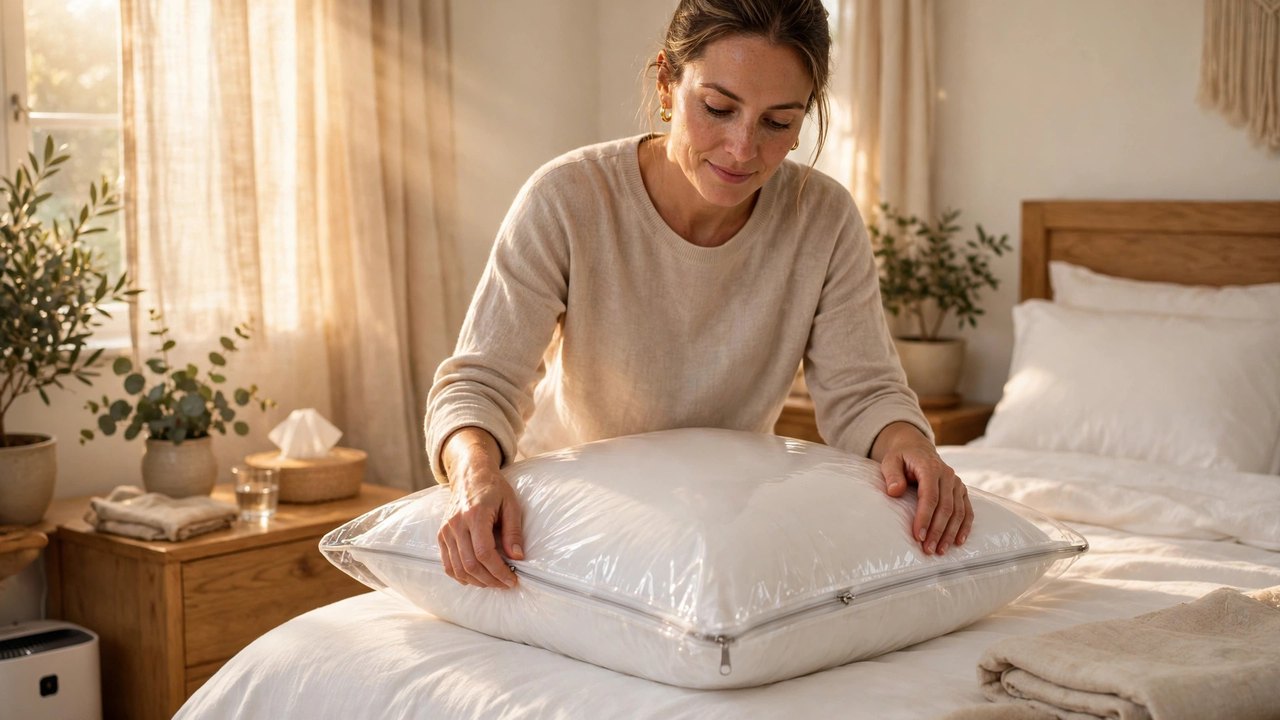
Coverage: zippered encasement, closing around the pillow rather than covering one side
An encasement is the right purchase when the pillow itself is not the problem. If your pillows are comfortable, supportive and not yet due for replacement, discarding them to buy allergy-marketed pillows wastes money; covering them completely is the more proportionate step. The Hospitology Products encasement does that covering in the most literal way in this list: it zips around the whole pillow, and the maker lists a waterproof construction with a breathable membrane, again in the maker’s wording, so fluids such as sweat and saliva, which the maker notes can damage a pillow, meet a washable barrier before they meet the fill.
The fabric hand is the usual objection to waterproof encasements, and the maker addresses it in its own listing by describing an extra-soft polyester knit that is cool and comfortable and a membrane that will not retain heat, as the maker lists it. Report that as a maker claim and judge it in your own bed over the first nights, ideally under your normal pillowcase, which is how encasements are meant to be used: encasement first, directly on the pillow, then your regular case over it. If the surface feel still distracts you, that is a legitimate reason to choose the cotton terry designs below instead; barrier bedding only helps a household that keeps it on the bed.
Practical details are favourable. The maker lists machine washable care with tumble dry low, a queen size of twenty by thirty inches in this variant, and a set of two, so a pair of pillows can be covered in one purchase. Measure your pillows before ordering, because queen pillows vary and an encasement that is strained at the zipper or bunched with excess fabric will annoy you nightly. The maker also lists a limited warranty period for this line on its page; read the current terms there rather than relying on any summary. For households whose main worry is protecting good pillows from moisture while adding a zippered barrier layer, this is the most direct pick in the guide.
Buy it if: your queen pillows are worth keeping and you want a zippered, waterproof, washable encasement in a set of two.
Skip it if: you dislike membrane fabrics under a pillowcase, or your pillows are already worn out and should be replaced instead of covered.
Format: the maker lists a set of two zippered pillow case covers, standard size 21 inches by 27 inches
Surface: the maker lists a 100% cotton terry surface
Construction: the maker lists 100% waterproof protection and a super fine zipper with Invisi-Zip technology, in the maker’s wording
Maker-listed positioning: the maker lists that it blocks dust mites, mould, mildew, pollen and pet dander, reported here as the maker’s claim
Care: the maker lists machine wash and dry
SureGuard’s design splits the difference between the membrane-first Hospitology encasement and a plain cotton cover. The surface you feel, through your pillowcase, is cotton terry as the maker lists it, a textured, moisture-wicking surface in the maker’s description, while the construction underneath is listed by the maker as fully waterproof. The maker also lists that the terry surface is soft and noiseless and retains the feel of the pillow, and lists the product as free from vinyl, PVC and phthalates in its own wording. As with every claim in this category, treat those as the maker’s stated specifications, and treat the verifiable structure, zippered, terry-surfaced, washable, as the reason to buy.
The zipper gets unusual attention in the maker’s listing, described as super fine with the maker’s Invisi-Zip wording and positioned as sealing the pillow completely. Zipper quality is not a glamorous specification, but on an encasement it is the specification: a cover that fully surrounds a pillow is only as closed as its closure, and a fine, well-seated zipper is easier to close fully and keep closed through washing and nightly movement than a coarse one. Open and close it slowly the first few times, keep fabric out of the teeth, and check after washing that it still runs the full length smoothly.
Sizing is explicit in the maker’s listing at twenty-one by twenty-seven inches for this standard variant, sold as a set of two, with machine wash and dry care. The maker also notes the design is intended to keep pillows clean and fresh and, in its wording, to stop feathers poking through down pillows, which makes this a useful pick for households keeping older feather or down pillows they are not ready to replace: the terry protector adds a washable, zippered layer between that fill and the sleeper. If your pillows are standard size and you prefer a terry hand to a smooth knit, this is your encasement.
Buy it if: you want a cotton terry surface, a fine zipper and waterproof construction for standard pillows, in a washable set of two.
Skip it if: your pillows are queen or king size, since this variant is the maker-listed standard size, or you want a smooth, non-terry surface.
Format: the maker lists a pack of one, fitting one standard size pillow
Materials: the maker lists a main panel of 80% cotton and 20% polyester, with a lining of 100% polyurethane laminate
Surface and construction: the maker lists premium cotton terry with a breathable waterproof membrane back coating, in the maker’s wording
Closure: the maker lists a secure Micro-Zipper, in the maker’s wording
Care: the maker lists machine washable and tumble dryer safe at low temperatures
SafeRest is the single-pillow option in a list of pairs, and that is a feature for the right household: a single bed, a guest pillow, a child’s pillow, or a first trial of whether your household tolerates a membrane encasement at all before you cover every pillow in the home. The materials are stated with unusual precision on the maker’s page, a main panel of eighty percent cotton and twenty percent polyester with a one hundred percent polyurethane laminate lining, which lets you compare construction honestly against the terry and knit designs above instead of guessing what sits between surface and pillow.
The maker lists a cotton terry surface over a waterproof membrane back coating and a micro-zipper closure, and describes the result as noiseless in its own wording. Report the dust particle barrier language on the listing as what it is, the maker’s claim about its zippered design, and focus your own judgement on the things you can check: does the zipper run smoothly and close fully, does the standard size fit your pillow without strain, does the terry surface feel acceptable under your usual pillowcase, and does it come through a low-temperature wash and tumble dry, as the maker lists, without damage. A protector that passes those household tests is one you will keep using.
Care is listed as machine washable and tumble dryer safe at low temperatures, and the maker’s wider care guidance for this line is to wash with other bedding and avoid high heat for the membrane. Follow the exact instructions on your product’s label when it arrives, since labels govern over summaries. Buy one first if you are unsure, live with it for several washes, and only then decide whether the same construction belongs on the rest of the bed. That staged approach costs a little more time and far less money than covering every pillow with a design your household turns out to dislike.
Buy it if: you need one standard pillow covered, want the maker-listed cotton blend panel with a polyurethane laminate lining, and prefer to trial an encasement before buying pairs.
Skip it if: you need to cover a whole household at once, where the paired options above are simpler, or your pillow is not standard size.
Buying guide
Decide first whether you are replacing or covering. Replacement makes sense when a pillow is lumpy, flat, stained through, odorous after washing, or old enough that you no longer know its history; covering makes sense when the pillow still supports your head and neck well and is clean enough to keep. The three AllerEase pillows in this guide cover the replacement routes, a fixed cotton-covered pair, an adjustable pair, and a body pillow, while the Hospitology, SureGuard and SafeRest products cover the covering routes. Buying both for the same pillow on day one is rarely necessary; add the second layer later if your clinician advises it or if moisture protection becomes the priority.
Read fabric listings like an inspector, not like a fan. The useful entries are composition and construction: one hundred percent cotton outer, polyester circular knit, cotton terry surface, a stated cotton and polyester panel with a polyurethane laminate lining, a waterproof membrane. Those entries, all reported above exactly as their makers list them, tell you what will touch your pillowcase, how the product is likely to feel and sound, and what washing it will tolerate. Vague comfort adjectives tell you none of that. When two products look similar, compare their listed compositions side by side in the table at the top of this guide and choose on fabric and closure, not on the loudest allergy wording, which in every case here is a maker claim rather than a measured promise.
Treat the zipper as a structural part. On encasements, prefer a zipper that closes the cover completely around the pillow, run it fully closed every time, and keep pillowcase fabric and loose threads out of the teeth. On the adjustable pillow, the zip-off cover serves a different purpose, access to fill and a washable surface, but the same care applies. After the first wash, inspect seams and zippers while the product is still new enough to exchange if a defect shows. A barrier with a gap is a pillowcase with ambitions, so the few seconds spent checking closure are the cheapest quality control in this entire category.
Washing is where these products either earn their keep or quietly fail. Follow each maker’s listed care exactly: wash warm and lowest-setting tumble for the AllerEase pillows as listed, tumble low for the Hospitology encasement, machine wash and dry for the SureGuard protectors, and low-temperature washing and drying for the SafeRest protector. Do not upgrade a maker’s warm instruction to a hot wash on your own initiative, because heat limits exist to protect membranes, laminates and fills, and a damaged barrier protects nothing. Wash on a regular schedule you can sustain, dry fully before remaking the bed, and replace pillows and encasements when fabric thins, zippers fail or fill no longer recovers, rather than stretching worn bedding indefinitely.
Size everything twice. Standard, queen and king pillows differ by only a few inches, which is exactly why mistakes happen: an encasement bought a size small strains at the zipper, and a size large bunches and shifts. Use the dimensions each maker lists, twenty by thirty inches for the Hospitology queen variant, twenty-one by twenty-seven for the SureGuard standard variant, twenty by fifty-four for the body pillow, and measure your own pillows with a tape rather than trusting the word on an old pillowcase. If you are between sizes or your pillow is unusually lofty, favour the fit that lets the zipper close without force.
Keep expectations clinical and calm. These products change your bedding’s materials, closures and washability, which are legitimate, checkable improvements to a sleep setup. They do not diagnose anything, they do not replace any treatment you have been prescribed, and this guide makes no claim that they prevent, treat or relieve allergies or asthma. If symptoms are new, severe, or involve wheezing or difficulty breathing, or if a child in the household is affected, speak to a clinician promptly and treat bedding as one environmental detail among many that the clinician may discuss with you.
FAQ
Should I buy a new pillow or just an encasement?
Cover a pillow that is comfortable, supportive and clean enough to keep, using a zippered encasement such as the Hospitology, SureGuard or SafeRest picks. Replace a pillow that is worn, lumpy or past sensible use, choosing a washable design such as the AllerEase pillows, and consider adding an encasement later if you want a waterproof layer as well.
Are the allergy claims in this guide guarantees?
No. Allergy and dust mite wording is reported only as each maker’s own claim about its fabric or construction, phrased as what the maker lists. This guide reports materials, closures and washing facts, and makes no claim that any product prevents, treats or relieves allergies or asthma.
How often should these pillows and encasements be washed?
Follow the care label on your specific product and the schedule your clinician suggests for your household. What this guide can say from the opened pages is how each maker says its product may be washed: the AllerEase pillows list machine wash warm with low tumble drying, and the encasements list machine washing with low or standard drying as detailed in each pick above. A schedule you actually keep matters more than an ambitious one you abandon.
Can I use an encasement and a pillowcase together?
Yes, that is the intended arrangement for the encasements here: the zippered encasement goes directly around the pillow, fully closed, and your regular pillowcase goes over it. The pillowcase remains the washable comfort layer you change most often, while the encasement stays in place between its own washes.
What if my pillow is queen or king size?
Buy the variant that matches your pillow’s measured dimensions, and verify that variant on its own product page before ordering. The picks above are pinned to specific sizes, standard for the Cotton Fresh, SureGuard and SafeRest products, queen for the Hospitology encasement, standard/queen for the Platinum pair, so do not assume a different size shares the identical listing details without checking.
When should I see a clinician instead of changing bedding?
Promptly, whenever symptoms involve difficulty breathing, wheezing, chest tightness, disturbed sleep that persists, or a child who is struggling at night. Bedding choices are not a medical treatment, and a clinician can assess causes and treatments that no pillow purchase can address.
Conclusion
For most households, the decision resolves into one of two clean moves. Replace tired pillows with a washable AllerEase design, the Cotton Fresh pair for a cotton outer and simple care, the Platinum Adjustable pair when loft has been the recurring failure, or the Cotton Top body pillow when the full-length pillow is the forgotten item in the bed. Or keep good pillows and close them inside a zippered, washable encasement, Hospitology for a waterproof membrane knit, SureGuard for cotton terry with a fine zipper, or SafeRest for a single, precisely listed cotton blend and laminate construction. Either move is grounded in facts you can verify on the product page and in your own laundry room, which is exactly where bedding decisions for an allergy-aware household should be grounded. Choose the construction you will maintain, wash it as its maker directs, and let a clinician, not a pillow, handle the medical side of the conversation.
M
Modern Line Home Editorial Team
We compare specs, materials and verified owner reviews before a product earns a spot. Rankings are never paid.
Affiliate disclosure. As an Amazon Associate we earn from qualifying purchases at no extra cost to you. Prices accurate as of the date shown.
House cold even with the heat on? Walk this ordered checklist: thermostat and filter first, then drafts, insulation, leaky ducts and a failing heating system.
Windows fogging up in winter? Check where the fog sits: on the room side it is indoor humidity, outside it is harmless, and between panes the seal has failed.
Store the main firewood pile about 30 feet from your house, off the ground and covered only on top. Compare racks, woodsheds, garages and indoor spots safely.
Place a portable generator outdoors only, at least 20 feet from windows, doors and vents, exhaust pointed away. Exact distances, setup steps and CO rules here.
Keep houseplants in the right winter spot: match window direction to plant type, stay clear of radiators and cold glass, and fix dry air and low light at home.
Mice enter through pencil-width gaps at foundations, pipes, vents, doors and the roofline. Walk this room-by-room winter checklist to find and seal each one.
A winter outage timeline: what to do in the first hour, first night and multi-day outage, with food safety times, pipe protection, heat and CO safety steps.
Size a space heater by room area: 10 watts per square foot at 8-foot ceilings, adjusted for insulation and ceiling height, with full wattage and BTU tables.
Start dripping at about 20 degrees, sooner for exposed pipes. Set a pencil-lead stream, drip the right faucets on both lines, and know when to stop safely.
A fridge needs 800-1,200 starting watts, not just 150-400 running watts. Use the tables to total your fridge plus freezer, lights, furnace fan and more today.












Write Your Review
No reviews yet. Be the first to share your experience!