We independently review everything we recommend. When you buy through our links, we may earn a commission. As an Amazon Associate we earn from qualifying purchases.
Best Pillows for Baby Flat Head: 4 Supervised Supports
Compare the best pillows for baby flat head concerns: contoured head supports for supervised awake time, with maker-listed fabrics, fills, fit, sizing and care.
Compare the best pillows for baby flat head concerns: contoured head supports for supervised awake time, with maker-listed fabrics, fills, fit, sizing and care.
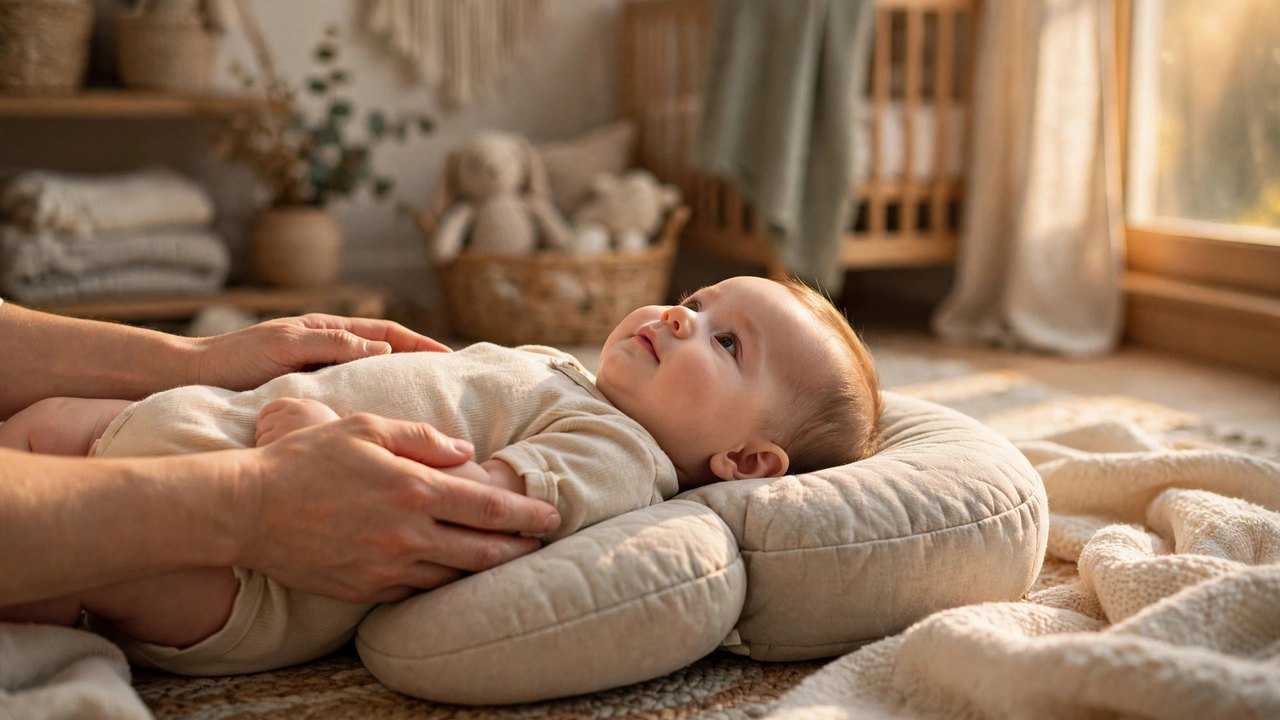
Parents searching for the best pillows for baby flat head are usually looking at a specific kind of product: a small, contoured head-support cushion designed to cradle a young baby’s head during supervised, awake moments in a bouncer, stroller, swing or on a play mat. This guide compares four of those supports that are genuinely sold for this use, and it describes each one strictly in terms of what its maker states about its shape, materials and intended use.
One boundary matters more than any feature in this roundup. None of the products below is a medical device purchase you should make instead of medical advice, and none of them is presented here as preventing, treating, correcting or fixing flat head syndrome or any other condition. Head shape is a health topic, and health questions belong with your baby’s pediatrician. What a pillow maker can legitimately describe is design: a shaped surface, a recessed center, a particular fill, a fabric, an age range and a set of supervised-use instructions. That is exactly what this article sticks to, product by product, using only details the makers themselves list.
The second boundary is about sleep. Every pick in this guide is a supervised awake-time support. The makers state this in their own listings, and this guide repeats it without softening: these cushions are not for unsupervised infant sleep, not for overnight use, and not loose items to place in a crib. If a product’s maker positions it for awake time in baby gear, that is how it is described here, and that is the only way it should be used.
Quick verdict
If you want the simplest, most established option, the Babymoov Lovenest Baby Head Support is the default pick: a small, light, inclined foam cushion in an organic cotton cover that the maker positions for bouncers, swings, strollers and play mats during supervised awake time. If your main outings are in a car seat or stroller and you like the idea of a cooler-feeling center panel, the Babymoov Cosyhead Fresh Headrest is the sibling design with a lyocell-blend center section. If adjustability matters most, the Huloo Sleep Baby Head Pillow stands apart: its center width can be tuned with five drawstring points, and the whole pillow, fill included, goes in the wash. If you prefer an organic cotton cover over a breathable mesh build at the simpler end of the category, the WelsLife Baby Head & Neck Support Pillow is the straightforward alternative. All four are supervised awake-time products, and the right choice is mostly about where you will use it, how you want to clean it, and whether you want a fixed shape or an adjustable one.
The products in this guide
Babymoov Lovenest Baby Head Support
Bouncers, swings, strollers and play mats, supervised awake time, from birth to about 4 months
Best if you want the established, lightweight option in an organic cotton cover, for supervised awake
Contoured head and neck support with a breathable 3D air mesh build
Breathable 3D air mesh construction
Newborn head and neck support during supervised use
Machine washable
How we selected
The starting point was the maker’s own positioning. A product only qualified if its maker genuinely sells it as a baby head-support cushion of the kind parents look for under this search term: a small contoured pillow or headrest for young infants, sold new on Amazon US, with a listing that states its materials, its intended settings and its supervision limits. Generic toddler pillows, full-size sleep pillows, loungers, head-protection backpacks and unbranded cushions with no identifiable maker or model were excluded, however often they appear in search results.
Each surviving product was checked on its opened Amazon listing, and every specification in this article is phrased as what the maker lists: fabric composition, fill, model number, size, weight, age guidance and care instructions all come from the maker’s own product details. Where a listing was thin, this article says less rather than filling gaps. Two well-known names in this category were dropped during research because their Amazon US listings could not be opened and verified, and they are simply absent rather than described from secondhand summaries.
Safety positioning was a selection filter, not an afterthought. Products whose makers state supervised awake-time use were preferred, and each pick’s own supervision wording is repeated in its section below. Products that blurred the line by presenting an infant cushion as an unsupervised sleep product were left out. Finally, each product needed a pinnable identity: a brand, a product name and an exact model, with an ASIN verified from its opened listing page, so that the linked product is the exact item described.
The Lovenest is the product that defines this category for many parents, and its design is a study in doing one small thing simply. The maker lists it as an inclined, contoured cushion developed in partnership with pediatricians, shaped to cradle a baby’s head and neck with what Babymoov describes as a gentle cocooning effect that still allows natural head movement. It is an oval cushion with a polyurethane foam fill, and the maker lists the weight at just 2.88 ounces, which is why it moves so easily between pieces of baby gear.
The cover is the headline material. The maker lists the Lovenest as covered in ultra-soft organic cotton, with the fabric type specified as 95 percent cotton and 5 percent elastane, and describes the fabric as breathable and easy to wash. Care is simple: the maker lists machine washing on a gentle cycle, followed by air drying. The pink version covered here is model A050223; the same Lovenest design is the maker’s long-running newborn headrest, made in Europe according to the listing, and backed by the maker’s lifetime warranty as stated in the product description.
Intended use is where the maker’s wording is unambiguous, and this guide follows it exactly. The maker lists the Lovenest for use during nursing, playtime, and in the bouncer, swing, stroller and similar gear, and states plainly that it is for awake time only, that it is not intended for infant sleep, and that it should always be used with supervision. On age, the maker lists it as suitable from birth up to about 4 months, and the product description adds the natural endpoint: until your baby can roll over unaided. Treat those limits as part of the product, not fine print.
Who it suits is a parent who wants a single, feather-light support that drops into whatever gear the baby is already spending supervised awake time in, with an organic cotton surface and wash-and-air-dry care. Its fixed shape is the trade-off: there is nothing to adjust, so fit is simply the maker’s contour, sized for the first few months.
Buy it if: you want the established, lightweight option in an organic cotton cover, for supervised awake time in a bouncer, swing, stroller or on a play mat, and you prefer machine-washable care.
Skip it if: you want an adjustable fit, a pillow you can wash as one piece including its fill, or anything for sleep — the maker is explicit that this is an awake-time-only support.
The Cosyhead Fresh is Babymoov’s other answer to the same design brief, and it differs from the Lovenest in ways that matter day to day. The maker lists it as an ergonomically shaped headrest crafted to gently cradle the baby’s head and neck, designed in France, with a universal fit the maker lists for bouncers, strollers and car seats. Where the Lovenest is a single-fabric cushion, the Cosyhead Fresh is built in panels, and the maker lists the size at 10 x 9.1 x 1.8 inches.
The panel construction is the distinguishing detail. The maker lists the top as 100 percent cotton, the bottom as 95 percent cotton and 5 percent elastane, and the central part as 70 percent lyocell and 30 percent cotton, over a polyurethane foam fill. That lyocell-blend center is the “Fresh” element of the design: the section directly under the head uses a different fabric from the surround. The model number for this version is A050233_US, in a gray and white colorway.
The maker’s stated window of use matches the Lovenest’s: the listing describes it as ideal from birth up to 4 months, or until the baby can roll over unassisted. As with every product in this guide, that positioning is for supervised time in baby gear at home or on the go — a headrest that travels with the stroller or car seat — and not a sleep product. The one practical step down from the Lovenest is care: the maker lists the Cosyhead Fresh as hand wash only, so spit-up cleanup is a sink job rather than a machine cycle.
Choose the Cosyhead Fresh over the Lovenest if your baby’s supervised reclined time happens mostly in a car seat or stroller and the panelled, fresh-feel center appeals to you. Choose the Lovenest if machine washing matters more than the center panel. Both come from the same maker, share the same foam-and-cotton approach, and carry the same first-months window.
Buy it if: you want a headrest shaped for bouncers, strollers and car seats, with a lyocell-blend center panel under the head, and you are comfortable with hand washing.
Skip it if: machine-washable care is a priority, or you want any adjustability — the shape is fixed, and the maker lists hand wash only.
The Huloo Sleep pillow is the engineering-led entry in this roundup, and almost every design choice the maker lists runs opposite to the foam cushions above. Instead of a solid foam core, the maker lists a fill of hundreds of soft TPE tubes that let air move through the cushion and shift with the baby rather than holding one molded shape. Instead of a fixed contour, the maker lists five drawstring points around the edge that let you fine-tune the center width by hand, so the recessed center can be narrowed or widened as your baby grows, with no inserts to add or remove. The shape itself is a recessed center with raised side lobes, which the maker describes as providing head and neck support that follows the baby’s natural curves.
The maker lists the size at 15 x 10.6 inches — noticeably larger than the Babymoov headrests, closer to a small pillow than a gear insert — and the weight at about 1.1 pounds (515 grams). The cover is two-sided by design: the maker lists one jacquard side that wicks moisture and lets heat escape, and a softer brushed side for a cotton-soft feel, with the fabrics specified as a lyocell and polyester blend on one face and a polyamide and spandex blend on the other. This version is light green, model 110801; the maker also lists a light yellow colorway.
On use, the maker’s listing is again explicit about supervision: it positions the pillow for supervised awake time, naming tummy time and the play mat, and the product title adds stroller and car seat use. Follow that wording as written. The standout practical feature is care: the maker lists the whole pillow as machine washable, fabric and filling together, washed separately and air dried, then reshaped by hand — the only pick here whose fill itself is designed to go through the wash.
This is the pick for parents who like the idea of one support that adapts instead of being outgrown on a fixed contour, and who expect to wash the whole thing often. The trade-offs are size and complexity: it is the bulkiest option here, and the drawstring system is one more thing to check and set before each use.
Buy it if: you want an adjustable center width, an airy tube fill instead of solid foam, a two-sided cover, and whole-pillow machine washing for supervised awake time and gear use.
Skip it if: you want the smallest, simplest insert for a bouncer, or a set-and-forget product — this one rewards a parent who will actually use the adjustment points.
The WelsLife pillow is the simplest construction in this guide: a contoured newborn head and neck support with a certified organic cotton cover over a breathable mesh build. The maker lists the cover as 100 percent organic cotton, certified as such, and describes the pillow’s construction as a sequential 3D air mesh that keeps air moving through the cushion in warm conditions and holds warmth in cooler ones. The listing describes the pillow as hypoallergenic and soft, and the Animal World version covered here carries a printed animal design.
Compared with the Babymoov pair, the WelsLife listing is lighter on published dimensions and model detail — the maker lists the model simply under its own brand name — so this guide describes only what the listing states: the organic cotton cover, the 3D air mesh construction, the contoured head and neck support shape, and machine-washable care. That restraint is deliberate. A shorter spec sheet is a fact about the product, and parents who want every dimension in writing will find the Babymoov and Huloo Sleep listings more detailed.
What the WelsLife offers in return is an unfussy middle path: an organic cotton surface like the Lovenest, a mesh-led approach to airflow like the tube-filled Huloo Sleep, and a straightforward contoured shape with no adjustments to manage. As with all four picks, use it as the maker positions it — a support for a newborn’s head and neck during supervised time — and keep it out of the sleep space entirely.
Buy it if: you want a simple contoured support with a certified organic cotton cover and a breathable mesh build, plus machine-washable care, without adjustment systems.
Skip it if: you want detailed published dimensions, an adjustable fit, or a named model with an extensive spec sheet — the other picks document more.
Buying guide
Start with supervision, not features
The first buying decision is not which pillow, but how any pillow in this category is used. These are supervised awake-time supports for gear and floor play. The makers say so, pediatric safe-sleep guidance says so, and no feature — not a breathable mesh, not a tube fill, not a contoured center — changes that. Buy one only if it fits supervised moments you already have: bouncer time while you cook nearby, stroller walks, play-mat sessions. If what you are actually looking for is something for the crib, the correct purchase is nothing at all: a bare, firm, flat sleep surface is the standard guidance for infant sleep.
Match the shape to the setting
Small oval headrests like the two Babymoov models are shaped to drop into bouncers, swings, strollers and car seats, and their makers list them for exactly those settings. A larger, flatter pillow like the Huloo Sleep suits floor-based supervised time — tummy time and play mats — as well as gear. Think about where your baby spends supervised reclined time and buy the footprint that matches it; a support that does not sit properly in the gear you own will not get used.
Fixed contour or adjustable center
Three of the four picks have a fixed shape: the maker’s contour is the fit. That is simple and predictable, and it is why the Babymoov models carry a defined window of use ending around 4 months or first rolling. The Huloo Sleep takes the other route, with drawstrings that change the center width. Adjustability can extend usefulness as a baby grows, but only if you will actually re-set it; a fixed contour that matches your baby today beats an adjustable one left at the wrong setting.
Fills and fabrics, as the makers list them
Foam is the traditional fill here: both Babymoov models list polyurethane foam under cotton covers, with the Cosyhead Fresh adding a lyocell-blend center panel. The Huloo Sleep lists a TPE tube fill, which the maker describes as letting air pass through the cushion and shifting under pressure rather than holding a mold. The WelsLife lists a 3D air mesh construction under organic cotton. None of these descriptions is a safety certification, and this guide does not treat them as one — they are comfort and design differences to weigh alongside fit and care, nothing more.
Care will decide more than you expect
Newborn gear gets washed constantly, so check the care line before the feature list. The Lovenest machine washes on a gentle cycle and air dries. The Huloo Sleep goes furthest: the whole pillow, fill included, is machine washable. The WelsLife is machine washable. The Cosyhead Fresh is hand wash only. If a support is a hassle to clean, it will spend its life in a cupboard, so be honest about which routine you will keep up.
Respect the age and rolling limits
Where a maker lists an age window or a rolling milestone, treat it as a hard stop, not a guideline. The Babymoov listings end use at about 4 months or when the baby can roll over unaided, whichever the maker’s wording gives. Once a baby can roll, reposition or push against a support, a cushion designed for a still newborn no longer matches the child using it, whatever its condition.
When to talk to a pediatrician instead
A pillow purchase is never the endpoint for a head-shape concern. If you notice a flattening area, a strong preference for turning the head one way, or limited neck movement, raise it with your baby’s pediatrician, who can examine your baby and advise whether anything further is needed. That conversation is the genuinely useful step; the products in this guide are comfort supports for supervised awake time, and they are described here as nothing more than that.
FAQ
Are any of these pillows safe for overnight or unsupervised sleep?
No. The makers position these products for supervised awake time in gear such as bouncers, strollers and swings, or on play mats, and the Babymoov listings state explicitly that their headrests are not intended for infant sleep. Keep pillows and other soft items out of the crib and any unsupervised sleep space, and follow the safe-sleep guidance your pediatrician gives you.
Will one of these pillows fix my baby’s flat head?
This guide makes no such claim for any product, and you should be wary of any listing that promises a medical outcome. What the makers describe is design: contoured or recessed shapes, specific fills and fabrics, and supervised-use instructions. Head shape is a health question, and only your baby’s pediatrician can assess your baby and advise you.
What age are these head supports made for?
The Babymoov listings give the clearest windows: from birth to about 4 months, ending when the baby can roll over unaided. The other makers position their pillows for newborns and young infants during supervised awake time. Whatever the brand, stop using a newborn head support once your baby can roll or reposition independently, and follow the specific limits in the maker’s own instructions.
What is the difference between a foam headrest and a tube-filled pillow?
As the makers list them, the foam designs — the two Babymoov models — use a polyurethane foam core in a fixed contoured shape under a cotton cover. The Huloo Sleep pillow uses a fill of soft TPE tubes that the maker describes as letting air move through the cushion and shifting under the baby, with drawstrings to adjust the center. The practical differences are feel, airflow design, adjustability and washing: the tube-filled pillow is the only one here whose whole body, fill included, is machine washable.
Can these supports be used in a car seat?
Two makers name car seats among their listed settings: the Babymoov Cosyhead Fresh, which the maker lists for bouncers, strollers and car seats, and the Huloo Sleep pillow, whose title includes stroller and car seat use. Only use any insert in a car seat exactly as both the pillow maker and your car seat manufacturer allow, since additions to a car seat are governed by the seat maker’s instructions first.
How do I choose between the two Babymoov models?
Pick on setting and care. The Lovenest is the lighter, simpler cushion, in an organic cotton cover, machine washable on a gentle cycle, listed for bouncers, swings, strollers and play mats. The Cosyhead Fresh adds a lyocell-blend center panel and is listed for bouncers, strollers and car seats, but it is hand wash only. Both share the same maker, foam approach and first-months window of use.
Conclusion
The honest summary of this category is that the products differ in design details, not in purpose. All four are contoured head supports for supervised awake time, and all four should be bought, used and retired on exactly those terms. The Babymoov Lovenest is the light, established default with an organic cotton cover and machine-washable care. The Babymoov Cosyhead Fresh suits car seat and stroller routines and adds a fresh-feel center panel at the cost of hand washing. The Huloo Sleep pillow is the adjustable, whole-pillow-washable option with an airy tube fill. The WelsLife is the simple organic-cotton-and-mesh alternative. Choose by setting, fit style and care routine — and for anything beyond comfort, from a persistent flat area to a head-turning preference, let your pediatrician, not a product page, guide you.
M
Modern Line Home Editorial Team
We compare specs, materials and verified owner reviews before a product earns a spot. Rankings are never paid.
Affiliate disclosure. As an Amazon Associate we earn from qualifying purchases at no extra cost to you. Prices accurate as of the date shown.
House cold even with the heat on? Walk this ordered checklist: thermostat and filter first, then drafts, insulation, leaky ducts and a failing heating system.
Windows fogging up in winter? Check where the fog sits: on the room side it is indoor humidity, outside it is harmless, and between panes the seal has failed.
Store the main firewood pile about 30 feet from your house, off the ground and covered only on top. Compare racks, woodsheds, garages and indoor spots safely.
Place a portable generator outdoors only, at least 20 feet from windows, doors and vents, exhaust pointed away. Exact distances, setup steps and CO rules here.
Keep houseplants in the right winter spot: match window direction to plant type, stay clear of radiators and cold glass, and fix dry air and low light at home.
Mice enter through pencil-width gaps at foundations, pipes, vents, doors and the roofline. Walk this room-by-room winter checklist to find and seal each one.
A winter outage timeline: what to do in the first hour, first night and multi-day outage, with food safety times, pipe protection, heat and CO safety steps.
Size a space heater by room area: 10 watts per square foot at 8-foot ceilings, adjusted for insulation and ceiling height, with full wattage and BTU tables.
Start dripping at about 20 degrees, sooner for exposed pipes. Set a pencil-lead stream, drip the right faucets on both lines, and know when to stop safely.
A fridge needs 800-1,200 starting watts, not just 150-400 running watts. Use the tables to total your fridge plus freezer, lights, furnace fan and more today.












Write Your Review
No reviews yet. Be the first to share your experience!