
Key takeaways
- The best outdoor rugs for rain are quick-drying polypropylene weaves that shed water, resist mildew and hose clean. Six verified picks for wet patios and decks.
Rain is the fastest way to ruin an outdoor rug. A rug that soaks up water like a sponge stays damp for days, grows mildew underneath, stains the deck boards below it and starts to smell long before it wears out. The best outdoor rugs for rain avoid all of that by design: they are woven from fibers that barely absorb water at all, built in open or low-pile weaves that let rain drain through instead of pooling, and finished so you can shake them out, hose them off and have them dry in hours rather than days.
This guide focuses on rugs made for genuinely wet spots — uncovered patios, open decks, pool surrounds, RV campsites and garden seating areas that take direct rainfall. Five of the six picks are reversible plastic straw rugs woven from polypropylene, the construction that handles standing rain best. The sixth is a woven polypropylene area rug with a short pile and a rubber backing; it feels the most like a real rug underfoot, and we flag exactly where its backing helps and where it slows drying down. Every pick below was checked on its product page for material, weave, size and care details, and every specification is reported the way the maker lists it.
Quick verdict
For most uncovered patios and decks, choose the SAND MINE Waterproof Outdoor Rug 5×8 ft. Its open plastic straw weave lets rain drain straight through, the maker lists a non-slip grid backing that sheds water instead of trapping it, and the flat profile dries faster than anything else here. If you need serious coverage, the fifame Outdoor Rug 9×12 ft and the YONILE Outdoor Rug 9×12 ft Striped cover a full seating set, and both fold into carry bags when a storm week calls for storage. On a small balcony, the GENIMO Outdoor Rug 5’x8′ Palm Leaf is the lightest pick in the group and the easiest to lift, shake and drape dry. The GarveeHome Outdoor Rug 8×10 ft Monstera Leaf splits the difference for mid-size decks and adds corner loops and stakes for windy, exposed spots. Pick the Nourison Aloha Indoor Outdoor Area Rug 8′ x 10′ only if the rug will live under cover or you are willing to lift it after heavy rain — it is the softest and heaviest option here, and its rubber backing is the one design in this guide that holds moisture against the floor.
Comparison table
| Product | Material (maker lists) | Size covered here | Weave / pile | Best for |
|---|---|---|---|---|
| SAND MINE Waterproof Outdoor Rug 5×8 ft | 100% virgin polypropylene plastic straw | 5 x 8 ft | Flat woven, low pile, open weave | Uncovered patios that take direct rain |
| GENIMO Outdoor Rug 5’x8′ Palm Leaf | Virgin polypropylene plastic straw | 5 x 8 ft | Braided weave, low pile | Small patios, balconies, easy lifting |
| fifame Outdoor Rug 9×12 ft | Virgin polypropylene plastic straw | 9 x 12 ft | Braided weave | Large decks and RV campsites |
| GarveeHome Outdoor Rug 8×10 ft Monstera Leaf | 100% virgin polypropylene plastic straw | 8 x 10 ft | Braided weave, low pile | Mid-size decks in windy spots |
| YONILE Outdoor Rug 9×12 ft Striped | Polypropylene woven plastic | 9 x 12 ft | Machine-made woven | Extra-large coverage on a budget of effort |
| Nourison Aloha Indoor Outdoor Area Rug 8′ x 10′ | Polypropylene with rubber backing | 7’10” x 10’6″ (listed as 8 x 10 ft) | Flat woven, 0.25 in pile | Covered porches, softest feel |
How we selected
Rain performance comes down to four things, and every pick in this guide had to satisfy the first two and score well on the rest. First, fiber: the rug had to be made from a synthetic fiber that does not absorb water in any meaningful amount. Polypropylene is the standard choice because it is solution-dyed, resists mildew growth on the fiber itself and dries fast. Natural fibers such as jute, sisal and cotton absorb rain, swell and mildew, so no natural-fiber rug appears in this guide no matter how good it looks in a catalog photo.
Second, construction: water has to have somewhere to go. Open plastic straw weaves let rain pass through the rug and off the deck surface below. Low-pile and flat weaves hold far less water in the face of the rug than a plush pile does. Thick backings are the weak point of many outdoor rugs — a solid rubber or latex backing keeps the rug planted, but it also seals moisture between rug and floor, so we treated backed rugs as covered-porch picks rather than open-rain picks and said so plainly in their reviews.
Third, cleanup: a rain rug lives outdoors through pollen season, mud season and leaf season, so every pick here can be hosed off or wiped down, and none requires machine washing or professional cleaning. Fourth, practical handling: because the single best rain habit is lifting the rug to dry the surface underneath, we noted the weight the maker lists for each size covered and whether the rug folds into a carry bag or includes loops and stakes for anchoring. Finally, we only included products whose material, dimensions and care details could be confirmed on an opened product page; anything that could not be confirmed was left out entirely.
Top picks
SAND MINE Waterproof Outdoor Rug 5×8 ft
The SAND MINE is the most rain-first design in this group. The maker lists it as 100% virgin polypropylene woven with plastic straw weaving technology, in a flat woven, low-pile construction. The important detail is the open weave: the maker states that the open-weave construction allows liquids to drain right through while dirt and debris stay on top, which is exactly the behavior you want in a downpour. Rain does not sit in a pile, and it does not get trapped in a backing layer either. Instead of a solid back, the maker lists a non-slip grid backing that drains rainwater while keeping the mat planted on hard surfaces — a meaningful difference on concrete and pavers, where a solid-backed rug can seal a puddle against the floor for days.
Day-to-day care matches the design brief. The maker says the rug can be rinsed with a hose, wiped or swept, and that it air-dries in minutes in typical conditions. The pattern is a reversible geometric diamond in black and beige, so flipping the rug gives you a second look and spreads wear across both faces. UV-resistant coating is listed for fade protection, and the rug folds down into an included carry bag, which makes it easy to pull inside ahead of a multi-day storm or to take to a campsite. At 5 x 8 ft it fits a small seating set, a bistro arrangement or the space under a porch swing, and the flat profile clears most door swings.
The trade-offs are the usual ones for plastic straw construction. The surface feels like a woven mat rather than a soft carpet, so if barefoot softness is your top priority this is not the pick. The light build also means furniture weight or the included grid backing does the work of keeping corners down on a windy, fully exposed deck.
Buy it if: your patio or deck is uncovered and takes direct rain, and you want the fastest-draining, fastest-drying construction available in a manageable size.
Skip it if: you want a plush, carpet-like feel underfoot, or you need coverage for a full six-seat dining set — go a size class up to the 9 x 12 ft picks below.
GENIMO Outdoor Rug 5’x8′ Palm Leaf
The GENIMO covers the same 5 x 8 ft footprint as the SAND MINE but in a braided plastic straw weave with a palm leaf pattern in grey and white, and the reason to pick it is handling. The maker lists the weight at just 2.9 pounds, the lightest in this guide. That matters more for a rain rug than it might seem: the best maintenance habit in a wet climate is lifting the rug after a storm to let the deck dry underneath, draping the rug over a railing to finish drying, and shaking off leaves and grit before they grind into the weave. A rug this light makes all three habits effortless, which means they actually happen.
The material story is the same rain-friendly formula. The maker lists virgin polypropylene, double-sided woven for durability, with a high-end UV coating and edge heat treatment intended to prevent the edges from peeling or fraying. The palm leaf design is reversible, with a pattern on each face, and the maker describes the rug as waterproof, stain resistant and breathable, cleanable with a rinse or a damp cloth. It folds into an included carry bag, so it doubles as an RV, picnic and beach mat when the patio season ends. The low-pile braided surface sheds water instead of holding it, and the fine, flat stitching the maker describes leaves few pockets where grit and moisture can sit.
Because it is so light, the GENIMO needs help staying put in exposed, windy locations — plan on furniture weight on at least two corners, or choose the fifame or GarveeHome below if your site is a wind tunnel and you want loops and stakes. The 5 x 8 ft size is also genuinely small: measure before ordering if your set has four chairs.
Buy it if: you have a small patio, balcony or porch, you will lift and drape the rug often, and you want the easiest-handling rain rug in the group.
Skip it if: your deck is large or very windy and unanchored corners will annoy you, or you need a rug that stays planted with no furniture on it.
fifame Outdoor Rug 9×12 ft
Scaling a rain rug up to 9 x 12 ft creates a problem: a big mat catches a lot of wind, and a wet big mat is heavy to move. The fifame answers both. The maker lists four reinforced corner loops and four stakes in the box, so the rug can be pinned flat on grass, soil or a campsite pad instead of relying on furniture alone. Despite the size, the maker lists the weight at 6.6 pounds, because the braided plastic straw weave uses hollow polypropylene strands rather than a dense pile — light enough for one person to shake out, fold and load into the included carry bag.
The material is listed as 100% virgin polypropylene with a UV coating and heat-sealed edges, and the maker describes the rug as truly waterproof: spills, mud and sand rinse off with a hose or a damp cloth, and the open braided structure lets water pass through rather than pool on the surface. The grey and white argyle pattern is reversible, giving two looks and evening out wear. Underfoot it is firmer than a piled rug, which is a fair trade for a surface that chairs, coolers and camping gear slide across without catching, and that does not stay soggy after a storm rolls through an RV site or a backyard gathering.
Two honest notes. First, stakes only help on ground that accepts them; on a hard deck you are back to furniture weight for anchoring. Second, a 9 x 12 ft rug covers a lot of deck, and any rug this size will hold a film of moisture against the boards beneath it after rain simply by shading the surface — lift a corner or fold it back on the first dry morning so the deck can dry fully.
Buy it if: you need full seating-set coverage, use the rug on grass or at campsites where stakes work, and want a large rain rug one person can still handle.
Skip it if: your space is a hard-surface deck with no furniture to anchor corners and constant wind, or a 9 x 12 ft footprint simply overwhelms your patio.
GarveeHome Outdoor Rug 8×10 ft Monstera Leaf
The GarveeHome sits in the middle of this lineup on size and adds the anchoring hardware that the other mid-size pick lacks. The maker lists the rug at 8 x 10 ft in a navy and white monstera leaf pattern, woven from 100% virgin polypropylene in a braided, low-pile construction, with a listed weight of 6.2 pounds. Like the fifame, it includes four corner loops and stakes, which makes it the better choice for an exposed deck edge, a poolside slab or a garden seating area where gusts get under unanchored corners.
For rain, the formula matches the group: the maker describes the rug as waterproof and stain resistant with a breathable build that facilitates quick drying, cleanable with a rinse or a wipe, and finished with a UV coating and heat-treated edges to resist fading and fraying. The double-sided weave means the monstera pattern appears on both faces, so the rug is reversible and a flip doubles as a quick refresh after one side has taken a muddy week. It folds into an included carry bag for storage or travel. The polypropylene back the maker lists is part of the woven straw construction rather than a solid rubber sheet, so water is not sealed against the floor the way it is under the Nourison below.
The braided straw surface is practical rather than plush, and the bold leaf pattern is a strong look that will not suit every deck. The 8 x 10 ft size is also the in-between footprint: confirm your furniture grouping fits it, because it is too big for most balconies and slightly small under the largest dining sets.
Buy it if: you want mid-to-large coverage with stakes and loops for windy or poolside spots, and a reversible tropical pattern suits your space.
Skip it if: you need the absolute largest footprint, prefer a subtle pattern, or your rug will sit permanently under heavy furniture where anchoring hardware is unnecessary.
YONILE Outdoor Rug 9×12 ft Striped
The YONILE is the straightforward large-coverage option: a 9 x 12 ft reversible plastic straw rug in a black and coffee stripe, listed by the maker as polypropylene woven plastic with a polypropylene back. The maker describes it as waterproof, dustproof and fade resistant, built to shrug off rain, sun and dirt, with a stain-resistant surface that cleans without scrubbing rituals. Stripes are a pragmatic pattern choice for a rain rug — they hide the leaf litter, pollen dust and water spotting that show up on solid colors between cleanings, and the two-tone design reverses for a second look.
The maker lists the weight at 3.4 kilograms, roughly seven and a half pounds, which keeps the big footprint manageable, and the rug folds into an included storage bag with handles for transport. There are no stakes or corner loops listed for this model, so anchoring relies on furniture placement — acceptable for a rug this size, since a full seating set or dining grouping typically covers most of the surface anyway. The woven straw face lets rain drain through and dries quickly once the sun returns, and the flat profile means chair legs and door swings clear it without catching.
Compared with the fifame at the same size, the YONILE trades the staking hardware for a simpler package and a bolder stripe. If your 9 x 12 ft spot is on grass or at a campsite, the fifame’s loops and stakes are worth having; if the rug lives on a patio under furniture, the YONILE’s simpler setup loses nothing.
Buy it if: you want maximum coverage in a classic stripe, the rug will live under furniture on a patio or deck, and easy folding storage matters to you.
Skip it if: you need stakes for ground use, or you want a subtle solid or small-scale pattern rather than wide stripes.
Nourison Aloha Indoor Outdoor Area Rug 8′ x 10′
The Aloha is the exception in this guide, included because many shoppers want a rain-capable rug that still feels like a rug. The maker lists it as machine made from durable polypropylene, flat woven with a soft cut pile, a pile height of 0.25 inches, and a high-low weave that gives the multicolor floral pattern real texture. Care is simple — the maker says to rinse with a hose and air dry — and the polypropylene fiber itself resists stains and does not feed mildew. At a maker-listed 21 pounds, it is by far the heaviest pick here, and that weight is a genuine advantage in wind: it stays where you put it with no stakes, loops or furniture required. The maker lists the true size as 7’10” x 10’6″ for the rug sold as 8 x 10 ft, and recommends a rug pad.
The caveat is the backing. The maker lists a rubber back, and a solid rubber backing changes the rain math: water that gets under the rug — and on an open deck, wind-driven rain always gets under the rug — cannot evaporate downward, and the underside dries slowly. Left flat on a solid surface through a wet week, this is the one rug in the guide that can hold a damp layer against your deck or patio. Used on a covered porch where rain arrives as occasional splashes rather than direct downpour, that weakness rarely matters, and the soft pile, real-rug looks and stay-put weight make it the most comfortable option here by a wide margin.
Our guidance is simple: choose the Aloha for covered or mostly covered spaces, and if a storm soaks it, prop it over a railing or chairs to dry the underside before laying it flat again. For fully exposed rain, pick one of the open-weave straw rugs above instead.
Buy it if: your porch or patio is covered, you want genuine rug softness and pattern, and you like a heavy rug that never needs anchoring.
Skip it if: the rug will sit in direct, frequent rain on a solid surface — the rubber backing will hold moisture underneath, and an open-weave pick will serve you better.
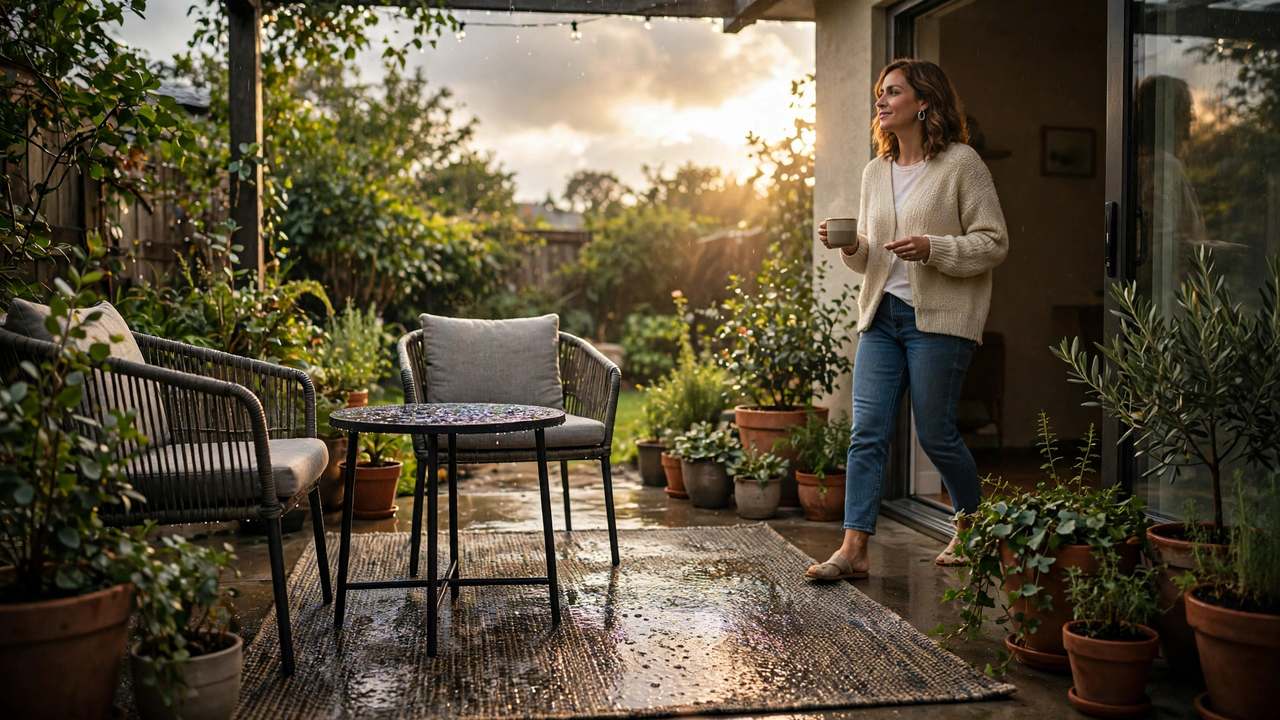
Buying guide: choosing an outdoor rug for rain
Start with the fiber. Polypropylene is the fiber to beat for wet locations. It absorbs almost no water, so the rug dries from the surface rather than staying saturated, and it resists the mildew that colonizes damp natural fibers. It is also solution-dyed in most outdoor lines, which is why the makers of the picks above can list UV coatings and fade resistance credibly. Polyester outdoor rugs exist and can work, but they typically hold more water in the face and dry more slowly. Natural fibers — jute, sisal, seagrass, cotton — are the wrong answer for rain no matter how they are marketed; they absorb water, swell, stain and mildew, and belong under a roof at most.
Then look at how water exits. There are three constructions to know. Open plastic straw weaves, like the five reversible mats in this guide, let rain pass straight through the rug; nothing pools on top and there is no backing to trap water below, which is why they are the default recommendation for uncovered spaces. Flatweave and low-pile woven rugs hold a little more water in the face but still dry quickly if the backing is open or minimal. Piled rugs with solid rubber or latex backings are the slowest to dry underneath, because the backing seals moisture against the floor; treat them as covered-space rugs. Whatever you choose, remember that even a through-draining rug shades the deck below it, so the surface underneath dries more slowly than bare deck — lifting the rug on dry mornings is part of owning any outdoor rug in a rainy climate.
Match the size to the furniture, not the deck. A rug should be large enough that the front legs of every seat in the grouping rest on it, with a border of bare floor around the edges. For a small bistro or two-chair set, 5 x 8 ft is usually right. A four-to-six-seat dining set or a full sofa grouping generally needs 8 x 10 ft or 9 x 12 ft. Leave a walkway margin so the rug edge does not become a trip line in the main traffic path, and check door clearance: flat straw weaves and low piles clear swinging doors, while thicker piles may not.
Plan for wind honestly. Lightweight rugs are easy to lift and dry but need anchoring on exposed sites. Your options, in order of convenience, are furniture weight on the corners, included corner loops with stakes on ground surfaces, and choosing a heavier woven rug for covered areas. If your deck is a known wind tunnel and the rug will sit mostly empty, the staked models in this guide — the fifame and the GarveeHome — solve the problem directly.
Build a two-minute rain routine. After a storm: shake or sweep debris off the face before it mats into the weave, lift one long edge or fold the rug back for an hour so the deck surface dries, and drape the rug over a railing if the underside feels damp. Hose the rug down when pollen, mud or spills build up, and let it dry fully before folding it into its storage bag — storing any rug damp is how mildew starts, even on mildew-resistant fiber. In winter storm seasons, the foldable straw rugs store in their carry bags in a fraction of the space a rolled piled rug needs.
Set expectations for feel. Plastic straw rugs feel like woven mats: firm, cool and grippy rather than soft. That firmness is the price of the fastest drainage and drying in the category, and most owners adapt within a day, especially with outdoor cushions doing the comfort work. If barefoot softness is non-negotiable, a low-pile woven polypropylene rug is the compromise — just respect its backing and give it a covered home or a regular lifting routine.
FAQ
Can an outdoor rug stay outside in the rain all season?
Yes, if it is the right construction. An open-weave polypropylene straw rug is built to live outside through rain: the fiber does not absorb water, the weave drains, and the material resists mildew and UV fading. What it cannot do is keep the deck surface beneath it dry, so lift it periodically on dry days to let the floor underneath dry out, especially on wood decking.
Will a waterproof outdoor rug damage my deck?
The rug itself is not the problem; trapped moisture is. Any rug shades the surface below and slows evaporation, and a solid-backed rug can seal moisture against boards or pavers. Open-weave rugs minimize the risk because water and air move through them. Whatever rug you own, the protective habit is the same: lift it after wet stretches, let both the rug underside and the deck dry fully, and never store the rug folded while damp.
How do you clean an outdoor rug after muddy rain?
Let mud dry first, then shake or sweep the rug to remove the dried dirt — it releases easily from polypropylene straw weaves. Hose the rug down for anything remaining, use a soft brush on stubborn spots, and drape it over a railing or chairs so both faces dry. The makers of the picks in this guide list hose rinsing or damp-cloth wiping as the standard care, and none of them requires machine washing.
What size outdoor rug should I buy for a patio dining set?
Measure the table and chairs with the chairs pulled out as they are when people sit down, then add a margin so chair legs stay on the rug when pushed back. Most four-seat sets fit an 8 x 10 ft rug, and six-seat sets usually need 9 x 12 ft. For a two-chair bistro set or a small seating pair, a 5 x 8 ft rug is typically enough.
Do plastic straw rugs feel cheap or uncomfortable?
They feel different from carpet — firmer and cooler, like a woven mat — and the makers describe the better ones as surprisingly comfortable for bare feet because the straw strands are smooth and slightly springy. What you trade in softness you gain back in drainage, drying speed and weight. If softness matters most and your space is covered, a low-pile woven polypropylene rug such as the Nourison Aloha in this guide is the better feel, with the backing caveat noted in its review.
How do I stop a lightweight outdoor rug blowing away?
Anchor it. Put furniture legs on at least two corners, use the corner loops and stakes included with models like the fifame and GarveeHome when the rug sits on grass or soil, and on hard surfaces keep heavier furniture or planters on the downwind edge. If a severe storm is forecast, the foldable straw rugs take under a minute to fold into their carry bags and bring inside — the simplest solution of all.
Conclusion
Rain does not have to shorten an outdoor rug’s life or turn your deck into a mildew project. The formula that works is consistent across every strong pick in this guide: polypropylene fiber that does not absorb water, an open or low weave that lets rain drain through, no solid backing sealing moisture against the floor, and a weight you can manage so lifting and drying the rug stays easy. For most uncovered patios, the SAND MINE 5×8 ft is the cleanest expression of that formula. Scale up with the fifame or YONILE at 9 x 12 ft, anchor a windy mid-size deck with the GarveeHome, keep small spaces simple with the featherweight GENIMO, and reserve the Nourison Aloha for covered porches where its soft pile and heavy, stay-put build shine. Pick the construction that matches how wet your space really gets, build the two-minute lift-and-dry habit after storms, and your rug will come through rainy seasons looking like it did on day one.
More from Amazon
Programs that pair well with the guide above. Offers and eligibility are set by Amazon and may change.
Collect the home and kitchen items you want in one registry that guests can shop from.
Create a wedding registrySet up recurring deliveries of everyday items on eligible products. Terms and savings are set by Amazon.
Explore Subscribe & SaveFree shipping on eligible items, Prime Video and more. Eligible new members can start with a free trial.
Start a Prime free trialAudiobooks and podcasts to listen to on the go. Eligible new members can start with a free trial.
Try Audible freeAs an Amazon Associate we earn from qualifying purchases.










Write Your Review
No reviews yet. Be the first to share your experience!