We independently review everything we recommend. When you buy through our links, we may earn a commission. As an Amazon Associate we earn from qualifying purchases.
Best Outdoor Cat Enclosures for Patios: 6 Picks (2026)
Compare the best outdoor cat enclosures for patios, from walk-in wooden catios to portable mesh kits, with sizes, roofs, doors and patio fit explained clearly.
Compare the best outdoor cat enclosures for patios, from walk-in wooden catios to portable mesh kits, with sizes, roofs, doors and patio fit explained clearly.
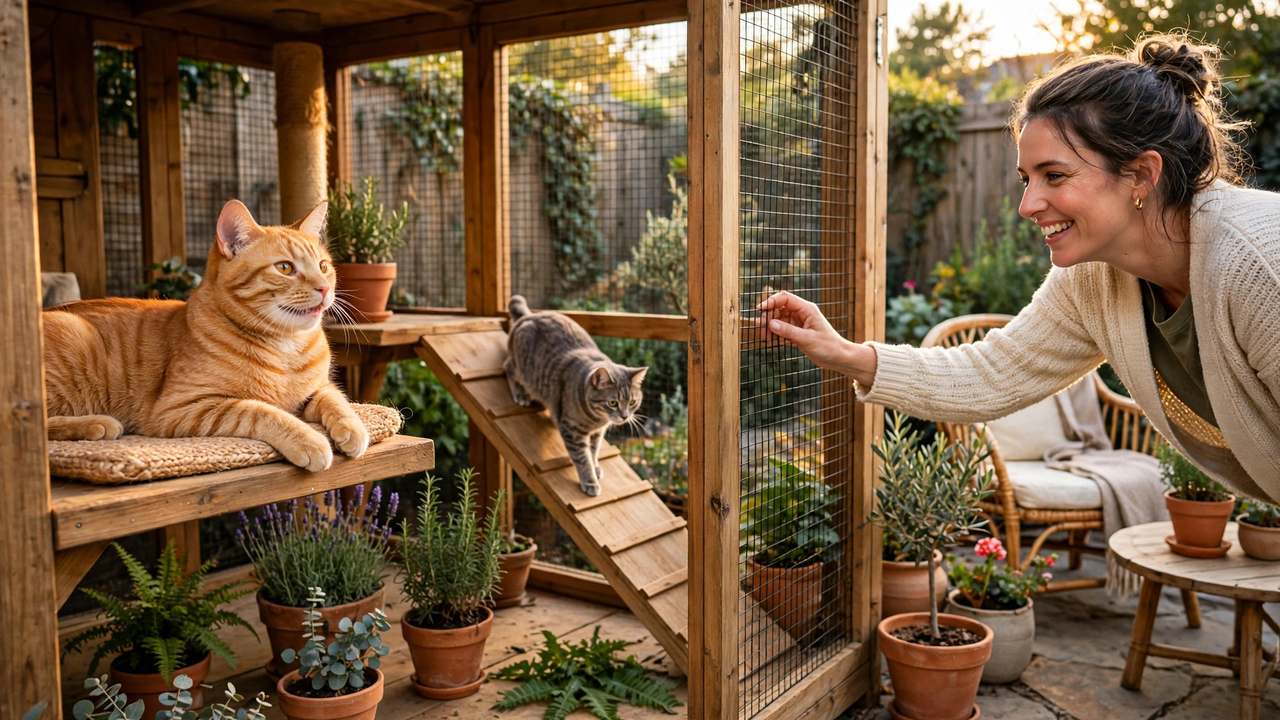
A patio is often the easiest place in the home to give an indoor cat a taste of the outdoors. It is close to the house, usually level, often partly shaded, and easy for you to reach for feeding, cleaning and play. The challenge is choosing an enclosure that actually fits that slab of concrete or decking, stands up to sun and rain, and gives your cat enough height and shelter to settle in rather than pace at the door. This guide to the best outdoor cat enclosures for patios compares six very different designs, from tall walk-in wooden catios you can step inside to light mesh kits you can fold away after an afternoon outside.
Some patio enclosures are essentially small buildings. They have framed walls, wire mesh, a solid or tarp roof, shelves at several heights and a door tall enough for a person. Others are closer to tents: nylon or Oxford fabric panels, fiberglass poles, tunnels and cubes that zip together. Neither approach is automatically better. A permanent wooden catio suits a cat who will use it every day and a household that wants window access so the cat can come and go without being carried. A portable kit suits renters, smaller patios and cats who only go out while someone is home. The sections below explain how each pick is built, what the maker lists for size and materials, and which patio and which cat it fits best.
Before you measure anything, think about how your cat will get into the enclosure. Carrying a calm cat across a patio is simple enough, but a nervous cat, a senior cat or a multi-cat household benefits from a catio placed against a window or pet door, so entry feels like a normal part of the house. Two of the wooden picks below are designed for exactly that, with removable back panels or doors. The portable kits, by contrast, rely on you placing the cat inside through a zip door, which works well for supervised sessions but is a different daily routine. Keeping that distinction in mind will make the comparison table and the individual reviews much easier to read.
Quick verdict
For most patios, the Aivituvin Catio Outdoor Cat Enclosure AIR37-M is the strongest all-round choice. The maker lists a footprint that is long rather than deep, which suits the edge of a typical patio, a full-height walk-in door for cleaning, multiple platforms and resting boxes, and removable doors that let it connect to a window. If you have a larger patio and several cats, the Aivituvin Large Catio AIR54 adds a longer run, four tiers and three resting rooms. For a narrower space or a catio you want to move with the shade, the PawHut 74-Inch Wooden Catio D32-019V00CG and the GUTINNEEN Catio Outdoor Cat Enclosure AIR7014-N both sit on wheels and keep a compact footprint.
If you rent, have a small patio, or only want supervised outdoor time, skip the timber and look at the fabric kits. The Kitty City Outdoor Mega Kit CM-10172 is a fully enclosed nylon mesh playset with rearrangeable cubby cubes, and the VIVOHOME 6-in-1 Outdoor Cat Enclosure VH1509CA goes further, combining two tents, a cube playpen and three tunnels in one light kit that folds into a storage bag. Both need a level surface, anchoring in wind and a cat who is not determined to chew or claw through mesh, but both store in a fraction of the space a wooden catio needs.
The products in this guide
Aivituvin Catio Outdoor Cat Enclosure AIR37-M
The AIR37-M is the pick that best matches how most patios are actually used
The table makes the main trade-off clear. The wooden catios give height, shelves, resting boxes and a roof that sheds rain, but they are heavy, need assembly and will occupy their corner of the patio all season. The mesh kits give flexibility and easy storage, but they offer less weather protection and less security, so they belong in supervised use on calmer days. Height matters more than many buyers expect: cats read vertical space as usable space, and every wooden pick here gives a cat several levels plus a high lookout, while the fabric kits compensate with floor area, tunnels and hiding cubes at ground level.
How we selected
We selected these enclosures by looking for products that are genuinely suited to a patio rather than a large yard. That meant a footprint that can sit on a slab or deck, a design that can stand close to a house wall or window, and enough shelter for a cat to stay out through a passing shower or a hot midday period. Each product had to be a real, identifiable model from a named brand, sold new, with specifications that could be checked on an opened product page. Products whose size, materials or included parts could not be confirmed were left out entirely, rather than described with guesswork.
Within that shortlist, we aimed for a spread of types and sizes. There are walk-in wooden catios for owners who want to step inside to clean and play, wheeled wooden catios for patios where the sunny spot moves during the day, and two fabric systems for households that cannot or do not want a permanent structure. We also weighed practical details that decide whether an enclosure gets used: how the cat enters, whether there is a shaded resting box as well as open perches, whether doors lock, whether the roof is solid, tarp or mesh only, and how the unit is cleaned. Specifications in this article are phrased as the maker lists them, because dimensions and included components can change between production runs, and the listing for the exact model is the source to check before you order.
Finally, we considered the patio itself. A deck needs an enclosure that will not trap water against the boards and that can be moved for cleaning underneath. A concrete slab can take a heavier frame but can get hot, so shade and a resting box off the ground matter. A covered patio relaxes the roof requirement, while an open patio makes a weatherproof roof close to essential. Those differences run through the individual reviews below, so you can match a pick to your surface and exposure rather than simply choosing the largest enclosure that fits.
The AIR37-M is the pick that best matches how most patios are actually used. The maker lists overall dimensions of 62.6 inches long, 32.6 inches deep and 70.1 inches high, in fir wood with wire mesh. That long, relatively shallow shape tucks along a house wall or the edge of a slab without swallowing the middle of the patio, while the height still gives a cat a proper climb. Inside, the maker lists six spacious platforms plus a central platform and resting boxes, arranged so a cat can move from ground level to a high lookout in stages rather than one big jump, which helps kittens and older cats as well as confident climbers.
Access is where this model stands out. The maker lists a full-height front door of about 64 inches, so you can walk in to clean, change a litter tray, sit with your cat or retrieve a cat who has settled into a resting box. There are six removable doors in total, and the back panel can be removed so the catio can connect to a window or pet flap. For a patio that sits under a living room or kitchen window, that turns the enclosure into a true extension of the house: the cat chooses when to go out, and you are not carrying anyone back and forth. Two ground-floor side doors also give lower, easier entry points and a way to attach a compatible tunnel to extend the play area.
For weather and safety, the maker lists a weatherproof tarp roof, secure locking doors, reinforced wire mesh and sturdy wooden bars at the corners for stability. An elevated shelf inside is designed to hold taller litter boxes, feeders and other essentials off the floor, which is useful if the catio will be used for longer stretches of the day. Assembly is listed at about 45 minutes with pre-drilled parts and clear instructions, though as with any large flat-packed wooden enclosure, having a second person to hold panels square while you fix them makes the job calmer and more accurate.
On a patio, plan the position before you build. Leave room for the front door to swing, keep the back panel accessible if you intend to use window access, and avoid placing the resting boxes in the hottest afternoon sun if your patio is fully exposed. Because the footprint is long, check that your slab is level across that full length; a small slope that you never notice with chairs can make a tall framed enclosure rock or leave a gap under one side. A thin outdoor mat or leveling shims under the frame can solve minor unevenness, and keeping the base off standing water will help the fir wood last.
Buy it if you want one permanent patio catio for daily use, you value being able to walk inside for cleaning and play, and window access would let your cat come and go independently.
Skip it if your patio is very small, you need to store the enclosure away between uses, or you cannot give it a level spot about five feet long against a wall or fence line.
The AIR54 is the larger, roomier wooden option in this guide. The maker lists dimensions of 76.8 inches long, 35.8 inches deep and 69.3 inches high, with a four-tier layout, three resting rooms, three platforms and five windows, four of them acrylic and one sliding. That combination matters on a patio because it creates distinct zones: open mesh sides for watching the garden, glazed windows that cut wind while keeping a view, enclosed resting rooms for a cat who wants to withdraw, and platforms at different heights for cats who prefer to be above the group. In a multi-cat home, separate resting rooms and routes up and down reduce the chance of one cat blocking another.
The front entry door is listed at 65.8 inches tall with two latches, so an adult can step in without ducking, which makes deep cleaning, rearranging boxes and spending time inside with the cats much more practical. For window connection, the maker lists a removable upper back door, with the option to remove some wire mesh, so the catio can be linked to the house and cats can enter and exit freely. An inner opening on the third layer lets cats move between levels inside. Latches on the front, back and small doors are described by the maker as upgraded safer latches intended to keep the enclosure closed against curious paws and outside animals.
This is a substantial piece of patio furniture, and the maker lists a weight that reflects that, so treat it as a seasonal or permanent installation rather than something you move weekly. It also ships in two boxes, which the maker notes may arrive at different times, so wait for both before you start assembly. On the patio, its length suits a wide slab, a deck along the back of the house or a covered patio where it can sit under some shelter. The weatherproof roof helps in open positions, but the resting rooms and acrylic windows are what make it comfortable in changeable weather, giving cats a dry, wind-sheltered option without coming indoors.
Think carefully about drainage and sun. A catio this long will shade part of your patio, which many cats love and many owners appreciate, but it can also sit in the path of water running off a roof edge. Position it so drips from gutters do not fall straight onto the roof seam, and check that rain on the slab drains away from, not under, the frame. Inside, put litter facilities at the opposite end from the main resting rooms, use the platforms to create a route that does not force a cat past the litter area to reach a lookout, and add a scratching surface so the wooden uprights are not the only option.
Buy it if you have two or more cats, a wide patio, and you want separate resting rooms, glazed windows and a tall walk-in door in one large enclosure.
Skip it if your patio is narrow, you rent and may need to move the enclosure soon, or a single cat would not use the extra rooms and length.
The PawHut D32-019V00CG takes the opposite approach to the wide Aivituvin models: it goes tall and narrow. The maker lists overall dimensions of 36 inches long, 25.5 inches wide and 74.25 inches high, in fir wood. That footprint is small enough for a modest patio, a balcony-style slab or the corner beside a back door, while the height gives a cat a genuinely high perch. The maker describes space for one cat to have plenty of room or up to three cats to play and lounge, with a box at the top set high above the ground, which suits cats whose favourite indoor spot is the top of a wardrobe or shelf.
Weather protection is a strength here. The maker lists a weatherproof asphalt roof, a more substantial covering than a fabric tarp, intended to keep cats dry if a shower arrives while they are outside. The catio also rolls on wheels, so you can move it to follow shade, bring it under a covered section of patio, or take it indoors for air-conditioned or heated play in extreme weather, as the maker suggests. Wheels are especially useful on a patio that doubles as your own sitting area: the catio can live against the wall during the week and roll to a sunnier or shadier spot at the weekend.
Platform size is the detail to check. The maker lists platform dimensions of 12 by 11.75 inches, and lists a maximum weight of 13 pounds in connection with use of the catio, so this design is better matched to small and average-sized cats than to a very large, heavy breed. A slim cat who likes to climb and sit high will use every level; a broad cat who likes to stretch out flat may prefer the wider platforms and resting boxes of the AIR37-M or AIR54. Assembly is required, and because the unit is tall and narrow, take extra care to place it on a level surface and, in an exposed or windy position, against a wall rather than in the middle of an open slab.
Used well, this is an elegant solution for a patio where floor space is the limiting factor. Put the high box where it gets morning sun rather than the full heat of the afternoon, add a cushion or mat to the resting area if your cat likes a soft surface, and use the lower levels for a small litter tray or water bowl if the catio will be used for longer sessions. Roll it aside periodically to sweep underneath, since a wheeled base makes that job easy and prevents a build-up of leaves and moisture against the wood.
Buy it if your patio is narrow, your cat loves height, and you want a solid asphalt roof plus wheels to reposition the catio as conditions change.
Skip it if you have a large or heavy cat who needs wide platforms, or several cats who each need a separate enclosed resting room.
The GUTINNEEN AIR7014-N is another mobile wooden catio, built around a compact square footprint. The maker lists a footprint of about 31.5 by 31.5 inches with a height of about 71 inches, in fir wood, with four wheels for moving it indoors or outdoors. That square shape fits a patio corner neatly and turns easily when you roll it, which matters if your patio has planters, a table or a barbecue competing for space. Inside, the maker lists a scratching post, a suspended hammock, a resting box and a platform, so even in a small footprint a cat gets a place to scratch, a place to sway and snooze, and a raised lookout.
Two design details set it apart. The top section is described by the maker as fully rotatable through 180 degrees, to make window attachment easier, so the catio can be aligned with a window for cats to move between indoors and outdoors. The bottom door can connect with a cat tunnel or pet door for further versatility. The roof is wire with a removable waterproof tarp over it, which shields a cat from direct sun and rain during outdoor use while still allowing the top to be opened up or adapted when the catio is used inside. A removable PVC bottom floor is listed for quicker cleaning, a practical touch in a compact unit where a litter tray and a resting area sit close together.
The maker also describes the design as expandable, with two or more sets able to be connected, which gives this model a growth path the other wooden picks do not emphasise. Start with one unit on a small patio, and if you later gain space or another cat, a second unit can extend the enclosure instead of replacing it. As with the PawHut, check platform and hammock suitability for your cat’s size before you order, anchor your expectations to supervised, settled use rather than rough play by a very large cat, and place the unit on level paving so all four wheels sit evenly and the brakes or weight of the frame keep it steady.
On a patio, the hammock is the feature most cats will claim first, so position the catio so that spot is shaded for part of the day and not in a draught between the house and a fence gap. Rotate or roll the unit a short distance rather than across the whole patio once a cat is inside and settled, and use the window connection if you can: a cat who can retreat indoors on its own terms tends to use an outdoor enclosure more confidently than a cat who has to wait to be let back in.
Buy it if you want a compact wooden catio on wheels with a hammock and scratching post, window or tunnel connection, and the option to expand later.
Skip it if you need a long run for active multi-cat play in a single unit, or you want a solid roof rather than a removable tarp over a wire top.
The Kitty City Outdoor Mega Kit CM-10172 is a completely different kind of patio enclosure. Instead of a timber frame, the maker lists a fully enclosed playset in nylon mesh, with overall dimensions of 47.25 inches long, 33 inches wide and 46.75 inches high, and a weight of 11.8 pounds. That light weight changes how you use it: you can carry it onto the patio for an afternoon, move it to follow a patch of shade, and bring it back indoors or into a garage without help. For renters and for anyone whose patio furniture already fills most of the slab, that flexibility can be the difference between an enclosure that gets used and one that does not.
Inside, the maker lists rearrangeable cubby cubes that can be positioned in different ways within the structure, giving cats spots to hide, snooze and get away from the action, and giving you a simple way to refresh the layout so a curious cat keeps exploring. A zip door in the side makes it easy for you to reach in, place a cat inside or retrieve one who has curled up at dinner time. The mesh lets in fresh air and gives you a clear view of your cats at play, and the maker describes the mesh as durable enough for energetic play and occasional claw climbing, though a fabric enclosure should still be treated as a supervised product rather than a predator-proof structure.
Expansion is a core part of the design. The maker lists that tunnels can zip this piece together with other Kitty City mesh playsets, so the Mega Kit can become one zone in a larger patio playground, with a tunnel run along a wall or around planters. That modularity suits a growing kitten or a household that wants to start small. There is no solid roof in the maker’s listing, so plan for shade yourself: position the kit under a patio cover, an umbrella or the shade of the house, provide water, and bring cats in during heavy rain or strong wind, when a light mesh structure should be anchored or taken down rather than left to strain against gusts.
On hard patio surfaces, put a mat or blanket under and inside the kit if your cat dislikes a bare floor, and check the mesh and zips before each use, especially if the kit has been stored folded. Supervise the first sessions closely to see how your cat treats the material. A cat who kneads, rests and watches the garden will do well; a cat who persistently bites mesh or throws its full weight at the walls is telling you it needs a framed wooden catio instead.
Buy it if you rent, have limited storage, want a light enclosure you can set up and pack away, and your cats will be supervised while they are outside.
Skip it if you need an enclosure that can be left outside in all weather, used unsupervised, or relied on where larger animals could approach the patio.
The VIVOHOME VH1509CA is the most versatile portable kit in this guide. The maker lists a 6-in-1 design combining a large net tent, a six-panel mesh tent, a cubed playpen and three tunnels, which can be used individually or transformed into a full playhouse layout. The maker lists the net tent at 47.2 by 47.2 by 34.7 inches, the six-panel mesh tent at 39.4 by 39.4 by 26.8 inches, the cubed playpen at 21.7 by 21.7 by 25.6 inches, and each tunnel at about 18.1 inches in diameter and 47.2 inches long. On a patio, that means you can run a tunnel along the wall, open one tent in the sun and keep the cube in shade, rather than committing to a single fixed shape.
Materials are listed by the maker as scratch-resistant mesh, a claw-resistant 210D Oxford cloth base, 420D reinforced pole sleeves with double stitching, and sturdy fiberglass poles, with resin zips for access. The whole kit is listed at 8.7 pounds, the lightest pick here. Included extras listed by the maker include an M-size cat leash, a 30 mm mint ball and an Oxford ring on top for hanging toys. The six-panel tent and cube have a pop-up design, while the large tent needs manual assembly; the maker lists ground nails for the pop-up pieces and 14 ground stakes for the large tent. On a hard patio where stakes cannot go into the ground, plan another way to keep pieces from shifting, use only the configurations that sit stably on the slab, and avoid setting the kit out in wind.
This kit shines for supervised variety: camping trips, visits to family, or a patio afternoon where you are sitting right there with a book while your cat explores a new layout. Secure zips and reinforced mesh sides are listed by the maker as safety features to prevent escapes and keep out pests, and easy-access doors help with feeding and interaction. Like the Kitty City kit, it is not a substitute for a framed, roofed catio for daily unsupervised use, and it offers no solid rain roof, so treat it as fair-weather equipment and store it dry in its bag so the fabric and poles stay in good condition.
Because there are many pieces, do a dry run without the cat first. Work out which layout fits your patio without blocking your own door or walkway, decide which single entrance you will use to put the cat in, and close every other zip fully. Cats learn a new enclosure faster when the layout stays the same for the first few sessions; once your cat is relaxed, rearrange one element at a time. That gradual approach turns a bag of tents and tunnels into a familiar outdoor territory rather than a new puzzle every weekend.
Buy it if you want the most flexible layout options, the lightest kit for travel and storage, and you will always supervise outdoor sessions on the patio.
Skip it if you want one permanent structure with a weatherproof roof, or your patio is exposed and windy with no way to anchor a light fabric kit.
Buying guide
Measure the patio, not just the enclosure. Note the length, depth and height of the space, then subtract room for the enclosure door to open, for you to walk past, and for your own furniture. A walk-in catio needs standing room in front of its door. A wheeled catio needs a clear rolling path. A fabric kit needs its full layout measured, including tunnels, which can quietly double the footprint you first imagined. Also measure any window you hope to connect to, including its height from the patio surface, and compare it with the position of the catio’s back door or removable panel before you commit to a window-access plan.
Match the type to the routine. Daily, independent access points to a framed wooden catio against the house. Weekend, supervised sessions point to a mesh kit you can store away. A cat who will spend long periods outside needs an enclosed resting box, shade, water and a litter option inside the enclosure; a cat who goes out for an hour while you garden needs safe containment, a view and a comfortable place to sit. Be honest about which routine is yours, because the best enclosure is the one that fits it without daily friction.
Check height and platforms against your cat. Cats use vertical space, but only if they can reach it comfortably and the platforms suit their size. Look at the number of levels, the spacing between them, whether there is a ramp, central platform or staged route, and the listed platform dimensions and any weight guidance from the maker. Kittens and senior cats need smaller steps and a low entry door. Large cats need wider platforms and a resting box they can turn around in. If the maker lists a capacity in cats, treat it as a guide to space, not a promise that every combination of personalities will share happily.
Take the roof seriously on an open patio. A solid asphalt roof sheds rain best. A tarp roof over a frame is a good middle ground and can often be removed or replaced. Mesh alone is not a roof: it gives air and a view but no rain protection and little shade. On a covered patio the difference shrinks; on an open slab it should drive your choice. Whatever the roof, position the enclosure so its main resting area is shaded during the hottest part of your patio’s day, and never rely on an enclosure to protect a cat from extreme heat.
Plan cleaning and storage before you buy. Walk-in doors, removable floors and wheeled bases all exist because enclosures get dirty. Think about how you will sweep or wash the base, reach the far corners, and clean under the unit. For fabric kits, think about where the folded bag will live and whether the fabric can dry fully before storage. For wooden catios, think about checking fixings, mesh and roof coverings at the start of each season, and about keeping the base out of standing water to protect the timber.
Introduce the enclosure gradually. Set it up, leave doors open, and let your cat explore it on the patio with familiar bedding and a scratching surface inside before you close anyone in. Short, calm first sessions build the association that the catio is a good place, not a cage. Keep water available, watch body language, and end a session before a restless cat escalates. A cat who chooses to nap in the resting box has accepted the enclosure; a cat who paces the mesh needs a shorter session, a different position, or a different type of enclosure.
FAQ
Can a catio stay on a patio all year? A framed wooden catio with a weatherproof roof is designed for outdoor use, but its life will be longer if it stands on a level, drained surface, out of standing water, with its roof and fixings checked each season. Fabric mesh kits are better treated as seasonal, supervised equipment that is stored dry indoors between uses, especially in wet or freezing weather.
How do I connect a patio catio to a window? Choose a model whose maker lists a removable back panel or back door, position that side flush against the house under the window, and align the opening with the window or a pet flap. The Aivituvin AIR37-M lists six removable doors and a removable back panel, the AIR54 lists a removable upper back door, and the GUTINNEEN AIR7014-N lists a rotatable top section for window attachment. Always check the exact heights on the listing for the model you order, and make sure there is no gap a cat could slip through between the catio and the wall.
Are portable mesh enclosures safe on a patio? They are suitable for supervised use with a cat who does not chew or force mesh, on a calm day, with all zips fully closed and the kit sitting stably on the surface. They are not framed, predator-resistant structures and they have no solid roof, so they should not be left outside unattended or in strong wind, heavy rain or extreme heat.
What should I put inside a patio enclosure? At minimum, water, a shaded resting place and a surface your cat likes to sit on. For longer sessions add a litter tray placed away from food and resting areas, a scratching post or pad, and one or two toys. Use the platforms and resting boxes the maker provides first, and add items gradually so the space does not become cluttered and hard to clean.
How many cats can share one enclosure? Follow the maker’s listed capacity as a starting point, then judge by space, resting spots and temperament. Cats who live together happily indoors still need separate places to withdraw outdoors. Models with several resting rooms or boxes, like the AIR54, suit groups better than a single-box design, and any group does better with more than one route between levels so no cat can block another.
Will a catio work on a deck as well as on concrete? Yes, provided the deck is level and strong enough for the enclosure’s weight, and you protect the boards from trapped moisture by moving or lifting the unit for cleaning underneath. Wheeled models are easier to shift for that cleaning. On both surfaces, check for gaps at the base on uneven ground, since a small gap is an escape route and a place where paws can get caught.
Conclusion
The right patio enclosure is the one that fits your slab, your weather and your cat’s routine. Choose the Aivituvin AIR37-M for a balanced, walk-in wooden catio with window access for daily use, the AIR54 when several cats need rooms and length, the PawHut D32-019V00CG for tall climbing space on a narrow, wheeled footprint, or the GUTINNEEN AIR7014-N for a compact mobile unit with a hammock and room to expand. Choose the Kitty City Outdoor Mega Kit CM-10172 or the VIVOHOME 6-in-1 VH1509CA when flexibility, light weight and easy storage matter more than a permanent structure. Measure carefully, check the maker’s listed dimensions and parts for the exact model, set the enclosure up in shade on a level surface, and let your cat discover it gradually. Done that way, a corner of the patio becomes a safe, familiar piece of the outdoors that your cat can enjoy day after day.
M
Modern Line Home Editorial Team
We compare specs, materials and verified owner reviews before a product earns a spot. Rankings are never paid.
Affiliate disclosure. As an Amazon Associate we earn from qualifying purchases at no extra cost to you. Prices accurate as of the date shown.
House cold even with the heat on? Walk this ordered checklist: thermostat and filter first, then drafts, insulation, leaky ducts and a failing heating system.
Windows fogging up in winter? Check where the fog sits: on the room side it is indoor humidity, outside it is harmless, and between panes the seal has failed.
Store the main firewood pile about 30 feet from your house, off the ground and covered only on top. Compare racks, woodsheds, garages and indoor spots safely.
Place a portable generator outdoors only, at least 20 feet from windows, doors and vents, exhaust pointed away. Exact distances, setup steps and CO rules here.
Keep houseplants in the right winter spot: match window direction to plant type, stay clear of radiators and cold glass, and fix dry air and low light at home.
Mice enter through pencil-width gaps at foundations, pipes, vents, doors and the roofline. Walk this room-by-room winter checklist to find and seal each one.
A winter outage timeline: what to do in the first hour, first night and multi-day outage, with food safety times, pipe protection, heat and CO safety steps.
Size a space heater by room area: 10 watts per square foot at 8-foot ceilings, adjusted for insulation and ceiling height, with full wattage and BTU tables.
Start dripping at about 20 degrees, sooner for exposed pipes. Set a pencil-lead stream, drip the right faucets on both lines, and know when to stop safely.
A fridge needs 800-1,200 starting watts, not just 150-400 running watts. Use the tables to total your fridge plus freezer, lights, furnace fan and more today.












Write Your Review
No reviews yet. Be the first to share your experience!