We independently review everything we recommend. When you buy through our links, we may earn a commission. As an Amazon Associate we earn from qualifying purchases.
Best Hot Tubs for Snow: 6 Winter-Ready Picks for Cold Yards
Find the best hot tubs for snow with full-foam or Arctic insulation, freeze protection, insulated covers and heaters built to hold heat all winter long at home.
Snow changes what a hot tub has to do. A spa that feels fine on a mild autumn evening can lose heat fast when the air drops well below freezing, the wind works at the cover seam, and every soak starts with brushing snow off the lid. Shoppers looking for the best hot tubs for snow are really shopping for heat retention first and everything else second: insulation around the shell and plumbing, a thick insulated cover that seals properly, a heater sized for cold air rather than a warm showroom, and construction that can stay filled, powered and ready outside through the whole winter instead of being drained and stored in October.
This guide compares six tubs that approach that problem in different ways. Two are acrylic spas from Bueno Spa with the maker’s Arctic Max insulation and included thermal covers. Two are resin plug-and-play models from Aqualife by Strong Spas, one of them with full-foam insulation and an all-season heater, the other a compact four-person design with a cover included. One is a large acrylic AquaLife Select Series spa with a high jet count, an insulated tapered cover and a heater the maker describes as all-season. The last is the outlier: an inflatable Bestway SaluSpa with insulated walls, an insulated cover and automatic Freeze Shield technology, included because some snowy yards have no room, no budget and no electrical panel for a hard-shell spa, and a winter-rated inflatable is better than no soak at all.
Every pick below was checked on its opened Amazon listing, including the availability block, and the specifications quoted are the ones the maker lists on that page. Where a listing and a manual disagree, this guide stays with the listing figure or leaves the number out. No prices appear in this guide, because snow-country running costs depend far more on your climate, your electricity supply and how well you maintain the cover than on a headline figure captured on one day.
Quick verdict
For most snowy backyards, the Bueno Spa Jersey is the strongest all-round answer: an acrylic shell, the maker’s Arctic Max insulation, an included cover and a proper hardwired electrical supply, which is what sustained winter heating really wants. The Bueno Spa Chicago stretches the same formula to seven seats for bigger households. If you want a spa that plugs into a standard outlet instead, the Aqualife Invi is the winter pick of the plug-and-play pair, because the maker lists full-foam insulation and a true all-season stainless steel heater for it. The AquaLife Select Series is the choice for shoppers who want the biggest shell, the most jets and an insulated tapered cover with locking clips. The Aqualife Current is the compact, simple option for a small deck. The Bestway SaluSpa Bali is the cautious budget route: genuinely winter-aware for an inflatable, with Freeze Shield protection and insulated walls and cover, but still an inflatable, with all the care and limits that implies in deep cold.
The products in this guide
Bueno Spa Jersey 6-Person 46-Jet Acrylic Hot Tub
The Jersey at 79 by 79 by 35 inches, with seating for six, 46 jets, a capacity of 290 gallons and an Ice White acrylic finish
Best if you want a permanent acrylic spa for a genuinely cold yard and
Freeze Shield technology and insulated walls and cover
The pattern in the table is the real lesson of this guide. Hardwired acrylic spas carry the strongest insulation packages and the heaters with the most headroom, plug-and-play resin spas trade some heating speed for a far simpler installation, and the inflatable trades durability for portability while using freeze protection and insulation to stay viable through winter. None of those trades is wrong. The right one depends on how cold your winters actually get, how often you plan to soak, and whether an electrician visit is on the table.
How we selected
We started with tubs sold new on Amazon US and opened each listing to check the product details, the maker’s listed specifications and the availability block. A listing that showed no live featured offer was excluded and replaced, however good its specifications looked, because a tub you cannot actually order in a new condition is not a useful recommendation. That availability gate removed more than one well-known plug-and-play model from this guide.
Winter suitability then decided the order. We looked for named insulation systems rather than vague efficiency language: full-foam insulation, the Arctic Max insulation Bueno Spa lists for its acrylic spas, insulated walls and covers on the inflatable, and heavy insulated covers on the hard-shell models. We looked for heaters described by the maker as all-season, and for freeze protection where the design offers it. We also favoured hard shells for permanent snowy installations, because a rigid acrylic or resin body, a fitted insulated cover and a cabinet that keeps wind off the plumbing are the basics of a tub that lives outside all year.
Finally, we kept the set deliberately varied. Snow country includes mountain towns where January nights are brutal, lake-effect suburbs where wind is the main enemy, and milder northern yards where the tub only faces a handful of hard freezes. A seven-person hardwired spa, a five-person plug-and-play, a compact four-person resin tub and a winter-rated inflatable give those different readers a sensible starting point each, instead of six versions of the same expensive answer.
The Jersey is the pick that treats winter as the main design brief rather than an afterthought. Bueno Spa builds it around an acrylic shell and lists its Arctic Max insulation for the model, describing that insulation as a way to lengthen comfortable soaking time without reheating and to conserve energy through the tub wall. In snow country that matters twice: the water holds its temperature longer between soaks, and the plumbing inside the cabinet sits behind insulation instead of facing cold air every time the temperature drops overnight.
The maker lists the Jersey at 79 by 79 by 35 inches, with seating for six, 46 jets, a capacity of 290 gallons and an Ice White acrylic finish. The seating layout mixes standard seats with a lounger-style position and shaped massage seats, and the listing highlights ergonomic seat shaping, a compact LCD control panel and a stereo system. A cover is included, which is not a small detail in winter: the cover is where most heat escapes, and a cover made for the tub’s own footprint seals better than a generic replacement bought later. Plan the installation properly, because the maker lists this as a hardwired model and the dry weight on the listing is substantial enough that placement, base preparation and delivery access deserve thought before the truck arrives.
Shell: the maker lists an acrylic shell in Ice White
Insulation: the maker lists Arctic Max insulation
Seating and jets: the maker lists 6 seats and 46 jets
Size: the maker lists 79 x 79 x 35 inches and 290 gallons
Power: the maker lists 220 volts, hardwired
Cover: the maker lists a cover included
Pros
Named Arctic Max insulation package aimed at heat retention
Acrylic shell and included fitted cover suit a permanent snowy installation
Six seats and a lounger-style layout work for households and guests
Hardwired power gives the heater proper headroom in cold air
Cons
Hardwired installation means arranging an electrician before the first soak
Large and heavy once delivered, so the site needs a prepared, level base
Shipping lead time on the listing is longer than for plug-and-play models
Buy it if you want a permanent acrylic spa for a genuinely cold yard and you are willing to do the electrical work once in exchange for stronger winter heating. Skip it if you rent, plan to move the tub between properties, or need to be soaking the week the tub arrives without any installation work.
The Chicago takes the Jersey’s winter formula and stretches it. Bueno Spa lists seven seats, 50 jets and a larger 86 by 86 by 36 inch footprint, with a capacity of 365 gallons. For a big household in a snowy state, that extra seat and extra water volume change the character of the tub: more people can soak together after skiing, shovelling or a winter walk, and the larger body of water changes temperature more slowly than a small tub when the cover comes off in cold air, provided the heater and insulation can keep up between soaks.
On that second point, the maker lists the same insulation thinking as its sibling. The Chicago’s listing describes covers manufactured by Bueno Spa itself for consistent thermal insulation, names Arctic Max insulation, and includes the maker’s ThermoCover in the box. The listing also highlights a stereo system and LED lighting. As with the Jersey, this is a hardwired acrylic spa, and the listed weight is higher again, so think of it as a piece of outdoor infrastructure: a reinforced, level base, a clear delivery path wide enough for the shell, and a planned route for brushing snow off the cover and stepping in without tracking slush across the seating.
Shell: the maker lists an acrylic shell in Ice White
Insulation: the maker lists Arctic Max insulation and an included ThermoCover
Seating and jets: the maker lists 7 seats and 50 jets
Size: the maker lists 86 x 86 x 36 inches and 365 gallons
Power: the maker lists 240 volts, hardwired
Extras: the maker lists a stereo system and LED lighting
Pros
Largest seating count in this guide for bigger winter gatherings
Arctic Max insulation and an included ThermoCover address heat loss directly
Greater water volume softens temperature swings when the cover is off
Acrylic construction suits leaving the tub filled and powered all winter
Cons
The biggest footprint and weight here, so base and access planning are essential
Hardwired supply and a longer shipping lead time slow down installation
More water to heat, filter and maintain than the compact picks
Buy it if your household is large, your winters are long, and you want one permanent spa that everyone can use together through the snow season. Skip it if your deck or patio is small, your delivery access is tight, or a two-to-four-person tub would honestly cover your real soaking habits.
The Select Series is the maximalist option: the maker lists 100 stainless steel jets, of which 80 are adjustable, seating for seven in a bench-style layout, and a pump package built around two high-power pumps plus an air blower pump, with a built-in ozonator. If your winter soaking is social and jet performance is the point, this is the listing that leans hardest into it. The shell is listed at 85 by 85 by 36 inches with a capacity of 480 gallons, the largest water volume in this guide.
Its winter credentials are specific rather than decorative. The maker lists a 4 kW all-season Balboa heater on its 240-volt supply, and an insulated tapered cover with locking clips. A tapered cover matters in snow country for a practical reason beyond insulation: the slope helps snow and meltwater shed instead of pooling and sagging in the middle of the lid, and locking clips keep the seal closed when winter wind gets under the edge. The package also includes steps and headrests, and a large LED waterfall. The trade-offs mirror the Chicago’s, only more so: this is a heavy, hardwired spa that rewards a prepared site and punishes a rushed one, and its jet and pump count means more components to maintain over a long service life.
Shell: the maker lists an acrylic spa measuring 85 x 85 x 36 inches
Heater: the maker lists a 4 kW all-season Balboa heater on 240 volts
Seating and jets: the maker lists 7 seats and 100 stainless steel jets, 80 of them adjustable
Capacity: the maker lists 480 gallons
Cover: the maker lists an insulated tapered cover with locking clips
Extras: the maker lists an ozonator, LED waterfall, steps and headrests
Pros
Highest jet count here, with most jets adjustable
All-season heater and insulated tapered cover are named winter features
Seven seats and the largest capacity suit frequent group soaking
Steps included, which helps with safe entry on icy ground
Cons
Heavy, hardwired and site-hungry, like the other large acrylic picks
More pumps and jets mean more long-term maintenance surface
Oversized for couples who will mostly soak alone or in pairs
Buy it if jet performance and group soaking lead your brief and you want the heater and cover specified for all-season use. Skip it if you want the simplest possible ownership experience, or your yard cannot take a spa of this size and weight.
The Invi is the most convincing plug-and-play answer to snow in this guide, because its winter features are structural. Strong Spas lists full-foam insulation for this resin spa, a heavy-duty insulated cover, and a 1 kW true all-season stainless steel Balboa heater, and describes the hard-sided resin cabinet as suited to all four seasons. Full foam is the insulation approach cold-climate shoppers look for first: it fills the cabinet around the shell and plumbing, slowing heat loss and giving the pipework some protection and support instead of leaving it in a hollow, cold cabinet.
The rest of the specification is deliberately modest, and that is part of the appeal. The maker lists 11 hydrotherapy jets driven by a two-speed pump, seating for five, a 69 by 69 by 29.5 inch octagonal footprint and a dry weight light enough that placement is far less of a project than with the acrylic spas. It plugs into a standard dedicated 15-amp outlet on 120 volts with no special electrical connection, and the maker notes it can be converted by a licensed electrician to 240 volts for greater energy efficiency if you later want faster heating in deep winter. That conversion path is a genuinely useful snow-country feature: start simple, and upgrade the supply if your first winter shows the heater working harder than you like. A digital topside control, cover, filter and filter cover are included, and the maker lists a five-year shell and cabinet warranty.
Shell: the maker lists a hard-sided resin cabinet in an octagonal shape
Insulation: the maker lists full-foam insulation and a heavy-duty insulated cover
Heater: the maker lists a 1 kW all-season stainless steel Balboa heater
Seating and jets: the maker lists 5 seats and 11 jets on a two-speed pump
Size: the maker lists 69 x 69 x 29.5 inches
Power: the maker lists 120-volt plug and play on a dedicated 15-amp outlet, convertible to 240 volts
Pros
Full-foam insulation is the strongest winter specification among the plug-and-play picks
No electrician needed to start, with an optional 240-volt conversion later
Light, compact resin body is far easier to site than an acrylic spa
Cover and filter included, with a listed five-year shell and cabinet warranty
Cons
Only 11 jets, so the massage experience is gentler than the acrylic picks
Heating on 120 volts is slower, especially from a cold fill in winter
Five seats in a compact shell will feel close with five adults
Buy it if you want a permanent hard-shell tub for a snowy yard without electrical work, and insulation matters more to you than jet count. Skip it if powerful jets are your priority, or your winters are severe enough that you already know you want a hardwired heater from day one.
The Current is the small, straightforward hard-shell option. Strong Spas lists a resin body measuring 71 by 61 by 29.5 inches, seating for four adults, 14 hydrotherapy jets and a simple electrical story: it plugs into a standard 120-volt, 15-amp outlet, and a GFCI cord is included. A cover is included as well, which keeps the basic winter equation intact for a compact tub: a rigid shell that does not care about cold air the way an inflatable wall does, a fitted cover to hold heat in overnight, and no installation project between delivery and the first soak.
Be clear-eyed about what the Current is not. The listing does not give it the Invi’s full-foam billing or an all-season heater headline, and a 120-volt plug-and-play heater has less headroom in deep cold than the hardwired acrylic spas above. In a snowy but not extreme climate, or on a sheltered deck against the house where wind exposure is low, that can be a fair trade for the Current’s size, simplicity and lower ownership friction. In an exposed yard in a harsh northern winter, it is the hard-shell pick most likely to make you wish you had chosen more insulation, so site it thoughtfully: out of the prevailing wind, close to the door you will actually use in January, and with a clear, lit path that you can keep free of ice.
Shell: the maker lists a resin body in a rectangular shape
Seating and jets: the maker lists 4 seats and 14 hydrotherapy jets
Size: the maker lists 71 x 61 x 29.5 inches
Power: the maker lists 120 volts on a 15-amp outlet, with a GFCI cord included
Cover: the maker lists a cover included
Setup: the maker lists plug-and-play installation with no special electrical work
Pros
Compact hard resin shell suits small decks and sheltered snowy patios
Simple plug-and-play setup with the GFCI cord included
Included cover covers the basic heat-retention requirement
Fourteen jets is a step up from the Invi for massage feel
Cons
No full-foam or all-season heater headline on the listing
120-volt heating has the least headroom here in severe cold
Four seats only, in the smallest footprint of the hard-shell picks
Buy it if you want a compact, permanent tub for a sheltered spot in a moderately snowy climate and value simplicity over specifications. Skip it if your yard is exposed and your winters are harsh, where the Invi’s full foam or a hardwired acrylic spa will serve you better.
An inflatable in a snow guide needs to earn its place, and the Bali earns it with named cold-weather systems rather than optimism. Bestway lists Freeze Shield technology for this SaluSpa, an automatic protection approach designed to keep the water and pump from freezing when the tub is left powered in cold weather, and lists insulated walls and an insulated cover under its EnergySense design, describing them as up to 40 percent more energy efficient at keeping the water warm than similar hot tubs. The maker lists 140 bubble jets, seating for four to six people, a round 77 by 28 inch footprint, MaxHold internal beams for air pressure retention and a three-layer Tritech outer material described as puncture resistant.
Ownership in snow still demands honesty. An inflatable wall, however well insulated, is not a foam-filled cabinet; heat loss will be higher, the pump unit must stay powered for freeze protection to work, and a power cut during a hard freeze is a real risk to plan around rather than a remote one. Snow load on an inflatable cover needs brushing off, not ignoring. The Bali also brings the inflatable advantages nothing else here can match: it can be set up without delivery machinery or an electrician, controlled through the maker’s app including temperature and timer functions, and deflated and stored if you decide a particular winter is simply too much. For a renter in a snowy town, or a first-time buyer testing whether winter soaking suits them before committing to a hard shell, that is a rational package.
Construction: the maker lists MaxHold internal beams and a three-layer Tritech outer layer
Freeze protection: the maker lists Freeze Shield technology
Insulation: the maker lists EnergySense insulated walls and an insulated cover
Seating and jets: the maker lists seating for 4 to 6 people and 140 bubble jets
Size: the maker lists a round shape at 77 x 28 inches
Controls: the maker lists app control for temperature, timer, filter and massage, plus a power-saving timer
Pros
Freeze Shield and insulated walls and cover are genuine winter features for an inflatable
No electrician, no delivery machinery and no permanent base required
Can be stored away if a winter turns too severe or you move home
App control and a power-saving timer help manage heating from indoors
Cons
Highest heat loss here, and freeze protection depends on uninterrupted power
Inflatable walls and cover need regular snow clearing and gentler handling
Bubble jets give a softer experience than the water jets of the hard-shell picks
Shorter expected service life than a rigid acrylic or resin spa
Buy it if you rent, are testing winter soaking for the first time, or have no route to a hard-shell installation and will keep the tub powered and maintained all winter. Skip it if you face long, severe freezes, unreliable power, or you want a fill-it-and-forget-it permanent spa.
Buying guide: choosing a hot tub for snow
Insulation decides your winter. Everything else is secondary. Full-foam insulation fills the cabinet around the shell and plumbing, perimeter insulation wraps the cabinet walls, and lighter designs insulate mainly through the cover. In a climate with weeks below freezing, full foam or a named insulation system such as the Arctic Max package on the Bueno Spa models is worth prioritising over extra jets, lights or speakers, because you pay for heat loss every single day the tub sits outside, whether you soak or not. Ask where the insulation is, not just whether the word appears in the listing.
The cover is a working part, not an accessory. Most heat leaves through the top. Look for a thick, tapered, insulated cover with a tight seal and locking clips, and plan to keep it that way: brush snow off before it becomes a heavy, waterlogged load, keep the seam closed, and replace a sagging, heavy cover rather than fighting it for another winter. A tapered profile sheds meltwater instead of pooling it. If a listing includes the cover, as every pick in this guide does, that is one less compatibility problem to solve later.
Match the electrical supply to your cold. Plug-and-play tubs on 120 volts are wonderfully simple, but their heaters are small, and on many designs the heater rests while the jets run, so a long soak in cold air can end cooler than it began. Hardwired 240-volt spas heat faster, recover quicker between soaks and hold temperature with jets running. A sensible middle path exists in this guide: a plug-and-play model the maker lists as convertible to 240 volts lets you start simple and upgrade if your first winter demands it. Whatever you choose, use a dedicated circuit as the maker directs, keep the cord and outlet protected from snow and meltwater, and never run a spa from an extension cord.
Plan for freezing as a when, not an if. A filled spa that loses power in a hard freeze can suffer cracked plumbing surprisingly quickly. Know your tub’s freeze protection behaviour, keep it powered and filled through winter if the maker designs it that way, and learn the full winterising procedure (drain, clear the pump, remove and dry the filter, drain the internal plumbing) before you need it, in case you ever have to shut the tub down mid-winter. Freeze Shield on the inflatable pick automates part of this, but it cannot help during a power cut, which is why hard-shell shoppers in outage-prone areas should think about who checks the tub when they travel.
Site the tub for January, not for the brochure. Put it close to the house door you will use in winter, on a level base that stays stable through freeze and thaw, sheltered from the prevailing wind where possible, with room to open and store the cover, brush snow away, and step in safely. Think about where the snow you clear will go, how meltwater drains in spring, and whether overhanging roofs will dump their snow load onto the cover. A windbreak, a non-slip path and outdoor lighting you can switch from indoors all sound minor in autumn and feel essential by February.
Size honestly. A seven-person acrylic spa is a joy for group soaks and a lot of water to heat for a solo Tuesday. Count your realistic regular users, then check the actual dimensions and dry weight against your space and delivery route, including gates, corners and deck load limits. Compact resin tubs exist precisely because many households soak in twos and threes, and a smaller volume of well-insulated water beats a large volume you resent paying to keep hot.
FAQ
Can a hot tub stay outside, filled, all winter in snow?
Yes, that is how hard-shell spas are designed to be used, provided the tub stays powered, the water stays treated and circulating, and the cover stays on and sealed between soaks. Insulation around the shell and plumbing, like the full foam on the Invi or the Arctic Max package on the Bueno Spa models, is what makes that practical in sustained cold. An inflatable can also run through winter if it has freeze protection and insulation, as the SaluSpa Bali does, but it needs more attention and uninterrupted power.
Is full-foam insulation really better for cold climates?
It is generally the approach cold-climate shoppers look for first, because foam fills the cabinet, slows heat loss through the shell, supports the plumbing and reduces the cold air volume around pipes. It is not the only workable system (perimeter insulation with a good cover can perform well and is easier to service), but for a tub that will sit in snow for months, a named, substantial insulation package matters more than almost any other specification.
Should I choose plug and play or hardwired for a snowy yard?
Choose hardwired if your winters are long and severe and you soak often, because the larger heater holds and recovers temperature better. Choose plug and play if installation simplicity matters most, your winters are moderate, or the tub will sit in a sheltered spot, and consider a model listed as convertible to 240 volts so you can upgrade later. Either way, follow the maker’s dedicated-circuit guidance exactly.
What happens if the power goes out during a freeze?
Keep the cover closed and do not drain the tub; a full tub of hot water holds its heat for a considerable time, and the insulation slows the cooling further. The risk grows the longer the outage lasts in deep cold. When power returns, check that the pump and heater restart and the water circulates. If you ever need to shut a tub down in winter, follow the maker’s full winterising steps, including draining the pump and internal plumbing, rather than simply switching it off.
Can an inflatable hot tub handle snow?
A winter-rated one can handle a snowy season with care: look for automatic freeze protection, insulated walls and an insulated cover, keep it powered continuously, brush snow off the cover, and respect the maker’s minimum temperature guidance. It will still lose more heat and need more attention than a hard-shell spa, so in regions with prolonged extreme cold, treat an inflatable as a seasonal or entry-level answer rather than a permanent one.
How do I keep running effort down in winter?
Keep the cover sealed and in good condition, shelter the tub from wind, maintain water chemistry so filtration stays efficient, and avoid turning the temperature down between frequent soaks, since reheating a cooled tub can use more energy than holding a steady temperature. The insulation and cover choices you make at purchase have more effect than any habit you adopt afterwards.
Conclusion
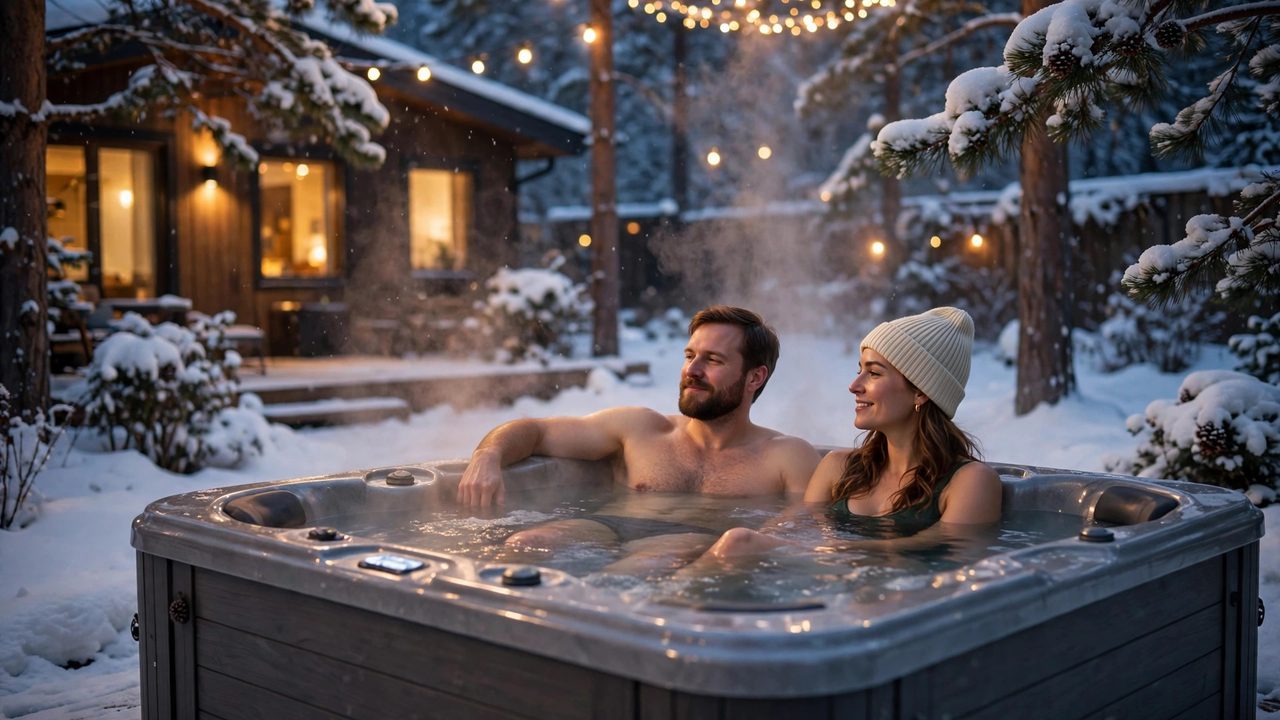
A hot tub for snow is bought on insulation, cover quality and heater headroom, in that order, and only then on jets and seating. The Bueno Spa Jersey is this guide’s default recommendation for a permanent cold-climate installation, with the Chicago stretching the same winter package to seven seats and the AquaLife Select Series adding the highest jet count, an all-season heater and a tapered insulated cover. The Aqualife Invi shows that plug and play can still be serious about winter when full foam and an all-season heater are in the specification, while the Current keeps things compact and simple for sheltered, moderately snowy yards. The Bestway SaluSpa Bali rounds the set out honestly: a winter-aware inflatable with freeze protection and insulation for buyers who cannot, or do not yet want to, install a hard shell. Pick the insulation story that matches your coldest month rather than your mildest, site the tub for the worst week of the year, and the soak on a snowy night, steam rising into falling snow, will repay every bit of that planning.
M
Modern Line Home Editorial Team
We compare specs, materials and verified owner reviews before a product earns a spot. Rankings are never paid.
Affiliate disclosure. As an Amazon Associate we earn from qualifying purchases at no extra cost to you. Prices accurate as of the date shown.
House cold even with the heat on? Walk this ordered checklist: thermostat and filter first, then drafts, insulation, leaky ducts and a failing heating system.
Windows fogging up in winter? Check where the fog sits: on the room side it is indoor humidity, outside it is harmless, and between panes the seal has failed.
Store the main firewood pile about 30 feet from your house, off the ground and covered only on top. Compare racks, woodsheds, garages and indoor spots safely.
Place a portable generator outdoors only, at least 20 feet from windows, doors and vents, exhaust pointed away. Exact distances, setup steps and CO rules here.
Keep houseplants in the right winter spot: match window direction to plant type, stay clear of radiators and cold glass, and fix dry air and low light at home.
Mice enter through pencil-width gaps at foundations, pipes, vents, doors and the roofline. Walk this room-by-room winter checklist to find and seal each one.
A winter outage timeline: what to do in the first hour, first night and multi-day outage, with food safety times, pipe protection, heat and CO safety steps.
Size a space heater by room area: 10 watts per square foot at 8-foot ceilings, adjusted for insulation and ceiling height, with full wattage and BTU tables.
Start dripping at about 20 degrees, sooner for exposed pipes. Set a pencil-lead stream, drip the right faucets on both lines, and know when to stop safely.
A fridge needs 800-1,200 starting watts, not just 150-400 running watts. Use the tables to total your fridge plus freezer, lights, furnace fan and more today.












Write Your Review
No reviews yet. Be the first to share your experience!