We independently review everything we recommend. When you buy through our links, we may earn a commission. As an Amazon Associate we earn from qualifying purchases.
Best Cordless Pool Vacuums for Energy-Efficient Cleaning
Compare cordless pool vacuums by runtime, charge time and battery size, from full-size robots to handhelds, and pick the efficient match for your pool today.
Compare cordless pool vacuums by runtime, charge time and battery size, from full-size robots to handhelds, and pick the efficient match for your pool today.
Energy use is easy to overlook with pool cleaning, because the electricity bill rarely separates the cleaner from the pump, the heater and everything else running in the backyard. Yet the cleaning method itself makes a real difference. A suction-side cleaner borrows power from the pool pump for every minute it works, and a corded robot draws mains power through a power supply for the whole cycle. A battery cleaner is different: it charges once, then cleans entirely from stored energy, and the pool pump can stay off while it works. That is the starting point for anyone comparing the best cordless pool vacuums for energy efficient cleaning, and it is why this guide judges every pick first on maker-stated battery facts rather than on marketing language about efficiency.
Those battery facts are the honest way to compare this category. Runtime tells you how much cleaning one charge buys. Charge time tells you how long the machine sits drawing power before the next session. Battery capacity, where the maker lists it, tells you roughly how much stored energy the cleaner carries into the water. A long-runtime robot that finishes a whole pool in one session wastes less effort than a short-runtime model that needs a second charge and a second pass over the same floor. A handheld vacuum, by contrast, uses a much smaller battery because a person guides it only to the spots that need attention, so it can be the lowest-energy choice of all for a small pool or a quick tidy between robot runs.
This guide covers six cordless models across those two shapes. Four are self-propelled robots for in-ground or above-ground floors, walls and waterlines, or for flat above-ground floors only. Two are handheld vacuums that work on a pole and suit spot cleaning, steps, spas and smaller pools. Every model below is battery powered, every specification is phrased as the maker lists it, and no corded robot or pump-driven cleaner appears anywhere in the lineup, because neither belongs in a cordless shortlist.
Quick verdict
For a full-size in-ground pool, the Aiper Scuba S1 is the strongest all-round pick: the maker lists up to 180 minutes of standard runtime, coverage for pools up to 1,600 square feet, and floor, wall and waterline cleaning, so one charge can finish a large pool without a mid-clean recharge. The WYBOT C1 is the closest alternative, with the maker listing up to 160 minutes, a triple-motor layout and app control for pools up to 1,618 square feet. For a flat above-ground pool, the WYBOT A1 stretches a smaller battery further, with up to 120 minutes of floor cleaning and a fast stated charge time, while the Aiper Scuba SE is the compact option for flat floors up to 860 square feet. For spot cleaning, the Water Tech Pool Blaster Max gives an hour of handheld cleaning with a wide head, and the Intex Rechargeable Handheld Pool Vacuum 28620E is the simple, light-duty choice for PureSpas and pools up to 18 feet across.
The products in this guide
Aiper Scuba S1 Cordless Robotic Pool Cleaner
The Scuba S1 is the pick for owners who want one charge to do the whole job in a larger in-ground pool
Best if you have an in-ground pool up to 1,600 square feet and want floor
The table already shows the central trade-off in this category. The two large robots carry the biggest batteries and the longest runtimes, and they need them, because they drive, climb and scrub on their own. The two flat-floor robots run smaller packs but still cover a whole small pool in one session. The handhelds carry the smallest batteries of all, yet for a ten-minute spot clean they use only a fraction of a charge, which is why runtime alone never tells the whole efficiency story. Match the machine to the size of the job first, then compare runtime and charge time inside that size class.
How we selected
Selection started with a hard filter: the cleaner had to be genuinely cordless, meaning it cleans from an onboard rechargeable battery with no power cord, no hose and no connection to the pool pump while it works. That single rule removed corded robotic cleaners, however efficient their motors might be, and removed every suction-side and pressure-side cleaner, because those models spend the pump’s energy rather than their own stored energy. Only handheld battery vacuums and battery robots remained.
Each surviving candidate then had to be verified on opened pages, with the maker’s own product material or manual as the source for specifications. Runtime, charge time, battery capacity, flow rate, filtration and pool-size limits in this guide all come from those maker listings, and each one is phrased as the maker lists it. Where sources disagreed between model years or editions, the guide uses the figure tied to the exact model named in the heading and leaves contested extras out rather than blending numbers from different versions into a specification that no single machine actually has.
Energy efficiency was judged only on those stated figures, never on invented savings percentages. The working measures were simple: how much cleaning a single charge delivers, how long the charger runs to replace that energy, how large the battery is relative to the pool the maker rates the cleaner for, and whether the design avoids obvious waste, such as an eco or scheduled mode that spreads light cleaning across several days instead of running full power daily. A cleaner also had to be a current model sold new, with a clear pool fit, so that readers could act on the comparison rather than admire discontinued hardware.
Finally, the six picks were spread deliberately across pool types and budgets of effort. A guide that listed six near-identical in-ground robots would not help the owner of a flat above-ground pool, and a guide of six handhelds would not help anyone with a deep in-ground floor. The result is two full-coverage robots, two flat-floor robots and two handhelds, each the clearest representative of its niche on verified specifications.
The Scuba S1 is the pick for owners who want one charge to do the whole job in a larger in-ground pool. The maker lists coverage for pools up to 1,600 square feet and up to 50 feet in length, with cleaning of the floor, walls, waterline and shallow areas. The maker lists battery life of up to 180 minutes in standard use, a charging time of 4 hours, and a lithium battery pack of 7,800 mAh in the model’s manual. The maker also lists an Eco pattern that runs shorter sessions spaced across several days, which suits pools that need frequent light attention rather than one deep weekly clean, because the robot sips at the debris load instead of letting it build into a long, full-power session.
Cleaning hardware is built around thoroughness per pass, which is its own kind of efficiency. The maker lists a flow rate of 4,200 gallons per hour, caterpillar treads for traction and wall climbing, and WavePath 2.0 navigation to guide the route rather than bounce randomly around the floor. Filtration pairs a 180-micron filter basket, which the maker lists at 3.5 litres, with a replaceable 3-micron MicroMesh ultra-fine filter, so fine silt is captured in the same pass as leaves and twigs instead of being left for a second run. Every avoided second run is energy and time saved, and that is the practical sense in which this robot earns its place at the top of an efficiency-focused list.
The trade-offs are size and commitment. This is a full robot that must be lifted out, rinsed and charged after sessions, and its 4-hour charge time means a same-day second full clean needs planning. Owners of small flat pools will also be paying, in battery capacity and machine size, for wall and waterline hardware they will never use. Within its intended class, though, the combination of the longest standard runtime in this guide, the finest stated filtration and full three-surface coverage makes it the most complete cordless cleaner here.
Buy it if you have an in-ground pool up to 1,600 square feet and want floor, wall and waterline cleaning finished in a single charge. Skip it if your pool is a small flat above-ground model, where the smaller robots below cover the floor with far less machine, or if you only ever spot-clean steps and spas.
The WYBOT C1, model OS7010C, is the other full-coverage robot in this guide, aimed at in-ground pools up to 1,618 square feet. The maker lists up to 160 minutes of runtime, a charging time of 3 hours in the model’s specification table, and a battery capacity of 4,600 mAh. That pairing matters for energy use: the C1 returns a long working session from a shorter stated charge than its closest rival, so owners who clean twice in a weekend spend less total time with the charger running. The maker lists a maximum depth of about 9.86 feet, which covers the deep ends of most residential in-ground pools.
The maker lists a triple-motor system, with an independent water pump motor, and a maximum filtration rate of 2,642 gallons per hour in the model’s manual. Navigation uses a high-precision gyroscope with N-path and S-path patterns, and the maker lists climbing on slopes up to 45 degrees, which is how the robot extends its coverage from the floor to the walls, waterline and steps in a single programme. App control adds scheduling and mode selection, and scheduled cleaning is an efficiency feature in disguise: a pool kept on a regular light schedule rarely needs the longest, hardest session the battery can deliver.
Filtration is a single-layer arrangement, with the maker listing a 180-micron filter and a filter capacity of about 3 litres. That is coarser than the dual-layer system on the Scuba S1, so pools troubled by very fine silt may need the separate pool filter to finish what the robot leaves suspended. The C1 is also a substantial machine to lift from the water at the end of a cycle. Against that, its blend of long runtime, shorter stated charge time, four-surface coverage and app scheduling makes it the most flexible alternative to the S1 for in-ground owners.
Buy it if you want wall, waterline and step cleaning with app scheduling, and value a shorter stated charge time between long sessions. Skip it if fine silt is your main problem and you want the finest stated filter in the robot itself, or if your pool floor is flat and above ground, where the A1 below is the better-matched machine.
The WYBOT A1, model OS2010, shows how far a modest battery goes when the job is kept simple. The maker lists up to 120 minutes of runtime from a 2,600 mAh battery, a charging time of about 2.5 hours, and coverage for flat-bottomed pools up to 1,076 square feet with a slope under 15 degrees. Two hours of cleaning from a two-and-a-half-hour charge is the best runtime-to-charge ratio among the robots in this guide, and it comes from focus: the A1 cleans floors only, so none of its stored energy goes into climbing walls or scrubbing a waterline.
The maker lists a dual-motor system, a suction rate of 2,140 gallons per hour, and a dual-layer filtration system that combines a 180-micron filter with a textured foam layer, which helps the tray hold finer material than a mesh alone. A cycle timer is the A1’s most interesting efficiency feature: the maker lists options to clean once for about 120 minutes, twice for 60 minutes across two days, three times for 40 minutes across three days, or four times for 30 minutes across seven days, with self-parking at the end of a run. Spreading the same total cleaning across the week keeps a flat floor consistently tidy without any single long session.
The limits follow directly from that focus. There is no wall or waterline cleaning at all, sloped or dished floors fall outside the maker’s stated fit, and the maker’s listed maximum water depth of about 8.2 feet rules out deeper pools. Owners also need to clean the dual-layer filter regularly, and more often in a heavily soiled pool, as the manual directs. For the flat above-ground and flat in-ground pools it is built for, though, the A1 delivers the longest floor-cleaning runtime per charge in its size class.
Buy it if your pool has a flat floor up to 1,076 square feet and you want long floor runtime, fast stated charging and a weekly cycle timer. Skip it if you need any wall or waterline cleaning, or your floor slopes steeply to a deep end.
The Scuba SE is the compact robot for smaller flat pools. The maker lists it for flat-floor pools up to 860 square feet, with battery life of 90 minutes, a charging time of 3 to 4 hours, and a battery capacity of 2,600 mAh, listed at 28.08 watt-hours. The maker describes a hydrodynamic design intended to use less power in propulsion and dedicate more of the battery to cleaning, and lists suction of 1,200 gallons per hour from its drive and pump motors. Treat the design claim as the maker’s own framing; the verifiable facts are the small battery, the 90-minute runtime and the modest pool size, and together they describe a light machine matched to light work.
Everyday details are simple, which suits the efficiency brief in a different way: a machine that is easy to deploy gets used in short, regular sessions instead of being left in a shed until the pool needs a rescue clean. The maker lists one-click activation, an audio alert system that announces low battery and other states, a 2-litre filter box with a 180-micron filter tray, and a rapid water release that drains most stored water in about 15 seconds, so the robot is lighter to lift out. The maker lists a maximum water depth range up to 10 feet, although the flat-floor and 860-square-foot limits are the figures that actually define its fit.
The compromises are coverage and headroom. The SE cleans floors only, it cannot follow a sloped floor profile, and a pool close to its size limit with heavy leaf fall may need the filter box emptied mid-session. Its runtime is also the shortest of the four robots here, so there is little spare capacity if the pool grows dirtier than usual. For a small flat above-ground pool kept on a routine, it remains a tidy, low-energy match.
Buy it if you have a flat pool up to 860 square feet and want the simplest possible drop-in robot routine. Skip it if your pool is larger, sloped, or needs wall cleaning, where the A1 or one of the full-coverage robots fits better.
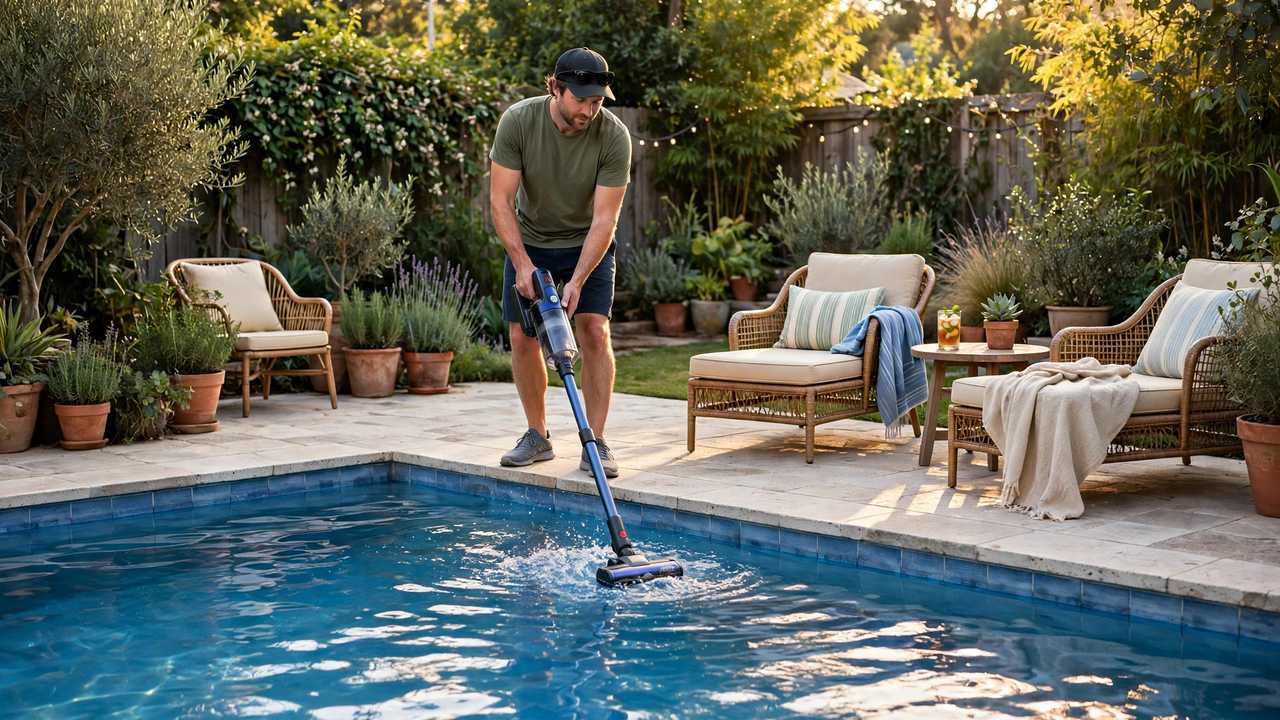
The Pool Blaster Max, model 30000ML, changes the efficiency equation completely, because a handheld vacuum only runs while a person is actively cleaning. The maker lists up to 60 minutes of run time from its lithium-ion battery, a charge time of about 4 hours, and a battery capacity of 2,200 mAh. In practice, a spot clean of steps, corners and a debris patch might use ten of those minutes, so a single charge can cover several short sessions across a week, and the total energy spent on touch-ups stays far below any robot programme. It also works entirely independently of the pool pump and filter, so debris goes into its own bag rather than loading the main filtration system.
The maker lists a 10.5-inch vacuum head, a P30 motor, and an X-Treme multilayer filter bag designed to capture both large debris and finer material, with a crevice nozzle for corners and spot work. The maker lists a minimum operating depth of 14.25 inches at a 45-degree angle, and the unit attaches to a standard telescopic pole, which is sold separately, for reaching across larger floors. Because the head is wide for a handheld, each guided pass covers a useful strip, which reduces the number of passes, and therefore the minutes of runtime, needed to clear a given patch of floor.
The limits are effort and endurance. You are the navigation system, so a full large floor is slow, arm-powered work, and 60 minutes is a ceiling, not a suggestion, for one session. The filter bag also needs emptying and rinsing as it fills, and heavy pool-opening debris is beyond what a maintenance handheld is built for. As a complement to a robot, or as the only cleaner for a small pool with light debris, it is the lowest-energy way in this guide to deal with dirt exactly where it sits.
Buy it if you want targeted cleaning of steps, corners and debris patches without running the pump or a full robot cycle. Skip it if you want hands-free whole-pool cleaning, or your pool regularly needs long, heavy debris sessions.
The Intex 28620E is the smallest-energy cleaner in this guide, built for PureSpas and above-ground pools up to 18 feet in diameter. The maker lists built-in rechargeable nickel-metal hydride batteries, a 94-inch telescoping aluminium shaft, two interchangeable brush heads, and a shaft adapter, so the kit arrives ready to reach across a small pool without buying a separate pole. The maker’s manual lists a full charge of about 8 to 10 hours providing about 40 to 50 minutes of operation, and charging is by USB cable using a standard compatible plug, which the maker notes is not included.
That long, slow charge is the honest weakness of this model, and it belongs in an efficiency guide rather than being hidden. The battery itself is small, so the total energy per charge is modest, but the turnaround is the slowest here by a wide margin, and owners who forget to plug it in after a session will find it flat when they need it. Set against that, the running side is frugal and fit for purpose: the maker lists an automatic shutoff when the vacuum is not submerged, which prevents the motor from wasting its charge running in air, and an IPX8 waterproof switch for underwater use.
This is a routine-maintenance tool, not a rescue tool. The maker positions it for general upkeep of pools and spas rather than pool opening, and its reach and runtime suit small, shallow water where a full clean is a short job. Owners of Intex pools and spas get a cleaner matched exactly to their equipment, with no pump connection, no hose and no cord. Owners of larger or deeper pools should look at the Pool Blaster Max for handheld work, or at any of the robots above.
Buy it if you own a PureSpa or a pool up to 18 feet across and want a light, simple rechargeable vacuum with its shaft included. Skip it if the slow stated charge time will leave it unready between sessions, or your pool is larger, deeper or heavily soiled.
Buying guide
Start with the pool, not the product. Measure or confirm your pool’s floor area, note whether the floor is flat or sloped, and decide honestly whether walls and the waterline need machine cleaning or whether a brush handles them. Those three answers divide this guide cleanly: sloped in-ground pools with wall needs belong to the Scuba S1 and WYBOT C1; flat floors up to about 1,076 square feet belong to the WYBOT A1 or Scuba SE; and spot work, spas and very small pools belong to the two handhelds. Buying a cleaner rated far above your pool size wastes battery capacity on every charge, while buying one at its limit invites unfinished second sessions.
Next, read runtime and charge time as a pair. Runtime per charge tells you whether one session finishes the pool; charge time tells you how forgiving the cleaner is when you forget to plug it in. A useful shorthand from the maker listings in this guide is the ratio between the two: the WYBOT A1 returns about two hours of cleaning from a two-and-a-half-hour charge, the large robots return roughly three hours from three to four hours of charging, and the Intex handheld returns under an hour from an overnight charge. None of these figures measures electricity cost directly, and this guide does not invent one; they measure readiness and how much cleaning each charging cycle buys.
Battery capacity deserves a careful read, because a bigger number is not automatically better. Capacity only means something relative to the pool the maker rates the cleaner for: a 2,600 mAh pack that covers 1,076 flat square feet is working efficiently, while the same pack would be undersized in a wall-climbing robot. Where the maker lists watt-hours, that figure is the closest thing to a fuel-tank size for stored energy, and comparing it against stated runtime gives a rough sense of how hard the motors draw on the pack. Always compare these numbers within the same cleaner shape, robot against robot and handheld against handheld.
Filtration affects energy use more than it first appears. A robot whose filter captures fine silt in the same pass as leaves finishes in one programme; a coarser filter can leave fine material to settle again, prompting another run. Dual-layer systems, like the 180-micron plus 3-micron pairing the maker lists for the Scuba S1 or the mesh plus foam pairing on the WYBOT A1, aim to close that gap. Whatever you choose, a clogged filter makes any motor work harder for less pickup, so rinsing the basket or bag after each session is the cheapest efficiency habit in pool care.
Modes and scheduling are the last lever. Eco modes, spaced cycle timers and app schedules all do the same thing in different clothes: they spread cleaning into shorter, more frequent sessions that match how debris actually accumulates. A pool cleaned lightly every two days rarely needs a maximum-length deep clean, and the total runtime across a week can end up similar while the water stays consistently clearer. If you travel, a cycle timer that keeps working while you are away also prevents the one scenario that wastes the most energy of all, the neglected pool that needs repeated heavy sessions to recover.
Finally, care for the battery you buy. Charge after use rather than storing the cleaner flat, keep charging contacts dry before connecting the charger, store the unit out of harsh heat and cold, and follow the maker’s stated charging times instead of leaving a charger connected indefinitely. A battery that holds its capacity keeps delivering the maker’s stated runtime for longer, which is what makes any of these cleaners efficient over years rather than just in their first season.
FAQ
Does a cordless pool vacuum really use less energy than a corded cleaner?
It uses energy differently. A cordless model draws power only while charging and cleans entirely from its battery, with the pool pump off, while a suction-side cleaner depends on the pump running for the whole session. This guide compares only maker-stated runtime, charge time and battery figures, and does not assign a savings percentage, because that depends on your pump, your pool and how long each cleaner runs.
How long should a cordless pool vacuum run on one charge?
Long enough to finish your pool in one session, with a little spare. In this guide the maker lists up to 180 minutes for the largest robot, 120 minutes for a flat-floor robot, 90 minutes for the compact robot, and 40 to 60 minutes for the handhelds, which are guided only to dirty areas. Match the figure to your floor area rather than simply buying the largest number.
Are handheld cordless vacuums more efficient than robots?
For spot cleaning, usually yes in practice, because they run for only the minutes you spend guiding them and carry much smaller batteries. For whole-pool cleaning, a robot is the better tool: it follows a planned route in one session instead of relying on a person to cover every strip evenly, which can take longer and miss areas that then need a second pass.
What do Eco modes and cycle timers actually do?
They split cleaning into shorter sessions spread across days. The maker lists an Eco pattern for the Scuba S1 that runs brief floor sessions spaced over a week, and the WYBOT A1 lists a cycle timer that divides its 120 minutes into two, three or four sessions across up to seven days. The point is steady light maintenance instead of occasional long, heavy cleans.
How can I keep a cordless cleaner efficient over time?
Rinse the filter basket or bag after every session so the motor is not straining against a clogged filter, charge the battery after use, dry the charging contacts before charging, and store the cleaner away from temperature extremes. Following the maker’s stated charge time, rather than leaving the unit on charge indefinitely, also helps the battery keep its stated capacity.
Can a cordless vacuum replace my pool pump’s filtration?
No. These cleaners collect debris in their own basket, tray or bag, which keeps that debris out of the main filter, but they do not circulate or sanitise the whole pool volume. Run the pump and filter on their normal schedule for water quality, and let the cordless cleaner handle the debris work it is designed for.
Conclusion
Energy-efficient pool cleaning is mostly a matching exercise. The Aiper Scuba S1 matches large in-ground pools with the longest standard runtime and the finest stated filtration in this guide. The WYBOT C1 matches similar pools with a shorter stated charge time and app-driven scheduling. The WYBOT A1 and Aiper Scuba SE match flat, smaller pools with modest batteries used well, and the Water Tech Pool Blaster Max and Intex 28620E match spot work and spas, where a small battery guided by hand beats any programme. Choose the smallest cleaner that genuinely finishes your pool in one session, keep its filter clean and its battery charged, and the efficiency follows from the fit.
M
Modern Line Home Editorial Team
We compare specs, materials and verified owner reviews before a product earns a spot. Rankings are never paid.
Affiliate disclosure. As an Amazon Associate we earn from qualifying purchases at no extra cost to you. Prices accurate as of the date shown.
House cold even with the heat on? Walk this ordered checklist: thermostat and filter first, then drafts, insulation, leaky ducts and a failing heating system.
Windows fogging up in winter? Check where the fog sits: on the room side it is indoor humidity, outside it is harmless, and between panes the seal has failed.
Store the main firewood pile about 30 feet from your house, off the ground and covered only on top. Compare racks, woodsheds, garages and indoor spots safely.
Place a portable generator outdoors only, at least 20 feet from windows, doors and vents, exhaust pointed away. Exact distances, setup steps and CO rules here.
Keep houseplants in the right winter spot: match window direction to plant type, stay clear of radiators and cold glass, and fix dry air and low light at home.
Mice enter through pencil-width gaps at foundations, pipes, vents, doors and the roofline. Walk this room-by-room winter checklist to find and seal each one.
A winter outage timeline: what to do in the first hour, first night and multi-day outage, with food safety times, pipe protection, heat and CO safety steps.
Size a space heater by room area: 10 watts per square foot at 8-foot ceilings, adjusted for insulation and ceiling height, with full wattage and BTU tables.
Start dripping at about 20 degrees, sooner for exposed pipes. Set a pencil-lead stream, drip the right faucets on both lines, and know when to stop safely.
A fridge needs 800-1,200 starting watts, not just 150-400 running watts. Use the tables to total your fridge plus freezer, lights, furnace fan and more today.












Write Your Review
No reviews yet. Be the first to share your experience!