We independently review everything we recommend. When you buy through our links, we may earn a commission. As an Amazon Associate we earn from qualifying purchases.
Best Chairs for Getting Up Stairs: 6 Picks for Homes
Compare the best chairs for getting up stairs, from fixed stair lifts to powered and manual stair chairs, with capacities, track lengths and folding sizes.
Compare the best chairs for getting up stairs, from fixed stair lifts to powered and manual stair chairs, with capacities, track lengths and folding sizes.
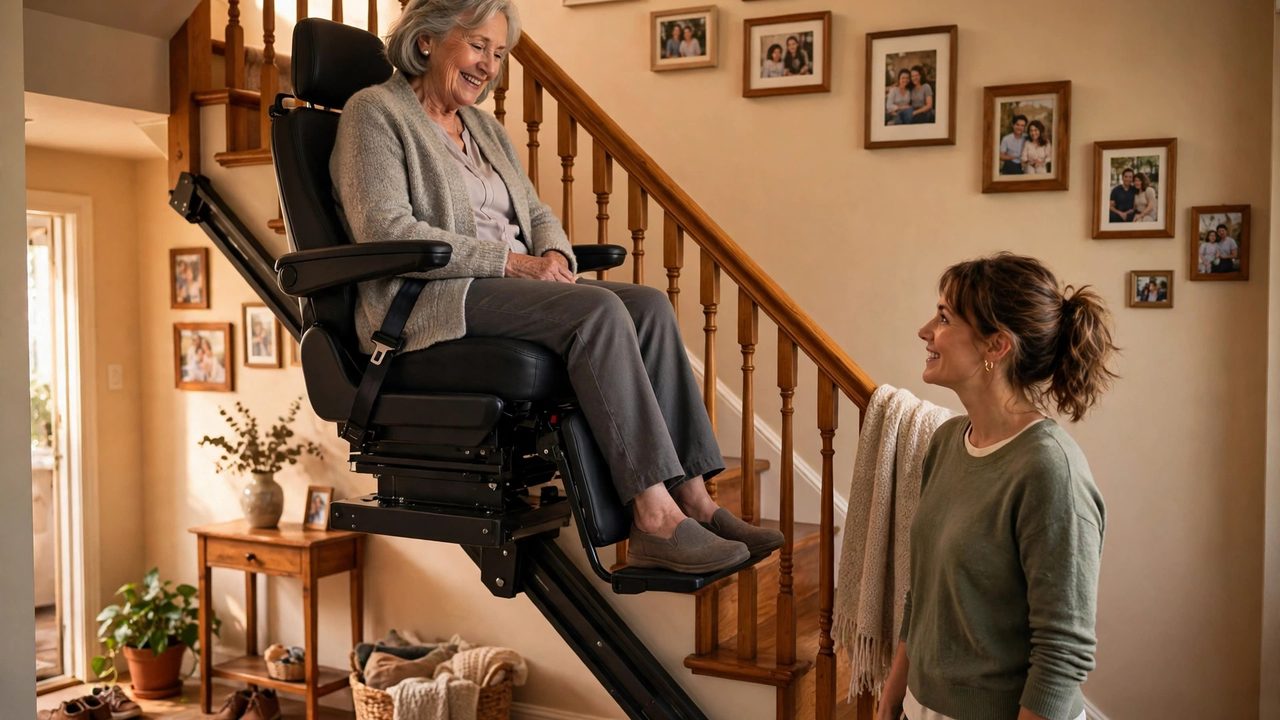
Getting up and down a flight of stairs stops being a small task when a member of the household cannot use the steps in the usual way, and that is exactly the problem the best chairs for getting up stairs are built to solve. The phrase covers three quite different kinds of equipment, and choosing well starts with understanding which kind fits your home. The first kind is a fixed stair lift: a motorised seat that runs on a track fitted along the staircase and stays in the home permanently. The second kind is a powered stair-climbing wheelchair: a portable chair with a motorised climbing system that an attendant guides up and down the steps, with no track and no installation. The third kind is a manual stair chair: a lightweight folding transfer chair, usually with two or four wheels and restraining straps, that one or two helpers use to move a seated person on stairs and across flat floors.
Each type suits a different situation. A fixed lift is the only option in this guide that the rider operates while seated on the chair itself, travelling between floors of the same home every day. A powered climbing wheelchair suits households that need to use more than one staircase, visit other buildings, or avoid permanent installation altogether. A manual chair suits occasional transfers, buildings without a lift, and keeping a folding chair stored ready in a cupboard, a car boot or an entrance hall. Capacity, track length, folding size and who operates the controls matter more than any headline feature, so this guide compares six verified products across all three types and explains, in plain terms, what the maker lists for each one.
Quick verdict
For a permanent, everyday solution on a straight staircase, the AmeriGlide Rave 2 Stair Lift is the strongest all-round pick in this guide: the maker lists a 350 lb capacity, battery power, 15 feet of track included, a swivel seat and wireless call stations at both ends of the stairs. The Universal Stair Lift is a close alternative for the same job, folding flat to the wall and plugging into a regular outlet with a battery backup the maker lists for more than twenty trips during an outage. If you want no installation at all, the Yawhew Electric Stair Climbing Wheelchair NXN20-205 and the QAUSOU Power Wheelchair YH-E7007 both carry a maker-listed 450 lb capacity and fold for storage, with an attendant guiding the climb. For a simple, light manual chair, the LINE2design EMS Mobility Chair 70002-Y weighs a maker-listed 22 pounds and carries up to 400 lb, while the Lemoeyes Stair Chair is a basic two-wheel folding option with three restraining straps and a wider 20-inch seat.
The products in this guide
AmeriGlide Rave 2 Stair Lift
The Rave 2 is the fixed stair lift in this guide aimed squarely at a home that needs a permanent, everyday way for one person to travel between floors
Best if you want a permanent lift on a straight staircase
Three restraining straps, retractable handle, 20-inch seat
How we selected
We started with the three equipment types that genuinely answer this keyword — fixed stair lifts, powered stair-climbing wheelchairs and manual stair chairs — and looked for real, named products sold new on Amazon US in each type, so the guide reflects the real choice a household faces rather than six versions of the same chair. Every product in the Top picks was verified on an opened product page, and every specification in this article comes from that opened page, phrased as what the maker lists. Products whose pages did not confirm a brand, a model and a clear set of features were excluded entirely, however promising their names sounded.
Within each type, we favoured products that publish the numbers a buyer actually needs: a stated load capacity, a track length for fixed lifts, a chair weight for portable chairs, and a clear description of how the rider is secured and who operates the controls. We also kept the spread honest. The two fixed lifts are similar in concept but differ in how they power and fold. The two powered wheelchairs share a capacity figure but come from different makers with different control and seating descriptions. The two manual chairs differ in wheel layout, restraint design and weight. Where a maker lists a limitation — for example, that a chair is manual with no tracks, or that a powered chair is attendant-controlled — we state it plainly in the pick, because that limitation is often the deciding factor.
A note on scope: this guide describes equipment features only, exactly as the makers list them. It does not assess whether any chair is suitable for a particular person, and it makes no claims about health outcomes. Stair equipment carries a seated person on a slope, so the maker’s own instructions, stated limits and fitting guidance are the authority for any individual purchase, and professional advice is the right route where a household is unsure which type of equipment fits its situation.
The Rave 2 is the fixed stair lift in this guide aimed squarely at a home that needs a permanent, everyday way for one person to travel between floors. The maker lists it as a self-installable lift for straight staircases, with 15 feet of track included in the box, which the maker presents as enough for a typical one-floor installation. It is battery powered, so the chair runs from its internal battery rather than depending on the mains at the moment of travel, and the maker lists a maximum weight capacity of 350 lb for the seat.
The seating and safety details are where this model earns its place. The maker lists a swivel seat, so the rider can turn the seat at the landing rather than stepping off sideways on the stairs themselves. The seat and armrests flip up, which keeps the staircase clearer for other household members walking past the parked lift. The maker also lists a footrest safety sensor, a feature designed around the footrest meeting an obstruction on the steps. Wireless call stations at both the top and the bottom of the stairs complete the picture: the chair can be sent or called from either end, which matters in a home where the lift is shared or where a helper waits at the other landing.
Because it is a fixed lift, the Rave 2 suits one staircase in one home, used repeatedly, rather than travel between buildings. The track is fitted along the stairs, the chair lives on that track, and the rider operates the lift from the seat. For a household comparing fixed lifts, the combination the maker lists here — battery power, included track, a swivel seat and call stations at both ends — is the complete everyday package, and it is why this model leads the guide.
Buy it if: you want a permanent lift on a straight staircase, the rider will travel seated on the lift itself, and you value a swivel seat and call stations at both landings.
Skip it if: your staircase is curved, you rent and cannot fit a track, or you need a chair that can be carried to other buildings.
The Universal Stair Lift is the second fixed option in this guide, and its defining trick is how little of the staircase it takes up when it is parked. The maker lists that it folds up flat to the wall, so the seat tucks away and the stairs stay easy for everyone else in the house to walk up and down. Like the Rave 2, the maker lists a 350 lb capacity and 15 feet of track included, which the maker describes as plenty for typical one-floor installations, and it installs on either side of the stairs, so the layout of your hall and landing does not dictate which side the rail has to run on.
The power arrangement is different from the Rave 2 and worth understanding. The maker lists that the power cord plugs directly into a regular AC outlet, with no wiring required, and that an internal rechargeable battery backup runs the lift up and down more than twenty times if the power goes out. In practice that means installation avoids an electrician for the supply, while an outage does not immediately strand the chair. The maker also lists three safety mechanisms and a wireless remote among the headline features, and states that the lift is made in America and includes a warranty.
Choose between this and the Rave 2 on the details of your staircase and household. If the stairs are narrow or heavily used on foot, a seat that folds flat to the wall is a genuine daily convenience. If your priority is the swivel seat and footrest sensor arrangement, the Rave 2 lists the fuller seating package. Either way, this is a fixed, single-staircase product: it does not travel, and it is listed for the standard straight-run home installation its track length describes.
Buy it if: your staircase is narrow or busy on foot, you want the parked seat folded flat to the wall, and you prefer a lift that plugs into a regular outlet with battery backup for outages.
Skip it if: you need a portable chair, your stairs turn a corner, or a swivel seat is your top priority.
The Yawhew NXN20-205 changes the approach completely: instead of a track fitted to one staircase, this is a powered wheelchair-style chair with a motorised climbing system that an attendant guides up and down the steps. The maker lists a load capacity of 450 lb, the joint highest figure in this guide, and describes attendant controls that move the chair at a steady, gradual pace on the stairs. Because nothing is installed, the same chair can be used on the stairs at home, carried to another building, and stored folded when it is not needed.
The maker lists a safety belt to secure the rider while climbing, and lockable rear wheels so the chair stays put on flat surfaces at the top and bottom of a flight. The chair folds for transport, and the maker presents it as fitting car boots and storage areas more easily than a fixed installation, with no permanent footprint on the staircase. The maker lists the chair’s own weight at 116 pounds and its construction as metal, which is the honest trade-off of the type: a powered climbing chair is a substantial piece of equipment for the attendant to move around off the stairs, even though the motor does the climbing work on the steps themselves.
This type of chair changes who does what. On a fixed lift the rider travels alone; here, the maker describes a caregiver operating the controls while the rider sits belted in the chair. Households where a helper is always present gain portability and a high stated capacity. Households where the person using the chair is usually alone should look at the fixed lifts above instead, because an attendant-controlled climber does not answer that situation.
Buy it if: a helper will operate the chair, you want a high maker-listed capacity without any installation, and the chair needs to work on more than one staircase or travel in a car.
Skip it if: the rider is usually unaccompanied, or the chair’s own 116-pound weight would be difficult to move between uses.
The QAUSOU YH-E7007 is the second powered climbing wheelchair in this guide, and it matches the Yawhew on the headline number: the maker lists a heavy-duty capacity of 450 lb, with a high-strength aluminium alloy frame. Operation follows the same attendant-led pattern — the maker lists simple button controls that let a caregiver guide the chair slowly and steadily up and down stairs, with a secure safety belt keeping the rider in place during the climb. No installation is required, and the chair folds for storage next to the stairs or in a vehicle boot.
Where this model puts its emphasis is the seat. The maker lists a spacious backrest and thick, plush PVC padding, describing the seat as soft yet supportive, waterproof for easy clean-up and fire-resistant. For a rider who will spend the climb seated while someone else drives the chair, padding and backrest size are not cosmetic details — they are most of what the rider experiences. The maker also positions the chair for use beyond the home, naming hospitals and clinics among the settings its portable, no-footprint design suits, as well as daily use at home.
Choosing between the two powered climbers comes down to the details each maker publishes. Both list 450 lb, attendant controls, a safety belt and a folding frame. The Yawhew lists lockable rear wheels and publishes its own weight; the QAUSOU lists the fuller seating description. Read both listings closely for the climbing mechanism, battery and control layout before deciding, and weigh the chair’s handling off the stairs as carefully as its performance on them.
Buy it if: a helper will drive the chair, rider comfort on the seat and backrest is a priority, and you want a folding powered climber with a maker-listed 450 lb capacity.
Skip it if: the rider needs to travel the stairs independently, or you would rather have a fixed lift that is always ready on the staircase.
The LINE2design 70002-Y is a manual stair chair from a maker whose range is built for emergency and transfer work, and its numbers explain its appeal: the maker lists a load capacity of 400 lb, yet the chair itself weighs just 22 pounds. That combination — a high stated capacity in a chair one person can carry to the stairs — is exactly what a manual chair is for. The maker is explicit that this is a manual chair with no tracks, so it does not climb by itself; helpers move the seated rider, using the chair’s wheels on flat ground and its handles on the stairs.
The construction details are published in unusual depth. The maker lists a 2-inch welded tubular frame with rust-resistant stainless steel hardware, a 2-inch heavy-duty cross-body safety restraint plus a 2-inch lower leg safety strap, and rear wheel brakes for stability during transfers. The wheel layout is two 5-inch rear wheels with smaller 3.5-inch swivel front wheels, which is the arrangement that lets a four-wheel chair roll and turn on landings and through doorways between flights. The seat and backrest are all-impervious vinyl, which the maker lists as resisting fluids, and a padded rear bar gives the operator a more comfortable grip.
Storage is part of the design: the maker lists folding rear handles and wall-mount capability, so the chair can live flat against a wall in a hall or be carried in a vehicle. For a household, that makes it a keep-it-ready chair — stored by the stairs for the occasions when a seated person needs to be moved between floors with help, rather than a machine used for every trip. It asks more of the helpers than any powered option here, and in return it is the lightest, simplest and most storable chair in the guide.
Buy it if: helpers will handle the transfers, you want a light 22-pound chair that stores flat or wall-mounted, and a 400 lb maker-listed capacity covers your needs.
Skip it if: you want powered climbing, a track system, or a chair the rider can use without assistance.
The Lemoeyes Stair Chair is the simplest manual option in this guide: a folding two-wheel transfer chair that the maker lists for moving people with limited mobility up and down stairs in high-rise buildings, and for use in settings such as hospitals, emergency centres and fire centres. The maker lists support for up to 350 lb. When it is not in use, the chair folds completely, and the maker presents that folded size as small enough to save space in a room or an ambulance and to fit easily in the boot of a car.
The securing system is the detail to note. The maker lists three restraining straps with quick fasteners, one more strap than the two-strap arrangement on many basic chairs, so the rider is held at more points during a transfer. The handle is retractable, with a button switch inside the handle controlling its length, which lets the operator adjust the grip position for the staircase in front of them. The maker also lists a 20-inch wider seat, describing it as more comfortable and giving the rider more room, and rounded corners on the chair as a safety detail.
Compared with the LINE2design chair above, this is a two-wheel design rather than a four-wheel one, and the maker describes one person being able to achieve the transfer and movement of a rider on the stairs with its wheeled layout. That makes it a budget-conscious, keep-in-the-boot style chair for occasional assisted transfers. Households expecting frequent use, or wanting the published frame, brake and restraint detail of the LINE2design, should weigh that difference carefully before choosing the simpler chair.
Buy it if: you want a basic folding chair for occasional assisted transfers, three restraining straps appeal to you, and it will mostly live folded in a car boot or cupboard.
Skip it if: you want four wheels for rolling on landings, rear wheel brakes, or any form of powered assistance.
Buying guide
Start with the type, not the product. The single biggest decision is which of the three types fits your household. If the same person needs to travel between the same two floors every day, and especially if they are often alone, a fixed stair lift is the type designed for that job: the rider sits down, operates the lift and arrives, with no helper and no carrying. If the stairs are in more than one place — a home plus a relative’s house, or a building you cannot alter — a powered climbing wheelchair moves the machinery into the chair itself. If transfers are occasional and helpers are available, a manual chair costs the least effort to store and the most effort to use. Buying the wrong type is the most common mistake in this category, and no feature list fixes it.
Check capacity against the real load. Every product in this guide publishes a maker-listed capacity: 350 lb for both fixed lifts and the Lemoeyes chair, 400 lb for the LINE2design chair, and 450 lb for both powered climbers. The figure that matters is the rider’s weight as the maker defines the load, with a sensible margin rather than a figure right at the limit. If the household is anywhere near a limit, choose the next capacity up rather than the chair that only just covers it.
Measure the staircase before falling for a fixed lift. Both fixed lifts here include 15 feet of track, which the makers describe in terms of a typical one-floor installation. Measure your own run from the bottom step to the top landing, check whether the staircase is straight — both lifts in this guide are straight-stair products — and think about where the parked chair sits. A seat that folds flat to the wall, like the Universal model lists, can be the difference between a lift the household loves and one everyone squeezes past. Also confirm which side of the stairs the track can run on; the Universal lift lists installation on either side.
Be honest about who operates the chair. Fixed lifts are rider-operated. Both powered climbers in this guide are attendant-controlled: a caregiver walks with the chair and drives the climb. Manual chairs need one or two helpers to do the physical work. There is no wrong answer, but there is a wrong match — a chair that needs a helper is the wrong purchase for someone who is home alone, and a fixed lift is the wrong purchase for a renter who cannot fit a track. Decide who will be there at the moment of use, and buy for that moment.
Weigh the chair, not just the rider. For portable chairs, the chair’s own weight decides how usable it really is. The LINE2design chair lists 22 pounds, light enough to carry to the stairs and wall-mount afterwards. The Yawhew powered climber lists 116 pounds: its motor does the climbing, but someone still has to position it, fold it and move it between uses. Ask who does that handling in your household before choosing a powered portable over a fixed lift that never needs moving at all.
Look at how the rider is secured. The makers list different arrangements: a swivel seat and footrest sensor on the Rave 2, a safety belt on both powered climbers, a cross-body restraint plus a leg strap and rear wheel brakes on the LINE2design, and three quick-fastener straps on the Lemoeyes. On a slope, these details are the product. Prefer the chair whose securing system is described most completely, and follow the maker’s instructions for using every strap and belt on every trip, not just the first one.
Plan for power and storage. Fixed lifts handle power differently: the Rave 2 is battery powered, while the Universal plugs into a regular outlet and lists a battery backup good for more than twenty trips in an outage. Powered climbers run from their own batteries and need a charging routine. Manual chairs need nothing but storage space — and the folding and wall-mount options the makers list decide whether that space is a cupboard, a boot or a hallway wall. Buy the version your home can actually keep ready.
FAQ
What is the difference between a stair lift and a stair-climbing wheelchair?
A stair lift is a motorised seat fitted permanently to a track along one staircase, and the rider operates it from the seat. A stair-climbing wheelchair is a portable chair with a motorised climbing system that an attendant guides up and down; nothing is installed, so it can be used on different staircases and folded away. The AmeriGlide and Universal models in this guide are stair lifts; the Yawhew and QAUSOU models are stair-climbing wheelchairs.
Can one person use a manual stair chair alone?
No. A manual stair chair carries a seated rider while one or two helpers move the chair; the rider does not operate it. The maker of the LINE2design 70002-Y states plainly that it is a manual chair with no tracks. If the person travelling the stairs is usually alone, a fixed stair lift is the type designed for independent use.
Do the fixed stair lifts in this guide work on curved stairs?
The makers list both fixed models for straight staircases: the AmeriGlide Rave 2 is listed for straight stairs with 15 feet of track included, and the Universal Stair Lift likewise includes 15 feet of track for a typical one-floor installation. A staircase with a turn needs a different, curved-rail product, which is outside the six picks verified for this guide.
What happens to a stair lift in a power outage?
It depends on the model. The maker lists the Rave 2 as battery powered, so it runs from its internal battery. The Universal Stair Lift plugs into a regular outlet and the maker lists an internal rechargeable battery backup that runs it up and down more than twenty times if the power is out. Check the maker’s stated backup figure for any lift you are considering.
How much weight can these chairs carry?
The maker-listed capacities in this guide are 350 lb for the AmeriGlide Rave 2, the Universal Stair Lift and the Lemoeyes Stair Chair, 400 lb for the LINE2design EMS Mobility Chair 70002-Y, and 450 lb for the Yawhew NXN20-205 and the QAUSOU YH-E7007. Always compare the rider’s weight with the maker’s stated limit and leave a sensible margin.
Does a powered stair-climbing wheelchair need installation?
No. Both powered climbers in this guide are portable chairs: the makers list folding frames, attendant controls and safety belts, with no track and no permanent footprint on the staircase. The trade-off is that an attendant operates the chair, and the chair itself has to be moved and stored between uses.
Conclusion
The best chair for getting up stairs is the one whose type matches your household’s daily reality. For a permanent, rider-operated solution on a straight staircase, the AmeriGlide Rave 2 Stair Lift leads this guide with its maker-listed 350 lb capacity, included 15 feet of track, swivel seat and call stations at both ends, while the Universal Stair Lift answers the same need with a seat that folds flat to the wall and an outlet-powered design with battery backup. For portability with power, the Yawhew NXN20-205 and QAUSOU YH-E7007 both list 450 lb capacities, attendant controls and folding frames that need no installation. And for simple, storable manual transfers, the 22-pound LINE2design 70002-Y and the three-strap Lemoeyes Stair Chair cover the job at two levels of detail. Measure your staircase, confirm who will operate the chair, check the maker’s capacity against the real load — and the right pick from these six will be the obvious one.
M
Modern Line Home Editorial Team
We compare specs, materials and verified owner reviews before a product earns a spot. Rankings are never paid.
Affiliate disclosure. As an Amazon Associate we earn from qualifying purchases at no extra cost to you. Prices accurate as of the date shown.
House cold even with the heat on? Walk this ordered checklist: thermostat and filter first, then drafts, insulation, leaky ducts and a failing heating system.
Windows fogging up in winter? Check where the fog sits: on the room side it is indoor humidity, outside it is harmless, and between panes the seal has failed.
Store the main firewood pile about 30 feet from your house, off the ground and covered only on top. Compare racks, woodsheds, garages and indoor spots safely.
Place a portable generator outdoors only, at least 20 feet from windows, doors and vents, exhaust pointed away. Exact distances, setup steps and CO rules here.
Keep houseplants in the right winter spot: match window direction to plant type, stay clear of radiators and cold glass, and fix dry air and low light at home.
Mice enter through pencil-width gaps at foundations, pipes, vents, doors and the roofline. Walk this room-by-room winter checklist to find and seal each one.
A winter outage timeline: what to do in the first hour, first night and multi-day outage, with food safety times, pipe protection, heat and CO safety steps.
Size a space heater by room area: 10 watts per square foot at 8-foot ceilings, adjusted for insulation and ceiling height, with full wattage and BTU tables.
Start dripping at about 20 degrees, sooner for exposed pipes. Set a pencil-lead stream, drip the right faucets on both lines, and know when to stop safely.
A fridge needs 800-1,200 starting watts, not just 150-400 running watts. Use the tables to total your fridge plus freezer, lights, furnace fan and more today.











Write Your Review
No reviews yet. Be the first to share your experience!