We independently review everything we recommend. When you buy through our links, we may earn a commission. As an Amazon Associate we earn from qualifying purchases.
Best Blow Up Pillows for Ultralight Camping: 6 Picks
Compare the best blow up pillows for ultralight camping by weight, packed size, thickness and valve, from a 1.6-ounce pillow to a soft insulated hybrid pick.
Compare the best blow up pillows for ultralight camping by weight, packed size, thickness and valve, from a 1.6-ounce pillow to a soft insulated hybrid pick.
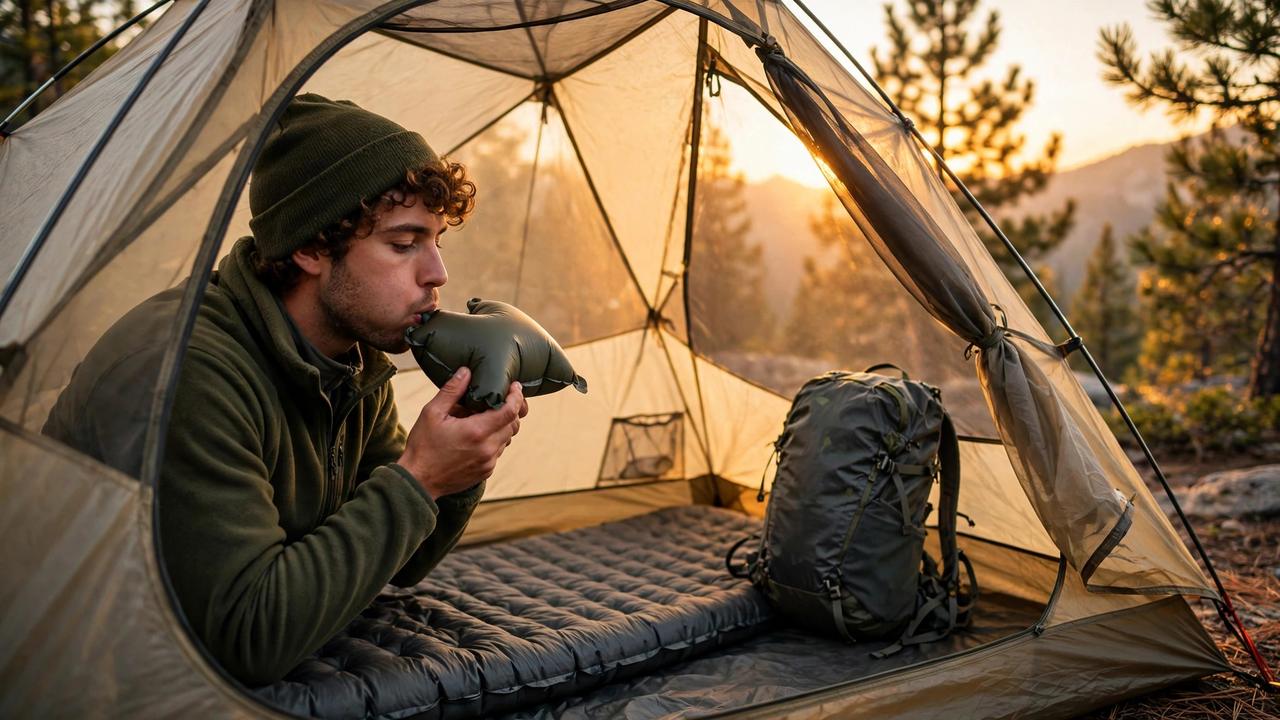
Ultralight camping asks a hard question about sleep. A jacket in a stuff sack weighs nothing extra, but it shifts, lumps up and goes flat under your head partway through the night. A dedicated inflatable pillow adds a few ounces, and in return it holds one height from lights-out to dawn, tunes with a puff or two of air, and packs down to almost nothing in the morning. The best blow up pillows for ultralight camping are the ones that earn those ounces honestly: low listed weight, a tiny packed bundle, enough thickness for your sleep position, a valve you can adjust without sitting up, and a shape that stays under your head instead of wandering off the pad.
This guide compares six inflatable pillows built for gram-conscious kits. The lightest pick here is listed at 1.6 ounces, the heaviest at 3.9 ounces, and every one of them packs smaller than a water bottle. Between those extremes sit real choices: a scalloped shape that cradles shoulders, a baffled bladder under a thin layer of insulation, a stretch-knit surface, fabric eyelets for tying a pillow to a pad, and a larger ergonomic outline for sleepers who move around. Read the quick verdict first, scan the table, then use the buying guide to match thickness, surface fabric and valve style to the way you actually sleep.
Quick verdict
For most ultralight campers, the Sea to Summit Aeros Ultralight Pillow Regular is the balanced starting point: the maker lists 2.1 ounces in Regular, a 14.2 by 10.2 by 4.7 inch inflated shape, and a packed size of just 2 by 2.8 inches, with a scalloped bottom edge that sits against the shoulders. If carried weight outranks everything else, the Big Agnes Rapide SL Pillow and the EXPED Ultra Pillow Medium are the lightest options here, listed at 1.6 ounces and 1.8 ounces in Medium respectively. If a bare air bladder feels too springy and you want a softer contact layer without leaving the ultralight class, the NEMO Fillo Elite Backpacking Pillow adds recycled insulation over a baffled air cell at a listed minimum weight of 2.8 ounces. The Therm-a-Rest Air Head Lite Pillow suits sleepers who want a larger, hood-friendly rectangle at a listed 2 ounces in Regular, and the TREKOLOGY ALUFT 2.0 Inflatable Camping Pillow suits campers who want the biggest inflated surface in this group and a pad strap, at a listed 3.9 ounces.
Best balanced pick: Sea to Summit Aeros Ultralight Pillow Regular — low weight, tall loft and a shoulder-friendly scalloped edge.
Lightest picks: Big Agnes Rapide SL Pillow and EXPED Ultra Pillow Medium — listed at 1.6 and 1.8 ounces.
Softest surface: NEMO Fillo Elite Backpacking Pillow — insulation over a baffled bladder, with a washable cover.
Largest surface: TREKOLOGY ALUFT 2.0 Inflatable Camping Pillow — the maker lists 16 by 11 by 4 inches inflated in the listing details used for this guide.
Hood-friendly rectangle: Therm-a-Rest Air Head Lite Pillow — shaped to sit inside a sleeping bag hood.
The products in this guide
Sea to Summit Aeros Ultralight Pillow Regular
The Regular at 2.1 ounces, with inflated dimensions of 14.2 by 10.2 by 4.7 inches and a packed size of 2 by 2.8 inches in its included stuff sack
Best if you want one balanced ultralight pillow — low listed weight, tall 4.7 inch loft
Weights and dimensions above are the figures the makers list for the size named in each row. Pillow lines often sell several sizes under one name, and a larger size always weighs more, so confirm the exact size on the listing before you compare one pillow against another. A half-ounce difference matters on a long carry, but a pillow that is too thin or too small for your sleep position is weight wasted at any number.
How we selected
Selection started with the category itself. Every pick is a true blow-up pillow: an inflatable air chamber provides the support, so the pillow deflates to a fraction of its sleeping size. Pure foam pillows and compressible pillows stuffed with loose fill were left out, because they solve a different packing problem and rarely stay in an ultralight kit for long. Hybrids were allowed only where air still does the structural work, which is why one pick with a thin insulation layer over its bladder appears here while heavier foam-topped designs do not.
Each product then had to be verified on opened pages. Specs in this article come from maker product information and detailed retail listings for the exact model named, and each spec is phrased as what the maker lists. Where sources disagreed — for example, where a review weighed a larger size than the one named here — the maker’s figure for the named size was used and the size is stated alongside it. Products whose existence, model identity or core specs could not be verified on opened pages were excluded rather than described with guesswork.
Availability on Amazon US as a new item was checked for every pick, and an Amazon link appears only where an ASIN could be pinned to that exact model from an opened product page or an unambiguous product link. No ASIN was borrowed from a sibling size, color or related product. Finally, the six were spread across the useful range of the category — lightest possible, balanced, softest surface, largest surface — instead of picking six near-identical bladders, so the guide maps to real decisions rather than a single winner repeated six times.
Air first: inflatable chamber provides support in every pick.
Verified specs: weight, dimensions and materials traced to opened maker or detailed listing pages.
Exact-model ASINs: a link is used only where the ASIN belongs to the named model.
Ultralight ceiling: every pick is listed under 4 ounces in the size named.
Distinct roles: lightest, balanced, softest and largest options are all represented.
The Aeros Ultralight is Sea to Summit’s lightest pillow line, and the Regular is the size most solo campers will carry. The maker lists the Regular at 2.1 ounces, with inflated dimensions of 14.2 by 10.2 by 4.7 inches and a packed size of 2 by 2.8 inches in its included stuff sack. That packed bundle is small enough to disappear into a hip-belt pocket or the lid of a pack, which removes the usual excuse for leaving a pillow behind on short trips.
The shape does more work than the weight suggests. The maker describes a scalloped bottom edge on the Regular and Large sizes that cradles the shoulders, which matters for back sleepers: instead of a straight edge pushing against your neck, the curve lets the pillow sit closer and keeps your head centered on the surface. Curved internal baffles support that centered feel, so the pillow reads less like a balloon and more like a shaped cushion once it is inflated to a comfortable firmness.
Material details are listed as a soft stretch-knit polyester face over a laminated TPU bladder, RF welded. In practice that pairing is about two things: a surface that does not feel like bare plastic against the cheek, and seams built for repeated inflation cycles. The low-profile multi-function valve lets you add air, dump air quickly when packing, and bleed off small amounts to fine-tune height — the adjustment side sleepers in particular end up using most, because shoulder width changes the ideal loft from night to night.
Sea to Summit also lists PillowLock compatibility, a system of adhesive patches that hold the pillow on compatible Sea to Summit pads. If your pad is from another maker, the scalloped shape and a sleeping bag hood still do most of the retention work. Choose the Regular for the lightest carry, and step up to the Large only if you know you roll across a pillow at night; the Large is listed at 2.5 ounces with a wider, taller inflated shape.
Buy it if: you want one balanced ultralight pillow — low listed weight, tall 4.7 inch loft, a tiny packed size and a shape that helps back and side sleepers stay centered.
Skip it if: you want a padded or insulated contact layer, or you need a wide rectangular surface; look at the insulated hybrid or the larger ergonomic pick below instead.
Therm-a-Rest builds the Air Head Lite as a pure air pillow with a soft-touch surface, and the numbers keep it firmly in ultralight territory. The maker lists the Regular at 2 ounces, with dimensions of 15.5 by 11 by 4 inches, and the Large at 2.8 ounces with dimensions of 18 by 12.5 by 4 inches. The Regular is the size referenced throughout this guide: a broad rectangle for its weight class, with four inches of air padding that you can customize by adding or releasing air.
The surface is where this model separates itself from basic bladders. The maker lists a soft stretch-knit polyester fabric, which gives the pillow a cloth-like feel without adding a separate cover or a foam layer. That matters on warm nights when a pillowcase or buff is one layer too many, and it also helps the pillow grip a pad or a hood lining instead of skating away every time you shift position.
Therm-a-Rest shapes the Air Head Lite to fit inside a sleeping bag hood, and that design choice solves the most common inflatable-pillow complaint: migration. Inside a hood, the pillow cannot slide off the pad, and the hood fabric adds a familiar sleeping surface. Used outside a hood it still works, but hood users get the most from the shape. A small stuff sack is included, and the maker notes the pillow is small enough, packed, to fit in a pocket — a useful trait for bikepackers and fastpackers who distribute small items through every available space.
The trade-off is structure. A single air chamber with a knit surface feels simpler and less sculpted than baffled or scalloped designs, so sleepers who want a pronounced cradle may prefer the Sea to Summit or NEMO shapes. In return you get one of the lightest listed weights in this guide attached to one of the larger Regular surfaces, which is exactly the trade many thru-hikers choose.
Buy it if: you sleep in a mummy bag hood, want a soft knit surface with no separate cover, and value a large Regular footprint at a listed 2 ounces.
Skip it if: you want baffles or a contoured shape to hold your head in place, or an insulated layer between you and the air chamber.
The Fillo Elite is the comfort-leaning pick in this group, built around a simple idea: keep the air chamber, but put something soft between it and your face. The maker lists a minimum weight of 2.8 ounces, dimensions of 15 by 11 inches with 3 inches of thickness, and a packed size of 4 by 3 inches in diameter. The pillow packs into an integrated stuff sack, so there is no separate sack to lose in the dark at the bottom of a pack.
Inside, the maker lists a baffled air cell with I-beam construction. Baffles matter because they stop an air pillow from bulging into a round balloon shape; the cell holds a flatter, more pillow-like profile that supports the head across its surface instead of pushing back at a single point. Over that cell sits a layer of post-consumer recycled insulation — listed as PrimaLoft in current product details — which softens the contact feel and takes the edge off the springy sensation pure bladders can have.
The cover is an ultra-soft jersey blend that the maker lists as removable and machine washable. On multi-week trips that washability is not a luxury detail; a pillow touches skin every night, and being able to wash the cover at a town stop resets the whole sleep system. The micro-adjustable valve lets you inflate quickly and then fine-tune firmness, which pairs well with the insulation layer: inflate firmly for structure, then let the padded surface provide the softness.
At 3 inches thick, the Fillo Elite is the thinnest pick here, and committed side sleepers with broad shoulders may find that loft low unless they pair it with a folded layer underneath. What it offers instead is the most bed-like surface in this guide at under 3 ounces listed minimum weight — the reason it suits campers who have tried bare bladders and disliked them, but still count every ounce.
Buy it if: you want the softest, most pillow-like surface in the ultralight class, a washable cover, and baffled support at a listed minimum weight of 2.8 ounces.
Skip it if: you are a broad-shouldered side sleeper who needs maximum loft, since the maker lists 3 inches of thickness, the lowest in this group.
EXPED’s Ultra Pillow is the gram-counter’s shaped option. The maker lists the Medium at 1.8 ounces, with inflated dimensions of 15 by 10.6 by 3.9 inches, and the Large at 2.3 ounces with dimensions of 18 by 11.8 by 4.7 inches. The Medium is the reference size here. The fabric is listed as 20D recycled stretch polyester with a TPU polyether film laminate, a shell chosen for low weight and a comfortable next-to-skin feel rather than for padding, since there is no added fill layer.
The shape is anatomical, with a contoured dip intended to keep the head centered and higher edges that support different sleeping positions. Height is adjustable through the valve, so back sleepers can run the pillow softer and lower while side sleepers keep more air in for support. EXPED lists a combination valve with a one-way flap for inflation and a deflation pin for fine adjustments and fast packing — small hardware, but it is the part of an inflatable pillow you interact with every single night.
A detail that sets the Ultra apart is its fabric eyelets. The maker lists side eyelets that allow the pillow to be attached to a sleeping mat, directly addressing migration without relying on a hood. If your pillow has ever ended the night under your shoulders or off the pad entirely, a tether point is a functional upgrade, and it costs effectively nothing in weight. The pillow is also listed as height adjustable and anatomically shaped for back, side and stomach positions, making it a flexible single-pillow choice for sleepers who change position through the night.
The honest limitation is surface feel: a thin stretch shell over air is a thin stretch shell over air. Campers who want insulation or padding between their cheek and the chamber should look at the Fillo Elite. Campers who want the lowest listed weight that still comes with shaping, a proper combination valve and a pad-attachment option will find the Ultra Pillow aimed directly at them.
Buy it if: you want a sub-2-ounce listed weight with an anatomical shape, a combination valve and eyelets to secure the pillow to your pad.
Skip it if: you dislike the feel of a bare air bladder against your face and would rather carry extra ounces for an insulated, padded surface.
The Rapide SL Pillow is the lightest pick in this guide. Retailer and maker-aligned listings put it at 1.6 ounces, with inflated dimensions of 16 by 10 by 4 inches and a packed size of 4.5 by 2.5 by 2 inches — roughly the size of an energy bar, in Big Agnes’s own framing of the product. At that weight, the decision changes character: the question stops being whether you can justify a pillow and becomes whether a shaped air pillow at 1.6 ounces beats a stuff sack of clothes, which for most sleepers it comfortably does.
The material is listed as TPU-laminated nylon. Nylon shells in this class tend to feel smooth and slightly cool against the skin, and the lamination is what lets a shell this light hold air reliably. Four inches of listed thickness gives side sleepers workable loft, and like every pillow here, the effective height is adjustable: leave a little air out and the pillow softens and lowers; fill it fully and it holds its full profile.
Big Agnes comes to pillows from its Rapide SL pad line, and the pillow is positioned as the matching ultralight companion for fast, light kits — bikepacking, fastpacking and thru-hiking setups where every item is expected to pack to almost nothing. The packed dimensions back that positioning up: at 4.5 by 2.5 by 2 inches, it fits in corners of a pack that most gear cannot use, including a jersey pocket or a hip-belt pouch.
Because the shell is a smooth laminated nylon with no listed cover, insulation or grip treatment, sleepers who run warm or who toss and turn may want a buff or lightweight pillowcase over it, and hood users will get the best retention. Those are acceptable trades at this weight for most ultralight campers, but they are worth naming: you are buying the minimum viable pillow, executed by a major maker, rather than a feature-rich one.
Buy it if: carried weight is your first criterion and you want the lightest listed option here — 1.6 ounces — with a full 16 by 10 inch inflated surface.
Skip it if: you want a soft fabric cover, insulation, baffles or anti-slip treatment built in; the hybrid and ergonomic picks cover those needs at higher weights.
The ALUFT 2.0 is the largest and most feature-fitted pick in this guide, and the heaviest at a listed 3.9 ounces — a weight that still qualifies as ultralight, and buys a noticeably bigger sleeping surface. The listing details list inflated dimensions of 16 by 11 by 4 inches, a packed size of 5 by 2 inches, and a fabric blend of 80 percent polyester with 20 percent TPU. It folds into its included storage bag at a size the maker compares to a soda can.
Two retention features stand out. The back of the pillow carries rubber anti-slip dots intended to increase friction between the pillow and the sleeping mat, and the ALUFT line includes a detachable latch strap for holding the pillow against a pad. Migration is the failure mode of every camp pillow, and this model attacks it twice — grip on the underside and a strap around the pad — which makes it a sensible pick for restless sleepers and for campers who sleep without a hood to trap the pillow.
The shape is ergonomic and contoured, designed in the maker’s description for head, neck or lumbar support, and the double-layer, one-way style valve is listed as inflating the pillow in a handful of breaths and deflating it in seconds, with air added or released to dial in firmness. That dual head-and-lumbar role also gives the ALUFT 2.0 a second life on long drives, flights and at camp during the day, which matters for campers who prefer gear that does more than one job.
The trade is straightforward: at 3.9 ounces it is more than twice the listed weight of the lightest pick here, and its packed bundle, while small, is the joint-largest in the group. Ultralight campers building a kit around a strict base-weight target may feel that difference. Campers moving up from a clothes stuff sack for the first time, or anyone who prioritizes surface size and staying-put behavior, will likely judge the ounces well spent.
Buy it if: you want the biggest inflated surface in this guide, anti-slip dots and a pad strap, and a pillow that doubles as lumbar support.
Skip it if: you are trimming to the lowest possible base weight, since at a listed 3.9 ounces it is the heaviest pick here by a clear margin.
Buying guide
Weight: know what an ounce buys
Every pillow in this guide is listed between 1.6 and 3.9 ounces in its named size, so the entire category spans barely two ounces. Within that span, weight buys surface features: insulation layers, covers, straps and grip treatments all add grams, while the lightest models strip everything except shell, valve and air. Decide which you actually use. A sleeper who always uses a hood gains little from anti-slip dots; a sleeper who hates bare-bladder feel gains little from saving an ounce on a pillow they will dislike nightly. Also compare like with like — a Large and a Regular of the same model can differ by half an ounce or more, so check the listed weight for the exact size you are buying.
Thickness and sleep position
Loft is the spec that most decides comfort. Back sleepers usually settle happily at lower effective heights, especially with a contoured or scalloped pillow that fills the neck curve. Side sleepers need the pillow to fill the gap between ear and shoulder, so listed thickness of around 4 inches or more — the Aeros Ultralight, Air Head Lite, Rapide SL and ALUFT 2.0 in this guide — gives more to work with, and many side sleepers also fold a layer under the pillow on the first night to learn their real requirement. Stomach sleepers generally run inflatables soft and low. Remember that listed thickness is measured fully inflated; the usable range is set by how much air you choose to leave in, which is why an adjustable valve matters as much as the headline number.
Packed size and where it rides
All six picks pack to pocketable bundles, but the smallest — the Aeros Ultralight at a listed 2 by 2.8 inches — can ride in a hip-belt pocket or pack lid, while larger bundles need a stuff sack corner or a clothing bag. Think about morning routine as well as volume: a pillow with an integrated stuff sack, like the Fillo Elite, cannot lose its sack; a pillow with a separate sack asks for a consistent home for two small items instead of one. If you bikepack or fastpack, packed shape matters too — short, wide bundles fit frame bags and running-vest pockets differently than long, thin ones.
Surface fabric and covers
The contact layer shapes how a pillow feels more than any other spec. Options here run from smooth TPU-laminated nylon, through soft stretch-knit polyester, to a jersey cover over insulation. Knit and jersey surfaces feel warmer and quieter and grip better; smooth nylon feels cooler and wipes clean easily. An insulation layer, as on the Fillo Elite, also softens the springy response of an air chamber. If you know you dislike one feel, weight comparisons are secondary — a pillow you enjoy at 2.8 ounces beats a lighter one you leave at home.
Valves: the part you touch every night
Look for three abilities: fast inflation, fast deflation, and fine adjustment without fully opening the valve. Combination and multi-function valves, like the designs listed on the EXPED and Sea to Summit picks, cover all three. Micro-adjustable valves let you bleed tiny amounts of air while lying on the pillow, which is how most sleepers actually find their height — inflate fully, lie down, release a little, repeat. A valve that sits flat or off to the side also keeps hardware away from your face; check valve placement in listing photos if you are a side sleeper.
Keeping the pillow in place
Retention comes in four forms in this guide: sleeping bag hoods, grip surfaces and straps, pad-attachment eyelets, and brand pad-lock systems. Hood sleepers need none of the hardware. Everyone else should pick at least one mechanism — anti-slip dots and a strap, eyelets for a cord, or a pad-lock patch system — because a pillow that migrates is a pillow that fails at its only job. Tent campers on wide pads without hoods benefit most from strap or eyelet designs.
Care and durability basics
Inflatable pillows live a hard life for something so light: grit on pads, body oils on covers, and repeated compression. Wipe shells down and let a pillow dry unrolled at home before long storage, store it with the valve open where the maker recommends it, and keep it away from sharp gear in transit. A washable cover, where fitted, extends comfortable life the most. Finally, inflate by breath as the makers intend for these small chambers — they need only a few breaths — and avoid sitting or kneeling on an inflated pillow, which stresses seams far beyond sleeping loads.
FAQ
Is a blow-up pillow really worth carrying on an ultralight trip?
For most campers, yes, once the listed weight drops under about 3 ounces. At that point the pillow costs less weight than many small items already in a pack, packs smaller than a fist, and replaces the least reliable part of a typical sleep system — a lumpy stuff sack of spare clothes — with a consistent, adjustable height that stays the same all night and from trip to trip.
How firm should an inflatable camping pillow be?
Softer than most people first inflate it. A fully hard pillow pushes back and can feel unstable; the common method is to inflate fully, lie down in your normal sleep position, then release small amounts of air until your head feels supported without being lifted. Side sleepers keep more air in than back sleepers. Valves with fine adjustment make this process much easier in the dark.
What thickness do side sleepers need?
Enough to fill the space between the ear and the outside of the shoulder while lying on your actual pad, since the pad compresses too. In this guide the models listed at 4 inches or more of thickness are the natural starting points for side sleepers, and the 4.7 inch Aeros Ultralight offers the most listed loft. Broad-shouldered sleepers sometimes place a folded layer under any camp pillow; that is a positioning choice, not a defect in the pillow.
How do I stop an inflatable pillow sliding off my pad?
Use one of the retention routes: sleep with the pillow inside your bag hood, choose a model with anti-slip dots or a pad strap, tie a model with fabric eyelets to the pad, or use a brand pad-lock patch system where compatible. Slightly under-inflating also helps, because a softer pillow deforms around your head instead of squirting away under pressure.
Can these pillows be used for travel as well as camping?
Yes. The same traits that suit ultralight camping — tiny packed size, adjustable firmness, light weight — suit long flights, road trips and hostel bunks. Several picks here are also described by their makers for lumbar support while seated. Keep in mind that cabin pressure changes can make a pillow feel firmer at altitude, so leave a little adjustment room in the valve if you inflate before takeoff.
How should I store an inflatable pillow at home?
Clean and dry it first, then store it loosely rather than compressed in its tiny travel bundle, with the valve left open if the maker recommends that for the model. Long storage under tight compression is hard on coatings and seams. Before a trip, inflate the pillow at home for a few hours to confirm it holds air, which is a calmer place to discover a problem than a trailhead.
Conclusion
The ultralight pillow decision is a small one with an outsized effect on how a trip feels, because sleep quality compounds across nights. Start from the lightest end if grams rule your kit: the Big Agnes Rapide SL Pillow at a listed 1.6 ounces and the EXPED Ultra Pillow Medium at 1.8 ounces prove that a real, shaped pillow no longer costs meaningful weight. Start from comfort if surface feel is what has kept you on a stuff sack until now: the NEMO Fillo Elite adds insulation and a washable jersey cover over its baffled cell, and the Sea to Summit Aeros Ultralight pairs tall loft with a shoulder-friendly shape at 2.1 ounces listed. Choose the Therm-a-Rest Air Head Lite if a hood and a knit surface fit your system, and the TREKOLOGY ALUFT 2.0 if surface size and staying put matter most. Match thickness to your sleep position, pick one retention method, and the pillow you carry will be the pillow you actually sleep on — every night of the trip.
M
Modern Line Home Editorial Team
We compare specs, materials and verified owner reviews before a product earns a spot. Rankings are never paid.
Affiliate disclosure. As an Amazon Associate we earn from qualifying purchases at no extra cost to you. Prices accurate as of the date shown.
House cold even with the heat on? Walk this ordered checklist: thermostat and filter first, then drafts, insulation, leaky ducts and a failing heating system.
Windows fogging up in winter? Check where the fog sits: on the room side it is indoor humidity, outside it is harmless, and between panes the seal has failed.
Store the main firewood pile about 30 feet from your house, off the ground and covered only on top. Compare racks, woodsheds, garages and indoor spots safely.
Place a portable generator outdoors only, at least 20 feet from windows, doors and vents, exhaust pointed away. Exact distances, setup steps and CO rules here.
Keep houseplants in the right winter spot: match window direction to plant type, stay clear of radiators and cold glass, and fix dry air and low light at home.
Mice enter through pencil-width gaps at foundations, pipes, vents, doors and the roofline. Walk this room-by-room winter checklist to find and seal each one.
A winter outage timeline: what to do in the first hour, first night and multi-day outage, with food safety times, pipe protection, heat and CO safety steps.
Size a space heater by room area: 10 watts per square foot at 8-foot ceilings, adjusted for insulation and ceiling height, with full wattage and BTU tables.
Start dripping at about 20 degrees, sooner for exposed pipes. Set a pencil-lead stream, drip the right faucets on both lines, and know when to stop safely.
A fridge needs 800-1,200 starting watts, not just 150-400 running watts. Use the tables to total your fridge plus freezer, lights, furnace fan and more today.











Write Your Review
No reviews yet. Be the first to share your experience!