
Key takeaways
- Find the best bathroom rugs for tile floors with rubber, TPR and PVC non-slip backings, absorbent chenille and memory foam, for tubs, showers and vanities.
Tile is the most common bathroom floor in American homes, and it is also the least forgiving surface a bath rug has to work on. Glazed ceramic and porcelain are smooth, hard and often slightly glossy, so a rug that feels secure on vinyl or wood can skate across tile the moment a wet foot lands on it. Add the water that drips off you after every shower, the grout lines that break up the contact patch underneath a rug, and the cold feel of tile first thing in the morning, and the job description for a bathroom rug on tile becomes very specific. It needs a backing that genuinely grips a smooth, hard surface. It needs a face that absorbs water quickly instead of letting it pool and spread toward the grout. And it needs to survive the washing machine again and again, because a bathroom rug that cannot be laundered easily will not stay fresh for long.
This guide to the best bathroom rugs for tile floors compares six rugs that meet that job description in different ways. Three are chenille rugs with rubber-style backings, built for maximum absorbency and a plush step out of the tub. Three are memory foam mats with PVC backings, built for cushioning at the vanity and a lower, quicker-drying profile. Every pick below was chosen because its maker lists a real non-slip backing material, a stated size that suits a standard tub, shower or sink position, and machine washable care. The sections that follow explain how the picks differ on backing type, pile, thickness and footprint, so you can match one rug to the tile, the grout pattern and the doorway clearance in your own bathroom rather than buying on looks alone.
Quick verdict
For most tile bathrooms, start with the GORILLA GRIP Bath Rug Mat in the 24 by 17 inch size. Its textured thermoplastic rubber backing is the strongest grip story in this group, the chenille face is thick and absorbent, and the compact footprint fits the tight strip of tile in front of most tubs and shower doors. If your tile area is larger, the OLANLY Bathroom Rugs 30×20 Chenille covers more floor with the same style of TPR backing and a full inch of pile. Households that stand at a vanity for long stretches should look at the memory foam trio: the Yimobra Memory Foam Bath Mat 31.5×20 for a wide, low-pile mat with a diamond-tread PVC backing, the ITSOFT Memory Foam Bath Mat 31×20 for a full inch of foam cushioning, and the compact Buganda Memory Foam Bath Mat 24×16 for small bathrooms and powder rooms. Anyone furnishing a whole bathroom in one purchase should consider the H.VERSAILTEX Bathroom Rug Set 2 Piece, which pairs a large rug and a smaller rug in matching striped chenille.
- Best all-round grip on tile: GORILLA GRIP Bath Rug Mat 24×17
- Best larger chenille rug: OLANLY Bathroom Rugs 30×20 Chenille
- Best wide memory foam mat: Yimobra Memory Foam Bath Mat 31.5×20
- Best two-piece set: H.VERSAILTEX Bathroom Rug Set 2 Piece
- Best compact memory foam mat: Buganda Memory Foam Bath Mat 24×16
- Best thick foam cushioning: ITSOFT Memory Foam Bath Mat 31×20
Comparison table
| Product | Face material | Backing the maker lists | Size | Thickness |
|---|---|---|---|---|
| GORILLA GRIP Bath Rug Mat 24×17 | Chenille | Thermoplastic rubber (TPR) | 24 x 17 in | 1 in |
| OLANLY Bathroom Rugs 30×20 Chenille | Chenille | Thermoplastic rubber (TPR) | 30 x 20 in | 1 in |
| Yimobra Memory Foam Bath Mat 31.5×20 | Memory foam with coral velvet face | PVC, diamond tread | 31.5 x 20 in | 0.75 in |
| H.VERSAILTEX Bathroom Rug Set 2 Piece | Chenille, striped | Hot melt (SBE) spray backing | 32 x 20 in plus 24 x 17 in | High pile |
| Buganda Memory Foam Bath Mat 24×16 | Memory foam with coral velvet microfiber face | PVC | 24 x 16 in | 0.7 in |
| ITSOFT Memory Foam Bath Mat 31×20 | Memory foam | PVC | 31 x 20 in | 1 in |
All six rugs are listed by their makers as machine washable. Backing material is the single most important column for tile: rubber and TPR backings grip smooth tile through texture and flexibility, PVC backings grip through tread pattern and stiffness, and hot melt spray backings grip through a coated underside that should be kept dry to work as intended.
How we selected
We started with a backing-first filter, because on tile the backing is the product. Every rug in this guide names its backing material in its own listing: thermoplastic rubber, PVC, or a hot melt spray coating. Rugs with no stated backing, rugs that rely only on the weight of a cotton face, and hotel-style cotton mats with no grip layer at all were left out, however absorbent they may be, because a plain cotton mat on wet glazed tile is a slide waiting to happen. Within the backed rugs, we then compared the face materials. Chenille microfiber is the absorbency leader and feels warm on cold tile. Memory foam trades some absorbency for cushioning, which matters at a vanity where you stand still rather than step and go.
Size was the next filter. A rug for tile has to cover the wettest patch of floor, which is the strip directly in front of the tub or shower door and the area in front of the sink. The picks here run from a compact 24 by 16 inch mat for a powder room up to a 32 by 20 inch rug and a two-piece set that covers both the tub front and the vanity front. Thickness mattered too: every pick is an inch thick or less, because a bathroom door has to swing over the rug and a thick rug that bunches under a door becomes a trip edge instead of a safety feature. Finally, we required machine washable care on every pick, and we checked that each rug is sold new with a live offer in the size and color named here. Specs throughout this guide are phrased as the maker lists them, taken from each product’s own listing details and feature descriptions.
Top picks
GORILLA GRIP Bath Rug Mat 24×17
The GORILLA GRIP Bath Rug Mat leads this guide because its backing story is the most explicit of the six. The maker lists a textured thermoplastic rubber backing and contrasts it directly with PVC and hot glue backings, saying the rubber layer is built to keep the rug in place on the bathroom floor and to hold up through repeated washing. On tile, that texture matters: a flexible rubber underside can settle into the slight texture of a glazed tile surface and resist the sideways push of a foot stepping down from a tub edge, which is exactly the movement that sends lesser rugs sliding toward the grout line.
The face is chenille, and the maker lists the rug at a full inch thick with a high pile, so it feels warm and padded on cold tile first thing in the morning. The size in this listing is 24 by 17 inches in grey, a footprint sized for the front of a standard tub or a single shower door rather than a whole vanity wall. The maker lists the material as chenille with thermoplastic rubber, the weight at 1.2 pounds, and the care as machine wash. The listing also notes OEKO-TEX certification for the materials, which is a useful detail for households that care about textile testing standards. The maker further states the rug was lab tested to withstand more than 30 machine wash and dry cycles, a claim that speaks directly to the main way rubber-backed rugs usually fail, which is backing breakdown in the laundry.
Because the footprint is compact, this is a one-spot rug. It will not cover a double vanity, and in a large primary bathroom you may want two of them side by side or the larger OLANLY below in front of the tub and this one at the vanity. Its high pile also holds more water than a low-pile foam mat, so in a poorly ventilated bathroom it benefits from being hung over the tub edge to dry between showers.
Buy it if: your tile is smooth or glossy, grip is your first priority, and you need a tub-front or shower-door rug in a standard single position.
Skip it if: you need to cover a long vanity run or a large open tile area with a single rug, or you prefer a low-pile mat that dries very fast.
OLANLY Bathroom Rugs 30×20 Chenille
The OLANLY Bathroom Rugs 30×20 Chenille takes the same basic formula as the Gorilla Grip rug, a chenille face over a thermoplastic rubber backing, and scales it up. The maker lists this rug at 30 by 20 inches in grey, with a one inch thickness, a high pile, and a weight of 1.7 pounds. That extra length and width covers more of the splash zone in front of a tub, so water that runs off your legs lands on chenille instead of bare tile, and the wider footprint gives both feet room when you step out and turn toward a towel.
The maker describes the chenille as ultra absorbent, soaking up water on contact, and as fade-resistant and quick-drying for a chenille rug, with machine wash cold and tumble dry low care. The backing is listed as thermoplastic rubber, the same TPR family as our top pick, which is the backing type we favor for smooth tile because it stays flexible in a cool bathroom and keeps its texture wash after wash. The listing’s own warning is worth repeating in spirit: water trapped under any rug can make it slip, so the underside and the tile beneath should be dry when the rug goes down, and the rug should be lifted regularly so the floor can dry fully.
Chenille this thick is a comfort choice. It feels plush and warm, and it hides the cold of tile completely, but it also takes longer to dry than the memory foam mats below and can feel heavy when saturated. In a busy family bathroom with back-to-back showers, plan on hanging it to air between uses. The 30 by 20 inch size is also the largest single chenille footprint in this guide apart from the H.VERSAILTEX set’s big rug, so measure your tub front: in a small bathroom it may run wall to vanity, which is fine as long as the door still clears its one inch pile.
Buy it if: you want one generously sized chenille rug with a TPR backing for a standard tub front, and you value plush warmth on cold tile.
Skip it if: your bathroom stays humid and you need the fastest possible dry time, or your door clearance is too tight for a one inch high-pile rug.
Yimobra Memory Foam Bath Mat 31.5×20
The Yimobra Memory Foam Bath Mat 31.5×20 is the widest single mat in this guide and the clearest expression of the memory foam approach. The maker lists a memory foam core with a coral velvet surface, a combination it describes as pulling water into the fibers while the foam core keeps it from seeping straight through to the floor. Underneath, the maker lists a PVC backing with a diamond tread pattern, and that tread is the grip mechanism on tile: the raised diamond pattern gives the underside texture that resists sliding on a smooth surface, in the same way a tread pattern works on a shoe sole.
The stated size is 31.5 by 20 inches in grey, with a thickness of 0.75 inches and a low pile. That lower, flatter profile is a practical advantage on tile in two ways. First, most bathroom doors clear it easily. Second, a low-pile foam mat presents less of a raised edge to catch a toe on than a high-pile chenille rug. The maker lists the mat as machine washable and quick drying, and describes the foam as providing cushioned comfort that conforms to your feet, which is most noticeable at a vanity where you stand in one place to brush teeth, shave or apply makeup. The listing also notes the surface and core are designed so the mat absorbs quickly and helps keep the floor around it dry.
Memory foam has its own trade-offs on tile. It does not absorb as much total water as a thick chenille rug, so after a very wet exit from the tub some moisture can sit on the velvet surface until it wicks in. The PVC backing also needs a dry floor to grip as intended, a point the maker itself makes for this style of mat: place it on clean, dry tile, and lift it if water gets underneath. Within those limits, this is the pick for a wide, cushioned, low-profile mat in front of a vanity or a long tub.
Buy it if: you stand at the vanity for long periods, want the widest single mat here, and prefer a low profile that doors clear easily.
Skip it if: maximum water absorption is your priority, or your bathroom floor is often wet underneath the mat area.
H.VERSAILTEX Bathroom Rug Set 2 Piece
The H.VERSAILTEX Bathroom Rug Set 2 Piece solves a different problem: most bathrooms need a rug in two places at once, in front of the tub and in front of the sink, and buying a matched set keeps the two pieces consistent in color, stripe and pile. This set pairs a 20 by 32 inch rug with a 17 by 24 inch rug, both in grey, both in a striped chenille the maker describes as extra thick and shaggy. The maker lists the chenille weight at up to 2000 grams per square meter, compared with a more typical 1350, which is its way of saying the pile is dense, and density is what makes chenille absorbent and warm on tile.
The backing is the point to understand before you buy. The maker lists a hot melt backing, described in the listing as an updated SBE hot melt spray backing that is slip-resistant and built to hold the rugs in place while lasting through use. A sprayed hot melt underside grips differently from a solid rubber sheet: it is lighter and more flexible, and it keeps the set’s total weight down to a listed 1.4 pounds for both pieces, but it also depends more on the floor being dry and clean underneath. On tile that is mopped and dried before the rugs go down, that is a reasonable trade; in a bathroom where water regularly runs under the rug, one of the solid TPR-backed picks above is the safer choice.
The maker lists the set as machine washable, quick drying for a chenille product, and highly absorbent, soaking up water to keep the floor dry. The striped pattern is also a practical touch on tile, because stripes show less lint and water spotting between washes than a flat solid pile. With two pieces, you can also rotate them: move the less-used vanity rug to the tub position after a wash, evening out wear across the set.
Buy it if: you are furnishing a full bathroom in one purchase and want matching rugs for the tub front and the vanity at once.
Skip it if: your tile is very glossy and you want a solid rubber backing rather than a sprayed hot melt underside, or you only need one rug.
Buganda Memory Foam Bath Mat 24×16
The Buganda Memory Foam Bath Mat 24×16 is the compact option in this guide, sized at 24 by 16 inches in grey for the bathrooms where the larger mats simply do not fit: a powder room with a pedestal sink, a small ensuite where the tub front is also the doorway path, or a toilet alcove that needs a small cushioned pad on tile. The maker lists a memory foam construction with an outer layer of microfiber coral velvet, a low pile, and a thickness of 0.7 inches, the thinnest profile here, which makes it the easiest of the six for a tight door swing to clear.
Underneath, the maker lists a PVC backing and describes it as sturdy and firm, providing a solid base for the foam. The maker is explicit about placement: the mat should go on a clean, dry, smooth floor, and the bottom should be kept dry, because a PVC-backed foam mat grips by contact and any water film between the backing and glazed tile breaks that contact. That guidance applies to every PVC-backed mat in this guide, but it is especially relevant for a small mat, which has less contact area and less weight holding it down than a big one.
The maker describes the coral velvet face as rapidly absorbing moisture so feet come away dry and water does not linger on the surface, and lists the mat as machine washable. In practice, a mat this size is a one-person, one-spot product: it is right for a single sink or a narrow tub front, and too small to catch the full splash pattern of a family shower exit. Think of it as the right-sized answer for small tile bathrooms that the standard 30 by 20 inch rugs overwhelm, where a big rug would bunch against a wall or ride up over a floor vent.
Buy it if: your bathroom is small, your door clearance is minimal, and you need a cushioned non-slip mat in a single compact spot.
Skip it if: you need coverage for a standard or large tub front, where this footprint will leave wet tile exposed on both sides.
ITSOFT Memory Foam Bath Mat 31×20
The ITSOFT Memory Foam Bath Mat 31×20 closes the guide with the thickest foam cushioning of the memory foam trio. The maker lists it at 31 by 20 inches in grey, a full inch thick, with a memory foam material and a high pile designation for its soft surface layer. That inch of foam is the selling point at a vanity: it puts real padding between your feet and hard, cold tile, and it keeps its shape as a standing pad through a long morning routine in a way a thin mat cannot.
The backing is listed as PVC, and the maker describes the design as a non-slip safety backing that keeps the mat securely in place on tile floors, with the same sensible condition attached: the floor should be dry before the mat goes down. The maker lists the mat as super absorbent, soaking up water after showers and baths to keep the surrounding floor dry, and as machine washable for regular care. At 31 by 20 inches it covers a single wide vanity or the working length of a standard tub, and its rectangular footprint sits neatly against a tub apron or vanity toe-kick without the shaped cutouts that contour rugs use around a toilet base.
Compared with the Yimobra above, the trade is thickness for profile: the ITSOFT is thicker and more cushioned, the Yimobra is slightly wider and lower. Compared with the chenille picks, the ITSOFT will dry faster and feel cooler and smoother underfoot, but it will not match a thick chenille rug for sheer water capacity after a bath. On tile, check your door swing before choosing the inch-thick option; in most bathrooms it clears, but a low-hung door over a high threshold is the one combination that can catch.
Buy it if: cushioning on hard tile is your main complaint and you want a wide, inch-thick foam mat for the vanity or tub front.
Skip it if: your bathroom door barely clears the floor, or you prefer the warm, high-pile feel and absorbency of chenille.
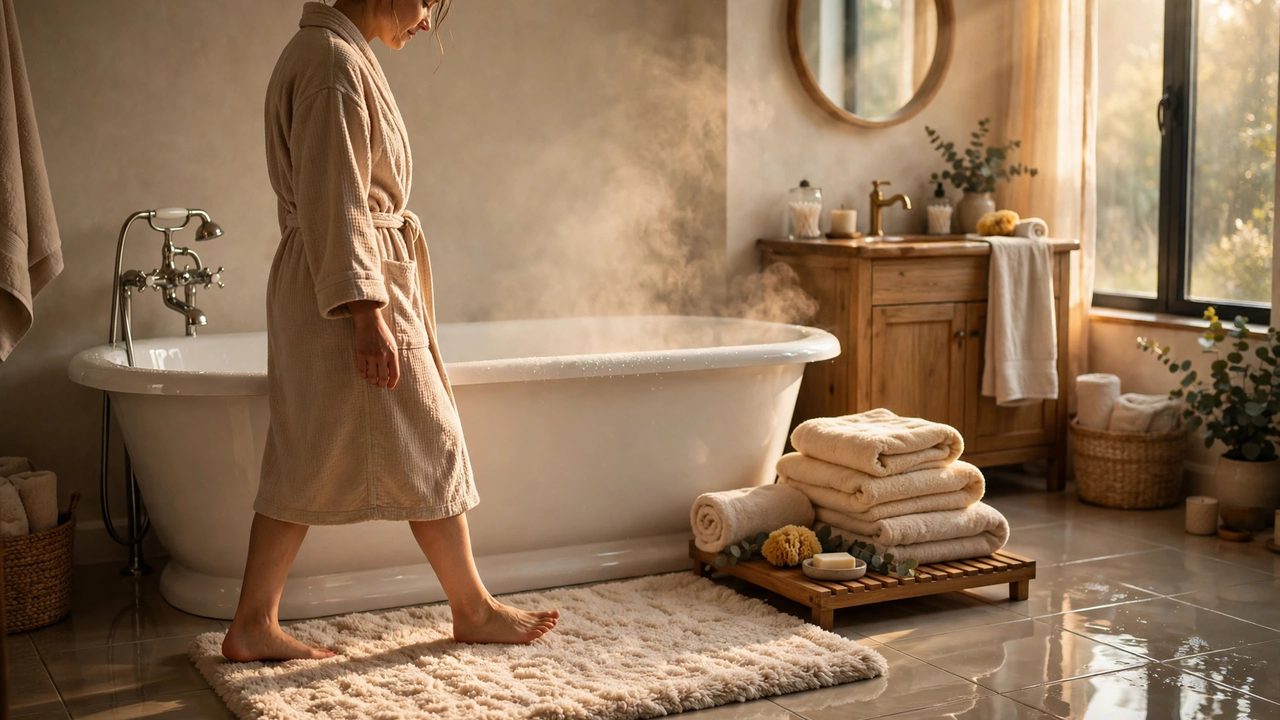
Buying guide: rugs on tile floors
Backing material decides whether a rug works on tile
Tile, especially glazed ceramic and polished porcelain, gives a rug very little to hold onto. The surface is hard, smooth and often slightly sealed, so friction has to come from the rug itself. Solid rubber and thermoplastic rubber backings, like those on the GORILLA GRIP and OLANLY rugs here, grip through a flexible, textured underside that conforms slightly to the tile and resists sideways movement. PVC backings, like those on the Yimobra, Buganda and ITSOFT mats, grip through stiffness and tread pattern, and they work well as long as the contact stays dry. Hot melt spray backings, like the one on the H.VERSAILTEX set, are the lightest option and depend most on a clean, dry floor. Unglazed or textured tile is more forgiving of every backing type; high-gloss polished tile is the strictest test, and on that surface a solid rubber-style backing is the most dependable choice.
Grout lines and rug size
Grout lines break a rug’s contact patch into segments, and on large-format tile with wide grout joints a small rug can rock slightly if it sits half on a joint. A rug that is large enough to span several tiles distributes its grip and feels steadier. As a rule, choose a rug that covers the full width of the tub or shower exit plus a few inches on each side, and long enough that both feet land on it when you step out and turn. For a vanity, the rug should run at least the width of the sink basin area where you actually stand. The sizes in this guide run from 24 by 16 inches for a single small spot up to 32 by 20 inches and a two-piece set for full coverage, so measure your tile area before choosing rather than assuming a standard size fits.
Chenille versus memory foam on cold tile
Chenille is the warmth and absorbency choice. Its dense, high pile traps air, feels warm the moment a bare foot lands on it, and holds a lot of water, which is why chenille rugs suit the tub front where the water load is highest. The cost is dry time: a thick chenille rug in a humid bathroom should be hung up between uses. Memory foam is the cushioning choice. It compresses under your weight and springs back, which relieves the hard feel of tile during long standing at a vanity, and its lower pile dries faster. The cost is total water capacity: foam mats handle splashes and drips well but saturate sooner than chenille under a full post-bath drip load. Many households end up with one of each, chenille at the tub and foam at the vanity, which is exactly the combination the H.VERSAILTEX set and the mixed picks in this guide make easy.
Thickness, doors and trip edges
Every rug here is an inch thick or less, and that ceiling is deliberate. Measure the gap under your bathroom door at its swing’s lowest point; the rug plus its pile must clear it, or the door will drag, fold the rug’s edge, and create the very trip hazard the rug was bought to prevent. High-pile chenille compresses under a door more than its stated thickness suggests, while foam compresses less at the edge. If your clearance is tight, the 0.7 inch Buganda or the 0.75 inch Yimobra is the safer geometry. Also check transitions: a rug edge sitting on tile next to a raised threshold or a floor register should lie flat, and any rug that will not lie flat after a wash should be replaced rather than taped down.
Care that keeps the backing alive
Backings die in the laundry long before faces wear out. Follow each maker’s stated care: the rugs here are listed as machine washable, with the OLANLY specifying cold wash and low tumble dry, and gentle cycles and moderate heat are the general pattern that rubber, TPR, PVC and hot melt backings tolerate best. Wash bathroom rugs on their own or with towels, shake them out over the tub first, and let the tile underneath dry completely while the rug is in the wash, which also gives you a regular chance to clean the floor the rug normally hides. Between washes, hang the rug over the tub edge after the morning rush so the underside airs; a backing that stays damp against tile loses grip and shortens its own life. Never place any of these rugs on a wet floor and expect the backing to perform: every maker in this guide conditions grip on a dry underside, and that single habit does more for safety than any backing material choice.
FAQ
Will a rubber-backed rug damage or stain tile?
Glazed ceramic and porcelain tile are hard, non-porous surfaces, and a rubber, TPR or PVC backing sitting on them is a standard, widely used combination. The practical risks are moisture related rather than chemical: water trapped under any rug for long periods can leave the grout beneath damp and discolored over time. Lift the rug regularly, let the tile and grout dry fully, and the combination is unproblematic for glazed tile. On natural stone tile, which is porous and sometimes sealed with topical coatings, check your stone care guidance first, because stone and its sealers are more sensitive than glazed tile to anything resting on them long term.
Why does my bathroom rug still slide on tile?
The three usual causes are water under the rug, dust or cleaning residue on the tile, and a backing that has worn smooth. Water is the most common: even a thin film between a backing and glazed tile acts as a lubricant, which is why every maker in this guide specifies a dry floor and a dry underside. Mop the area, let it dry completely, put the rug down, and check the underside after the first few showers to see whether your shower door or tub edge is leaking water into the rug’s footprint. If the tile itself is polished and very glossy, a solid textured rubber backing will hold better than a sprayed or smooth backing.
What size bathroom rug is right for a standard tub?
A standard alcove tub is about 60 inches long, but you do not need a 60 inch rug: you step out at one end, usually near the shower controls and the towel. A rug in the 30 to 32 inch range, like the OLANLY 30×20, the ITSOFT 31×20 or the larger piece of the H.VERSAILTEX set, covers the exit zone where both feet land and turn. A 24 inch rug, like the GORILLA GRIP 24×17, suits a shower door or a narrower exit. For a double vanity, either choose one wide mat per sink position or a two-piece set that gives each station its own rug.
How often should a bathroom rug be washed?
A rug that gets wet daily should be washed regularly, roughly weekly in a busy household and at least every couple of weeks in a single-person bathroom, and hung to dry between uses in between. All six picks here are listed as machine washable. Washing also restores grip: soap film, body oils and dust accumulate on both the pile and, when a rug is handled, the backing, and a clean backing grips tile better than a filmed one. If a rug comes out of the wash with a backing that is cracked, stiff or peeling, its grip on tile is compromised and it should be replaced.
Are memory foam mats or chenille rugs better for tile?
It depends on the position. At the tub or shower exit, where the job is absorbing a lot of water quickly and feeling warm on cold tile, chenille has the advantage. At the vanity, where the job is cushioning a long stand on a hard floor, memory foam has the advantage. Both work on tile when the backing is right: the chenille picks here use TPR or hot melt backings, and the foam picks use PVC backings with tread or a firm contact surface. Choose by position first and backing second, and keep the underside dry either way.
Can I use a rug pad under a bathroom rug on tile instead?
A separate pad adds a layer that can bunch, hold water against the tile, and complicate washing, and none of the makers of the rugs in this guide positions their product as needing one, because each already carries its own non-slip backing. A pad makes more sense under a decorative rug with no backing of its own. For a bathroom, a rug with an integrated backing that you can wash as one piece is simpler, dries more predictably, and avoids a hidden damp layer sitting on your grout.
Conclusion
On tile, a bathroom rug succeeds or fails at its underside. The six picks in this guide all name a real backing material, all state machine washable care, and all come in sizes matched to the places bathroom rugs actually work: the tub front, the shower exit and the vanity. Choose the GORILLA GRIP Bath Rug Mat 24×17 for the strongest rubber grip story in a standard size, the OLANLY Bathroom Rugs 30×20 Chenille for more chenille coverage, the H.VERSAILTEX Bathroom Rug Set 2 Piece to cover two stations at once, and the Yimobra, Buganda or ITSOFT memory foam mats when cushioning on hard tile matters more than maximum absorbency. Whichever you pick, put it down on dry tile, lift it often so the floor beneath can dry, and wash it on the maker’s stated cycle. Do those three things and a good rug turns the coldest, slickest floor in the house into the most comfortable one to step onto.
More from Amazon
Programs that pair well with the guide above. Offers and eligibility are set by Amazon and may change.
Collect the home and kitchen items you want in one registry that guests can shop from.
Create a wedding registrySet up recurring deliveries of everyday items on eligible products. Terms and savings are set by Amazon.
Explore Subscribe & SaveFree shipping on eligible items, Prime Video and more. Eligible new members can start with a free trial.
Start a Prime free trialAudiobooks and podcasts to listen to on the go. Eligible new members can start with a free trial.
Try Audible freeAs an Amazon Associate we earn from qualifying purchases.










Write Your Review
No reviews yet. Be the first to share your experience!