We independently review everything we recommend. When you buy through our links, we may earn a commission. As an Amazon Associate we earn from qualifying purchases.
Best Bath Towels for Infants: 6 Hooded Picks Compared
Compare the best bath towels for infants: six hooded picks in organic cotton, terry, muslin and bamboo blends, with maker-listed sizes, fabrics and care today.
Compare the best bath towels for infants: six hooded picks in organic cotton, terry, muslin and bamboo blends, with maker-listed sizes, fabrics and care today.
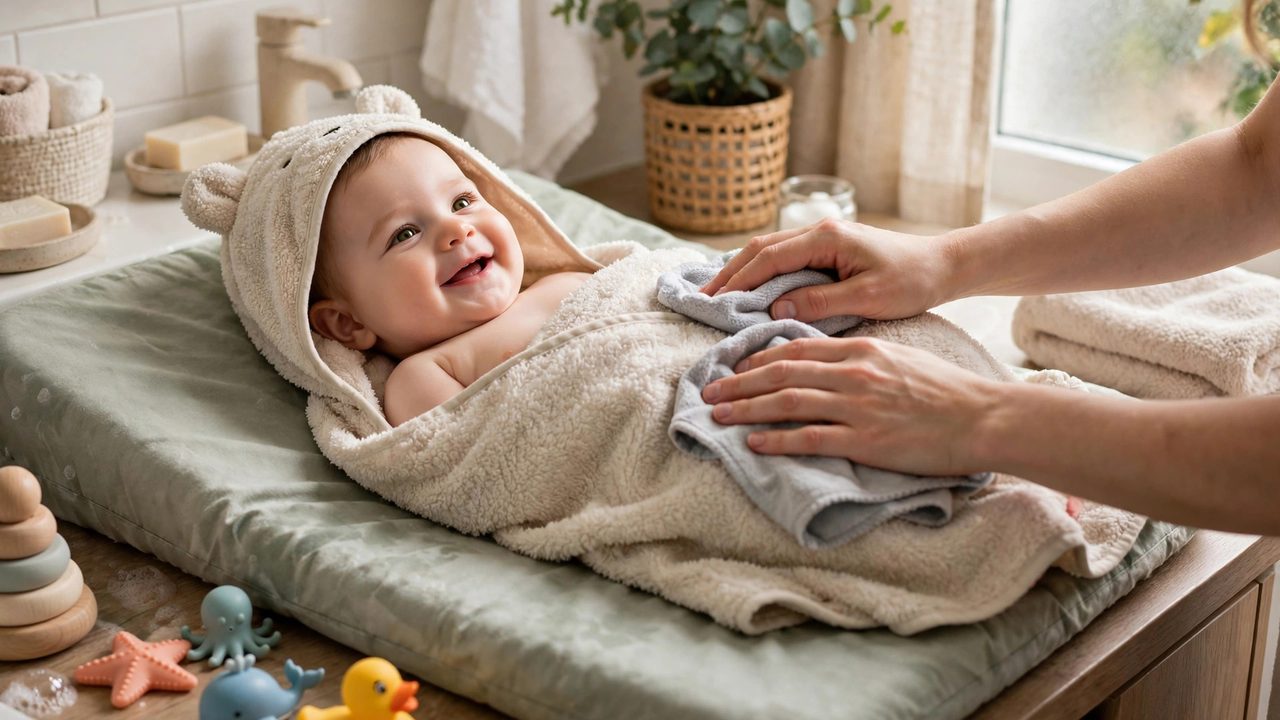
An infant comes out of the bath small, slippery and cooling down fast, so the towel you reach for has to do three jobs at once: wrap fully, absorb quickly and stay put while you carry your baby to the changing mat. Hooded towels dominate this category for a practical reason — the hood gives you a corner to anchor over the head, which keeps the wrap from sliding while the rest of the fabric covers the body. The best bath towels for infants in this guide are six hooded designs that differ in the ways that actually matter day to day: fabric, square size, pack count, hood style and care routine.
Every pick below was checked on its opened Amazon listing, and every specification is reported the way the maker lists it — fabric content, dimensions, pack size and wash instructions — with no added claims. You will find compact 28-inch squares for the newborn weeks, standard 32- and 33-inch squares that stretch further into the first year, a two-pack in muslin, a two-pack in a bamboo-derived blend, and a character hood with embroidered details for gift buyers. None of them is the single right answer for every nursery; the right one depends on how often you bathe your baby, how much laundry you want to run, and whether you prefer terry loops, flat muslin layers or a knit blend against the skin.
Quick verdict
If you want one towel-and-washcloth set in a certified organic fabric, the Burt’s Bees Baby woven terry set is the most complete package here: the maker lists 100% organic cotton, a 32 x 32 inch square and a hood sized so it does not fall over the face. If you want the largest simple cotton square, the Hudson Baby animal face towel measures 33 x 33 inches in 100% woven terry cotton. For a character gift with listed fabric weight, the Delta Children unicorn towel pairs a 30 x 30 inch body with a 320-gram terry blend and embroidered hood details. Families who prefer muslin have two distinct routes: the Yoofoss two-pack builds its towel from six layers of muslin cotton at 32 x 32 inches, and the Blissful Diary two-pack adds animal hoods and a stitch-free hood interior at the same square size. The Momcozy two-pack is the compact option — 28 x 28 inches in a half viscose, half cotton knit terry — sized for the smallest infants and for keeping a spare in the bath caddy.
The products in this guide
Hudson Baby Cotton Animal Face Hooded Towel (Cutesy Owl)
The Cutesy Owl version pinned here follows the same construction as the rest of the line — the maker lists 100% woven terry cotton and a 33 x 33 inch
Best if you want the biggest square in the guide, classic woven terry cotton
Selection started with the format infants actually get wrapped in: a hooded bath towel sold new on Amazon US, in a size a caregiver can use from the first baths onward. Each candidate had to open to a live listing with a current featured offer; a towel whose page showed no available new offer was dropped and replaced, however good its fabric sounded. We then read the maker’s own listing copy for the specifications that decide daily use — fabric content, square dimensions, number of layers or fabric weight where the maker states it, pack count, hood construction and care instructions — and only towels with those details stated on the page made the final six.
Variety was deliberate. A single-fabric list would not help a parent choosing between terry and muslin, so the final set spans woven cotton terry, a rayon-cotton terry blend, layered muslin cotton and a viscose-cotton knit. Sizes span 28 to 33 inches square, and pack formats span single towels, two-packs and a towel-plus-washcloth set. This article also sits alongside a companion piece on baby bath towels in the same series, so the six products here were chosen to avoid repeating that set: different brands, different fabrics and different pack formats, so a reader comparing both guides sees twelve distinct options rather than the same towels twice.
Two ground rules shaped the writing. First, specifications are phrased as the maker lists them; where a maker does not state a detail, this guide does not fill the gap. Second, this is a bath textile, so the guide sticks to textile questions — absorbency construction, size, layers, care — and makes no health or safety claims about any towel. A hooded towel is a drying and wrapping tool, nothing more, and it should always be used with the baby attended, as with every bath product.
Burt’s Bees Baby builds this set around one hooded towel plus matching washcloths, and the fabric story is the headline: the maker lists 100% organic cotton, combed and ring-spun, woven as a terry with two distinct faces. One side is smooth and the other is loop-knit terry, so the same towel gives you a flatter surface for the first pat-down and a looped surface that holds more water for the second pass. The maker also lists GOTS certification for the cotton, identified on the listing by certifier code CU 831717, which makes this the pick for buyers who want the organic claim tied to a named standard rather than left as a bare adjective.
The square measures 32 x 32 inches as the maker lists it, which is the standard infant wrap size in this guide — enough fabric to bring both corners across a newborn and still have length to spare as the baby grows through the first months. The hood deserves a specific mention because the maker addresses the most common hooded-towel annoyance directly: the hood is sized to sit on the head without being so large or deep that it slides down over the baby’s face. In practice that means the wrap stays anchored while you lift, which is when a too-deep hood usually ends up covering eyes and starting a protest.
The Oat colorway in this listing is a warm neutral with the line’s rugby stripe styling, and the set format matters for routine: the washcloths handle the in-bath washing while the towel stays dry on the hook for the wrap afterwards, instead of one cloth doing both jobs and arriving at the drying stage already damp. The maker lists the set as machine washable, and describes the combed ring-spun yarn as a no-pill construction, which is the detail to note if your household washes baby laundry several times a week and expects the towel to keep its surface. As a registry item it also reads as a complete gift on its own — towel and washcloths in one box — rather than a single piece the giver has to round out.
Buy it if: you want a certified organic cotton set, a two-sided terry weave, and a hood the maker specifically sizes to stay off the face.
Skip it if: you want a multi-pack of full towels for laundry rotation — this is one towel with washcloths, so heavy bath schedules will need a second towel from elsewhere.
Hudson Baby’s animal face line is the traditional end of this category: a single square of woven terry cotton with a character hood, sold one towel at a time in a long list of animal designs. The Cutesy Owl version pinned here follows the same construction as the rest of the line — the maker lists 100% woven terry cotton and a 33 x 33 inch square, which makes it the largest towel in this guide by an inch in each direction. That extra inch is not a rounding error in daily use; on a longer baby, or once you are wrapping a wriggling six-month-old, the bigger square keeps the bottom corner reachable for a full tuck.
Woven terry is the classic bath-towel structure, with loops on the surface that lift water off the skin as you pat rather than rub. The maker positions this towel for everyday use, and the single-towel format suits that: there is no set to keep together, no washcloth bundle to track, just one towel that goes from hook to bath to wash and back. The animal face on the hood is detailed rather than printed flat, which is the part gift buyers are paying for — the owl’s face is what shows in the post-bath photos, and the line lets you pick the animal to match a nursery theme without changing the towel underneath it.
Care is simple: the maker lists machine wash instructions, and the one-size format is listed for the baby age range. The trade-offs are equally clear. One towel means one towel — if bath time is daily and laundry is not, you will want two, and buying two singles is the only way to get there with this line. The woven terry is also a single-fabric construction, so buyers specifically hunting for layered muslin or a bamboo-derived blend should look at the two-packs further down this list instead. As a straightforward, generously sized cotton terry towel with a character hood, though, it is the most conventional pick here, and conventional is often exactly what a first nursery needs.
Buy it if: you want the biggest square in the guide, classic woven terry cotton, and a specific animal design for the hood.
Skip it if: you need several towels at once — the single-count format means building a rotation one purchase at a time.
Delta Children is a nursery furniture name that also makes soft goods, and its hooded towel is the most precisely specified character towel in this guide. The maker lists the fabric as 70% rayon and 30% cotton terry cloth, and — unusually for this category — states a fabric weight: 320 grams. That number gives you a concrete way to compare hand feel before ordering; a weighted terry blend like this sits in the middle of the range, substantial enough to hold water across a whole wrap without being the heaviest towel on the rail. The rayon share is what the maker credits for the smooth, soft surface of the cloth.
The body measures 30 x 30 inches as the maker lists it, a step down from the 32- and 33-inch squares above, and the maker breaks the hood out separately at 17.5 inches wide by 7.25 inches high. That hood specification is genuinely useful: hood width is what decides whether the hood settles over the head or perches on it, and few makers publish the measurement at all. The maker lists the baby size as recommended for ages 0 to 24 months. The Light Purple Unicorn design carries the character work on the hood itself — a unicorn horn, two ears and embroidered facial details — so the decoration is stitched texture rather than a surface print.
Because the same listing family also sells a larger kids’ towel and personalized versions, check that the variant on the page is the baby towel size before ordering; the ASIN pinned in this guide is the 30 x 30 inch baby version in Light Purple Unicorn. Within the infant brief, this is the gift pick with substance behind it: the embroidered hood photographs well, and the stated fabric weight and hood dimensions mean you are not buying the character blind. Buyers who want the longest possible use from one towel should note the 30-inch square will be outgrown sooner than the 33-inch Hudson Baby, which is the honest cost of the more compact, giftable format.
Buy it if: you want a character towel with published fabric weight and hood dimensions, and embroidered rather than printed hood details.
Skip it if: you want maximum wrap coverage — at 30 x 30 inches it is the second-smallest square here and will be outgrown earlier.
Yoofoss takes the opposite construction route from terry: instead of loops, the maker builds this towel from six layers of muslin cotton, listed as 100% muslin cotton across the set. Muslin’s open weave layered six deep gives the towel its absorbency through the stack rather than through a pile surface, and it changes the feel completely — flat, flexible and light in the hand, draping over a small body instead of standing away from it. For caregivers who find terry bulky on a newborn, that drape is the reason to choose this format.
Each towel in the two-pack measures 32 x 32 inches as the maker lists it, so you give up nothing in coverage against the terry picks, and the maker lists the size as suitable from newborn through small kids up to 3 years old. The two-pack format is the practical core of the offer: one towel in use and one in the wash is the minimum rotation for a household bathing an infant most days, and this set delivers that rotation in a single purchase. The Apricot and Green pairing pinned here keeps the two towels visually distinct, which helps when one is designated for home and the other lives in the diaper bag.
The maker lists the towels as machine washable and quick drying, and describes the muslin as holding its softness, thickness and color through repeated washes — relevant because layered muslin is often bought specifically by parents who plan to wash on a near-daily cycle. The maker also lists secondary uses beyond the bath, including as a light blanket, a swaddle-style wrap or a changing mat cover, which follows naturally from the flat layered construction; a muslin square folds far smaller than a terry towel of the same dimensions, so it packs into a bag corner in a way terry does not. If your priority is a soft, flat, fast-folding towel in a ready-made rotation, this is the set built around that priority.
Buy it if: you prefer layered muslin over terry loops, want a two-towel rotation in one purchase, and value how small a muslin square folds.
Skip it if: you want a plush pile surface — six flat layers absorb well but never feel like a looped terry towel.
Momcozy’s hooded towel set is the compact specialist in this guide. The maker lists each towel at 28 x 28 inches — the smallest square here — in a knit terry made from 50% viscose derived from bamboo and 50% cotton, with two towels in the pack. The smaller square is a deliberate fit for the newborn and young infant stage: less fabric to bunch around a tiny body, less overhang to drag through the bath water when you lift, and a wrap that a small baby does not disappear into. Parents who found standard squares unwieldy in the first weeks are the audience for this size.
The fabric blend is the other half of the design. The maker describes the viscose share as giving the knit a silky hand feel while the cotton share provides the terry structure, and lists the blend as a knit terry cloth rather than a woven one — knit terry typically has more give in the hand, which helps the towel conform when you wrap corners across. The Lemon design pinned here is one of the line’s fruit and nature prints, and the two-pack is presented by the maker in gift packaging, aimed at registry and shower buyers as much as at parents stocking their own nursery.
Size honesty matters with this pick: a 28-inch square that is perfect at six weeks will feel short well before the first birthday, so treat this set as the newborn-stage specialist it is, or as the bath-caddy and travel spare alongside a larger everyday towel. The maker lists machine wash care. Within its brief, though, the combination is coherent — smallest square, smoothest-listed fabric blend, two towels per pack — and for the first months, when baths are short and the baby is smallest, a towel actually sized to the baby is easier to handle than an oversized one folded down.
Buy it if: you are buying for the newborn weeks specifically and want a compact square in a smooth bamboo-derived blend, two to a pack.
Skip it if: you want one purchase to last deep into the toddler stage — the 28 x 28 inch size is the first in this guide a growing baby will outgrow.
Blissful Diary is the second muslin entry here, and it differs from the Yoofoss set in the hood rather than the body. The towels are muslin cotton in a multi-layer construction at 32 x 32 inches as the maker lists them, sold as a two-pack — but the hoods are shaped animal designs, a bear and a giraffe in the pairing pinned here, where the Yoofoss hoods are plain. That makes this the muslin option for buyers who still want the character-hood look in the post-bath routine and in photos.
One construction detail stands out in the maker’s listing: the hoods have no decorative stitching on the inside. Decorative hood embroidery usually leaves a rougher stitched reverse against the head; a stitch-free interior keeps the surface that touches the baby’s head as plain muslin. It is a small specification, but it is exactly the kind of detail that separates two otherwise similar muslin two-packs, and it is stated by the maker rather than left for buyers to discover. The maker also lists the muslin as getting softer and fluffier with washing, and positions the two-pack as the always-have-a-clean-one rotation for daily baths.
Like the other muslin set, the maker lists uses beyond drying — the squares double as swaddle-style wraps, beach or pool towels and stroller covers — and lists machine wash care. The choice between this and the Yoofoss set comes down to hood preference and colorway: plain hoods and a striped-fruit palette on one side, animal hoods and a stitch-free hood interior on the other, with the same 32-inch muslin square underneath both. As a shower gift, the bear-and-giraffe pairing is the more presentable of the two muslin options, while households buying purely for the wash rotation will be happy with either.
Buy it if: you want muslin’s flat drape with animal hoods, and a hood interior the maker lists as free of decorative stitching.
Skip it if: you want terry absorbency construction — like all muslin here, it dries by layered weave rather than by loops.
Buying guide
Start with the square size
Infant hooded towels cluster between 28 and 35 inches square, and the six here span 28 to 33. Size decides two things: how long the towel stays useful, and how manageable it feels in the first weeks. A 28-inch square wraps a newborn neatly with little excess, but the corners stop meeting across the body sooner as the baby grows. A 32- or 33-inch square looks generous on a newborn — you will fold the excess — yet it is still working at the first birthday and beyond. If you are buying one towel to cover the whole infant stage, choose from the larger half of the range. If you are buying specifically for the newborn months, or as a second towel for travel and the bath caddy, the compact square is easier to handle and dries faster in the wash cycle. Measure against what you own: hold a receiving blanket at 30 inches and at 33 inches and the difference in wrap length is immediately obvious.
Choose the fabric construction, not just the fiber
Fiber names alone do not tell you how a towel dries. Woven terry cotton, as in the Hudson Baby and the Burt’s Bees Baby set, lifts water with surface loops — the familiar bath-towel mechanism, durable and quick to pat dry. A rayon-cotton terry blend, as in the Delta Children towel, keeps the loops but changes the hand feel toward smoother, and the maker’s stated 320-gram weight tells you how much cloth is in the square. Layered muslin, as in the Yoofoss and Blissful Diary sets, absorbs through stacked open-weave layers: flatter, lighter, faster to fold and quick to dry on the line, with a feel closer to a blanket than to a bath towel. A viscose-cotton knit, as in the Momcozy set, adds stretch and a silky surface to a terry structure. None of these is universally best; match the construction to your routine — heavy daily washing favors simple terry, small-space drying favors muslin, and the newborn stage favors whichever fabric you find easiest to wrap one-handed.
Read the hood as a functional part
The hood is not decoration, even when it carries an animal face. It anchors the wrap: hood on first, then corners across, and the towel stays in place during the carry to the changing mat. Check three things in a maker’s listing. First, hood depth — a hood sized too deep slides over the face, which is why the Burt’s Bees Baby listing’s explicit sizing note matters. Second, hood dimensions where published, as Delta Children publishes them, since width decides fit. Third, the hood interior — decorative stitching looks good from outside, but a plain interior, as Blissful Diary lists, is the simpler surface against the head. Character hoods from Hudson Baby and Delta Children add embroidered or shaped details that make the towel the giftable, photographable option; plain hoods from Yoofoss and Burt’s Bees Baby keep the whole towel flat for folding and stacking.
Plan the rotation before you buy
Count baths per week and laundry runs per week, and the pack format chooses itself. A household bathing an infant daily and washing every other day needs at least two towels in play, which is why the Yoofoss, Momcozy and Blissful Diary two-packs exist. A towel-plus-washcloth set, like the Burt’s Bees Baby set, solves a different problem — keeping the drying towel separate from the washing cloths — but still leaves you one towel deep. Single towels like the Hudson Baby and Delta Children picks are best bought deliberately in pairs, or chosen when bath frequency is lower. Also consider where the spare lives: a muslin two-pack folds small enough for one towel to stay in the diaper bag permanently, which ends the forgotten-towel problem for baths away from home.
Care instructions decide the towel’s second year
Every pick here is listed by its maker as machine washable, which is the baseline for anything used in a daily bath routine. Beyond that, read what the maker claims about repeat washing: combed ring-spun yarn listed as no-pill, muslin listed as softening with washes, layered construction listed as holding thickness and color. These are the claims that predict how the towel looks after fifty cycles, which is the real lifespan question for an infant towel that may be washed more in a year than an adult towel is in three. Follow the maker’s wash guidance on the listing and the sewn label, wash new towels before first use as you would any bath textile, and keep the routine simple — a towel that needs special handling will quietly fall out of rotation in a busy household.
FAQ
What size hooded towel is right for a newborn?
The maker-listed sizes in this guide run from 28 x 28 inches to 33 x 33 inches, and both ends work for a newborn. A 28-inch square, like the Momcozy set, wraps a newborn with the least excess fabric. A 32- or 33-inch square, like the Yoofoss, Blissful Diary and Hudson Baby towels, needs a fold at first but stays in service far longer. Choose by whether you are buying for the newborn weeks specifically or for the whole infant stage.
Is muslin or terry better for drying an infant?
They dry differently rather than one being better. Terry — woven cotton, a rayon-cotton blend, or a viscose-cotton knit — absorbs through surface loops and feels like a conventional bath towel. Muslin absorbs through stacked layers of open-weave cotton, feels flatter and lighter, folds smaller and typically dries faster between uses. Households that wash daily often prefer muslin’s quick turnaround; households that want one thick wrap often prefer terry.
How many infant bath towels does a household need?
Two is the practical minimum for a daily bath routine — one in use, one in the wash — which is why three of the six picks here are two-packs. A single towel works if baths are less frequent or laundry is daily. A towel-and-washcloth set covers washing and drying tools in one purchase but still counts as one drying towel, so pair it with a second towel if baths are frequent.
What does the fabric weight on the Delta Children towel mean?
The maker lists the Delta Children towel’s terry blend at 320 grams, a grams-per-square-metre style measure of how much fabric the cloth carries. More weight generally means a more substantial cloth that holds more water; less means a lighter, faster-drying one. Most infant towel makers do not publish this figure at all, so where it is listed, as here, it is a useful comparison point rather than a quality verdict on its own.
Can these towels be used beyond the bath?
The makers of the two muslin sets list additional uses for their squares, including as light wraps, beach or pool towels and stroller covers, which follows from muslin’s flat, foldable construction. Terry towels are generally listed for bath use. Whatever the use, a towel is a textile for drying and wrapping while the baby is attended — always follow the maker’s listed uses and care instructions for the specific product.
How should infant towels be washed?
All six makers list machine wash care for their towels. Wash a new towel before its first use, follow the temperature and drying guidance on the product’s label, and expect fabric behavior to match the construction: the makers of the muslin sets list their cotton as softening with washing, while the Burt’s Bees Baby set’s combed ring-spun cotton is listed as a no-pill construction. When a listing and a sewn label differ, follow the label on the towel you own.
Conclusion
The six towels here divide cleanly by the decisions that matter. For a certified organic set with washcloths included, choose the Burt’s Bees Baby woven terry set. For the largest plain-terry square with a character hood, choose the Hudson Baby Cutesy Owl. For a gift towel with published fabric weight and embroidered hood details, choose the Delta Children unicorn. For muslin, choose the Yoofoss two-pack for plain hoods and six-layer construction, or the Blissful Diary two-pack for animal hoods and a stitch-free hood interior. For the newborn weeks in a compact, smooth blend, choose the Momcozy Lemon two-pack. Match the square size to the stage you are buying for, the construction to your laundry rhythm, and the pack count to your bath frequency, and the towel you pick will still be the one you reach for at the end of the infant stage.
M
Modern Line Home Editorial Team
We compare specs, materials and verified owner reviews before a product earns a spot. Rankings are never paid.
Affiliate disclosure. As an Amazon Associate we earn from qualifying purchases at no extra cost to you. Prices accurate as of the date shown.
House cold even with the heat on? Walk this ordered checklist: thermostat and filter first, then drafts, insulation, leaky ducts and a failing heating system.
Windows fogging up in winter? Check where the fog sits: on the room side it is indoor humidity, outside it is harmless, and between panes the seal has failed.
Store the main firewood pile about 30 feet from your house, off the ground and covered only on top. Compare racks, woodsheds, garages and indoor spots safely.
Place a portable generator outdoors only, at least 20 feet from windows, doors and vents, exhaust pointed away. Exact distances, setup steps and CO rules here.
Keep houseplants in the right winter spot: match window direction to plant type, stay clear of radiators and cold glass, and fix dry air and low light at home.
Mice enter through pencil-width gaps at foundations, pipes, vents, doors and the roofline. Walk this room-by-room winter checklist to find and seal each one.
A winter outage timeline: what to do in the first hour, first night and multi-day outage, with food safety times, pipe protection, heat and CO safety steps.
Size a space heater by room area: 10 watts per square foot at 8-foot ceilings, adjusted for insulation and ceiling height, with full wattage and BTU tables.
Start dripping at about 20 degrees, sooner for exposed pipes. Set a pencil-lead stream, drip the right faucets on both lines, and know when to stop safely.
A fridge needs 800-1,200 starting watts, not just 150-400 running watts. Use the tables to total your fridge plus freezer, lights, furnace fan and more today.












Write Your Review
No reviews yet. Be the first to share your experience!