We independently review everything we recommend. When you buy through our links, we may earn a commission. As an Amazon Associate we earn from qualifying purchases.
Best Air Purifiers for Kitchen: 6 Picks for Odor Control
Compare the best air purifiers for kitchen use, from compact countertop-friendly units to large open-plan models with strong carbon filters for cooking odors.
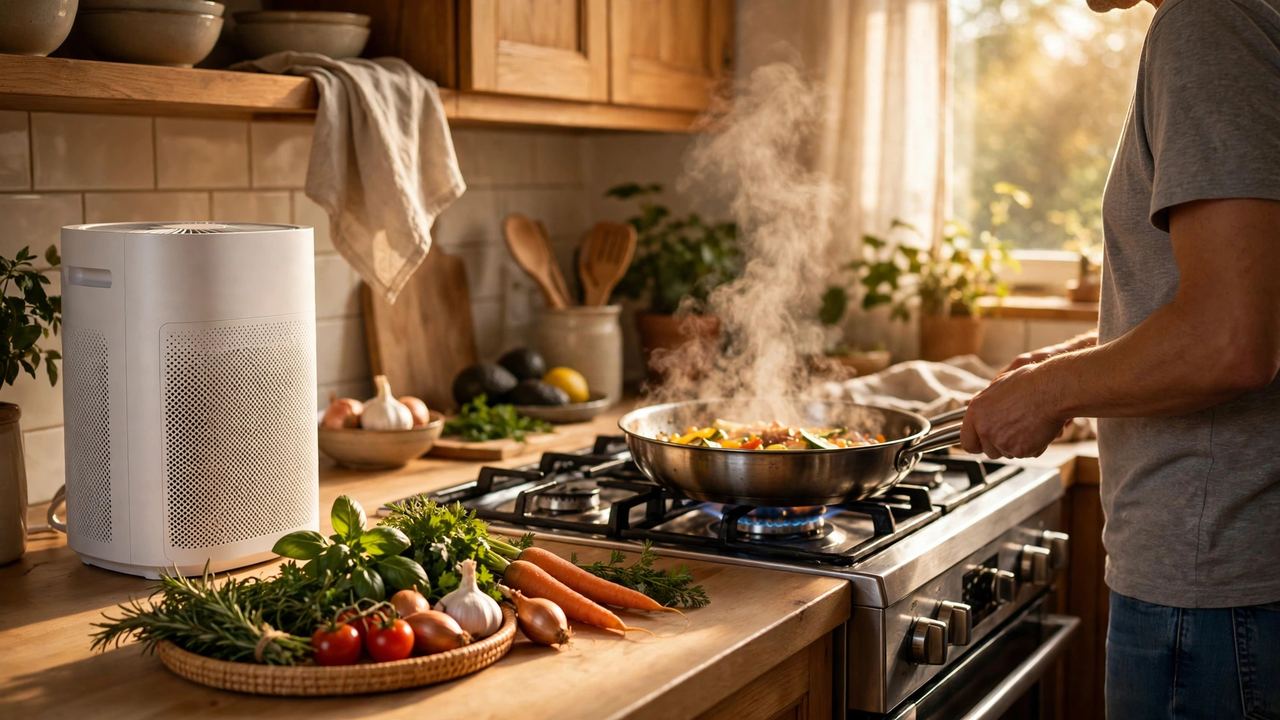
A kitchen asks more of an air purifier than almost any other room in the house. Frying fills the air with fine grease particles, a hot oven releases a steady stream of cooking smells, and gas burners, spices, cleaning sprays and a full trash bin all add volatile organic compounds and lingering odors that drift into the rest of the home. A purifier that works well in a quiet bedroom can struggle here, because kitchen air needs two different kinds of cleaning at once: particle filtration for smoke, flour dust and airborne grease, and a serious activated carbon stage for the smells themselves. The best air purifiers for kitchen use combine both, move enough air to keep up with an active stove, and tolerate being run hard during cooking and then left on auto afterwards.
Placement matters just as much as filtration. A kitchen purifier usually has to live on the floor in a corner, on a spare stretch of counter, or just outside the kitchen in an open-plan space, because putting any appliance too close to heat, steam and splashing oil is a bad idea. That means footprint, noise at higher fan speeds, and how easy the pre-filter is to wash all become practical deciding factors. Grease is hard on filters, so a washable pre-filter that catches the coarse layer before it reaches the main filter is worth a great deal in this room.
This guide compares six purifiers that suit kitchen duty in different ways. Some are compact enough for a small apartment kitchen, some are built for large open-plan kitchen-living spaces, and some put most of their budget into carbon filtration for odor control. Every specification below is phrased the way the maker lists it, so you can compare coverage, CADR, noise and filter design on equal terms before choosing the unit that fits your cooking style.
Quick verdict
For most kitchens, the LEVOIT Core 400S-P is the strongest all-round choice: the maker lists AHAM-verified CADR figures, a three-stage filter with an activated carbon stage for smoke and odors, a laser dust sensor that reacts automatically, and a low noise floor for a unit of its output. If cooking odor is your single biggest problem, the WINIX 5520 puts a high-deodorization carbon filter and a washable fine mesh pre-filter at the center of its design, which is exactly the combination a busy stove calls for. For a large open-plan kitchen and living area, the Blueair Blue Pure 211i Max moves far more air than the rest of this list. On a smaller scale, the Medify Air MA-25 suits a compact kitchen or apartment, the Coway Airmega Mighty offers a deodorization filter and an Eco mode in a proven mid-size cabinet, and the LEVOIT Vital 200S-P adds a U-shaped intake and strong verified CADR for bigger rooms that connect to the kitchen.
The products in this guide
LEVOIT Core 400S-P Smart Air Purifier
The Core 400S-P is the pick that fits the widest range of kitchens
Best if you want one purifier that handles a kitchen and the room beyond it
We started from what kitchen air actually contains. Cooking produces fine particles from frying and searing, water vapor and grease aerosol from boiling and roasting, and a changing mix of odor molecules and volatile organic compounds from food, oils, spices and cleaning products. A purifier for this room therefore had to offer both particle filtration and an activated carbon or deodorization stage, because a particle filter alone does little for smell, and carbon alone does little for smoke haze.
Next we looked at airflow. CADR, the clean air delivery rate, tells you how much filtered air a unit delivers, and kitchen duty rewards higher figures because cooking loads the air quickly. Each pick below states the CADR or coverage figures the maker lists, and we favored models with independently verified ratings where the maker publishes them. Coverage claims are always given on the maker’s own terms in this guide, usually as the largest area cleaned once per hour, with the smaller AHAM-style room size noted where the maker provides it.
We also weighed grease tolerance. A washable pre-filter that can be rinsed or vacuumed matters more in a kitchen than in any other room, because airborne grease coats the first surface it meets. Models with washable pre-filters earned preference, and we noted where a design relies on replaceable filters only. Noise mattered too: a purifier that is only tolerable on its lowest speed will not keep up during cooking, so we recorded the full noise range the maker lists rather than only the quietest figure.
Finally, every product had to be a current model sold new, with its specifications confirmed on opened product pages, and with practical controls for kitchen life: auto modes that react when the air loads up, timers, filter indicators and, on several picks, app control so the unit can be started from another room when cooking begins. Products that could not be verified to that standard, or that showed no live offer, were excluded rather than described from secondary sources.
The Core 400S-P is the pick that fits the widest range of kitchens. The maker lists it as AHAM verified with CADR ratings of 231 CFM for smoke, 240 CFM for dust and 259 CFM for pollen, and as designed to refresh the air in rooms up to 1,718 square feet once per hour. In a typical kitchen or kitchen-diner, that output means the unit can run on a moderate speed during cooking instead of being pushed to a noisy maximum, and still turn the room’s air over at a useful rate.
Filtration follows the three-stage pattern kitchen air needs. The maker lists a pre-filter that captures dust, lint, fibers, hair and fur, a main filter that captures 99.97 percent of airborne particles down to 0.3 microns, and an activated carbon filter that adsorbs smoke and odors. That carbon stage is the part that earns this unit its place in a kitchen roundup: it is aimed at the smell of frying oil and seared food that would otherwise settle into curtains, upholstery and the next room.
The controls suit cooking particularly well. The maker lists an AirSight Plus laser dust sensor that detects PM2.5 levels, displays the reading in real time and drives an auto mode that adjusts fan speed as air quality changes, so the purifier reacts when a pan starts smoking without anyone touching it. The VeSync app adds schedules, timers and filter-life monitoring, and the maker lists compatibility with Amazon Alexa and Google Assistant. Sleep mode runs as low as 24 dB and can dim or switch off the display, which helps in open-plan homes where the kitchen unit stays on overnight. The maker lists power draw of 24 watts and a weight of 12.8 pounds, so moving it between the kitchen and an adjoining room is easy.
Filtration: the maker lists a pre-filter, a main filter rated at 99.97 percent down to 0.3 microns, and an activated carbon filter for smoke and odors
CADR: the maker lists AHAM-verified figures of 231 CFM smoke, 240 CFM dust and 259 CFM pollen
Coverage: the maker lists rooms up to 1,718 sq ft refreshed once per hour
Noise: the maker lists operation as low as 24 dB in sleep mode
Controls: the maker lists a laser PM2.5 sensor, auto mode, VeSync app control and Alexa and Google Assistant compatibility
Power and size: the maker lists 24 watts and 12.8 pounds
Pros
Verified CADR figures rather than coverage claims alone
Activated carbon stage aimed at smoke and cooking odors
Sensor-driven auto mode reacts while you are busy at the stove
Quiet sleep mode and a display that can be turned off
Cons
Pre-filter is not the washable type, so grease-heavy kitchens will replace filters on schedule
Round tower shape needs a clear floor corner rather than a narrow counter gap
Buy it if: you want one purifier that handles a kitchen and the room beyond it, with verified performance and hands-free auto operation.
Skip it if: your kitchen produces heavy frying grease daily and you specifically want a washable pre-filter as the first line of defense.
The WINIX 5520 is the odor specialist of this group. The maker lists an advanced odor control carbon filter that reduces volatile organic compounds and household odors from cooking, pets and smoke, and positions that filter to catch airborne particles before they reach the True HEPA stage, which also helps prolong the HEPA filter’s life. For a kitchen, that ordering is sensible: the carbon bed does the smell work, and the particle filter is protected from loading up too quickly.
Airflow is strong for the cabinet size. The maker lists the unit as AHAM verified at 392 square feet, and as cleaning rooms up to 1,882 square feet in one hour, 941 square feet in 30 minutes and 470 square feet in 15 minutes. That pace matters after a smoky cooking session, when the goal is to clear the room before the smell settles into soft furnishings. The maker lists True HEPA filtration capturing 99.99 percent of airborne allergens including pollen, dust, smoke and pet dander, as small as 0.01 microns.
Grease handling is a genuine strength. The maker lists a washable fine mesh pre-filter as the first line of defense against the largest airborne particles, and in a kitchen that layer can be rinsed instead of replaced when it collects the coarse film that frying produces. Smart sensors and an auto mode adjust fan speed in real time, an LED air quality indicator shows the room’s status at a glance, and the maker lists Winix Smart app compatibility plus Alexa control. The maker lists noise from 23.5 dB, power draw of 50 watts and a weight of 13.3 pounds in the black finish.
Filtration: the maker lists a washable fine mesh pre-filter, an advanced odor control carbon filter and True HEPA
CADR and coverage: the maker lists AHAM verification at 392 sq ft and cleaning up to 1,882 sq ft in 1 hour
Particle capture: the maker lists 99.99 percent capture of particles as small as 0.01 microns
Noise: the maker lists a low end of 23.5 dB
Controls: the maker lists smart sensors, auto mode, an LED air quality indicator and app compatibility
Power and size: the maker lists 50 watts and 13.3 pounds
Pros
Carbon filter designed specifically for cooking odors and VOCs
Washable pre-filter suits grease-heavy kitchen air
Fast room clearing at the maker’s listed 15 and 30 minute figures
Auto mode with a clear visual air quality indicator
Cons
Higher power draw than the most efficient picks here
Tower footprint is deeper than the compact models
Buy it if: lingering cooking smell is your main complaint and you want carbon filtration and a washable pre-filter working together.
Skip it if: you need the smallest possible unit for a tight galley kitchen with no spare floor space.
The Coway Airmega Mighty, model AP-1512HH in white, is a long-running mid-size design that suits a kitchen-diner well. The maker lists it as designed to clean spaces up to 1,748 square feet in 60 minutes, with a four-stage filtration system combining a washable pre-filter, a deodorization filter, a bipolar device and a HEPA filter. The maker lists that system as reducing 99.97 percent of 0.3 micron particles including pollen and other allergens, and as reducing volatile organic compounds and odor, which is the combination kitchen air calls for.
Day-to-day operation is simple and automatic. The maker lists an auto mode that constantly monitors air quality and adjusts the fan to purify the space as needed, plus an Eco mode and a timer. A pollution sensor communicates indoor air quality in real time through a brightly colored LED, and the light can be turned off for sleeping in open-plan homes. Filter alerts tell you when filters need replacing and when the pre-filter needs cleaning, based on how much air the unit has processed, which is a useful prompt in a kitchen where the pre-filter loads faster than in other rooms.
The trade-offs are controls and efficiency. This model is operated by button control on the unit rather than by app, and the maker lists power consumption of 77 watts, the highest here, with a noise range topping out at 53.8 dB. The maker lists a weight of 12.5 pounds and a three-year warranty on the listing, and certifications including CARB and ETL. For cooks who want a purifier that simply sits near the kitchen, senses a smoky pan and gets on with it, those are acceptable compromises.
Filtration: the maker lists a washable pre-filter, deodorization filter, bipolar device and HEPA filter in four stages
Coverage: the maker lists spaces up to 1,748 sq ft cleaned in 60 minutes
Particle capture: the maker lists reduction of 99.97 percent of 0.3 micron particles
Noise: the maker lists a range up to 53.8 dB
Controls: the maker lists auto mode, Eco mode, a timer, a real-time quality indicator and filter alerts, all on the unit
Power and size: the maker lists 77 watts and 12.5 pounds
Pros
Dedicated deodorization filter for odor and VOC reduction
Washable pre-filter with a cleaning reminder based on air processed
Eco mode trims running when the air stays clean
No app or account needed; everything is on the unit
Cons
No Wi-Fi or voice control
Highest power draw of the six picks
Buy it if: you want proven, simple, sensor-driven purification near the kitchen without smart-home setup.
Skip it if: app scheduling and voice control are part of how you run your kitchen.
The Vital 200S-P, model LAP-V201S-KUS in black, is built around intake design. Alongside a traditional air inlet, the maker lists an additional U-shaped air inlet, so airborne hair and odors are drawn in easily without causing clogs. In a kitchen that shares space with the rest of the home, that wide intake helps the unit keep pulling in smoky, odor-carrying air from a broad area rather than only from directly in front of the cabinet. The flat-front design also sits more neatly against a wall than a round tower.
Performance figures are independently framed. The maker lists the Vital 200S-P as AHAM verified with CADR ratings of 250 CFM for smoke, 254 CFM for dust and 289 CFM for pollen, and lists coverage up to 1,875 square feet. The maker lists filtration efficiency of 99.97 percent for 0.3 micron airborne particulates including pollen, dust and animal dander, through a three-stage filter with a washable pre-filter. That washable layer is a practical plus where flour dust and cooking aerosol are part of daily air.
The maker lists a noise level of 27 dB in sleep mode, power draw of 51 watts and a weight of 13.2 pounds. An air quality monitor and smart control through the maker’s app round out the package, so the purifier can be started before cooking begins and checked afterwards without walking over to it. For an open-plan kitchen and living room that needs one machine to cover both zones, the Vital 200S-P is the balanced option: stronger verified airflow than the compact picks, a washable pre-filter, and a cabinet that does not dominate the room.
Filtration: the maker lists a three-stage filter with a washable pre-filter and 99.97 percent capture at 0.3 microns
CADR: the maker lists AHAM-verified figures of 250 CFM smoke, 254 CFM dust and 289 CFM pollen
Coverage: the maker lists up to 1,875 sq ft
Noise: the maker lists 27 dB in sleep mode
Controls: the maker lists an air quality monitor, auto operation and app control
Power and size: the maker lists 51 watts and 13.2 pounds
Pros
U-shaped extra intake draws in odor-carrying air from a wide area
Strongest verified smoke CADR among the mid-size picks
Washable pre-filter handles flour dust and cooking aerosol
Flat front sits flush against a wall
Cons
Carbon capacity is shared with the combined filter, so heavy odor work means timely filter changes
Larger footprint than the compact kitchen picks
Buy it if: your kitchen opens into a living area and you want one verified, wall-friendly unit to cover the combined space.
Skip it if: your kitchen is small and closed off, where this much airflow is more than the room needs.
The Blue Pure 211i Max is the heavy lifter for big, open kitchens. The maker lists it as cleaning up to 674 square feet in just 12.5 minutes, or 3,235 square feet in one hour, figures well beyond the other picks here. In a large open-plan space where cooking smells would otherwise wander through the whole floor, that airflow is the point: the unit can exchange the air fast enough to keep up with a long cooking session rather than slowly catching up afterwards.
Filtration uses Blueair’s HEPASilent approach. The maker lists HEPASilent dual filtration capturing airborne particles including dust, pollen, wildfire smoke, pet hair, pet dander and mold particles, with a particle retention size of 0.1 microns, a washable fabric pre-filter for larger particles, and an activated carbon filter stage in the filter class the maker lists. The maker lists the model as AHAM verified, with 360-degree air intake, so placement against a kitchen island or at the edge of the cooking zone still lets it draw air from all sides.
Smart features are complete. The maker lists built-in air quality sensors that detect pollution and automatically adjust fan speed, Wi-Fi with app monitoring, scheduling and filter-life tracking, and compatibility with Alexa and mobile control. The maker lists noise from 23 dB at the quiet end up to 53 dB, power draw of 46 watts, and dimensions of 14.4 by 14.4 by 22.7 inches in the white and slate finish. It is the largest cabinet here, so it suits homes where the kitchen flows into a living space and floor room exists near, but not inside, the cooking zone.
Filtration: the maker lists HEPASilent dual filtration with a washable fabric pre-filter and carbon stage, retaining particles down to 0.1 microns
Coverage: the maker lists 674 sq ft cleaned in 12.5 minutes and up to 3,235 sq ft in 1 hour
Noise: the maker lists 23 to 53 dB
Controls: the maker lists Wi-Fi, app control, auto mode from built-in sensors and Alexa compatibility
Intake: the maker lists 360-degree air intake
Power and size: the maker lists 46 watts and 14.4 x 14.4 x 22.7 inches
Pros
By far the highest airflow in this roundup
Washable fabric pre-filter and 360-degree intake suit open layouts
Full app feature set with filter-life tracking
Quiet low end for a unit of this output
Cons
Largest footprint here; too big for a small closed kitchen
Replacement filters for a unit this size are a bigger ongoing commitment
Buy it if: you cook in a large open-plan kitchen-living space and want one purifier that can turn over the whole area quickly.
Skip it if: your kitchen is a separate small room, where a compact model will do the same job with less cabinet.
The MA-25, part number MA-25-W1 in white, is the compact answer for small kitchens and apartments. The maker lists it as designed to clean spaces up to 825 square feet in one hour, in a cabinet measuring 10 by 9.5 by 15.5 inches and weighing 6.5 pounds. That size can sit on a wide counter away from the stove, on a kitchen cart, or on the floor of a small dining area, places where the tower models simply do not fit.
Instead of a single filter, the maker lists dual True HEPA filters, capturing 99.97 percent of particles at 0.3 microns including dust, pollen, pet dander, smoke and wildfire smoke. Two filter faces give a small unit more media area than its footprint suggests, which helps it keep up with the particle load from daily cooking in a modest space. The maker lists the unit’s contaminant filtration as covering dust, odors, pollen, cigarette smoke and pet dander.
Controls are handled from one touch panel. The maker lists three fan speeds running from 19.8 to 49.3 dB, a timer adjustable from 0 to 8 hours, a sleep mode that dims the panel lights, a child lock and a filter indicator. The maker lists power draw of 28 watts, Energy Star certification on the listing, and a limited lifetime warranty, which the maker describes as long-term support for the machine. There is no carbon bed of the size the larger picks carry and no app, so this is a straightforward particle-focused purifier for smaller kitchens rather than an odor-heavy frying station.
Filtration: the maker lists dual True HEPA filters capturing 99.97 percent of particles at 0.3 microns
Coverage: the maker lists spaces up to 825 sq ft cleaned in one hour
Noise: the maker lists 19.8 to 49.3 dB across three fan speeds
Controls: the maker lists a touch panel with a 0 to 8 hour timer, sleep mode, child lock and a filter indicator
Power and size: the maker lists 28 watts, 6.5 pounds and 10 x 9.5 x 15.5 inches
Support: the maker lists a limited lifetime warranty
Pros
Genuinely compact; fits counters and small floor spaces
Dual filters give a small cabinet more filtration area
Quiet low speed and a dimming sleep mode
Simple touch controls with a timer and child lock
Cons
No app or sensor-driven auto mode
Less carbon capacity for persistent heavy cooking odors than the larger picks
Buy it if: your kitchen is small, your cooking is light to moderate, and counter or corner space is the deciding factor.
Skip it if: you fry or sear daily and need a large carbon filter dedicated to odor control.
Buying guide
Start with the carbon filter, not the HEPA filter. Almost every purifier in this class captures fine particles well. What separates a kitchen purifier from a bedroom purifier is how much activated carbon it carries and how that carbon is arranged. Cooking odors and volatile organic compounds are gases, and gases pass straight through particle media; they are removed when they adsorb onto carbon. A model that names a deodorization or advanced odor control carbon filter, like the WINIX 5520 and the Coway Mighty, is built with that job in mind. If your main frustration is that last night’s dinner still greets you in the morning, carbon capacity should be your first filter for choosing, in both senses.
Match airflow to the space the air actually fills. In a closed kitchen, the room’s own area is the target. In an open-plan layout, the purifier has to serve the whole connected volume, which is why makers quote coverage two ways: a smaller AHAM-style room size for repeated air changes, and a much larger once-per-hour figure. Use the smaller figure for honest sizing. A purifier that can clean your space several times an hour on a bearable fan speed will clear a smoky incident quickly; one that only manages the job on its loudest setting will spend its life switched down and underperforming.
Plan for grease from day one. Airborne cooking grease coats the first filter surface it reaches. A washable pre-filter, listed on the WINIX 5520, the Coway Mighty, the Vital 200S-P and the Blue Pure 211i Max, lets you rinse that layer away instead of shortening the main filter’s life. Whatever model you choose, keep the unit out of the direct plume above the stove, away from steam and splashes, and expect the pre-filter to need attention more often than the same machine would in a bedroom. Never run a purifier so close to a hob that heat can reach it, and always follow the maker’s own placement guidance.
Decide how the purifier will be controlled while you cook. Hands are busy and often messy at the stove, so sensor-driven auto modes earn their keep: the Core 400S-P, the WINIX 5520, the Coway Mighty and the Blue Pure 211i Max all adjust themselves when the air loads up. App control adds the option to start the unit before cooking or check it from another room, and a simple timer, like the one on the Medify MA-25, is enough if your routine is predictable. An air quality indicator you can read at a glance is more useful mid-cooking than a detailed app graph.
Count the running costs honestly. Filters are the main ongoing expense, and kitchen duty shortens their comfortable life compared with a quiet room. Note how many filters a model uses, whether the carbon and particle stages are combined or separate, and what the maker lists for power draw, which here ranges from the Core 400S-P at the low end to the Coway Mighty at the high end. A purifier left running on auto all day becomes part of the household’s background energy use, so the efficient models have a real advantage over years of ownership.
Use the purifier alongside ventilation, not instead of it. A range hood that vents outdoors removes heat, moisture and a large share of cooking particles at the source, and no portable purifier replaces that. The purifier’s role is to handle what escapes into the room and the rest of the home: the haze that drifts past the hood, the odors that linger after cooking ends, and the background mix from trash, spices and cleaning. Run the purifier during cooking and for a while afterwards, and let auto mode decide when the air is back to baseline.
FAQ
Where should an air purifier be placed in a kitchen?
Place it on a stable surface near the cooking zone but out of the direct path of heat, steam and oil splashes, with clear space around its intake and outlet. Floor placement in a corner or just outside the kitchen in an open-plan space works well for tower models, while compact units can sit on a counter away from the stove. Always follow the placement clearances the maker lists for your model.
Can an air purifier remove cooking smells completely?
A purifier with a substantial activated carbon stage reduces cooking odors noticeably, because the carbon adsorbs the gases that carry smell. It will not erase a strong odor instantly, and very heavy frying can saturate carbon over time, which is why timely filter changes matter. Ventilating with a range hood or an open window during cooking removes odor at the source and makes the purifier’s job much easier.
How often will kitchen use require filter changes?
Follow the interval and filter indicator for your model, and expect kitchen duty to sit at the demanding end of the maker’s guidance. Washable pre-filters should be cleaned whenever they look coated, which in a frying-heavy kitchen can be often. A purifier whose carbon stage is spent will still move air and catch particles, but odor control fades first, so a return of lingering smells is a practical sign to check the filters.
Is a bigger purifier always better for a kitchen?
Only up to the size of the space it serves. Oversizing a closed small kitchen wastes cabinet space, while undersizing an open-plan area means the unit runs at full speed and still falls behind. Match the maker’s smaller, repeated-air-change coverage figure to your connected space, and favor a model you can run comfortably at a moderate speed during cooking.
Should the purifier run all the time?
Running on auto mode is the practical pattern for most homes: the sensors keep the fan low when the air is clean and raise it when cooking loads the air. That approach covers unexpected odor sources like a full trash bin or cleaning sprays without the noise and energy of constant high speed. Models with an Eco mode, like the Coway Mighty, can pause the fan entirely when the air stays clean for a period.
Conclusion
The right kitchen purifier depends on what your cooking produces and how your space is arranged. Choose the LEVOIT Core 400S-P for verified all-round performance with a carbon stage and a reactive sensor, the WINIX 5520 when odor control and a washable pre-filter matter most, or the Coway Airmega Mighty for simple, proven auto operation with a dedicated deodorization filter. Pick the LEVOIT Vital 200S-P to cover a kitchen that opens into a living area, the Blueair Blue Pure 211i Max for the largest open-plan spaces, and the Medify Air MA-25 when the kitchen is small and every inch of counter counts. Whichever you choose, pair it with source ventilation, keep the pre-filter clean, and replace the carbon stage on schedule, and the smells of cooking will stay where they belong: in the meal, not in the house.
M
Modern Line Home Editorial Team
We compare specs, materials and verified owner reviews before a product earns a spot. Rankings are never paid.
Affiliate disclosure. As an Amazon Associate we earn from qualifying purchases at no extra cost to you. Prices accurate as of the date shown.
House cold even with the heat on? Walk this ordered checklist: thermostat and filter first, then drafts, insulation, leaky ducts and a failing heating system.
Windows fogging up in winter? Check where the fog sits: on the room side it is indoor humidity, outside it is harmless, and between panes the seal has failed.
Store the main firewood pile about 30 feet from your house, off the ground and covered only on top. Compare racks, woodsheds, garages and indoor spots safely.
Place a portable generator outdoors only, at least 20 feet from windows, doors and vents, exhaust pointed away. Exact distances, setup steps and CO rules here.
Keep houseplants in the right winter spot: match window direction to plant type, stay clear of radiators and cold glass, and fix dry air and low light at home.
Mice enter through pencil-width gaps at foundations, pipes, vents, doors and the roofline. Walk this room-by-room winter checklist to find and seal each one.
A winter outage timeline: what to do in the first hour, first night and multi-day outage, with food safety times, pipe protection, heat and CO safety steps.
Size a space heater by room area: 10 watts per square foot at 8-foot ceilings, adjusted for insulation and ceiling height, with full wattage and BTU tables.
Start dripping at about 20 degrees, sooner for exposed pipes. Set a pencil-lead stream, drip the right faucets on both lines, and know when to stop safely.
A fridge needs 800-1,200 starting watts, not just 150-400 running watts. Use the tables to total your fridge plus freezer, lights, furnace fan and more today.












Write Your Review
No reviews yet. Be the first to share your experience!