We independently review everything we recommend. When you buy through our links, we may earn a commission. As an Amazon Associate we earn from qualifying purchases.
Best Air Purifiers for Car Pollution: Top 6 Picks for Cars
Compare the best air purifiers for car pollution, from the IQAir Atem Car to cup-holder HEPA models, with filtration specs, power options and mounting advice.
Compare the best air purifiers for car pollution, from the IQAir Atem Car to cup-holder HEPA models, with filtration specs, power options and mounting advice.
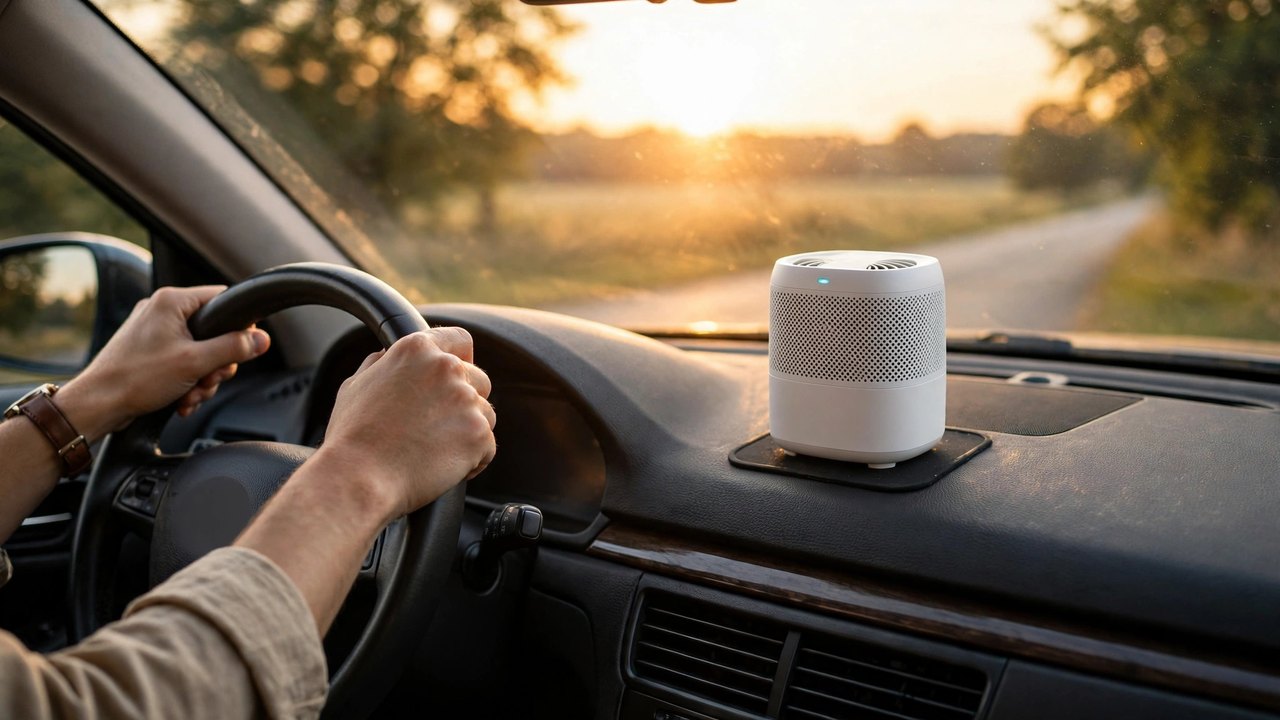
A car cabin is a small, sealed box that sits in traffic, and that simple fact shapes everything about cleaning the air inside it. Exhaust fumes from the vehicles around you, fine particles kicked up from the road, gases released by hot interior plastics and the odors that build up in upholstery all concentrate in a space far smaller than any room in your home. A room purifier with a big clean air delivery rate is wasted here, and a novelty ionizer with no real filter does very little against the particle side of the problem. Choosing among the best air purifiers for car pollution means matching filtration media, power source and mounting style to the way you actually drive.
This guide compares six car-focused purifiers that approach cabin pollution from different angles. At one end sits a premium headrest-mounted unit with ultrafine particle filtration and gas-phase media. At the other end are compact cup-holder models with true HEPA filters that cost far less and ask almost nothing of you beyond a USB port. Between them are a gesture-controlled metal unit from an established electronics brand, a rechargeable personal purifier you can move between vehicles, and an ion generator from a maker known for that technology. None of them replaces your cabin air filter, and none of them turns a car into a clean room. What the right one can do is steadily pull particles and gaseous pollutants out of the small volume of air you breathe on every trip.
Quick verdict
For drivers who spend long hours in heavy traffic and want the strongest filtration the maker lists for a vehicle, the IQAir Atem Car is the standout: its HyperHEPA Plus filter is rated by the maker down to 0.003 microns and it mounts to a headrest so it works on the whole cabin rather than one corner of it. For most commuters, the LUFTRUM C401A is the balanced choice, with a four-stage filter stack, a built-in PM2.5 sensor, automatic start with the ignition and a long power cord that makes placement flexible. The JVC KS-GA100 is the easiest to live with day to day thanks to its gesture controls and included 12-volt USB charger, while the Aucleia KQ-20 covers the cup-holder basics with an H13 HEPA filter and a filter-change reminder at a simple, low-effort level. The Pure Enrichment PureZone Mini is the pick for drivers who swap between cars, because its rechargeable battery removes the cord entirely. The Sharp IG-NX15 takes a different route altogether: it is a Plasmacluster ion generator rather than a HEPA filter unit, suited to drivers who mainly want an ion-based device in the cup holder and understand the trade-offs of that approach.
The products in this guide
IQAir Atem Car
Its HyperHEPA Plus filter as ozone-free filtration rated down to 0.003 microns, and states that the technology captures 99 percent of contaminants
Every product in this guide was checked on its opened Amazon listing and, where available, the maker’s own product material. A model only stayed on the list if its listing showed a live offer for a new unit at the time of checking; listings that had slipped to unavailable or offer-free pages were dropped and replaced. We also required the maker to publish a concrete filtration specification — a named filter type, a particle size or efficiency figure, a clean air delivery rate, or a defined ion technology — rather than vague freshness language. Models whose pages offered no verifiable specification at all were excluded, however popular they were.
Beyond verification, we weighted four things. First, filtration fit for traffic pollution: exhaust brings both fine particles and gases such as nitrogen dioxide and sulfur dioxide, so a particle filter alone and a gas-phase layer together cover more of the problem than either on its own. Second, power practicality: a purifier that starts with the ignition or runs from a battery you can charge at home is one you will actually use, while one that needs unplugging and replugging tends to be left off. Third, placement: headrest mounts serve the whole cabin, cup-holder units serve the front seats, and personal units serve one breathing zone. Fourth, running costs and upkeep, including filter life in hours and whether the device tells you when a change is due. The six picks below were chosen to span those trade-offs rather than to repeat the same cup-holder design six times.
The Atem Car is the most serious piece of filtration hardware in this guide, and it is built around a different idea from the cup-holder models: instead of cleaning the air near the console, it mounts to a headrest and creates a zone of filtered air around the occupants. The maker lists its HyperHEPA Plus filter as ozone-free filtration rated down to 0.003 microns, and states that the technology captures 99 percent of contaminants, filtering particles up to 100 times smaller than those a traditional HEPA filter is rated for. For car pollution specifically, that ultrafine range matters because combustion-related particles from traffic sit at the very small end of the size spectrum, below the 0.3-micron point where standard HEPA ratings are measured.
The maker also lists the Atem Car as addressing gases and odors alongside particles, naming NO2 and SO2 — the two exhaust gases drivers most often ask about — among the pollutants its listing covers, together with pollen, dust, smoke and pet dander. That combination of ultrafine particle filtration plus gas-phase media is rare in vehicle purifiers, most of which offer a HEPA layer and a thin carbon layer and stop there. Bluetooth connectivity lets you adjust the unit from your phone rather than reaching behind a headrest, which is a practical touch given where the device sits. The listing notes the unit weighs 5.3 pounds, runs on vehicle DC power, uses touch controls, and carries a signature-on-delivery requirement, all of which underline that this is a semi-permanent installation rather than a gadget you toss in a bag.
Installation deserves a moment of thought. The maker lists a simple mount that attaches to most headrests in cars, trucks, SUVs and vans, and the compact housing is designed to stay out of the way once fitted. Because it is wired, you should plan the cable route when you fit it rather than letting a cord cross the cabin. Filter replacement is the other ongoing commitment: the HyperHEPA Plus filter is a proprietary consumable, and the three-year limited warranty the maker describes in its listing applies to the unit rather than the filter. None of that is a flaw, but it means the Atem Car rewards a driver who keeps one vehicle for years and drives it daily in polluted conditions, and it is poor value for someone who changes cars often or drives ten minutes a week.
Buy it if: you commute in dense traffic, keep your cars for a long time, and want the finest particle filtration and the gas coverage the maker lists for a vehicle, in a fit-and-forget headrest installation.
Skip it if: you want a portable unit you can move between vehicles, you dislike proprietary filter costs, or your driving is mostly short rural trips where cabin pollution is a minor concern.
The LUFTRUM C401A is the most sensor-driven purifier in this group. The maker lists a four-stage filtration system built around a double-rotating air duct design, and states that its high-efficiency filter layers remove 99.9 percent of harmful gaseous substances such as car exhaust fumes and chemicals emitted by plastic interior materials — the two gas sources that dominate in a modern cabin. A HEPA layer handles the particle side, so the C401A addresses both halves of the traffic-pollution problem rather than treating odor as an afterthought.
What sets it apart in daily use is the built-in PM2.5 sensor. The maker lists a display that shows the cabin’s particle level, which turns an invisible problem into something you can watch falling after you close the windows in a tunnel or behind a diesel truck. The unit also starts and stops automatically with the ignition, so it works on every trip without a routine to remember, and a touch button cycles its three fan speeds when you want manual control. The maker lists fan performance of up to 5300 RPM at 4 watts, a full cabin filtration pass in about six minutes and up to ten passes per hour, with a rated service life of up to 60,000 hours and near-silent operation.
Placement is unusually flexible for a corded unit. The maker lists a 3-meter original power cord, and the unit weighs under a pound by the maker’s description, with a cloth-covered finish the brand describes as Swedish design. That long cord means the purifier can sit on a rear parcel shelf, beside a child seat or on the console rather than being limited to wherever the socket happens to be. The maker also lists the C401A as 100 percent ozone free, meeting California Air Resources Board certification requirements for indoor air cleaning devices and holding ETL certification, which is the kind of third-party paper trail worth looking for in this category. If you want one purifier that monitors, starts itself and covers particles and gases in a family car, this is the most complete package here.
Buy it if: you want visible PM2.5 feedback, automatic ignition-linked operation and a long cord that lets you place the unit where the passengers actually sit.
Skip it if: you prefer a battery-powered unit with no cord to route, or you want the ultrafine 0.003-micron filtration rating the IQAir lists rather than a sensor-led design.
JVC’s KS-GA100 solves the most annoying part of cup-holder purifiers: controlling one without taking your attention off the road. The maker lists motion-activated gesture controls — wave a hand over the top of the unit once for low fan speed, again for maximum, and a third time to switch it off. It is a small feature that changes how the device fits into real driving, because adjusting a tiny touch button on a vibrating console is exactly the kind of fiddly interaction you should not be doing at speed. The aluminum body is the other practical highlight; the maker lists it as the basis for long, rust-free performance, and it feels a step above the all-plastic housings typical of this category.
Filtration is a three-stage system built around an H13 true HEPA filter. The maker lists capture of 99.97 percent of airborne particles down to 0.3 microns, and describes the system as eliminating car and indoor allergens, odors and pollutants. That 0.3-micron figure is the standard HEPA test point, so the claim is directly comparable with other true HEPA models in this guide. Power is straightforward: the maker lists USB power input and includes a 12-volt USB car charger and cable in the box, so the unit is ready to run from the vehicle socket on day one and can also run from a USB source outside the car. The listing puts the weight at 16 ounces, which keeps it firmly in cup-holder territory.
The KS-GA100 is best understood as a front-seat purifier for the driver and front passenger rather than a whole-cabin system. Its fan and filter are sized for that zone, and its gesture control is designed for the person sitting next to it. In a large SUV with three rows, rear passengers are outside its effective working area, and a headrest-mounted or long-cord model will serve them better. Within its intended role, though, it is one of the most thoughtfully designed options here: established brand, metal body, standard HEPA specification, everything needed in the box, and controls you can operate by feel.
Buy it if: you want a cup-holder purifier from an established electronics brand, with gesture controls you can use without looking down and a charger included in the box.
Skip it if: you need filtration for rear-seat passengers in a large vehicle, or you want a sensor display showing cabin particle levels.
The Aucleia KQ-20 covers the cup-holder formula thoroughly: a washable pre-filter in front of an H13 true HEPA filter and an activated carbon layer, sized to drop into a standard cup holder. The maker lists the HEPA stage as capturing 99.97 percent of airborne pollutants including dust, pollen, pet hair, dander and cigarette smoke, and positions the carbon stage for the odors and stale air that build up in a closed cabin. A built-in aromatherapy pad lets you add fragrance if you want it; drivers sensitive to scents can simply leave the pad unused, since the filtration works independently of it.
Two details lift the KQ-20 above the most basic cup-holder units. The first is the filter replacement indicator: the maker lists an alert — a beep with a red flashing light — after 360 hours of use, which removes the guesswork that causes most small purifiers to run for years on a clogged filter. The second is the negative ion function, which the maker lists as releasing negative ions to freshen the cabin air alongside the mechanical filtration. Because the HEPA and carbon stages do the measurable work, treat the ion feature as a secondary extra rather than the reason to buy. The maker lists three adjustable modes with color indication for daily through stronger cleaning, noise of 22 dB, power draw of 3 watts and a weight of just over nine ounces.
That quiet rating and small footprint make the KQ-20 an easy fit for a commuter car, a rideshare vehicle where passenger impressions matter, or a second car that does not justify a premium purifier. The 360-hour filter cycle is shorter than the yearly rhythms many drivers expect, so check the cost and availability of its replacement filters before you commit; a purifier is only as good as the filter supply behind it. Within those limits, it is a complete, honest package: named filter stages, a maintenance reminder, and no requirement to learn an app or a mounting system.
Buy it if: you want straightforward H13 HEPA and carbon filtration in a cup holder, with a filter-change reminder and very quiet operation for daily commuting or rideshare work.
Skip it if: you want a long filter life between changes, a particle sensor readout, or filtration sized for a large multi-row cabin.
The PureZone Mini is the only fully cordless purifier in this guide, and that single fact defines its role. The maker lists a rechargeable lithium-ion battery lasting up to 12 hours on the low setting, with USB charging, so the unit can clean the air in a car with no spare socket, move to a second family vehicle for a weekend trip, or come indoors to a desk between drives. At 9.6 ounces by the maker’s listing, it is light enough that moving it is genuinely effortless rather than a chore you stop bothering with.
Filtration is a two-stage system: the maker lists an activated carbon pre-filter that traps odors and gases as stage one, and a true HEPA filter as stage two, eliminating 99.97 percent of dust, dander, pet hair, pollen, mold spores and smoke. The maker lists its coverage honestly in personal-space terms — cleaning 6 square feet of air in 12 minutes — and that framing is the right way to think about this device. It conditions the air immediately around one occupant rather than exchanging the whole cabin volume, which suits a driver with a long solo commute far better than a family of five in a minivan. Three fan speeds let you trade cleaning rate against noise and battery life, and the adjustable handle allows the unit to stand upright, lie on its side or be removed entirely to fit the space available.
Support is a quiet strength here. The maker lists a five-year manufacturer’s warranty and includes the 2-in-1 filter and a USB charging cable in the box, and its replacement filter is a standard, widely stocked part rather than an obscure cartridge. The trade-offs are the mirror image of its strengths: battery power means a charging habit, the personal-space coverage means modest whole-cabin effect, and the two-stage stack has less gas-phase capacity than the multi-layer car-specific units above. For the driver it suits — one person, one seat, possibly several cars — those compromises are exactly the right ones.
Buy it if: you drive more than one vehicle, lack a free power socket, or want a personal-space purifier that also works at a desk or bedside between trips.
Skip it if: you need whole-cabin filtration for passengers, or you know a rechargeable device will sit uncharged in your glovebox when you need it.
The Sharp IG-NX15 is the outlier in this guide, and it is included deliberately so you can compare approaches rather than assume every car purifier works the same way. It is not a HEPA filter unit. The maker lists it as an ion generator for the car cup holder, equipped with its Plasmacluster NEXT technology, which releases positive and negative ions into the cabin air. Sharp has developed Plasmacluster over many years and fits the technology across a wide range of its air treatment products, so this is a mature implementation of the ion approach rather than a novelty gadget.
Understanding the difference matters for car pollution. A filter physically removes particles from the air that passes through it, and its performance can be expressed as an efficiency at a particle size. An ion generator works on the air in the cabin volume, and its effects are described by the maker in terms of ion density and coverage rather than a filtration percentage. For a driver whose main complaint is stale, stuffy cabin air and lingering smells, and who dislikes the idea of buying replacement filters, an ion unit has a real appeal: there is no HEPA cartridge on a replacement cycle, the cup-holder form is compact — the listing puts the package at 0.43 kg — and the maker lists AC/DC power flexibility with touch controls.
The honest limitation is the particle side of traffic pollution. Fine exhaust particles are the pollutant class where a rated filter gives you a measurable, specified capture performance, and the IG-NX15’s listing does not claim a HEPA-style efficiency figure because that is not how the device works. Drivers who specifically want exhaust particles filtered out of the air should choose one of the filter-based models above. Drivers who understand that distinction and still prefer a filter-free ion device from the maker most associated with the technology will find the IG-NX15 is the credible version of that idea, rather than an unbranded plug-in ionizer with no specifications behind it.
Buy it if: you prefer an ion-based, filter-free device in the cup holder, value Sharp’s long track record with Plasmacluster technology, and are not relying on it for rated particle filtration.
Skip it if: your priority is capturing fine exhaust particles with a specified filter efficiency — choose a HEPA model instead.
Buying guide
Start with the pollutant, not the product. Car pollution is two problems wearing one name. The particle problem — fine dust, soot and the particulate fraction of exhaust — is handled by mechanical filtration, and the specification to look for is a filter rating: true HEPA and H13 describe capture of 99.97 percent at 0.3 microns, while the IQAir’s HyperHEPA rating extends the maker’s claim down to 0.003 microns for ultrafine particles. The gas problem — exhaust gases such as NO2 and SO2, fuel vapors and the volatile compounds released by interior plastics — is handled by sorbent media such as activated carbon and the HESA-type layers in multi-stage car purifiers. A purifier with only a particle filter will leave gas and odor largely untouched; one with only an ionizer or a scented pad gives you no rated particle capture at all. Match the stack to your driving: urban stop-and-go traffic argues for both layers, while occasional highway trips on clean-air days need far less.
Power decides whether you will use it. Ignition-linked automatic start, as the maker lists for the LUFTRUM C401A, is the most foolproof arrangement because the purifier works on every trip with no routine at all. A 12-volt socket unit like the JVC, with the charger included, is nearly as easy. USB-powered models are flexible but compete with phone charging unless your car has spare ports. Battery models like the PureZone Mini remove the cord entirely and move between vehicles, at the cost of a charging habit and a runtime limit the maker lists at up to 12 hours on low. Decide which compromise fits your habits honestly; the best purifier is the one that is switched on.
Placement sets the coverage. Headrest-mounted units treat the cabin as a whole and aim filtered air at the occupants’ breathing zone. Cup-holder units are front-seat devices, convenient and close to the driver. Long-cord units can reach the rear seats, which matters if children ride in the back in traffic every school day. Personal-space units serve one person. None of these is wrong, but buying a cup-holder purifier to protect three rows of passengers is a mismatch no filter quality can fix.
Budget for the filter, not just the device. Filter life in this category is often quoted in hours — 350 hours is a figure the maker lists for one established car purifier line, and the Aucleia in this guide reminds you at 360 hours — which for a two-hour daily commute means roughly two changes a year. Before buying, confirm the replacement filter’s model number, that it is genuinely stocked, and what a year of replacements costs relative to the device. A purifier run on an exhausted filter is moving air, not cleaning it. Also check the basics of fit: measure your cup holder if you choose a cup-holder model, confirm your socket stays powered or switches with the ignition as you expect, and keep the purifier clear of airbag deployment zones and your line of sight.
Keep expectations calibrated. A car purifier treats the air already inside the cabin. It works alongside, not instead of, the habits that limit pollution intake in the first place: using recirculation mode in tunnels and behind heavy vehicles, keeping the cabin air filter on its service schedule, and closing windows in the worst traffic. Combined with those habits, a well-chosen purifier meaningfully reduces the particle and gas load in the small volume of air you breathe on the road, which is exactly the job it is sized to do.
FAQ
Do car air purifiers actually help with exhaust fumes?
They help with the parts of exhaust their filtration is specified for. A true HEPA stage captures the fine particle fraction of exhaust that passes through it, and a sorbent stage such as activated carbon addresses gaseous compounds and odors. Check what the maker lists: models in this guide name exhaust-related targets explicitly, including NO2 and SO2 figures in one established maker’s specifications and exhaust fume coverage in the LUFTRUM’s four-stage description. No cabin purifier seals the car against outside air, so pairing it with recirculation mode in heavy traffic gives the best result.
What is the difference between a HEPA car purifier and an ionizer?
A HEPA purifier pulls cabin air through a filter that physically traps particles, and its performance is expressed as a rated efficiency at a particle size. An ionizer such as the Sharp IG-NX15 releases ions into the cabin instead of filtering the air stream, so it carries no equivalent filtration rating and typically no replacement filter. The two approaches suit different priorities: choose filtration when exhaust particles are your main concern, and an ion device only when you understand and accept that trade-off.
Where is the best place to put a car air purifier?
As close to the occupants’ breathing zone as its design allows, with its intake and outlet unobstructed. Headrest mounts sit behind the front seats and serve the cabin broadly; cup-holder units serve the front seats; a long-cord model can be placed near rear passengers. Keep any unit clear of airbag zones, pedals and your sight lines, and route cords so they cannot tangle with controls or seat rails.
How often do car purifier filters need replacing?
Follow the maker’s stated filter life rather than a calendar guess. Lives in this category are commonly listed in hundreds of hours of use — 350 to 360 hours appears in the specifications and reminder settings of models in this guide — so a heavy commuter may change filters twice a year while an occasional driver goes much longer. A replacement indicator, where fitted, is the most reliable guide; a visible drop in airflow or returning odors are the backup signs.
Can a car purifier replace my cabin air filter?
No. The cabin air filter treats air entering through the ventilation system and is part of the car’s own maintenance schedule. A portable purifier recirculates and cleans air already inside the cabin. The two work on different air paths and complement each other; skipping cabin filter service because you bought a purifier leaves the ventilation intake unprotected.
Are ozone-generating car purifiers a concern?
It is a fair question to ask of any device that uses ions or high-voltage discharge. Look for an explicit statement from the maker: the IQAir in this guide is listed as ozone-free filtration, and the LUFTRUM is listed as 100 percent ozone free and meeting California Air Resources Board requirements for air cleaning devices. If a listing makes no statement about ozone at all, treat that silence as a reason to choose a model whose maker does.
Conclusion
The right car purifier depends on which part of traffic pollution bothers you and how you drive. Choose the IQAir Atem Car for the finest filtration rating and gas coverage in a permanent headrest installation, the LUFTRUM C401A for sensor-guided, ignition-automatic everyday commuting, or the JVC KS-GA100 for gesture-controlled cup-holder convenience from an established brand. The Aucleia KQ-20 keeps the cup-holder formula simple and quiet with a filter reminder, the PureZone Mini frees you from cords entirely for personal-space use across vehicles, and the Sharp IG-NX15 offers a filter-free ion alternative for drivers who prefer that approach with open eyes. Match the filtration stack to your traffic, the power source to your habits and the placement to your passengers, and the purifier you choose will earn its space in the cabin on every trip.
M
Modern Line Home Editorial Team
We compare specs, materials and verified owner reviews before a product earns a spot. Rankings are never paid.
Affiliate disclosure. As an Amazon Associate we earn from qualifying purchases at no extra cost to you. Prices accurate as of the date shown.
House cold even with the heat on? Walk this ordered checklist: thermostat and filter first, then drafts, insulation, leaky ducts and a failing heating system.
Windows fogging up in winter? Check where the fog sits: on the room side it is indoor humidity, outside it is harmless, and between panes the seal has failed.
Store the main firewood pile about 30 feet from your house, off the ground and covered only on top. Compare racks, woodsheds, garages and indoor spots safely.
Place a portable generator outdoors only, at least 20 feet from windows, doors and vents, exhaust pointed away. Exact distances, setup steps and CO rules here.
Keep houseplants in the right winter spot: match window direction to plant type, stay clear of radiators and cold glass, and fix dry air and low light at home.
Mice enter through pencil-width gaps at foundations, pipes, vents, doors and the roofline. Walk this room-by-room winter checklist to find and seal each one.
A winter outage timeline: what to do in the first hour, first night and multi-day outage, with food safety times, pipe protection, heat and CO safety steps.
Size a space heater by room area: 10 watts per square foot at 8-foot ceilings, adjusted for insulation and ceiling height, with full wattage and BTU tables.
Start dripping at about 20 degrees, sooner for exposed pipes. Set a pencil-lead stream, drip the right faucets on both lines, and know when to stop safely.
A fridge needs 800-1,200 starting watts, not just 150-400 running watts. Use the tables to total your fridge plus freezer, lights, furnace fan and more today.











Write Your Review
No reviews yet. Be the first to share your experience!