We independently review everything we recommend. When you buy through our links, we may earn a commission. As an Amazon Associate we earn from qualifying purchases.
Best Vacuum Storage Bags for Winter Comforters & Blankets
Shrink bulky bedding fast with the top vacuum storage bags for winter comforters and blankets, from jumbo cube bags to XXL sets with hand pumps included inside.
Shrink bulky bedding fast with the top vacuum storage bags for winter comforters and blankets, from jumbo cube bags to XXL sets with hand pumps included inside.
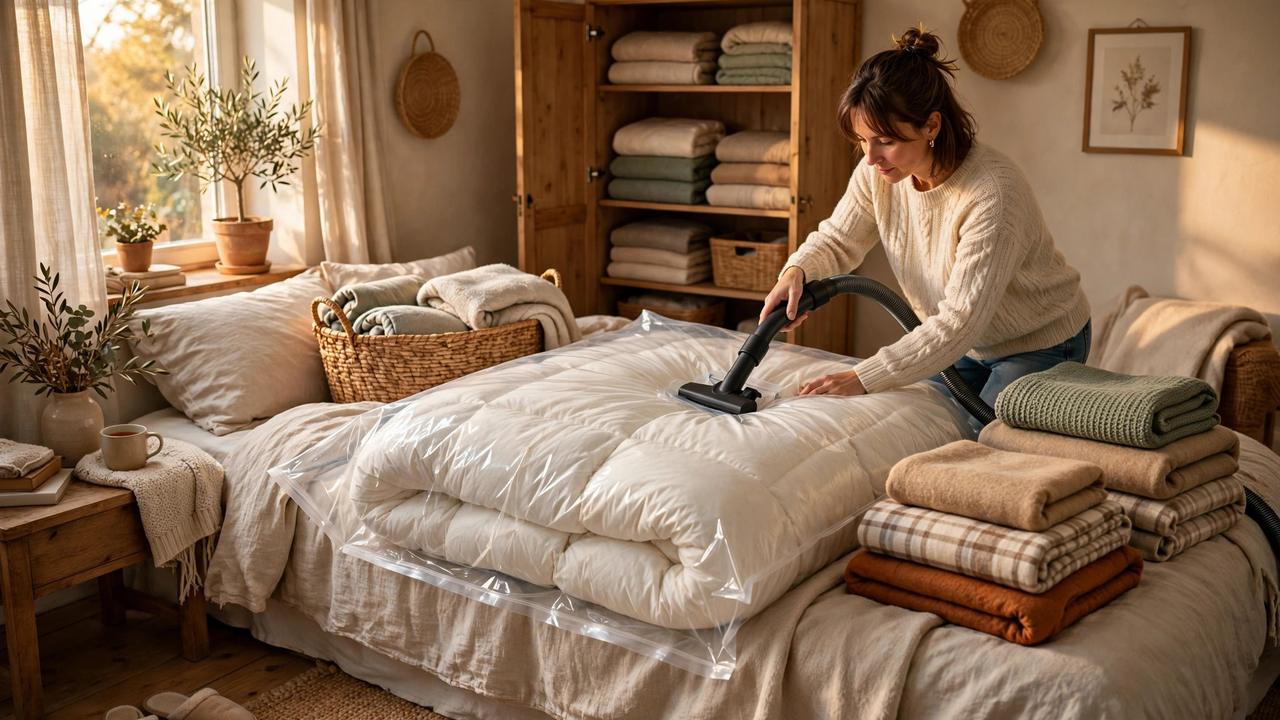
Winter bedding is the bulkiest thing most households own. A single king comforter can swallow an entire closet shelf, a spare duvet eats the top of the wardrobe, and the blankets that rotate in from the guest room never seem to fold down to anything reasonable. When the cold season ends, all of that loft has to go somewhere, and in a small apartment, a crowded linen closet, or a home with one storage bench for the whole family’s bedding, “somewhere” is a genuine problem. That is exactly the problem the best vacuum storage bags for winter comforters and blankets are built to solve: you load the bedding in, seal the bag, pull the air out with a vacuum cleaner or a hand pump, and the pile compresses into a flat, stackable package that takes up a fraction of the shelf space.
Not every bag handles a thick winter comforter well, though. Comforters and heavy blankets are wide, lofty, and surprisingly heavy once compressed, and they punish weak seals. A bag that works beautifully for a stack of T-shirts can slowly re-inflate around a down-alternative duvet if the zipper track is flimsy, the valve leaks, or the film is thin enough to puncture on a closet edge. Size matters just as much: a standard large bag that fits a throw will not swallow a king comforter, and forcing one in stresses the seams exactly where they are most likely to fail. For winter bedding, you want jumbo or extra-large formats, a double-zip closure you can run a slider over more than once, a valve that caps or seals itself, and film thick enough to survive a season pressed against other storage.
This guide compares six vacuum storage bag sets that are genuinely sized and built for winter comforters and blankets. Every pick below is sold new on Amazon US, and every specification quoted comes from the maker’s own listing details, phrased the way the maker lists them. The six sets take different approaches: one uses a self-standing cube shape that behaves like a storage box, one goes extra-extra-large for king bedding, one is a mixed-size wardrobe set for a whole seasonal rotation, and the rest are straightforward jumbo packs at different counts. Read the quick verdict for the short answer, use the comparison table to line the sets up side by side, and then check the individual reviews for the details that decide whether a set fits your bedding and your storage space.
Quick verdict
If you want one set that handles most winter bedding well, start with the TAILI 6 Pack Vacuum Storage Bags, Jumbo Cube. The cube format stands upright on a closet floor instead of slumping into a pile, the maker lists each bag at 31 x 40 x 15 inches with room for three to five quilts, comforters, or duvets, and the cap-free valve works with any regular vacuum cleaner. For the biggest single items, the Cozy Essential 4 Pack XXL Jumbo Vacuum Storage Bags are the pick: at 47.2 x 35 inches per bag, they are the largest in this guide and are listed for king-size comforters. Households packing away an entire family’s winter rotation should look at the GONGSHI Vacuum Storage Bags, 12-Pack, which mixes jumbo, large, medium, and small bags in one box, or the HIBAG Vacuum Storage Seal Bags, 10 Jumbo if every load is bedding-sized. The Amazon Basics Vacuum Compression Storage Bags, Jumbo, 6-Pack are the simple, no-fuss jumbo set, and the Spacesaver Vacuum Storage Bags, Jumbo, 8 Pack give you more jumbo bags per box from one of the longest-running names in this category.
The products in this guide
TAILI 6 Pack Vacuum Storage Bags, Jumbo Cube
The TAILI Jumbo Cube takes a different shape: it is a box-format bag with a gusseted bottom, and the maker lists its dimensions at 31 x 40 x 15 inches
Best for Standing storage on closet floors and shelves
12 bags: 3 jumbo (40 x 30 in), 3 large (32 x 24 in), 3 medium (28 x 20 in), 3 small (24 x 16 in)
Thick plastic, reinforced edges
Double-seal zipper with slider; triple-seal turbo valve
Travel hand pump included
A full seasonal wardrobe and bedding rotation
How we selected
We started with a hard size filter. Winter comforters and blankets are the largest soft items in most homes, so every set in this guide includes bags in jumbo formats or larger, and every set is explicitly listed by its maker for comforters, duvets, quilts, or blankets rather than for clothing alone. Sets that topped out at medium or large travel sizes were left out, however good they might be for suitcases, because a bag you have to force a king comforter into is a bag whose seams will eventually give way.
Next, we checked construction. Each pick uses a double-zip style closure, which gives you two parallel seals to run the slider over instead of one, and each uses a sealed valve design — most use what the makers call a triple-seal turbo valve, while the TAILI cube bags use a cap-free valve that closes without a separate cap to lose. Film material mattered too: five of the six sets are made from PA+PE film, the nylon-and-polyethylene combination makers use when they want puncture resistance and flexibility at the same time, and several listings specifically describe extra-thick or reinforced construction for long-term storage.
We also verified availability the strict way. Every product below was checked on its live Amazon product page, and a set only stayed in the guide if that page showed a live featured offer for a new item at the time of checking. Listings that were unavailable, or that only surfaced used or resale offers, were excluded and replaced. Finally, we spread the picks across genuinely different use cases — cube versus flat bags, the largest XXL format versus standard jumbo, all-jumbo packs versus one mixed-size set — so that the right answer depends on your bedding and your storage space rather than on small differences between near-identical products.
One honesty note: compression claims in this category are maker claims. Where a listing says a set reduces volume by up to 80 percent, we report that as the maker’s figure, because real-world results depend on how lofty the fill is, how completely you vacuum the bag down, and how well the seal is closed. Down and down-alternative fills compress the most; dense wool blankets compress the least. The guidance in the buying guide below will help you set realistic expectations for your own bedding.
Most vacuum bags are flat envelopes, and once you suck the air out they turn into stiff, awkward slabs that slide off shelves and slump against each other in the closet. The TAILI Jumbo Cube takes a different shape: it is a box-format bag with a gusseted bottom, and the maker lists its dimensions at 31 x 40 x 15 inches. That extra depth changes how the bag behaves in storage. The maker says the bags retain their shape and can stand upright on their own, so a compressed comforter ends up as a tidy rectangular block you can line up on a closet floor, stand in a storage bench, or stack two high on a shelf without the whole pile leaning.
Capacity is the other reason this set leads the guide. The maker lists each cube as spacious enough to store three to five quilts, blankets, comforters, or duvets, which makes a six-pack a realistic whole-household solution: one cube for the master bed’s winter set, one for each child’s bedding, one for guest blankets, and spares for throws and seasonal clothing. The bags are made of PA+PE, the material the maker specifies for strength across bedroom storage, moving, and dorm use. Sealing uses a widened bottom opening to load bulky items, then a double-zip closure that you lock by running the included slider clip firmly along the entire track several times.
The valve design is the detail frequent users will appreciate most. The maker describes an upgraded cap-free air valve that works with any regular vacuum cleaner and is three times faster than a traditional valve, with no hand pump required and no separate cap to keep track of between seasons. For winter bedding, which you typically compress once in spring and reopen in autumn, not having to hunt for a loose cap or a pump is a small but real convenience. The trade-offs: the cube shape is designed to stand, so it is less suited to sliding under a low bed frame than a flat bag, and because there is no pump in the box, using these away from home means finding a vacuum at the destination.
Buy it if: you store compressed bedding standing on closet floors, in ottomans, or on open shelves, and you want the compressed result to behave like a storage box rather than a slab.
Skip it if: your storage spot is a shallow under-bed gap, or you need a hand pump in the box for travel and dorm use away from a vacuum cleaner.
Some winter bedding simply does not fit in a standard jumbo bag. A king-size comforter with high-loft fill, a thick weighted-style winter blanket layered over a duvet, or a full queen bedding set with pillows can leave a 40 x 30 inch bag bulging at the seams before you even start vacuuming. The Cozy Essential XXL set exists for exactly those loads: the maker lists each bag at 47.2 x 35 inches, the largest footprint in this guide, and describes the set as easily storing king and queen sized comforters, quilts, duvets, blankets, and pillows, with each bag able to hold a king comforter, one queen bedding combo, or four to six pillows.
Construction follows the proven pattern for this category. The maker lists a premium thick plastic construction with a triple-seal turbo valve and a double-zip seal, designed to hold compression and prevent the slow rebound that plagues cheaper bags, and the bags are reusable across seasons. A hand pump is included for compression away from home, and the valve is also compatible with standard vacuum cleaners for faster air removal, which you will want: a bag this size holds a lot of air, and pumping an XXL bag flat by hand is a workout. With the vacuum doing the work, the maker lists a space saving of up to 80 percent.
Four bags is the smallest count in this guide, and that is the honest trade-off for the size: this is a set for a few very large items, not a whole wardrobe. It suits a household whose storage problem is two king comforters and a set of guest bedding, rather than six bedrooms’ worth of mixed blankets. The compressed bags are also large, flat, and heavy, so plan where they will live — a closet shelf or the top of a wardrobe suits them better than a narrow under-bed space. Used for the loads it is sized for, though, nothing else here swallows a king comforter with this much room to spare, and that room matters, because a bag that is not overfilled seals better and holds its vacuum longer.
Buy it if: your problem items are king-size comforters, full bedding sets, or pillow bundles that strain or overflow standard jumbo bags.
Skip it if: you need to store many separate medium loads, where a higher bag count in standard jumbo sizes will serve you better than four very large bags.
The Amazon Basics set is the straightforward option in this guide: six jumbo bags, all the same size, no mixed assortment to sort through. The maker lists each bag at 40 x 30 inches in jumbo size, providing ample space for comforters, blankets, large bedding, and clothing items, which makes the set a natural fit for the classic spring task of packing away one comforter or blanket set per bag and stacking the results in the linen closet. Because every bag is identical, there is no guessing which size you grabbed, and replacements or additions match what you already own.
The maker lists the bags as made from clear PA+PE films in a rectangular shape, providing improved tear and wear resistance for reusable use, and the transparency is genuinely useful for seasonal storage: you can see at a glance whether the flat slab on the shelf is the winter duvet or the spare blankets, without breaking a seal to check. The closure is a heavy-duty double-zip seal paired with a triple-seal turbo valve, which the maker describes as delivering lasting airtight protection that keeps contents secure from dust, moisture, and pests. Compression is listed at up to 80 percent reduction for bulky textiles, producing compact, stackable packages for under beds, wardrobes, closets, or suitcases.
A hand pump is included for efficient air suction while traveling, and the valve also connects to a standard vacuum cleaner hose for faster deflation — for jumbo bags full of comforter loft, the vacuum route is the one you will use at home. What this set does not do is variety: there are no smaller bags for throws, sweaters, or travel loads, and no cube shape for standing storage. It is a single-purpose bedding set, and for households whose storage problem starts and ends with winter comforters and blankets, that focus is the point. Six bags covers a typical family’s main winter sets with a spare or two left over.
Buy it if: you want one uniform jumbo size for comforters and blankets, clear film so you can identify contents at a glance, and both a hand pump and vacuum compatibility in the box.
Skip it if: you also need smaller bags for clothing, throws, or travel in the same purchase — a mixed-size set will cover more of the seasonal rotation.
Ten jumbo bags is the highest all-jumbo count in this guide, and it changes what a single purchase can cover. Instead of rationing bags between the master comforter and the kids’ duvets, a ten-pack lets you give every winter item its own bag: each bed’s comforter and blanket set, the guest bedding, the spare throws, and still have bags left for seasonal clothing. The maker positions the set for clothes, bed sheets, blankets, and more, and lists a volume reduction of up to 80 percent, which across ten bags adds up to a serious amount of reclaimed closet and shelf space.
The maker lists the bags as made of extra-thick, rip-resistant PA+PE material, and describes the material as airtight and watertight, with a professionally designed double-zip seal and triple-seal turbo valve that expels air and protects contents from dust and dirt during storage. One practical detail stands out: a stay-on clip that helps ensure the bag remains secure during the sealing process. Anyone who has chased a loose slider clip across the floor mid-seal, with a half-closed bag of comforter slowly taking in air, will understand why a clip that stays attached to the bag is more than a gimmick — sealing a jumbo bag properly means running the closure more than once, and the clip needs to be there for every pass.
A portable hand pump is included in the package, and the bags are compatible with any vacuum cleaner, so you can choose speed at home or portability when packing for a move or a trip. The maker also notes the compressed bags can be stored in any orientation, standing upright in a closet or lying flat in a suitcase. The consideration with a ten-pack of one size is storage for the bags themselves and whether you truly have ten jumbo loads; households with only two or three winter sets may find a six-pack covers them, while anyone rotating bedding for a full house will use all ten without thinking about it.
Buy it if: you are packing away bedding for several beds at once and want every load in a full-size jumbo bag, with a stay-on sealing clip and a hand pump included.
Skip it if: you only store two or three winter items, where a smaller-count set meets the need and the extra bags become clutter of their own.
Spacesaver is one of the original names in vacuum storage, and this set is its classic formula in a generous count: eight jumbo bags with a hand pump in the box. The maker lists the bags for compressing comforters, large blankets, duvets, and clothing, with a space saving of up to 80 percent, aimed at maximizing storage in a closet, luggage, or basement. Eight bags sit in a sweet spot for many households — enough for the main beds plus guest bedding and a couple of spares, without committing to the largest packs in the category.
The maker describes the bags as crafted from thick, durable PA+PE material that is rip-resistant and designed for multiple uses, suiting them to both seasonal rotation and one-off jobs like moving house or clearing a dorm room. The seal pairs a double-zip closure with a triple-seal valve, which the maker describes as providing airtight and waterproof protection that keeps items safe from dust, dirt, moisture, and odors during storage — relevant for winter bedding, which often sits untouched in a closet or basement for six months or more and comes out needing to smell like bedding, not like the basement.
Using the bags follows the standard routine: fill, seal the zip, vacuum the air out through the valve, and store. The maker notes the bags are compatible with the included hand pump, and the included pump makes the set self-contained for travel, moving day, or a storage unit where no vacuum is handy — though for eight jumbo bags of comforters, a vacuum cleaner at home will do the heavy lifting far faster. What you do not get here is size variety or a specialty shape: all eight bags are the same flat jumbo format. For buyers who know their loads are comforter-sized and want a proven, uniform set in a higher count, that simplicity is exactly the appeal.
Buy it if: you want a well-known maker’s jumbo bags in an eight-count that covers a family’s main winter bedding, with airtight and waterproof sealing for long off-season storage.
Skip it if: you need standing cube bags for shelf organization or an XXL format for oversized king bedding, both of which are covered by other picks in this guide.
The GONGSHI set is the one to look at when the seasonal changeover involves more than bedding. The box holds twelve bags in four sizes: the maker lists three jumbo bags at 40 x 30 inches, three large at 32 x 24 inches, three medium at 28 x 20 inches, and three small at 24 x 16 inches. The jumbos take the winter comforters and big blankets, the large bags handle spare duvets and pillows, and the medium and small bags absorb the rest of the rotation — throws, sweaters, winter clothing, and linens — so one purchase can empty and organize an entire wardrobe’s worth of cold-weather gear in a single afternoon.
The maker describes the bags as built with industrial-grade thick plastic, combining a four-point sealing system and reinforced edges, and lists a double-seal zipper with slider and a triple-seal turbo valve designed to get the air out and keep it out. The bags are reusable, work with any standard vacuum cleaner, and the set includes a travel pump for use away from home. The maker also positions the seal as shielding fabrics from dust, moths, and humidity during long-term storage, which is the right worry list for items that will sit from spring through autumn.
The trade-off is the mirror image of the all-jumbo sets: only three of the twelve bags are true jumbo size, so a household whose problem is five king and queen comforters will run out of big bags and find the smaller sizes less useful. But for a mixed household load — a couple of comforters, some blankets, and a pile of winter clothes that also need to disappear — the assortment matches reality better than any single-size pack. Think of it as the whole-rotation set: fewer bags per size, but a size for everything in the seasonal pile.
Buy it if: your spring pack-away includes comforters and blankets plus winter clothing, throws, and linens, and you want one box with a bag size for each category.
Skip it if: nearly everything you store is comforter-sized, since only three bags in this set are jumbo and the smaller sizes will sit unused.
Buying guide
Start with size, and be honest about your biggest item. Measure your bulkiest comforter loosely folded, then compare it with the bag sizes the maker lists. Standard jumbo bags around 40 x 30 inches handle most queen comforters and folded blanket sets. King comforters, high-loft duvets, and whole bedding sets with pillows are safer in an XXL format like the 47.2 x 35 inch Cozy Essential bags. Cube bags such as the TAILI set trade footprint for depth — 31 x 40 x 15 inches — and suit standing storage. Whatever size you choose, leave headroom: every maker in this guide warns in its own way that overfilling is the main cause of bags re-inflating, and most bags have a fill line for exactly that reason. A bag filled to about four-fifths gives the zipper an easy close and the seal a fair chance of holding all season.
Judge the seal before the film. Bags rarely fail because the film tears; they fail because air creeps back through the closure or the valve. Look for a double-zip closure you can run a slider clip over two or three times, and a valve that seals in multiple stages — the triple-seal turbo valves used across most of this guide — or a cap-free design that cannot lose its cap, like the TAILI valve. A stay-on slider clip, as on the HIBAG set, makes the repeated passes easier. When you pack, wipe the zipper track clean of lint and fill fibers before the final pass; a single strand of comforter fill across the track is enough to create a slow leak that flattens your work over a few weeks.
Match the pack to the rotation. Count your loads before you count bags. A household storing two comforters and a blanket set is well served by a six-pack of jumbos. A family packing bedding for four or five beds should look at eight- and ten-count jumbo sets, or the cube six-pack where each bag holds several items. If the pack-away also includes winter coats, sweaters, and throws, a mixed-size set like the GONGSHI twelve-pack covers the whole pile in one purchase. Buying count you will not use is not a saving, but running one bag short in the middle of a pack-away weekend is its own annoyance — err one size up in count if you are between options.
Think about how you will remove the air. Every set here works with a standard vacuum cleaner, which is by far the fastest way to flatten a jumbo bag. Hand pumps, included with most sets here, are for travel, dorms, moving day, and storage units — they work, but a jumbo comforter bag holds a lot of air and pumping one flat is slow, physical work. If you know you will mostly compress at home, a set without a pump, like the TAILI cubes, loses nothing. If the bags will travel with you, make sure a pump is in the box.
Store the compressed bags like the flat, heavy objects they become. A compressed king comforter is dense and surprisingly heavy. Put the heaviest bags on the lowest shelf or the closet floor, keep sharp-edged items away from the film, and avoid dragging bags across rough surfaces. Check each bag a day after packing: if it has visibly re-inflated overnight, the seal was not fully closed — reopen, clean the track, reseal, and vacuum again. After that first check, a well-sealed bag should hold for the season. When you reopen in autumn, let bedding air out and loft back up for a day before use, and fold the empty bags flat so they are ready for the next rotation.
FAQ
Can vacuum storage bags damage a comforter if it stays compressed all season?
For most synthetic and down-alternative comforters, a season of compression is fine, and the makers of every set here list comforters and duvets as intended uses. Very lofty natural down can lose some loft if it is compressed hard for many months, so for a premium down comforter, vacuum the bag down only partway rather than fully flat, or store it in the largest bag you have so the fill is less crushed. Always make sure bedding is completely dry before sealing, since a sealed bag traps whatever moisture goes in with it.
How many comforters fit in one jumbo vacuum bag?
It depends on size and loft. The maker of the TAILI cube bags lists each 31 x 40 x 15 inch bag as holding three to five quilts, blankets, comforters, or duvets, while the maker of the Cozy Essential XXL bags lists each 47.2 x 35 inch bag as holding one king comforter, one queen bedding combo, or four to six pillows. For flat jumbo bags around 40 x 30 inches, plan on one queen comforter or a folded set of blankets per bag, and resist stuffing more in — an overfilled bag is the most common cause of seals failing and bags re-inflating.
Do I need a special vacuum cleaner to use these bags?
No. Every set in this guide is listed by its maker as working with a standard vacuum cleaner: you hold the hose over the open valve, run the vacuum until the bag is flat, and close the valve. Most sets also include a hand pump for places where no vacuum is available, and the TAILI set’s cap-free valve is designed to work with any regular vacuum cleaner without a pump at all. A vacuum with a hose attachment is all the equipment the job requires.
Why did my vacuum bag re-inflate after a few days?
Almost always, air is getting back through the closure or the valve. The usual causes are a zipper track that was not run over enough times with the slider, lint or fill fibers caught in the track, a valve cap that was not fully closed, or a bag filled past its fill line so the seal is under constant strain. Reopen the bag, check the track is clean, reseal by running the slider firmly along the full length two or three times, vacuum again, and confirm the valve is shut. If a bag still will not hold, inspect the film for a puncture before blaming the seal.
Can I store vacuum bags under the bed?
Flat jumbo bags are well suited to under-bed storage once compressed, since they end up as thin, wide slabs. Measure your under-bed clearance first, because a compressed comforter bag is still a few inches thick, and low platform frames may not fit one. Cube bags like the TAILI set are designed to stand upright instead and are better used on a closet floor or shelf. Wherever you store them, keep the film away from sharp bed-frame edges and check the bag after the first day to confirm the seal held.
Conclusion
Winter comforters and blankets only feel like a storage crisis because they are mostly air. The right vacuum bags remove that air and keep it out, turning a closet swallowing pile of bedding into a neat stack of flat, labeled packages. For most households, the TAILI 6 Pack Vacuum Storage Bags, Jumbo Cube are the easiest recommendation: the standing cube shape organizes a closet better than flat slabs, each bag holds several bulky items, and the cap-free valve keeps the process simple. Choose the Cozy Essential 4 Pack XXL Jumbo set when your bedding is king-size or unusually lofty, the HIBAG 10 Jumbo or Spacesaver 8 Pack when you have many bedding loads of the same size, the Amazon Basics 6-Pack for a simple uniform jumbo set, and the GONGSHI 12-Pack when the seasonal pack-away includes clothing and linens alongside the bedding. Measure your biggest comforter, count your loads, seal carefully, and the off-season closet problem mostly solves itself.
M
Modern Line Home Editorial Team
We compare specs, materials and verified owner reviews before a product earns a spot. Rankings are never paid.
Affiliate disclosure. As an Amazon Associate we earn from qualifying purchases at no extra cost to you. Prices accurate as of the date shown.
House cold even with the heat on? Walk this ordered checklist: thermostat and filter first, then drafts, insulation, leaky ducts and a failing heating system.
Windows fogging up in winter? Check where the fog sits: on the room side it is indoor humidity, outside it is harmless, and between panes the seal has failed.
Store the main firewood pile about 30 feet from your house, off the ground and covered only on top. Compare racks, woodsheds, garages and indoor spots safely.
Place a portable generator outdoors only, at least 20 feet from windows, doors and vents, exhaust pointed away. Exact distances, setup steps and CO rules here.
Keep houseplants in the right winter spot: match window direction to plant type, stay clear of radiators and cold glass, and fix dry air and low light at home.
Mice enter through pencil-width gaps at foundations, pipes, vents, doors and the roofline. Walk this room-by-room winter checklist to find and seal each one.
A winter outage timeline: what to do in the first hour, first night and multi-day outage, with food safety times, pipe protection, heat and CO safety steps.
Size a space heater by room area: 10 watts per square foot at 8-foot ceilings, adjusted for insulation and ceiling height, with full wattage and BTU tables.
Start dripping at about 20 degrees, sooner for exposed pipes. Set a pencil-lead stream, drip the right faucets on both lines, and know when to stop safely.
A fridge needs 800-1,200 starting watts, not just 150-400 running watts. Use the tables to total your fridge plus freezer, lights, furnace fan and more today.












Write Your Review
No reviews yet. Be the first to share your experience!