We independently review everything we recommend. When you buy through our links, we may earn a commission. As an Amazon Associate we earn from qualifying purchases.
Best Cast Iron Dutch Ovens for Thanksgiving Sides (2026)
Compare six cast iron Dutch ovens for Thanksgiving side dishes, from enameled family-size pots to a pre-seasoned classic, with sizes, lids and oven limits.
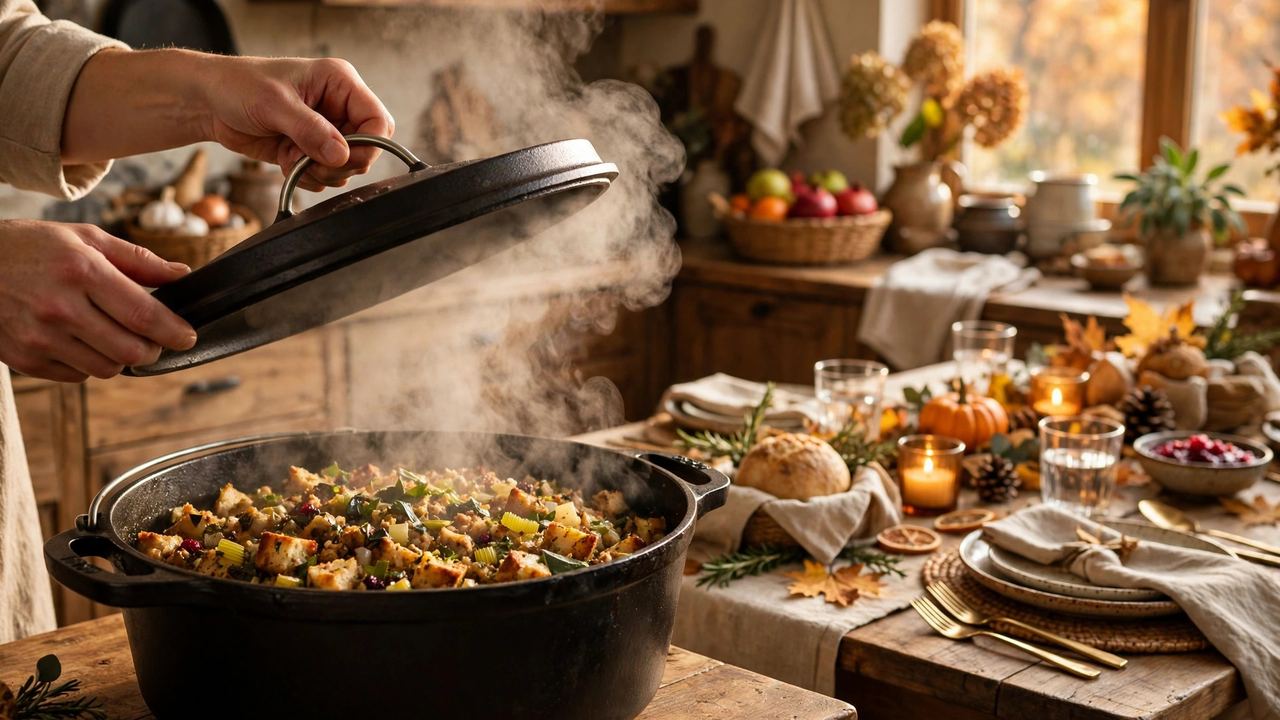
Thanksgiving side dishes ask a lot of a single pot. The green beans want a quick blanch and then a gentle hold. The sweet potatoes want a long, slow bake under a lid so their edges soften and their sugars deepen. The dressing wants a vessel that can start on the stovetop, where the celery and onion pick up color, and then slide straight into a crowded oven without a transfer, a second pan, or a last-minute scramble for counter space. That is exactly the job a cast iron Dutch oven was built for, and it is why so many holiday cooks reach for one long before they reach for anything lighter. This guide to the best cast iron dutch ovens for thanksgiving side dishes under $300 compares six real pots that are sold new today, five of them enameled and one of them pre-seasoned bare iron, so you can match a pot to the sides you actually serve, the oven you actually own, and the way your family actually gathers.
A Dutch oven earns its place on Thanksgiving for three practical reasons. First, cast iron holds heat. When the oven door opens for the third time in ten minutes because someone is checking a pie, a thin pot loses its temperature quickly, while a heavy iron pot keeps cooking at a steadier pace. Second, the same pot works on the stovetop and in the oven, which matters when burner space is the scarcest resource in the kitchen. A side can be started where there is room and finished where there is heat. Third, a good Dutch oven goes to the table. Enameled iron in a deep red, a matte navy, or a soft latte looks at home next to serving platters, and it keeps a side warm through grace, through second helpings, and through the long, happy drift toward dessert. None of that requires anything exotic. It requires the right capacity, a lid that fits well, handles you can grip with oven mitts, and an oven temperature rating that covers the recipes on your menu.
The six picks below were chosen for side dishes first, not for main courses. A Thanksgiving turkey or a large roast has its own pan, so these pots are sized for the food around it: mashed and scalloped potatoes, braised greens, glazed carrots, roasted Brussels sprouts, cornbread dressing, baked macaroni, candied sweet potatoes, and the gravy-adjacent drippings that benefit from a heavy base. Capacities run from five quarts to six and a half quarts, which is the useful band for sides. Smaller than that and a family batch crowds the pot and steams instead of browning. Larger than that and the pot becomes hard to lift, hard to store, and hard to fit beside everything else in a holiday oven. Every pick is round, every pick includes a lid, and every pick is described only with details its maker lists, so what you read here is what you can confirm on the product page before you buy.
Quick verdict
If you want one answer, start with the Lodge Essential Enamel Cast Iron Dutch Oven in the six-quart size. It covers the widest range of Thanksgiving sides, it is listed for use on gas, electric, ceramic, and induction cooktops as well as in the oven, and its size sits right in the middle of the group, big enough for a family batch of dressing and small enough to share an oven rack with a casserole dish. If your menu leans toward the largest batches, the Tramontina Bestow in six and a half quarts gives you the most room in this group, with a self-basting style lid design and a hand-wash-only enamel finish that suits cooks who like to serve straight from the pot. If you prefer the simplest possible specification sheet, the Amazon Basics six-quart pot keeps things plain: enameled iron, a fitted lid, looped handles, and a clear hand-washing instruction.
For a slightly smaller household, or for a cook who plans to run two sides at once in two pots, the two five-quart enameled options split the difference in different ways. The Cuisinart Chef’s Classic brings wide handles, a porcelain enamel interior, and broiler use to the table, which suits gratins and toppings that want a final blast of top heat. The Crock-Pot Artisan counters with a self-basting lid that redirects moisture back onto the food, a feature braised greens and slow-cooked roots appreciate. And if you want bare iron with no enamel at all, the Lodge five-quart pre-seasoned Dutch oven is the traditionalist pick: seasoned with vegetable oil, fitted with dual loop handles, and ready for the oven, the stove, the grill, or a campfire when the holiday moves outdoors. There is no wrong answer in this group. There is only the pot whose size, finish, and care routine fit your kitchen best.
The products in this guide
Lodge Essential Enamel Cast Iron Dutch Oven, 6 Quart, Caribbean Blue
Lodge is the name most American cooks associate with cast iron, and this enameled six-quart pot is the company’s answer for cooks who want iron’s
Read the table as a starting map, not a ranking carved in stone. Capacity is the first filter because it decides which recipes fit without crowding. The oven limit is the second filter because a few holiday bakes, especially bread-style dressings and high-heat roasted vegetables, run hotter than others, and the lid knob and enamel must be rated for the temperature you plan to use. Finish is the third filter, and it is mostly about care and about acidic foods. Enameled iron does not need seasoning and does not react with tomato-based or vinegar-kissed sides, while bare seasoned iron asks for a little more attention after washing and rewards it with a surface that builds character over years of holidays. With those three filters in mind, the detailed picks below explain who each pot suits, and just as importantly, who should skip it.
How we selected
Selection started with the category itself. Every product in this guide is a cast iron Dutch oven as its maker lists it, with a lid, sold new on Amazon in the United States. Stainless stockpots, aluminum roasters, ceramic bakers, and slow cooker inserts were all set aside, however good they may be at other jobs, because the keyword asks for cast iron and because iron’s heat retention is the whole point for side dishes that need to stay warm at the table. Each candidate then had to be verified on opened pages: a maker product page, an Amazon listing surfaced with full product details, or both. Products whose specifications could not be confirmed that way were excluded entirely rather than described with guesswork.
Capacity came next. Thanksgiving sides are batch food. A five-quart pot handles a generous batch of mashed potatoes, a standard dressing recipe, or a braise for a smaller gathering. A six-quart pot adds headroom for doubling a recipe or for leafy greens that start voluminous and cook down. The six-and-a-half-quart Tramontina is the ceiling here because anything larger starts to crowd a standard home oven when it shares space with other dishes, which on Thanksgiving it always does. Weight was considered alongside capacity. These are heavy pots even when empty, with listed weights in the thirteen-pound range for the larger enameled models, so handles matter. Every pick has two side handles, and the buying guide below returns to the question of lifting a full, hot pot safely.
Oven ratings were taken exactly as makers list them, and they are not all the same. Most of the enameled pots here are listed to five hundred degrees Fahrenheit. The Tramontina Bestow is listed to four hundred fifty degrees, which still covers the great majority of side dish recipes, from slow braises to roasted roots, but is worth knowing if your dressing recipe starts with a very hot oven. The Cuisinart is listed as oven and broiler safe without a single headline number in its bullet points, so this guide describes it that way rather than inventing a figure. Cooktop compatibility was checked the same way. Induction matters in more kitchens every year, and most of these makers list induction among the compatible cooktops, but the Amazon Basics listing does not name cooktops in the details reviewed, so this guide does not claim them for that pot. Confirm the current listing for your exact cooktop before you buy.
Finally, availability was treated as a gate, not an afterthought. A pick only counts if its Amazon page shows a live offer for a new pot. A beautiful specification sheet means nothing if the pot cannot actually be ordered for the holiday. Prices were deliberately not used as a selection filter beyond the level named in the keyword, and no prices appear in this guide, because holiday pricing moves constantly and the right pot at the wrong size is still the wrong pot. What follows is what each pot is, what its maker lists, and which Thanksgiving cook it fits.
Lodge is the name most American cooks associate with cast iron, and this enameled six-quart pot is the company’s answer for cooks who want iron’s heat without seasoning or rust worries. The maker lists a six-quart capacity, a porcelain enamel finish over cast iron, and oven safety up to five hundred degrees Fahrenheit, with a stainless steel lid knob listed to the same temperature. The pot is listed for gas, electric, ceramic, and induction cooktops as well as the oven, which makes it the most flexible stovetop-to-oven mover in this group. For Thanksgiving, that flexibility shows up in the first hour of cooking: onions and celery for dressing can sweat on whatever burner is free, the pot can finish in the oven beside the sweet potatoes, and the finished dressing can go straight to the table in the same vessel, still warm, in a blue that sits comfortably among holiday serving pieces.
The details suit side dishes specifically. Six quarts is the sweet spot for a family batch of scalloped potatoes or a doubled recipe of braised greens, with enough headroom that the food roasts and simmers rather than steaming in its own crowding. The lid fits tightly to seal in moisture, which is what a slow side wants, and the dual loop handles give two secure grip points for mitts when the pot comes out of the oven full and heavy. The maker lists the enamel as chip resistant and easy to clean, and while the pot is described as dishwasher safe, Lodge recommends hand washing with warm soapy water to keep the enamel looking its best, advice worth following for a pot you plan to serve from. The maker also notes the enamel surface does not react with food, so a vinegar-brightened braise of greens or a tomato-based side will not pick up off flavors from the pot.
Buy it if: you want one Dutch oven that handles nearly every Thanksgiving side, you cook on induction or a mix of cooktops, or you want the highest listed oven rating in this group paired with a true family size. Skip it if: lifting a heavy enameled pot is a concern even before food goes in, or if you cook sides for only two or three people and a five-quart pot would be easier to handle, store, and wash.
The Tramontina Bestow is the largest pot in this guide, and for the cook who hosts the big Thanksgiving, that extra half quart over the six-quart models is not a rounding error. It is the difference between a batch of dressing that fits comfortably and one that rides at the rim, between greens that can be added in two handfuls instead of four, and between a sweet potato casserole that bubbles under its lid and one that bubbles over it. The maker lists the Bestow at six and a half quarts, built from HT150 cast iron alloy for heat retention, with a porcelain enamel finish inside and out and a light-colored interior that makes it easy to watch browning as a base of vegetables takes on color. The listed weight is just under fourteen pounds, so plan on two hands and good mitts every time it moves.
The maker lists this pot as oven safe up to four hundred fifty degrees Fahrenheit, with a cast stainless steel knob, and compatible with gas, electric, and induction stovetops. Four hundred fifty degrees covers the overwhelming majority of Thanksgiving side recipes: braises, gratins, roasted roots, baked beans, and dressings all live comfortably at or below that line. It only becomes a planning point if a recipe in your rotation calls for a hotter oven, in which case one of the five-hundred-degree pots in this guide is the better match. Care is hand wash only, which is standard for enameled iron you want to keep glossy, and the latte finish with its contrasting knob is designed to look composed on the table, so the pot can carry a finished side from oven to serving without a transfer dish. Tramontina describes the Bestow line as part of its gourmet collection, and the lid design includes basting ridges that collect and redirect moisture onto the food, a quiet advantage for slow sides that should stay moist over a long, low cook.
Buy it if: you host the largest gathering in this guide’s audience, you regularly double side recipes, or you want the most headroom for bulky vegetables and leafy greens. Skip it if: your signature sides bake hotter than its listed oven limit, your oven is compact and already crowded on Thanksgiving, or a pot of this weight and footprint will be hard to store the other three hundred sixty-four days of the year.
The Amazon Basics entry makes its case with simplicity. The listing describes a six-quart round Dutch oven in matte navy, made of heavy-duty cast iron with a smooth enamel finish, listed as oven safe up to five hundred degrees Fahrenheit. The listed capacity is described as serving four to six people, which maps neatly onto a family Thanksgiving side: a full batch of mashed potatoes, a pot of soup to start the meal, or a braise that needs to hold warm while the rest of dinner catches up. Looped side handles and a fitted lid that traps heat and moisture round out a specification sheet that is short, clear, and focused on the fundamentals rather than on extra features.
For holiday cooking, fundamentals are often enough. The enamel surface means no seasoning routine before the big day and no worry about rust if the pot sits with leftovers in the refrigerator overnight. The maker lists the pot at just over thirteen pounds and gives dimensions of roughly thirteen and a half inches by eleven inches, so it fits a standard oven and a standard storage shelf without drama. Care instructions are explicit: hand wash only, in warm soapy water, avoiding metal utensils and citrus-based cleaners. That is a slightly stricter routine than some rivals list, and it is worth respecting, because the enamel is the surface you will be serving from for years of holidays. One honest note: the listing details reviewed for this guide do not name specific cooktop types for this pot, so if you cook on induction, confirm compatibility on the current product page before ordering rather than assuming it.
Buy it if: you want a straightforward six-quart enameled pot with a high listed oven rating, a calm matte finish that suits a holiday table, and a simple care routine you will actually follow. Skip it if: induction compatibility is essential and unconfirmed for your kitchen, or if you want a self-basting lid design or broiler-specific features that other picks in this guide emphasize.
Cuisinart’s Chef’s Classic is the gratin specialist of this group. The maker lists a five-quart round covered casserole in cardinal red, with cast iron construction for heat retention and even heat distribution, a porcelain enamel exterior, and a porcelain enamel interior that the maker says does not impart flavors or absorb odors. That interior matters on Thanksgiving, when the same style of pot might hold a savory dressing one day and a sweet potato bake the next, with no lingering taste carried between them. The maker lists the pot as safe for induction, halogen, glass and ceramic, gas, and electric stovetops, and as oven and broiler safe, which is the detail that sets it apart: a macaroni and cheese or a scalloped potato gratin can finish under the broiler for a browned top without changing pans at the busiest moment of the day.
At five quarts, this is a side dish pot in the truest sense. It is sized for a standard casserole recipe, a batch of glazed carrots, a pot of braised cabbage, or a dressing for a smaller table, and its smaller footprint lets it share an oven rack more easily than the six-quart models when the bird and two other dishes are all competing for heat. Wide cast iron handles are a genuine ergonomic plus when the pot is full and the kitchen is crowded, giving mitts more to hold onto during the short, critical trip from oven to trivet. The maker lists the pot as dishwasher safe for convenient maintenance, which some holiday cooks will welcome after a long day, though hand washing remains the gentler choice for any enamel finish. Cuisinart backs the line with a limited lifetime warranty, as the maker lists it, which suits a purchase meant to serve many Thanksgivings.
Buy it if: your favorite sides finish under a broiler, you cook for a smaller gathering, or you want wide handles and an enamel interior that will not carry flavors between a savory and a sweet side. Skip it if: you routinely double recipes or cook for a large table, where the five-quart capacity will crowd, or if you need a single published oven temperature figure and prefer a pot whose maker states one outright.
This is the only bare iron pot in the guide, and it exists for the cook who believes Thanksgiving should smell faintly of a well-used kitchen. Lodge lists this five-quart Dutch oven as pre-seasoned with one hundred percent natural vegetable oil, with dual loop handles and a matching iron lid. There is no enamel to chip and no coating to protect, just iron that improves with use as its seasoning builds. The maker lists it for use in the oven, on the stove, on the grill, and over a campfire, which gives it a second life that none of the enameled pots claim: the same pot that braised your holiday greens in November can bake camp bread in July. Lodge also lists this line as made in the United States, a detail that matters to many buyers of classic cast iron.
For side dishes, bare iron brings one clear strength and one clear responsibility. The strength is searing and browning. A seasoned iron surface takes a hard sear on Brussels sprouts or on the base vegetables for a dressing, and it tolerates metal utensils and high, direct heat without the care an enamel surface requires. The responsibility is moisture and acid management. Long, wet, acidic braises are harder on seasoning than on enamel, and the pot should be dried promptly and lightly oiled after washing rather than left to soak in a busy holiday sink. None of that is difficult, but it is a routine, and Thanksgiving is the worst day of the year to discover you do not enjoy a routine. Choose this pot because you like the ritual, and it will reward you for decades. Choose it only because it looks traditional, and one of the enameled picks will probably serve you better.
Buy it if: you prefer bare seasoned iron, you want a pot that also works on a grill or over a campfire, or you enjoy maintaining seasoning as part of cooking. Skip it if: your signature sides are long, acidic braises, you want to soak or dishwasher the pot after a long day, or you prefer the serve-at-the-table color and zero-seasoning care of enameled iron.
The Crock-Pot Artisan is built around its lid. The maker, Gibson, lists a self-basting lid that redirects moisture back onto the food, creating a continuous basting environment while a side cooks. For Thanksgiving, that design speaks directly to the dishes that dry out when a meal runs long: braised greens waiting on a late turkey, root vegetables holding in a low oven, a dressing that needs to stay moist from its finish time until the moment everyone finally sits down. The maker lists the pot at five quarts, round, in matte navy blue, with an enameled cast iron body that distributes and retains heat, wide handles for a secure hold when serving from oven to table, and an oven rating up to five hundred degrees Fahrenheit.
Compatibility is broad. The maker lists the Artisan for use in the oven and on all cooktops, including induction, so it can start a side wherever there is a free burner and finish wherever there is free oven space, the essential Thanksgiving shuffle. Care is hand wash only, as the listing states, and the enamel finish means no seasoning routine before the holiday and no flavor carryover between dishes. At five quarts it is a true side dish size, well matched to a standard batch rather than a doubled one, and its footprint leaves room in the oven for the rest of the menu. The matte finish gives it a quieter table presence than the glossy reds in this group, which some hosts will prefer when the table is already full of color from the food itself.
Buy it if: your sides braise, simmer, and hold for a while before serving, you want a self-basting lid working in your favor, or you cook on induction and want that compatibility stated by the maker. Skip it if: you need six quarts or more for doubled batches, or if you prefer a glossy finish and a pot from a maker whose entire identity is cast iron cookware.
Buying guide
Start with the menu, not the pot. Write down the sides you serve every year, the ones nobody allows you to change, and estimate their volumes honestly. A standard dressing recipe, a family batch of mashed potatoes, or a casserole for eight each fit comfortably in five quarts. Doubling any of them, cooking greens that start as a mountain, or making soup for the whole table pushes you to six quarts or the six and a half of the Tramontina. Buying one size too small is the most common Dutch oven mistake, and Thanksgiving exposes it cruelly, because a crowded pot steams where it should brown and simmers unevenly where it should bubble gently throughout. When in doubt between two sizes for a holiday pot, choose the larger one and accept the extra storage space it asks for.
Then check your oven, literally. Measure the rack space a pot will share on the day. A round six-quart Dutch oven is roughly eleven inches across the body and wider across its handles, and it needs headroom for its lid knob when the rack above is also in use. Compact ovens and double-oven ranges with a smaller upper cavity reward the five-quart picks, which leave breathing room for a second dish. Also check the rack itself: a full Dutch oven is a serious load, and it should sit on a sturdy rack positioned so you can slide the pot out far enough to lift it with both hands, rather than reaching deep into a hot cavity at an awkward angle.
Oven temperature rating deserves a careful look because it is the specification cooks most often assume instead of reading. Most picks here are listed to five hundred degrees Fahrenheit. The Tramontina Bestow is listed to four hundred fifty degrees, which covers braises, gratins, roasted vegetables, baked beans, and nearly every dressing recipe, but not the hottest bread bakes or high-heat roasting methods. The rating that matters includes the lid and its knob, not just the pot body, so use the figure the maker lists for the complete piece. If your Thanksgiving includes a cornbread baked at high heat in the same pot, or a final uncovered blast for crisp edges, match the recipe to the rating before the holiday, not during it.
Decide honestly between enamel and bare iron. Enameled pots, five of the six here, ask for no seasoning, tolerate acidic and wine-based sides without reacting, go to the table looking finished, and clean up with soap and water, with most makers recommending hand washing to protect the finish. Their limits are gentleness: avoid metal utensils where the maker says so, avoid citrus cleaners where the maker says so, and do not treat the enamel like bare iron over a campfire. Bare seasoned iron, represented here by the Lodge five-quart, reverses the trade. It sears beautifully, shrugs off metal tools and open flame, and can last generations, but it wants prompt drying, a light coat of oil after washing, and some restraint with long acidic simmers. Neither choice is more authentic. They are simply different care contracts, and the right one is the one you will keep happily.
Handles and lids are the quiet specifications that decide whether you love a pot on its busiest day. Look for two wide loop handles that fit oven mitts without a squeeze, because you will lift this pot full, hot, and heavy, probably while someone is standing exactly where you need to walk. A lid should sit securely, feel substantial, and ideally help the food, whether that is a tight moisture seal or a self-basting design that returns condensation to the dish. A knob should be listed for the same oven temperatures as the pot itself. Finally, think about storage and the rest of the year. A Thanksgiving Dutch oven that also makes Sunday soup, winter chili, and weeknight braises earns its shelf space. Every pick here is a year-round pot that happens to shine on the holiday, which is exactly what a considered purchase should be.
FAQ
What size Dutch oven is best for Thanksgiving side dishes?
For most families, six quarts is the most versatile size, holding a doubled dressing recipe, a large batch of mashed or scalloped potatoes, or greens that cook down from a big pile. Five quarts suits standard single-batch sides and smaller gatherings, and it fits crowded ovens more easily. Six and a half quarts, the largest size in this guide, suits hosts who regularly double recipes or cook several bulky vegetables at once.
Can a cast iron Dutch oven go from the stovetop to the oven?
Yes, that is one of its main advantages, and every pick here is listed for both stovetop and oven use. A side can be started on a burner, where aromatics and vegetables pick up color, and finished in the oven without changing pans. Always confirm the oven temperature your recipe needs against the limit the maker lists for the specific pot, including its lid and knob, and use mitts for every move, since the handles heat through completely.
Is enameled or bare cast iron better for holiday sides?
It depends on the sides and on the cook. Enameled iron needs no seasoning, does not react with acidic dishes, serves attractively at the table, and cleans up simply, which is why five of the six picks here are enameled. Bare seasoned iron sears exceptionally well and tolerates grills and campfires, but it asks for prompt drying and light oiling after washing. Cooks who want the lowest-maintenance holiday usually choose enamel; cooks who enjoy maintaining iron usually choose bare.
How do I keep side dishes warm in a Dutch oven at the table?
Cast iron retains heat well, so a side served in its lidded pot stays warm far longer than one transferred to a thin serving dish. Keep the lid on between servings, set the pot on a trivet to protect the table, and return it to a low oven between courses if the meal runs long, staying within the temperature the maker lists. Avoid placing a hot pot on a cold stone counter, since sudden temperature changes are hard on any cooking surface, enamel included.
Can I cook acidic sides like tomato-based dishes in cast iron?
In an enameled pot, yes. The makers of the enameled picks here describe enamel as a non-reactive surface, so tomato, wine, and vinegar-based sides will not pick up flavors from the iron beneath. In a bare seasoned pot, shorter acidic cooking is generally part of normal use, but long acidic simmers are harder on the seasoning layer. If acidic braises are central to your menu, an enameled pick is the simpler choice.
How should I clean a Dutch oven after Thanksgiving dinner?
Follow the maker of your specific pot. Most enameled makers here recommend or require hand washing in warm soapy water, and some advise against metal utensils and citrus-based cleaners; let the pot cool before washing, and use a soft brush or sponge on the enamel. The bare iron Lodge should be washed, dried promptly and thoroughly, and lightly oiled to protect its seasoning. None of these routines is long, and doing them the same evening keeps the pot ready for the leftovers that make the next day almost as good as the holiday.
Conclusion
A Thanksgiving table is built on side dishes, and a cast iron Dutch oven is the pot those dishes quietly depend on. The six picks in this guide cover the real range of holiday needs: the Lodge Essential Enamel as the flexible all-rounder, the Tramontina Bestow for the largest batches, the Amazon Basics for plain family-size fundamentals, the Cuisinart Chef’s Classic for broiler-finished gratins at a smaller scale, the pre-seasoned Lodge for bare-iron traditionalists, and the Crock-Pot Artisan for braised sides under a self-basting lid. Choose by capacity first, by oven rating second, and by the care routine you will genuinely keep third. Do that, and the pot you buy this year will still be carrying dressing, greens, and sweet potatoes to the table, warm and unhurried, at Thanksgivings many years from now.
M
Modern Line Home Editorial Team
We compare specs, materials and verified owner reviews before a product earns a spot. Rankings are never paid.
Affiliate disclosure. As an Amazon Associate we earn from qualifying purchases at no extra cost to you. Prices accurate as of the date shown.
House cold even with the heat on? Walk this ordered checklist: thermostat and filter first, then drafts, insulation, leaky ducts and a failing heating system.
Windows fogging up in winter? Check where the fog sits: on the room side it is indoor humidity, outside it is harmless, and between panes the seal has failed.
Store the main firewood pile about 30 feet from your house, off the ground and covered only on top. Compare racks, woodsheds, garages and indoor spots safely.
Place a portable generator outdoors only, at least 20 feet from windows, doors and vents, exhaust pointed away. Exact distances, setup steps and CO rules here.
Keep houseplants in the right winter spot: match window direction to plant type, stay clear of radiators and cold glass, and fix dry air and low light at home.
Mice enter through pencil-width gaps at foundations, pipes, vents, doors and the roofline. Walk this room-by-room winter checklist to find and seal each one.
A winter outage timeline: what to do in the first hour, first night and multi-day outage, with food safety times, pipe protection, heat and CO safety steps.
Size a space heater by room area: 10 watts per square foot at 8-foot ceilings, adjusted for insulation and ceiling height, with full wattage and BTU tables.
Start dripping at about 20 degrees, sooner for exposed pipes. Set a pencil-lead stream, drip the right faucets on both lines, and know when to stop safely.
A fridge needs 800-1,200 starting watts, not just 150-400 running watts. Use the tables to total your fridge plus freezer, lights, furnace fan and more today.












Write Your Review
No reviews yet. Be the first to share your experience!