We independently review everything we recommend. When you buy through our links, we may earn a commission. As an Amazon Associate we earn from qualifying purchases.
Best Pool Handheld Vacuums for Spas: 6 Cordless Picks
Compare the best pool handheld vacuums for spas, from the Pool Blaster Catfish Gen 2 to the Kokido Xtrovac 110, with runtimes, poles and filters all compared.
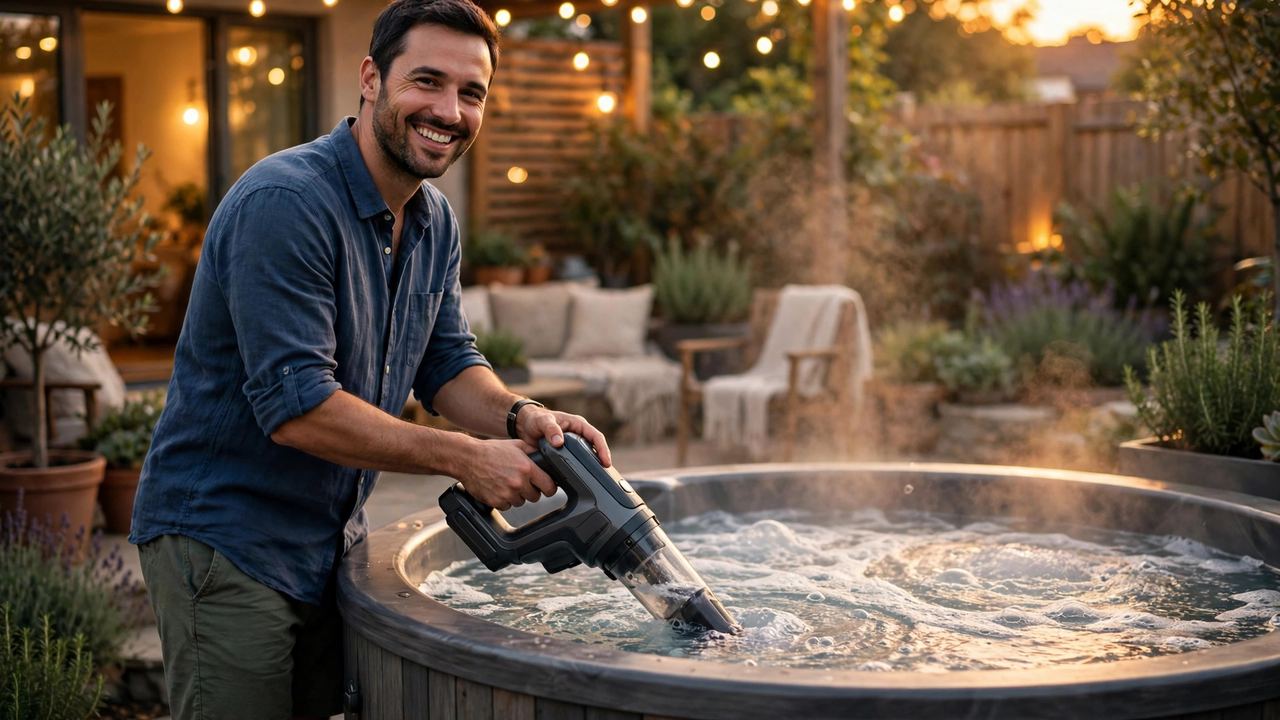
A spa collects debris in a way a full-size pool never does. The water is shallow, the seats and footwell create sheltered corners, and every leaf, grain of sand and bit of grit that blows in settles exactly where bathers put their feet. A robotic cleaner is too bulky for most hot tubs, a full-size pool vacuum head is clumsy on contoured seats, and skimming by hand with a net does nothing for the sand sitting on the floor. That is why the best pool handheld vacuums for spas are compact cordless units: small enough to work around benches and jets, light enough to use one-handed from the edge of the tub, and fitted with fine filtration that traps grit instead of stirring it back into suspension. This guide compares six cordless handheld vacuums that are genuinely suited to spa and hot tub work, explains how they differ on runtime, reach, filtration and debris type, and walks through the buying decisions that matter most in a small, warm body of water.
Quick verdict
For most spa owners, the Water Tech Pool Blaster Catfish Gen 2 is the strongest all-round pick: it was designed specifically for spas and hot tubs, pairs an 8-inch omni-directional head with a multilayer filter bag that catches sand and silt, and runs for up to 45 minutes per charge. If you want a complete kit with its own long pole in the box, the Kokido Xtrovac 110 adds a 72-inch aluminum pole, two brush heads and a 60-minute runtime. The Intex Rechargeable Handheld Pool Vacuum (28620EP) is the natural choice for Intex PureSpa owners, with a 94-inch telescoping shaft and USB charging. The HTH Cordless Handheld Vacuum 91028 stands out for its pivoting head and a pole that reaches water up to 8 feet deep. Owners who also spot-clean a pool should look at the Water Tech Pool Blaster Max, the most powerful unit here, while the Kokido Telsa 5 is the simple, lightweight option for small spas and above-ground pools up to 18 feet.
The products in this guide
Water Tech Pool Blaster Catfish Gen 2
The Catfish Gen 2 is the only vacuum in this roundup that Water Tech positions first and foremost as a spa and hot tub cleaner, and that focus shows
Every product in this guide had to meet the same baseline before it was considered. First, it had to be a true handheld vacuum: a self-contained, battery-powered unit with its own motor and debris chamber, not a hose-fed head that depends on the spa’s circulation pump and not a robotic cleaner that drives itself. Second, it had to be sized and shaped for spa work, meaning a head narrow enough to run along bench seats and into footwells, and a body light enough to maneuver in water that is often no more than waist deep. Third, it had to be sold as a current model by a recognizable pool-care brand with a published specification, so that claims about runtime, water depth and filtration could be checked against what the maker lists rather than repeated from marketplace copy.
Within that shortlist, we compared the factors that decide whether a handheld vacuum actually gets used. Runtime matters because a spa clean is usually a quick job done often, and a vacuum that is always flat will be skipped. Filtration matters more in a spa than in a pool, because the debris load is dominated by fine material — sand tracked in on feet, silt, and body oils that bind grit together — and a coarse screen simply pushes it around. Reach matters because many owners clean from outside the tub, standing on the deck, so pole length and whether a pole is included at all changes the real cost and convenience. Finally, we weighed how each unit handles the spa environment itself: warm water, chemical exposure, and storage in a small equipment area. Products that could not be verified against an opened listing and a maker specification were left out entirely.
The Catfish Gen 2 is the only vacuum in this roundup that Water Tech positions first and foremost as a spa and hot tub cleaner, and that focus shows in the details. The maker lists an 8-inch omni-directional vacuum head fitted with brushes and bumpers, a combination that suits acrylic spa shells well: the brushes loosen grit that has settled into the slight texture of the footwell, while the bumpers keep the head from scuffing the surface as it rolls over seat contours. Because the head moves in any direction without needing to be lifted and re-aimed, it is easy to work around the molded shapes, jet housings and steps that make up most of a modern hot tub interior.
Filtration is the other half of the appeal. The Catfish Gen 2 ships with the maker’s Xtreme Multilayer Filter Bag, which the maker lists as the improved-filtration option for fine material. In a spa, that means sand, silt and the small organic particles that cloud warm water are captured in the bag rather than blown back through the vacuum and resettled five minutes later. The bag releases with a push-button mechanism, so emptying it is a quick shake-out over a bin rather than a fiddly disassembly with wet hands. The maker lists a runtime of up to 45 minutes from the lithium-ion battery, which is several full spa cleans for most owners, and the push-button start with an ergonomic grooved handle keeps operation simple when the unit is used by hand at arm’s length.
One point to plan around: no pole is included. The vacuum attaches to any standard 1.25-inch telescopic pool pole, and many households already own one, but spa-only owners may need to add one to reach the center of a large tub from outside. Used by hand while sitting on the edge or standing in the water, it needs no pole at all.
Buy it if: your cleaning is almost entirely spa and hot tub work, you battle sand and silt in the footwell, and you want filtration fine enough to catch it in one pass.
Skip it if: you do not own a standard pool pole and want everything in the box, or you regularly need to vacuum a full-size pool floor as well.
The Xtrovac 110 takes the opposite approach to the Catfish: everything arrives in one box. Kokido includes a 72-inch aluminum pole and two interchangeable brush heads, so the vacuum is ready to clean a spa from the deck the day it arrives, and the pole also makes it useful in small above-ground and inground pools up to 20 feet. The body itself is compact — the maker lists it at 17 inches long without the pole and under 3 pounds — so on the occasions you clean from inside the tub, it handles like a hand tool rather than a piece of pool equipment.
The maker lists a 60-minute runtime from the lithium rechargeable battery, the joint-longest in this guide, and a working water depth from 12 inches to 9.8 feet, which covers everything from a shallow spa ledge to the deep end of a small pool. It is also listed as working in water from 41 to 108 degrees Fahrenheit, a range that comfortably includes hot tub temperatures, and the unit carries an IPX8 waterproof rating. A thoughtful safety touch is the automatic power-off: the vacuum shuts down when it is not submerged, so it cannot run dry on the deck if it is knocked or lifted out mid-clean. Kokido rates operation at around 60 decibels, which keeps conversation possible while it runs.
The trade-off is debris size. The maker notes the Xtrovac 110 is aimed at sand and light debris and is not intended for leaves or debris larger than 3 inches, so in a spa that sits under trees it is a finishing tool after a net pass rather than the only tool. For the typical covered or indoor spa, where the load is grit and small particles, that limitation rarely matters.
Buy it if: you want a complete, ready-to-use spa vacuum kit with a long pole included, the longest listed runtime, and quiet operation.
Skip it if: your spa collects large leaves and twigs that need a wide-mouth leaf vacuum instead.
Intex builds this vacuum for its own ecosystem, and the maker lists it as suitable for all PureSpas as well as above-ground pools up to 18 feet in diameter. For the large number of households whose “spa” is an inflatable or portable Intex model, that is a meaningful fit: the vacuum is sized for shallow water and soft walls, and the two interchangeable brush heads let you swap between general floor work and a brush better suited to scrubbing the corners where inflatable spas trap debris along their seams.
Reach is a strength. The maker lists a 94-inch telescoping aluminum shaft, the longest included pole in this guide, plus an adapter that lets the vacuum connect to other Intex telescoping poles. Standing outside an inflatable spa, that length means the far wall and the center of the floor are reachable without leaning over the air ring. Power comes from built-in Ni-MH rechargeable batteries, which the maker lists at a 50-minute run time per charge, and charging is by the included USB cable — convenient if the spa sits near a patio outlet or a power bank lives in the same storage box. Like the Kokido, it shuts off automatically when it is not submerged, and the maker lists an IPX8 waterproof switch for protection during use.
The Ni-MH battery chemistry is older than the lithium cells in most rivals, which is worth knowing for long-term ownership, and 50 minutes sits mid-pack here. Neither point undermines it for its intended job: frequent, short cleans of a portable spa, where it will rarely run more than ten minutes at a time.
Buy it if: you own an Intex PureSpa or a small above-ground pool and want the longest included reach plus simple USB charging.
Skip it if: you prefer lithium battery chemistry or need a vacuum rated for deeper inground pool work.
HTH is best known for water-care chemicals, and its handheld vacuum applies the same maintenance-minded thinking to debris. The headline feature is the pivoting vacuum head. In a spa, debris does not spread evenly across a flat floor; it collects in corners, along the base of steps and in the angle where the seat meets the wall. A pivoting head changes its angle as it meets those surfaces, keeping the suction opening in contact with the shell instead of bridging across the corner and leaving the grit line behind. For owners whose main frustration is the ring of sand that survives every clean, that geometry matters more than raw suction figures.
The maker lists a runtime of up to 60 minutes and a lightweight telescoping aluminum pole that extends to 8 feet, with the vacuum able to clean water from 8 inches to 8 feet deep. That range makes it unusually flexible: shallow enough for the top step of a swim spa, deep enough to reach the floor of a plunge pool or the deep seat of a large hot tub from outside. Filtration is described by the maker as fine-particle filtration that traps leaves, twigs, hair, gravel and sand, which covers the full span of typical spa debris from windblown material down to footwell grit. There are no hoses, pumps or cords involved, and the maker lists a fast recharge, so the unit can live on its charger near the tub and be ready for the quick cleans that keep a spa pleasant between full services.
As the newest name in this category among our picks, the HTH has a shorter track record than the Water Tech and Kokido models, and its filtration uses an internal filter rather than a named multilayer bag system. Neither is a reason to rule it out, but owners who prioritize proven filter-bag ecosystems may lean elsewhere.
Buy it if: debris collects in your spa’s corners and steps, and you want a pivoting head plus the depth range to handle swim spas and deep seats.
Skip it if: you want a vacuum with a long-established replacement filter-bag range behind it.
The Pool Blaster Max is the heavyweight of this guide, included because many spa owners also have a pool and want one cordless vacuum that covers both. The maker lists a 10.5-inch vacuum head with an omni-pivot design, a debris chamber of 0.227 gallons, and a rechargeable lithium-ion battery good for up to 60 minutes of continuous cleaning. Water Tech explicitly lists spas among its uses, alongside steps, shelves and spot cleaning in inground and above-ground pools, and the unit is certified for underwater use up to 16 feet deep, so depth is never a constraint in a spa setting.
In spa terms, the Max’s extra capacity cuts both ways. The larger chamber means a heavily neglected tub — say, after a storm has blown a weekend’s worth of debris into an uncovered spa — can be cleaned in one session without stopping to empty. The wider head covers a footwell quickly. The reusable filter bag keeps debris out of the spa’s own filtration system, which matters in a small water volume where the filter cartridge is compact and clogs quickly. Water Tech also offers finer filter bag options in the same ecosystem for sand and silt, which brings its fine-debris performance closer to the Catfish’s.
The compromises are size and focus. This is a bigger, heavier tool than a spa genuinely requires, and in a small two-person tub its 10.5-inch head is less nimble around seats than the Catfish’s 8-inch head. No pole is included, so budget for a standard telescopic pole if you do not own one. Treat it as the dual-duty choice: excellent if it will serve a pool as well, more than necessary if the spa is its only job.
Buy it if: one vacuum must cover both your spa and your pool, or your spa regularly needs a deep, high-capacity clean.
Skip it if: the vacuum will only ever clean a small hot tub, where a narrower, lighter head is easier to live with.
The Telsa 5 is Kokido’s straightforward take on the rechargeable handheld: a three-piece set built around simplicity. The maker lists it for small to medium above-ground pools up to 18 feet and for spas, with simultaneous vacuuming and filtering that keeps debris out of the spa’s own filter and extends the life of the cartridge. It arrives with an easy-to-assemble five-section pole and two heads — one basic head and one wide pivoting head — so you can run the narrow head around spa seats and swap to the wide head for open floor areas or the pool.
A distinctive detail is the wide nozzle’s rotational ball wheels, which let the head glide along the floor rather than dragging. On the smooth floor of an acrylic or inflatable spa that translates to an easy, low-effort push, and it reduces the chance of the head catching on seams. The maker lists a 30-minute runtime with a charge time of four to five hours. Thirty minutes is the shortest runtime in this guide, but it deserves context: a full spa clean typically takes five to ten minutes, so the Telsa 5 still covers several cleans per charge. The longer charge time simply means it should live on its charger as a habit rather than being charged in a panic before guests arrive.
The Telsa 5 makes no claims about fine silt filtration on the level of the Catfish’s multilayer bag, and its runtime rules it out for owners who want to clean a spa and a pool back to back. Within its intended niche — a small spa or pool, cleaned little and often — it is a sensible, uncomplicated tool.
Buy it if: your spa is small, your cleans are short and frequent, and you value a light, simple kit with two heads and a pole included.
Skip it if: you need long runtime for combined spa and pool sessions, or fine silt is your main enemy.
Buying guide
Match the head to the spa’s shape. The single biggest difference between these vacuums in daily use is how the head behaves on a contoured shell. Spa interiors are all seats, steps and curves, so look for an omni-directional or pivoting head if your debris collects in corners, and a narrower head — around 8 inches — if your tub is small. Wide heads are faster on open floors but bridge across tight angles and leave the debris line untouched.
Prioritize fine filtration. Pool debris is often leaves; spa debris is usually sand, grit and silt, because bathers carry it in and the small water volume concentrates it. A vacuum with only a coarse screen will pick up the visible material and redistribute the fine fraction. Multilayer filter bags and fine-particle filters are the features that make a spa floor feel clean underfoot, and they also protect the spa’s own cartridge filter from loading up with grit.
Check what “included” really means. Two of the strongest vacuums here, both from Water Tech, ship without a pole and assume you own a standard telescopic pole. That is a reasonable assumption for pool owners and an extra purchase for spa-only households. The Kokido and Intex models include poles of 72 and 94 inches respectively, and the HTH’s pole extends to 8 feet. If you clean from outside the tub, measure your reach: you need enough pole to cover the far seat without leaning on the shell.
Think in cleans per charge, not minutes. Listed runtimes here run from 30 to 60 minutes, and every one of them covers multiple spa cleans because a single clean is short. Runtime only becomes decisive if the same vacuum also serves a pool. Charge time and chemistry matter more for spas: a unit that lives on its charger near the tub gets used; one stored flat in a garage does not. USB charging, as on the Intex, is a genuine convenience where outdoor outlets are scarce.
Respect the water ratings. Check the maker’s listed working depth and temperature range against your spa. Hot tubs run hot, and not every pool vacuum is listed for water at spa temperatures; the Kokido Xtrovac 110, for example, lists an upper limit of 108 degrees Fahrenheit, which covers normal hot tub settings. An IPX8 rating and automatic shut-off when the unit leaves the water are both worth having in a tool that will be lifted in and out of the tub constantly.
Plan for consumables. Filter bags and internal filters wear, clog and eventually need replacement. Brands with established replacement ranges — Water Tech’s filter bags and Kokido’s accessories — make long-term ownership easier. Before buying, confirm the replacement filter for your chosen model is readily available, and consider ordering a spare with the vacuum so a torn bag never sidelines it.
FAQ
Can I use a regular pool vacuum in my spa instead? A hose-fed pool vacuum head works in a spa, but it is usually oversized for seats and footwells, ties up the spa’s circulation system, and sends fine debris straight into a small cartridge filter. A cordless handheld is sized for the space, keeps debris in its own chamber, and needs no hose setup, which is why most owners who try one stop reaching for the pool vacuum.
How often should I vacuum a hot tub? A quick pass once a week suits most home spas, with an extra session after storms, heavy use or any time grit is visible on the floor. Because a handheld clean takes only a few minutes, frequent light cleans are easier than occasional deep ones and keep sand from being ground into the shell surface by bathers’ feet.
Will a handheld vacuum pick up sand and fine silt? Yes, provided the filtration is fine enough. Models with multilayer filter bags or fine-particle filters — the Catfish Gen 2 and the HTH 91028 in this guide — are designed for that material. A vacuum with a coarse screen alone may pick up leaves and larger grit while letting the finest sand pass back into the water.
Can these vacuums be used while the spa is running? They are battery-powered and independent of the spa’s jets and pump, so they can be used whether or not the spa is circulating. Many owners vacuum with the jets off so debris stays settled and visible, then run a circulation cycle afterward. Always follow the vacuum maker’s guidance on water depth and temperature.
Do I need a pole for a spa vacuum? Not always. Small tubs can be cleaned by hand from the edge or while standing in the water. A pole helps when cleaning from the deck, reaching the far side of a large spa, or working in a swim spa. If the vacuum you want ships without one, any standard telescopic pool pole fits the Water Tech models listed here.
How do I maintain a cordless spa vacuum? Empty and rinse the filter bag or internal filter after each use, let the unit dry before charging, and store it out of direct sunlight. Check the maker’s guidance on battery storage, and inspect the head’s brushes and wheels periodically — a few minutes of care keeps suction consistent and extends the vacuum’s working life.
Conclusion
The right handheld vacuum turns spa maintenance from a chore into a five-minute habit. The Water Tech Pool Blaster Catfish Gen 2 is the pick for dedicated spa owners, thanks to its compact omni-directional head and multilayer filtration aimed squarely at sand and silt. The Kokido Xtrovac 110 is the best complete kit, with pole, heads and a 60-minute runtime in one box. Intex PureSpa owners are best served by the matching 28620EP, the HTH 91028 earns its place on corner-cleaning geometry and depth range, the Pool Blaster Max covers households splitting time between spa and pool, and the Kokido Telsa 5 keeps things simple for small spas. Whichever you choose, match the head and filtration to your tub’s shape and debris, keep it charged and close at hand, and the footwell grit that makes a spa feel neglected will stop being part of the experience.
M
Modern Line Home Editorial Team
We compare specs, materials and verified owner reviews before a product earns a spot. Rankings are never paid.
Affiliate disclosure. As an Amazon Associate we earn from qualifying purchases at no extra cost to you. Prices accurate as of the date shown.
House cold even with the heat on? Walk this ordered checklist: thermostat and filter first, then drafts, insulation, leaky ducts and a failing heating system.
Windows fogging up in winter? Check where the fog sits: on the room side it is indoor humidity, outside it is harmless, and between panes the seal has failed.
Store the main firewood pile about 30 feet from your house, off the ground and covered only on top. Compare racks, woodsheds, garages and indoor spots safely.
Place a portable generator outdoors only, at least 20 feet from windows, doors and vents, exhaust pointed away. Exact distances, setup steps and CO rules here.
Keep houseplants in the right winter spot: match window direction to plant type, stay clear of radiators and cold glass, and fix dry air and low light at home.
Mice enter through pencil-width gaps at foundations, pipes, vents, doors and the roofline. Walk this room-by-room winter checklist to find and seal each one.
A winter outage timeline: what to do in the first hour, first night and multi-day outage, with food safety times, pipe protection, heat and CO safety steps.
Size a space heater by room area: 10 watts per square foot at 8-foot ceilings, adjusted for insulation and ceiling height, with full wattage and BTU tables.
Start dripping at about 20 degrees, sooner for exposed pipes. Set a pencil-lead stream, drip the right faucets on both lines, and know when to stop safely.
A fridge needs 800-1,200 starting watts, not just 150-400 running watts. Use the tables to total your fridge plus freezer, lights, furnace fan and more today.












Write Your Review
No reviews yet. Be the first to share your experience!