We independently review everything we recommend. When you buy through our links, we may earn a commission. As an Amazon Associate we earn from qualifying purchases.
Best Air Purifiers for Kitchen Smells: 6 Picks (2026)
Compare the six best air purifiers for kitchen smells by carbon weight, CADR and room size, from a 15-pound carbon bed to smart units for open-plan kitchens.
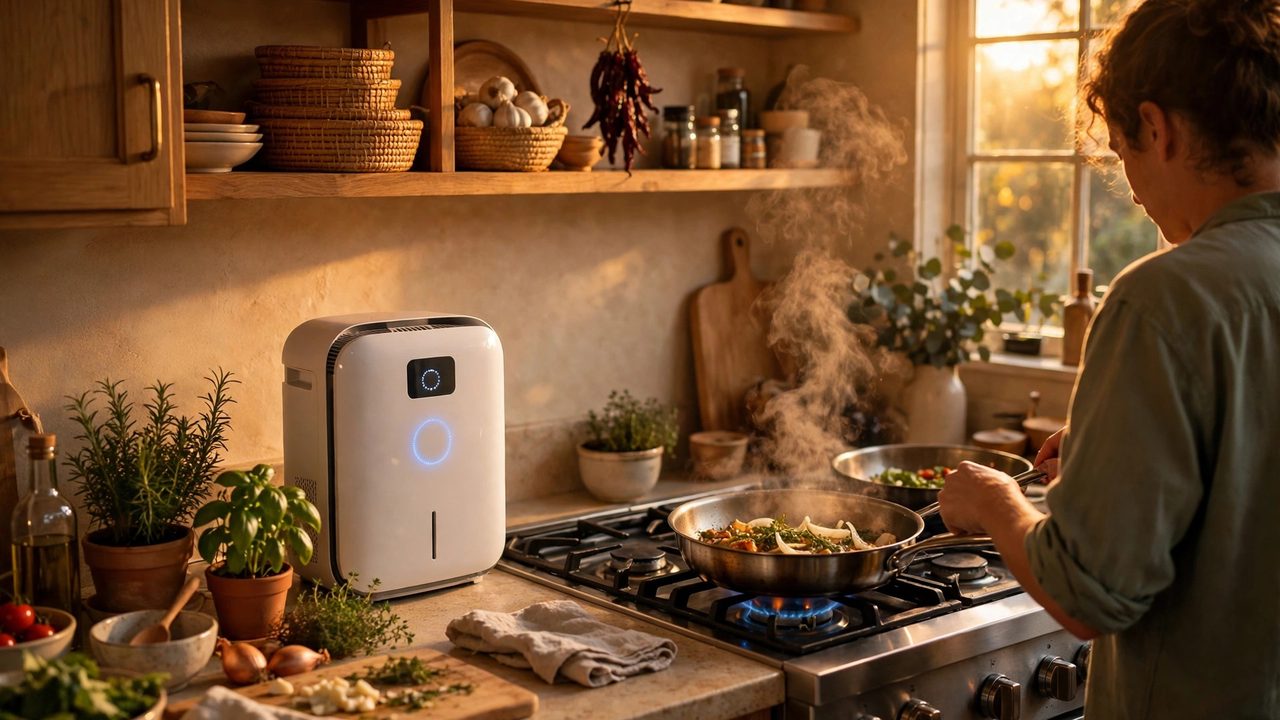
Cooking smells behave differently from dust. Fry oil, seared meat, garlic, spices and fish release gases and vapors that drift out of the kitchen, settle into soft furnishings in the next room and can still be noticeable the following morning. A standard particle filter does very little against that load, because odor molecules are gases, not particles. What captures them is activated carbon, and the amount of carbon in the machine — a thin coated sheet versus pounds of granular media — is the single biggest difference between purifiers that genuinely help a kitchen and purifiers that only clean the dust out of cooking air. This guide to the best air purifiers for kitchen smells therefore ranks six machines first by the carbon system the maker lists, then by clean air delivery rate, room size, noise and the practical details of living with a purifier near a working kitchen.
The six picks cover very different kitchens. At one end sits a steel machine with up to 15 pounds of activated carbon and zeolite and a filter the maker rates for up to five years. At the other end are compact smart units with pellet or honeycomb carbon, laser particle sensors and app control that suit an apartment kitchen that opens onto the living area. Between them are two Coway models with dedicated deodorization stages, a high-airflow Blueair tower for open-plan spaces, and a dual-filter Medify unit built for very large rooms. None of them replaces a vented range hood — exhausting cooking vapor outdoors at the source is always the first line of defense — but each one works on the odor that escapes the hood, spreads through the home and lingers after the cooking is done.
Quick verdict
For the strongest odor capacity in this group, choose the Austin Air HealthMate Standard. The maker lists up to 15 pounds of activated carbon blended with zeolite inside its combined filter, which is several times the carbon load of a typical consumer purifier, and that filter is rated for up to five years of normal use. For an open-plan kitchen and living space where airflow matters as much as carbon, the LEVOIT Core 600S pairs a high-efficiency activated carbon stage with the joint-highest CADR here and a laser particle sensor that reacts automatically when cooking starts. The Coway Airmega 250 is the balanced mid-size pick, with a Max2 filter that combines pelleted activated carbon with a Green True HEPA stage in a slim, wide body. The Coway Airmega Mighty is the smaller, simpler Coway, with a separate deodorization filter ahead of its HEPA stage. The Blueair Blue Pure 211i Max moves the most air per minute on the maker figures and runs quietly at low speed, which suits kitchens that flow into living and dining areas. The Medify MA-112 V3.0 is the large-room option, with dual H13 filters, a substantial carbon stage and coverage figures aimed at big open spaces and shared living areas.
The products in this guide
Austin Air HealthMate Standard Air Purifier (HM400)
The HealthMate is the odor specialist of this group, and the reason is a single specification: the maker lists over 780 cubic inches — up to 15
Best when cooking odor is your main problem, you cook strongly flavored food often
Every product in this guide was verified on opened pages — the maker’s own product documentation and the live Amazon listing for that exact model — and a model was only kept if its Amazon page showed a live featured offer for a new unit at the time of checking. Models whose listings showed no featured offer were excluded entirely, however strong their specifications looked on paper, and no specification in this article comes from anywhere other than the maker’s published figures or the opened listing for that model.
The selection criteria were specific to cooking odor. First, the carbon system: the maker had to list a real activated carbon stage — granular, pelleted, honeycomb or a deep bed — rather than a scented pad or a carbon-coated pre-filter alone, because carbon mass and contact time are what determine how long a filter keeps adsorbing cooking vapors before it saturates. Second, airflow: a kitchen purifier needs enough CADR to cycle the air of the kitchen and the space it opens into several times an hour while food is cooking and after it is served, so each pick lists a CADR or airflow figure appropriate to at least a medium kitchen. Third, the particle stage still matters, because frying and searing produce fine airborne grease and smoke particles alongside the gases, so every pick pairs its carbon with a HEPA-type stage. Fourth, practical kitchen fit: physical size, noise at working speeds, whether the pre-filter can be washed or vacuumed to deal with grease-laden air, and how often the carbon-bearing filter needs replacing in a home that cooks daily.
Two well-known models were cut during this process. One popular washable-carbon model was excluded because its Amazon listing showed no featured offer when checked, and one large-room Honeywell model was excluded for the same reason. Both may return to stock, but under the rules of this guide a purifier that cannot actually be bought new does not earn a place in the list.
The HealthMate is the odor specialist of this group, and the reason is a single specification: the maker lists over 780 cubic inches — up to 15 pounds — of activated carbon and zeolite inside its four-stage filter. Most purifiers carry carbon as a thin sheet or a light layer bonded to the particle filter, and in a kitchen that sheet can saturate within months. A bed measured in pounds gives the carbon far more adsorption capacity, which is exactly what a home that fries, grills or cooks with strong spices several times a week needs. The zeolite in the blend is a porous mineral the maker adds to widen the range of gases the bed can hold. Around that carbon stage sit a large-particle pre-filter, a medium-particle pre-filter and 60 square feet of true medical-grade HEPA media, which the maker rates at 99.97 percent capture at 0.3 microns.
The rest of the machine is deliberately simple. The maker lists coverage of up to 1,500 square feet, a three-speed centrifugal fan, a steel housing with perforated intake on all four sides, casters for moving the unit, and dimensions of 14.5 by 14.5 by 23 inches with a weight of about 47 pounds. There is no app, no particle sensor and no automatic mode — you choose one of three speeds and the machine runs. The combined filter is the long-life part of the design: the maker rates it for up to five years under normal residential use and backs it with a pro-rated filter warranty alongside a five-year mechanical warranty. For a kitchen, that long carbon life matters more than smart features, because the usual failure mode of a kitchen purifier is not the fan wearing out but the carbon quietly filling up and the smells coming back.
Placement is flexible thanks to the 360-degree intake: the HealthMate can sit against a kitchen wall or at the edge of an open-plan space and still draw air from every direction. The trade-offs are size, weight and the absence of a published CADR figure — the maker gives airflow figures rather than an AHAM rating, so it is harder to compare its particle-cleaning speed directly against the rated figures of the Levoit or Blueair below. It is also a considered purchase rather than an impulse one, justified by the carbon capacity and the five-year filter interval rather than by features.
Buy it if: cooking odor is your main problem, you cook strongly flavored food often, and you want the largest carbon capacity and the longest filter life in this guide.
Skip it if: you want app control, an air quality display or automatic fan adjustment, or you need a light unit you can carry between rooms daily.
The Core 600S is the open-plan pick. The maker lists a CADR of 410 cubic feet per minute and a rated room size of 635 square feet, which is the scale of a kitchen that opens into a living and dining area rather than a closed galley kitchen. Its three-in-one filter combines a pre-filter, an H13 True HEPA stage and a high-efficiency activated carbon stage in a honeycomb-style structure, so the same cartridge that traps frying particles also adsorbs the vapors that carry cooking smells into the next room. The maker lists the filter life at six to twelve months, and in a heavy cooking household the carbon end of that cartridge will be the part that decides when it is changed.
What separates the 600S from the Austin Air is sensing and automation. The maker lists an AirSight Plus laser particle sensor with a numeric PM2.5 display, an auto mode that raises fan speed when the sensor detects a cooking event, VeSync app control with schedules, and voice control through Alexa and Google Assistant. In practice that means the unit can sit in the corner of an open-plan space on auto, idle quietly, and ramp up on its own when a pan starts smoking — then settle back down after the air clears. The maker lists noise from 26 dB on the lowest setting to 55 dB at full power, and a rated power draw of 49 watts. The body measures 12.3 by 12.3 by 23.6 inches, a tall square column that tucks beside a kitchen island or at the end of a counter run.
The honest limitation is carbon depth. The 600S carbon stage is far more substantial than the coated sheets on small desktop purifiers, but it is still a layer inside a combined cartridge rather than a multi-pound bed, so in a home that deep-fries daily it will saturate sooner than the HealthMate filter — and when it does, the whole three-in-one cartridge is replaced, particle media included. For typical family cooking, though, the combination of high CADR, automatic response and a real carbon stage is the most convenient package in this guide.
Buy it if: your kitchen opens into your living space, you want the purifier to react to cooking automatically, and you value app control and a live air quality readout.
Skip it if: odor is severe and constant — a deep carbon bed will outlast this cartridge — or you dislike replacing a combined filter when only the carbon is spent.
The Airmega 250 takes a different approach to the filter. Coway’s Max2 cartridge combines a Green True HEPA stage with pelleted activated carbon in a single unit, behind a washable pre-filter. Pelleted carbon gives the air a deeper, more granular bed to pass through than a carbon sheet, and the maker states that the Max2 filter reduces more than 99 percent of volatile organic compounds and odors such as ammonia, acetaldehyde and acetic acid — the kind of sharp, lingering notes produced by fish, vinegar-based cooking and fried food — while capturing up to 99.97 percent of airborne particles down to 0.3 microns. The maker lists the filter life at approximately twelve months based on eight hours of daily use at maximum speed.
The body is wide and slim — the maker lists dimensions of 18.5 by 8.03 by 19.7 inches and a weight of 20.5 pounds — which suits placement flat against a kitchen wall or on a wide counter-adjacent floor space where a cylindrical tower would crowd the walkway. Coverage is listed at 930 square feet at two air changes per hour, with a CADR of about 240 cubic feet per minute, and power consumption is listed at 64 watts. A three-color air quality indicator drives a smart mode that adjusts the fan automatically, and there is a rapid mode for a fast clear-out after cooking, a timer, and a sleep mode. The washable pre-filter is a genuine kitchen advantage: grease-bearing air loads a pre-filter quickly, and being able to rinse it rather than replace it keeps the expensive Max2 cartridge behind it working longer.
Choose the 250 if your kitchen is medium to large but enclosed, and you want pelleted carbon without stepping up to the size and simplicity of the Austin Air. Its CADR is lower than the Levoit and Blueair picks, so in a big open-plan space it will clear a cooking event more slowly, but for a defined kitchen and dining room its carbon format and washable pre-filter are well matched to daily cooking.
Buy it if: you want pelleted activated carbon in a slim, wall-friendly body, with a washable pre-filter for grease-heavy kitchen air.
Skip it if: your space is a large open-plan floor where a higher CADR would clear cooking air noticeably faster.
The Airmega Mighty is the long-running smaller Coway, and its filter layout is the classic one for odor work: a washable pre-filter first, then a separate deodorization filter dedicated to odors and volatile organic compounds, then a True HEPA stage. Keeping the carbon-based deodorization filter separate from the HEPA filter is a practical advantage in a kitchen, because the two stages age at different rates — the odor filter works hardest in a cooking household, and the maker lists separate replacement intervals for the stages, with the deodorization filter changed more often than the HEPA filter. The listing states that the four-stage system, which also includes a bipolar device stage, reduces 99.97 percent of particles down to 0.3 microns and reduces volatile organic compounds and odor.
Coway lists coverage of up to 1,748 square feet in 60 minutes, which corresponds to a working room of roughly 361 square feet at the recommended air change rate, with a dust CADR of 246 cubic feet per minute. That makes the Mighty a fit for a standard enclosed kitchen, a kitchen-diner, or a small apartment’s combined cooking and living space rather than a large open floor. An air quality indicator shows pollution levels as a colored light in real time, auto mode adjusts the fan to match, eco mode stops the fan when the air stays clean for a period, and filter alerts track when each stage needs attention based on how much air has passed through it. The unit is compact enough to sit on the floor beside a counter or in the corner of a dining area without dominating the room.
The Mighty’s carbon stage is lighter than the pelleted bed in its bigger sibling and far lighter than the Austin Air’s bed, so in a household that cooks with a wok or fryer every day it will need its deodorization filter changed on schedule to keep performing. What it offers instead is a proven, simple layout, genuinely separate odor filtration at a smaller size, and running costs that stay predictable because each filter stage is replaced on its own interval.
Buy it if: your kitchen is small to medium, you like the idea of a separate, replaceable deodorization filter, and you want auto and eco modes without an app.
Skip it if: you cook heavily every day and want maximum carbon capacity, or your kitchen opens into a large living area that needs a higher CADR.
The Blue Pure 211i Max is built around airflow. Blueair lists CADR figures of 435 cubic feet per minute for smoke, 452 for dust and 450 for pollen under the updated DOE test basis, with a recommended room size of 674 square feet — the strongest airflow numbers in this guide. Its HEPASilent technology combines electrostatic and mechanical filtration, which lets it move that much air at lower noise than a purely mechanical design of similar output: the maker lists a sound range of 23 to 53 dB, energy consumption of 46 watts, dimensions of 22.7 by 14.4 by 14.4 inches and a weight of 16.2 pounds. A 360-degree intake draws air from all sides, and the fabric pre-filter that wraps the lower body can be vacuumed or washed, which again helps in a kitchen where airborne grease would otherwise clog a disposable pre-filter.
For odor specifically, the 211i Max uses a combination particle and carbon filter, and Blueair’s own description of the model names cooking odors among the pollutants its filtration addresses. The carbon element here is a layer within that combination filter rather than a deep bed, so this machine’s kitchen strategy is dilution and speed: it cycles the whole room’s air so frequently that cooking smells are captured and dispersed quickly after they escape the hood, rather than relying on a huge carbon reservoir. Smart features include app control, automatic mode driven by a built-in sensor that monitors PM1, PM2.5 and PM10, a night mode, and filter life tracked by usage rather than a fixed timer, with the maker listing up to nine months per main filter.
This is the pick for a kitchen that is really one zone of a large open living space, where the purifier must also serve the sofa and dining table and where a loud fan would be intrusive during meals. If lingering odor the next morning is your main complaint and you cook pungent food daily, the deeper carbon of the Austin Air or the pelleted carbon of the Coway 250 will hold up longer between filter changes; if the complaint is that cooking smells spread everywhere while you cook and hang in the air during dinner, the 211i Max’s airflow answers it directly.
Buy it if: you have a large open-plan kitchen and living space, want the highest airflow here, and prefer quiet low-speed running with app control.
Skip it if: maximum carbon capacity for daily heavy frying is the priority — its carbon is a layer in a combination filter, not a deep bed.
The MA-112 V3.0 is the heavy-duty option for very large spaces. Medify fits this model with dual filtration — two filter sets, each combining a pre-filter, an H13 True HEPA stage and a substantial activated carbon filter — so both particle capture and carbon capacity are doubled up compared with a single-cartridge machine of similar footprint. The product page lists a CADR figure of 1009 and coverage of up to 4,455 square feet in one hour, or 2,228 square feet in thirty minutes, which positions it for great rooms, large open-plan homes, and shared spaces where a kitchen serves a big combined living area. The maker lists the H13 filtration as removing 99.9 percent of particles down to 0.1 microns, and the carbon stage is there for the odors, smoke and volatile compounds that cooking releases into that large shared volume.
Controls are handled from a touch panel with four fan speeds, a timer of up to eight hours, an auto mode driven by a dust sensor with a PM2.5 indicator, a sleep mode that dims the panel lights, a filter replacement indicator, a child lock and an optional ionizer function. The maker lists a maximum noise level of 70 dB on the highest setting, so the top speed is a clear-the-room setting to run while you cook and eat elsewhere, with lower speeds for occupied rooms. Replacement filters are listed as lasting about 3,000 hours, roughly six months, and the unit carries a lifetime warranty when genuine Medify filters are used, alongside CARB and ETL listings.
Size is the consideration: with dual filters and coverage aimed at thousands of square feet, this is a floor-standing unit for a big space, not a countertop appliance for a small kitchen. In the right setting — a large open-plan home where cooking smells currently reach every room — its combination of dual carbon filters and very high coverage is difficult to match with a single smaller machine, and it can serve the whole floor instead of only the kitchen corner.
Buy it if: your kitchen is part of a very large open space and you want dual HEPA and dual carbon filtration with the highest coverage figures in this guide.
Skip it if: your kitchen is small or enclosed — this unit is oversized for it — or you are sensitive to fan noise at high speed.
Buying guide: choosing a purifier for cooking smells
Start with the carbon, not the HEPA rating. Every purifier in this guide traps particles well; they differ in how they handle gases. The maker lists for the picks above show the range clearly: a carbon and zeolite bed of up to 15 pounds, pelleted carbon in a combined cartridge, a honeycomb carbon layer in a three-in-one filter, a separate deodorization filter, and a carbon layer in a combination filter. As a rule, the more carbon by weight and the deeper the bed, the longer the filter keeps adsorbing cooking vapors before it saturates and smells start passing through. If you cook with high heat, frying oil or strong spices most days, weight of carbon should be your first filter for choosing. If you cook lightly a few times a week, a carbon layer in a well-sealed cartridge is usually enough, and airflow becomes the deciding factor.
Match CADR to the whole space the kitchen air reaches. Cooking odor does not respect the kitchen doorway. Size the purifier for the kitchen plus any open adjoining space, using the maker’s room figure at a high air-change rate rather than the largest headline number, which is usually calculated at one air change per hour. The comparison table shows both kinds of figure, so read the basis before comparing: a purifier listed at 930 square feet at two air changes per hour is a stronger claim than the same number at one air change. For a closed kitchen, the Coway Mighty or Airmega 250 class of CADR is appropriate; for open-plan, look at the Core 600S, the 211i Max or the MA-112.
Plan for grease. Kitchen air carries fine grease that coats filters and shortens their useful life. A washable or vacuumable pre-filter — fitted to the Coway models and the Blueair above — is worth having, because it catches the coarse load before it reaches the carbon and HEPA stages. Keep the purifier out of the direct plume above the stove, run your range hood during cooking and for a while afterwards, and expect carbon filters in a heavy-cooking home to need changing at the early end of the maker’s stated range. A purifier is a second line of defense behind source ventilation, not a substitute for it.
Think about noise and automation at cooking times. A purifier only helps if it is running while you cook and for an hour or so afterwards. Sensor-driven auto modes, like those on the Levoit, Blueair and Medify picks, handle this without you remembering to switch the unit up before you start frying. If you choose a manual model like the Austin Air, the habit is simple: turn it to a higher speed when cooking starts and leave it running through the meal. Check the maker’s listed noise at the speed you will actually use during dinner, not just the sleep-mode figure.
Budget for the filter, not just the machine. Replacement intervals in this guide range from roughly six months for the Medify cartridges to up to five years for the Austin Air’s combined filter. A lower-cost machine with a combined cartridge that needs replacing twice a year in a cooking household can cost more to run than a premium machine whose carbon bed lasts for years. Compare the maker’s listed filter life against how much you cook, and prefer designs where the carbon stage can be replaced on its own schedule if your particle load is light but your odor load is heavy.
FAQ
Do air purifiers actually remove cooking smells, or just mask them?
A purifier with activated carbon adsorbs the gas molecules that carry cooking smells onto the carbon’s internal surface; it does not mask them with fragrance. How long it keeps working depends on how much carbon the maker fits and how much cooking vapor it processes, which is why carbon weight and filter replacement intervals matter more for kitchens than for bedrooms.
Can a purifier replace a range hood for kitchen smells?
No. A vented hood removes cooking vapor, heat and grease at the source before they spread. A purifier handles what escapes the hood and what lingers in the room and adjoining spaces afterwards. The two work best together: hood on while cooking, purifier running during and after.
Where should I place a purifier for kitchen smells?
In or near the kitchen but out of the direct rising plume above the stove, with clearance around the intake so air can circulate. For open-plan homes, place it between the kitchen and the living area so it intercepts odor as it drifts. Models with 360-degree intake, like the Austin Air and Blueair picks, are the most flexible about placement against a wall.
How often will the carbon filter need replacing in a kitchen?
At the early end of the maker’s listed range if you fry or cook strongly flavored food daily. The picks here list intervals from about six months for standard cartridges to approximately twelve months for the Coway Max2 filter and up to five years for the Austin Air’s deep carbon bed. A return of cooking smells that the purifier previously handled is the practical sign that the carbon is saturated.
Is a higher CADR or more carbon better for kitchen odor?
They solve different halves of the problem. CADR determines how quickly the room’s air is cycled and how fast a cooking event is cleared; carbon capacity determines whether the odor molecules are actually captured and how long the filter keeps capturing them. Heavy daily cooking calls for carbon first; a large open-plan space calls for CADR first; many kitchens need a balance of both, which is what the middle picks in this guide aim for.
Will a purifier help with smoke from searing and frying?
The particle stage will capture the fine smoke and grease particles from searing, and the carbon stage addresses the accompanying smell. Every pick here pairs a HEPA-type stage with its carbon for exactly that combination. Venting with the hood first still removes the bulk of it at the source.
Conclusion
The right purifier for kitchen smells is the one whose carbon system matches how you cook. Choose the Austin Air HealthMate Standard if odor capacity and filter life come first — its maker-listed carbon and zeolite bed of up to 15 pounds is in a class of its own here. Choose the LEVOIT Core 600S if your kitchen opens into your living space and you want high CADR with automatic, sensor-driven response. The Coway Airmega 250 brings pelleted carbon and a washable pre-filter in a slim body for medium and large kitchens, while the Coway Airmega Mighty offers a separate deodorization filter in a smaller, simpler package. The Blueair Blue Pure 211i Max answers with sheer airflow and quiet running for large open-plan homes, and the Medify MA-112 V3.0 doubles up its HEPA and carbon filtration for the biggest spaces of all. Run any of them alongside your range hood, keep the pre-filter clean, and replace the carbon on schedule, and last night’s cooking stops becoming this morning’s background smell.
M
Modern Line Home Editorial Team
We compare specs, materials and verified owner reviews before a product earns a spot. Rankings are never paid.
Affiliate disclosure. As an Amazon Associate we earn from qualifying purchases at no extra cost to you. Prices accurate as of the date shown.
House cold even with the heat on? Walk this ordered checklist: thermostat and filter first, then drafts, insulation, leaky ducts and a failing heating system.
Windows fogging up in winter? Check where the fog sits: on the room side it is indoor humidity, outside it is harmless, and between panes the seal has failed.
Store the main firewood pile about 30 feet from your house, off the ground and covered only on top. Compare racks, woodsheds, garages and indoor spots safely.
Place a portable generator outdoors only, at least 20 feet from windows, doors and vents, exhaust pointed away. Exact distances, setup steps and CO rules here.
Keep houseplants in the right winter spot: match window direction to plant type, stay clear of radiators and cold glass, and fix dry air and low light at home.
Mice enter through pencil-width gaps at foundations, pipes, vents, doors and the roofline. Walk this room-by-room winter checklist to find and seal each one.
A winter outage timeline: what to do in the first hour, first night and multi-day outage, with food safety times, pipe protection, heat and CO safety steps.
Size a space heater by room area: 10 watts per square foot at 8-foot ceilings, adjusted for insulation and ceiling height, with full wattage and BTU tables.
Start dripping at about 20 degrees, sooner for exposed pipes. Set a pencil-lead stream, drip the right faucets on both lines, and know when to stop safely.
A fridge needs 800-1,200 starting watts, not just 150-400 running watts. Use the tables to total your fridge plus freezer, lights, furnace fan and more today.












Write Your Review
No reviews yet. Be the first to share your experience!