We independently review everything we recommend. When you buy through our links, we may earn a commission. As an Amazon Associate we earn from qualifying purchases.
Best Car Drying Towels That Won’t Scratch Your Paint
Compare plush, twist-loop and waffle car drying towels that dry paint without scratching, with sizes, GSM, edges and care compared for cars, trucks and SUVs.
Compare plush, twist-loop and waffle car drying towels that dry paint without scratching, with sizes, GSM, edges and care compared for cars, trucks and SUVs.
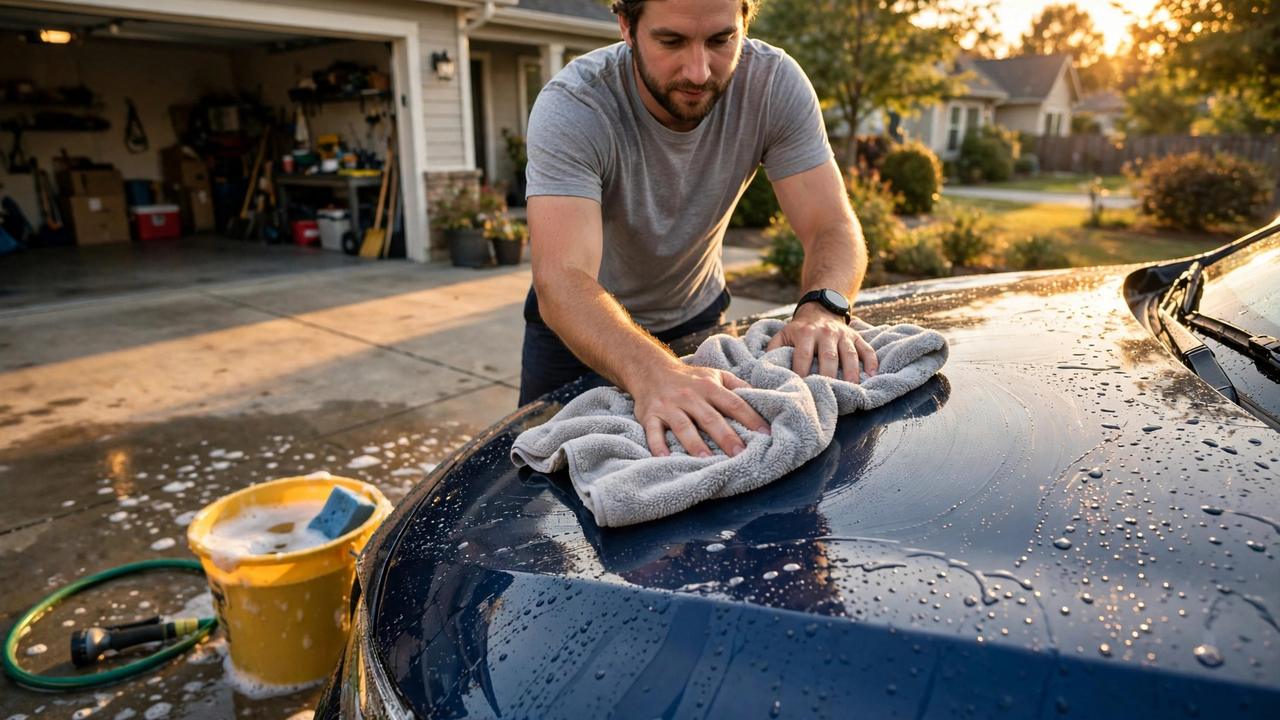
Drying is the stage of a wash where good paint most often picks up fine swirls. The wash itself loosens dirt, the rinse floats much of it away, but the towel is the last thing that touches the panel, and anything trapped between the towel and the clear coat gets dragged across the finish under the weight of your hand. That is why the search for the best towels to dry you car and not scratch is really a search for three things at once: a pile deep enough to pull leftover grit away from the surface, an edge that cannot dig in, and enough absorbency that you are laying the towel down and lifting water off instead of scrubbing back and forth. A towel that fails on any one of those points can leave marks even when your wash technique was careful.
This guide compares six real car drying towels from established detailing makers, each built around a paint-safe idea. Some use twisted-loop microfiber that drinks water in a single lay-and-pull pass. Some use a plush or terry-style pile that cushions the panel. One uses a waffle weave that wrings out easily and suits smaller cars and tighter budgets of effort, if not of money. Every specification below is phrased as the maker lists it, taken from the maker’s own listing details, so you can match the towel to your vehicle size, your paint, and the way you like to dry. If you wash a dark car, a coated car, or a car with soft paint, the differences between these towels matter more than the headline absorbency numbers, and the buying guide at the end explains how to read those numbers honestly.
Quick verdict
For most drivers, the Rag Company Liquid8r is the easiest recommendation: the maker lists a dense twist-loop weave, a high fabric weight, and a hidden hem edge, so the whole face of the towel is soft against paint and it clears a large panel in very few passes. If you want a slightly smaller, more manageable towel with a suede border, the Rag Company Gauntlet covers the same ground in a handier size. Owners of large SUVs, trucks, and RVs should look first at the Griot’s Garage Extra-Large PFM Edgeless towel, which pairs the largest footprint here with a fully edgeless, double-ply build. The Autofiber Dreadnought XL is the long-reach option, with a double-twist pile in a long, narrow format that suits roofs and hoods you have to stretch across. The Meguiar’s Water Magnet is the simple, proven waffle-style choice for smaller cars and for anyone who prefers a towel that wrings out fast. The Chemical Guys Gray Matter rounds out the set with a large waffle weave and a soft-banded edge for drivers who like a lighter towel that still covers a full panel.
The products in this guide
The Rag Company Liquid8r Drying Towel
The Liquid8r is built around the idea that the safest drying pass is a short one
Selection started with the scratch question, not the absorbency question. A towel only made this list if the maker describes a construction that keeps hard contact points away from paint: a twisted-loop or plush pile that stands up from the backing, an edgeless or hidden-hem build, a suede or soft-banded border, or a waffle weave paired with a soft edge treatment. Towels with exposed stiff stitching, rough tags in the drying face, or no maker information about their weave or edge were left out, however cheap or popular they might be.
Next, each towel had to be a real, current product from a named maker, with a model name or model number that could be checked against the maker’s own listing details. That check is what pins down the figures used in this guide: the size, the fabric weight where the maker publishes one, the fiber blend where the maker states one, and the care instructions. Where a maker does not publish a fabric weight, the table says so rather than filling the gap with a number borrowed from a review or from a different towel in the same range, because GSM figures are not transferable between models.
Finally, each pick had to be available to buy new, as a current listing, at the time of checking. A discontinued towel or a listing with no live offer does a reader no good, so availability was treated as a gate, not a footnote. The six towels that remain cover the realistic spread of drying styles: two twist-loop towels from one maker in different sizes and weights, one very large edgeless terry-weave towel, one long double-twist towel, and two waffle weaves that trade some pile depth for easier wringing and a lighter hand feel. Between them, there is a sensible option for a compact hatchback, a family SUV, a coated show car, and everything in between.
The Liquid8r is built around the idea that the safest drying pass is a short one. The maker lists a double twist-loop weave at 1100 GSM in a 70/30 blend of polyester and polyamide, sized at 25 x 36 inches. Twisted loops present the tips and sides of looped fibers to the panel rather than a flat woven face, and the loops give water somewhere to go: it is pulled up into the towel instead of being pushed ahead of it across the paint. That matters for scratch avoidance, because a towel that saturates quickly and then starts pushing a film of dirty water around is a towel that starts dragging whatever is in that water.
The edge treatment supports the same goal. The maker lists a hidden hem edge, which keeps the stitched seam tucked away from the drying face, so the part of the towel most likely to feel firm is not the part sweeping your doors and fenders. At 25 x 36 inches the towel drapes over a hood or roof panel in a way that lets you lay it flat, let the loops drink, and pull it toward you in one slow motion, which is the lowest-friction drying technique there is. The maker also notes that it works well with a drying aid, and a light mist of drying aid adds glide on coated or freshly waxed paint, further reducing the pressure you need to apply.
Care is straightforward: the maker lists machine washing, and like all microfiber it will keep its softness longest when washed without fabric softener and dried gently. The trade-offs are size and weight when wet. A dense 1100 GSM towel at this size gets heavy once it is loaded with water, and on a small car the extra material can feel like more towel than you need, especially around mirrors, badges, and tight bumper shapes. Those are handling points, not safety points, and for a midsize car, SUV, or truck this is the most complete package in the guide.
Buy it if: you want one large, dense twist-loop towel that can dry most of a vehicle in lay-and-pull passes, and your paint is dark, coated, or otherwise unforgiving of careless drying.
Skip it if: you drive a very small car and prefer a compact towel you can fold into quarters and control with one hand in tight areas.
The Gauntlet takes a hybrid approach. The maker lists a patented twist-loop hybrid weave at 900 GSM, in a plush 70/30 Korean split microfiber blend, sized here at 20 x 30 inches. The listing describes alternating twist-loop and plush stripes, a design intended to combine the fast water pickup of loops with the cushioned feel of plush pile, while reducing drag across the panel. Less drag means less temptation to press harder, and pressure is where most drying marks come from, so a towel that glides at light pressure is a genuinely safer towel, not just a nicer-feeling one.
The border is the other headline. The maker lists a ButterSoft suede microfiber border, which replaces conventional stitched edging with a soft suede-style trim. On curved panels, edges and corners of a towel make contact at least as often as the center does, particularly when you fold the towel or work around mirrors and handles, so a border designed to glide without scratching addresses a real contact point rather than a theoretical one. The maker also lists a very high fiber count per square inch, which is consistent with the dense, thirsty character described for the towel, and lists care as washing separately with non-bleach detergent and air drying or tumble drying on low heat.
At 20 x 30 inches, this is the handier of the two Rag Company towels. It folds neatly, it is easier to keep off the ground when you are working low panels, and it suits drivers who dry in sections rather than draping a whole panel at once. The compromise is coverage: on a large SUV or truck you will move and reposition it more often than the bigger towels here, and each repositioning is another chance to pick up grit if the towel touches something it should not. Used with a clean folding routine, turning to a fresh face as you go, it is an excellent middle option between compact detailing towels and full-size drying blankets.
Buy it if: you want twist-loop absorbency in a more controllable size, with a suede border for worry-free work around mirrors, trim, and curved panels.
Skip it if: your vehicle is large and you want to clear a roof or hood in as few repositionings as possible.
Size is the story here, backed by the heaviest fabric weight in this guide. The maker lists this towel, model 55596, at 29 x 36 inches with a 1120 GSM microfiber build using its PFM terry weave technology, in a double-ply, long-looped construction. The listing describes it as roughly twenty percent larger than the maker’s standard PFM drying towel, aimed squarely at SUVs, trucks, and RVs, where a normal drying towel saturates halfway down the vehicle and the second half of the job gets done with a wet, heavy towel that no longer lifts water cleanly.
The scratch-relevant feature is in the name: edgeless. The maker lists an edgeless double-ply design that removes harsh stitching and seams from the towel entirely, so there is no border material to catch on an emblem or drag across a fender edge. Combined with the long-loop terry-style pile, the whole contact surface stays soft and lofty, and the maker describes the result as a streak-free, scratch-free drying experience on paint, glass, and trim. For big, flat, expensive paint surfaces, such as the long hoods and tall doors of a full-size truck, that combination of coverage and edge-free contact is exactly the right priority.
Care follows the maker’s guidance for premium microfiber: machine washable with a free and clear detergent, no fabric softener, and dry on low or no heat, or air dry. The honest trade-off is bulk. A double-ply towel at this size and weight is a lot of material to handle, wring, wash, and store, and on a compact car it will feel oversized, with corners that want to trail on the ground if you are not disciplined about folding. It earns its place for large vehicles, where its capacity prevents the mid-dry saturation problem, rather than as a universal pick for every driveway.
Buy it if: you dry an SUV, truck, or RV and want the largest, heaviest, fully edgeless towel here, so one towel finishes the vehicle without saturating.
Skip it if: you drive a small car, have limited storage, or prefer a lighter towel you can wring out easily by hand.
The Dreadnought XL takes the twist-loop idea and stretches it. The maker lists a double-twist pile construction in a long 20 x 40 inch format, describing it as a one-pass vehicle drying towel. The long, narrow shape is more useful than it first sounds: draped lengthwise, it covers a hood from windshield to grille in a single pull, and on a roof it lets you stand on one side of the car and draw water across without walking around with a dripping towel. The maker describes the double-twist pile as absorbing more water on the first pass with less friction and drag, which again points at the real safety mechanism, fewer passes at lighter pressure.
Edges are handled with a hidden design. The maker lists soft invisible edges, with the edge sewn inside so that no non-microfiber edge is dragged across the paint. That inside-sewn construction also gives the towel a slightly firmer perimeter that can be worked into moderately tight areas, such as around mirror bases and along window seals, where pooled water likes to hide and later run out as streaks. The maker also highlights glass work, describing a lint-free, streak-free result on windows, which makes this a sensible single towel for drivers who dry paint and glass with the same tool.
The maker lists machine washing for care, and notes that when the towel has been used on a clean vehicle it can be hung to dry and reused between washes, a practical point for people who wash weekly. Autofiber does not publish a GSM figure in the listing details checked for this guide, so judge it on its weave, shape, and edge design rather than a density number. Its shape is also its limitation: the long format is brilliant on big horizontal panels and less natural on small, sculpted cars, where the extra length can bunch. If your drying is mostly hoods, roofs, and trunk lids, the format feels made for you.
Buy it if: you want a long double-twist towel for one-pass pulls across hoods and roofs, with hidden edges and strong glass performance.
Skip it if: you prefer a square towel that folds into neat quarters, or your car is small with heavily sculpted panels.
The Water Magnet, model X2000, is the long-established waffle-weave option in this set. The maker lists it at 22 x 30 inches in a waffle-textured microfiber, and describes absorbency of up to two times that of terry towels, with reduced drying time and fewer wring-outs than conventional towels. Waffle weave works differently from plush or twist-loop pile: the recessed pockets hold water and give the towel its capacity, while the raised weave keeps the contact patch relatively light, so the towel glides and wrings out easily instead of becoming a heavy, saturated slab.
For scratch avoidance, the waffle format has a practical virtue that is easy to overlook. Because it wrings out so readily, you are more likely to actually wring it, and a towel that is regularly wrung and refolded onto a clean face is a towel that is not grinding a load of trapped grit across the next panel. The maker describes a spot-free, streak-free finish, and lists the towel as machine washable and reusable, with a size that also suits motorcycles, boats, and household jobs. It is the least specialized towel here, and for many owners that simplicity is the appeal.
The trade-off is pile depth. A waffle weave does not offer the deep, cushioned loft of the twist-loop and PFM towels above, so on very soft or freshly corrected paint, drivers who want maximum cushion between hand and panel may prefer one of the plush options. Technique matters more with this towel: keep it flat, keep it clean, work panel by panel, and let the pockets do the work rather than pressing and scrubbing. Judged as an easy-handling, easy-care drying towel for small to midsize cars, it remains a sound and honest choice.
Buy it if: you want a proven waffle-weave towel that wrings out fast, handles easily, and suits a small or midsize car washed regularly.
Skip it if: your paint is very soft or freshly polished and you want the deepest possible plush or looped cushion while drying.
The Gray Matter, model MIC_781_01, brings the waffle weave up to full drying-towel size. The maker lists it at 25 x 36 inches, in a premium microfiber blend described as 80/20, with a waffle weave texture intended to hold large amounts of water and dry a vehicle faster, reducing the chance of water spots setting in while you work. At this size, one towel covers the broad panels of a sedan or crossover in the same lay-and-pull style as the big loop towels, but with the lighter, easier-wringing character that waffle fans prefer.
The paint-safety detail is the edging. The maker lists soft-banded edging, describing it as a soft band that helps limit scratches and swirls during drying, even during higher-contact work. That is a meaningful distinction from a plain stitched hem, because the band is the part of the towel that meets the panel when you fold the towel over your hand or catch a panel edge. The maker lists the towel as safe for paint, glass, chrome, and plastic, and suitable across cars, trucks, motorcycles, RVs, and boats, which makes it a reasonable single-towel answer for households with more than one kind of vehicle.
Care is listed as machine washable. As with the Water Magnet, the waffle weave will not match the deepest loop piles for sheer cushion, and it rewards a flat, unhurried technique rather than pressure. What it offers instead is coverage plus manageability: a large towel that does not become unwieldy when wet, that can move from paint to glass without a swap, and whose soft banding keeps its edges on your side. For drivers who have tried heavy plush towels and found them tiring, this is the lighter full-size alternative.
Buy it if: you want full-size coverage in a lighter waffle weave, with soft-banded edges, for drying paint and glass with one towel.
Skip it if: you want maximum loop depth and fabric weight for the gentlest possible contact on delicate or coated paint.
Buying guide
Weave decides how the towel touches paint
Twist-loop, plush, terry-style, and waffle weaves all dry cars, but they touch paint differently. Twisted loops stand up from the backing and pull water into the loops, so contact is spread across many soft fiber ends and trapped particles tend to be drawn up and away from the surface. Plush and terry-style piles cushion the panel with loft, which many owners of soft paint prefer. Waffle weaves hold water in recessed pockets and glide with a lighter contact patch, trading cushion for easy wringing. None of these is automatically safe or unsafe: a dirty towel of any weave will mark paint, and a clean towel of any of these weaves, used flat and gently, is a reasonable choice. Choose the weave that matches how you actually dry, because the towel you handle well is the towel you will use carefully.
Read GSM as a guide, not a guarantee
GSM, grams per square meter, describes fabric weight, and heavier towels generally hold more water and feel more cushioned. In this guide the maker lists figures for the Liquid8r, the Gauntlet, and the Griot’s PFM towel, and does not list a figure for the other three. A missing GSM is not a defect and a high GSM is not proof of gentleness: fiber blend, split quality, and weave construction all shape how a towel behaves. Use GSM to compare towels within a similar style, and treat any source that assigns a precise GSM to a towel whose maker does not publish one with suspicion.
Edges and borders are contact points
Scratches from drying often come from the edge of the towel, not its face. Stiff stitching, exposed seams, and rough tags concentrate pressure on a narrow line. That is why this guide pays attention to hidden hems, inside-sewn edges, suede borders, soft banding, and fully edgeless builds. When you shop beyond this list, run a thumb along the border before you buy if you can, and whatever towel you choose, fold edges inward on delicate panels so the softest surface leads.
Size the towel to the vehicle
A towel should cover the largest panel you dry without trailing on the ground. Compact cars are well served by towels around 20 x 30 inches, which fold into a manageable pad. Midsize cars and crossovers suit the 25 x 36 inch class. Large SUVs, trucks, and RVs justify the biggest, heaviest towels, because saturation halfway through the job leads to rushed, heavy-handed drying on the remaining panels. Owning two midsize towels, and swapping to the dry one for the second half of the vehicle, is often better than owning one enormous towel, and it gives you a clean backup if one towel is dropped. A dropped towel, on any vehicle, should be retired to wheels or door jambs for that wash, never shaken out and returned to paint.
Technique protects paint more than any label
Start with a genuinely clean car and a final rinse that sheets water off the panels, so the towel has less work to do. Lay the towel flat on horizontal panels and pull it slowly toward you instead of rubbing in circles. On vertical panels, fold the towel, use a fresh face for each section, and blot or glide downward with light pressure. Work in the shade where you can, dry the roof and glass first, and chase the drips that escape from mirrors, badges, and fuel doors last. If the towel starts to feel gritty or leaves water behind in streaks, it is saturated or dirty: wring it, refold it, or swap it. No towel can compensate for pressing harder at that point, and most drying damage happens in the last, tired minutes of a wash.
Care keeps a safe towel safe
Wash drying towels separately from household laundry, with a mild or free and clear detergent as the makers here direct, and skip fabric softener and dryer sheets, which coat the fibers and cut absorbency. Dry on low heat or air dry, store the towels clean and enclosed rather than loose in a garage where they collect dust, and inspect the pile before each wash day. A towel that has picked up embedded grit, lost its loft, or developed a rough edge should move to wheels, jambs, and engine bay duty. Rotating two or three paint towels extends the life of each and means a fresh towel is always available, which is the simplest scratch-prevention system of all.
FAQ
Can a microfiber towel really scratch paint?
Yes, if it is dirty, dropped, pressed hard, or built with a rough edge. Clean, soft microfiber used flat with light pressure is designed to be paint-safe, which is why the towels here emphasize looped or plush piles, soft borders, hidden hems, and edgeless builds. The towel is only one part of the system; clean technique matters just as much.
Is twist-loop better than waffle weave for drying?
Twist-loop towels generally hold more water and offer a deeper cushion, making them strong choices for large vehicles and delicate paint. Waffle weaves wring out more easily, feel lighter, and suit smaller cars and drivers who prefer to work panel by panel. Both can dry without scratching when they are clean and used gently, so the better choice is the one that fits your vehicle and your habits.
How many drying towels do I need for one car?
One large, high-capacity towel can dry a midsize car, but two towels are the safer setup. The second towel gives you a clean, dry face for the lower panels, which collect the most road film, and a backup if the first towel is dropped or saturates early. Drivers of large SUVs and trucks often prefer one extra-large towel or a pair of full-size towels.
Should I use a drying aid with these towels?
A drying aid can add glide and reduce the pressure needed on coated, waxed, or dark paint, and at least one maker in this guide specifically notes that its towel works well with a drying aid. It is optional, not required. If you use one, apply it lightly to the wet panel and let the towel do the lifting rather than rubbing the product in.
How do I stop a drying towel leaving lint or streaks?
Wash new towels before first use, wash them separately without fabric softener, and avoid overloading a panel with a saturated towel. Streaks usually mean the towel is full of water, so wring it or swap to a dry face. Lint usually settles after the first few washes, and storing towels clean and enclosed keeps dust out of the pile between washes.
When should a drying towel stop being used on paint?
Retire a towel from paint duty when it has been dropped on the ground and cannot be washed immediately, when grit stays embedded in the pile after washing, when the edges become rough, or when it stops absorbing and starts pushing water around. Demoted towels still work well for wheels, door jambs, and exhaust tips, where the finish is far less delicate.
Conclusion
Scratch-free drying is not about finding a magical towel. It is about matching a soft, well-edged, absorbent towel to your vehicle, keeping it clean, and using it flat and gently. The Liquid8r is the strongest all-round choice here for its dense twist-loop build and hidden hem, the Gauntlet offers the same family of performance in a handier size with a suede border, and the Griot’s PFM covers the largest vehicles with an edgeless, double-ply design. The Dreadnought XL brings long-reach, one-pass drying, while the Water Magnet and the Gray Matter show that a well-made waffle weave, honestly used, still dries paint safely. Pick the towel that fits your car and your routine, keep a clean backup on hand, and the drying stage can go back to being the satisfying finish of a wash rather than the risky part of it.
M
Modern Line Home Editorial Team
We compare specs, materials and verified owner reviews before a product earns a spot. Rankings are never paid.
Affiliate disclosure. As an Amazon Associate we earn from qualifying purchases at no extra cost to you. Prices accurate as of the date shown.
House cold even with the heat on? Walk this ordered checklist: thermostat and filter first, then drafts, insulation, leaky ducts and a failing heating system.
Windows fogging up in winter? Check where the fog sits: on the room side it is indoor humidity, outside it is harmless, and between panes the seal has failed.
Store the main firewood pile about 30 feet from your house, off the ground and covered only on top. Compare racks, woodsheds, garages and indoor spots safely.
Place a portable generator outdoors only, at least 20 feet from windows, doors and vents, exhaust pointed away. Exact distances, setup steps and CO rules here.
Keep houseplants in the right winter spot: match window direction to plant type, stay clear of radiators and cold glass, and fix dry air and low light at home.
Mice enter through pencil-width gaps at foundations, pipes, vents, doors and the roofline. Walk this room-by-room winter checklist to find and seal each one.
A winter outage timeline: what to do in the first hour, first night and multi-day outage, with food safety times, pipe protection, heat and CO safety steps.
Size a space heater by room area: 10 watts per square foot at 8-foot ceilings, adjusted for insulation and ceiling height, with full wattage and BTU tables.
Start dripping at about 20 degrees, sooner for exposed pipes. Set a pencil-lead stream, drip the right faucets on both lines, and know when to stop safely.
A fridge needs 800-1,200 starting watts, not just 150-400 running watts. Use the tables to total your fridge plus freezer, lights, furnace fan and more today.












Write Your Review
No reviews yet. Be the first to share your experience!