We independently review everything we recommend. When you buy through our links, we may earn a commission. As an Amazon Associate we earn from qualifying purchases.
Best Paper Towels for Homemade Disinfectant Wipes: 6 Picks
Find the best paper towels for homemade disinfectant wipes: six strong-when-wet, low-lint picks compared by ply, sheet size and roll format, plus setup tips.
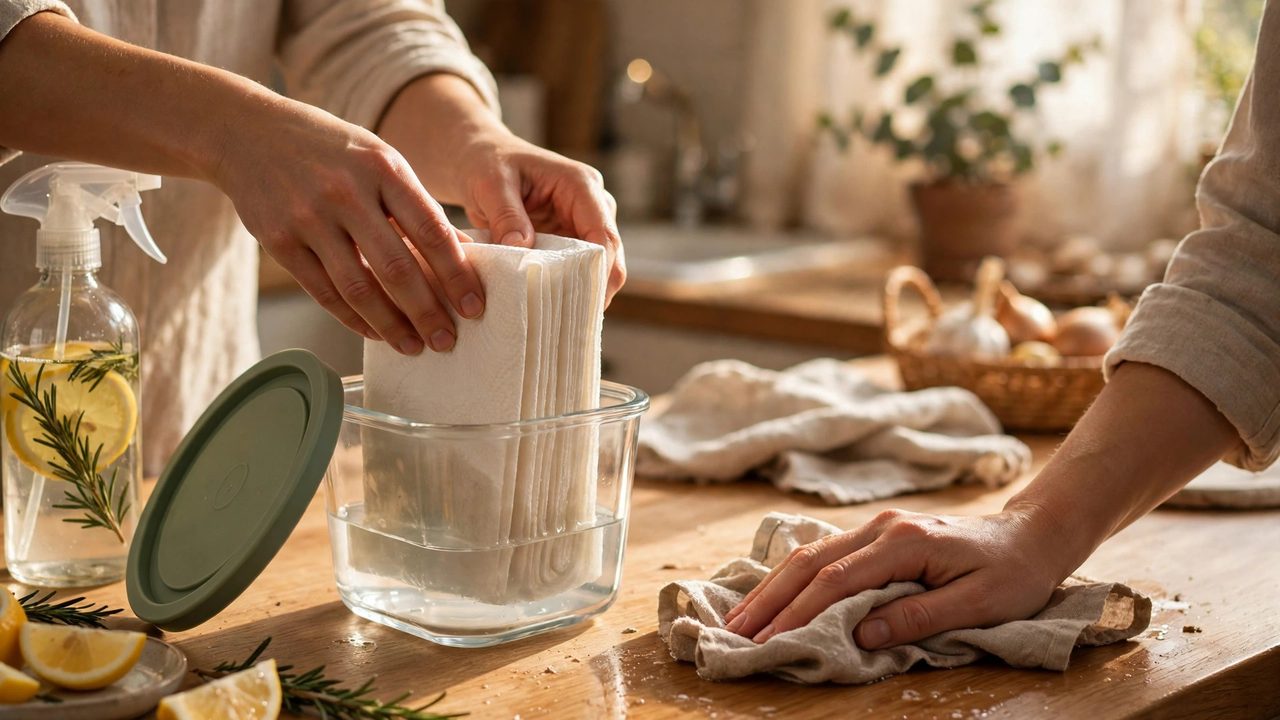
Making your own wipes at home sounds simple: take a roll of paper towels, cut it to fit a container, pour over the cleaning solution you have chosen, and pull out a sheet whenever a counter, handle or tabletop needs attention. The part that decides whether the project works is not the container or the solution. It is the towel itself. A sheet that is perfectly fine for drying hands can turn to pulp the moment it is saturated, shed fibres across the surface you just wiped, or tear in half as you pull it from the centre of the roll. Choosing the best paper towels for homemade disinfectant wipes means choosing towels that behave more like cloth than like tissue once they are wet: they need wet strength, even absorbency, a surface that does not leave lint behind, and a sheet size you can cut, fold or tear to match your container.
This guide compares six towels that meet that standard in different ways. Two are cloth-like household towels from Viva, one is a three-ply towel with unusually flexible sheet sizes from Brawny, one is a simpler two-ply select-size towel from Bounty Essentials, one is a high-count flexible-sheet roll from the Amazon Presto! line, and one is a blue shop towel from Scott that was built for wet, heavy work in the first place. None of them is a wipe on its own, and this guide makes no claim about what any towel or homemade solution does to germs. What a towel can honestly offer is physical performance: how much liquid it holds, whether it stays in one piece while saturated, how cleanly it wipes, and how predictably it dispenses from a container. Those are the properties compared below, using only what each maker lists about its own product.
Quick verdict
If you want one roll to start with, start with Viva Signature Cloth. The maker lists it as two times more durable when wet than the leading value brand, and its cloth-like sheet is the closest match in this group to the feel of a pre-moistened wipe: soft, flexible and reluctant to fall apart in a container. If your wipes live on a kitchen counter and get used for scrubbing as much as wiping, Viva Multi-Surface Cloth is the better fit, because the maker lists a micro-scrubbing texture and a sheet that traps mess better when wet. If you want maximum thickness in the hand, Brawny Tear-A-Square 3-Ply is the only three-ply towel here, and its quarter-sheet option makes small wipes without any cutting. Bounty Essentials Select-A-Size is the straightforward, lighter-duty choice for a small container and gentle jobs. Presto! Ultra-Strong Flex-a-Size suits households that go through wipes quickly and want very large rolls with flexible tear sizes. Scott Shop Towels Original Big Rolls are the heavy-duty outlier: a blue, cloth-like shop towel on a standard roll, listed by the maker as working well even when wet, and a sensible pick for utility rooms, garages and pet areas rather than the kitchen counter.
The products in this guide
Viva Signature Cloth Paper Towels
Viva Signature Cloth is the towel most often reached for in homemade wipe projects, and the maker’s own listing explains why
Best if you want the most wipe-like result from a paper towel, with cloth-like softness
Cloth-like blue sheets, 11 x 9.4 inches; listed as working well even when wet
Utility, garage and pet-area wipes
How we selected
Every towel in this guide had to pass the same physical tests on paper, using only maker-listed information from its product page. First, wet strength: a homemade wipe spends its whole life saturated, so the maker had to list durability, strength when wet, or a construction, such as multiple plies or a cloth-like sheet, that is designed to hold together under scrubbing pressure. Towels positioned purely as soft, light or budget drying towels were left out, however pleasant they are for hands. Second, absorbency: the sheet has to take up solution evenly through a whole cut roll, not just at the edges, so absorbency claims and sheet construction were checked next. Third, surface behaviour: lint and fibre shedding matter more in a wipe than in a spill towel, because fibres left behind sit on the surface until it dries, so smooth, cloth-like and low-residue constructions were favoured. Fourth, format: the roll had to be practical to cut in half, unroll and re-roll, or tear into container-sized sheets, and sheet-size options such as select-size, flex-size and tear-a-square perforations counted in a towel’s favour because they remove the cutting step entirely. Finally, each product had to be a real, currently listed product sold new, checked on its own product page, with its pack format and sheet count confirmed there. Six towels cleared all five filters; they are ranked by how completely they suit the wipe job, not by brand size.
One boundary is worth stating plainly. A paper towel is a carrier, nothing more. This guide compares carriers: their strength, absorbency, texture and format. It does not compare cleaning solutions, does not offer recipes, and does not claim that any towel, solution or homemade wipe disinfects a surface. If you use a store-bought cleaning product as your solution, its label is the authority on dilution, contact time, surfaces and safety, and it should be followed exactly. If a surface genuinely needs a disinfecting product, use a ready-made product that is labelled for that purpose rather than assuming a homemade wipe does the same job.
Viva Signature Cloth is the towel most often reached for in homemade wipe projects, and the maker’s own listing explains why. The maker lists these towels as two times more durable when wet than the leading value brand, and describes the sheet as cloth-like in both softness and durability, built for deep cleaning and scrubbing rather than for blotting. That combination is exactly what a wipe needs. In a container, the sheet stays flexible instead of stiffening, pulls from the centre of a cut roll without shredding at the perforation, and keeps its surface together while you work it across a counter edge or around a tap base. The listing describes the pack as twelve family rolls with 143 sheets per roll, and the sheet is listed as 1-ply, which surprises people who equate thickness with strength: here the strength comes from the cloth-like construction rather than from stacked layers, so the finished wipe feels thinner and more pliable than a multi-ply wipe, closer to the handling of a disposable cloth. The task-size sheet also suits wipe making, because a halved roll gives you wipes that cover a hand without a large flap of extra towel trailing behind it. For bathrooms, where wipes get used on mirrors, porcelain and chrome, the soft surface is a practical advantage, since it wipes without the scratchy drag of a textured scrub towel and leaves a cleaner-looking finish on shiny fittings. If you make one batch to learn the process, make it with this towel, because its behaviour in solution is the most forgiving of small mistakes in how much liquid you add.
Buy it if: you want the most wipe-like result from a paper towel, with cloth-like softness, listed wet durability, and a sheet that holds together for bathroom and kitchen wiping alike.
Skip it if: you prefer a thick, cushioned wipe in the hand, or you want a textured scrubbing surface, since this sheet is smooth and comparatively slim by design.
Viva Multi-Surface Cloth comes from the same family as the Signature Cloth above but is built for a different kind of wipe. Where Signature is smooth and soft, the maker lists Multi-Surface with a uniquely textured sheet using micro-scrubbing technology, and lists the towel as trapping mess three times better when wet than the same towel dry. It also lists a Choose-A-Sheet format, so each sheet can be torn at a smaller size for a quick handle wipe or kept whole for a full counter pass. The pack checked for this guide contains 24 double rolls with 110 sheets per roll, which makes it a practical stock-up format for a household that keeps a container in the kitchen permanently and refills it often. As a wipe, the textured face earns its place on stovetops, hob surrounds, fridge shelves and the greasy film that collects around cooking areas, where a smooth sheet tends to skate over the surface. The trade-off is feel: the scrubbing texture that helps in the kitchen is less pleasant on skin and less suited to polishing shiny bathroom fittings, where it can drag rather than glide. Think of the two Viva towels as a pair: Signature for the bathroom container and general wiping, Multi-Surface for the kitchen container that has to deal with cooked-on splashes. Households that only want one container should choose by room: the towel that lives where the mess is greasiest should be this one.
Buy it if: your homemade wipes mainly serve the kitchen, and you want a maker-listed scrubbing texture plus choose-a-sheet sizing for different wipe sizes.
Skip it if: your wipes are mostly for bathrooms, mirrors or hand-adjacent use, where the smoother Signature Cloth sheet is the better match.
Brawny Tear-A-Square 3-Ply takes a different route to wipe strength: layers. The maker lists it as a three-ply towel, and describes that construction as providing the strength, absorbency and durability to tackle tough messes without tearing or falling apart. Three plies matter in a container for a simple reason: a saturated sheet is pulled, folded and pressed repeatedly, and a layered sheet resists the thinning and pinholing that a single layer can develop at fold lines. The second advantage is the perforation pattern. The maker lists quarter, half and full sheet sizes from the same roll, which removes the messiest step in wipe making: there is no need to saw a roll in half at all. You can tear quarter sheets for a small lidded tub, half sheets for a standard container, or leave sheets whole, stack them flat, and pour solution over the stack. The pack checked here contains eight triple rolls with 114 sheets per roll, listed as three times the sheets of a regular roll, so one pack supplies several batches. The maker also lists the towel as made from responsibly sourced trees certified by the Sustainable Forestry Initiative. The honest limitation is bulk: a three-ply wipe is noticeably thicker, so a container holds fewer wipes than the same container filled with a 1-ply towel, and the stack absorbs more solution per batch. Choose it when you want each individual wipe to feel substantial and to survive a long, firm wiping session on a big surface such as a dining table or a set of patio doors.
Buy it if: you want the thickest wipe in this guide and the option of quarter-size wipes with no cutting, straight off the roll.
Skip it if: you want to fit the maximum number of wipes in a small container, since three plies take up noticeably more room per wipe and drink more solution per batch.
Bounty Essentials Select-A-Size is the simplest towel in this guide, and for a first, small batch that simplicity is a virtue. The maker lists it as a 2-ply towel, strong enough to hold up against multiple messes, with Select-A-Size rolls that let you choose the sheet size according to the size of the job. The pack checked here contains two triple rolls with 162 sheets per roll, a manageable quantity if you are filling one modest container rather than stocking a whole house. In wipe form, the two plies give a middleweight sheet: more body than a 1-ply cloth-like towel, less bulk than the three-ply Brawny, and a familiar, even texture that wipes counters, cabinet fronts and appliance handles without fuss. The select-size perforations let you tear shorter sheets for a narrow container, which keeps the finished wipes from bunching. Be realistic about its ceiling, though. This is the Essentials line, positioned by the maker for everyday messes, and its sheet is the one in this group most likely to show its limits under hard, repeated scrubbing of rough or heavily soiled surfaces. Use it where wipes are used lightly and often: a quick pass over a highchair tray after it has been washed, door handles, light switches, the outside of the fridge, a desk. For that rhythm of use, where a container is refilled frequently and no single wipe is asked to do heavy work, it is a sensible, uncomplicated carrier that keeps the whole project inexpensive in effort, whatever solution you pair it with.
Buy it if: you are making a first or small batch for light, frequent wiping, and you want a 2-ply sheet with selectable sizes in a compact two-roll pack.
Skip it if: your wipes regularly face rough surfaces or long scrubbing sessions, where the cloth-like Viva sheets or the three-ply Brawny will hold together better.
Presto! Ultra-Strong Flex-a-Size is the volume pick. The maker lists the pack as twelve huge rolls with 158 two-ply sheets per roll, equal to 38 regular rolls, and lists the towel as up to 75 percent more absorbent than the leading 1-ply brand. Absorbency is the headline property for wipe making at scale, because a cut roll has to draw solution evenly from the bottom of the container to the top sheets; a towel that absorbs eagerly and evenly produces a batch where the last wipe is as evenly moist as the first, instead of a soggy base under dry top sheets. The Flex-a-Size format, listed by the maker as multiple tearable sheet sizes for customised cleanup and less waste, lets you match sheet length to container height without trimming. The maker also lists the paper as FSC-certified, from well-managed forests, recycled materials and other controlled sources. As a wipe, the sheet is a workmanlike two-ply: not cloth-like like the Viva towels and not as thick as the Brawny, but consistent, which is what a high-turnover container in a family kitchen, a shared house or a small workplace kitchenette actually needs. If your household empties a container every few days and refills it as a routine, like refilling a kettle, the combination of very large rolls, strong absorbency and flexible sheet sizes makes this the least fussy towel to keep in stock for the job.
Buy it if: you refill wipe containers constantly and want very large rolls, listed high absorbency and flexible sheet sizes in a 2-ply sheet.
Skip it if: you make only an occasional small batch, since the twelve-roll huge-roll pack is a lot of towel to store for a single container.
Scott Shop Towels Original are not a kitchen towel at all, and that is precisely their case. The maker lists these blue, cloth-like towels as absorbing two times more than the leading value brand paper towel, as ultra-strong and durable, and as working well even when wet, with a portable standard roll format, perforated sheets and a sheet size the maker lists as 11 by 9.4 inches. They were designed for garages and workshops, cleaning up grease, liquids, oils and spills, which means the sheet was engineered from the start for the exact condition a homemade wipe lives in: fully saturated, dragged across imperfect surfaces, and expected not to disintegrate. The pack checked here is the Big Rolls case format, with 60 towels per roll across 24 rolls, and the Big Rolls carry five more towels per roll than the maker’s regular 55-sheet shop towel rolls. As wipes, they suit the places where a white kitchen towel is wasted: a utility room, a garage bench, pet feeding areas, muddy boot trays, the inside of a car footwell. The blue colour is a practical feature here, since it keeps these wipes visually separate from food-area towels, an easy hygiene habit when several containers live in one house. Two cautions follow from their workwear character. The sheet is utilitarian rather than soft, so it is not the towel for mirrors or delicate finishes, and the case format is a bulk commitment that makes most sense split across several containers or shared between a house and a workshop.
Buy it if: you want wipes for the garage, utility room or pet area, and you value a cloth-like sheet the maker lists as working well even when wet above softness or looks.
Skip it if: your wipes live in the kitchen or bathroom and touch food-prep or polished surfaces, where the white household towels above are the right tool.
Buying guide
Wet strength comes first. Everything else about a homemade wipe is secondary to the sheet staying in one piece while saturated. Look for maker-listed wet durability, a cloth-like construction, or multiple plies. If a towel’s listing talks only about softness or quick spill pickup, it is a drying towel, not a wipe towel, and it will repay you in lint and torn fragments.
Match the sheet to the container. The classic method cuts a roll in half, removes the cardboard core and pulls sheets from the centre, which suits standard rolls like the Viva, Bounty Essentials and Scott towels here. Select-size, flex-size and tear-a-square formats offer a shortcut: tear sheets at the listed perforation sizes, stack them in a lidded container or a resealable bag, and skip the sawing entirely. Whichever route you choose, the container must seal well, because an unsealed batch dries from the top down and the first dry wipe usually tears.
Think about lint before you commit a whole pack. A towel can be strong and still shed. Cloth-like sheets and shop towels are built to leave little behind, while softer, fluffier sheets can leave fibres on glass, dark stone and stainless steel that only show once the surface dries. If your wipes will be used on dark or glossy surfaces, favour the smooth cloth-like options and make a small test batch first.
Let the solution’s label lead. The towel is only a carrier. If you use a commercial cleaning product, mix and use it exactly as its maker directs, including dilution, surfaces, gloves and contact time, and never mix different cleaning products together. Store the container labelled, sealed and out of reach of children and pets, and make small batches you will use promptly rather than a large batch that sits for weeks. If a job genuinely calls for disinfecting, choose a ready-made product labelled for that purpose instead of relying on a homemade wipe.
Buy the format your household will actually finish. A twelve-roll pack of huge rolls is efficient only if containers are refilled often. For a first attempt, a smaller pack such as the two triple rolls of Bounty Essentials or a single Viva format lets you learn how much solution your container drinks and how quickly you use a batch, before you commit storage space to a case of shop towels or a dozen huge rolls.
FAQ
Can any paper towel be used for homemade wipes? Technically most can, but light, soft or single-purpose drying towels tend to tear, pill or shed once they stay saturated in a container. The towels in this guide were chosen because their makers list wet durability, cloth-like construction or multiple plies, which are the properties that keep a wipe usable.
Do I have to cut the roll in half? No. Cutting suits centre-pull containers, but towels with selectable sheet sizes, such as the Brawny, Bounty Essentials, Viva Multi-Surface and Presto! picks here, can simply be torn to size, stacked flat in a lidded container and moistened evenly. Choose the method that matches your container.
How long do homemade wipes stay usable? That depends on the solution you use and how well the container seals, so follow the solution maker’s guidance. As a practical habit, make small batches, keep the container sealed between uses, label it clearly, and discard any batch that has dried out, smells off or has been sitting far longer than the solution maker suggests.
Are shop towels safe to use as wipes around the house? The Scott shop towels here are listed by their maker for wiping surfaces and for grease, liquid and oil cleanup, and they work well as wipes in utility and garage areas. Keep them for those areas rather than food-preparation surfaces, and keep any wipe, whatever the towel, away from surfaces the solution maker says to avoid.
Will these wipes disinfect my counters? This guide makes no such claim, and a paper towel itself disinfects nothing. A wipe does only what the solution carried in it is labelled to do, used exactly as that label directs. When disinfecting genuinely matters, use a ready-made product that is labelled as a disinfectant and follow its instructions.
Why do some of my wipes tear when I pull them out? Usually the batch is unevenly moistened, the container opening is too tight, or the towel is a light one being asked to do a saturated job. Even out the moisture, loosen the pull opening, and if tearing persists, move to a cloth-like or multi-ply towel from this list rather than pulling harder.
Conclusion
Homemade wipes succeed or fail on a single property: whether the towel still behaves like a cloth after days spent saturated in a container. Viva Signature Cloth is the most complete answer here, with a cloth-like sheet the maker lists as twice as durable when wet as the leading value brand, and it is the right default for most households. Viva Multi-Surface Cloth adds a scrubbing texture for kitchen containers, Brawny Tear-A-Square 3-Ply adds thickness and cut-free small sheets, Bounty Essentials Select-A-Size keeps a first small batch simple, Presto! Ultra-Strong Flex-a-Size feeds high-volume refills with very large, absorbent rolls, and Scott Shop Towels Original Big Rolls take the same idea into the garage and utility room with a sheet built for wet work. Pick the towel that matches the room the container will live in, follow your solution maker’s label exactly, and the humble roll of paper towels becomes a reliable, always-ready stack of wipes.
M
Modern Line Home Editorial Team
We compare specs, materials and verified owner reviews before a product earns a spot. Rankings are never paid.
Affiliate disclosure. As an Amazon Associate we earn from qualifying purchases at no extra cost to you. Prices accurate as of the date shown.
House cold even with the heat on? Walk this ordered checklist: thermostat and filter first, then drafts, insulation, leaky ducts and a failing heating system.
Windows fogging up in winter? Check where the fog sits: on the room side it is indoor humidity, outside it is harmless, and between panes the seal has failed.
Store the main firewood pile about 30 feet from your house, off the ground and covered only on top. Compare racks, woodsheds, garages and indoor spots safely.
Place a portable generator outdoors only, at least 20 feet from windows, doors and vents, exhaust pointed away. Exact distances, setup steps and CO rules here.
Keep houseplants in the right winter spot: match window direction to plant type, stay clear of radiators and cold glass, and fix dry air and low light at home.
Mice enter through pencil-width gaps at foundations, pipes, vents, doors and the roofline. Walk this room-by-room winter checklist to find and seal each one.
A winter outage timeline: what to do in the first hour, first night and multi-day outage, with food safety times, pipe protection, heat and CO safety steps.
Size a space heater by room area: 10 watts per square foot at 8-foot ceilings, adjusted for insulation and ceiling height, with full wattage and BTU tables.
Start dripping at about 20 degrees, sooner for exposed pipes. Set a pencil-lead stream, drip the right faucets on both lines, and know when to stop safely.
A fridge needs 800-1,200 starting watts, not just 150-400 running watts. Use the tables to total your fridge plus freezer, lights, furnace fan and more today.












Write Your Review
No reviews yet. Be the first to share your experience!